(ZH) Gundlach: "People Are Starting To Believe That Stimulus Is Permanent"

Gundlach: "People Are Starting To Believe That Stimulus Is Permanent"
BY TYLER DURDEN
TUESDAY, MAR 09, 2021 - 17:40
It's time for Jeff Gundlach to regale DoubleLine fund investors and assorted hangers on with his views of the economy, the stock market and everything else. The title of the latest webcast is "Looking Backward" although we expect a substantial does of forward looking views and hot takes, including Gundlach's inaugural assessment of the US economy.
Readers can listen to the webcast by clising on the following link or the image below.
The last time we heard from Gundlach, financials were just starting to take off thanks to surging yields. But that was a much smaller move compared to the action we’ve seen since the start of February. Back then, Gundlach pulled up a chart saying U.S. banks are wearing a “normal scuba vest” whereas their Japanese and European counterparts act as if they have an “aqualung vest.” Why? He says negative interest rates. As we noted earlier, US banks may be forced to adopt negative rates as soon as April 1.
As Bloomberg also reminds us, last month Gundlach tweeted that he had been a long-term gold bull and U.S. dollar bear, but has turned neutral on both. Bitcoin may well be the “Stimulus Asset,” he said, a reference to the cryptocurrency’s rally amid a wave of cash pumped into the financial system during the pandemic.
More recently, he noted the divergence below, with Bitcoin rapidly outpacing both gold and the S&P 500’s gains over the past year, adding ominously, “Great dispersions often precede great reversions.” So will Gundlach announce his full-blown endorsement of the cryptocurrency? Stay tuned to find out.
We'll update this post with periodic highlights from the webcast.
Gundlach explains the title of today's webcast “Looking Backward”, which is a nod to a novel written in 1888, and where the protagonist of Edward Bellamy’s socialist-utopian novel goes into a trance in 1887 and awakens in 2000. Gundlach says the novel resembles situations in society today. In the novel the protagonist finds a year 2000 described as having shorter working weeks and equal distribution of goods. In the book, Boston is part of a totally changed world in which the U.S. has been transformed to a socialist utopia, which includes internet and full-benefits retirement at 45.
"So think about this as we go through some of the slides" Gundlach said.
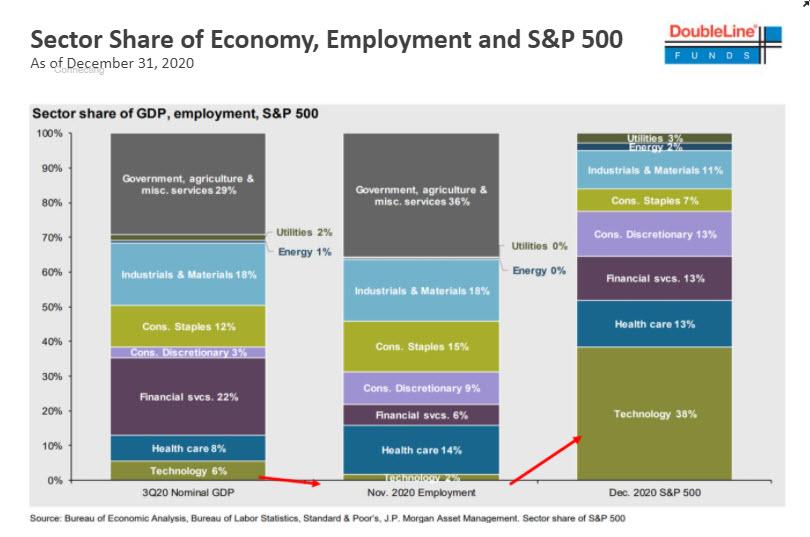
Gundlach starts by showing a chart breaking down the US economy between Nominal GDP, Employment and market cap, with Technology "monopolies" clearly dominating.
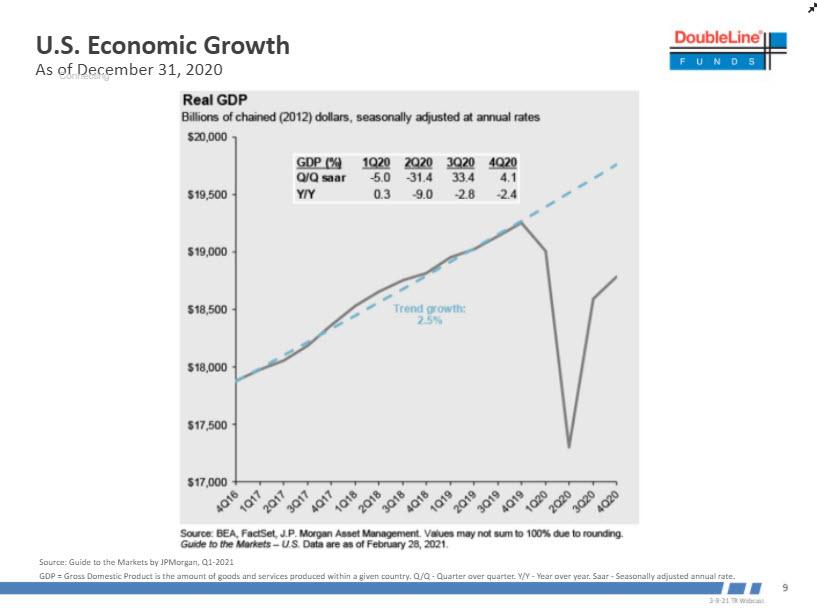
He then shows a chart of US economic growth, saying that despite all the stimulus, the US won't be fully out of the recession until we regain the economic growth rate.
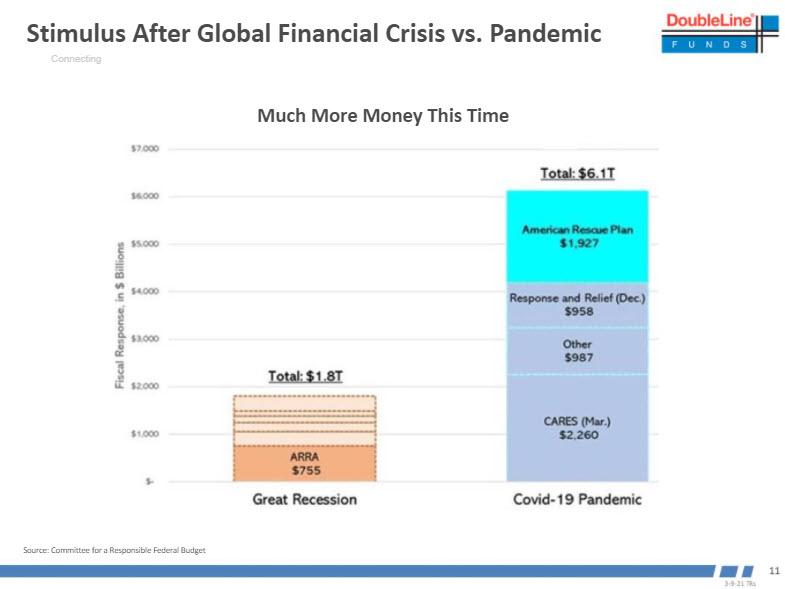
The DoubleLine CEO then shows just how much bigger the stimulus at $6.1TN is compared to the Great recession's $1.8TN.
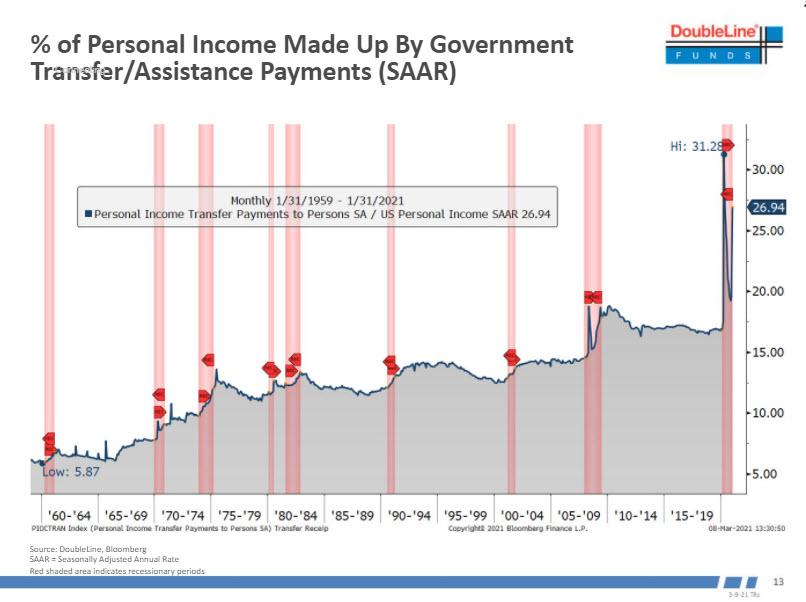
Gundlach then uses one of our favorite charts, the one showing that government accounts for a whopping 27% of all personal income.
Of course, this socialism won't come cheap and the US budget deficit has now hit a record 16.2% of GDP.
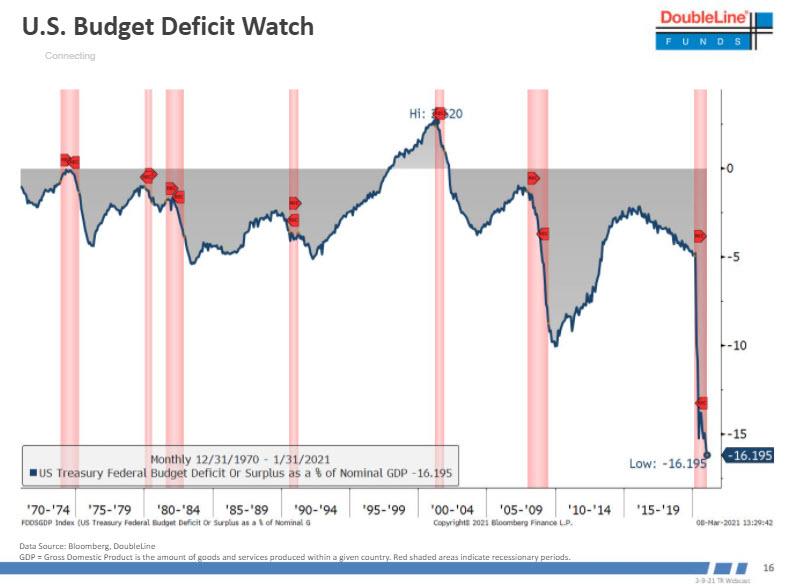
Echoing one of our favorite lines, Gundlach says that “80% of the budget is borrowing, so why bother with taxes at all?”
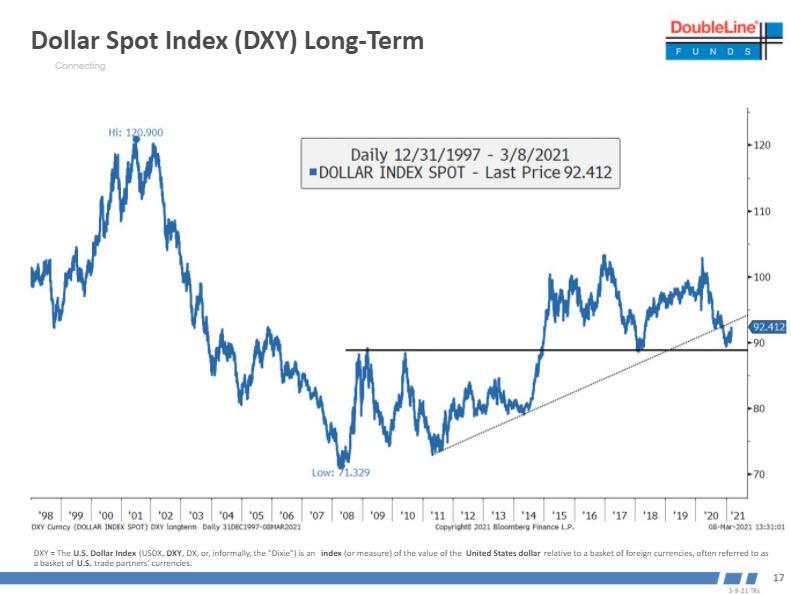
Next, touching on his views on the dollar, Gundlach says that while he has been bullish in recent months, he expects the next move in the dollar to be down after a brief bounce.
Gundlach, who is jumping around like crazy from topic to topic, then slams the "phony" 6.2% unemployment rate pointing to the true US unemployment which is far greater than the official 6MM print, as a result of more than 18MM people receiving various forms of unemployment benefits, more than 10% of the entire US labor force.
Going back to the stock market, Gundlach mentions the “super six” tech stocks again and says it's amazing how high these stocks are valued versus pre-pandemic levels. He then shows surging P/E ratios, saying forward P/E ratios are elevated at 19 but not as high as 1999. Noting that Joe Biden is talking about increased corporate tax rates, Gundlach says P/E ratios could go even higher once that legislation is folded into the valuations.
Which brings us to one of of Gundlach's most bombastic comments so far. Looking at the tremendous outperformance of mega caps relative to micro caps...
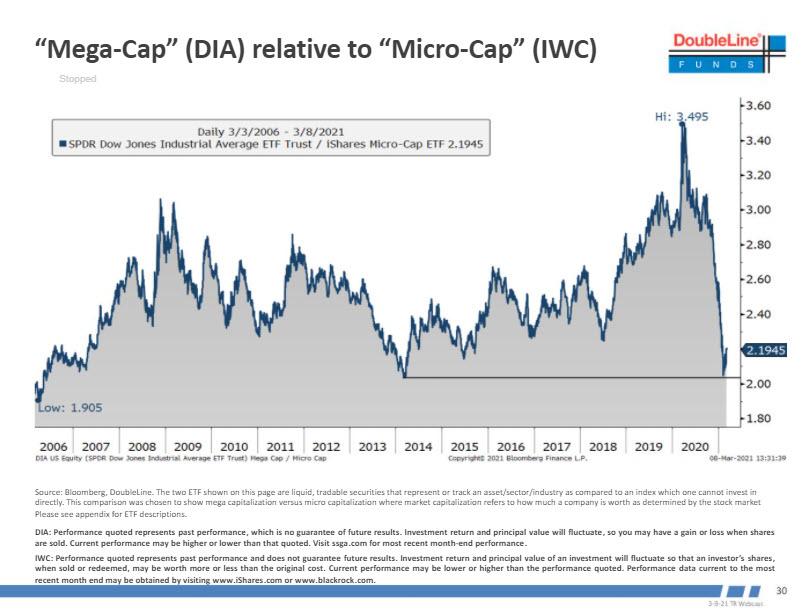
... and the tremendous gains in the Nasdaq vs SPX, which recently just took out the dot com higher...
... Gundlach warns that the Nasdaq may see a decline like in 2000-2003 and makes a shocking prediction that "The VIX will go over a 100 during the next downturn."
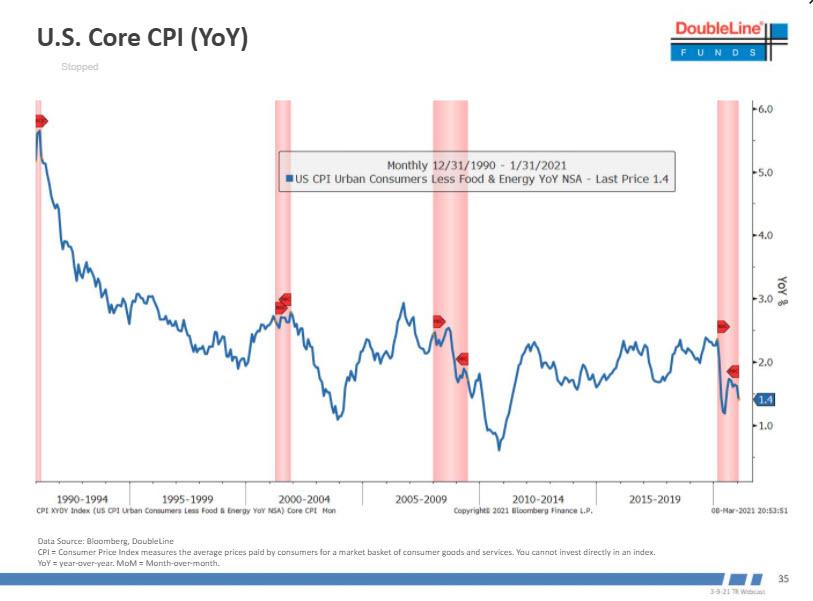
What could cause such a crash? Perhaps inflation - Gundlach notes that he expects headline inflation to be over 3% for a few months this summer on the back of base effect and stimulus.
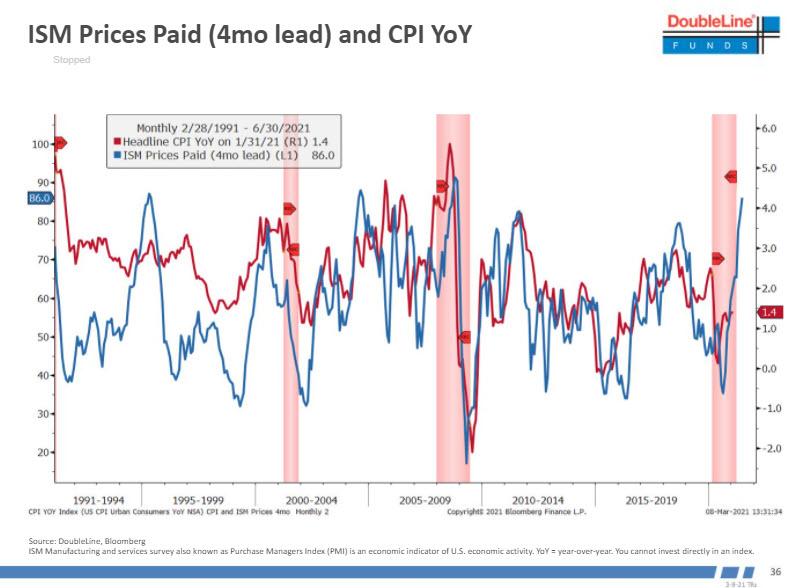
It could get worse: Gundlach compares CPI to ISM Prices Paid and says that one could plausibly predict headline inflation could rise above 4%. "That would really spook the bond market."
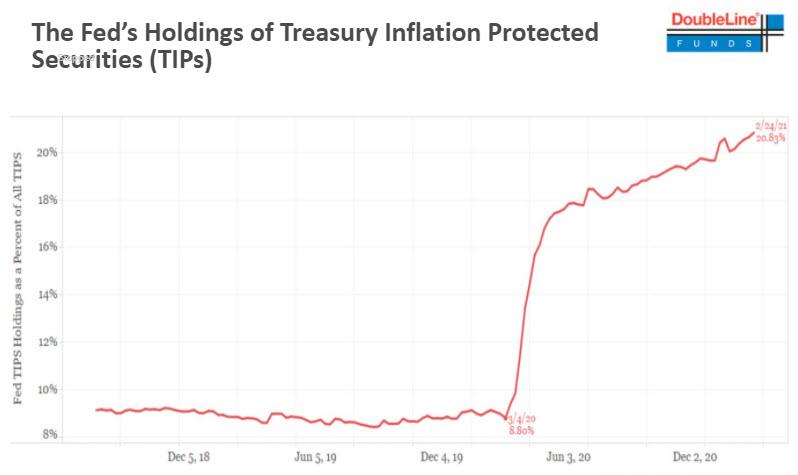
As a tangent, Gundlach points out something we have frequently noted, namely that buy purchasing massive amounts of TIPS, the Fed is skewing the TIPS and thus breakevens market.
Gundlach then switches to Gold, and referring to yesterday's plunge in the price of gold to $1,680 he says that that could be the low for gold for this cycle.
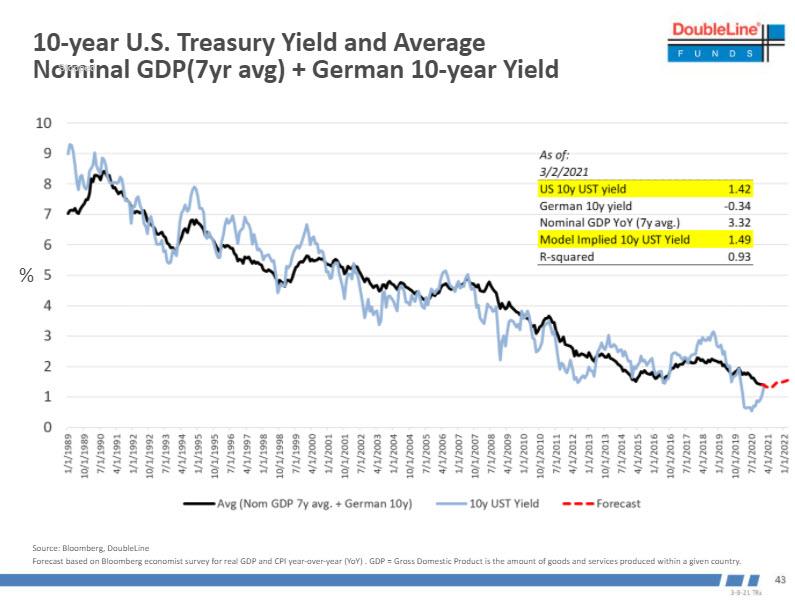
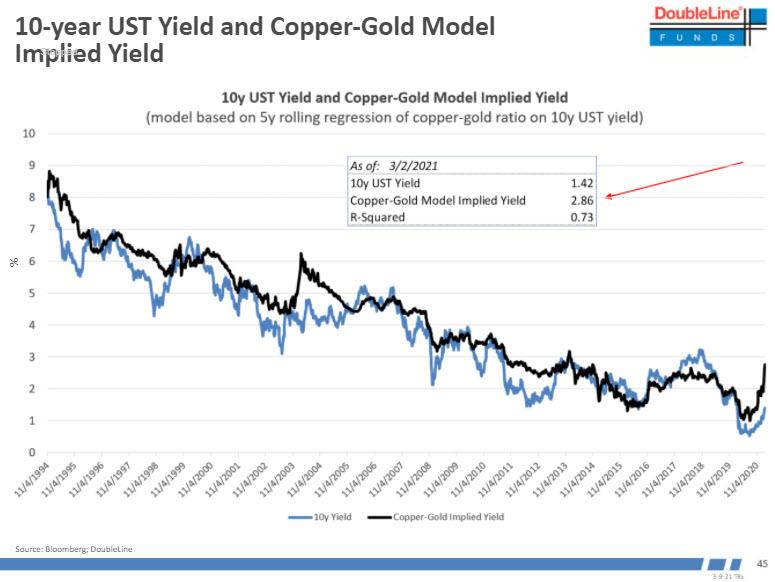
He then rapidly shifts to bonds, and saying that while according to German yields, the 10Y is priced correctly...
... the gold/copper ratio suggests that the 10Y should be at 3%.
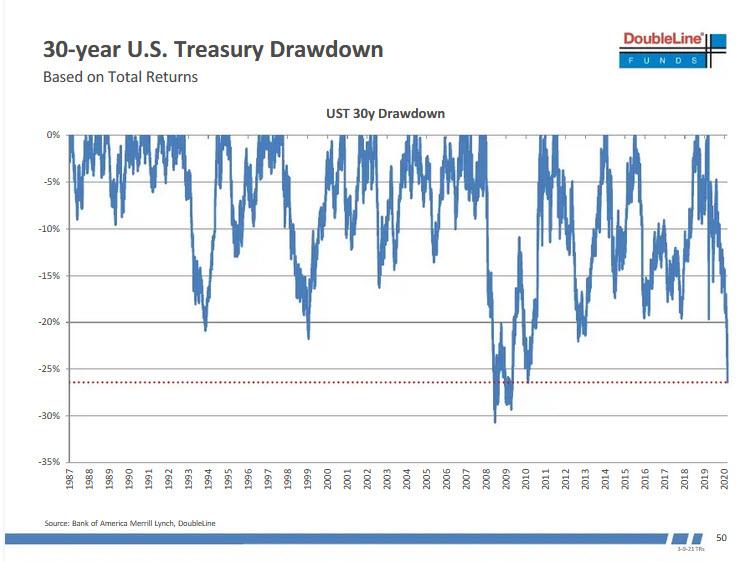
Gundlach then looks at the "bloodbath" in the long end, and specifically the move in the 30Y, saying it was the largest drawdown since the GFC (charted below), and echoing David Tepper, Gundlach says that "I’d expect a modest or moderate decline in yields on the long-end. It’s overextended sentiment-wise."
The DoubleLine CEO then said what most people know, namely that the only marginal buyer of Treasuries in the past couple of years has been the Fed as Foreigners continue to sell Treasury bonds. Gundlach talks about a “lack of robust, organic demand,” and points to the recent catastrophic seven-year Treasury auction as further evidence.
In short, the "Magic" in "Magic Money Tree" (or MMT) is and has always been the Fed.
Gundlach concludes on a dismal note, criticizing stimulus programs for giving people who make $150,000 a year a pile of money, and extending his criticism to broader debt monetization saying while bemoaning what he says is a reliance on stimulus programs for growth.
Warning that people may be starting to believe stimulus is permanent, he says that “The biggest problem is we’ve become totally addicted to these stimulus programs” adding that while "people may be starting to believe that stimulus is permanent", he worries that "we can see some real need for endless stimulus."
And yet, in a world where a quarter of all personal income comes from the government, stimulus programs need to be kept going because consumers have been “trained” to rely on them. Hammering the point that people could become dependent on these stimulus programs, he said that this is something that tends to be associated more with Europe than the U.S, and warns that we could be seeing a “neverending” aid regime stateside.
Welcome to socialism with American characteristics - perpetual universal basic income for everyone, courtesy of a reserve currency... while it lasts. Because as Gundlach warns, China is doing everything in its power (both economic and military) to replace the US as a global hegemon.
One final point Gundlach made is that while bond vigilantes can overcome the Fed's effort to keep yields low, the central bank would then launch Yield Curve Control. That said, the Fed isn’t yet at the point where it would implement YCC: “There’s a pretty good shot that they’ll let the 10-year yield go above 2% before they do anything about it."
And in response to a question of what is the world's cheapest asset right now, his answer: farmland.
Gundlach's full presentation below.

(ZH) ​​​​​​​Dollar Bottom? USD At Major Crossroads

​​​​​​​Dollar Bottom? USD At Major Crossroads

The US Dollar faded 3.5-month highs on Tuesday morning as Treasury yields dipped, allowing more riskier currencies to rise. The latest surge in the dollar has put it at an important crossroad after stabilizing in the last three months around the 89-90 level.
With dollar shorts under strain, the latest Commodity Futures Trading Commission data ending Mar. 2 shows the short dollar trade is widely overcrowded. The chart below is relatively important but doesn't cover the real FX market, i.e., FX futures markets but does represent a sizeable short in the dollar.
The dollar's latest push higher has put bears under pressure, especially since the monthly 200 exponential moving average (91.355) has been breached to the upside with the 23.6-Fib (92.319) in a test.
Even though the dollar has slumped Tuesday along with Treasury yields, falling to around 1.54% on 10Y, yields could rise further this week as the market will have to digest $120 billion auctions of 3, 10, 30-year treasuries. After last month's abysmal 7-year note sale that spiked yields and dollar.
"Stability is likely to remain the theme of the day ahead of the UST auctions and the US inflation release tomorrow, which are the near-term risks for FX markets (given the possible negative spillover into USTs and the risk of a further sell-off)," ING strategists Chris Turner, Francesco Pesole and Petr Krpata wrote in their daily note.
The dollar has perhaps attracted short-term traders due to oversold conditions and high net speculative positioning heavily short (hello Robinhood or WSB kids...). Further, the rise in interest rates increases the dollar's appeal.
And should this occur, it would not be welcome for the equity markets due to the negative correlation between the dollar and stocks. Most importantly, a surging dollar, with rising interest rates, could put a severe dent in the “reflation trade.”
More on dollar strength is JPMorgan who recently warned dollar strength may be driving some of the recent weakness in commodities.
However, bear in mind that trading the dollar in FX markets is merely betting its the best-looking - or worst - horse in the glu factory of fiat finance...
We suspect 'alternative currencies' may be a better longer-term signal for where the dollar ends up, but counter-trend rallies against its currency peers are obviously tradable.

WSJ : Inside Roblox’s Stock Debut, from Direct Listing Decision to Its Financial

Inside Roblox’s Stock Debut, from Direct Listing Decision to Its Financial Outlook
Videogame platform’s shares to begin trading March 10 on New York Stock Exchange

Roblox Corp. will soon join the ranks of closely held companies turning to public markets to support growth. The San Mateo, Calif.-based videogame provider’s stock will begin trading March 10 on the New York Stock Exchange under the symbol RBLX. The shares are trading through a direct listing, bypassing the traditional route of an initial public offering.

Roblox’s reference price was set at $45, in lieu of a formal IPO price, and is based on recent private-market transactions.

Roblox isn’t a traditional videogame company and is using a nontraditional process to potentially reach investors as the pandemic has driven people to spend more time and money on gameplay. Here’s what you need to know about the company and its plans for a direct listing.

What is Roblox?
Roblox is a free online platform that features tens of millions of multiplayer games made by its own players with tools the company provides. The games range from obstacle-course challenges and iterations of capture the flag to contests based on popular characters such as Peppa Pig and Sonic the Hedgehog. Company officials have said they are interested in increasing the use of Roblox for things such as virtual concerts and meetings.

Who plays Roblox and how?
Roblox is accessible on computers, consoles and mobile devices. The company said it had roughly 33 million daily users last year, of whom more than half are under the age of 13. Players in Roblox appear in the form of customizable avatars.

Who started Roblox?
Programmers David Baszucki and Erik Cassel started Roblox in 2004. Mr. Cassel died from cancer in 2013, and Mr. Baszucki serves as chief executive, president and board chairman. Mr. Baszucki remains the company’s largest shareholder and holds more than 70% of the voting rights.

How does Roblox make money?
Roblox primarily generates revenue through sales of Robux, a virtual currency that players can buy with real money to enhance their experience. For example, Robux can be spent on virtual pets, vehicles or premium avatar accessories. The company also has a subscription service that lets users buy Robux monthly at a discount and receive other benefits such as the ability to trade items.

Roblox generated $923.9 million in revenue last year, up from $508 million in 2019.

Roblox posted a loss of more than $253 million in 2020, compared with a loss of $71 million in 2019, due to an increase in fees paid to developers and other expenses such as those for its information-technology infrastructure, safety, and research and development. Operating cash flow was $524 million last year, up from $99.2 million in 2019.

The company projects brisk business in 2021 as well, with revenue forecast to rise between 56% and 64% to between $1.44 billion and $1.52 billion. It expects its daily user count to climb as high as 36.4 million, helped by attracting users older than its primarily Generation Z base and from regions such as western Europe and East Asia.

How much is Roblox worth?
Roblox was privately valued at $29.5 billion in January after raising more than a half-billion dollars of funding from private investors such as Altimeter Capital and Dragoneer Investment Group. The company was valued at $4 billion following a February 2020 fundraising round led by Andreessen Horowitz.

Once the shares begin trading, the company’s valuation could fluctuate.

What is a direct listing, and how is it different from an IPO?
A direct listing allows a company to float its shares on a stock exchange while saving a significant portion of money paid to investment banks in a traditional IPO. It may also allow private companies to capture more of the gains in their share price when they go public. Typically, the gains during a first-day share pop are enjoyed by institutional investors like mutual funds and hedge funds who buy shares before the company starts trading publicly.

Companies typically go public to raise money from investors. But in a direct listing, companies don’t raise any cash since it allows existing shareholders to sell their shares.

The $45 reference price set by the NYSE for Roblox’s Class A shares comes after the company issued preferred stock in its latest round of private funding at the same price.

Other companies that have completed direct listings are Spotify Technology SA, Slack Technologies Inc. and Palantir Technologies Inc.

Roblox originally planned an initial public offering last year but held off after company officials decided that the strong trading debuts of Airbnb Inc. and DoorDash Inc. made it too difficult to determine the right price for its shares.

Roblox is expected to join other videogame-industry companies that have gone public within the past year such as Corsair Gaming Inc., Unity Software Inc. and Playtika Holding Corp.

WSJ : ESPN Nears Deal for Rights to NHL Games

ESPN Nears Deal for Rights to NHL Games
Deal could bolster signups for ESPN+, the sports network’s centerpiece streaming service

Walt Disney Co.’s ESPN is closing in on a long-term rights deal for National Hockey League games that would bolster both its cable platforms and its ESPN+ streaming service, people familiar with the matter said.

An agreement between the NHL and ESPN could be unveiled as early as this week, the people said.

The pact would put games on ESPN’s TV channels and continue to keep the NHL on ESPN+, people close to the company said.

Currently, Comcast Corp.’s NBCUniversal is the biggest television partner of the NHL. It has a 10-year pact valued at $2 billion that expires at the end of this season. NBCUniversal is also in talks with the NHL about maintaining their relationship with the league, one of the people said.

NBCUniversal currently carries most of its coverage on the NBC Sports Network and the NBC broadcast channel. NBCUniversal has said it is shutting down NBC Sports Network at the end of the year and moving its NHL games to the USA Network.

An agreement with ESPN and the NHL wouldn’t necessarily mean the end of the league’s relationship with NBC, the person close to those talks said.

The NHL also carries games on its own channel, the NHL Network. Comcast is a partner in the NHL Network.

A deal with ESPN is expected to increase the overall value of NHL rights and would continue a trend of escalating sports costs. ESPN, along with NBC, ViacomCBS Inc.’s CBS and Fox Corp.’s Fox are also in the midst of negotiating new long-term National Football League rights contracts.

Besides games, ESPN+’s existing NHL offerings include a daily studio show, “In the Crease” on ESPN+.

WSJ : Transportation Startup Via Makes $100 Million Bet on Mapping Company

Transportation Startup Via Makes $100 Million Bet on Mapping Company
The acquisition is Via’s third in the past several months as the pandemic shakes up public transportation

Via Transportation Inc. has acquired mapping software maker Remix for about $100 million, Via’s chief executive said in an interview, as the New York-based company seeks a larger slice of the new market bringing together ride-sharing and public transportation.

The deal is the third acquisition over the past several months for Via, which is bidding to play a central role as cities, transportation authorities and universities rejigger their transportation offerings in the wake of the coronavirus pandemic. The cash and equity deal comes almost two years after Via first became interested in buying Remix, said Daniel Ramot, Via’s CEO and co-founder.

San Francisco-based Remix, which was founded in 2014, has software that uses data to help cities plan their transportation routes and make decisions on such things as where to put one-way streets, bike lanes or special lanes for emergency services. Remix investors cashing out as part of the deal include venture-capital firm Sequoia and Y Combinator, a Silicon Valley startup accelerator.

A year ago, the pandemic threw into doubt the future of Via and public transportation. Lockdowns kept people at home and would-be riders shied away from busses, subways and trams for fear of catching the virus in closed spaces. Large cities are still working to assuage riders’ fears, a key step needed before economies around the world can fully reopen.

“Last summer, it became clear that…existing transportation systems were too rigid and weren’t working,” said Mr. Ramot.

To pay for the deal and the other recent acquisitions, Via used money it raised last year when Italy’s Agnelli family paid $200 million for a 9% stake in the company. That funding round valued all of Via at $2.25 billion.

Via’s software helps cities integrate their public transportation systems by adding aspects of ride-hailing apps like those of Uber Technologies Inc. and Lyft Inc. to existing infrastructure. Cities can use Via to offer on-demand transportation and pre-scheduled pickups for people who don’t live near bus stops. The services, which have been rolled out in 24 countries, can be accessed by a smartphone app, computer or with a phone call. The software can also be used to quickly identify unexpected surges in demand so extra buses can be sent to a specific route.

Privately held Via also competes with Uber and Lyft in offering its own service to ferry multiple riders in the same vehicle.

“It used to be that demographic shifts would happen over many years and public transportation would adapt over time. Now things are moving so quickly due to the pandemic,” said Mr. Ramot. “Maybe a city would change its transportation plan every 20 years and now thanks to data and algorithms that can be done much more quickly.”

Via isn’t looking to raise capital right now, but isn’t ruling out doing so in the future as it seeks to continue to grow, Mr. Ramot said. He declined to say whether Via might seek a stock market listing.

Exor—which also owns large stakes in luxury car maker Ferrari NV and Stellantis NV, the world’s third-largest car maker—is Via’s largest shareholder after Mr. Ramot and his co-founder Oren Shoval.

WSJ : Lucid, Long Before SPAC, Promised to Build Saudi Auto Plant

Lucid, Long Before SPAC, Promised to Build Saudi Auto Plant
Electric-car maker told at least one institutional investor of commitment, a condition of 2018 Saudi investment

Electric-car startup Lucid Motors Inc. has an undisclosed commitment to build an assembly plant in Saudi Arabia, a potentially costly promise the company made after accepting more than $1 billion in financing from the Saudi Public Investment Fund in 2018, according to people familiar with the matter.

The plant promise represents a significant investment commitment for the startup, which hasn’t yet sold a car from its one existing factory in Arizona. It is also a potential boon for Saudi Arabia, which has struggled to lure Western companies to the country in the wake of the 2018 murder of Saudi journalist Jamal Khashoggi.

Last month, Lucid agreed to a special-purpose acquisition company merger, a deal that if consummated would allow it to trade publicly later this year. The merger agreement valued the Silicon Valley startup at some $24 billion.

Lucid hasn’t discussed the Saudi car plant plans publicly, but at least one big institutional investor that has agreed to invest as part of the SPAC deal was told about them, according to people familiar with the discussion.

A Lucid Motors spokesperson said it “expects to establish manufacturing facilities in multiple geographies, including Asia-Pacific, the Middle East and potentially Europe in the coming years.” The spokesperson said the company’s “near-term priority” is beginning production later this year at its Arizona facility.

Spokespersons for Churchill Capital Corp. CCIV 10.73% IV, the SPAC that agreed to merge with Lucid, and PIF didn’t return requests for comment.

Churchill Capital is run by former Citigroup Inc. investment banker Michael Klein. He has worked for years as a financier in the Middle East and advised Saudi Arabia on the 2019 local listing of Saudi Arabian Oil Co. , or Aramco.

PIF, a Saudi Arabia sovereign-wealth fund, first agreed to invest more than $1 billion in Lucid in 2018. It has agreed to boost that investment through Lucid’s SPAC merger, and it recently provided the auto maker with $600 million in bridge financing to provide stability through the deal’s conclusion, Lucid Chief Executive Officer Peter Rawlinson told The Wall Street Journal last month. PIF will continue to be Lucid’s majority shareholder once it lists through its SPAC deal, the company has disclosed.

Lucid, originally called Atieva, was founded as a battery-technology company in 2007 before pivoting to making its own cars. In 2013, it recruited Mr. Rawlinson, formerly of Tesla Inc., where he was chief engineer on the company’s first mass-produced Model S luxury sedan. Lucid hasn’t sold any cars, but it ranks among the most mature electric-vehicle startups in a race to one day compete with Tesla, according to analysts. The company plans to begin selling its first model, a luxury sedan called the Air, later this year.

Lucid recently finished the first phase of a $700 million plant in Casa Grande, Ariz., which the company says is capable of making 34,000 cars annually. With expansion, the site is capable of increasing production up to 365,000 vehicles a year, the company has said. In a presentation to investors, Lucid said by 2030 it plans to produce upward of 500,000 vehicles annually.

Lucid’s SPAC deal comes in the midst of a torrent of similar agreements between special-purpose acquisition companies, also known as blank-check companies, and startups looking to list their shares quickly. By merging with a SPAC, essentially a big pool of cash that is already listed on an exchange, companies can bypass the more typical initial public offering process.

Some people familiar with the Saudi factory promise said such an investment could cost several hundred million dollars or more. Saudi Arabia has very little of the manufacturing footprint necessary for building cars, meaning many of the cars’ parts would likely need to be imported. That would potentially double the manufacturing costs at the plant, according to these people.

Lucid executives have been pushing for more Saudi incentives to help cover the costs and make up for the inefficiencies that building the plant would create, these people said. Senior PIF executives are pushing the company to follow through on their 2018 commitment, these people said.

PIF, under the direction of Crown Prince Mohammed bin Salman, had taken to investing the country’s oil wealth internationally, aiming to make investments that could reduce the Saudi economy’s reliance on the petrochemical industry. Many of the fund’s bets explicitly sought to attract direct investment back into Saudi Arabia, in hopes of creating jobs for young Saudis in growth sectors such as tech and advanced manufacturing.

Those efforts stalled as many Western companies distanced themselves from Saudi Arabia after the 2018 murder of Mr. Khashoggi. The murder took place after the PIF invested in Lucid that same year. Last month, the U.S. declassified a report that blames Crown Prince Mohammed for ordering the killing. Prince Mohammed has said the killing happened on his watch but hasn’t said he ordered it.

Saudi officials have, in particular, been trying for nearly a decade to entice an auto maker to build an assembly plant in Saudi Arabia. Jaguar Land Rover, owned by India’s Tata Group, signed a letter of intent with the government in 2012 to evaluate the feasibility of a Saudi assembly plant. The plant was never built.

FT : Admiral warns US military losing its edge in Indo-Pacific

Admiral warns US military losing its edge in Indo-Pacific
Biden prepares to meet Quad allies to discuss countering China in region

The US is losing its military edge in the Indo-Pacific as China rapidly expands in ways that suggest it is preparing for aggressive action, the top American commander in the region has warned.

Admiral Philip Davidson, head of Indo-Pacific command, said the military balance in the region has “become more unfavourable” to the US, raising the threat of China taking action because of declining deterrence.

“We are accumulating risk that may embolden China to unilaterally change the status quo before our forces may be able to deliver an effective response,” Davidson told a Senate armed services committee hearing.

“I cannot for the life of me understand some of the capabilities that they're putting in the field, unless it is an aggressive posture,” he said.

China said last week that it would increase its defence budget by 6.8 per cent this year. Davidson said China was rapidly expanding its navy and was expected to be able to deploy three aircraft carriers by 2025. He also produced charts showing the stark rise in Chinese assets in the region.

His comments came as the US has become alarmed about aggressive Chinese military activity around Taiwan. Asked if the US should change its long-term policy of “strategic ambiguity” — refusing to say how it would respond to an attack on Taiwan — he suggested it should be examined.

“Forty years of the strategic ambiguity . . . has helped keep Taiwan and its current status, but you know these things should be reconsidered routinely,” Davidson said. “I would look forward to the conversation.”

A military spokesperson said Davidson was speaking in general terms and was not advocating a change in the policy.

Davidson said China had quadrupled its nuclear capabilities over the past two decades and could surpass the US by 2030 if its current level quadrupled, as some experts have projected.

Tom Cotton, senator from Arkansas, said the US was limited to deploying 800 nuclear weapons under the recently extended New Start arms control treaty, but China could steam ahead with no restrictions.

“If they triple or quadruple their stockpile, [China] could possibly have nuclear overmatch against the US before the end of this decade. Is that correct?” Cotton asked Davidson.

“If they were to quadruple their stockpile, yes, sir,” the admiral said.

But some experts questioned that calculation, saying the US would remain far ahead.

“If China quadruples its stockpile of nuclear warheads, it increases from the low 200s . . . to approximately 900,” said Bonnie Glaser, a China expert at the Center for Strategic and International Studies. “The New Start treaty limits the US to 1,550 deployed nuclear warheads, and the current US stockpile is around 3,800. So even a quadrupling of China’s nuclear warhead would leave its inventory well behind that of the United States.” 

President Joe Biden has taken a tough rhetorical posture towards China over its military activity around Taiwan and in the South and East China Seas. The US president will on Friday host a summit with the members of the Quad — Japan, India and Australia — to discuss how they can counter China in the Indo-Pacific.

Last month, two US aircraft carriers conducted joint training exercises in the South China Sea — only the second time that dual carrier drills have been held in the area since 2012. US warships have also sailed through the Taiwan Strait after Chinese fighter jets and bombers simulated missile attacks on the USS Theodore Roosevelt, one of the two carriers.

Rear Admiral Michael Studeman, head of intelligence at Indo-Pacific Command, said last week that China continued to militarise disputed islands in the South China Sea, including the Spratly Islands.

In addition to installing surface-to-air and coastal defence cruise missiles, China would deploy fighter jets to the Spratlys, he said — another move that would undermine President Xi Jinping’s 2015 pledge not to militarise the islands.

“At some point, you’re going to see fighters,” Studeman said. “There’ll be a few at first and then they’ll try to do the boiling frog sort of approach where I just do a little, no one’s going to notice and not push back very much. And then pretty soon they’ll have as much as they’ll want to deploy there.”