Gapping down
In reaction to earnings/guidance:
- TUP -8.3%, XM -4.4%, TISI -3.1%, OSH -2.3%, ARRY -1.9%, CPB -1.1%, WMK -1%
Other news:
- XENE -5.7% (prices $100 mln offering consisting of stock and warrants)
- ITRI -3.9% (prices underwritten public offering of 3,888,889 shares of common stock at a price to the public of $90.00 per share and prices $400 million zero coupon convertible senior notes offering)
- JNCE -3.2% (prices offering of 5 mln shares of common stock at $11.25 per share)
- APA -1.2% (co and Total [TOT] provided update on Keskesi East-1 discovery well)
- WHD -1% (prices secondary offering of 5.5 mln shares of common stock at for total gross proceeds of $173.3 mln)
Analyst comments:
- AQB -3.3% (downgraded to Neutral from Buy at H.C. Wainwright)
- MTW -1.9% (downgraded to Underweight from Overweight at Barclays)
- WERN -1.3% (downgraded to Neutral from Buy at Goldman)
Gapping up
In reaction to earnings/guidance:
- EXPR +26.3%, NARI +11.6%, OM +11.5%, UNFI +11.4%, LPRO +8.9%, CLNE +8%, GSKY +7.2%, ABM +6.1%, AEGN +3.3%, MDB +2.3%
Other news:
- MNOV +95.2% (announced partnership with BARDA to develop MN-166 as medical countermeasure against chlorine gas-induced lung injury)
- XELA +22.6% (after closing higher by +180%)
- AFMD +12.4% (announces continuation of REDIRECT, a registration-directed study of AFM13 in PTCL, after positive preplanned interim futility analysis)
- BLDP +9.3% (to provide fuel cell modules for Canadian Pacific's [CP] Hydrogen Locomotive Program)
- BLUE +9.2% (provides updated findings from reported case of AML in LentiGlobin for sickle cell disease gene therapy program)
- VBIV +7.9% (initiated enrollment in Phase 1/2 study of prophylactic COVID-19 vaccine candidate VBI-2902; VBI Vaccines and CEPI to collaborate on advancing vaccine candidates against COVID-19 variants)
- CLNE +7.8% (Clean Energy Fuels will work with BP Products North America to develop, own and operate new renewable natural gas facilities at dairies and other agriculture facilities)
- HTOO +6.5% (announced MoU with Magnesitas De Rubian for green hydrogen solutions for mining sector)
- ETM +3.8% (announced the acquisition of Podcorn)
- IAC +3.3% (reported February metrics)
- ALKS +2.8% (receives FDA orphan designation for treatment of mucosal melanoma)
- PENN +2.7% (approved to launch Barstool Sportsbook mobile app in Illinois)
- ANGI +2.3% (reported February metrics)
- GLP +2.2% (lightly traded)
- TOL +2.2% (raised dividend)
- COHR +2.2% (Coherent enters revised merger agreement with Lumentum Holdings (LITE))
Analyst comments:
- RUN +6.1% (upgraded to Overweight from Equal-Weight at Morgan Stanley)
- MTLS +4.2% (upgraded to Buy from Neutral at Bryan Garnier)
- SSYS +3.9% (upgraded to Neutral from Underweight at JP Morgan)
- TS +2.6% (upgraded to Equal Weight from Underweight at Barclays)
- BSY +1.6% (upgraded to Overweight from Sector Weight at KeyBanc Capital Markets)
- ECOL +1% (upgraded to Outperform from Perform at Oppenheimer's Kansas City Capital)
Pierre Andurand’s hedge fund rides commodity rally for early 2021 gain
French oil specialist gained on last year’s fall in crude and has now bet on rebound
Hedge fund manager Pierre Andurand has emerged as one of the early winners from the big commodity market rebound, drumming up returns of almost 15 per cent since the start of the year thanks to bets on rising oil and European carbon prices.
The French oil specialist, who returned investors as much as 152 per cent in 2020 betting on the coronavirus-driven collapse in crude, has now taken to betting on oil’s recovery.
Andurand Capital Management’s main fund was up 14.8 per cent as of March 5, according to people familiar with its performance, while its Discretionary Enhanced fund, which can at times take more risk, was up by a similar amount. Combined the two funds have about $700m in assets under management.
Oil and other commodities have extended a rally at the start of 2021 as investors bet raw material markets will strengthen as the world economy starts to rebound from the depths of the coronavirus pandemic.
Brent crude, which has also been boosted by large cuts to supply by Opec and its allies, hit a 14-month high above $70 a barrel this week.
While the fund declined to comment on its returns, Andurand told the Financial Times that he saw further gains for oil this year, with Opec members indicating they are in little rush to increase production.
Andurand said the Opec+ group, which has been restricting output since the spring last year, was likely underestimating how quickly demand would rebound as vaccines are rolled out in wealthier countries and travel restrictions ease.
“The oil price firmly is in the hands of Opec this year,” Andurand said. “We will probably see $80 sometime as demand is likely to surprise to the upside in the second half of the year and the market will beg for extra production.”
While Andurand has a reputation for making big bets on the oil price, a large part of his returns in 2021 are also coming from European carbon allowances.
The European carbon market, which is designed to cut CO2 emissions by putting a price on pollution, has soared more than 70 per cent in the past four months, hitting a record high above €41 a tonne on Wednesday.
The fund manager, who revealed last year that he was dipping a toe into the carbon market, diverted a bigger portion of his fund to carbon in 2021, betting prices will rise much further, according to a person familiar with the matter.
Late last year the European Commission pledged to reduce carbon emissions by 55 per cent by 2030, up from a target of 40 per cent previously.
European carbon prices still have “a long way to go”, Andurand told the FT. One of Andurand Capital’s analysts told Bloomberg in February that the fund believed the EU carbon price would eventually rise to about €100 a tonne, a level that would make alternative fuels like hydrogen produced from renewable energy sources competitive.
The EU carbon market is seen as a key tool for reducing emissions in the bloc, with the number of allowances available to utilities and industry expected to tighten over time.
Early premarket gappers
- Gapping up:
- MNOV +89.6%, XELA +51.2%, CYBE +22.3%, AFMD +18.8%, OM +13.1%, IAC +10%, BLDP +9.2%, GSKY +6.9%, ABM +6.1%, NARI +6%, AER +5.2%, HT +4.6%, CLNE +4.1%, CLNE +4.1%, GE +3.5%, AEGN +3.3%, VBIV +3.2%, ANGI +3.1%, ALKS +2.8%, HTOO +2.4%, GLP +2.2%, COHR +2.2%, HRB +1.7%, TOT +1.6%, AVAV +1.5%, AVAV +1.5%, TOL +1.2%
- Gapping down:
- JNCE -4.5%, XENE -4.3%, ARRY -4%, XM -3.9%, APA -3.6%, TISI -3.1%, OSH -2.3%, APAM -1.3%, NCLH -1%, WMK -1%, AB -0.8%, SONO -0.8%, PENN -0.7%, BL -0.6%
Russia Restricts Twitter Speed Over Banned Content
Move follows warning that U.S. social-media giant could face fines if it fails to remove content linked to suicide, pornography and drugs
MOSCOW—Russia’s communications watchdog said it would slow down the speed of Twitter in the country for failing to delete banned content, escalating its crackdown on internet freedoms.
The regulator, Roskomnadzor, said Wednesday that it would limit the speed of the service on all cellphones and half of stationary devices, such as desktop computers, beginning March 10. The agency said it could block Twitter entirely if it failed to remove banned content linked to suicide, pornography and drugs.
The move against the platform, which is used by Kremlin opposition activists, follows a warning by the regulator earlier this month that if the company doesn’t remove the content it could face fines of $100,000 or more. It comes in the aftermath of a wave of protests last month following the detention of opposition politician Alexei Navalny.
“In order to protect Russian citizens and force the internet service to comply with the legislation on the territory of the Russian Federation, centralized response measures have been taken against Twitter, namely, the primary slowdown of the service speed,” Roskomnadzor said, adding that there were more than 3,000 posts containing illegal content on the platform.
An official from the agency told the Russian Interfax news agency that the move would affect photo and video content and not text posts.
Russian officials said Wednesday that other online services, including Facebook, could be hit with similar slowdowns.
Kremlin spokesman Dmitry Peskov said that Russia isn’t looking to fully block social-media platforms but it has the right to move against them.
“Russians should be able to have access to all the world’s resources. This is the main goal,” Mr. Peskov told reporters Wednesday. “But it is quite reasonable to take measures to force these companies to comply with our laws.”
Twitter and Facebook didn’t immediately respond to requests for comment.
Twitter was fined $54,000 last year and $41 in 2019 for failing to meet the country’s requirements that its servers used to store Russians’ personal data be located in Russia.
Twitter has also faced pushback in other countries, including Turkey, Egypt, Cuba and the United Arab Emirates, with some governments disrupting or suspending the service during times of protest or political upheaval. The platform is completely blocked in some states, such as China, Iran and North Korea.
In Russia, social-media platforms have been under increasing pressure in recent years as authorities have seen the threat they pose in helping to spread antigovernment discourse and calls to action, including protests.
In the wake of January’s demonstrations, which were the biggest in a decade and centered on shrinking political freedoms and falling living standards as well as Mr. Navalny’s jailing, the communications watchdog demanded social networks remove posts about protests.
Last year, the lower house of parliament, or Duma, passed a bill giving authorities broader scope to block access to Western social-media sites if they discriminate against Russian media and slap larger fines on them if they fail to delete illegal content. President Vladimir Putin subsequently signed the bill into law.
In a speech at the World Economic Forum in January, Mr. Putin said that tech giants are attempting to “manage society at one’s own discretion and in a tough manner,” restricting people’s right to express themselves freely.
In 2019, Mr. Putin signed a law known as the Sovereign Internet Law, which would allow Russia to effectively cut itself off from the global internet, in a move activists said would tighten government control of cyberspace and stifle free speech. That same year, Russian authorities ordered dating app Tinder to share user data and messages with government and intelligence agencies.
The Stimulus Package Won't Cut Poverty, It Will Accelerate It

The United States Senate narrowly voted in favor of the American Rescue Package over the weekend. The $1.9 trillion stimulus package is being presented as a savior for the citizens still suffering from the COVID-induced economic crisis, but the actual impact of the package is likely to be a net negative.
Before we get started, here is a quick overview of where the $1.9 trillion is reportedly going:
- Stimulus checks: Individuals making less than $75,000 and married couples making less than $150,000 will receive direct payments of $1,400 per person. The bill will also provide $1,400 per dependent.
- Unemployment benefit boost: The bill extends unemployment programs through early September, including the $300-per-week federal supplement provided in the last stimulus plan passed in December.
- Child tax credit: For 2021, the bill would temporarily expand the child tax credit, which is currently worth up to $2,000 per child younger than 17. Under the legislation, the tax credit would be as much as $3,600 for children up to age 5 and as much as $3,000 for children 6 to 17.
- Local government: It would provide $350 billion for states, local governments, territories and tribal governments, and it contains $130 billion for schools. It also includes funding for colleges and universities, transit agencies, housing aid, child care providers and food assistance.
- Small business: The bill contains funding to help businesses, including restaurants and live venues, and it includes a bailout for multi-employer pension plans that are financially troubled.
- Vaccine: The legislation includes $160 billion for vaccine and testing programs to help stop the virus’s spread and ultimately end the pandemic. The plan includes money to create a national vaccine distribution program that would offer free shots to all U.S. residents regardless of immigration status.
There is plenty more in the $1.9 trillion stimulus package but you get the idea. The new administration is being heralded as the savior of the low and middle class. It is being praised for sending minimal amounts of money to small businesses (less than $50 billion for restaurants, venues, and other small businesses). We, the American people, are even being told that the government has cut poverty!
No, seriously. The Washington Post published an article over the weekend titled “Biden stimulus showers money on Americans, sharply cutting poverty and favoring individuals over business.” How these journalists know that the stimulus package, which hasn’t even been implemented yet, has cut poverty is confusing to me. They must be able to see into the future.
Obviously, no one can see into the future. No one knows exactly the impact of this stimulus package. Some people claim it will help the people who need it most. Others believe it will lead to higher levels of inflation, which disproportionately hurt the lowest socioeconomic classes.
One thing we should all be able to agree on is that the Washington Post headline is pure propaganda. These journalists have become a mouthpiece for the state. Showering money on Americans. Sharply cutting poverty. It sounds like a third-world dictator wrote these headlines in an attempt to tell their citizens that everything is going to be alright.
The truth is that the new stimulus package drastically reduces the number of people who are eligible to receive stimulus checks. The cap used to be anyone who made up to $100,000 but that has been cut by 20% down to $80,000. The unemployment insurance boost was originally $600, but it got cut down to $300 in the extension at the end of 2020. The Biden administration proposed a $400 per week extension, but that was cut by 25% in the last few hours leading up to the Senate vote.
So if one hyperbolic headline includes showering money and cutting poverty, the other extreme could read “Biden Stimulus Withholds Money From Those In Need To Bail Out Failing Local Governments and States.” Wait, what? Think about this — the stimulus package includes $360 billion in relief for state, local, and territorial governments. That is almost 20% of the entire allocation of capital in this measure.
While $360 billion may sound small, the total cost of the stimulus checks would be $245 billion if we gave a $1,400 stimulus check to each of the 175 million who make less than $75,000 a year. Add in $300 unemployment insurance per week for the 10 million Americans who are out of work and you could fund the $3 billion of unemployment insurance for almost 10 months before you had given more money to the people, rather than to local and state governments.
So for those keeping track at home, the government gave more money to bail out poorly run local and state governments that shut down their economies than they gave the actual citizens that everyone is claiming they are helping.
Sounds a lot like they are showering money on the government, rather than the people.
Now on the topic of cutting poverty, there is no denying that the personal savings rate and the income rate have exploded during the pandemic. In hindsight, we made everyone sit at home and then handed them money. There wasn’t much for them to do with that money other than save it.
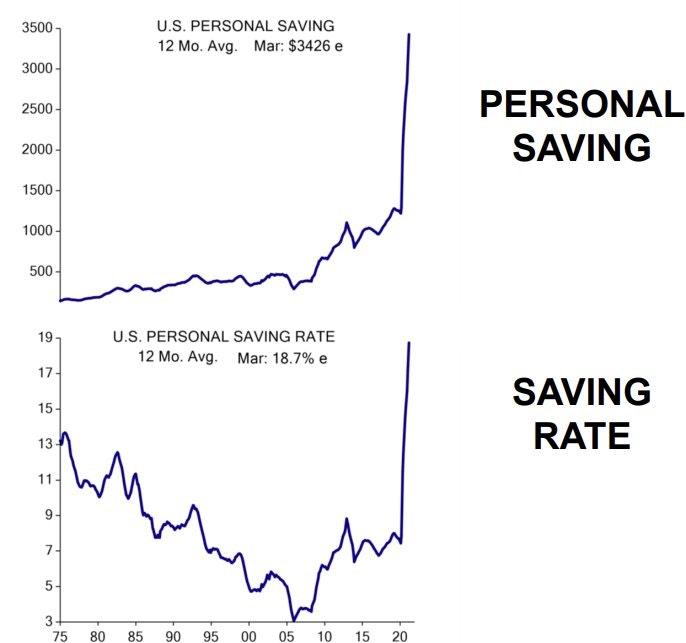
But these statistics suggest that everyone is making more money and everyone is wealthier post-pandemic. This isn’t how we should interpret the data though. Take this excerpt from the New York Times in September 2020 that analyzed previous data:
American families shored up their savings substantially between 2016 and 2019, according to Federal Reserve data released on Monday, but wealth inequality remained stubbornly high — and that was before the coronavirus pandemic took hold.Median net worth climbed by 18 percent in those three years, the Fed’s Survey of Consumer Finances showed, as median family income increased by 5 percent. The survey, which began in 1989, is released every three years and is the gold standard in data about the financial circumstances of households. It offers the most up-to-date and comprehensive snapshot of everything from savings to stock ownership across demographic groups.The figures tell a story of improving personal finances fueled by income gains and rising home prices, the legacy of the longest U.S. economic expansion on record, one that had pushed the unemployment rate to a half-century low and bolstered wages for those earning the least. Yet many Americans had less in savings than they did before the last recession a decade ago and yawning gaps persisted — the share of wealth owned by the top 1 percent of households was still near a three-decade high.Nearly all of the data in the 2019 survey were collected before the onset of the coronavirus. Economists worry that progress for disadvantaged workers has probably reversed in recent months as the pandemic-related shutdowns threw millions of people out of work. The crisis has especially cost minority and less-educated employees, who are more likely to work in high-interaction jobs at restaurants, hotels and entertainment venues. Inequality appears to be poised to widen as lower earners fare the worst.Employment remains sharply depressed compared with before the pandemic, leaving many households in a more precarious position. Stock market indexes have rebounded, which should help to support household wealth, but the benefits will mostly accrue to the rich. Only about half of Americans hold stocks, the survey showed.
So even though personal income and personal savings rate increase, it doesn’t mean that the wealth inequality gap is closing. In fact, you could argue that the only indicator of whether the wealth gap is closing or widening is what percent of Americans hold investable assets.
What people forget is how bad the wealth inequality gap in America is. According to the St. Louis Fed, the bottom 50% of Americans own only 1% of the wealth, including 13.4 million families that have a negative net worth. It doesn’t matter how many stimulus checks you send to those 13 million families, it won’t pull them out of the dire situation that they currently are in. The checks help, but let’s not kid ourselves — they do not cut poverty.
So why exactly do I believe this stimulus package is a net negative for the bottom 50% of Americans?
Simply, the benefit of a stimulus check and unemployment insurance is drastically outweighed by the negative impact of inflation, both in consumer goods and asset prices.
All the academics, millionaire bloggers, and wealthy hedge fund managers get real mad when you start to disprove their narrative that the government is cutting poverty and showering money on people. Here is a generalized view of the problem:
- Each socioeconomic class experiences different levels of inflation. The richest hold investable assets and are less likely to purchase consumer goods most affected by inflation. The lowest socioeconomic classes hold no investable assets and are more likely to purchase inflationary goods.
- The official inflation numbers are widely inaccurate. The official data says less than 1.5% inflation, but the Chapwood Index claims 7-12% depending on the city and Shadow Stats claims over 6% inflation as well.
- These large stimulus packages flood the system with liquidity, which drives asset prices much, much higher. (Zero interest rates help significantly here too).
- Those holding investable assets get wealthier and those not holding investable assets become poorer.
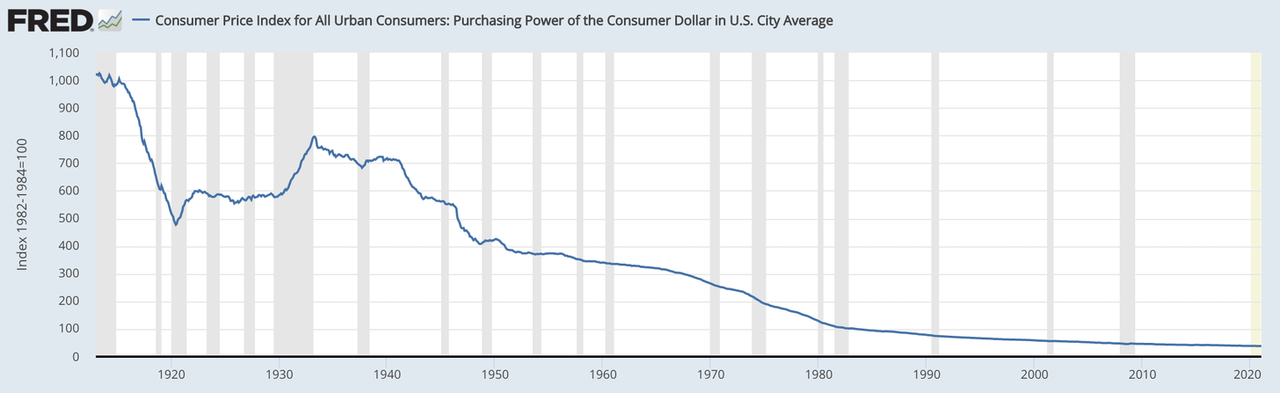
It is that simple. The purchasing power of the U.S. dollar is being eroded away based on historical trends, but these massive stimulus bills (which now total almost $6 trillion in a year) accelerate the problem. As I said, the second the Senate voted positively for this bill, the government is further enriching the wealthiest people in America, while simultaneously pushing the bottom 40% of Americans into a worse financial situation.
I don’t want to present problems without solutions. That feels unfair and intellectually dishonest. So how do we solve the problem?
First, we have to help small businesses, the unemployed, and those who are struggling financially due to the economic crisis. We don’t do that by creating new money to inject into the system, but rather by reallocating the government budget from bad investments to good investments. The U.S. government wastes an ungodly amount of money each year. From defense to pork, there are hundreds of billions of dollars that can be reallocated for those in need.
I know people will argue that those activities will be difficult and arduous. Of course, they are. But just because something is hard doesn’t mean we shouldn’t do it. Politicians have been working on this latest stimulus bill for months, which would have been plenty of time to figure out a reallocation strategy as well.
Next, we have to significantly overhaul the financial education in our country. The lack of financial education must be a national emergency. Just as we are racing to roll out vaccines, we must race to educate our citizens on the dollar’s depreciating purchasing power, the value in holding investable assets, and why saving majority of your wealth is a losing strategy. This education will arm citizens with the tools necessary to improve their financial position.
Lastly, we should ruthlessly prioritize what is most important. Are we more interested in bailing out governments or are we more interested in helping people? Do we want poorly-run companies like airlines to be bailed out or do we want to bail out individuals? Will we cheer on the violation of our freedoms with lockdowns or will we encourage entrepreneurs and business owners to do what they do best: problem-solve.
The current situation is disappointing. We have a government that destroyed our economy, forced the most vulnerable in our society into a worse financial position, and are now showing up with a bad solution. It is like setting a house on fire and then showing up pretending to be the firemen ready to put out the fire.
Printing more money will not solve this problem. It will actually exacerbate it. The mainstream media won’t call it out because they have become mouthpieces for the state. The Wall Street hedge fund managers won’t call it out because they get rich off this nonsense. Instead, the responsibility falls on the independent thinkers.
There are no contrarians left on Wall Street. There are no contrarians left in finance. They’re all sheep.
They take the information that is force-fed to them by the propaganda machine and repeat it religiously.
Showering money. Cutting poverty. No inflation. Government good. Bitcoin bad.

It is almost comical. My promise to you, the reader, is that I will always say the uncomfortable truth. I have significantly invested in bitcoin, which I believe will be the big winner in all this, which means that I will profit greatly off what is transpiring in the stimulus package. That doesn’t mean that I think the government is doing the right thing, nor does it mean that I think it will actually help the people who need it most.
However, it does mean that I recognize what is happening, what the consequences will be, and have positioned myself financially to not only be protected from the madness, but also to benefit from it. Each of you has the power to educate yourself and do what you think is best. Don’t wait around for anyone to save you. They’re not coming. You must do your own research. Think for yourself. And ensure that you aren’t exclusively exposed to any one way of thinking. Diversify your inputs to diversify your conclusions.
Latest Stimulus Package Could Jolt U.S. Growth, Revive Inflation in 2021
Economists surveyed by WSJ expect 5.95% GDP growth, fastest in nearly 40 years
WASHINGTON—The nearly $1.9 trillion relief package heading for House passage Wednesday is projected to help propel the U.S. economy to its fastest annual growth in nearly four decades, reduce poverty and revive inflation.
The legislation—following trillions of dollars in federal aid last year and arriving amid rising Covid-19 vaccination rates—prompted economists surveyed by The Wall Street Journal in recent days to boost their average forecast for 2021 economic growth to 5.95%, measured from the fourth quarter of last year to the same period this year. That was up from their 4.87% projection last month and would be the U.S. economy’s fastest since a 7.9% burst in 1983.
The analysts also lifted their forecasts for inflation and job growth from last month’s survey. The new poll found that they expected consumer prices would rise 2.48% by December from a year earlier and projected that employers will add an average 514,000 jobs a month over the next four quarters.
Some economists warned they might be underestimating the bounce to come. “The impact of the $1.9 trillion relief package could well ignite faster growth than we anticipate,” said Constance Hunter, chief economist at KPMG.
President Biden’s Covid-19 aid bill adds to considerable tailwinds that have already produced a faster-than-expected recovery from last year’s collapse in economic activity amid restrictions to contain the coronavirus. These include roughly $4 trillion in spending that Congress authorized last year to combat the pandemic, easy-money policies by the Federal Reserve and—most important—an expected reopening of businesses and schools as the population is vaccinated against Covid-19.
“It’s unprecedented,” Oxford Economics chief U.S. economist Gregory Daco said of the fiscal response to the pandemic. He expects the latest legislation to add 3 percentage points to U.S. GDP growth this year, and between 3 million and 3.5 million jobs.
The new outlook, if it materializes, would defy policy makers’ and business executives’ expectations last year that the economy’s path was likely to resemble Nike’s “swoosh” logo—a sharp drop followed by a long and grueling recovery.
It also contrasts starkly with the aftermath of the previous recession, when employers shed 8.7 million jobs between 2008 and 2010, and took more than six years to add them back.
The coronavirus pandemic led to the loss of 22 million jobs between February and April of last year. Nearly 13 million of those jobs have been recovered. Treasury Secretary Janet Yellen said Monday that she expects the U.S. labor market will return to its pre-pandemic health by next year.
“There are no benefits to enduring two historic economic crises in a 13-year span, except for one: Our mistakes are fresh in our memories. We can learn from them,” Ms. Yellen said in a speech Tuesday, outlining the case for a more muscular fiscal response than occurred after the 2008 financial crisis.
The U.S. recovery is also expected to underpin a stronger global comeback. The Organization for Economic Cooperation and Development said the latest aid package, along with faster vaccination, could increase U.S. GDP growth by 3 percentage points to 6.5% in 2021, measured year over year, and help drive demand for U.S. trading partners, including Canada, Mexico, China and euro area countries.
The aid package includes another round of $1,400 stimulus checks for most Americans, extends enhanced jobless benefits through September and provides billions to help schools reopen and accelerate vaccine production and distribution. It also includes provisions aimed at supporting low-income families, including an enhanced child tax credit, rental assistance and additional funding for food stamps—provisions that Columbia University researchers estimate will cut child poverty in half this year.
The economy has shown recent signs of a pickup, due in part to pandemic aid that Congress authorized at the end of last year and vaccine distribution. Household income rose 10% in January, priming the economy for rapid growth, and consumer spending climbed 2.4%, the first gain in three months. Employers added 379,000 jobs last month, primarily in the leisure and hospitality sector, after cutting jobs at the end of 2020.
“We were probably already on pace for a pretty good economy, assuming everything with the pandemic broke our way,” said Wendy Edelberg, an economist and senior fellow at the Brookings Institution, who didn’t participate in the Journal survey. “This bill absolutely provides a lot of insurance around that.”
Ms. Edelberg said she thinks the bill’s biggest impact could come at the end of 2021 and carry into 2022, as households that faced fewer financial constraints begin to spend down their savings and social-distancing measures presumably end.
She projects the economy will grow 7% this year and 4% in 2022 before returning to much more modest growth in 2023.
“The challenge policy makers will face and people in the economy more generally is how to manage the slowdown,” she said.
The forecasts aren’t without risk. Economists surveyed by the Journal warned that a mutation of the virus resistant to available vaccines, or a slowdown in the pace of vaccinations, could alter the outlook.
The looming demand surge has also fueled concerns that high inflation could follow, forcing the Federal Reserve to raise interest rates in response. That could deal a setback to the economy and labor market before a complete recovery is achieved.
“There’s a real possibility that within the year, we’re going to be dealing with the most serious incipient inflation problem that we have faced in the last 40 years,” former Treasury Secretary Lawrence Summers said in late February.
Fed officials acknowledge that annual inflation is likely to jump in the coming months, as the economy picks up and ultralow readings from March and April of 2020 fall out of 12-month price indexes. There is also a possibility that a spending surge after the economy reopens, or supply-chain bottlenecks, could cause some prices to rise faster than normal.
But decades of slowing inflation—the consequence of globalization, technological advances and aging populations—in rich countries prompted the Fed last year to ditch its longtime practice of raising interest rates to pre-empt higher prices. Now, policy makers plan to wait until inflation hits their 2% target and is expected to remain above it for some time before they will contemplate interest-rate increases.
Economists in the Journal survey said they see annual inflation rising to 2.8% by the middle of this year, then falling gradually after that.
“Inflation will reach levels rarely experienced over the past decade, at close to 3% in mid-2021, but uncontrolled overheating isn’t likely,” Mr. Daco said.
Northvolt Purchases U.S. Startup Cuberg to Boost Battery Technology
Swedish battery maker accelerates ramp-up as European EV sales surge
Swedish battery maker Northvolt AB has acquired U.S. startup Cuberg Inc., gaining access to technology that could significantly boost the range of its electric-vehicle batteries, in the latest move in a race between upstart battery makers and established ones to get a competitive edge.
The deal comes as Europe becomes a focus for the industry, with Asia’s big dominant battery makers competing against Europe’s homegrown startups to supply auto makers such as Volkswagen AG , Stellantis NV, BMW AG and Daimler AG with the batteries that will power millions of electric cars.
The terms of the acquisition weren’t disclosed.
To serve rising demand amid an EV sales boom in Europe, Northvolt, founded in 2016 by Swedish native Peter Carlsson, a former Tesla executive, is building a giant battery factory in northern Sweden, a second plant together with VW in Germany, and is looking for a site for a third plant that will also be built in Germany.
“The Asians have a scale advantage,” Mr. Carlsson told The Wall Street Journal. “The scale-up of this industry and thereby the supply chains happened in Asia. And it’s about to happen in Europe and the U.S.”
Analysts say Northvolt will struggle to compete on scale with China’s Contemporary Amperex Technology Co. , Korea’s LG Chem Ltd. 051910 3.48% and China’s SVolt Energy Technology Co. These companies already have the integrated supply chains and financial power to fuel their global expansion. CATL is building a battery plant in eastern Germany, while LG Chem is expanding its production in Poland. SVolt, which has developed a cobalt-free battery, is building a plant in Western Germany.
Instead, they say, Northvolt should focus on developing technological advantages.
“It’s going to be very challenging for new entrants,” said Tim Bush, a battery analyst with UBS. “You’re going to need some kind of new disruptive technology.”
Cuberg has developed a battery cell that increases battery density—or the amount of energy a battery can store—but which can be integrated in existing large-scale battery manufacturing, enabling Northvolt to improve the range of its batteries with its existing production facilities. The extended range of the batteries enables an electric car or other vehicle to run longer on a single charge. And it means that fewer battery cells are needed to power a car, reducing the overall cost and increasing the number of cars that Northvolt can equip.
The Emeryville, Calif.-based company has mainly targeted the aviation industry until now and received backing from Boeing’s HorizonX venture-capital arm in 2018.
“Cuberg’s battery technology has some of the highest energy density we’ve seen in the marketplace, and its unique chemistries could prove to be a safe, stable solution for future electric air transportation,” Steve Nordlund, a Boeing executive, said at the time.
Mr. Carlsson, the Northvolt founder, said he expects that the technology from Cuberg, spun out of Stanford University in 2015, will enable Northvolt to offer a battery with more than 70% more range than comparable lithium ion batteries, allowing Northvolt to grow faster and lower the unit cost of its batteries.
But the acquisition is also about future development. Cuberg will become the nucleus of a new Northvolt development center that aims to tap engineering talent in Silicon Valley to develop future battery technology. The company hopes to tap U.S. tech companies and universities for top-notch engineers.
“We will be pulling on a lot of academia,” said Richard Yang, Cuberg’s chief executive and co-founder.
Northvolt’s acquisition of Cuberg also highlights that the battle for brains is going to be one of the biggest challenges for car makers and their battery suppliers as the demand for developers and new battery technology intensifies.
“In the battery industry, there is going to be a war over competences,” said Mr. Carlsson, adding that Cuberg doesn’t yet have the “total secret formula” Northvolt needs. “But they are a bridge in our road map to get us from where we are today to where we need to be in 2030.”
>>> Up
* Agfa-Gevaert Raised to Buy at KBC Securities (+)
* Campari Raised to Hold at HSBC; PT 8.50 euros
* CNP Assurances Raised to Buy at Berenberg; PT 21.40 euros
* Deutsche PBB Raised to Buy at Pareto Securities; PT 11 euros
* Deutsche Telekom Raised to Buy at Citi; PT 18.50 euros
* Ferrovial Raised to Buy at SocGen; PT 26.20 euros
* Ferrexpo Raised to Buy at Liberum; PT 500 pence
* Gimv Raised to Buy at KBC Securities (+)
* Melia Hotels PT Raised to 8.50 euros at Deutsche Bank
* NH Hotel Raised to Buy at Deutsche Bank; PT 5.20 euros
* Norsk Hydro Raised to Overweight at Barclays; PT 73 kroner
* Senior Raised to Add at Peel Hunt; PT 128 pence
* Tenaris Raised to Equal-Weight at Barclays; PT 10.50 euros
* Texaf Raised to Buy at KBC Securities; PT 44 euros
* Vaisala Raised to Reduce at Inderes; PT 30 euros
* Vaisala Raised to Reduce at Inderes; PT 30 euros
* Voyageurs du Monde Raised to Buy at Gilbert Dupont; PT 115 euros (+)
>>> Down
>>> Down
* ASTM SpA Cut to Neutral at Banca Akros (ESN); PT 25.60 euros (+)
* Basic-Fit Cut to Sector Perform at RBC; PT 35 euros
* Basic-Fit Cut to Sector Perform at RBC; PT 35 euros
* Capital & Counties Cut to Hold at Stifel; PT 185 pence (+)
* Continental Cut to Underperform at Oddo BHF; PT 110 euros (+)
* Inditex Cut to Neutral at Alantra Equities; PT 30.50 euros (+)
* Lundin Energy Cut to Hold at SEB Equities; PT 300 kronor (+)
>>> Initiation
>>> Initiation
* Ferrovial Rated New Outperform at Mediobanca SpA; PT 27.20 euros (+)
* Italgas Reinstated Outperform at RBC; PT 5.75 euros
* Italgas Reinstated Outperform at RBC; PT 5.75 euros
* Snam Reinstated Sector Perform at RBC; PT 4.65 euros
* Terna Reinstated Sector Perform at RBC; PT 5.75 euros
>>> Call
* IAG Raised at JPMorgan After Greensill-Driven Selloff ‘Overdone’
>>> Call
* IAG Raised at JPMorgan After Greensill-Driven Selloff ‘Overdone’
* CNP Assurances Strategy Shift Prompts Upgrade at Berenberg
* ESG Single Biggest Risk for Alcoholic Beverage Stocks: Jefferies (+)
* Ferrexpo Upgraded to Buy at Liberum on Demand for Greener Steel
* Hydro Raised to Overweight on Upside Potential at Barclays
* Just Eat Takeaway Results Enough for a Bounce, Jefferies Says (+)
* Leonardo Cash Guidance Weaker, Orders Positive: Morgan Stanley
* Melia, Scandic Get Street High PTs at ‘Selective’ Deutsche Bank (+)
* Regulated Utilities’ Growth Prospects Underappreciated, RBC Says
* Ferragamo’s 4Q Shows ‘Small’ Signs of Recovery, Says Jefferies
* Senior Upgraded at Peel Hunt on Improved Long-Term Prospects
* Spirax-Sarco Earnings Ahead, Outlook is Robust, Jefferies Says (+)