WSJ : Roblox Soars in Debut as IPO Market Surge Resumes

Roblox Soars in Debut as IPO Market Surge Resumes
Market capitalization of the videogame platform now stands at roughly $45 billion

Shares of videogame platform Roblox Corp. RBLX 54.44% soared in their public debut Wednesday, in an indication that the mania that gripped the IPO market late last year shows no sign of abating.

The stock leapt more than 54% above the $45 reference price for its direct listing, an increasingly popular way for companies to go public that sidesteps the traditional IPO process. At its closing price of $69.50, the San Mateo, Calif., company has a market capitalization of roughly $45 billion, a steep jump from the $29.5 billion valuation it secured in a private fundraising just two months ago.

It is the latest marker of a historic boom in initial public offerings, as investors clamor for newly minted shares of fast-growing companies in the midst of a record surge in technology and other stocks. So far this year, nearly $103 billion has been raised in IPOs, including the red-hot market for special-purpose acquisition companies, or SPACs, according to Dealogic. That far outpaces every comparable-period total on record and the full-year tally in all but three years since 1995.

What also makes this surge different from prior ones is that companies are taking a variety of routes to the public market, including by merging with SPACs or through direct listings.

SPACs, empty shells that raise money in an IPO and then look for a private company to merge with, have dominated the headlines this year, raising more than $75 billion, or roughly 74% of overall stock issuance. Yet even stripping out that amount, more money has been raised so far this year for traditional IPOs—roughly $26.5 billion—than in any other comparable period on record, including at the height of the dot-com boom.

While there has been a recent selloff in shares of technology firms and SPACs, many of the hardest hit among them surged Tuesday in a sign that the appetite for risk that is fueling new issues remains voracious.

Indeed, the 2021 IPO party is just getting started, bankers say.

South Korean e-commerce giant Coupang Inc. is expected on Thursday to follow Roblox with a traditional IPO that is set to be the largest this year by dollars raised and valuation, and the biggest for a foreign company since Alibaba Group Holding Ltd. ’s blockbuster 2014 debut.

The shares priced at $35 apiece, above an already-raised range of $32 to $34, according to people familiar with the deal. That means Coupang’s IPO will raise more than $4 billion and its valuation on a fully diluted basis including proceeds is set to be nearly $63 billion.

Demand has been so ravenous that the underwriting team has expressed concerns that the shares will pop as dramatically on the first day of trading as stock in Airbnb Inc. and DoorDash Inc. did in their respective debuts in December, according to people familiar with the matter.

Fears over such a pop, which effectively means the company and other sellers in the offering leave big money on the table, led Roblox to delay a planned December IPO and opt instead for a direct listing, in which no money is raised.

The current boom times will invariably come to an end—it is just a matter of when and why—and some market participants say that helps explain the rush to the public markets now.

Bankers and other IPO advisers say both established and still-nascent companies are accelerating their timetables for moving into the public markets. In two examples, WeWork and Shutterfly Inc. are in talks to go public through SPACs, The Wall Street Journal has reported.

All the exuberance is helping mint fortunes. The rush of public investors into Roblox and Coupang means giant returns for their early investors.

Roblox raised $520 million from Altimeter Capital and Dragoneer Investment Group, which paid $45 a share in the January funding round. That valuation was already a dizzying jump from the $4 billion at which the company raised money in early 2020, from a group including venture-capital firm Andreessen Horowitz.

A group of investors including Japan’s SoftBank Group Corp. , hedge fund Maverick Capital Ltd. and venture-capital firm Greenoaks Capital Partners LLC are poised to book big gains on the Coupang IPO. Greenoaks, whose founder Neil Mehta serves on the board, invested in Coupang in 2010 when it was valued at roughly $10 million and now owns about 17% of the company. Maverick bought in at a valuation of less than $100 million in 2011, and now it owns roughly 6% of Coupang.

Since 2015, SoftBank has invested $2.7 billion in Coupang in exchange for roughly 37% of the company. At a $60 billion valuation, SoftBank and its Vision Fund would generate a profit of roughly $19 billion.

SoftBank also holds more than one-third of Compass Inc.’s stock. The real-estate brokerage firm is expected to debut in the coming weeks at a valuation of around $20 billion, according to people familiar with the deal, more than triple the $6.4 billion valuation at which it last raised capital.
WSJ : Brazil, Hit by Covid-19 Variant, Surpasses U.S. in Daily Cases and Deaths

Brazil, Hit by Covid-19 Variant, Surpasses U.S. in Daily Cases and Deaths
P.1 strain from the Amazon fills up ICUs across South America’s most populous country; some patients left to die

SÃO PAULO—Brazil has overtaken the U.S. as the country with the most daily Covid-19 cases and deaths in the world, as an aggressive strain of the disease from the Amazon leaves Latin America’s biggest nation scrambling for space in hospitals and cemeteries.

Brazil’s daily Covid-19 death toll surged to 2,286 on Wednesday, its highest yet during the pandemic. The U.S. death toll on Tuesday was 1,947.

Brazil’s seven-day average daily death toll has risen to 1,573 while the rate in the U.S. is plunging—down to 1,566 a day—amid fewer cases and more vaccination, according to Our World in Data at Oxford University. The U.S. hit a peak of just over 3,400 daily deaths in January.

As many countries put the worst of the pandemic behind them, Brazil is facing one of its worst humanitarian crises yet as deaths and infections surge, registering in the past week almost 1,000 new cases every 20 minutes—more than 70,000 a day.

Public health specialists lay part of the blame on the rapid spread of the P.1 strain from the Amazonian city of Manaus, which studies have shown to be more contagious and better able to reinfect people than previous versions of the disease. Deaths have also surged as Brazil’s health system has struggled to cope, meaning patients who could have been saved were left to die in chaotic hospital corridors or—in the worst cases—suffocated to death for lack of oxygen.


Brazil is now home to hundreds of new Covid-19 variants, researchers said, warning that other more dangerous versions could emerge the longer the disease is left to fester and mutate, threatening to undermine the progress of other countries against the pandemic.

“It seems like a nightmare,” said Mohamed Parrini, chief executive of the Moinhos de Vento Hospital in the southern city of Porto Alegre, who has been racing to convert other wards into makeshift ICUs. “The saddest thing is when you start to see the people around you also getting intubated—people’s husbands, the spouses and uncles of employees.”

Like many doctors across the country, Mr. Parrini said he was seeing more younger patients—many in their 30s and 40s—than during Brazil’s first wave of cases in the middle of last year. Researchers are still trying to understand why.

Covid-19 has killed more than 260,000 people in Brazil, including more than 10,000 in the past week. That puts the country only behind the U.S., which has more than 525,000 deaths.

Public-health specialists have also blamed President Jair Bolsonaro for failing to secure more vaccines and for playing down the danger of the disease. The former army captain recently told Brazilians to get back to work and “stop whining.”

Brazil has inoculated only about 4% of its population. That means cases and deaths are likely to remain higher in Brazil for the coming months, epidemiologists say.

The U.S., Brazil and India have led in the total number of daily deaths for every month of the pandemic but the first few, when the virus began its deadly march from China to South Korea and Europe.

Public hospitals in the capital Brasília and across more than 20 of Brazil’s 26 states have now reached full capacity or are close to running out of beds in their ICU wards. Hospitals in Brasília, the Amazon and the south have resorted to renting refrigerated shipping containers to store corpses after their on-site morgues filled up. Meanwhile, cemeteries in some cities such as Campo Grande in the center-west have dug up their parking lots to make more room for graves.

As a proportion of its population of 213 million people, Brazil has suffered fewer deaths so far than the U.S., as well as Mexico, Peru and several European nations. But the speed of Brazil’s recent wave of fatalities—and the fact it runs contrary to the global trend—has prompted deep concern over the country’s fate as well as the potential of the P.1 strain to wreak similar havoc across the region.

A recent study showed P.1 to be 1.4 to 2.2 times more contagious than versions of the virus previously found in Brazil, and 25% to 61% more capable of reinfecting people.

Researchers believe P.1 first emerged in Manaus in early November and by January, the new strain was already responsible for 85% of new Covid-19 infections in the city.

Chaos soon followed. After scores of patients suffocated to death in Manaus in January following a citywide shortage of oxygen, a convoy of trucks from Venezuela made the 26-hour drive south through the rainforest to deliver supplies. Prosecutors have also been investigating reports last month that intubated patients in the region were tied to their beds following a shortage of sedatives.

While the infection rate and daily death toll have shown signs of falling in Amazonas state over recent weeks, other states further south are facing their darkest days yet as P.1 continues to spread. São Paulo, Brazil’s biggest and wealthiest city, has called on volunteer doctors to help relieve exhausted medical staff as ICU occupancy rates reach 80% for the first time.

Brazil began its vaccination campaign on Jan. 17, but has proceeded slowly. There have been mixed signs over how Brazil’s principal vaccine, the Chinese CoronaVac shot, and other Covid-19 vaccines will work against P.1. The Butantan Institute and Fiocruz, Brazilian research centers that are producing the CoronaVac vaccine and the Oxford- AstraZeneca shot respectively, said studies show both are effective against P.1.

A laboratory study this week showed that Pfizer Inc.’s vaccine was able to neutralize P.1. However, another small study showed this month that plasma from people vaccinated five months ago with CoronaVac “failed to efficiently neutralize” the strain.

Business of Fashion : At Louis Vuitton, Nicolas Ghesquière’s Newfound Ease

At Louis Vuitton, Nicolas Ghesquière’s Newfound Ease
The designer’s latest collection was as high concept as ever, but the outcome felt fresh, even spontaneous, reports Angelo Flaccavento.

Travel is at the core of the Louis Vuitton brand, but what do you do when a pandemic keeps much of the world grounded? “There’s no need to venture far to create the impression of traveling” was the answer supplied by artistic director Nicolas Ghesquière. In practice, his collection was a familiar collage of far-ranging elements, stretching this season from the mythological iconography of Italian “practical madness” master Piero Fornasetti to angular volumes with an ’80s aftertaste. There were slouchy boots and padded capes stuck halfway between history and science fiction. Overall, the vision, staged in the Michelangelo and Daru galleries of the Louvre, certainly captured a mind traveling here and there, across time as well as space.

The past year seems to have been good for Ghesquière. Early in his tenure at Vuitton, his work was marked by a sort of forced conceptualism. You could see him and his teams fussing for days on every single look. The product of so much thinking and chiselling has felt, quite honestly, forced; a bit hard to decipher and digest.

Today’s outing had a certain ease, conveyed by the cocooning shapes, by clothing that danced away from the body. The time clashes and the juxtaposition of the overtly decorated and the more “casual” was definitely Ghesquière in method, but the outcome felt fresh, dare we say spontaneous. It would be interesting to see Ghesquière let go a little more in the future.

WWD : H&M x Simone Rocha Capsule Breaks the Internet in China

H&M x Simone Rocha Capsule Breaks the Internet in China
The server for H&M's Chinese website, WeChat mini-program, and app crashed moments after the capsule was released at midnight on March 11.


In keeping with the times, the infamously long queues outside H&M’s annual designer collaboration have moved online.

Due to an unprecedented level of traffic, the highly anticipated H&M x Simone Rocha capsule crushed the fast-fashion giant’s server in China moments after it was released in the market at midnight on March 11.

Users began to report issues accessing H&M’s official website, app and WeChat Mini-program on social media, and many were unable to complete payment. Instead of taking them to the shopping page, some were redirected to an under maintenance page. This issue lasted at least two hours.

It’s understood that the issue now has been resolved and many were able to buy the half Irish and half Chinese designer’s signature lace dresses and tulle tops, as well as men’s wear and children’s options at a fraction of the label’s usual price.

The hashtag “HM x Simone Rocha” has seen 1.8 million impressions and 6,400 discussions on Weibo so far.

>>> US Close Dow +1.46% S&P +0.60% Nasdaq -0.04% Russell +1.81%

Closing Stock Market Summary

The S&P 500 advanced 0.6% on Wednesday, as value and cyclical stocks reclaimed their recent leadership roles and inflation concerns were put on hold. The pro-cyclical trade disproportionally benefited the Dow Jones Industrial Average (+1.5%) and Russell 2000 (+1.8%), with the Dow setting intraday and closing record highs.

The Nasdaq Composite (-0.04%), however, closed slightly lower after being up as much as 1.6% intraday. The S&P 500 information technology sector (-0.4%) and Philadelphia Semiconductor Index (-1.8%) were other growth-stock pockets of weakness. 

Prior to the open, the February Consumer Price Index (CPI) report didn't reveal any surprising upticks in inflation, with total CPI increasing an expected 0.4% m/m and core CPI increasing just 0.1% (Briefing.com consensus +0.2%). The yr/yr increases remained below 2.0%, although many still expect upwards pressure in the coming months. 

Notwithstanding those inflation expectations, equity futures reacted positively to the report, long-term interest rates backed down from pre-CPI highs, and most stocks opened in positive territory. Ten of the 11 S&P 500 sectors closed higher, including the cyclical energy (+2.6%), financials (+1.9%), and materials (+1.6%) sectors atop the standings on the back of follow through from buyers. 

The so-called reopening trade was aided by the House passing the $1.9 trillion stimulus bill, as expected, and New York Governor Cuomo saying that restaurants in New York City and New Jersey will expand indoor dining to 50% beginning March 19.

Like the price action in the Nasdaq, the information technology sector (-0.4%) was up as much as 1.1% in early action, briefly adding to Tuesday's 3.4% gain. Amid a lack of negative catalysts, the rebound rally in growth stocks appeared gassed out, even as Treasury yields declined.

The 10-yr yield decreased three basis points to 1.52%, with the market showing little reaction to the tepid $38 billion 10-yr note auction in the afternoon. The 2-yr yield decreased one basis point to 0.15%. The U.S. Dollar Index decreased 0.2% to 91.79. WTI crude futures increased 0.7%, or $0.43, to $64.45/bbl.

In corporate news, Roblox (RBLX 69.50, +24.50, +54.4%) had a solid public debut at the NYSE. General Electric (GE 13.25, -0.75, -5.4%) lowered its FY21 EPS guidance following its confirmed merger deal between its aircraft leasing business and AerCap (AER 53.39, -2.61, -4.7%). 

Reviewing Wednesday's economic data:

  • Total CPI increased 0.4% m/m, as expected, while core CPI, which excludes food and energy, rose 0.1% (consensus 0.2%). The monthly changes left total CPI up 1.7% yr/yr, versus 1.4% in January; however, the yr/yr increase in core CPI edged lower to 1.3% from 1.4% in January.
    • The key takeaway from the report is the recognition that it didn't contain any headline surprises today to fan the flames of inflation concerns, which many expect to fire up in coming months.
  • The February Treasury Budget showed a $310.9 bln deficit, versus a $235.3 bln deficit in the same period a year ago. The budget data is not seasonally adjusted, so the February deficit can't be compared to the January deficit of $162.8 bln.
    • The fiscal year-to-date budget deficit is $1.05 trln versus -$624.5 bln for the same period a year ago. The budget deficit over the last 12 months is $3.55 trln versus -$3.48 trln in January.
  • The weekly MBA Mortgage Applications Index decreased 1.3% following a 0.5% increase in the prior week.

Looking ahead, investors will receive the weekly Initial and Continuing Claims report on Thursday.

  • Russell 2000 +15.7% YTD
  • Dow Jones Industrial Average +5.5% YTD
  • S&P 500 +3.8% YTD
  • Nasdaq Composite +1.4% YTD

>>> US After Hours Summary: AMC +6%, BMBL +6% rise on earnings while ALTO -17%,

After Hours Summary: AMC +6%, BMBL +6% rise on earnings while ALTO -17%, CLDR -11% decline following earnings

After Hours Gainers:

Companies trading higher in after hours in reaction to earnings/guidance: AMC +6.3%, BMBL +5.9%, ASAN +5.5%, AVO +3.7%, SKLZ +3.5%, FNV +2.7%

Companies trading higher in after hours in reaction to news: AVEO +28.9% (continued momentum after receiving FDA approval for FOTIVDA), ENFA +6.3% (in talks for merger with BuzzFeed, according to Bloomberg), MSGN +4.6% (weighing merger with MSG Entertainment [MSGE], per Bloomberg), CRIS +3.4% (announced abstract for CA-4948 accepted for presentation at AACR Annual Meeting), MSGE +3.40% (MSG Networks [MSGN] exploring merger with co, per Bloomberg), SPFR +3.7% (following report that co is weighing merger with Velo3D), SURF +2.8% (announced presentations at AACR Annual Meeting), RWT +2% (increased dividend)

After Hours Losers:

Companies trading lower in after hours in reaction to earnings/guidance: ALTO -17.0%, CLDR -10.6%, SUMO -7.2% (also announced acquisition of DFLabs), ORCL -5.2%, TTCF -4.9%, LC -3.5%

Companies trading lower in after hours in reaction to news: JE -17.3% (TSX and NYSE commence delisting proceedings), KDMN -12.2% (FDA extends review period for belumosudil for the treatment of cGVHD), NVEE -9.9% (stock offering), HESM -9.6% (announced secondary public offering of Class A shares by selling shareholders), IVC -7.2% (convertible senior notes offering), MGP -2.5% (Class A shares offering), BAND -1.4% (convertible senior notes offering)

(ZH) SEC Issues Investor Alert About Celebrity SPACs After Bruising Selloff

SEC Issues Investor Alert About Celebrity SPACs After Bruising Selloff

When we look back at the COVID-19 era, there's little doubt that the SPAC boom that dominated financial headlines last year will be remembered as a shining example of what happens when the Fed steps up to monetize trillions of dollars in federal government stimulus, while millions of scared and desperate Americans scramble to parlay one free paycheck into two.
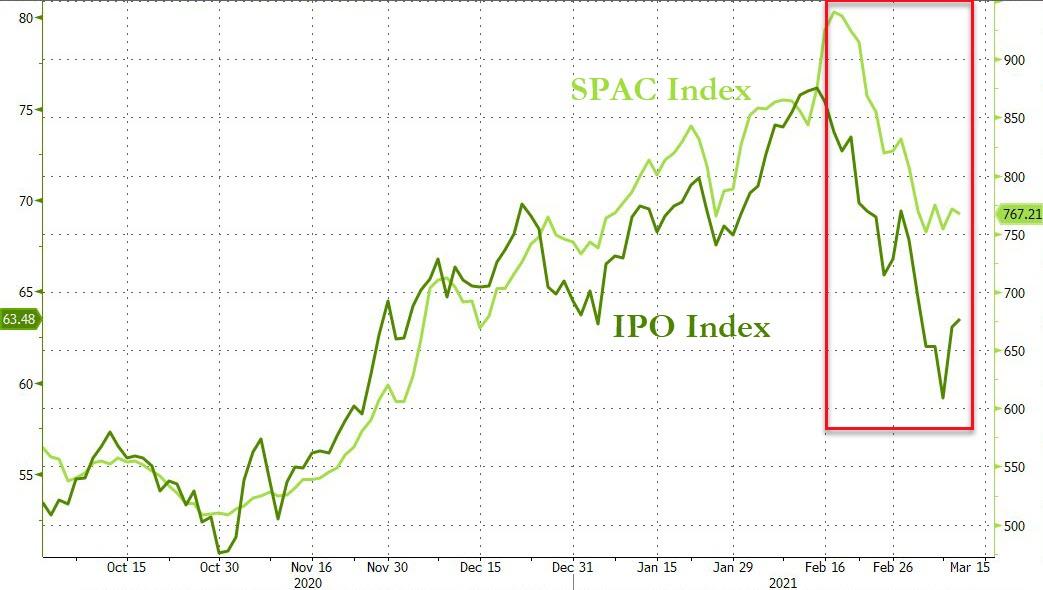
A few days ago, Chamath Palihapitiya, "the King of SPACs" whose leadership in the Virgin Galactic deal arguably makes him one of the progenitors of the contemporary bubble, warned that there will be even more pain ahead for SPAC investors, especially if bond yields continue to rise (which, as we have explained, they likely will, especially if Senators Sherrod Brown and Elizabeth Warren get their way).
“The SPAC market has taken a real beating...if you have one or two more months of this where all of a sudden bonds look better…you’ll have a bunch of busted IPOs or mergers.”
To borrow a phrase form Palihapitiya, SPACs "took a beating" during the Nasdaq drawdown that started last month.
...the SEC has decided to issue a rare public alert about the sector, warning investors to think twice before investing their hard-earned money in shares of a SPAC, especially when celebrity pitchmen or women are attached to the deal. The notice cautions investors not to make investment decisions "solely based on celebrity involvement".
Most importantly, the notice explained to readers how the economic interests of SPAC sponsors sometimes differ from those of their customers, as sponsors will typically get in on deals at more favorable terms.
The agency also offered readers a walk-through of how SPACs work, including explaining what a "warrant" is, the standard $10 debut trading price, and the typical two-year timeframe (SPACs usually promise investors they will close a deal within 2 years).
Read the full notice below:
The SEC’s Office of Investor Education and Advocacy (OIEA) cautions investors not to make investment decisions related to SPACs based solely on celebrity involvement.
Celebrities, from movie stars to professional athletes, can be found on TV, radio, and social media endorsing a wide variety of products and services. Sometimes they are even involved in investment opportunities such as special purpose acquisition companies, or SPACs, as sponsors or investors. Those celebrities may even be well-known professional investors.
However, celebrity involvement in a SPAC does not mean that the investment in a particular SPAC or SPACs generally is appropriate for all investors. Celebrities, like anyone else, can be lured into participating in a risky investment or may be better able to sustain the risk of loss. It is never a good idea to invest in a SPAC just because someone famous sponsors or invests in it or says it is a good investment.
SPACs have become a popular vehicle for transitioning a private company to a publicly traded one. A SPAC is a blank check company with no operations that offers securities for cash through an initial public offering (IPO). SPACs then have a specified period of time—typically two years—to identify and merge with a private operating company. This business combination is often used as an alternative means of taking the acquired company public, rather than through a traditional IPO.
Special purpose acquisition companies (SPACs). To learn more about SPACs and what to consider before investing in a SPAC, see our Investor Bulletin about what you need to know.
However, SPAC transactions differ from traditional IPOs and have distinct risks associated with them. For example, sponsors may have conflicts of interest so their economic interests in the SPAC may differ from shareholders. Investors should carefully consider these risks. In addition, while SPACs often are structured similarly, each SPAC may have its own unique features, and it is important for investors to understand the specific features of any SPAC under consideration.
Differing economic interests.SPAC sponsors generally acquire equity in the SPAC at more favorable terms than investors in the IPO or subsequent investors on the open market. As a result, the sponsors will benefit more than investors from the SPAC’s completion of a business combination and may have an incentive to complete a transaction on terms that may be less favorable to you. To learn more, see our Investor Bulletin.
Even if a celebrity is involved in a SPAC, investing in one may not be a good idea for you. Before investing, always do your research, including these three steps:
  • Check out the background, including registration or license status, of anyone recommending a SPAC, using the search tool on Investor.gov;
  • Learn about the SPAC sponsors’ backgrounds, experience, and financial incentives, how the SPAC is structured, the securities that are being offered, the risks associated with an investment in the SPAC, plans for a business combination, and other shareholder rights by carefully reading any prospectus which may be available through the SEC’s EDGAR database; and
  • Consider the investment’s potential costs, risks, and benefits in light of your own investment goals, risk tolerance, investment horizon, net worth, existing investments and assets, debt, and tax considerations.
Never invest in a SPAC based solely on a celebrity’s involvement or based solely on other information you receive through social media, investment newsletters, online advertisements, email, investment research websites, internet chat rooms, direct mail, newspapers, magazines, television, or radio.
* * *
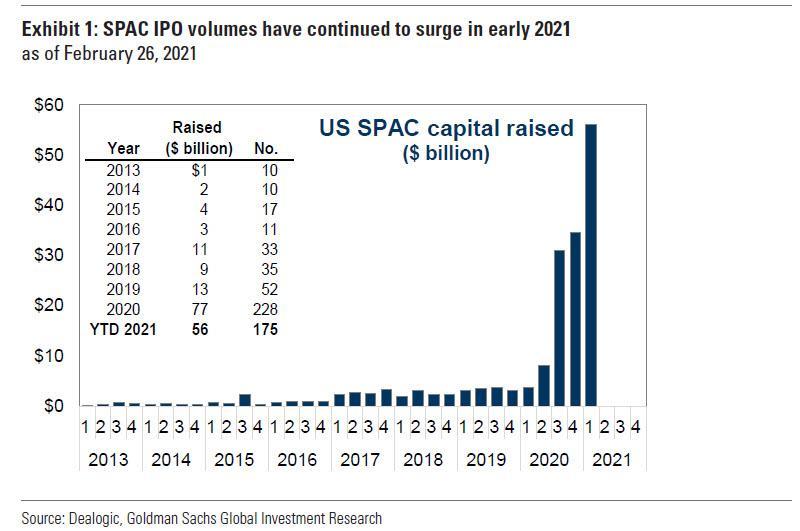
Is this too little, too late for the SEC? After all, the SPAC craze has already reached a surreal, permanently high plateau where 5 new SPACs price ever single day so far in 2021, and that YTD, 144 SPACs have gone public raising a total of $44 billion.

(ZH) $100 Billion Has Rotated Back To Value Investing, And More Could Be Coming

$100 Billion Has Rotated Back To Value Investing, And More Could Be Coming

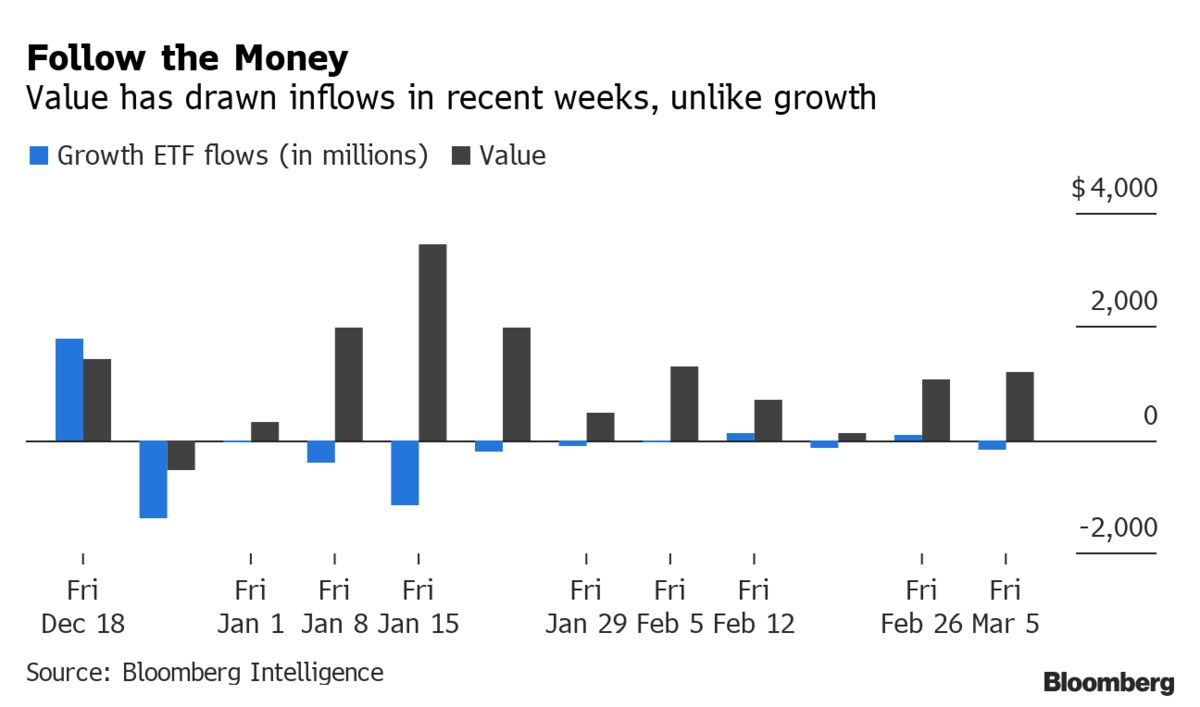
Heading out of the Covid era, it looks as though value investing is officially back. $100 billion has poured back into the investments that were once left for dead, as investors either "broaden the bull market", to borrow Cathie Wood's term from several days ago, or just become more risk adverse and head out of risky, speculative, tech plays in favor of value.
In fact, value investing, as a strategy, has now surpassed levels last seen before the pandemic, according to Bloomberg. And with $1.9 trillion more in stimulus about to hit the market, the rotation could continue.
An Evercore note out Monday read: “Value crushed it for the right reasons.”
As part of the shift, value investing ETFs have brought in new money for 10 straight weeks. Assets have jumped $100 billion since the start of November, Bloomberg notes.
Now the question becomes whether or not the value trade is going to unseat the bull market in the NASDAQ, or simply join it. With trillions in stimulus making its way to the market, it's going to be tough to tell until several more quarters pass. The chaos in the bond market of recent isn't slowing down the rotation, either. Momentum names are suffering one of their biggest ever losses versus value, according to MSCI global indexes, during this rotation.
Saxo Bank strategist Eleanor Creagh said this week: “The higher that yields go, the more pressure is on that rotation.”
Value has underperformed significantly since 2008, Bloomberg notes: "Its price-to-book gap with growth remains more than twice the 25- or 10-year average and not far from the peak that preceded the burst of the dot-com bubble."
Argument remains abound as to whether or not this means the gap could continue closing, or whether or not a new standard has been set.
Cliff Asness, of AQR Capital Management, wrote in a paper last week that it would be "misleading" to assume that value investing - a strategy he has stuck with over the last decade - has been dead based on poor historical returns. Instead, he argued that weak performance was driven by the factor getting cheaper.
Evercore believes that with capex recovering, cyclical shares will have even more room to run: “The macro backdrop still favors value and price volatility, but the pace of returns should slow.”
Meanwhile, as we noted Tuesday, the streams have crossed...