(ZH) JPMorgan Estimates Up To $316 Billion In Forced Month-End Selling

JPMorgan Estimates Up To $316 Billion In Forced Month-End Selling

Friday's post-European close ramp notwithstanding...
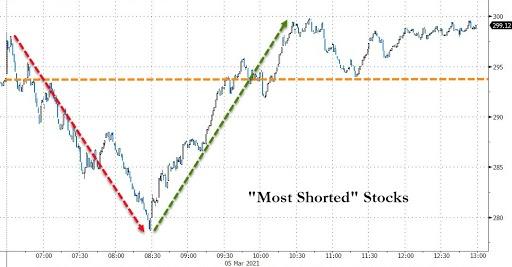
... stock markets, and especially growth stocks, had a rude awakening this week as rising rates finally hammered high duration stocks, shown in this chart which we have been posting ever since November to warn readers of who will get hammered first.
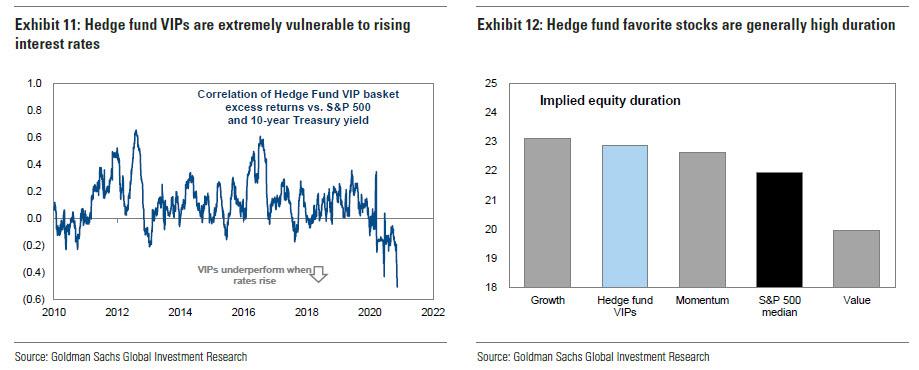
For those who hope that the worst is now over, JPM has some bad news.
In one of his latest Flows and Liquidity reports, JPM quant Nick Panigirtzoglou writes that as we approach quarter-end, the equity rebalancing flow question is resurfacing in client conversations. As we notes, "the equity rally and the bond sell-off during the current quarter is naturally creating a pending rebalancing flow for multi-asset investors away from equities into bonds for pension funds and balanced mutual funds. How much of equity/bond rebalancing flow should we expect into current quarter-end?"
To answer this question, the Greek strategist applies a familiar framework and looks at the four key multi-asset investors that have either fixed allocation targets or tend to exhibit strong mean reversion in their asset allocation. These are balanced mutual funds, such as 60:40 funds, US defined benefit pension plans, Norges Bank, i.e. the Norwegian oil fund, and the Japanese government pension plan, GPIF.
For those curious about the details, below is a more detailed summary of the considerations behind the four key investor classes ahead of month and quarter-end.
1. Balanced mutual funds including 60:40 funds, a close to $7.5tr AUM universe globally, tend to rebalance over 1-2 months or so. The lesson from last Nov/Dec is that balanced mutual funds exhibit flexibility and they do not necessarily rebalance every single month. During the previous quarter, they appear to have postponed rebalancing for Nov-end or Dec-end and to have waited until January to de-risk/rebalance. JPM believes that funds de-risked in January, as a result of the tumble in balanced MFs equity beta...
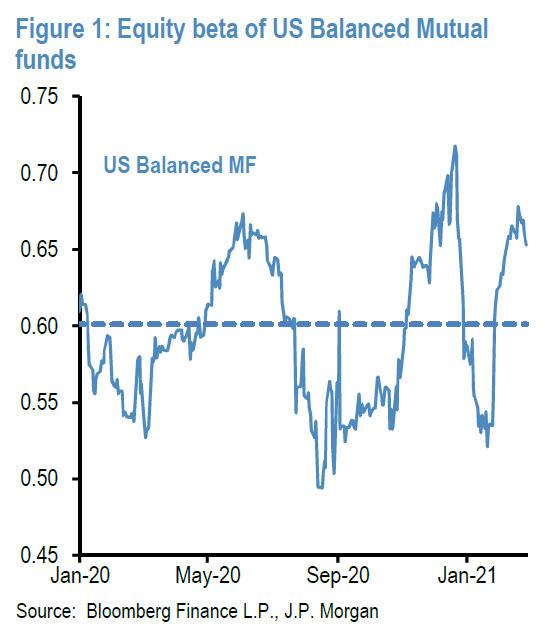
.. and since it would have been too soon to rebalance again in February, the quant believes that they have likely postponed any pending rebalancing to March. Assuming they were fully rebalanced at the end of January, which is a reasonable hypothesis given the reduction in their betas in January and by taking into account the performance of global equities and bonds since then, JPMorgan estimates around $107bn of equity selling by balanced mutual funds globally into the end of March in order to revert to their 60:40 target allocation.
2. US defined benefit pension plans are a similarly big universe with AUM of around $8tr. They tend to rebalance more slowly over 1-2 quarters or so. Assuming they were fully rebalanced at the end of December, and by taking into account the QTD performance of US equities and bonds, JPM expects that the pending equity rebalancing flow by US defined benefit pension plans into the current quarter-end is negative at around -$110bn: "In other word, US defined benefit plans would need to sell $110bn of equities towards the end of the current quarter and buy a similar amount of bonds for their allocations to revert to end-December levels." Making matters worse, and given the improvement in their funded ratios, Panigirtzoglou notes that it is possible that they would seek to take advantage of this improvement to de-risk, "which could pose some upside risk to this estimate."
3. Norges Bank, a $1.3tr AUM entity as at the end of 2020, is calculated to see negative $65bn in rebalancing (out)flows. This, according to JPM, incorporates also the fact that the Norwegian government looks set to continue to rely on net transfers from its fund to finance part of its budget deficit and assumes that the equity weight would be returned to its target of around 70%. In the second half of 2020, the Norges Bank allowed its equity weight to increase to nearly 73%, and in the event it would simply seek to keep its equity weight unchanged at 73% would imply around $22bn of equity sales, which JPM thinks of as a lower bound estimate.
4. The Japanese government pension plan, or GPIF, a $1.7tr AUM entity, is also set to sell: JPM estimates that the pending equity rebalancing flow by the GPIF into the current quarter-end based on current equity and bond returns is also likely negative at around $34bn.
Putting these together, we get:
  • Mutual -$107BN
  • Defined Pension -$110BN
  • Norges Bank -$65BN (could be -$22BN)
  • GPIF -$34BN
... a grand total of $316BN.
To be sure, this number will likely be lower following last week's selloff which followed the original JPM analysis, and may be some $40BN less based on assumptions about forced Norwegian selling, we are still talking about selling in the $100BN+ range in the days before quarter end, which is why JPM concludes that "in all, we see some vulnerability in equity markets into quarter-end from pension funds entities as well balanced mutual funds selling equities and buying bonds to rebalance towards their target equity/bond allocations."
And while JPM's last forced selling forecast was a dud, with the bank's Nov 2020 prediction of a similar number ($310BN) in year-end selling never materializing (as JPM now acknowledges) and stocks shooting higher by the end of last year, the reality this time is that with markets suddenly far more jittery many whale investors will not risk testing if JPM is wrong twice in a row and may simply frontrun the potential selling, creating a self-fulfilling prophecy as fears of possible selling spark waves of actual selling. The only question we have is when does the frontrunning officially begin?

(ZH) Saudis + Commodity Funds = Energy Stock Explosion

Saudis + Commodity Funds = Energy Stock Explosion

By Ryan Fitzmaurice, senior commodity strategist at Rabobank
Summary
  • The OPEC+ meeting resulted in a decision to maintain the current supply cuts through April with the exception of Russia and Kazakhstan, who received allowances for small increases
  • Saudi Arabia shrewdly fed bullish information to the oil market in order to maintain the recent positive price momentum and speculative buying interest
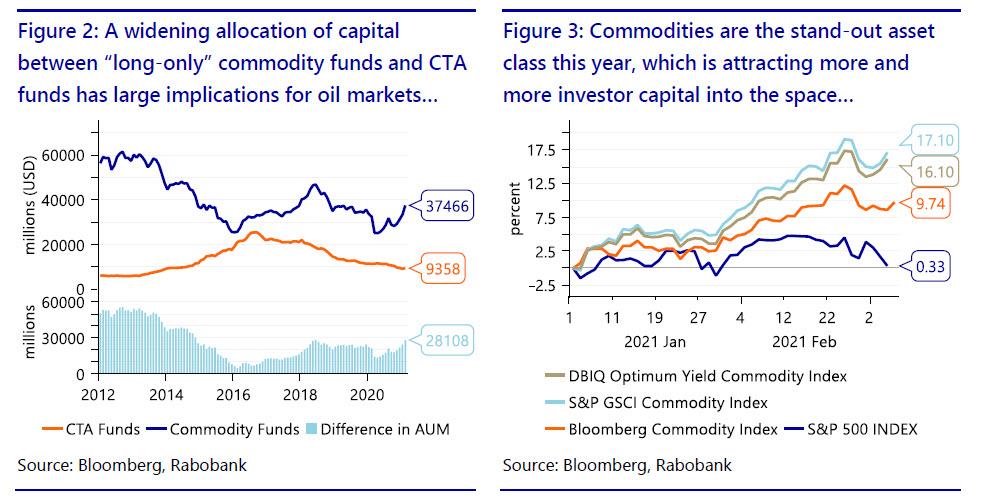
  • Assets under management (AUM) at “long-only”commodity funds are increasing quite rapidly while the assets held at CTA funds dwindle to multi-year lows
  • This widening allocation of capital between “long-only” commodity funds and CTA funds has large implications for oil futures prices and calendar spreads
Feeding the bull
The oil market received a nice nudge higher from the all-important OPEC+ supply meeting this week. To that end, the group of oil exporters sent oil prices surging to new multi-month highs following their decision to roll forward the current oil supply cuts into April, including the 1mb/d unilateral cut that the Saudis put in place for February and March. The group did, however, make small exemptions again for both Russia and Kazakhstan, allowing for modest increases in production of +130kb/d and 20kb/d, respectively. This follows on the last supply decision that also witnessed exemptions for Russia and Kazakhstan, the two members that make up the plus in OPEC+. The reluctance of both countries to join in on the cuts begs the question of whether this expanded alliance is shrinking back to just the traditional OPEC member nations. Nonetheless, the small increases from the non-core OPEC countries were hardly noticed by the oil market and prices surged on Thursday, the day of the event. In fact, oil prices rallied despite a strong move higher in the US dollar and sharply weaker global equity markets, which made the oil move all the more impressive, to our minds.
As we noted last week, CTAs and momentum traders recently went “all-in” on oil futures from a directional point of view and commodity index products have also been witnessing a surge in interest this year. As such, the Saudis shrewdly recognized that in order to maintain the recent positive oil price momentum and speculative buying interest, they needed to “feed the bull”, as the old trading adage goes. So in a way, the decision was simply a way to hand-feed the oil-bulls a tighter supply narrative to chew on until the next OPEC meeting.
Ever-changing cycles
As regular readers know, we spend a great deal of time and effort analyzing speculative money flows into and out of oil futures markets as these flows can have a tremendous impact on prices, even much more than fundamentals in the short-term. As such, we regularly flag CTA-style fund positioning and flows as this group of traders has held a dominant role in the oil price formation in past years. This once dominant role has been waning though in more recent times which speaks to the power of ever-changing cycles in financial markets. This dynamic is quite clear from the sharp drop in assets under management (AUM) at publicly traded CTA funds or Managed Futures programs as they are also known. This reduction in capital is only half of the story though and as we noted last week, a new and perhaps more important trend has emerged to replace the dominant role that was most recently played by CTAs. To that end, we have been highlighting the surge in AUM at “long-only” commodity funds this year on a regular basis. In fact, these commodity fund flows have been significant again this week with close to +1B USD of inflows just in the last five days, taking the year-to-date figure above the 5B USD mark.
This surge in assets under management at “long-only” commodity funds coupled with the huge drop off in assets under management at CTA-style funds has resulted in a widening allocation of capital and a shift in trading behavior in the managed money category of traders as a result. In our view, and as the title implies, one needs to follow the speculative money flows to stay on top of current investor trends and right now the money is increasingly coming from macro-inspired inflation bets on commodities from an asset class perspective more so than any one specific commodity’s fundamentals, as we see it.
This has large implications going forward and one of the biggest differences between the two style of funds is that CTAs are “long/short” while the commodity index flows are “long-only”. So on the margin, we would expect to see a reduction in speculative “shorts” going forward and an increase in speculative “longs” holding all else equal. In addition to the directional positioning bias implications, flows along the forward curve are likely to change as CTA funds generally trade the nearby contract for liquidity purposes while “long-only” commodity funds tend to trade up to twelve months out in an effort to optimize roll-yield. As such, this new market cycle is likely to have a material impact for both oil futures prices and calendar spreads.
Looking Forward
Looking forward, we continue to expect money flows into commodity funds to have a significant influence on oil prices this year and increasingly more so than CTA flows.
The sharp uptick in assets under management this year is notable, but total AUM at commodity funds is still just a fraction of what it was back in the early 2010s. Considering how much “new“ money is flushing through global financial markets, we see scope for this to change in a big way as asset allocators chase the strong year-to-date returns while also seeking out portfolio diversification benefits.

FT : Aston Martin promises to make electric models in UK

Aston Martin promises to make electric models in UK
Luxury brand will make a battery sports car and SUV in current plants from 2025

The billionaire boss of Aston Martin has promised it will build its electric models in the UK from 2025, at a time when the country is struggling to attract the investment required to secure the industry’s future.

Lawrence Stroll, who led a bailout of the business last year, told the Financial Times that a battery sports car and sport utility vehicle will be made at Aston plants in Gaydon in the Midlands and St Athan in Wales, rather than by its partner Mercedes-Benz, which owns 20 per cent of the company.

“The SUV will be built in Wales and the sports cars will be built here [in Gaydon],” he said in an interview at the company’s headquarters.

Aston’s pledge comes as Stellantis, the carmaker formed by the merger of PSA and Fiat Chrysler, is still weighing whether to invest in making electric cars at its Ellesmere Port plant in Cheshire, after weeks of talks with the UK government.

The UK is planning to phase out the sale of non-hybrid petrol and diesel cars by 2030 but Stroll said Aston will carry on making traditional engines for enthusiasts well into the next decade.

But it also plans to expand its range of hybrid and electric cars over the next four years.

A hybrid version of the DBX, Aston’s first sport utility vehicle, is due later this year, with more types of hybrids from 2023, and its first battery-only models from 2025.

“We are way ahead of our rivals, and all because of our partnership with Mercedes,” Stroll said.

Ferrari has committed to making battery models by 2030, while McLaren and VW-owned Lamborghini have not set timelines. Though Bentley, also owned by VW, is planning a battery car for the middle of the decade.

Aston has yet to decide whether to use the DB moniker on its electric models, Stroll added. “We will have a front engine version of a DB11/Vantage, and an SUV higher four wheel drive one, but we don’t know the names yet,” he said, adding the designs are not yet finalised.

Mercedes, which supplies some of Aston’s engines and technology, may provide batteries, he added. “We’re looking at all options”.

Stroll is hopeful that the 108-year-old brand will help the company remain relevant when it is unable to market cars on their purring engine tones.

Every carmaker will be able to produce electric vehicles he said, but Astons will have “our beautiful body, our suspension, our vehicle dynamics, our bespoke interiors”.

Stroll, who made his fortune moving brands such as Tommy Hilfiger, Michael Kors and Ralph Lauren upmarket, aims to restore the luxury credentials of the company that has struggled financially since an ill-fated IPO in 2018.

A policy of emptying dealerships of excess stock cost the company millions last year, pushing it to a loss even before the pandemic, but means that the business will in future only make cars that have a buyer lined up, he said.

“By showing a little bit the first signs of scarcity, we’re already seeing results,” he said. “We’re already sold out until September on the sports cars, and until July on the DBX.”

Last week, he unveiled the racing car to be used by the new Aston Martin F1 team, which he believes will further boost the brand.

“80 per cent of people who watch F1 buy a high performance car at various price points,” he said. “And of the 23 countries where there are races, we have dealers in 20.”

FT : Will the ECB intensify efforts to keep a lid on bond yields?

Will the ECB intensify efforts to keep a lid on bond yields?
Market Questions is the FT’s guide to the week ahead

Will the ECB intensify efforts to keep a lid on bond yields?
The European Central Bank’s monetary policy meeting on Thursday will give its president Christine Lagarde and other senior policymakers the opportunity to discuss the recent rise in government bond yields.

At the press conference following the meeting, Lagarde is likely to face questions about exactly how high the central bank’s pain threshold is on rising yields.

By then, the ECB will have already provided an indication of how worried it is about the bond market by publishing on Monday the weekly figures for its pandemic emergency purchase programme. 

Analysts expect the ECB to step up the pace of its emergency bond purchases in the first week of March after they fell to €12bn in the final week of February, down from more than €17bn a week earlier. 

“Market participants will be expecting the ECB to deliver on its promises,” said Frederik Ducrozet, strategist at Pictet Wealth Management, predicting its weekly bond buying was likely to rise above €20bn in the numbers released on Monday.

The sell-off in bond markets has spread from the US, where it is being fuelled by expectations that a sharp economic recovery will reignite inflation that eats into real bond returns. 

Inflation expectations are lower in Europe, leading Fabio Panetta, an ECB board member, to say that the recent steepening of the eurozone’s GDP-weighted yield curve was “unwelcome and must be resisted”. 

But other ECB governing council members are more sanguine. Bundesbank president Jens Weidmann said last week that “not each and every increase in financing costs will be a source of concern”, adding that financing conditions remained favourable. Martin Arnold

How fast will US inflation rebound?
Evidence is building that inflationary pressures will rise later this year, as the economic recovery gains traction and coronavirus restrictions decline. Investors will gain further insight on Wednesday, when February’s US consumer price index is released. 

While the Federal Reserve’s favourite inflation gauge, the personal consumption expenditures price index, still languishes around 1.5 per cent, market measures of future expectations have soared since the start of the year as investors eye higher growth after an imminent burst of stimulus from the Biden administration.

Last week, the so-called five-year break-even rate hit 2.5 per cent for the first time since 2008. Analysts surveyed by Bloomberg have raised their year-on-year expectations for February’s CPI to 1.7 per cent.

US yields have climbed, with the 10-year note now hovering around 1.56 per cent. Investors have raised their rate forecasts as a result, with Goldman Sachs predicting the benchmark yield will reach about 1.9 per cent by the end of the year against a previous forecast of 1.5 per cent.

“Inflation measures globally will rise significantly by early summer,” predicted James Sweeney, chief investment officer for the Americas at Credit Suisse, who pointed to goods sector supply issues, a jump in healthcare and financial services inflation, and the likelihood of services sector price rises as demand outpaces inventories.

Given this trajectory, Sweeney expects the Fed to hit its new average 2 per cent inflation target in 2022, with a slight “overshoot” the following year. That may mean the first rate rise could come as early as 2023. Colby Smith

Will China inflation remain in negative territory?
Data released in China on Wednesday are expected to show a key inflation marker remains lodged in negative territory even as scrutiny of the country’s interest rate environment intensifies.

Economists polled by Bloomberg forecast a 0.3 per cent year-on-year decline in the consumer price index in February, unchanged from a month earlier. CPI in China turned negative in November for the first time in more than a decade.

Inflation data in China, which comes a day before the country’s National People Congress concludes in Beijing, will be closely watched by traders and investors looking for signs of when the country will adjust its main interest rate policy following a rapid economic recovery from the coronavirus pandemic. 

Interbank rates in China have crept higher over recent weeks, while in late January an adviser to the central bank warned of an asset bubble if policy were not adjusted.

Stubbornly low inflation in China, driven in part by falling pork prices after sharp increases due to African swine fever, has resulted in a conundrum for policymakers eager to limit risks across a fast-growing economy.

The producer price index, which measures factory gate prices and in January returned to positive territory for the first time since the initial coronavirus outbreak, is expected to have risen 1.4 per cent in February.

The gain at the start of the year was driven by higher costs of raw materials such as cement, and further highlighted the pace of industrial activity across China. Thomas Hale

Barron’s Weekend Summary: Barron’s list of the 100 Most Influential Women in Fin

Barron’s Weekend Summary: Barron’s list of the 100 Most Influential Women in Finance; As the pandemic winds down, tech companies may no longer have a monopoly on growth

* Cover Story: The women on Barron’s annual list of the 100 Most Influential Women in Finance, all based in the US, were chosen based on their achievements, leadership, influence in their organizations, and capacity to shape their firms or the industry at large in the future; This year’s list has 28 new names, including Erika James, the first woman—and the first person of color—to head the Wharton School at the University of Pennsylvania, and Cathie Wood, founder of ARK Investment Management.

* Tech Trader: “The problem when it comes to technology shares is that good news is bad news,” says columnist Eric Savitz. As the pandemic eases amid greater accessibility to vaccines, the market is prepping for boom times, which means tech companies no longer have the exclusive on growth investing—and higher rates spell trouble for fast-growing, high-multiple stocks that led last year’s broad rally.

* Trader: Many investors find themselves on the wrong side of the so-called reflation trade as the US economy heats up, with Treasury yields climbing, something not every index is built for; If credit markets can remain calm, the pain may only be starting for the market’s most expensive, best-performing stocks, says Christopher Harvey of Wells Fargo Securities; “Markets are nervous about rising inflation and companies are already feeling the price pressure. If companies pass on rising costs to customers, that would make inflation more widespread and would have serous implications for stocks.”

* Profile: Dan Hammer, managers of the $3.2B Pimco High Yield Mutual Bond fund, sees value in high-yield munis, which had net outflows in 2020, relative to investment-grade munis and other debt, such as high-yield corporate bonds—but he says it’s important to be selective (top 10 state exposures: Illinois, New York, California, Ohio, Texas, Florida, New Jersey, Georgia, Wisconsin, Pennsylvania).

* Features: 1) Story profiles Cathie Wood, founder of ARK Investment Management, who joins Barron’s 100 Most Influential Women in Finance list this year; Wood embraced active management when investing seemed inexorably tied to indexing, implemented stock-picking in active ETFs when large asset managers said it couldn’t be done, and bought companies that others thought were overpriced, a joke, or both; 2) Positive on MYTE: The Munich-based company, which caters to wealthy shoppers looking for help in finding their next designer handbag, pair of shoes, clothing item, or accessory, should benefit from the growing luxury market, and get a boost from expansion in the US and China, as well as from new collections for men and kids; 3) Positive on VRTX: The high-flying pharma company’s shares plunged last year after it canceled development of a once-promising drug after disappointing trial results, but the pullback has been overdone, and its pipeline beyond cystic fibrosis is coming into focus, creating an opportunity for investors; 4) Positive on LOW: Despite gaining nearly 40 percent during the past year, the home improvement company’s shares are languishing, with the potential for rising yields to slow housing and more consumer dollars to go to dining out when the pandemic ends—but concerns are probably overblown, and don’t change the fact Lowe’s is a turnaround story and is set to become more profitable.

* Follow-Up: Positive on MIK, SBH, BLKB: Barron’s profiled the companies last July when it looked for cheap stocks with no Buy ratings from Wall Street analysts, a “hodgepodge of businesses linked only by Wall Street’s disdain”—and yet they have all done quite well since then.

* European Trader: Positive on Sandvik: The company has taken a hit from slumping industrial demand as the auto, aerospace, and mining sectors grapple with the pandemic, but chief Stefan Widing has been reorganizing the business to focus on growth areas such as rock crushing equipment and automation software, and the shares are set to bounce back when economic activity increases.

* Emerging Markets: Semiconductors, also called microchips, are the top supply-chain priority for the US, given the sudden shortage afflicting auto makers worldwide, but since the dominant companies are in Taiwan and South Korea, altering the supply chain poses a challenge for Washington—and is a possible opportunity for investors.

* Commodities: “It has been a decade since the Japan nuclear disaster caused the energy industry to rethink the safety of the power source, but the event hasn’t led to the destruction of the market or uranium demand—and may have highlighted the importance of nuclear-power generation in the world’s efforts to provide clean energy.”

* Streetwise: Columnist Steve Hough says Volkswagen and VIAC are reinventing themselves—the automaker with its push into electric vehicles, where its scale could help it compete with TSLA, and Viacom with a shift to unified advertising and distribution teams, and by getting studio heads on board with streaming.

CNBC : Jack Dorsey is offering to sell the first tweet as an NFT and the highest

Jack Dorsey is offering to sell the first tweet as an NFT and the highest bid is $2.5 million

  • Crypto collectibles have exploded in popularity lately, with anyone from artists to rock bands minting their content.
  • Now, Jack Dorsey appears to be offering to sell the very first tweet as a non-fungible token.
  • The Twitter CEO shared a link Friday afternoon to a platform called “Valuables,” where his March 21, 2006 tweet was up for bidding.

Jack Dorsey appears to be offering to sell the very first tweet as a non-fungible token, or NFT.

The Twitter CEO shared a link Friday afternoon to a platform called “Valuables,” where his March 21, 2006 tweet “just setting up my twttr” was up for bidding. The highest offer is from Sina Estavi, CEO of Bridge Oracle, for $2.5 million as of Saturday afternoon, according to the website.


Ownership of these assets is recorded on a blockchain — a digital ledger similar to the networks that underpin bitcoin and other cryptocurrencies. However, unlike most currencies, a person can’t exchange one NFT for another as they would with dollars or other assets. Each NFT is unique and acts as a collector’s item that can’t be duplicated, making them rare by design.

Crypto collectibles have exploded in popularity lately, with anyone from artists to rock bands minting their content. A digital rendition of the Nyan Cat meme from 2011, for example, sold for nearly $600,000 in an online auction last month.

Some people who are buying NFTs believe it can help them prove ownership of a virtual item thanks to blockchain.

Dorsey has also been an advocate of digital currencies, displaying ”#bitcoin” in his Twitter bio, so jumping into NFTs seems to be a natural extension. His digital payments company Square also purchased approximately 3,318 bitcoins in late February, expanding on its October 2020 buy of 4,709.

WSJ : Electric Vehicles Are the U.S. Auto Industry’s Future—If Dealers Can Figur

Electric Vehicles Are the U.S. Auto Industry’s Future—If Dealers Can Figure Out How to Sell Them
Car dealers say they are struggling to square the industry’s enthusiasm with shoppers’ reality

Car dealer Brad Sowers is spending money to prepare for the coming wave of new electric models from General Motors Co. He is installing charging stations, upgrading service bays and retraining staff at his St. Louis-area dealership to handle the technology-packed vehicles.

But when he considers how many plug-in Chevy Bolts he sold last year—nine, out of the nearly 4,000 Chevrolets sold at his Missouri dealerships—it gives him pause.

“The consumer in the middle of America just isn’t there yet,” when it comes to switching to electric vehicles, he said, citing the long distances many of his customers drive daily and a lack of charging infrastructure outside major cities.


As auto executives and investors buzz about the coming age of the electric car, many dealers say they are struggling to square that enthusiasm with the reality today on new-car sales lots, where last year battery-powered vehicles made up fewer than 2% of U.S. auto sales.

Most consumers who come to showrooms aren’t shopping for electric cars, and with gasoline prices relatively low, even hybrid models can be a tough sell, dealers and industry analysts say.

Auto makers are moving aggressively to expand their electric-vehicle offerings with dozens of new models set to arrive in coming years. Some like GM are setting firm targets for when they plan to phase out gas-powered cars entirely.

Many dealers say that puts them in a delicate spot: They are trying to adjust, but unsure whether and how fast customers will actually make the switch. About 180 GM dealers, or roughly 20%, have decided to give up their Cadillac franchises rather than invest in costly upgrades that GM has required to sell electric cars.

A GM spokesman said the company expected some Cadillac dealers to opt out and is pleased that the roughly 700 remaining share its all-electric goals.

Past attempts by car companies to expand electric-car sales have largely flopped, saddling retailers with unsold inventory. Even now, some dealers say they are reluctant to stock electric models en masse.


“The biggest challenge is that dealers have a bit of ‘boy who cried wolf’ syndrome,” said Massachusetts dealer Chris Lemley.

Car companies have promised for years to make electric cars mainstream, but produced only low-volume, niche models, he said. He recalls Ford Motor Co. rolling out an all-electric Focus that sold poorly and stacked up on his lot. It was discontinued in 2018.

“So when we are told, ‘This time, we really mean it,’ it’s easy to be skeptical,” Mr. Lemley added.

Some shoppers also are unsure. Joe Daniel, an energy analyst at the Union of Concerned Scientists, said he was determined to buy an electric car, but eventually abandoned his effort after realizing there weren’t enough public charging stations near his apartment in Washington, D.C. Without a place to plug in, the purchase made little sense, he added.

“For EVs to take off, they need to be as convenient as gas-powered cars—that’s the whole point of this big purchase,” Mr. Daniel said.

To solve problems like this, President Biden has said he wants to spend billions of dollars to upgrade the country’s charging infrastructure as part of a push to incentivize battery-powered cars.

Ford, GM and other major car companies say they are confident in their new electric-vehicle offerings and are training dealers to sell and service them.

Still, some auto retailers say they worry about the long-term implications for their business.


Tesla Inc.’s influence on the electric-car market has created a new standard for car shoppers, offering an online transaction and a simplified lineup with no price negotiation. Other electric-vehicle startups, like Rivian Automotive and Lucid Motors, say they’ll likewise sell directly to consumers and bypass traditional dealerships.

Some car companies are now following their lead, initially stocking dealership lots with few if any electric models and allowing customers to order more directly from the manufacturer.

Volvo Cars CEO Håkan Samuelsson recently said that all future battery-electric vehicles would be sold exclusively online and the price would be set centrally, eliminating the ability to haggle. Dealerships will help deliver vehicles to customers and perform other services, like maintenance, he said.

“The marketplace is moving from the physical dealership to online. That’s what will happen in the next 10 years,” Mr. Samuelsson said.

Howard Drake, a GM dealer in Los Angeles, said he is considering converting two of his showrooms. Rather than separate models by brand, he is considering two stores—one for electrics, the other for gas-powered vehicles.

“These are really different customers,” Mr. Drake said. “A Hummer EV buyer probably doesn’t want to be sitting next to some guy buying a gas-guzzling pickup truck.”

Mr. Sowers said he sees encouraging signs. GM recently dropped the sticker price of the all-electric Bolt and helped boost sales for the model in February. But he said his electric-vehicle inventory will remain light because he is uncertain about longer-term demand.

“It’s still very early days,” Mr. Sowers said.

As soon as dealers figure out how to sell EVs, another business problem awaits in the service bay.

Electric vehicles typically have fewer mechanical parts and don’t require the same type of service that gas engine cars need, such as oil changes. That work right now is a big profit center for dealerships.

“There’s going to be an impact, but it might take three or four years to see the full effect,” Mr. Lemley said. “That’s really my biggest question mark heading into all of this.”