Reuters : Too early for Britons to book summer holidays abroad, minister says

Too early for Britons to book summer holidays abroad, minister says

LONDON (Reuters) - It would be premature for Britons to book summer holidays overseas as Britain must avoid a situation where holidaymakers return with vaccine-resistant variants of COVID-19, Defence Secretary Ben Wallace said on Sunday.

Half of all adults in Britain have received at least one dose of a COVID-19 vaccine, placing it well ahead of all other major economies, and of neighbouring European countries where the vaccine rollout is slow and chaotic.

Wallace said Britain should avoid throwing away the gains of its vaccination campaign by allowing dangerous variants into the country via returning tourists.

“If we were to be reckless in any way, and import new variants that put out risks, what would people say about that? We’ve got good direction of travel, we’re getting there, and I think we need to make sure we preserve that at all costs,” he said on Sky News.

Foreign holidays are currently banned. Under the government’s four-stage roadmap, they could be allowed to resume from May 17 at the earliest, although it could be later than that.

“I haven’t booked my holiday,” Wallace said in a separate interview on BBC television. “It would be premature to do that.”

Under the four-stage plan, a taskforce is due to report to the government in April on the issue of foreign travel. Wallace said people should at least wait to hear that the advice from that taskforce will be.

His comments were the latest in a series of similar warnings from scientists, public health experts and politicians, raising fears of a second consecutive lost summer season for British holidaymakers as well as for airlines and travel companies.

“We can’t be deaf and blind to what’s going on outside the United Kingdom. If you look in Europe, increases in infections,” Wallace told Sky News.

WWD : Euromonitor International’s 2021 GDP Predictions

Euromonitor International’s 2021 GDP Predictions
Data from Euromonitor indicates growth — and decline — for the next several years in key global markets.

Although the global recession in 2020 was more minor than expected, data from Euromonitor anticipates key global markets to still rebound. According to its latest Global Economic Forecasts report for the first quarter of 2021, real gross domestic product only shrunk 3.6 percent. By contrast, 2021 is expected to see global real GDP grow 5.6 percent, with growth in 2022 anticipated to be around 4 percent.

As evidenced, the coronavirus is the largest component in determining an economy’s recovery. In the U.K., for example, public restrictions knocked a percentage point off of the country’s forecast. Conversely, in the U.S., the recently passed stimulus package was the biggest factor in determining the country’s growth. Here, see the world’s advanced economies, ranked by percent projected growth in 2021.

Fastest-Growing Advanced Economies, By Projected Growth in 2021:

Spain: 5.5 percent
France: 5 percent
U.S.: 4.7 percent
Italy: 4.2 percent
Eurozone: 4.1 percent
United Kingdom: 4 percent
Canada: 4 percent
Germany: 3.3 percent
South Korea: 3 percent
Japan: 2.3 percent

Source: Euromonitor
Time period: First Quarter, 2021

(ZH) Top NATO Scientist With High-Level Security Clearance Spied For Chinese Int

Top NATO Scientist With High-Level Security Clearance Spied For Chinese Intelligence

Intelligence services for the country of Estonia have reportedly uncovered that one of its top scientists had been recruited by Chinese military intelligence and was working at a sensitive NATO research institution specializing in maritime and submarine research, according to a bombshell Daily Beast report.
It's been revealed that the spy, identified as 57-year old Tarmo Kõuts, was recently arrested and stood trial last week. The man "renowned in the Estonian scientific community for his research" was convicted of espionage and handed a three year prison sentence (reportedly the "lighter" sentence was due to his case not being deemed "treason").
While Baltic countries' intelligence services have been heavily focused on exposing Russian plots and operatives, it's believed that Chinese operatives have recently made deep inroads into Eastern Europe, despite this latest case being the first conviction of its kind.
The spy for the Chinese was a leading expert in oceanography at Tallinn Technical University, via Facebook/SCMP
The case had until just days ago remained under a strict gag order, only coming to light upon the conviction. He was alleged to have had access to sensitive NATO technology and research while at the same time maintaining contact with his Chinese handlers for up to three years. Some of the details are as follows:
According to Aleksander Toots, the deputy director of KAPO and Tallinn’s top counterintelligence official, Kõuts was recruited in 2018 by China’s Intelligence Bureau of the Joint Staff Department of the Central Military Commission—as Beijing’s military intelligence agency is known—along with an alleged accomplice who is yet to be tried in court. Both were arrested on September 9, 2020, with no publicity or discussion of the case in the Estonian media.
The top Estonian intelligence official further said that Kõuts was recruited on Chinese territory during a trip: "He was motivated by traditional human weaknesses, such as money and need of recognition," Toots said.
Akin to recent cases in the US involving similar accusations of Chinese influence ops and research theft and gaining access to trade secrets, the spy's handlers had used a think tank as cover. He had earned over $20,000 from Chinese intelligence, but what's more is he had enjoyed multiple paid trips across southeast Asia which was said to include high-end luxury hotels and Michelin star restaurants.
"From 2006, Kõuts became directly involved in the national defense sector," the report details of his background. "He was named a member of the Estonian Ministry of Defense’s Scientific Committee, which oversees the country’s military research and development initiatives." He'd long been on the scientific committee of NATO's Undersea Research Center in Italy. There he helped advise the military alliance on its maritime capabilities and strategy.
He'd had a NATO security clearance for fourteen years as well as a 'state secret permit' in Estonia. However authorities don't actually believe he had yet passed any specific confidential military information to his Chinese handlers, which likely would have resulted in a much longer prison sentence.
The Estonian intelligence official Toots had said further as part of his statement that Kõuts's possessing security clearances :"was one of the reasons we decided to put a stop to his collaboration [with the Chinese] so early."

FT : Law firms prepare claims for Credit Suisse’s Greensill investors

Law firms prepare claims for Credit Suisse’s Greensill investors
Holders of supply chain finance funds face potential losses after group’s collapse

Investors in Credit Suisse’s Greensill-backed supply-chain funds have enlisted law firms in Zurich and London to initiate claims against the Swiss lender to recover potential losses.

More than 1,000 professional investors across Europe and Asia have money trapped in the $10bn supply-chain finance funds, which Credit Suisse suspended on March 1 following a lapsed insurance policy.

The funds were promoted as low-risk products that offered a higher return than cash deposits. But the implosion this month of Greensill Capital, the SoftBank-funded specialist finance firm that provided securities for the funds, has raised questions about how much money will be returned to investors.

Credit Suisse conceded last week that some of its funds’ investors had threatened litigation, adding that the fallout from the crisis could lead to “material” financial losses, client desertions and tumbling assets under management.

Just over $3bn has already been returned to investors, but Credit Suisse has said there is “considerable uncertainty” over much of the remaining assets in the funds.

“Given the amounts at stake, claims from investors could be significant,” said Matthias Gstoehl, a banking litigation partner at Zurich firm Lalive. He added that investors had already instructed his firm to “assess their options and work on recovery strategies”.

Class action lawsuits are rare in Switzerland, but Gstoehl said there were mechanisms to allow investors to consolidate their claims. “In a dispute of this magnitude it is key to scope out every possible remedy,” he added.

The funds were sold mainly to institutional investors such as pension funds, insurers and corporate treasuries, many of which were Credit Suisse clients. Ultra-wealthy individuals were also invested in the funds, with many from Asia and the Middle East, areas where Credit Suisse had been trying to grow its private banking business.

Natasha Harrison, managing partner of Boies Schiller Flexner, said the US law firm with a London office had seen “significant interest” from its clients in pursuing claims against Greensill Capital, its management and directors, and Credit Suisse.

“Litigation against some or all of these parties seems inevitable, given the fact pattern that is emerging,” she said.

It is unclear whether that would include David Cameron, the former UK prime minister who acted as an adviser to Greensill. The Financial Times reported last week that Cameron had lobbied on behalf of the firm.

One person with knowledge of the potential litigation against Credit Suisse and Greensill said several hedge funds had already expressed interest in “claims trading”, where they would buy ownership of any bankruptcy claim from creditors and seek to profit from any payout.

Lawsuits will probably centre around potential misrepresentation and non-disclosure to investors, as well as the relationship between Greensill, Credit Suisse and the insurers that underwrote some of the securities in the funds.

Credit Suisse and Greensill, through the finance firm’s administrators Grant Thornton, declined to comment.

Last week, Credit Suisse said in a statement to the FT: “Wherever there is evidence of fraud or malpractice that impacts investors in the supply chain finance funds, CSAM [Credit Suisse Asset Management] will consider appropriate legal action.”

Greensill has already been the subject of litigation in the US. Last week, the governor of West Virginia filed a lawsuit against Greensill Capital and its founder Lex Greensill, alleging that the now collapsed financing firm “perpetrated a continuous and profitable fraud” against his mining company.

Jim Justice launched legal action against Greensill in Manhattan federal court, alleging his coal mining empire is under threat due to its “sudden and unjustified abandonment” by the financing firm.

Justice’s Bluestone Resources and its related companies have been one of Greensill’s biggest clients in recent years.

Boies Schiller Flexner is acting on behalf of investors in an English High Court case against Credit Suisse in relation to the so-called tuna bond scandal in Mozambique.

Business Of Fashion : Gucci Is Selling $12 (Virtual) Sneakers

Gucci Is Selling $12 (Virtual) Sneakers
As talk around NFTs heats up, the luxury house is teaming up with AR fashion platform Wanna to expand further in the digital product space.


In collaboration with fashion-tech company Wanna, the Italian house is debuting a digital sneaker, available to purchase for $11.99 on its app or $8.99 on Wanna’s app.

Designed by creative director Alessandro Michele, the sneaker is also the first original digital product from Belarus-based Wanna, which specialises in using augmented reality (AR) to create 3D models for digital fittings of sneakers and watches. So far, the app’s technology has been used by Reebok, Farfetch, Puma and Snapchat to test out how consumers engage with virtual try-ons, and perhaps more importantly, taking photos of themselves with new products using augmented reality.

The brand previously worked with Wanna to digitalise its sneaker catalogue for AR try-ons as well as integrating the capabilities within the brand’s own Gucci app.

The frenzy around digital-only products has grown in recent weeks, in part due to the large sales of digital assets in the form of non-fungible tokens (NFTs), the rise in online gaming and the continued pandemic e-commerce boom.

Wanna co-founder and CEO Sergey Arkhangelskiy is confident in the digital fashion market and the company is looking to expand beyond shoes and watches to clothing. He also predicts AR technology like Wanna’s will be further integrated into brands and retailers’ online shops.

“In five or maybe 10 years a relatively big chunk of fashion brands revenue will come from digital products,” he said. “Our goal as a company is to actually supersede the product photos ... and substitute it for something which is way more engaging and closer to offline shopping.”

Gucci has rapidly expanded its presence in the world of virtual clothing, collaborating with gaming platform Roblox, fashion styling game Drest, 3D social media app Zepeto, Sims 4 and Pokemon to create products and branded avatar items. Though purchased through the Gucci app, the sneakers can be “worn” in other virtual worlds on Roblox and virtual reality chat.

The virtual sneakers are largely targeted towards a digitally-native Gen Z audience, consumers that hold interest in the sneaker market but may not be able to afford physical Gucci products. Instead, they can spend $9 or $11 on the shoes for gaming and social media posts. And while NFT products rely on a one-of-one, minted asset, the virtual Gucci sneakers are unlimited and interchangeable for consumers.

Unlike the physical sneaker market, however, the secondary market for digital products is still nascent: resale or gifted products aren’t currently possible through Apple, meaning those that buy Gucci’s digital shoes won’t be able to flip them later on StockX. Resale in particular is an important area; the market for sneakers is a key part of the industry and an opportunity for further revenue and engagement among consumers. Arkhangelskiy said Wanna is working to develop trading capabilities, as well as limited-edition digital products that are in some ways similar to the NFT approach.

However, he acknowledges that the digital product space still has much room to grow. He’s cautious of the NFT market, citing the hurdles in setting up bitcoin wallets and purchasing on blockchain for consumers.

“It’s not very user friendly,” he said. As for the development of digital products, “we’re on the very early stages of this.”

Business Of Fashion : NFTs for Fashion: Fad or Opportunity?

NFTs for Fashion: Fad or Opportunity?
A fast-moving market for digital collectibles offers people a new way to communicate status in their increasingly digital lives. How should fashion brands respond?

Last week, NFT mania hit new highs when 255-year-old auction house Christie’s sold a JPEG file by the digital artist known as Beeple for a record-breaking $69.3 million.

Some saw a speculative bubble, others a historical inflection point. But there’s no disputing the explosion of interest in “non-fungible tokens,” unique digital assets, whose authenticity and ownership is verified by a digital ledger known as a blockchain. Proponents of NFTs say they remove a key barrier to virtual goods, which are otherwise easily copied, being valued and collected like physical objects.

A unique version of Nyan Cat, a flying cartoon cat with a Pop-Tart body and rainbow trail that became a viral sensation and has been seen and shared hundreds of millions of times since it was first uploaded to YouTube almost ten years ago, sold for $580,000 last month.

And it’s not just the art world that’s taking the plunge. In music, Grimes sold 10 digital works on NFT marketplace Nifty Gateway for nearly $6 million earlier this month. Some of the pieces were offered in large editions and sold for $7,500 each, while others were auctioned as one-offs. A music video called “Death of the Old” commanded almost $389,000.

Meanwhile, in sport, NBA Top Shot, a partnership between the NBA and blockchain company Dapper Labs, has sold virtual basketball cards featuring short video clips for thousands of dollars each. An NFT depicting a LeBron James dunk recently sold for $208,000.

The NFT craze has come to fashion, too. Two weeks ago, a collaboration between 18-year-old crypto artist Fewocious and virtual sneaker brand RTFKT Studios sold out in seven minutes, generating $3.1 million. Though each virtual edition of the drop came with a physical pair of shoes, the digital product with associated bragging rights was the primary source of value.

According to market sources, leading fashion brands are examining the NFT space. But are NFTs a real opportunity for the fashion industry or just a passing fad?

There’s no denying that the space is heavily hyped, not least by speculators. During the pandemic, housebound day traders looking for new and entertaining asset classes have poured money into the market. What’s more, NFTs are typically purchased with cryptocurrency and many see a bubble within a bubble as crypto investors, who have seen the value of their holdings skyrocket, pile into the space.

“I feel like I got a steal,” the mystery buyer of the record-breaking Beeple work, a Singapore-based crypto entrepreneur who goes by the pseudonym MetaKovan, told The New York Times this week. As it turns out, MetaKovan, who had bought other works by Beeple and sold fractional ownership of them to the public as NFTs, may have also profited from pushing the price he paid Christie’s to astonishing heights in a calculated cash grab.

But beneath the hype there are signs that NFTs could have staying power.

From paintings to baseball cards, people have long assigned emotional and social value to physical objects that far outweigh their material worth. After all, canvas and paint is worth nothing compared to a Picasso. The same is true for fashion goods like handbags and sneakers.

Collecting these objects, over which we enjoy a kind of sovereignty, turning them into extensions of ourselves, is a fundamentally human activity deeply linked to how we craft and communicate our identities. And as we lead more and more of our lives online, everywhere from social media to video games, the concept of collecting and displaying digital objects seems likely to grow.

How should fashion brands respond?

Many are taking a wait and see approach, not the worst idea given how fast the space is shifting. For those eager to experiment, NFTs can be minted with a range of creative assets — a designer’s sketch or a memorable runway moment — and used to drive a variety of marketing outcomes, from being seen as “innovative” to deepening fan loyalty. It doesn’t hurt that NFTs are hot with precisely the young, affluent, tech-savvy audience many fashion brands are after.

But issuing NFTs that are linked to physical products and extend their value is perhaps the most strategic way to engage with the space. These could be arty digital certificates that prove ownership of physical products, earning consumers clout when they display them online (unlike an Instagram pic or unboxing video, NFTs prove the goods haven’t been returned or resold) or “digital twins” for people to wear online, when they play video games, for example.

“Luxury customers have digital lives now, and it’s natural for them to want to take products into these lives,” said Ian Rogers, chief experience officer at French crypto start-up Ledger and an advisor to LVMH. “The idea of buying a luxury handbag and taking a digital representation of this into a video game or another digital environment is not too far away.”

NFTs linked to physical goods can also help combat counterfeiting, serving as proof of authenticity. They could also have a transformative effect on the resale market. That’s because with NFTs, the blockchain that authenticates them can also create a contract that governs their future use. In the case of Beeple, the artist is set to make 10 percent in royalties every time one of his NFTs is sold on the secondary market. What if handbags and sneakers came with NFTs that guaranteed the brand got a royalty each time the product changed hands?

While diving headfirst into the digital art gold rush may be tempting for fashion brands eager to test the waters and generate marketing buzz, NFT strategies anchored in physical goods could unlock far greater value for the sector.

NYP : SpaceX engineer ‘MillionaireMike’ pleads guilty to insider trading

SpaceX engineer ‘MillionaireMike’ pleads guilty to insider trading

A SpaceX engineer who called himself “MillionaireMike” has pleaded guilty to insider trading using information he bought on the dark web, the feds said.

James Roland Jones faces up to five years in prison for the trading schemes he committed roughly four years ago, according to Florida federal prosecutors who brought the case.

The Securities and Exchange Commission filed a separate complaint accusing Jones of selling bogus “insider tips” in what the agency called its first enforcement action against alleged securities crimes on the dark web.

The Tampa US Attorney’s Office on Thursday identified Jones as a SpaceX engineer from Hermosa Beach, California, but did not say when he worked at the rocket-builder or how long he was there.

A link to Jones’ LinkedIn profile describes him as a “Level II Manufacturing Engineer” at the Elon Musk-led company, but the rest of the profile has apparently been deleted.

His alleged crimes don’t appear to involve SpaceX given that it’s a privately held company. SpaceX did not immediately respond to a request for comment Friday.

Jones used his “MillionaireMike” moniker on the dark web to buy names, addresses, Social Security numbers and other personal information, the feds said. He allegedly used those details to set up bogus investment accounts for the purpose of trading securities based on non-public information.

Jones made several such trades after an undercover FBI worker gave him a purported tip about a publicly traded company in April 2017, according to prosecutors.

About three months later, Jones told the FBI worker that he’d gotten inside info about a different company that he used to make more trades over a roughly two-week period, the feds alleged.

Jones also signed on to a dark web marketplace where he sold info he “falsely described as material, nonpublic information” in exchange for bitcoin, according to the SEC, which said it reached a settlement with Jones.

“This case shows that the SEC can and will pursue securities law violators wherever they operate, even on the dark web,” David L. Peavler, director of the regulator’s Fort Worth regional office, said in a statement.

A lawyer for Jones did not immediately respond to a request for comment.

(ZH) If Bitcoin Didn't Exist, We'd Have To Invent It Right Now

If Bitcoin Didn't Exist, We'd Have To Invent It Right Now

The conventional take on Bitcoin and crypto-currencies in general from the mainstream skeptics is that it’s some sort of speculative bubble. The recent mania in NFTs seemingly adds credence to this argument. However, the NFT craze, as unfathomable as it is, even to somebody like myself, has precedents that show it doesn’t invalidate the crypto thesis.
Coming up in the domain and DNS business, I’ve seen this movie before. I’ve also made the point back in the 2017 crypto cycle that the Tulipmania analogy for Bitcoin was a bad one for many reasons, and that it was a more accurate comparison to the domain name aftermarket of the 2000’s era. When companies and speculators were paying millions of dollars for strings of words from the dictionary with “.com” appended to them, that was a speculative mania and it was akin to Tulipmania. And from our vantage point in the present we can draw the comparison to NFTs.
But when the .com aftermarket fizzled, the entire internet kept right on plugging along using DNS as the carrier tone, and domain names for endpoints. That didn’t change and to this day, without DNS you’ve basically got nothing. It’s part of the internet plumbing (yes, there are multiple projects seeking to supplant DNS via blockchain, separate convo for another day).
The overall point is, a seemingly speculative mania can erupt out of a relatively new protocol, be it the long defunct hedge fund that rang the bell at the top by purchasing “fund.com” for $10M USD, or an NFT selling today for $69M USD, and that doesn’t make the underlying protocol from which it sprang forth a speculative bubble (we discussed this along with attention markets and BAT on the latest AxisOfEasy Salon #40).
But if everything from NFTs to stonks to real estate and gold and cryptos are all hitting fresh all-time-highs, it seems to be that the obvious pattern here isn’t necessarily that “Everything is in a Bubble” as much as that the numéraire is collapsing.
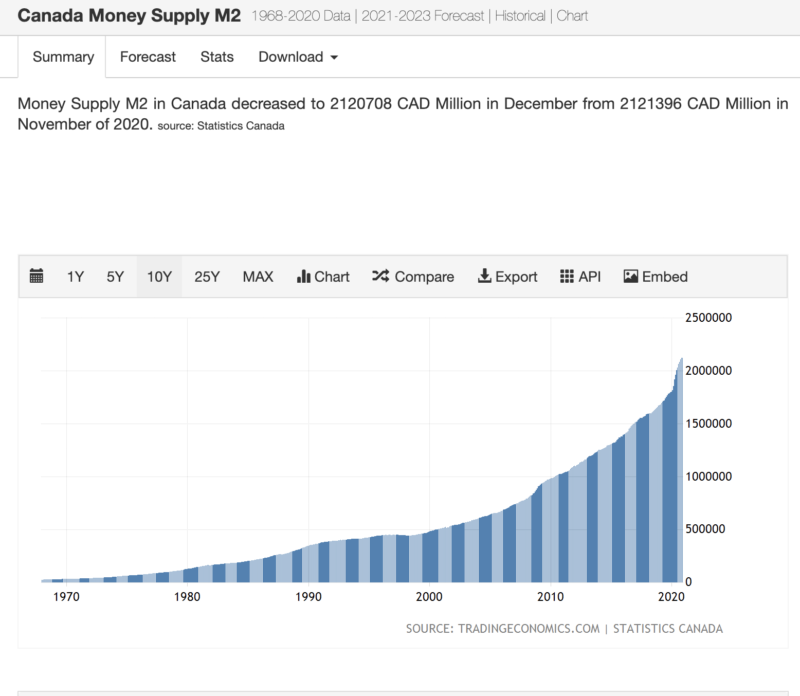
Most people reading these kinds of articles know that bonds are a dead man walking and M2 money supply is going up everywhere. I was going to pull in charts from multiple places (my home country of Canada’s is below). Japan, Eurozone, China, there’s no point, they all look the same, everything looks like this:
And if you zoom in on the last year, the Pandemic Year that will bisect modern history into The Beforetimes and The New Normal, they all look like this:
The Pandemic panic and the monetary response to it pulled forward what I’ve been calling The Great Bifurcation by decades.
That acceleration and its intensity is a big reason why everything that can be construed as an asset in the world is going like this:
We aren’t in a hyperinflation yet. Policy makers are still trying to pretend inflation is undershooting and they’re still trying like hell to ignite it. As Charles Hugh Smith noted recently, money velocity is plummeting, even as M2 is blasting off (hold that thought).
When you read about historical hyperinflationary episodes, you will find that what invariably happens is that capital flight occurs in all directions and people end up using some sort of “notgelt”. From Jens O. Parsson’s “Dying of Money”
“The seas of marks which had been stored up… flooded forth and fought to buy into other investments, foreign currencies, tangible goods, almost anything but marks
Germany’s money printing industry could not turn out enough trillions to keep up. States, towns, and companies got into the act by issuing their own “emergency money” (Notgeld). Barter became prevalent. Still money grew scarcer while prices continued to soar.”
“Notgeld” could be a peculiar word. It might connote “not money”, “geld” or “gelt” being the German for money. If the money is worthless, people would want what isn’t that. However that’s because we’re thinking in English. “Not money” in German would probably be nichtgeld. Notgeld actually does mean “emergency money”.
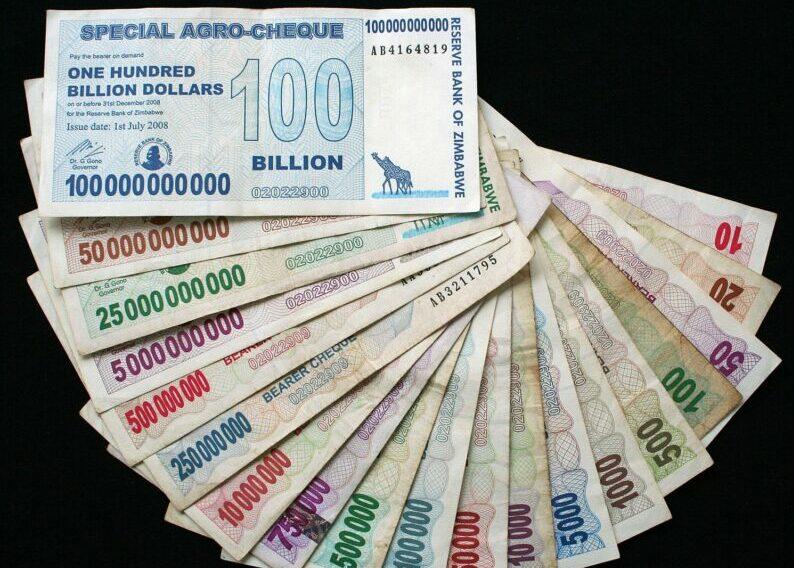
In Zimbabwe it was prepaid cellphone cards. In 90’s Yugoslavia things came somewhat full circle and everybody flocked to Deutsche Marks.
One time at easyDNS (in 2019), we found a customer who kept pre-funding his account with us and had enough of a balance in there to prepay his single website out to 2085. When I asked him what the hell he was doing, it turned out he was an Argentine trying to protect his savings through one of their incessant currency collapses. He was using us as a bank.
In all previous hyperinflations people just needed to get out of their local currencies and they’d come up with all manner of ways to do it. But when hyperinflation goes global, across all currencies in all nations, then what do you go into?
Bitcoin in particular and crypto currencies in general are this coming hyper-inflationary event’s “Notgeld”.
The recent institutional move into Bitcoin and cryptocurrencies is a reaction against systemic, global financial repression. What the naysayers like Peter Schiff and Nouriel Roubani don’t get about where we are in history is this:
If Bitcoin didn’t exist, we would have to invent it, right now.
Fortunately Bitcoin and the other crypto-currencies do exist, and they’ve enjoyed a spectacular debut onto the world stage and into monetary history.
Fortunately proof-of-concept has already occurred and countless FUD cycles surmounted.
Fortunately the decentralized crypto ecosystems are ready for prime time, exactly when humanity needs it the most. Necessity really was the mother of invention.
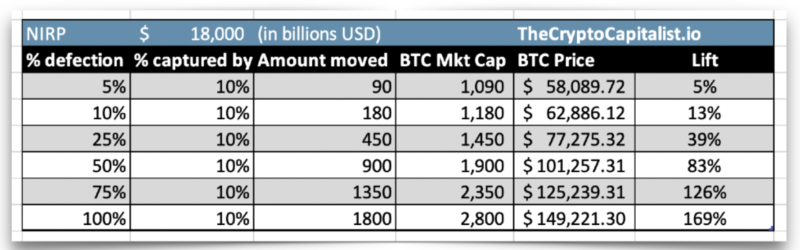
In my Crypto Capitalist Manifesto (30 pages), which is one of the documents subscribers receive after they sign up to my new Crypto Capitalist Letter, I lay out some scenarios which show the theoretical effect of an exodus from bonds and cash on the price of bitcoin, I’ll extract a couple below:
This one estimates the lift to the Bitcoin price in nominal terms based on capturing a fraction of a fraction of a secular exodus from the nearly $20 Trillion USD in negative yield bonds. If half of the capital fled negative yielding debt and of that, 10% moved into Bitcoin, it would push it up over $100K (extrapolating in linear terms of the price is where it is today when this happens).
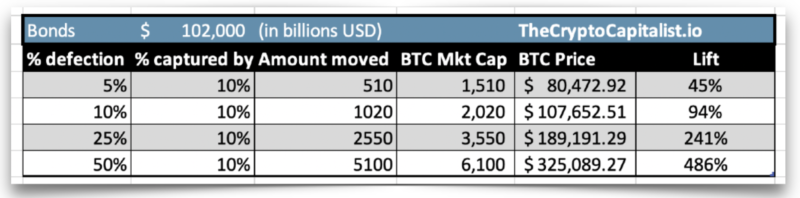
There’s at least another $100 Trillion USD in nominally positive yield bonds, but mostly negative real returns that would also be good candidates for re-allocation. The second table tries to model Bitcoin capturing a fraction of a fraction of that as well. If there was a 25% exodus out of bonds and Bitcoin caught 10% of that, that alone would put Bitcoin up over $6 Trillion. Other alternative assets like other cryptos, and gold and silver and real estate would all experience similar lifts.
Of course those are all linear extrapolations based on the current price. In the manifesto I model out a bit more, such as Bitcoin capturing more of the exodus out of bonds as it accelerates. There would also be a generalized acceleration of the Bitcoin price once the market participants became increasingly aware of this dynamic.
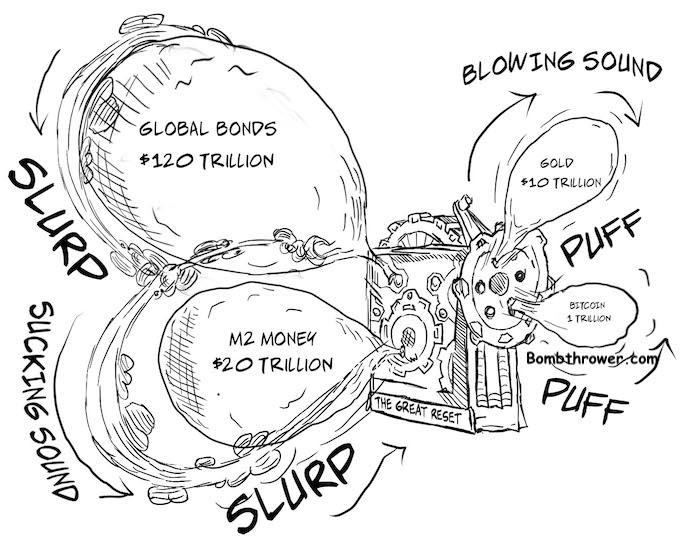
In other words, this is what I think is happening, metaphorically….
The Crypto Capitalist Letter will (hopefully) be in the tradition of The Privateer, but with a tactical focus on investing in crypto stocks.
Given what has happened to asset prices and crypto in response to just an inkling of inflation, imagine if Charles Hugh Smith is right, looking at the collapse in money velocity occurring now, that this is one final deflationary “tide receding” before the inflationary tsunami hits. Then what happens to the price of Bitcoin, cryptos and gold?

WSJ : The Places You Can’t Fly to Anymore

The Places You Can’t Fly to Anymore
The pandemic has created a less-connected world. Here’s a snapshot of two days, a year apart.

The pandemic has changed how we fly, dramatically reducing the number of flights around the world. To show how Covid-19 has altered the skies, The Wall Street Journal analyzed flight data from aviation data provider Cirium Core for a 24-hour period—Friday, Feb. 28, 2020. That was a month after the new coronavirus forced Wuhan, China, into lockdown and a week after Italy ordered Europe’s first lockdowns. It was still before other big countries initiated lockdowns and travel bans to slow the spread.

Full pdf attached