>>> Europe : Brokers Upgrades & Downgrades - 22nd of April 2021

>>> Up
* Alstom Raised to Buy at Deutsche Bank; PT 52 euros
* Deutsche Telekom PT Raised to 25 euros at Deutsche Bank
* Entain PLC PT Raised to 2,090 pence at Deutsche Bank
* Faurecia SE Raised to Buy at HSBC; PT 57 euros
* Kering PT Raised to 761 euros from 635 euros at Citi
* Melrose Industries PT Raised to 300 pence at Peel Hunt
* SAP ADRs Raised to Outperform at Exane; PT $160
* Workday Raised to Neutral at Exane; PT $250

>>> Down
* Arjo Cut to Hold at SEB Equities; PT 72 kronor
* Mercialys Cut to Neutral at Goldman; PT 10.90 euros
* Nordex Cut to Hold at SocGen; PT 27 euros
* Nyfosa Cut to Sell at SEB Equities; PT 90 kronor
* Platzer Cut to Hold at Pareto Securities; PT 114 kronor
* Sartorius Stedim Biotech Cut to Hold at SocGen; PT 429 euros
* Synthomer Cut to Neutral at JPMorgan; PT 540 pence
* VW Cut to Hold at HSBC; PT 285 euros

>>> Initiation
* Aroundtown Rated New Hold at SocGen; PT 6.60 euros
* Vantage Towers Rated New Neutral at JPMorgan; PT 29 euros

>>> Call
* Accor 1Q Revenues Weak, But Management Upbeat on Recovery: Citi
* Brunello Cucinelli 1Q ‘Solid,’ Guidance Reiterated: Jefferies
* Electrolux May See Whirlpool Readacross on Price Hike, Citi Says
* Handelsbanken Terminates Research Coverage on Norwegian Insurers
* Jefferies Hikes Oil Explorer PTs, Prefers Lundin and Harbour
* Melrose is a ‘Must-Own’ Stock, Peel Hunt Sets Street-High PT

>>> US After Hours Summary: WHR +2.1% and CMG +0.3% headline earnings, but not b

After Hours Summary: WHR +2.1% and CMG +0.3% headline earnings, but not big movers; TDC +37.4% jumps on bullish guidance; SNBR -6.1%, NTGR -2.2%, LVS -1.7% fall on earnings

After Hours Gainers:

Companies trading higher in after hours in reaction to earnings/guidance: TDC +37.4% (raises Q1 EPS guidance above consensus), EFX +8.5%, XM +6.2%, CHDN +6%, UFPI +6%, RHI +3.8%, CLB +3.5%, KMI +3% (also increases dividend by 3%), DFS +2.9%, SLM +2.5%, CP +2.4%, WHR +2.1%, LSTR +1.7%, SAVE +1.6%, CVBF +0.8%, CMG +0.3%

Companies trading higher in after hours in reaction to news: KMPH +4.8% (confirms receipt of $10 mln milestone payment for FDA approval of AZSTARYS), LDI +3.6% (announces $200 mln special dividend and early lock-up release), CF +2.9% (signs engineering and procurement contract with thyssenkrupp), GBX +2.4% (CEO purchased 50K shares worth ~$2.2 mln), SONY +1.2% (DIS and Sony Pictures sign deal to bring SONY's titles to Disney+ after NFLX run), DHI +1% (announces new $1 bln stock repurchase authorization), BALY +0.9% (issues response to City of Richmond's decision to remove BALY casino from selection process), RF +0.5% (authorizes repurchase of up to $2.5 bln in shares), TEN +0.4% (Carl Icahn affirms lowered active stake following recent sale of ~133K shares), INTC +0.3% (INTC cleared of patent infrigement claims for patents formerly owned by NXPI in Texas trial, according to Bloomberg), SRG +0.2% (announces operational reorganization; names new COO), GIX +0.1% (discloses non-reliance on previously issued financial statements), ARGO +0.1% (says Q1 results will be hurt by catastrophes losses of $47 mln), KAMN +0.1% (Air Vehicles division announces the first flight of its new unmanned helicopter, the K-MAX TITAN), DIS +0.1% (DIS and Sony Pictures sign deal to bring SONY's titles to Disney+ after NFLX run), NTNX +0.1% (reduces size of the Board from nine to eight members)

After Hours Losers:

Companies trading lower in after hours in reaction to earnings/guidance: SNBR -6.1%, NTGR -2.2%, LVS -1.7%, SEIC -1.6%, NWE -0.7%, TCBI -0.5% (also to sell mortgage servicing rights asset to PHH Mortgage), BDN -0.4%, BXS -0.4%, CACI -0.1%, CCI -0.1%, GL -0.1%, REXR -0.1%, RLI -0.1%, SLG -0.1%

Companies trading lower in after hours in reaction to news: EOLS -12.7% (stock offering), NBSE -9.5% (stock offering), ATOS -1.2% (stock offering), SMTS -0.9% (to invest $28 mln for construction of magnetite processing plant), DVAX -0.4% (announces Valneva's initiation of Phase 3 trial for inactivated, COVID-19 vaccine candidate using Dynavax's CpG 1018 adjuvant), F -0.2% (planning for more production downtime at several factories in North America due to chip shortages, according to WSJ), NFLX -0.1% (DIS and Sony Pictures sign deal to bring SONY's titles to Disney+ after NFLX run)

>>> US Close Dow +0.93% S&P +0.93% Nasdaq +1.19% Russell +2.35%

Closing Stock Market Summary

The S&P 500 increased 0.9% on Wednesday, bouncing back from back-to-back declines amid renewed buying interest. The Nasdaq Composite (+1.2%) and Dow Jones Industrial Average (+0.9%) posted similar gains. The small-cap Russell 2000 outperformed the large-cap indices with a 2.4% gain. 

The advance was relatively broad-based with nine of the 11 S&P 500 sectors closing higher and advancing issues outpacing declining issues by more than a 3:1 margin at the NYSE and Nasdaq. Seven sectors rose more than 1.0%, including materials (+1.9%) and energy (+1.5%) atop the standings. 

The communication services (-0.3%) and utilities (-0.9%) sectors were the only sectors that closed lower, largely due to losses in Netflix (NFLX 508.90, -40.67, -7.4%), Verizon (VZ 58.14, -0.24, -0.4%), and NextEra (NEE 77.97, -2.56, -3.2%) following their earnings reports. NFLX fell 7.4% after missing subscriber estimates and issuing disappointing Q2 guidance. 

CSX (CSX 102.69, +4.24, +4.3%) was the earnings standout, driving the advance in the Dow Jones Transportation Average (+1.0%). 

Earnings news was a big talking point today given the lack of new macro developments, but it'd be self-serving to attribute the generally positive reports to the broader advance. That's based off an observation that the market declined for two straight days this week when most reports exceeded expectations. 

Instead, the price action in the market was consistent with consolidation activity: two down days followed by an up day. In other words, no progress. Granted, there was a noticeable uptick in the market within the last hour of the session, possibly due to investors not wanting to get left behind if the consolidation phase is over. 

U.S. Treasuries finished little changed in a tight-ranged session that included a decent $24 billion 20-yr bond auction. The 2-yr yield decreased one basis point to 0.14%, and the 10-yr yield was unchanged at 1.56%. The U.S. Dollar Index decreased 0.1% to 91.13. WTI crude futures declined 2.0%, or $1.26, to $61.35/bbl.

Wednesday's economic data was sparse. The weekly MBA Mortgage Applications Index increased 8.6% following a 3.7% decline in the prior week. Looking ahead, investors will receive the weekly Initial and Continuing Claims report, Existing Home Sales for March, and the Conference Board's Leading Economic Index for March on Thursday. 

  • Russell 2000 +13.4% YTD
  • Dow Jones Industrial Average +11.5% YTD
  • S&P 500 +11.1% YTD
  • Nasdaq Composite +8.2% YTD

FT : Scientists warn of challenges to find antiviral pill to treat Covid

Scientists warn of challenges to find antiviral pill to treat Covid
Creation of task force by UK government welcomed but no trials have delivered a solution so far

The search for a pill to protect people from the effects of Covid-19 is confounding scientists, suggesting the UK government’s decision to set an autumn target for finding two effective antiviral drugs will be difficult to meet.

Experts have welcomed the government’s new task force to speed up the search with investment in a neglected but vital area of pharmaceuticals. But many are not yet convinced that the drugs in development could be used to treat patients within a few months. 

Steve Bates, chief executive of the BioIndustry Association, who was closely involved with creating the vaccines task force, on which the new drive to find antivirals has been modelled, suggested the ventures were different but carried similarly high levels of risk.

“It's like comparing reaching the North Pole to climbing Everest,” he said. However, the clear objective “to have at least two effective treatments this year, either in tablet or capsule form . . . is really good because it's really clear,” he added.

One difference between the two task forces is the decision to run a competition to recruit a chair for the antivirals effort, on a salary of £63,000 a year and working for a minimum of three days a week.

The chair’s task will not be limited to the goal of producing “two effective antiviral treatments which are deployable by autumn/winter 2021”. The appointee will “also be required to create a pipeline of additional promising novel antivirals for potential deployment in 2022 and beyond, ensuring that there are strong manufacturing and supply chains in place,” the job advertisement said.

While the Oxford university-based Recovery trial is admired around the world for identifying drugs that treat the inflammatory symptoms in late stage Covid-19, such as dexamethasone, neither it, nor other trials, have found a drug that is very effective at tackling the virus directly.

The frustratingly slow pace stands in stark contrast to the rapid development of a number of highly effective vaccines. 

“I think we should try to develop such a drug that can benefit mankind, but we cannot overestimate the challenges of such an aspiration,” said Kin-Chow Chang, a professor at Nottingham university, who has tested drugs in animals to discover an antiviral for Covid-19.

Doctors have used Gilead’s remdesivir, an infusion originally designed for Ebola but now approved for Covid-19 in the UK and the US, where it is commonly deployed. But a World Health Organization study found it had no substantial impact on a patient’s chances of survival.

Other attempts have flopped, including one to investigate using HIV drugs, and an oral antiviral developed by Merck, which decided last week to abandon it, saying that the extra data requested by the US regulator would mean it would take too long to come to market. 

Antivirals are challenging to create: scientists must peer into the virus’s mechanisms to identify how to stop it from replicating, rather than focusing on the surface, as the vaccine makers did with the spike protein. The drugs must be able to keep up with the evolving virus and are often taken in combination so the virus finds them harder to evade.

There are already promising drugs in human trials, including a repurposed treatment for flu, and new drugs. Professor Peter Horby, who helps lead the Recovery trial, said the new task force was necessary as it would be able to pick up early-stage products and accelerate them. 

“It's a challenging market, so that the economics of developing these kinds of drugs are not great, which is why it needs public investment,” he said. 

Favipiravir is being tested in the Glasgow Getafix trial and University College London’s Flare study. The Japanese drug for flu, owned by Fujifilm, was studied in Japan last year but the health ministry in Tokyo said the efficacy data were inconclusive. It also cannot be taken by pregnant women because of a risk of birth defects. Fujifilm started a new study this week.

Dr Janet Scott, clinical lecturer in infectious diseases at Glasgow university, who is leading the Getafix trial, said it was currently looking to recruit some 300 people and hoped the treatment might even prevent Long Covid.

Asked about the feasibility of the end-of-year target, she said: “Even if we fail we'll have failed well because we'll have moved things forward in terms of what doesn't work. ”

Merck’s molnupiravir, developed with Ridgeback Therapeutics, is heading into a phase 3 trial after positive data among outpatients. Roche’s AT-527, part of a collaboration with Atea Pharmaceuticals, was previously shown to be safe and to show antiviral activity in Hepatitis C patients. It is also due to enter phase 3 within weeks. Pfizer started a phase 1 study last month for PF-07321332, saying lab studies concluded the oral drug was “potent”. 

How fast these trials can go depends largely on how quickly they can recruit patients with Covid-19. Theoretically, they could be faster than vaccine trials because researchers are not waiting to see who catches the disease, but how quickly a patient recovers.

However, as rates of Covid-19 decline in the UK, Bill Anderson, chief executive of Roche Pharmaceuticals, said its trial had to expand to countries where Covid-19 was more prevalent. 

“They did an excellent job rolling out Covid vaccines in the UK . . . and so there's just simply not enough patients to enrol in that study with the speed that we were hoping to,” he said. 

Stephen Griffin, who leads the antiviral group at the Leeds School of Medicine, said it had been “frustrating” to see how little investment there had been in this area. 

“I think that investment in fundamental research and translational research to develop new antivirals would be a fantastic thing,” he said, adding that he hoped it would help for this pandemic — and could certainly be good preparation for the next one. 

>>> US Gapping down

Gapping down
In reaction to earnings/guidance
:

  • NOTV -15.6% (also announces stock offering), NFLX -8.4% (also announces $5 bln share buyback authorization), NEE -2.1%, MRO -0.8%

M&A news:

  • MIDD -6.5% (Welbilt (WBT) to be acquired by The Middleby Corp (MIDD) in an all-stock transaction)

Other news:

  • ROKU -3.4% (in sympathy with NFLX earnings, weak sub adds)
  • FUBO -2.9% (in sympathy with NFLX earnings, weak sub adds)
  • CPSH -2.5% (files for $75 mln mixed securities shelf offering)
  • CMCO -2% (files for $150 mln common stock offering)
  • FUTU -1.7% (offering of 9,500,000 American depositary shares, each representing eight Class A ordinary shares of the Company, at a price of $130/ADS)
  • WRAP -1.5% (police-related stocks react to Chauvin verdict)
  • CNI -0.9% (CP comments on CNI unsolicited offer to acquire KSU)

Analyst comments:

  • ZBRA -2.3% (downgraded to Underweight from Equal-Weight at Morgan Stanley)
  • AZO -1.6% (downgraded to Underperform from Neutral at BofA Securities)
  • JACK -1.5% (downgraded to Hold from Buy at Deutsche Bank)
  • COOP -1.5% (downgraded to Equal Weight from Overweight at Barclays)
  • SCCO -1.3% (downgraded to Sell from Neutral at UBS)
  • JCOM -1.1% (downgraded to Neutral from Overweight at Piper Sandler)

>>> US Gapping up

Gapping up
In reaction to earnings/guidance
:

  • LRN +4.9%, EW +4.5%, ERIC +4.4%, ISRG +3.9%, ASML +3.8%, HWC +3.6%, THC +3%, IBKR +2.4%, TEL +2.1%, RCI +2%, LAD +1.9%, FHN +1.8%, SBNY +1.6%, NEP +1.1%, HAL +1%, NDAQ +1%

M&A news:

  • WBT +17.1% (to be acquired by The Middleby Corp (MIDD) in an all-stock transaction)
  • FTFT +1.2% (signed a preliminary term sheet to acquire 100% of the equity of Khyber Money Exchange from its shareholder for ~$820k)

Other news:

  • ZLAB +4.1% (prices offering of ADS and ordinary shares for gross proceeds of $750 mln)
  • TRVN +2.9% (selected for inclusion in an international, multi-site, adaptive, Phase 2-Phase 3 trial in COVID-19 patients)
  • KIN +2.8% (unveils "positive" results in an interleukin IL-31 antibody program)
  • CP +1.6% (CP comments on CNI unsolicited offer to acquire KSU)
  • WES +0.8% (slightly increases quarterly cash distribution)

Analyst comments:

  • NCLH +1.9% (upgraded to Buy from Neutral at Goldman)
  • CTXS +1.8% (upgraded to Buy from Hold at Jefferies)
  • FSS +1.1% (upgraded to Strong Buy from Mkt Perform at Raymond James)
  • MS +0.7% (upgraded to Buy from Hold at Berenberg)

(ZH) Market 'Tsunami' Warning (John Mauldin)

Market 'Tsunami' Warning
A tsunami is a wall of water that wipes out everything in its path, typically caused by earthquakes. But first, the water actually disappears from the usual shoreline, leaving land where there should be sea.
If you are on the shore and see that happen, the correct response is to run for high ground. Tragically, though, people often rush toward this new and unusual sight. It’s hard to blame them; we humans are drawn to the unknown. This impulse explains much of our progress, but it has costs, too.
Right now, the stock market is in the land-where-there-should-be-sea phase. What we don’t know is when the wave is coming. Maybe there’s time to venture out and see what treasure was hidden beneath the waves... or maybe not. Prudence would suggest that we go searching for treasure on higher ground.
This is an age-old investor conundrum. How do you balance risk and reward? You have clues, but you can’t be certain of what is coming, or when it will arrive, or what it will look like. You know you need positive returns, but you also need to avoid major losses. The answers are never easy. You take your chances, no matter what you do. Today we’ll see what some of my favorite market wizards see on the horizon.
When Every Lot Is Odd
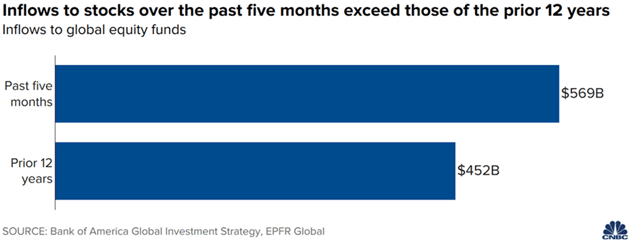
One sign the water may soon rush out of stocks, indicating tsunami, is the amount of money rushing in. My friend Doug Kass recently shared this staggering chart. It shows the inflows to stock funds since November exceed the total inflows of the last 12 years. Doug helpfully pointed out that one of the legendary Bob Farrell’s rules is that “individuals buy most of the top and buy the least at the bottom.”
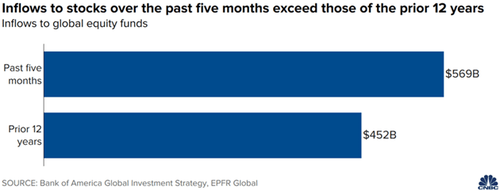
Source: CNBC
Note also, this is just stock funds. It doesn’t include individual trading accounts, and I suspect the amount entering the market via those is equally staggering.
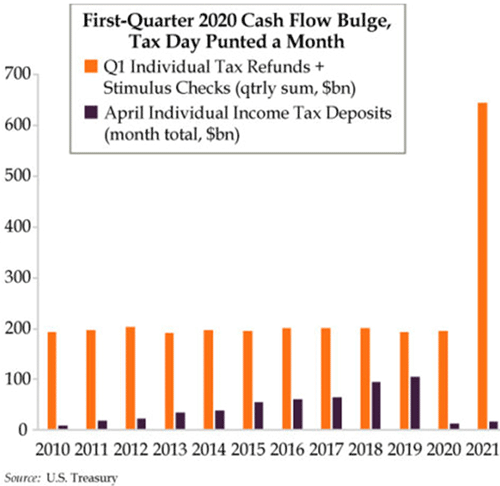
Where is the money coming from? The obvious answer is from the Federal Reserve and government stimulus. But Danielle DiMartino Booth gives us a visual chart to understand just how completely out of historical context the current levels are (from Quill Intelligence):
Yes, some of this is showing up in retail sales (which were gonzo last week), but clearly some of it is showing up in stock purchases (see some reasons why below). We see well over three times the normal tax refund and stimulus number (pushing $700 billion), and I assume this doesn’t even include state unemployment and other indirect stimulus. Also, notice the tiny blip on income tax deposits. The differential is even more stark.
When markets change, as they clearly have in the last two years, you want to ask if something else changed that might explain it. Federal Reserve activity and COVID stimulus payments are obvious factors, but I think something else is contributing. Some history may clarify it.
Way back in ancient times, which some of us can remember, stocks traded in 100-share “round lots.” If the share price was $30, you had to invest $3,000, or $6,000, or some other multiple. You could trade in smaller increments but brokers frowned on it and some charged higher commissions, which back then were already extremely high compared to today. And odd lot orders often got executed at inferior prices, too.
(I have a friend who once ran serious money for a family office, focused entirely on buying bonds in odd lots. He didn’t need to find odd lots, as they had plenty of money. He could simply get 1 to 2% more yield for the little bit of extra work.)
Over time, “odd lot” trading became a sign of amateur activity, to the point some used it as a contrary indicator. More odd lot activity meant uninformed people were entering the market and a top was approaching.
By the 1990s, back office technology had made the whole round lot preference obsolete. Brokers stopped caring how many shares you traded. In effect, a “round lot” became one share. But now it is even less. Robinhood and many other trading platforms let users trade fractional shares, as little as 1/1,000,000 of a share. I believe this may be more consequential than is generally recognized.
Look at the share prices for of some of today’s top companies: Apple (AAPL) is around $130. In the old round-lot world, you would have needed $13,000 to trade it efficiently. Now you need less than a penny. This vastly expands the universe of people who can trade Apple shares. And Apple is low-priced compared to some other popular names like Tesla (TSLA) around $750, or Amazon (AMZN), which is over $3,000 per share.
We have, without really noticing, severed the connection between share price and liquidity. This matters in ways I think we may not fully understand. Combine it with game-like mobile apps that let people buy and sell in individually tiny amounts that add up to the big numbers once reserved for giant institutions. And without any kind of institutional decision-making process to constrain rash moves.
Further add trillions in government cash payments, often to people with time on their hands because they are unemployed, and who need ways to generate income. Of course, some turn to stock trading. It’s an attractive “side hustle” for a time when Uber driving is less attractive. If all you have is $100, that’s okay.
We have raised a generation playing adrenaline-charged video games. For a relatively small stimulus check, they get to play in a game where Dave Portnoy assures them that stocks only go up, or they can “stick it to the man” in GameStop. Sigh….
In the bigger picture, all those small accounts add up to enormous sums of hair-trigger money. Some of it has much higher risk tolerance. The app users don’t see it as a nest egg to preserve. In their minds, it’s more like buying gas to get to work—something you have to burn. The whole concept of a stock being overvalued or undervalued doesn’t apply. They just want it to move.
Where all this leads is uncertain but I suspect it won’t be good.
A Key Difference
One of the first rules my mentors taught me: All it takes to create a bull market is for buyers to show up. All it takes to create a bear market is for the buyers to disappear. Just reading the zeitgeist, I don’t think they’re going to disappear for a while.
Dave Rosenberg at Rosenberg Research has also been following these inflows, and finds them problematic. He added another perspective in his latest monthly chartbook. The line in this chart shows current equity exposure in the AAII Asset Allocation Survey going back to 2002.
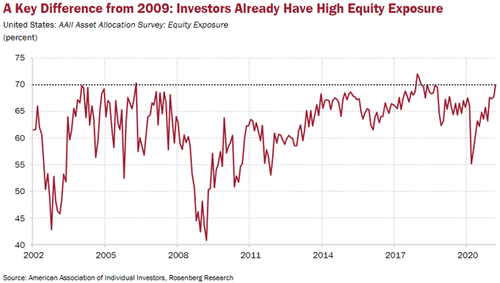
Source: Rosenberg Research
As you can see, equity exposure dropped in early 2020 as the coronavirus struck, climbed sharply and is now far stronger than it was when the last bull market began in 2009. I’m not sure the AAII survey captures the individuals (it’s hard to call them “investors”) trading small amounts on Robinhood and other apps. But their inclusion would only make the point stronger. A bull market needs fuel and this one has already burned a lot of it.
This is important also because we are talking about percentages, which include whatever money people may have received from the various stimulus programs. That money is already in the woodpile and being burned along with preexisting cash.
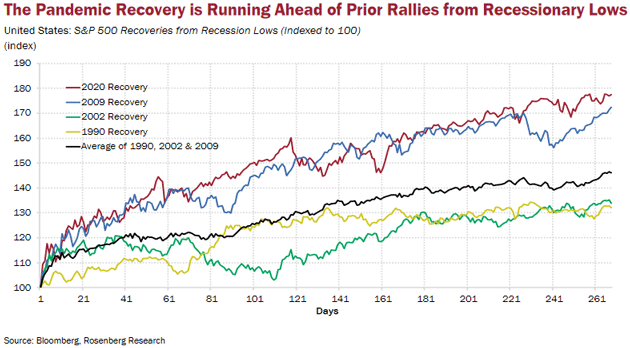
Dave has another chart showing the result. Comparing S&P 500 gains in the last four recessions, this one is stronger than the others were.
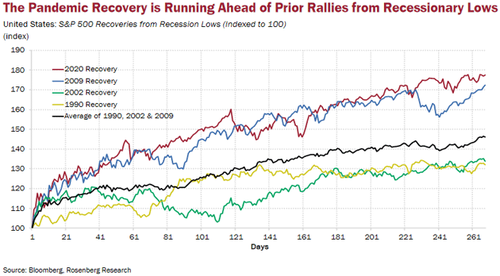
Source: Rosenberg Research
This market recovery has actually tracked the 2009 one pretty closely. But remember the previous chart: In 2009, investors had pulled out and then spent months furiously reinvesting. The current recovery happened with people closer to fully invested. That means it is even stronger than the price action shows.
None of this means the bull will tire in the near future. Major market trends often persist far longer than we think possible. Precedent is reliable until something unprecedented happens. It is certainly plausible to think the economy will bounce once the pandemic is out of the way, which we all hope will be soon. I’ve noted how crises often generate growth-sparking innovations. Good things may be coming. The question is whether they will both justify today’s valuations and even higher future valuations that justify further price gains.
Let’s think about this. The Fed is adding QE at an ~$1.5 trillion annual pace. They say interest rates won’t rise until 2023 at the earliest. The US government (by my latest count) has thrown, or soon will, $5 trillion of stimulus money, almost 25% of annual GDP, into the economy. Yes, not all of it goes directly to individuals, but it will eventually find a home, creating new jobs or programs.
At some point the government stimulus simply has to stop. Job openings are plentiful and the economy is opening up. Employers are having to pay much higher wages to get someone to come to work. When you can make $20-$30,000 a year staying at home, $10-$12 an hour just isn’t appealing. Ironically, the unemployment checks are actually creating wage inflation.
While we may get a massive infrastructure bill later this year, it will be spread out over a decade. I don’t think we are going to see anything like the current free-for-all, multi-trillion-dollar injections like the last 12 months.
The Contest of Supply Versus Value
Central banks and governments worldwide are supplying massive amounts of rocket fuel for supercharged markets. The yields on high-yield bonds (junk bonds) are close to the recent all-time lows. Investors are desperate for yield and the only place that seems to offer return, if you’re only paying attention to price momentum, is the stock market. So Baby Boomers and retirees, along with their Millennial children, are taking more risk than they can possibly imagine.
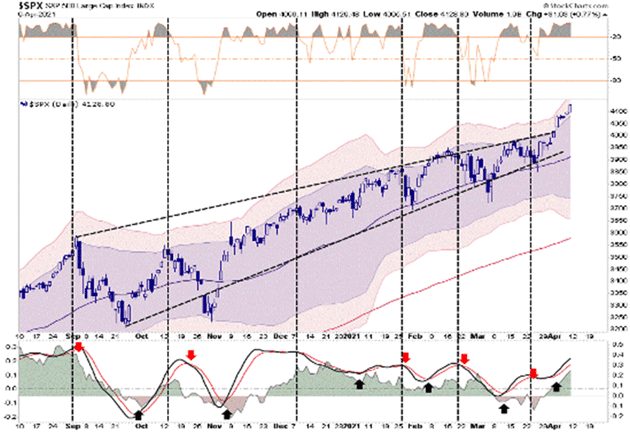
The stock market is trading at more than three standard deviations above its 50-day moving average (courtesy Doug Kass).
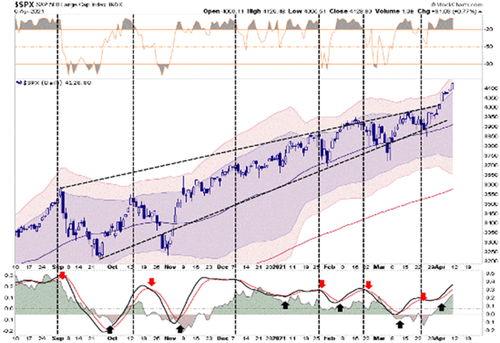
Source: Doug Kass
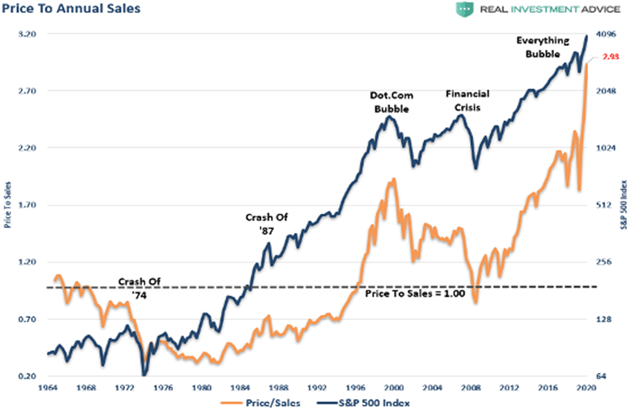
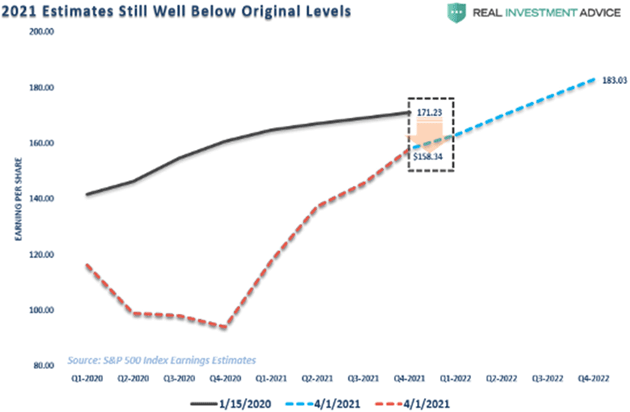
Our friend Lance Roberts at Real Investment Advice offered these two charts
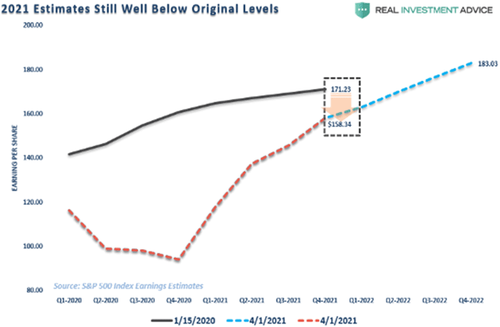
Source: Real Investment Advice
I don’t know of a time when valuations and markets were more stretched than they are right now. I also don’t remember a time when monetary and fiscal stimulus was more than it is right now. I would not be surprised to see the market rise considerably more from here. That being said, let me repeat what I said last week. I do not want to play the stock market or bond market game. There are other, more profitable games with much less risk. I am not bearish. I am 100% invested and as aggressive as I have ever been in my life. Just not in index funds.
CPI inflation has a real chance of approaching 3% and maybe 4% this year. Something could easily become the tipping point (it literally doesn’t matter what it is) that makes the market roll over 20% or more.
In that scenario, I will bet you a dollar to 47 doughnuts the Federal Reserve steps in, and in giant size. QE increases another $50 billion per month? Or Whatever It Takes! If that’s not enough, then some clever lawyer will find a loophole to allow the Federal Reserve to enter the stock market through the back door. Or Janet Yellen walks over to her friend Nancy Pelosi and says we need a bill letting the Fed be more aggressive. It won’t be Hank Paulson on his knees to Pelosi this next time. Literally nothing—I truly mean nothing—will be off the table. When you are in the middle of a crisis, you channel your inner Mario Draghi and do whatever it takes.
Will it work? Who knows? I truly don’t know what will happen. We are exploring brand-new territory this decade. The new era we are entering can bring challenges as well as opportunities. Time to think about changing your game if you are still playing the old one.

>>> US Early premarket gappers

Early premarket gappers

  • Gapping up:
    • KIN +5.1%, ISRG +5%, LAD +4.1%, EW +3.8%, ASML +3.7%, HWC +3.6%, ZLAB +2.8%, ERIC +2.4%, IBKR +2.2%, ANTM +2%, LRN +1.9%, THC +1.7%, GVA +1%, WES +0.8%, MRNA +0.7%, WRB +0.6%, CNI +0.5%
  • Gapping down:
    • NOTV -16.1%, NFLX -8.1%, ROKU -3.2%, FUBO -2.6%, CPSH -2.5%, CMCO -2%, WRAP -1.3%, FTI -1.2%, QGEN -1%, CSX -1%, AXON -0.9%, ALKS -0.8%, NOVA -0.8%, CP -0.7%, TEL -0.6%, WHR -0.5%, MRO -0.5%

Challenges : Sandro, Maje, Jules... Le dossier ouïghour froisse la mode français

Sandro, Maje, Jules... Le dossier ouïghour froisse la mode française

Un collectif d'ONG dénonce l'usage du travail forcé en Chine par des grandes marques, dont Sandro et Maje. De son côté, la chaîne Jules relocalise sa production de jeans.

C’est l’un des piliers du business plan de SMCP, géant de la mode connu pour ses marques Sandro et Maje. "La responsabilité sociale de l’entreprise est au cœur de nos préoccupations et de celles de nos clients", déclarait l’an dernier au journal Investir son PDG, Daniel Lalonde. Pourtant, le 8 avril, un collectif d’ONG a porté plainte en France contre ce groupe et d’autres multinationales comme Zara et Uniqlo. Il dénonce "l’existence d’un travail forcé systématisé dans la région ouïghoure du Xinjiang par le gouvernement chinois". C’est désormais au tribunal judiciaire de Paris de dire si les robes et pantalons vendus par Maje et Sandro sont fabriqués dans des camps fermés. Le sujet est explosif pour ces marques qui produisent essentiellement en Chine. Récemment, le géant H&M a été victime d'un boycott dans ce pays après avoir annoncé qu'il cessait de s’approvisionner dans le Xinjiang.

La difficile traçabilité de la production textile
Dans ce contexte très politique, mieux vaut s’engager pour la planète que sur les droits de l’homme. Plus encore pour SMCP dont le principal actionnaire, Shandong Ruyi, est un groupe chinois proche du pouvoir. "Sandro veille à s’approvisionner de manière responsable et éthique, conformément aux plus hautes normes internationales du travail en vigueur", affirme cependant l’entreprise. "La Chine n’est pas signataire des principales conventions de l’Organisation internationale du travail", rétorque Nayla Ajaltouni, de l’ONG Ethique sur l’étiquette, à la pointe du combat contre les multinationales qui "diluent les responsabilités".

La mode durable doit être aussi éthique
Comment, en effet, garantir la traçabilité d’un vêtement, depuis le champ de coton jusqu’aux usines de confection en passant par les filatures? Surtout quand des centaines de fournisseurs interviennent dans la chaîne de fabrication. D’où l’idée de FashionCube, qui regroupe sept enseignes d’habillement de la famille Mulliez, de réduire massivement ses sous-traitants pour mieux les contrôler. "Nous vivons un tsunami avec une montée de l’hostilité des pouvoirs publics et des consommateurs qui considèrent notre industrie comme trop polluante", expliquait son PDG, Jean-Christophe Garbino, lors de la présentation en 2019 du nouveau modèle économique de la chaîne textile Jules, baptisé "Men in progress".

Une usine de jeans dans le Nord de la France
Un stratégie responsable réaffirmée par la marque le 12 avril, jour de la saint Jules, lors d'une campagne publicitaire: "Jules s’engage pour une mode qui fait sens, qui dit stop à la surproduction, qui privilégie la qualité, qui utilise des matières recyclées", listait l'enseigne. Pas un mot, en revanche, sur les sites de production qui fabriquent ses tee-shirts vendus pour quelques euros. Dans quelques jours, cependant, Jean-Christophe Garbino doit annoncer l’ouverture d’une usine de 80 salariés près de Lille, qui fournira des jeans made in France aux chaînes de vêtement Jules, Pimkie ou Grain de Malice. Une relocalisation hautement symbolique dans une région où l'industrie textile employait 170.000 personnes il y a un demi-siècle.