- Carnival Plc (POH1 TH) +3%
-
Nokia (NOA3 TH) +2.5%
- Nokia 1Q Net Sales Beat Estimates
- Glaxo (GS7 TH) +1.8%
-
BAT (BMT TH) +1.8%
- Kenneth Dart Builds GBP5B Stakes in Bat, Imperial Brands: FT
-
Airbus (AIR TH) +1.5%
- Airbus 1Q Adjusted Ebit Beats Estimates
-
STMicroelectronics (SGM TH) +1.4%
- STMicro Continues Strong Sales After Auto, Power Demand (1)
-
Nemetschek (NEM TH) +1.4%
- Nemetschek 1Q a Beat, Margins the Main Highlight, Baader Says
-
Total (TOTB TH) +1.1%
- Total 1Q Adjusted Net Beats Estimates
- Smurfit Kappa (SK3 TH) +1.1%
- Infineon (IFX TH) +0.9%
- Lufthansa (LHA TH) -0.7%
- Lufthansa Rebound Delayed as Virus Continues to Grip Europe (1)
- Tomra (TMR TH) -0.8%
-
Veolia (VVD TH) -0.8%
- Veolia Must Deliver Suez Merger to Justify Bond, Hybrid Spreads
- Eurofins Scientific (ESF0 TH) -1%
>>> Up
* Apple Raised to Neutral at Goldman; PT $130
* ASML Raised to Reduce at AlphaValue
* Borregaard Raised to Hold at SEB Equities; PT 175 kroner
* Epiroc PT Raised to 260 kronor from 245 kronor at Citi
* Georg Fischer Raised to Buy at Baader Helvea
* Georg Fischer Raised to Buy at Baader Helvea
* Persimmon PT Raised to 3,631 pence from 3,474 pence at Jefferies
* UPM-Kymmene Raised to Hold at Jefferies; PT 30 euros
* Verbund Raised to Hold at HSBC; PT 67 euros
>>> Down
>>> Down
* Aareal Bank Cut to Hold at HSBC; PT 26 euros
* Assa Abloy Cut to Hold at Deutsche Bank; PT 250 kronor
* Demant Cut to Hold at SEB Equities; PT 305 kroner
* Dixons Carphone Cut to Equal-Weight at Barclays; PT 145 pence
* Kion Cut to Hold at HSBC; PT 93 euros
* Klovern Cut to Hold at SEB Equities; PT 17 kronor
* Klovern Cut to Hold at SEB Equities; PT 17 kronor
* Saipem Cut to Sell at SocGen; PT 1.59 euros
* Storebrand Cut to Sell at SpareBank; PT 75 kroner
* Tele2 Cut to Hold at Berenberg; PT 120 kronor
* VIB Vermoegen Cut to Hold at SRC Research; PT 33 euros
>>> Initiation
* Deoleo Rated New Outperform at Renta 4; PT 61 euro cents
>>> Initiation
* Deoleo Rated New Outperform at Renta 4; PT 61 euro cents
* Pryme Rated New Buy at Fearnley; PT 110 kroner
* Wickes Group Rated New Hold at Deutsche Bank; PT 280 pence
>>> Call
>>> Call
* Equinor’s 1Q Upstream Beat Partly Offset by Weak Midstream: RBC
* Georg Fischer on Path To Record Profit, Up to Buy: Baader Helvea
* Georg Fischer on Path To Record Profit, Up to Buy: Baader Helvea
* StanChart Suggests Interest Margins Stabilizing, Jefferies Says
* UPM-Kymmene PT, Estimates Raised at Jefferies on Better Outlook
* WH Smith 1H Better Than Expected on Strong High Street Unit: RBC
U.S. equity futures jumped Thursday and Asian stocks rose, buoyed by robust earnings from technology heavyweights and the prospect of further stimulus to fuel the economic recovery from the pandemic.
S&P 500 and Nasdaq 100 contracts were in the green, with the latter climbing as much as 1% after Apple Inc. crushed revenue estimates and Facebook Inc.reported increases in sales and users. In South Korea, Samsung Electronics Co.beat analyst profit forecasts but warned of further fallout from chip shortages. Hong Kong stocks led Asia higher. Japan is shut for a holiday.
In his first address to Congress, President Joe Biden laid out a $1.8 trillion social-support plan. The package of tax credits and domestic priorities -- including child care, paid family leave and tuition-free community college -- would be funded partly by the largest tax increases on wealthy Americans in decades.
The dollar held at lows after the Federal Reserve signaled it’s not ready to consider scaling back policy support. The Fed said it will continue with asset purchases and described inflation pressures as likely “transitory.” Australia’s 10-year bond yield retreated, following a Treasuries rally in U.S. hours.
US After Hours Busy earnings night, notable names: FB +6.2%, QCOM +5.4%, AAPL +2.3% on upside; NOW -7.3%, EBAY -5.5%, F -3.1% on downside
Nikkei +0.21% Hang Seng +0.50% CSI +0.38% Shanghai +0.26% Shenzen +0.08%
Eur$ 1.2140 CNH 6.4655 CNY 6.4690 JPY 108.54 GBP 1.3957 CHF 0.9091 RUB 74.3509 TRY 8.1975
S&P +0.57% Nasdaq +0.88% EuroStoxx +0.15% FTSE +0.12% Dax +0.13% SMI +0.09%
Macro :
- Saudis in Talks to Sell Aramco Stake to Global Energy Firm
- Five Takeaways From Biden’s First Address to Congress
Keep an eye on :
Keep an eye on :
- AENA SM : Aena 1Q Net Loss EU241.2M, Est. Loss EU213.6M
- AIR FP : Airbus 1Q Adjusted Free Cash Flow Beats Estimates
- AIXA GY : Aixtron Boosts FY Ebit Margin Forecast
- AMUN FP : Amundi Posts Record Quarterly Profit on Jump in Performance Fees
- ANDR AV : Andritz 1Q Ebita Beats Estimates
- APPL US : Apple Finally Feels the Global Semiconductor Shortage
- ALC SW : Alcon to Acquire U.S. Commercialization Rights to Simbrinza
- ATEA NO : Atea 1Q Revenue Meets Estimates
- BAS GY : BASF Boosts FY Adjusted Ebit Forecast
- BETSB SS : Betsson 1Q Operating Profit Beats Estimates
- BMW GY : Chip Shortage to Halt Mini Car Production in Oxford: FT
- BPOST BB : Bpost Is Putting Ubiway Retail Unit up for Sale: Tijd
- BT/ LN : BT Is Said to Be in Talks With Amazon, Disney on Sports TV Stake
- CADLR NO : Cadeler Offering of 23m Shares Prices at NOK34.5/Share
- CAP FP : Capgemini 1Q Revenue Beats Estimates
- CLN SW : Clariant 1Q Adjusted Ebitda Beats Estimates
- CBK GY : Commerzbank Holders Should Reject Discharging Board: Glass Lewis
- BN FP : Danone Narrows Number of Candidates for Next CEO, Les Echos Says
- DRW3 GY : Draegerwerk 1Q Ebit EU128.9M
- ENGI FP : Engie to End Coal-Based Electricity Output in Chile by 2025
- EQR NO : Equinor 1Q Adjusted Net Beats Estimates
- FIE GY : Fielmann 1Q Pretax Profit EU41.8M Vs. EU17.6M Y/y
- FSKRS FH : Fiskars 1Q Revenue Beats Estimates
- HIAG SW : Hiag Names Rico Muller as CFO
- INTRUM SS : Intrum 1Q Adjusted Ebit Beats Estimates
- JMT PL : J. Martins 1Q Net Income EU58M Vs. EU35M Y/y
- KAYEK IPO : Katek SE Sets Issue Price at 23.00 Euros/SHR
- KCO GY : Kloeckner 1Q Adjusted Ebitda EU130M Vs. EU21M Y/y
- MMB FP : Arnaud Lagardere Pledges No Asset Sales: Le Figaro
- LOGN SW : Logitech 4Q Sales Beat Estimates
- LHA GY : Lufthansa Sees Delayed Rebound as Virus Continues to Grip Europe
- LUNE SS : Lundin Energy 1Q Ebitda Beats Estimates
- MCOVB SS : Medicover 1Q Operating Profit Beats Estimates
- NEM GY : Nemetschek 1Q Ebitda Beats Estimates
- NEX FP : Nexans 1Q Revenue EU1.50B Vs. EU1.57B Y/y
- NOKIA FH : Nokia 1Q Net Sales, Adj. Operating Profit Beat Estimates
- NDA SS : Nordea Bank 1Q Net Interest Income Beats Estimates
- REP SM : *REPSOL 1Q ADJ NET EU471M, EST. EU361.5M
- RR/ LN : Cinven Readies Bid for Rolls-Royce Spanish Unit ITP: Cinco Dias
- SALM NO : SalMar Proposes Leif Inge Nordhammer as New Chairman
- SAN FP : Sanofi Says 97.39% of Kiadis Shares Committed Under Offer
- SIOE BB : Sioen Family Has 97.71% of Sioen, Starts Squeeze-out Offer
- S30 FP : Solutions 30 FY Revenue EU819.3M
- SNBN SW : SNB Posts 1Q Profit of CHF37.7B Thanks to Foreign Currencies
- STAN LN : Standard Chartered 1Q Adjusted Pretax Profit Beats Estimates
- STM FP : STMicroelectronics 2Q Net Revenue Forecast Beats Estimates
- STMN SW : Straumann 1Q Revenue Beats Estimates
- SCMN SW : Swisscom Boosts FY Net Revenue Forecast
- SEV FP : Suez 1Q Ebit Rises 39% on Organic Basis to EU340Million
- TTK GY : Takkt 1Q Ebitda Beats Estimates
- TIT IM : Telecom Italia Plans to Eliminate Huawei as 5G Supplier: Sole
- TIETO FH : TietoEVRY 1Q Adjusted Operating Profit Beats Estimates
- TNOM FH : Talenom Holders Sell About 1m Shares at EU12.50 Apiece: Terms
- TEN IM : Tenaris 1Q Net Sales Miss Estimates
- UMI BB : Umicore Maintains FY Adjusted Ebit About EU1.00B
- URW NA : Unibail 1Q Revenue EU452.2M
- URW NA : Unibail 1Q Revenue EU452.2M
- FR FP : Valeo 1Q Revenue Beats Estimates
- VLA FP : Valneva Launches Proposed Global Offering
- VRLA FP : Verallia 1Q Rev. Falls 6.2%, Confirms Objectives
- VOS GY : Vossloh 1Q Ebit EU12.1M
- WALLB SS : Wallenstam Offering of Shares Prices at SEK127/Share via SEB
Cruise Lines Could Start U.S. Sailings by Mid-July, CDC Says
The update paves the way for the restart of operations that have been suspended for longer than a year amid the Covid-19 pandemic
Cruise operators could restart sailings out of the U.S. by mid-July, the Centers for Disease Control and Prevention said, paving the way to resume operations that have been suspended for longer than a year due to the Covid-19 pandemic.
The CDC, in a letter to cruise-industry leaders Wednesday evening, also said cruise ships can proceed to passenger sailings without test cruises if they attest that 98% of crew members and 95% of passengers are fully vaccinated. The move was a result of twice-weekly meetings with cruise representatives over the past month, the agency said.
Under the conditional-sail order put in place in October, cruise operators were required to conduct test cruises and apply for a certificate at least 60 days before offering passenger cruises. The CDC on Wednesday said it would now review and respond to applications for simulated voyages within five days.
“This puts cruise ships closer to open-water sailing sooner,” the CDC said.
The CDC also loosened testing and quarantine requirements for passengers and crew. For the first passenger voyages out of the U.S., fully vaccinated people can now take a rapid test upon embarkation instead of a polymerase chain-reaction test, the CDC said. Passengers will be able to quarantine at home if they are within driving distance, the agency added.
The agency said passenger voyages could restart by mid-July if operators submit documents related to port agreements as soon as possible. Cruise operators can enter into an agreement with multiple ports as opposed to a single-port agreement given that all relevant port and local health authorities are signatories.
The loosening of the requirements brings cruise operators, which have lost billions of dollars over the past year to sailing suspensions, closer to the opportunity of generating revenue. The industry recently clashed with the CDC as it asked the agency to remove the sailing framework and let cruises restart in the U.S. starting July. The state of Florida also sued the U.S. government to invalidate the framework.
In their bid to resume cruises, companies have promised various health and safety measures. For instance, Norwegian Cruise Line Holdings Ltd. has said it would require passengers and crew to be vaccinated at least two weeks before embarking on a ship.
Growth-value rotation to prompt major rebalancing of $15bn ETF
Top-10 holdings of iShares MSCI USA momentum fund thought to be at risk of exclusion include Amazon
Investors in a $15bn exchange traded fund are being warned to brace for a major rebalancing at the end of May that could see Amazon, currently one of the top 10 holdings, removed from the index altogether.
The cautionary advice on the iShares MSCI USA Momentum Factor ETF (MTUM) from CFRA, a research consultancy, might not come as a complete surprise to those who have been monitoring the market rotation away from growth to value companies, but the scale of the expected changes is a reminder that some ETFs can dramatically revamp their holdings.
“We have highlighted to our clients the importance of a regular look under the hood of their ETFs because what is inside is often not static,” said Todd Rosenbluth, head of ETF and mutual fund research at CFRA.
“Those that used momentum ETFs as a replacement for growth funds need to be aware that these funds will soon hold more traditional value-oriented securities than in the past,” he said, adding that investors who wanted to retain a strategy that consistently favoured growth might want to select something like Invesco’s QQQ ETF, which tracks the Nasdaq 100, or another vehicle focused on the technology sector.
BlackRock said that the benchmark index for MTUM is the MSCI USA Momentum SR Variant Index, which rebalances semi-annually. MSCI said that as this related to a forthcoming rebalancing, it was not able to discuss inclusion and/or exclusion as it related to constituents.
“This particular fund has no sector constraints, so sector exposures can flip,” said Kenneth Lamont, senior research analyst for passive strategies at Morningstar.
MTUM is a smart beta, or strategic beta, ETF. These funds, which allow investors to emphasise so-called investment factors such as momentum — buying securities when they are rising in price and selling them when they are falling — or stock-centred approaches such as value or growth, had collective assets of $1.2tn at the end 2020, according to Morningstar.
However, the total number of strategic beta exchange traded products listed worldwide fell 2.9 per cent in 2020, and in the US, the number of new product launches (21) was the lowest since 2009 (when there were seven) and was outnumbered 2.5 times by the number of strategic-beta ETPs that were shuttered (73).
Morningstar blames unrelenting fee competition for their decline in popularity.
MTUM has a total expense ratio of 0.15 per cent. CFRA research indicates the ETF climbed 52 per cent in the 12 months ended April 23, in line with the S&P 500, but had trailed the index since the beginning of the year, rising just 7.9 per cent — much lower than the 12 per cent gain for the broad US benchmark.
The fund’s May revamp will be based on stocks’ relative performance in the six and 12-month periods up to the end of April, with companies that have underperformed the wider S&P 500 index potentially replaced by those that have outperformed it.
Based on market movements as of this week, Rosenbluth forecast that Amazon, which currently accounts for 4.6 per cent of the portfolio, could be removed altogether.
MTUM is currently heavily weighted to growth stocks in the broader information technology sector, which accounts for 42 per cent of assets. It has minimal exposure to traditionally value-oriented financials, at 1.5 per cent and no energy sector holdings at all. CFRA expects financials such as Wells Fargo and Capital One to be added in the next rebalancing when it forecasts exposure to financials to rise to the mid-single digits.
Other stocks at risk of ejection include Costco Wholesale, Netflix and Nike, which have “been hurt as [market] sentiment shifted from companies that benefited as people stocked up on food and watched movies in 2020 to those well positioned as people prepared to leave their homes”, amid vaccination programmes in countries such as the US, Rosenbluth said.
In a sign of the market rotation, energy companies such as Occidental Petroleum and Valero Energy, which have more than doubled in value over the past six months, are likely to be added. Rosenbluth forecast that MTUM’s exposure to the energy sector would exceed its 2.6 per cent weight in the S&P 500 after the rebalance.
While investors in MTUM might want to check their overall exposure to certain sectors as a result of its coming rebalancing, Elisabeth Kashner, director of ETF research and analytics at FactSet, said the logic behind purchasing it in the first place was still sound.
“My hope is that investors don’t buy that ETF because they want access to tech stocks in particular, but because they want access to that strategy,” Kashner said.
Gucci Trumped Balenciaga on Social Media Over Creative ‘Hacking’
"Very few influencers mentioned Balenciaga and even fewer celebrities," Launchmetrics said.
The creative “hacking” of Demna Gvasalia’s designs from sister label Balenciaga that debuted at the Gucci Aria show did not significantly boost impact on social media — and the latter brand won more mention than the former.
According to data compiled by data and insights firm Launchmetrics, the Aria film that was released on April 15 yielded $20.9 million in Media Impact Value, of which only $2.9 million mentioned Balenciaga. The overall MIV was on par with GucciFest, the Italian megabrand’s last collection reveal that involved filmmaker Gus Van Sant.
At WWD’s request, Launchmetrics reviewed social media mentions through April 23, excluding Chinese channels, as it had no comparative data for GucciFest from that geography.
Read Next Article
Key looks from Alber Elbaz Throughout the Years
Hayley Paige and JLM Couture Legal Fight Continues
The data suggests that the press covered the Gucci/Balenciaga tie-up more than another voice on social media, considering Gucci-branded channels, celebrities, influencers and partners. “Very few influencers mentioned Balenciaga, and even fewer celebrities,” Launchmetrics noted.
The show was talked about globally, but Europe and Asia took the top places, it added.
Branding experts and luxury analysts gave an enthusiastic thumbs-up to the rule-breaking tie-up, calling it more subtle than cobranding and predicting it would burnish the desirability of the Gucci brand.
The top celebrity voice around the Aria show was Miley Cyrus, yielding $1.8 million in MIV with two posts, and Nagita Slavina was the top influencer with $1.3 million in MIV generated by her two posts.
Slavina’s mention of Gucci far outstripped Maria Minogarova’s mention of Balenciaga, valued at $49,000 in MIV. Gucci mentioned Balenciaga the most, with Hypebeast a runner-up.
Gucci’s creative director Alessandro Michele described the creative experiment as “playing with possibly the biggest sacrilege,” blending distinctive elements and logos from two very recognizable brands, “getting out of the closed-in atelier. Creativity means dialogue, continuous experiment and freedom.”
Gucci has yet to detail how this will translate into production and distribution, and underscored that it was neither a collaboration nor a capsule.
One Bank Warns Soaring Food Prices Will Lead To Social Unrest
Yesterday we explained why with prices already soaring, global inflation was about to go into overdrive as the leading food price indicator that is the Bloomberg Agri spot index hit the highest level in six years.
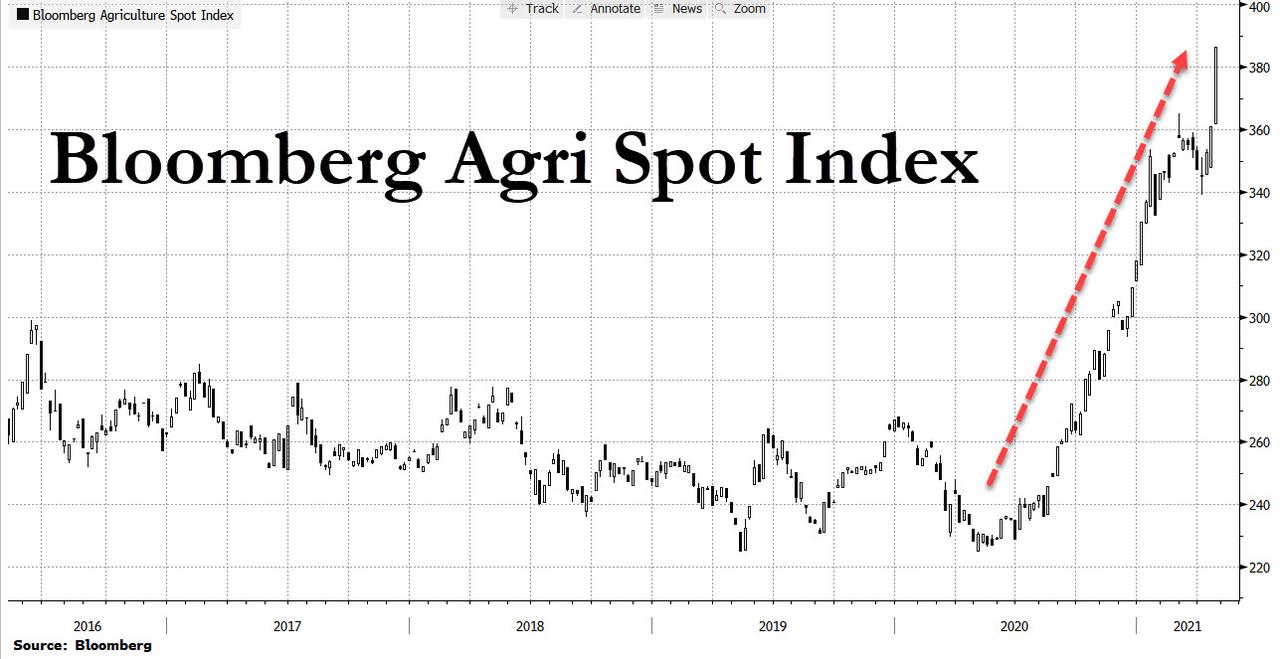
In a nutshell, this is a problem since food is a large component of CPI baskets in Asia, and "this large inflationary impulse in the region that houses more than half the world’s population should result in higher wage costs in the factory base of the world. As CPI and PPI rise in Asia, it will feed through globally in the months ahead."
Today, DB's Jim Reid picked that chart as his "Chart of the day", repeating what readers already know, namely that Bloomberg’s agriculture spot index has risen by c.76% year-on-year, noting that "that’s the biggest annual rise in nearly a decade, and there are only a couple of other comparable episodes since the index begins back in 1991."
Like us, Reid then patiently tries to explain to all the idiots - like those employed in the Marriner Eccles building - that the importance of this record surge "extends far beyond your weekly shop, as there’s an extensive literature connecting higher food prices to periods of social unrest." Indeed, you’ll notice from the chart that the last big surge from the middle of 2010 to early 2011 coincided with the start of the Arab Spring, for which food inflation is regarded as a contributing factor.
While this is hardly new - we discussed it in "Why Albert Edwards Is Starting To Panic About Soaring Food Prices" and in "We Are Edging Closer To A Biblical Commodity Price Increase Scenario" - Reid also reminds us that emerging markets are more vulnerable to this trend, since their consumers spend a far greater share of their income on food than those in the developed world.
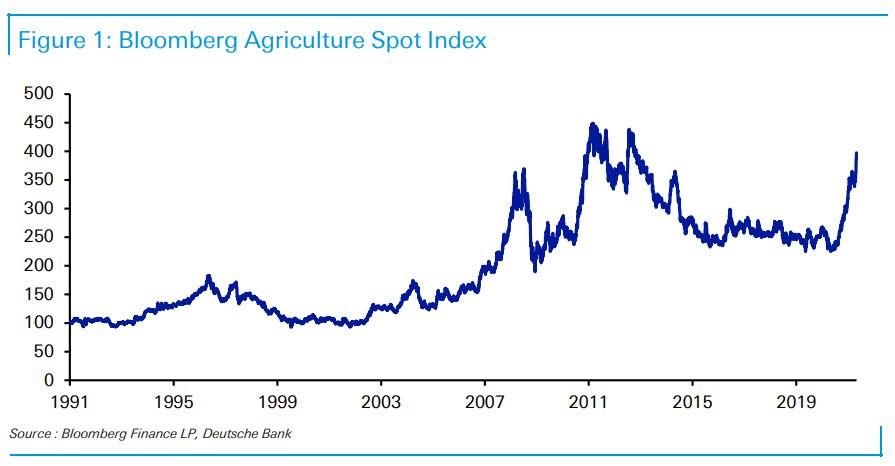
The DB strategist then goes all-in and says what everyone is thinking, namely that "this trend of higher food prices leading to social unrest extends far back into history and surrounds many key turning points. The French Revolution of 1789, which overthrew the Ancien Régime, came after a succession of poor harvests that led to major rises in food prices. It was a similar story at the time of Europe’s 1848 revolutions too, which followed the failure of potato crops in the 1840s and the associated severe famine in much of Europe. And the 1917 overthrow of the Tsarist regime in Russia took place in the context of food shortages as well."
So while it remains to be seen what the consequences of today’s surge in food prices could be, Reid cautions that "given the hardship that’s already occurred thanks to the pandemic, a fresh wave of unrest would be no surprise on a historical basis."
Chinese Sovereign Wealth Fund Eyes Stake In Aramco
As the production cuts agreed to by OPEC+ drive oil prices higher amid a broad-based commodity boom, China's sovereign wealth fund China Investment Corp is eying a major investment in Aramco, the world's most valuable company, as Aramco again looks to sell off a piece of its business after scrapping an international IPO a few years back.
Aramco abandoned plans for a public listing amid fears that US law might make Aramco assets vulnerable to seizure as families of victims who died in 9/11 seek compensation from the Saudi government. Instead, the company sold some debt on the international markets and offered shares that are traded domestically on Saudi Arabia's bourse, but now it appears the oil giant, currently controlled by the Saudi royal family, is once again planning to sell off a stake in its business.
But instead of turning to the public markets, Aramco is seeking out sovereign wealth funds to invest directly, according to Reuters.
"There are talks now for the acquisition of a 1% stake by a leading global energy company in an important deal that would boost Aramco's sales in ... a major country," Prince Mohammed said, without elaborating."There are talks with other companies for different stakes, and part of Aramco's shares could be transferred to the (Saudi) Public Investment Fund and a part listed ... on the Saudi bourse," he said in an interview aired by Saudi TV marking the fifth anniversary of Vision 2030.
A 1% stake would equate to around $19 billion based on Aramco's current market capitalization.
Crown Prince Mohammad bin Salman has also spoke highly of the blossoming bilateral relationship between Riyadh and Beijing.
Prince Mohammed said in the interview that Riyadh was strengthening its relationships with China, India and Russia, though the United States remained a strategic partner despite some differences with the Biden administration, which has taken a tougher stance on Saudi Arabia.
"China has said Saudi Arabia is a strategic partner, India has said Saudi Arabia is a strategic partner and Russia has also said Saudi Arabia is a strategic partner," the prince said.
According to Reuters, Aramco has been in talks with CIC, as well as Chinese national oil companies. Aramco has been "in touch" with these investors for a few years now.
"The kingdom does have close relations with China," said a third source, who is close to Aramco. "The major shareholder will decide what to do with their shares."
A tie-up between Saudi and China might make Washington uneasy. But the deal makes sense from a financial standpoint. Saudi Arabia is already China's biggest crude oil supplier, a position it maintained for a seventh consecutive month in March.
Private Equity and Hedge Funds, Facing a New Tax Burden, Prepare Their Defense
Wall Street firms that benefit from carried-interest treatment say Biden’s proposal could discourage small-business investment
Some private-equity firms and hedge funds are pushing back against a proposal from President Biden to end the carried-interest tax advantage these types of firms enjoy.
Mr. Biden is unveiling a $1.8 trillion proposal that includes new spending on child care, education and paid leave, as well as extensions of some tax breaks. To pay for it, he would largely raise taxes on the wealthiest Americans, including many on Wall Street.
Hedge funds and private-equity firms are among those that would be affected by Mr. Biden’s proposal, given his plan would get rid of lower rates on long-term capital gains for high-income households and end what the administration calls the “carried-interest loophole.” The moves would mean investment managers would no longer be allowed to pay a lower rate on a substantial portion of their compensation.
Lobbyists for the private-equity industry responded to the proposal by arguing it might do more harm than good. They said private investment has been beneficial to the U.S. economy, including investing in renewable energy and healthcare, providing jobs and supporting pension plans. The proposed taxes would threaten that investment, they said.
“We share the administration’s goal of rebuilding the economy, accelerating the Covid-19 recovery and spurring job creation for families across our country,” said Drew Maloney, president and chief executive of private-equity trade group the American Investment Council and a former Trump administration Treasury official. “Instead of moving forward with tax increases that discourage investment in small businesses, workers and innovation, the administration and Congress should deliver policies that will put more private investment to work for families across the country.”
Higher capital-gains tax rates could also change firm founders’ calculations in deciding whether and when to sell their businesses, and that is a concern to some of them, said an industry executive. Currently, the capital-gains rate applies if they sell, typically leading to major windfalls for founders after decades of building up their firms.
The argument over carried interest has long been a hot-button issue between Washington and Wall Street. Carried interest is generally the share of investment gains that goes to the managers of the firm. Those profits are taxed at the relatively low capital-gains tax rate. Critics have argued those payments are equivalent to compensation for work and should be taxed as ordinary income, a higher rate.
The current top capital-gains rate stands at 23.8% versus 37% for much of ordinary income; including existing payroll and investment taxes, the Biden administration proposal would see the top rate on wages and capital gains both reaching 43.4%.
The 2017 tax law passed under the Trump administration contained a measure that affected the treatment of carried interest by lengthening the period that firms must hold an asset before it is eligible for the long-term capital-gains rate to three years from one. The change generally affected hedge funds more than private-equity firms, which tend to hold assets longer.
Hedge-fund strategies vary widely, but many are active traders with holding periods of less than three years. Still, hedge funds that engage in activism, invest in beaten-down or distressed assets, or invest in long-term plays like biotech companies, for example, can stay in their positions for years and would be hurt by carried interest’s elimination.
Some hedge funds, in a bid to diversify their businesses, also have migrated to private-equity style drawdown structures that invest over longer periods.
The Managed Funds Association, the hedge-fund industry’s lobbyist, said hedge funds work to benefit teachers, firefighters, other pension beneficiaries and endowments and foundations. “Considering this important work and its economic benefit for Main Street America, it’s unfortunate that our industry has been singled out by the administration,” MFA President Bryan Corbett said in a statement.
Mr. Corbett said the group supported a “fair and growth-oriented tax code that promotes long-term investment activity.”
Despite both major political parties now having decided to take on the carried-interest treatment in different ways, one reason it has survived this long may be that closing it doesn’t generate significant additional revenue for the government.
Taxing carried interest as ordinary income would generate about $14 billion in revenue over 10 years, according to a 2018 estimate by the Congressional Budget Office. That could help explain why the Biden administration is also focused on raising capital-gains tax rates for wealthy individuals more broadly.
The National Venture Capital Association said in a blog post that such a significant increase in the capital-gains tax rate would “reduce long-term investment and entrepreneurship by making short-term economic activity relatively more attractive.”
“Taxing capital gains at ordinary income rates undercuts President Biden’s own Build Back Better agenda,” said NVCA President and CEO Bobby Franklin in the post. “We urge the administration not to take one step forward and two steps back on encouraging long-term investment and innovation activity, but to set aside these tax increases and instead collaborate with the startup ecosystem to achieve shared objectives.”
Ford sets out escalating impact of chip shortage
Carmaker will produce 1.1m fewer vehicles this year, overshadowing operational improvements
Ford would make 1.1m fewer vehicles this year because of the worldwide shortage of semiconductors, the carmaker said on Wednesday, significantly more disruption that previously hoped.
The company had earlier forecast it would make between 200,000 and 400,000 fewer vehicles. Under its new guidance, Ford’s production will be down 50 per cent in the second quarter and 10 per cent in the second half of the year.
The revised outlook took the shine off figures for the first three months of 2021, which showed Ford’s highest quarterly profits in a decade.
The semiconductor shortage has hamstrung car manufacturers across the globe, as chipmakers reserved chips for consumer electronics customers, who pay more. Matters were compounded by severe weather in Texas and a fire at a Japanese plant owned by Renesas.
“We now expect the semiconductors shortage to get worse,” said John Lawler, Ford’s chief financial officer. “We do see the trough being in Q2.”
The carmaker said it would take a $2.5bn hit to the year’s earnings before interest and taxes as a result of the disruption — the upper limit of the range it gave in February.
Its shares dropped 3 per cent in after-hours trading.
Ford credited popular products and worldwide operating improvements for helping achieve $3.3bn in net income in the three months to the end of March, its highest quarterly profit since 2011. It posted a $2bn loss for the first quarter of 2020.
Revenue was $36bn, up 6 per cent from the same period last year. Its adjusted earnings before interest and taxes were a record $4.8bn.
Ford had commanded better prices than the overall industry as inventory on dealers’ lots had stayed low, and consumers had proved eager to buy, Lawler said.
But the company is also reaping the fruits of the restructuring plan it began several years ago, where Ford decided to focus on more profitable trucks and sport utility vehicles and shuttered some unprofitable operations outside North America, most recently in Brazil.
“Our team is relentlessly executing our plan to turn around our automotive business,” said Jim Farley, chief executive. “There’s no question we’re becoming a stronger, more resilient company.”
Lawler said: “Although we’ve seen some good news come through from the dynamics of the marketplace, you’re also seeing the strength of the underlying business improve.”
So far Ford has built 22,000 vehicles that are waiting for chips to be installed. It was implementing special inspections and testing “so we can guarantee those vehicles will have the same quality as if they’d just moved off the production line”, Lawler added.