After Hours Summary: very busy with earnings; key names trading higher: ROKU +8.7%, PTON +6.3%, DDOG +5.5%; lower: STMP -9.2%, SHAK -8.8%, BYND -6.5%After Hours Gainers:
Companies trading higher in after hours in reaction to earnings/guidance: BILL +14% (also confirms acquisition of Divvy for $2.5 bln in cash and stock), ANGI +9%, ROKU +8.7%, NET +8.2%, GRPN +7.4%, GPRO +7.3%, SCOR +7.1%, AXON +7%, PTON +6.3%, DDOG +5.5%, SVMK +5.5%, PBYI +5.4%, ZGNX +4.7%, AVLR +4.4%, ET +4.3%, EXPE +4.3% (also files for 8.4 mln share offering by selling shareholders), FLGT +4.1%, MCHP +4.1% (also increases dividend), EOG +3.7%, TSE +3.4%, ENDP +3.1%, BCC +2.8%, TRHC +2.8%, YELP +2.7%, AMC +2.6%, TWST +2.6%, NKTR +2.5%, NWSA +2.5%, CDXS +2.5%, CWK +2.4%, MSI +2.4%, RVLV +2.4%, MTZ +2.1%, SQ +2.1%, DBX +1.9%, MP +1.8%, CARG +1.7%, CABO +1.6%, EXEL +1.6%, SYNA +1.4%, CORT +1.3% (also announces "positive" Phase 2 results on cancer trial), PRDO +1.2%, WFG +1.2%, LYV +1%, CMBM +0.9%, MCK +0.9%, CLI +0.7%, MAIN +0.7%, OPRT +0.7%, EB +0.7%, SXI +0.5%, ENTA +0.4%, PBA +0.4%, PRAA +0.4%, USM +0.4%, KWR +0.2%, MTX +0.2%, POST +0.2%, REZI +0.2% (also acquires Shoreview Distribution), SEM +0.2%, UIS +0.2%, Y +0.2%, ED +0.1%, IRTC +0.1%, OEC +0.1%, SWX +0.1%
Companies trading higher in after hours in reaction to news: IBIO +43.1% (reports COVID-19 toxicology study results; announces next-gen COVID-19 vaccine program), NKTX +22.7% (CRSP and NKTX announce a strategic partnership), TTOO +12.1% (announces acceleration of development initiatives under BARDA contract), DDOG +5.5% (names new COO), GENI +4.7% (to acquire Second Spectrum for $200 mln in cash and stock), OUST +2.2% (names new President of Field Ops to accelerate lidar adoption), KSU +1.9% (Surface Transportation Board approves Voting Trust for CP's proposed acquisition of KSU), AMSC +1.5% (acquires Neeltran, a supplier of rectifiers and transformers to industrial customers), CRSP +1.2% (CRSP and NKTX announce a strategic partnership), ASTS +0.8% (stock offering), ENTA +0.4% (announces "positive" data from Phase 1b study of EDP-514), RTX +0.4% (awarded $500 mln Navy contract), VYNE +0.3% (files for $200 mln mixed securities shelf offering), PBPB +0.2% (files for $75 mln mixed securities shelf offering), WMT +0.1% (Walmart Health to acquire MeMD), CACI +0.1% (awarded $500 mln Air Force contract), TWTR +0.1% (introduces new Tip Jar feature to enable tipping on platform)
After Hours Losers:
Companies trading lower in after hours in reaction to earnings/guidance: AUPH -19.9%, APPN -12.8%, STMP -9.2%, SHAK -8.8%, FROG -8.5%, BYND -6.5%, VIR -6.2%, TRIP -6.1%, GH -5.8%, CLNE -5.5%, MNST -5.3%, TDC -5.3%, PODD -5.2%, SFM -5.2%, ICUI -4.5%, PGNY -4.4%, CGNX -3.9%, AGO -3.7%, PFSI -3.6%, FRG -3.2%, QDEL -2.3%, WPRT -2%, CERT -1.6%, PK -1.6%, FNF -1.4%, PLNT -1.2% (also announces minority investment in iFIT), FNKO -1%, ZIOP -0.7%, IOVA -0.6%, OLED -0.6%, AIG -0.4%, AQN -0.4% (also increases dividend), CHUY -0.3%, ENV -0.3%, APLE -0.3%, ACMR -0.2%, AL -0.2%, FND -0.2%, MTD -0.2%, AMN -0.1%, CVNA -0.1%, RMAX -0.1%, SPXC -0.1%
Companies trading lower in after hours in reaction to news: CTOS -1.6% (stock offering), COUR -0.5% (announces partial early lock-up release of common shares), BDX -0.1% (files mixed securities shelf offering)
Here Comes The Squeeze: Goldman Prime Says Hedge Funds Shorted Tech For 9 Of The Past 10 Days
With the Nasdaq set for its biggest weekly drop since the end of February, when the infamous, catastrophic, "near-failed" 7Y auction sparked reflation fears and hammered tech stocks and duration in general...
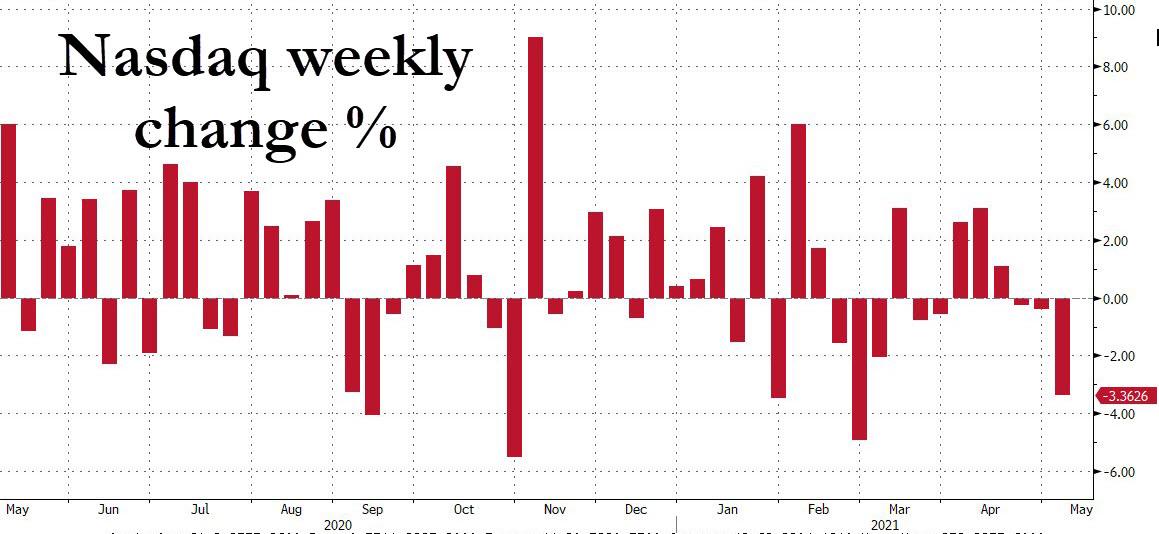
... it will not come as a surprise that "someone" has been puking tech stocks, especially after we reported on Tuesday that in the past 4 weeks BofA's hedge fund clients had sold a record amount of stocks.
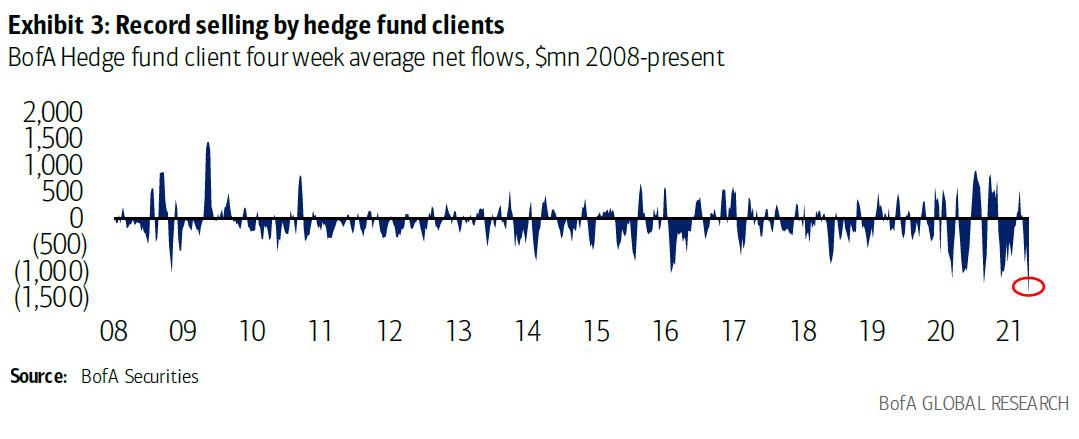
Today, in an update report from Goldman's Prime Brokerage, we learn just how acute the tech revulsion has been across the entire hedge fund community, which we can now safely say is that certain "someone."
While superficially appetite for risk was present, with GS Prime writing that its book "was modestly net bought yesterday (+0.5 SDs vs. average daily flow of the past year), driven by risk-on flows with long buys outpacing short sales 1.6 to 1" with "7 of 11 sectors were net bought on the day led in $ terms by Comm Svcs, Real Estates, Consumer Disc, and Utilities" a detailed look reveals that the smart money has decided to aggressively pursue continued declines in tech.
Indeed, validating the recent horrific price action in tech, Goldman Prime notes that i) Tech stocks were net sold for a 7th straight day (9 of the past 10), and more importantly, ii) the bulk of this selling was short selling, i.e., the flows were "driven by short sales outpacing long buys 2 to 1."

As a result of the aggressive selling/shorting, Info Tech's weighting vs. the SPX now stands at -3.3%, the most underweight level since December. Digging deeper, on an industry group level, Goldman notes that managers are the most U/W Tech Hardware (-5.6%) followed by Semis & Semi Equip (-2.4%) while still O/W Software & Services (+4.8%).
Why does this matter? Because the last time we saw such coordinated hedge fund selling was at the end of April when we noted that "Hedge Funds Sell Stocks 7 Of The Last 8 Days", a move which we said would precede a major short squeeze and sure enough in the days that followed both the S&P and Nasdaq hit all time highs.
Now that the selling is far more focused in tech - for obvious reasons: reflation fears, taper concerns, WFH trade ending, a coordinated campaign to crush Cathie Wood, etc. - it is safe to say that tech is about to experience yet another squeeze, something we predicted first yesterday...
... and which today's Goldman Prime data just confirmed.
Here Comes The Hwangover: Prime Brokers Begin Slashing Hedge Funds' Leverage After Archegos Debacle
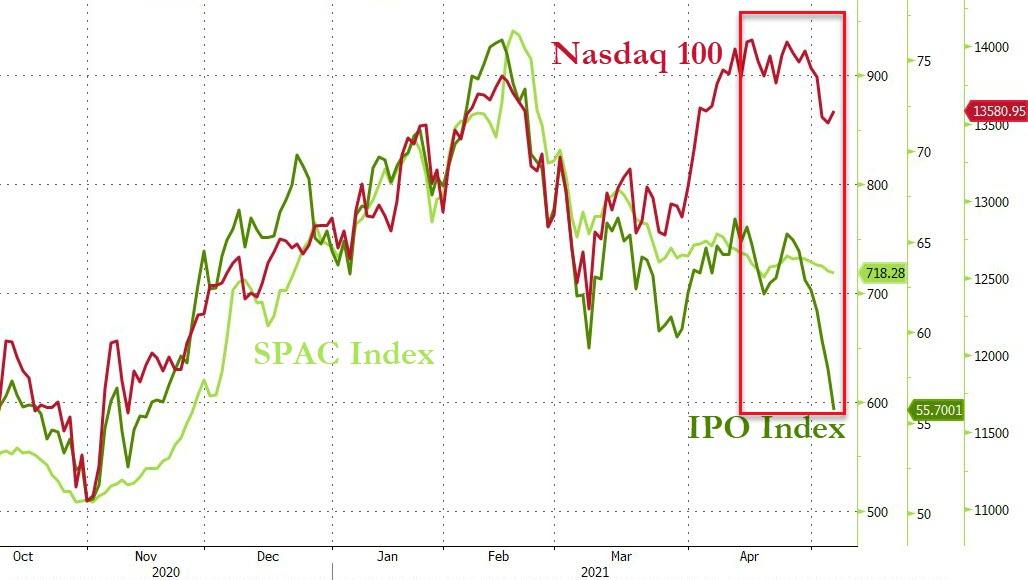
Given that rates have stopped soaring and earnings have been red-hot, many have questioned why growthy stocks have dramatically underperformed recently.
Source: Bloomberg
We may have found the answer... and it's a major problem for those hoping to buy-the-dip.
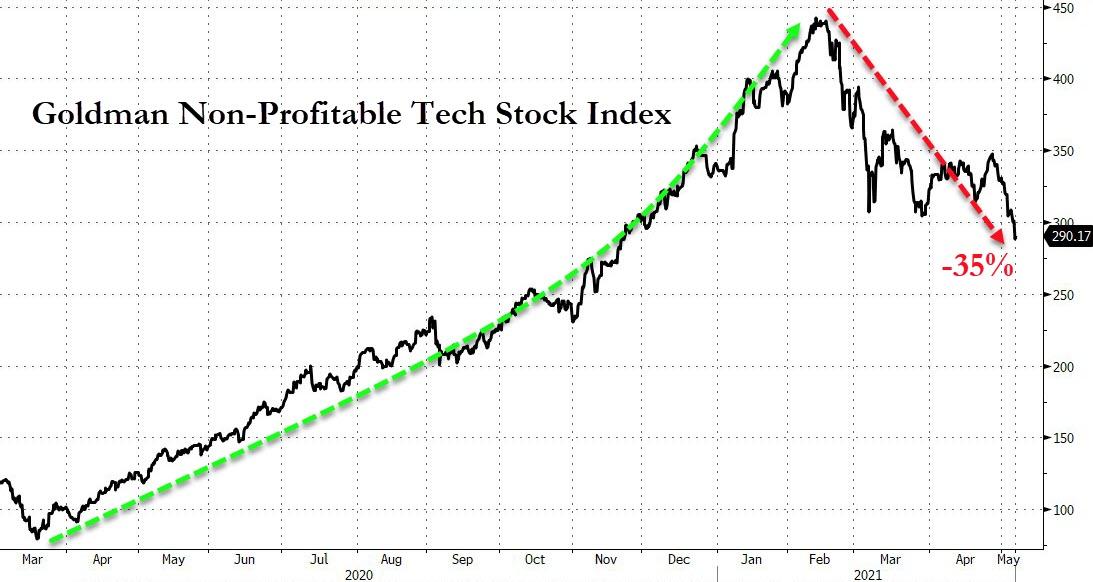
As momentum charged higher last year, riding a sea of liquidity, every stock market 'guru' bought the junkiest junk...
Source: Bloomberg
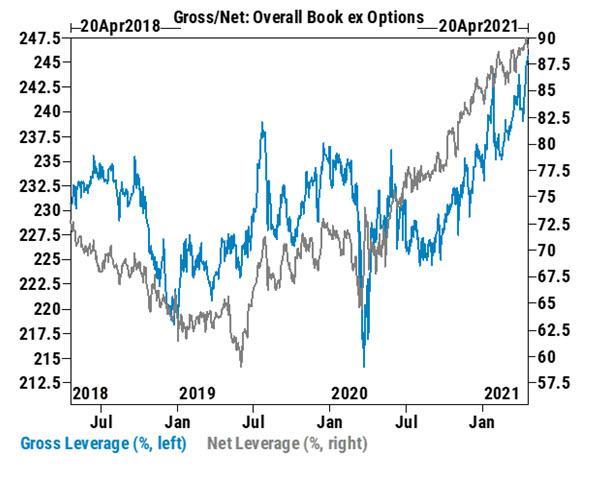
In fact, hedge fund leverage - both gross and net - hit record highs in late April, according to Goldman's Prime Brokerage.
And that's a problem going forward, because, as Bloomberg reports, across the entire street, amid fallout from the Archegos debacle, Prime Brokers are slashing available leverage for their hedge fund clients.
...managers of small hedge funds who lack the negotiating clout of trading whales are grousing. For the little guy especially, the saga will make it harder to borrow money from banks to finance bets.While specific measures will vary by bank and client - and in many cases are still being ironed out - the talks and tensions point to greater pressure on clients to reveal their biggest wagers, stricter margin limits on those positions, more frequent collateral adjustments and more rigorous audits. The deliberations were described by executives close to prime brokerage desks and money managers.
At its most extreme, Credit Suisse, which was the hardest hit among Archegos' primes, drastically adjusted risk tolerances and practices, slashing lending to hedge funds by a third.
“There will be more calories expended, both in terms of those desks doing due diligence in the market as well as in some cases they may outright ask clients about that,” Mike Edwards, deputy chief investment officer at Weiss Multi-Strategy Advisers, a $3 billion hedge fund.Previously, it was “not a requirement at most places that you would disclose to a swap counterparty that you have the same position on at multiple places.”
While smaller money managers have always generally faced more-onerous terms on trades, Bloomberg warns that the Archegos blowup is going to make that situation all the worse, two veteran managers atop smaller firms said. Deeper due diligence costs prime brokerages time and money.
Fewer mid-sized prime brokerages will offer as much margin or the breaks on trading terms that were available just months ago. The money managers worry that they face a more take-it-or-leave-it environment than interest in doing business.
And the riskiest, most-levered members of the stock market (and the small/medium sized hedge funds who trade around this junk) will feel the pain the most as deleveraging forces unwinds and kill any momentum that remained.
As Larry McDonald warned in his latest Bear Traps Report, Archegos may be the catalyst that triggers a deleveraging cycle.
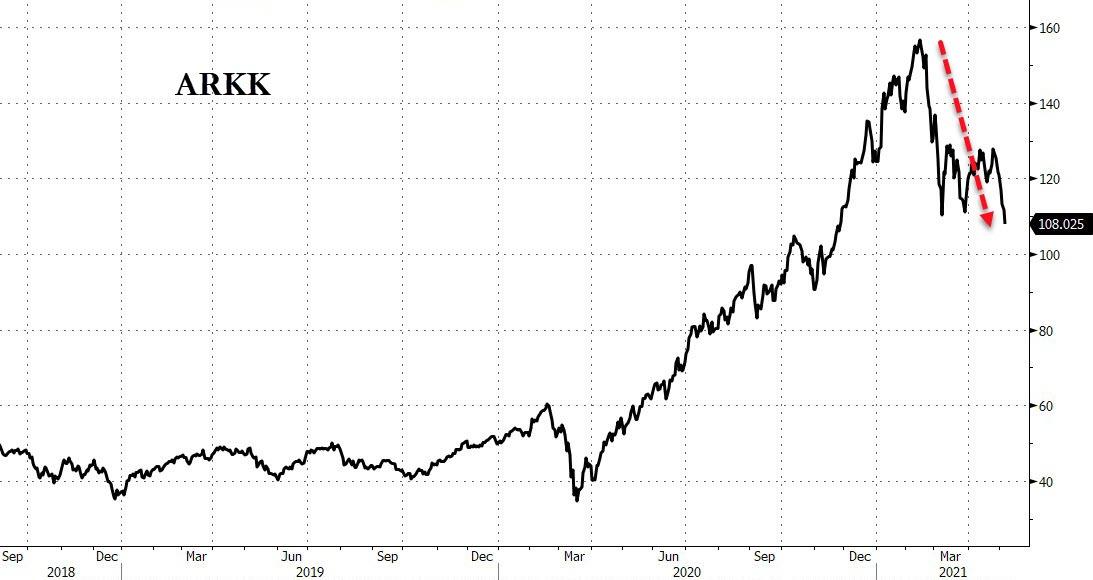
Bull markets never, EVER die of valuation old age, its the leverage blow-up which triggers the deleveraging and takes the madness out of the crowd. Just look at the ARK ETFs, the marginal - over the top buyer is taking the sword as we speak.Every hedge fund compliance officer across the Street is now in search of the next Archegos, and they have as much trust in their prime broker as the lovely Maryilyn Monroe had in the playboy that was JFK.
Marshall Wace co-founder Paul Marshall raged over how Archegos caught prime brokers by surprise using opaque swaps.
“The prime brokers have paid the price for extending so much risk,” he wrote last month, chiding them for not asking enough questions. “PBs will improve.”
EY fraud expert: ‘incomprehensible’ that Wirecard ‘red flags’ were ignored
Christian Muth told German MPs his ‘professional honour’ had been hurt after his findings were dismissed
A senior EY anti-fraud specialist who investigated whistleblower allegations of fraud at Wirecard said it was “incomprehensible” that audit partners at the Big Four firm had dismissed “red flags” pointing to accounting manipulations at the disgraced payments group.
In a day of explosive testimony before German MPs in Berlin, Christian Muth, a 45-year-old former German army officer who led an EY probe into the allegations between 2016 and 2018, said that his “professional honour” had been hurt after its findings were discounted.
He pointed out that the investigation, which was first reported by the Financial Times last year and codenamed “Project Ring”, had made six distinct observations that supported the allegations from a whistleblower in India.
The probe had been commissioned by Wirecard’s management board and conducted by EY Forensic & Integrity Services, an arm of the Big Four firm that specialises in white-collar crime.
However, Wirecard ultimately blocked EY’s anti-fraud team from investigating the issues further and eventually aborted the probe in early 2018. Just over two years later, the payments group collapsed in one of Europe’s largest postwar accounting frauds.
According to Muth, the EY partners in charge of Wirecard’s audit were aware of the issues raised by the probe, but still issued unqualified audits having concluded the allegations were of “no substance”.
“I was irritated. From my point of view as a forensic investigator, this assessment was incomprehensible,” Muth told MPs in a hearing that lasted for more than five hours.
Danyal Bayaz, an MP for the Greens, said Muth’s “outspoken testimony heavily incriminated his audit colleagues”, adding that there was “strong evidence” that risks were not properly assessed.
The damning assessment from Muth was in sharp contrast to how the hearing began, with the EY partner initially refusing to answer even basic questions. He argued that many of the documents that he would need to reference were classified as secret.
That drew a stern rebuke from MPs of all parties on the parliamentary committee from the pro-business Free Democrats to the hard-left Die Linke party. “Stop playing hide and seek with a constitutional body,” said Hans Michelbach, an MP for Angela Merkel’s conservative CDU/CSU.
“You may be trying to protect company secrets but I wonder how long as a company in Germany [EY] will continue to exist”, thundered Jens Zimmermann, a Social Democrat MP.
After consulting with his lawyer and EY representatives, Muth relented and began his testimony.
“EY Germany welcomes the fact that a partner testified today at the parliamentary inquiry committee,” the Big Four firm told the FT, adding that “at no point did EY Germany object to its partner providing public testimony and this was confirmed to his lawyer”. It stressed that it has supported the committee “throughout and will continue to do so”.
However, Muth’s testimony is a further blow for EY, which has been under intense scrutiny after giving Wirecard unqualified audits for a decade. An investigation into its audit work for the company, which was commissioned by the German parliament, last month uncovered serious shortcomings.
Munich prosecutors have launched a criminal investigation against the EY partners who oversaw the Wirecard audits, while the firm has lost several high-profile clients in Germany.
In his testimony, Muth stressed that while “Project Ring” was separate from EY’s annual audit of Wirecard, the audit partner in charge of the once high-flying payments group was part of the probe’s team.
Muth told MPs how right from the start Wirecard had stonewalled the probe, blocking many of the investigative steps that were initially agreed. Muth said he had “continuously and clearly” told the payments group and his EY audit colleagues that further action was needed.
In March 2017, EY’s audit team had threatened to withhold an unqualified audit from Wirecard unless a series of key questions related to “Project Ring” were answered. However, just weeks later they changed their mind and signed off the group’s 2016 results without qualifications.
Muth said that while Wirecard provided additional information to EY after the threat, “this did not resolve all the issues” and many were still pending when Wirecard aborted “Project Ring” a year later.
Asked if he thought the unqualified audits were flawed, Muth declined to comment, saying that “I am a forensic expert, not an auditor. This is something other people have to determine.”
He also described how Wirecard’s then chief financial officer, Burkhard Ley, had tried to influence the wording in EY’s status memorandum, suggesting that EY should clearly state that the allegations could not be validated. “I flipped out when I learned about that,” he said.
EY has repeatedly said it was deceived by the fraud at Wirecard. “Based on our information, the EY Germany auditors performed their audit procedures at Wirecard professionally, to the best of their knowledge and in good faith,” the firm said.
Fashion shows that travel for you
Chanel and Saint Laurent released the latest of an increasingly sophisticated run of digital shows — and which may be some of the industry’s last
The big luxury houses are feeling optimistic, and with good reason. Thanks to the resilience of Chinese and American consumers, 2020 was not as disastrous as many had feared. The IMF predicts that most advanced economies will suffer little lasting damage from the pandemic. And though many people have lost their jobs in the past year, others have seen their stock portfolios and savings swell, and are ready to go out, travel and spend as restrictions ease. Another Roaring Twenties may be upon us.
“The situation is quite good,” says Chanel president Bruno Pavlovsky, speaking from Provence on Monday, the day before the brand’s audience-less Cruise 2021/22 show was broadcast online. While he says it is “far too early” to say whether the company’s 2021 sales will match the record $12.3bn Chanel generated in 2019, he is encouraged by the brand’s recovery in China, the US, Russia and “pockets” such as Dubai. “[Dubai] is one of the rare situations where you can see people coming from abroad. When that exists, business is always quite good.” If, as indicated, vaccinated American tourists are welcomed back to Europe this summer, that will also be good for Chanel, Pavlovsky adds.
With many of its customers unable to travel, creative director Virginie Viard took viewers on a virtual journey to the Carrières de Lumières, the white limestone quarries immortalised by Gabrielle “Coco” Chanel’s friend and collaborator Jean Cocteau in his 1960 film The Testament of Orpheus. Their chalky, roughly hewn surfaces were the backdrop and inspiration for the largely black-and-white collection, which combined typical Cruise fare (Breton stripes, riffs on sailors’ uniforms, white waistless dresses) with clothes imbued with a punkish spirit: band tees and short tweed skirts with frayed edges; capes and mini skirts in fringed black leather; weighty, heart-shaped lockets and nose rings fixed with double Cs.
Chanel’s founder was celebrated for freeing women, and Viard does her best work when homing in on this legacy. There was a heaviness to some of these clothes that was evident in the way the models moved. Better were the looks that were unrestricted and simply styled: a cropped white moto-style jacket and ecru pleated trousers with polished cap-toe boots, a fitted long-sleeve dress of ivory lace, an effortless white kaftan with full sleeves gathered gently at the throat.
Although she worked alongside predecessor Karl Lagerfeld for more than three decades, Viard is a wholly different designer. She is shy of the limelight, granting few interviews, and those she does grant are devoid of the controversial material that often kept Lagerfeld, and by extension Chanel, in the headlines for weeks. But customers appear to love her clothes: ready-to-wear sales were up 28 per cent between 2018 and 2019.
“They are different,” Pavlovsky replies when asked whether the era of the “star” designer is over at Chanel. “What I like with Virginie is that she is what she is; she is doing quite well but is not in the public sphere. That’s a decision but also a culture, which is quite meaningful.”
Chanel has been somewhat late to the sustainability conversation; the online watchdog Good on You rates the company’s environmental progress “Not good enough” for not furnishing evidence that it is on track to meet the carbon reduction targets the company unveiled 14 months ago, and the lack of eco-friendly materials in its collections. Pavlovsky promises the company will publish an update on those targets when it releases its 2020 earnings next month. As for the materials — more than a third of the looks in the collection were crafted primarily from organic or recycled fabrics, including four “eco-friendly” tweeds from its wholly owned supplier, Lesage. It’s a start.
This month may mark the last of the digital fashion shows. Dior plans to show Cruise (the collection that arrives in stores around the end of the year) in Athens on June 17, and Chanel expects to host guests at its haute couture show in Paris in early July. Although Pavlovsky says the company has learnt a lot about amplifying shows and events via digital, and grown its business with local customers by the “double digits”, the past year has neither damped its enthusiasm for bricks-and-mortar nor for live, physical fashion shows.
Which is almost a shame, because after 14 months of experimentation, some of these digital fashion shows are getting seriously good. Case in point: Saint Laurent’s recently released autumn/winter 2021 show, an epic production filmed against the grand waterfalls, icebergs and stark volcanic rock cliffs of Iceland. (Or what is obviously Iceland; Saint Laurent’s publicity team declined to confirm local media reports that the video was filmed there.)
Just as other houses are leaning into black-and-white, creative director Anthony Vaccarello went the opposite way, unveiling a collection high on colour, shine and unabashed sexiness that was wonderfully offset by the powerful landscape. A gold-buttoned tweed jacket of cobalt blue was teamed with a silver leotard and a thigh-baring skirt ringed with raspberry fur (Saint Laurent is one of the few houses still using the stuff). Gold brocade tunics were layered over the briefest of shorts, while jodhpurs were belted over bodysuits with deep scoop necks or, for evening, paired with a tuxedo jacket and frilly white shirt. And then there were the accessories: lithe bags suspended from metal chains, sensible for nights out; gold chain necklaces and belts, some affixed with four-leaf clovers or crosses; and stacks of chokers and earrings of fringed diamanté. Semi-sheer black tights were worn with slingbacks with pointed metallic toes, or else slipped under thigh-high stiletto boots.
It was all very sellable. One could imagine a younger customer picking up the little chain bags, or splurging on the slingbacks. A more mature customer might pick up one of the rectangular, early ’90s-ish wool jackets or cardigans and pair it with jeans. “The irrepressible lightness of the collection mocks its serious ambitions,” Vaccarello observed in his show notes.
More importantly, the show was good for the brand overall, which along with ready-to-wear, footwear and accessories has a significant beauty licence with L’Oréal. After crossing the €2bn revenue threshold in 2019, Saint Laurent’s sales slipped to €1.7bn last year due to the pandemic. Vaccarello has said that it is vital for the brand’s shows to rival that of bigger houses, and he clearly achieved that here.
John Laing shares surge as KKR talks are confirmed
UK infrastructure investor gives US buyout group until June to make an offer
Shares of John Laing Group, one of Britain’s best-known infrastructure companies, surged on Thursday after it confirmed it was in talks with US buyout firm KKR over a possible takeover.
The group’s shares jumped 14 per cent to 362.70p, valuing it at about £1.8bn, as it gave the private equity company until June 3 to make an offer.
John Laing, which invests in transport, social and environmental public-private partnership programmes worldwide, added that there was no certainty that an offer would be made.
Infrastructure investors expect to benefit from a government shift towards net zero carbon emissions and spending on road, energy and housing projects as countries recover from the Covid-19 pandemic.
Last month, John Laing and Macquarie Capital said they would invest £200m in retirement homes developed by McCarthy & Stone to help address a shortage of elderly accommodation in Britain.
John Laing has also invested in the rollout of high-speed fibres in Germany with two small takeovers of regional telecoms businesses.
KKR has been one of the most active private equity firms since the start of the coronavirus pandemic, seizing an opportunity amid the turmoil to take over companies that in some cases have been on its radar for years.
Joe Bae, KKR’s co-president, said in June that its “active investment pace since the beginning of Covid has been quite intentional”, as it sought to “buy high-quality businesses at attractive prices”.
It bought Coty’s professional beauty division in a cut-price deal early in the crisis, and has purchased assets in holiday park operator Roompot as well as taking an €1.8bn stake in Telecom Italia’s last-mile network.
Its activity contrasts with some European private equity groups that have taken a more cautious stance.
The US firm is also braced for megadeals, having approached the Dutch telecoms operator KPN in what could be an €18bn deal and considered a buyout offer in excess of $20bn for Japan’s Toshiba.
John Laing reported a £65m pre-tax loss in 2020 compared with a loss of £95m a year earlier, while net asset value per share slipped to 310p from 337p.
Joe Brent, analyst at Liberum, called the approach “opportunistic” and pointed to the company’s transformation under new management.
“The shares have underperformed and are cheap relative to similar companies,” he said.
KKR declined to comment.
Hedge Week : Crypto hedge fund Argentium unveils systematic multi-strategy arbitrage fund
The Argentium Chimera Fund is systematic multi-strategy arbitrage fund which combines three investment strategies borrowed from foreign exchange investing and adapted to tackle cryptocurrencies’ higher volatility and lower liquidity.
Fusing market neutral arbitrage with long/short and market-making approaches, the fund will target the top 30 cryptocurrencies by market value traded across the top 10 global exchanges by volume, and aims to generate consistent returns regardless of market direction.
AK Jensen, an FCA-regulated platform, will provide infrastructure for the fund, which begins trading with around USD20 million in external capital on 1st June. The fund has raised capital from a mix of family offices, ultra-high-net-worth individuals and institutional investors.
Commenting on the launch, founder and CEO Paul Frost-Smith described cryptocurrencies’ current momentum as a “once in a generation opportunity.”
“The decentralised nature of digital assets and cryptocurrencies, and the differences in infrastructure and liquidity between exchanges, presents a unique opportunity for arbitrage and liquidity provision,” Frost-Smith said. “Transforming established FX strategies into the higher vol crypto environment is where we excel.”
Before launching Argentium alongside co-founders Larry Grant, COO, and Marc Deveaux, CTO, Frost-Smith had been CEO and head of markets at Haitong Securities. Before that, he was global head of longevity markets at Credit Suisse and was previously global head of asset management strategy at Swiss Re, having founded multi-strategy hedge fund Castlegrove Capital Management in 2004. Earlier, he had been a founding member of fund-of-funds KGR Capital, having spent seven years at JP Morgan in Tokyo and Hong Kong, latterly as head of equity derivatives for Asia-Pacific.
US-based CTO Deveaux, who had software-focused stints at TradingScreen, Morgan Stanley and the Toronto Stock Exchange, is joined by head of portfolio risk Sean Wang, a former executive director at Morgan Stanley.
Frost-Smith added: “I believe we are at an inflection point in the adoption of crypto assets, and that they will become increasingly important to diversification of investor portfolios and to the way in which value is perceived and stored.”