After Hours Summary: Bipartisan senators reach infrastructure deal; VRTX -13.2% falls on clinical data; PGEN +32.3% jumps on data; PLAY +4.4% higher on earnings but CHWY -1.5% ticks lowerAfter Hours Gainers:
Companies trading higher in after hours in reaction to earnings/guidance: PLAY +4.4% (says its "brand is back"), AVO +1.2%
Companies trading higher in after hours in reaction to news: PGEN +32.3% (announces "positive" top-line results from Phase 1b/2a study of AG019), AMEH +11% (to be added to S&P SmallCap 600), RFP +7.3% (declares special dividend of $1/sh; also announces $50 mln in lumber investments), TYME +3.8% (completes strategic review, announces OASIS breast trial with Georgetown, reports earnings), ABCL +3.1% (stock offering), RWT +2.6% (increases dividend), CVI +2.4% (finalizes special dividend payment), MGM +0.7% (expands betting app, BetMGM, into Washington DC), GILD +0.6% (announces FDA approval of new formulation of Epclusa), BSN +0.5% (announces combination agreement with Vertical Aerospace; also Avolon confirms eVTOL aircraft order with Vertical Aerospace; also AAL confirms investment in Vertical Aerospace and aircraft pre-order agreement), LHX +0.4% (awarded $3.3 bln Army contract), AAL +0.2% (confirms investment in Vertical Aerospace and aircraft pre-order agreement), JOE +0.1% (announces joint venture partnership with HomeCorp)
After Hours Losers:
Companies trading lower in after hours in reaction to earnings/guidance: CHWY -1.5%, NVGS -0.9%
Companies trading lower in after hours in reaction to news: VRTX -13.2% (primary endpoint achieved in Phase 2 study of VX-864), ELY -4.5% (to be added to S&P MidCap 400), SNOW -3.9% (hosting Investor Day today), AGNC -3.5% (reports tangible net book value of $16.82/sh), ADC -3.2% (stock offering), JFIN -2.4% (announces at-the-market offering of up to US$30 mln), RIOT -0.8% (provides May production and operations updates), WY -0.3% (files mixed securities shelf offering), WOR -0.1% (divides its Pressure Cylinders segment into three new reporting segments), AMK -0.1% (reports May 2021 highlights), CCL -0.1% (announces first cruise for Mardi Gras on July 31; return of additional ships in August
Half of the pandemic's unemployment money may have been stolen
Criminals may have stolen as much as half of the unemployment benefits the U.S. has been pumping out over the past year, some experts say.
Why it matters: Unemployment fraud during the pandemic could easily reach $400 billion, according to some estimates, and the bulk of the money likely ended in the hands of foreign crime syndicates — making this not just theft, but a matter of national security.
Catch up quick: When the pandemic hit, states weren't prepared for the unprecedented wave of unemployment claims they were about to face.
- They all knew fraud was inevitable, but decided getting the money out to people who desperately needed it was more important than laboriously making sure all of them were genuine.
By the numbers: Blake Hall, CEO of ID.me, a service that tries to prevent this kind of fraud, tells Axios that America has lost more than $400 billion to fraudulent claims. As much as 50% of all unemployment monies might have been stolen, he says.
- Haywood Talcove, the CEO of LexisNexis Risk Solutions, estimates that at least 70% of the money stolen by impostors ultimately left the country, much of it ending up in the hands of criminal syndicates in China, Nigeria, Russia and elsewhere.
- "These groups are definitely backed by the state," Talcove tells Axios.
- Much of the rest of the money was stolen by street gangs domestically, who have made up a greater share of the fraudsters in recent months.
What they're saying: “Widespread fraud at the state level in pandemic unemployment insurance during the previous Administration is one of the most serious challenges we inherited," said White House economist Gene Sperling.
- "President Biden has been clear that this type of activity from criminal syndicates is despicable and unacceptable. It is why we passed $2 billion for UI modernizations in the American Rescue Plan, instituted a Department of Justice Anti-Fraud Task Force and an all-of-government Identity Theft and Public Benefits Initiative.”
How it works: Scammers often steal personal information and use it to impersonate claimants. Other groups trick individuals into voluntarily handing over their personal information.
- "Mules" — low-level criminals — are given debit cards and asked to withdraw money from ATMs. That money then gets transferred abroad, often via bitcoin.
The big picture: Before the pandemic, unemployment claims were relatively rare, and generally lasted for such short amounts of time that international criminal syndicates didn't view them as a lucrative target.
- After unemployment insurance became the primary vehicle by which the U.S. government tried to keep the economy afloat, however, all that changed.
- Unemployment became where the big money was — and was also being run by bureaucrats who weren't as quick to crack down on criminals as private companies normally are.
- Unemployment fraud is now offered on the dark web on a software-as-a-service basis, much like ransomware. States without fraud-detection services are naturally targeted the most.
The bottom line: Many states are now getting more sophisticated about preventing this kind of fraud. But it's far too late.
Hertz’s Complex Shareholder Payout Explained
Shareholders have several options for how to get paid as the rental-car company exits bankruptcy
Hertz Global Holdings Inc. is concluding a chapter 11 case that generated big gains for shareholders, who are usually an afterthought in corporate bankruptcies. Bullish individual investors, in particular, were drawn to Hertz and were rewarded for the risk they took on a bankrupt stock.
But many of Hertz’s backers are unfamiliar with the bankruptcy process and with their options to get paid under the company’s exit plan, which was approved by a judge Thursday. WSJ Pro Bankruptcy breaks down the choices facing Hertz shareholders, who face a Friday deadline for some parts of the payout.
Q: How are shareholders treated under the bankruptcy plan?
A: A bidding war among investment firms drove up Hertz’s value so much it was able to cover its debts in full, with value left over for equity. Current shareholders will receive $1.53 in cash per share, plus their proportion of a 3% stake in the restructured business set aside for shareholders, and warrants for an additional 18% stake.
The warrants are akin to options, conferring on their owner the right to buy shares at a certain price. If Hertz’s equity valuation surpasses $6.5 billion, the warrants are in the money. The more Hertz is worth beyond that threshold, the more valuable the warrants.
Certain accredited shareholders—institutional buyers and wealthier individuals—can forego the warrants and instead participate in an equity rights offering.
Q: Who can participate in the rights offering?
A: To qualify, individuals must have either a net worth of $1 million or more, or have generated at least $200,000 in income for 2019 and 2020 and can expect to earn the same in 2021. Otherwise, they and their spouse must have collectively earned more than $300,000 for 2019 and 2020 and expect to earn the same in 2021 to qualify.
Q: Why is the rights offering valuable?
A: Shareholders who participate in the rights offering will pay $10 a share, raising $1.635 billion in equity financing to ease Hertz’s exit from bankruptcy.
Through the rights offering, shareholders can buy shares in the company at a discount to Hertz’s own valuation under its bankruptcy plan. The stock sales are based on a theoretical $4.7 billion valuation, meaning that $1.635 billion will purchase 35% of the company.
Even if very few shareholders participate, there are certain large institutional investors who have agreed to backstop the stock sale, meaning that they will provide the full $1.635 billion to make sure no shares go unsold.
The warrants for shareholders who don’t participate are premised on an equity valuation of $6.5 billion, meaning that warrant holders are paying more to acquire shares, and can only do so if Hertz’s value rises to that level.
Q: Do shareholders who are ineligible for the rights offering have any decisions to make?
A: Yes. Those who are ineligible for the rights offering can still elect to sell their subscription rights to participate in the rights offering to other, qualified investors in a court-supervised auction.
Any shareholder who doesn’t want to participate in the rights offering and doesn’t want to sell their rights, can choose to accept their share of the warrants, plus the cash payout and 3% equity distribution.
If a shareholder doesn’t notify Hertz of their decision, they will automatically be granted the warrants.
Q: Is there a deadline?
A: The deadline to participate in the rights offering, and to put subscription rights up for auction, is Friday, June 11.
Atlantia agrees to sell toll road arm for €9.3bn
Deal with investors including Italy’s CDP, Blackstone and Macquarie brings to end 3-year dispute with Rome
Atlantia, the Italian infrastructure group controlled by the Benetton family, has agreed to sell its toll road arm for €9.3bn, bringing to an end a three-year dispute with the Italian government.
The group of investors that bought Autostrade per l’Italia (Aspi) was led by state-controlled Cassa Depositi e Prestiti (CDP) and included Blackstone of the US and Australia’s Macquarie.
Atlantia said its board had accepted a binding offer in a statement on Thursday, with its 88 per cent stake bought through a new investment vehicle owned by the groups.
CDP will own 51 per cent of the new vehicle and the two funds will each own a 24.5 per cent stake. The signing of the share purchase agreement is scheduled for Friday.
It brings down the curtain on a row that pitted Rome against Atlantia’s shareholders, including the Benetton family and UK-based hedge fund TCI, following the collapse of a Genoa bridge that killed 43 people in 2018.
Last summer Atlantia had agreed to relinquish control of its toll road business to Italy’s CDP, but major disagreements over the asset’s valuation and the terms of the concession to operate the infrastructure derailed the plan several times.
In July, TCI’s founder, Chris Hohn, lodged a complaint with the European Commission claiming the Italian government was trying to illegally force Atlantia to renounce its toll roads unit.
Atlantia had been at loggerheads with the government over its lucrative concession to operate the majority of the country’s toll roads since the bridge disaster.
Several former Atlantia and Aspi executives are under investigation for the fatal collapse. According to prosecutors in Genoa, the bridge crumbled to the ground because of scarce maintenance by its operator.
Recommended
InterviewEuropean companies
Infrastructure group Atlantia aims to expand in struggling airport sector
Three years ago, Italy’s senior coalition partner, the Five Star Movement, vowed to revoke Atlantia’s concession to operate the toll roads as a way to punish the group and its shareholders.
The option was never pursued as it would have cost the Italian state billions in compensation under the terms of the agreement signed in 2008.
The decision to sell the asset to CDP, Blackstone and Macquarie was approved by the majority of Atlantia’s shareholders, including TCI, last month.
Proxy advisers such as the Institutional Shareholder Services and Glass Lewis had also backed the sale. Meanwhile, Spain’s ACS’ more lucrative offer, first reported by the Financial Times in April, failed to materialise.
According to people involved in the negotiations, investors decided to back the sale after the terms of the concession to operate the toll roads had been amended by the Italian government.
The business will be less lucrative for shareholders going forward, according to Italian officials. This meant the asset’s valuation had inevitably dropped.
CDP, Blackstone and Macquarie declined to comment.
The deal is expected to be finalised by the end of the year, according to Atlantia.
Melvin and Light Street suffer as meme stocks rally again
Hedge fund industry has collectively lost $6bn shorting just five stocks since May
Melvin Capital and Light Street Capital, two US hedge funds hard hit by a rally in stocks popular with retail investors in January, have suffered further losses in May as meme stocks have shot up again.
Melvin, the highest-profile casualty of the first meme stock rally in January, lost another 4 per cent in May, said people familiar with the numbers.
That takes the fund’s losses this year to about 44.7 per cent, the people said. The S&P 500 index of US stocks rose 0.6 per cent last month and is up almost 12 per cent in the first five months of the year.
Hedge fund losses just from betting against five popular meme stocks — GameStop, Bed Bath & Beyond, AMC, BlackBerry and Clover Health — total about $6bn since the start of May, according to the data firm Ortex Analytics. Peter Hillerberg, Ortex’s co-founder, said funds had recently reduced their short positions in meme stocks but that short interest remained “at very high levels”.
New York-based Melvin, run by Steve Cohen protégé Gabe Plotkin, found itself at the centre of the GameStop saga in January. Melvin’s performance plummeted 53 per cent amid a stratospheric rise in the share price.
The fund, which in January sustained a $4.5bn fall in the value of its assets from the end of last year, received a $2.75bn investment shortly afterwards from Cohen’s Point72 Asset Management and Ken Griffin’s Citadel.
Melvin’s assets have since risen further to $11bn as of June 1, according to a person familiar with the firm. After the extent of the firm’s losses were revealed, Melvin said it had exited its bet against GameStop and reduced risk in its investments — although it still suffered further losses last month.
Stocks such as GameStop, AMC and BlackBerry rocketed in late January, as amateur investors co-ordinating their actions on forums such as Reddit, and in some cases directly targeting hedge funds, piled in.
After falling back, these stocks have risen strongly again in recent weeks. The rallies have hurt both short sellers betting directly against the stocks, and also managers with short positions in other stocks that have been hit in the ensuing market volatility or as other short sellers unwind their bets.
Others that have lost money include Light Street Capital, set up by Glen Kacher, a so-called Tiger Cub who previously worked at Julian Robertson’s Tiger Management.
The firm, which managed about $3.3bn in assets at the start of this year, was hit during the first quarter. Its flagship fund lost a further 3 per cent in May and is now down 20.1 per cent this year, according to numbers sent to investors. The fund’s losses in the first quarter were predominantly driven by losses on shorting, said a person familiar with its positioning.
Melvin and Light Street declined to comment.
Scor and Covéa agree peace deal after bitter takeover fight
French insurers seek to bury hatchet with end to legal battles and agreement on cutting stakes
France’s Scor and Covéa have agreed a sweeping deal to end a no-holds-barred fight that began with a hostile bid and saw executives and bankers dragged through the courts.
The two companies have been locked in conflict ever since a failed takeover bid in 2018 by mutual insurer Covéa was rejected by Scor, a global reinsurer.
This was followed by a series of lawsuits that centred on allegations that Thierry Derez, Covéa chief executive, had told his advisers about the reinsurer’s confidential plans to merge with PartnerRe, allegedly to quash the deal and help with his own merger plans. Denis Kessler, Scor chief executive, reacted with fury to the approach.
But, with lawsuits rumbling on and the French regulator pushing for the two sides to put enmity behind them, Scor and Covéa said in a joint statement on Thursday evening that they “wish to restore peaceful relations, based on professionalism and in keeping with their respective independence”.
The deal, which involves “no admission of liability on either side” involves Covéa agreeing to sell down its 8 per cent stake and give Scor the right to buy those shares for €28 over the next five years.
Scor can transfer those shares, which currently trade at €26.10, to a third party. Covéa’s offer for Scor in 2018 was at €43 a share.
Covéa has also agreed not to buy any Scor shares for seven years and must vote with the Scor board while it still has a stake. It also has to pay Scor a sum of €20m.
The quid pro quo is that all legal cases between the two sides will be stopped, sparing Derez further legal risk, and the two groups will start doing business together again.
One case that could still proceed is against Barclays, a Covéa adviser, which is due to begin next week in London.
“Barclays acquired, used and/or disclosed the trade secrets of Scor unlawfully in circumstances where it knew or ought to have known that it obtained the trade secrets from Mr Derez who had himself used or disclosed them lawfully,” Scor’s claim form at the High Court says.
Barclays denies the claims in the lawsuit. Derez has also consistently defended himself against the charges and was until this deal appealing with Covéa against a ruling in this case by a Paris court last year.
Another bank caught up in the crossfire was Credit Suisse which dropped Covéa as a client after a call between Kessler, who recently accelerated plans to step down as Scor chief, and Tidjane Thiam, who ran the Swiss bank at the time.
Scor later won a case in the High Court, London, to force Credit Suisse to hand over documents relating to the deal.
Closing Stock Market SummaryThe S&P 500 gained 0.5% on Thursday, setting intraday and closing record highs in the process, as the market reacted positively to a hotter-than-expected Consumer Price Index (CPI) for May and a weekly initial claims trend that continued to improve.
The Nasdaq Composite (+0.8%) outperformed and closed near session highs, while the Dow Jones Industrial Average increased just 0.1% and the Russell 2000 decreased 0.7%. The underperformance of the Dow and Russell 2000, which are more cyclically-oriented, contradicted any growth optimism.
Briefly, total CPI rose 0.6% m/m in May (consensus 0.4%) and core CPI, which excludes food and energy, rose 0.7% m/m (consensus 0.4%). The year-over-year increases garnered the headlines, though, with total CPI up 5.0% and core CPI up 3.8%. In addition, weekly initial claims totaled 375,000 (Briefing.com consensus 365,000), which was its lowest level since March 14, 2020.
Despite the economic data feeding into reflationary/reopening themes, the market was guided by counter-cyclical sectors like health care (+1.7%), real estate (+1.0%), and consumer staples (+0.7%). The information technology sector (+0.8%) was another key leader alongside the mega-caps, excluding Apple (AAPL 126.11, -1.02, -0.8%).
Note, it didn't start that way. The financials (-1.1%), materials (-0.6%), industrials (-0.5%), and energy (-0.1%) sectors, which closed lower today, were among the leaders shortly after the open. The Dow was up as much as 0.8% and the small-cap Russell 2000 was up as much as 0.5%.
The inflation-sensitive 10-yr yield reasonably jumped to 1.53% soon after the CPI report, supporting the early move in the financials sector, but quickly turned around and settled at 1.46%. This was three basis points below yesterday's settlement.
Presumably, the Treasury market defaulted to its Fed-influenced view that a lot of inflation pressures will be transitory while potential harboring some peak growth rate concerns. A separate viewpoint suggested cyclical stocks succumbed to a sell-the-news reaction after outperforming so far this year.
The 2-yr yield increased one basis point to 0.15%. The U.S. Dollar Index decreased 0.1% to 90.06. WTI crude futures rose 0.6%, or $0.40, to $70.30/bbl.
Reviewing Thursday's economic data:
- Total CPI increased 0.6% month-over-month in May ( consensus 0.4%), with a 7.3% increase in the index for used cars and trucks accounting for about one-third of that increase. Core CPI, which excludes food and energy, jumped 0.7% (consensus 0.4%). On a year-over-year basis, total CPI was up 5.0% (vs. 4.2% in April), which was the largest increase since August 2008. Core CPI was up 3.8% year-over-year (vs. 3.0% in April), which was its largest increase since June 1992!
- The key takeaway from the report, aside from it showing broad-based price increases, is that one can see the potential for stickier inflation looking at just the last six months when pandemic base effects weren't fully depressed. To wit, total CPI is running at an annualized rate of 5.8% over the last six months while core CPI is running at an annualized rate of 4.0%.
- Initial claims for the week ending June 5 decreased by 9,000 to 375,000 (consensus 365,000), hitting their lowest level since March 14, 2020. Continuing claims for the week ending May 29 decreased by 258,000 to 3.499 million, which is the lowest since March 21, 2020.
- The key takeaway from this report is that the trends are moving in a manner that reflects an economy that is moving with increased reopening vigor.
- The Treasury Budget for May showed a $131.9 bln deficit, versus a $398.7 bln deficit in the same period a year ago. The budget data is not seasonally adjusted, so the May deficit can't be compared to the April deficit of $225.6 bln.
- The fiscal year-to-date budget deficit is $2.06 trln versus -$1.88 trln for the same period a year ago. The budget deficit over the last 12 months is $3.32 trln versus -$3.58 trln in April.
Looking ahead, investors will receive the preliminary University of Michigan Index of Consumer Sentiment for June on Friday.
- Russell 2000 +17.0% YTD
- S&P 500 +12.9% YTD
- Dow Jones Industrial Average +12.6% YTD
- Nasdaq Composite +8.8% YTD
Over 11 Million Americans Are Still On Pandemic Jobless Benefits (Despite 9 Million Job Openings)
Initial Jobless claims continued their slide week-over-week (from 385k to 376k), but remain near pandemic lows (but are still almost double those pre-pandemic levels)...
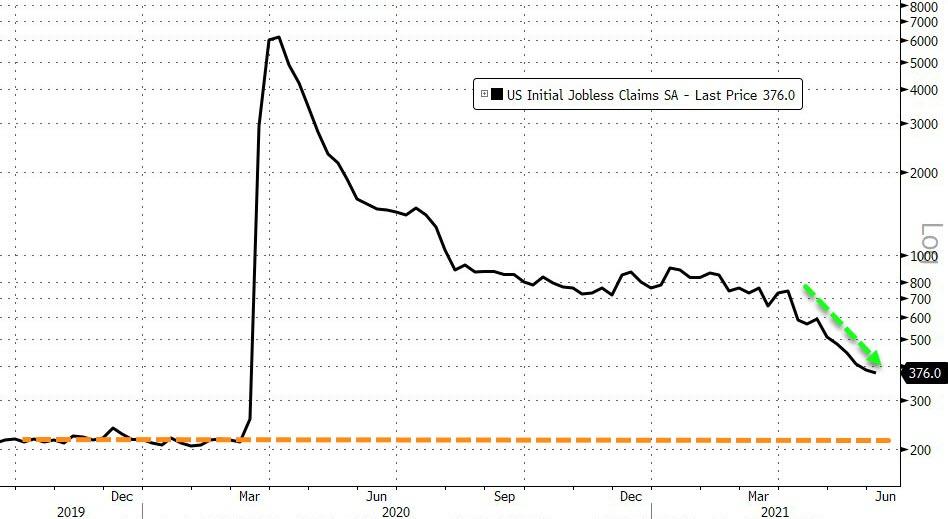
Source: Bloomberg
However, there are still over 15 million Americans on some form of government dole...
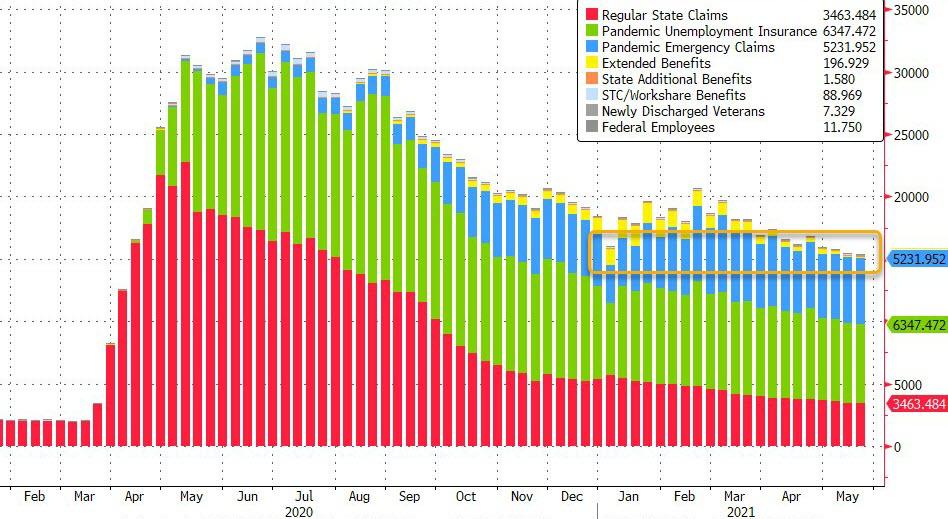
Source: Bloomberg
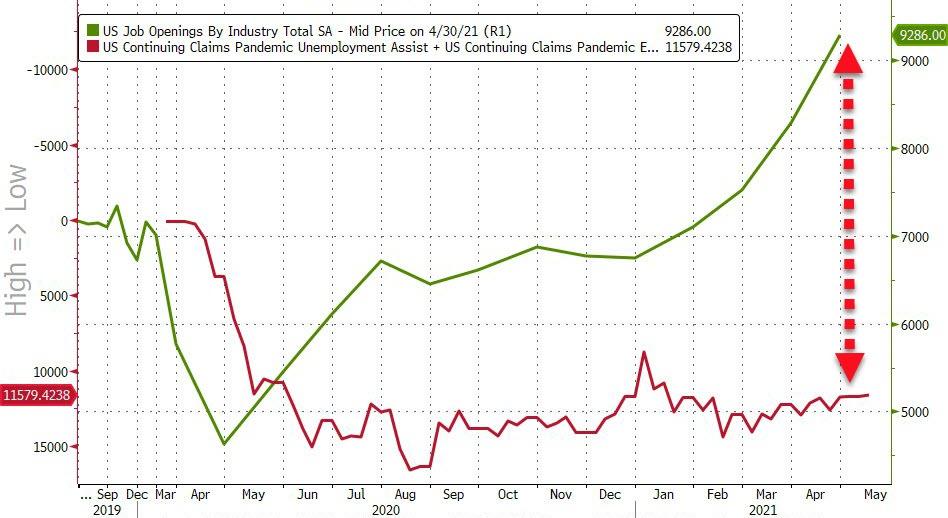
And despite over 9 million job openings, over 11 million Americans remain on some form of pandemic-specific unemployment benefits...
Source: Bloomberg
As the chart shows, there has been very little movement OFF the pandemic-based dole in over a year.
Will the Democrats ever allow those couch-sitters to be free of government handouts?