NYT : Apple Is Said to Have Turned Over Data on Trump’s White House Counsel in 2

Apple Is Said to Have Turned Over Data on Trump’s White House Counsel in 2018
The company notified Donald F. McGahn II last month that it had been subpoenaed for his account information three years ago.

WASHINGTON — Apple told Donald F. McGahn II, the White House counsel to former President Donald J. Trump, last month that the Justice Department had subpoenaed information about an account that belonged to him in February 2018, and that the government barred the company from telling him at the time, according to two people briefed on the matter.

Mr. McGahn’s wife received a similar notice from Apple, said one of the people, who spoke on the condition of anonymity to discuss a sensitive matter.

It is not clear what F.B.I. agents were scrutinizing, nor whether Mr. McGahn was their specific focus. In investigations, agents sometimes compile a large list of phone numbers and email addresses that were in contact with a subject, and seek to identify all those people by using subpoenas to communications companies for any account information like names, computer addresses and credit card numbers associated with them.

Still, the disclosure that agents secretly collected data of a sitting White House counsel is striking as it comes amid a political backlash to revelations about Trump-era seizures of data of reporters and Democrats in Congress for leak investigations. The president’s top lawyer is also a chief point of contact between the White House and the Justice Department.

Apple told Mr. McGahn that it complied with the subpoena in a timely fashion but declined to tell him what it provided the government, according to a person briefed on the matter. Under Justice Department policy, gag orders for subpoenas may be renewed for up to a year at a time, suggesting that prosecutors went to court several times to prevent Apple from notifying the McGahns earlier.

Spokespeople for Apple and the Justice Department did not immediately respond to requests for comment. A lawyer for Mr. McGahn declined to comment.

Apple told the McGahns that it received the subpoena on Feb. 23, 2018, according to a person briefed on the matter. The other person familiar with the matter said the subpoena had been issued by a grand jury in the Eastern District of Virginia.

It is not clear why prosecutors obtained the subpoena. But several notable events were occurring around that time.

One of the roughly concurrent events was that the federal court in the Eastern District of Virginia was the center of one part of the Russia inquiry led by the special counsel, Robert S. Mueller III, that focused on Paul Manafort, the onetime chairman of the 2016 Trump presidential campaign.

Because Mr. McGahn had been the top lawyer for the Trump campaign in 2016, it is possible that at some earlier point he had been among those in contact with someone whose account the Mueller team was scrutinizing in early 2018.

SIGN UP FOR ON POLITICS WITH LISA LERER: A spotlight on the people reshaping our politics. A conversation with voters across the country. And a guiding hand through the endless news cycle, telling you what you really need to know.
Sign Up
Notably, Mr. Manafort had been hit with new fraud charges unsealed the day before the subpoena. Subsequent developments revealed that Mr. Mueller’s investigators were closely scrutinizing some of his communications accounts in the days that followed.

Another roughly concurrent event was that around that time, Mr. Trump had become angry at Mr. McGahn over a matter related to the Russia investigation, and that included a leak.

In late January 2018, The New York Times had reported, based on confidential sourcing, that Mr. Trump had ordered Mr. McGahn the previous June to have the Justice Department remove Mr. Mueller, but Mr. McGahn had refused to do so and threatened to resign. The Washington Post confirmed that account soon after in a follow-up article.

The Mueller report, and Mr. McGahn himself in private testimony before the House Judiciary Committee this month, described Mr. Trump’s anger at Mr. McGahn after the Times article, including trying to get him to make a statement falsely denying it. Mr. Trump told aides that Mr. McGahn was a “liar” and a “leaker,” according to former Trump administration officials. In his testimony, Mr. McGahn said that he had been a source for The Post’s follow-up to clarify a nuance — to whom he had conveyed his intentions to resign — but he had not been a source for the original Times article.

There are reasons to doubt that Mr. McGahn was the target of any Justice Department leak investigation stemming from that episode, however. Among others, information about Mr. Trump’s orders to have Mr. Mueller removed does not appear to be the sort of classified national-security secret that it can be a crime to disclose without authorization.

Yet another roughly concurrent event is that the subpoena to Apple that swept up Mr. McGahn’s information came shortly after another one the Justice Department had sent to Apple on Feb. 6, 2018, for a leak investigation related to unauthorized disclosures of information about the Russia inquiry, ensnaring data on congressional staff members, their families and at least two members of Congress.

Among those whose data was secretly seized under a gag order, and who were only recently notified, were two Democrats on the House Intelligence Committee: Eric Swalwell and Adam B. Schiff, both of California. Mr. Schiff, a sharp political adversary of Mr. Trump, is now the panel’s chairman. The Times first reported on that subpoena last week.

Many questions remain unanswered about the events leading up to the politically sensitive subpoenas, including how high they were authorized in the Trump Justice Department and whether investigators anticipated or hoped that they were going to sweep in data on the politically prominent lawmakers. The subpoena sought data on 109 email addresses and phone numbers.

In that case, the leak investigation appeared to have been primarily focused on Michael Bahar, then a staff member on the House Intelligence Committee. People close to Jeff Sessions and Rod J. Rosenstein, the top two Justice Department officials at the time, have said that neither knew that prosecutors had sought data about the accounts of lawmakers for that investigation.

It remains murky whether agents were pursuing a theory that Mr. Bahar had leaked on his own or whether they suspected him of talking to reporters with the approval of the lawmakers. Either way, it appears they were unable to prove their suspicions that he was the source of any unauthorized disclosures; the case has been closed and no charges were brought.
FT : Greens vow to turn Germany into ‘socio-ecological economy’

Greens vow to turn Germany into ‘socio-ecological economy’
Environmental party approves election manifesto that calls for fast-tracking of transition to carbon neutrality by 2035

Germany’s Green party adopted an election manifesto on Sunday that vowed to transform the country’s economy and fast-track its transition to carbon neutrality by ten years to 2035.

Pledging to turn Germany into a “socio-ecological market economy”, Annalena Baerbock, the party’s candidate for chancellor, this weekend proposed a “pact with German industry”. Companies that became climate neutral and localised their production would receive compensation from the state, she said.

“To those who think too much climate protection endangers prosperity, I would like to say: Yes, in the past, our prosperity was based on burning coal, oil, and gas. But the 20th century is over,” Baerbock said. “The markets of the future will be climate-neutral . . . The question is not whether this will happen, but who will do it best. And I want us to be at the forefront.”

She and her party have come under heavy scrutiny ahead of parliamentary elections this September, which will not only mark the end of Angela Merkel’s 16 years as chancellor but see the eco-party field its first nominee for Germany’s top job. 

The Greens rode a wave of popularity after Baerbock’s nomination but rivals have argued its climate plans would cost individuals more — in terms of fuel and flights.

In the wake of fierce attacks from Merkel’s centre-right Christian Democrats and the centre-left Social Democrats, the Greens registered sixth-place in a state election last weekend. They have dropped to 22 per cent in the polls, with the CDU again at the top, with 28 per cent.

Baerbock, meanwhile, has been mired in a wave of criticism over delayed reporting of extra income and embellishing her curriculum vitae. 

The CDU and SPD, long Germany’s dominant parties and wary of the Green ascendance, have attacked its planned carbon tax of 60 euros per tonne, arguing it placed a heavy burden on lower-income citizens. Green leaders have struggled to convey their message that it will only cost citizens a few more cents more than the current government plan.

Delegates at this weekend’s conference broadly backed Baerbock, despite complaints from its younger leftwing base that the leadership’s plan is too moderate. Delegates rejected their proposal to further raise carbon prices, and backed a €500bn spending plan for the next ten years, based on a Green proposal to loosen Germany’s debt brake.

Changing the debt law, enshrined in the constitution, requires support from two-thirds of parliament, which analysts doubt the Greens can secure. But the party is keen to shake its image as the Verbotspartei (the party of bans) and portray itself as drivers of innovation and social justice.

That has done little to shift the tone of attacks. On Friday, a lobby group called the Initiative for a New Social Market Economy placed ads in nearly every major paper, portraying Baerbock in green robes as Moses, holding up two stone tablets with “new” Ten Commandments, including bans on flying and fossil fuel vehicles.

In promoting her economic plan, Baerbock explicitly referred to US President Joe Biden’s $1.9tn infrastructure plan and called for “a transatlantic alliance for climate neutrality”.

She also had some harsh words for European and German foreign policy, criticising the EU for its complacency over Chinese purchases of European infrastructure, and reiterated her rejection of Berlin’s support for the contested Nord Stream 2 pipeline. “Europe has sold itself short. Yet we are the largest economic community in the world,” she said. “We have everything we need to set our own standards . . . If we do not become more sovereign, others will decide for us.”

While pushing for a tougher line on China and Russia might be music to many ears in Washington, the Greens also vowed to renegotiate Germany’s pledge to Nato to spend 2 per cent of its budget on defence, a move likely to be unpopular with the Biden administration.

Stefan Müller, parliamentary directory of the CDU’s Bavarian sister party, the CSU, skewered the new platform as “the old familiar leftwing mix of redistribution, comprehensive state control and moralising know-it-allism”,

Achim Post, deputy head of the SPD parliamentary group, called it a “fiscal policy boondoggle,” arguing it was “dominated by the principle of hope instead of realism”.

Baerbock, smiling after 98 per cent of delegates voted in the platform, acknowledged the difficulties ahead. “That was the easy part,” she said. “Now the real campaign begins.”

(ZH) Citadel Settles Suit Alleging Former Senior Trader Shared Its Algorithmic "

Citadel Settles Suit Alleging Former Senior Trader Shared Its Algorithmic "Secret Sauce"

Citadel has reached a settlement with the British hedge fund it accused of trying to plunder one of its senior traders in an effort to get to its algorithmic "secret sauce".
GSA Capital Partners LLC and Citadel announced the settlement late last week after Citadel accused the fund of obtaining "closely guarded" trading strategies when it hired the employee in question, Vedat Cologlu, according to Bloomberg.
GSA said of the settlement that the two firms “recognize and respect the importance and value of the other’s rights over their confidential information and intellectual property.”
We first documented that Citadel was suing British hedge fund GSA Capital in January of 2020, after GSA attempted to hire Cologlu, allegedly in hopes of accessing the quant secrets at the core of Citadel's "ABC" automated trading strategy.
Recall, we wrote back in November of 2020 that Citadel was seeking around $40 million over claims that GSA was able to obtain information on the strategy via texts and WhatsApp.
Citadel argued late last year that GSA "can't unsee" and can't forget the information that was taken from Citadel's secret algorithm. Citadel is also moving to try and block GSA from using their trading model. GSA has argued that they found no "secret sauce" from a high-level description of the structure of a trading algorithm.
David Craig, a lawyer for Citadel Securities, said in late 2020: “GSA’s most senior managers now know where and how Citadel makes hundreds of millions of dollars in annual revenues. They cannot forget that information, or put it out of their minds.”
He noted that only 15 of Citadel's 3,000 employees ever had access to the "strategic logic" of the strategy. One of those employees was Cologlu, a 2007 Wharton grad and self-described "stat arb trader", who helped operate and administer the models whose "returns were notably high given the low level of risk it took on."
Citadel has claimed its "ABC" quant strategy cost more than $100 million to develop. In its lawsuit, Citadel alleged that the UK fund wanted Cologlu to hand over confidential information about the strategy:
GSA asked for sensitive information on his equity-trading including his profits and the speed of the trades. And then Cologlu handed over a plan that Citadel argues was based on its own confidential model, including the way the algorithm made predictions.
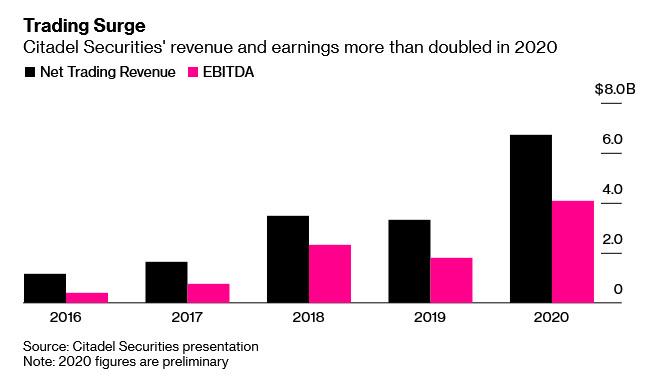
And there's good reason for the information to be coveted. Citadel Securities has been wildly profitable: the company posted a record $6.7 billion in revenue in 2020. This was almost double the previous high in 2018. The blockbuster result came after some of its traders moved from Chicago and New York to set up shop in a Palm Beach hotel in late March 2020 as the pandemic upended lives and markets across the globe. The results of the privately-held company were released in presentation to investors as part of a $2.5 billion loan Citadel Securities was seeking.
The Citadel securities trading arm started as a high-frequency market-maker in options before pushing into equities. Today, the firm dominates that realm and has had a very close relationship with the likes of the millennials' favorite trading platform, Robinhood. We documented back in September 2020 that Citadel now controls 41% of all retail trading.
GSA was spun out of Deutsche Bank AG in 2005 and manages around $7.5 billion. Citadel’s legal filing names GSA founder and majority owner Jonathan Hiscox as a defendant, alongside other officials including the chief technology officer.

WSJ : Hedge-Fund Manager Who ‘Came Undone’ Is Headed to Prison

Hedge-Fund Manager Who ‘Came Undone’ Is Headed to Prison
Dan Kamensky broke bankruptcy laws with a series of frantic messages over a few hours in a long-running fight over Neiman Marcus

On a summer Friday afternoon last year, hedge-fund manager Dan Kamensky broke bankruptcy laws. That evening on a recorded line, he pleaded with a banker to say the whole thing was a misunderstanding.

“Maybe I should go to jail,” Mr. Kamensky said on the call.

Mr. Kamensky reports to federal prison on June 18. His hedge fund is in the process of closing, and a career that included stints at white-shoe law firm Simpson Thacher & Bartlett and storied hedge fund Paulson & Co. has been wrecked.

“He came undone,” U.S. District Judge Denise Cote said during a court hearing on May 7.

Mr. Kamensky, 48 years old, worked in the high-stakes, high-conflict world of distressed investing, which aims to profit from companies teetering on the brink of or in bankruptcy. He launched his hedge fund, Marble Ridge, in 2015 with $20 million and was managing nearly $1 billion a few years later.

Running his own firm became stressful for Mr. Kamensky. He was anxious, had difficulty sleeping, lost weight and had trouble concentrating at the office or at home, he says. His fund, while it grew quickly, was still a relatively small player in the distressed market, which is dominated by giant private-equity companies, hedge funds and major law firms.

In 2017, Mr. Kamensky began working with a psychologist and a sleep specialist. He also consulted an executive coach, while in the middle of the day he would head to a meditation studio. He began to feel healthier and more relaxed, he says. He enjoyed family time again, playing games like Scrabble and doing crossword puzzles.

His efforts to control his emotions began to unravel in a bitter fight over struggling luxury-goods retailer Neiman Marcus Group Ltd. Things got worse in the coronavirus pandemic, which removed the support system of coaches and therapists that Mr. Kamensky had erected to help deal with his pressures.

Mr. Kamensky began buying bonds of the department-store chain in 2018 for about 60 cents on the dollar. Neiman was owned by private-equity firm Ares Management Corp. ARES 1.30% , which made an ill-fated bet that the chain could thrive despite an onslaught from online competitors. Neiman had one hidden gem; under Ares ownership it had acquired a thriving German online site called MyTheresa.

Interviews with Mr. Kamensky and court documents and transcripts show how the fight over MyTheresa led to Mr. Kamensky’s downfall.

Seeing the value of MyTheresa, Ares decided to separate it from Neiman, giving itself full control of the online site and leaving the bondholders with just the company’s bricks-and-mortar stores. The move borrowed from classic private-equity tactics, but still came as a surprise to Mr. Kamensky, who said he thought Ares had gone too far by taking a company’s crown-jewel asset for nothing in return.

“It’s like someone takes your wallet out of your back pocket on the subway and stares you right in the face while doing it,” he said. A spokesperson for Ares declined to comment.

In press releases that revealed his private letters to Ares’s board, Mr. Kamensky accused the private-equity firm of “lining its pockets” and “looting” Neiman. He said Ares broke the law by moving assets out of an insolvent company and had conflicts of interest. Word got out that he would sue to stop the deal.

Then Ares and Neiman fought back. James Sprayregen, a lawyer representing Neiman, warned that if Mr. Kamensky sued, “we’re going to come down on you like a pile of bricks,” Mr. Kamensky later testified. Mr. Sprayregen, a bankruptcy lawyer at Kirkland & Ellis LLP, didn’t return calls seeking comment.

Mr. Kamensky’s fund did file suit in 2019. Neiman responded, stepping up the fight by suing Marble Ridge for defamation, alleging that Mr. Kamensky’s lawsuit hurt the retailer’s business position. “A defamation suit is unheard of,” he says. While litigation is common in the world of distressed debt and restructuring, a defamation suit is unusual.

Neiman eventually agreed to restore nearly half of MyTheresa to its creditors. Almost all of the creditors went along, but Mr. Kamensky thought it was a bad deal and continued to push Ares to give more of MyTheresa to Neiman’s creditors. “It felt like I was tilting at windmills,” says Mr. Kamensky, a reference to the novel “Don Quixote,” which he loved as a youth.

With the battle over MyTheresa already joined, Covid-19 hit and Neiman filed for bankruptcy. Mr. Kamensky’s fund fell 12%, adding to his pressures.

‘There was a fuse exploding. I lost it.’— Dan Kamensky
Staying at his Long Island home because of the pandemic, he worked in a cramped bedroom that he had converted into an office. A puppy once relieved himself on Mr. Kamensky’s foot during a business call. Sometimes, after working late into the night, Mr. Kamensky slept in the same room.

It became difficult to work with his coach and consult with colleagues. “Everything became more ad hoc,” he says.

As one of the few Neiman bondholders opposing the chain’s restructuring plan, Mr. Kamensky took a seat on Neiman’s creditors’ committee, which was tasked with advocating for the rights of investors during bankruptcy proceedings. He had to act in the interest of all creditors, rather than push for things that would benefit only his firm.

Once again a deal was reached on MyTheresa but Mr. Kamensky rejected it. He had spent millions on the fight and wanted to have the right to buy a bigger stake in MyTheresa to potentially boost his fund’s profits. He would offer to buy the preferred shares in MyTheresa that would be issued to other creditors.

By July, he was close to getting what he wanted and his hedge fund had recouped about half of its losses. Mr. Kamensky was feeling optimistic. But on July 31, he was blindsided by word that another bidder was also trying to buy the preferred shares. The bidder, he learned, was investment bank Jefferies LLC, one of his longtime brokers.

He feared Jefferies could scuttle a deal he had been pursuing for more than two years, just days before completion.

At 3:20 that summer Friday afternoon, he texted Joe Femenia, his contact at Jefferies, “DO NOT SEND IN A BID.” In a phone call 20 minutes later with Mr. Femenia and Eric Geller, a Jefferies colleague, he yelled and cursed at the men, according to a Justice Department probe.

Mr. Geller not long after told a lawyer for the Neiman creditors committee that Jefferies wouldn’t bid because Mr. Kamensky told the firm to back off.

Mr. Kamensky realized he had violated the law. As a member of the creditors committee, he shouldn’t try to stop a higher bid that could benefit other investors.

Four hours after he made his threat, Mr. Kamensky called Mr. Femenia again. On the call, he pleaded with Mr. Femenia to tell a different story to authorities—that Mr. Kamensky wanted Jefferies to bid only if it was serious about going through with the deal. “I pray you tell them that this was a huge misunderstanding,” Mr. Kamensky said on the call, which was recorded by Mr. Femenia. He said he could go to jail without Mr. Femenia’s help.

The creditors committee lawyer filed a report on possible wrongdoing in bankruptcy court. Mr. Kamensky apologized while admitting his wrongdoing to Justice Department lawyers.

In September, Mr. Kamensky was arrested in a surprise raid at his home, and in February pleaded guilty to one charge of extortion and bribery related to the Neiman bankruptcy.

Upon entering prison on Friday, Mr. Kamensky faces weeks of solitary confinement in keeping with Covid-19 guidelines. After completing his six-month sentence, he could face a lifetime ban from serving as an investment adviser.

While waiting to go to prison, Mr. Kamensky has given lectures to business and law students about the dangers of intense stress and letting emotions undermine one’s judgment. He spoke at several graduate schools, including the NYU Stern School of Business and the Duke University School of Law. He wonders, if he had been in his office with colleagues around, would he have reacted so quickly and angrily.

Mr. Kamensky is a “good man, but one who lost his moorings,” Judge Cote said at his sentencing. She said it wasn’t clear to her whether his actions had caused economic harm to creditors. Prosecutors requested a sentence of 12 to 18 months. Mr. Kamensky will serve six months of probation after prison.

“I regret letting anger get the best of me,” Mr. Kamensky says.

WSJ : Facebook and Its Advertisers Feel Pinch of Apple’s Privacy Drive

Facebook and Its Advertisers Feel Pinch of Apple’s Privacy Drive
Recent changes in IOS operating system have diminished Facebook’s ad targeting abilities

Advertising relationships are often about the people who foster them. But when you are as big as Facebook, FB -0.36% relationships are about money.

On Wednesday, Facebook’s head of global advertising sales Carolyn Everson said she was leaving the company after more than a decade. Just a few months ago, Facebook’s revenue chief David Fischer said in a Facebook post that he would be leaving the company later this year.

These exits have led some to worry about the impact on Facebook’s advertiser relationships. Last year, for example, Ms. Everson played a big role keeping major advertisers on Facebook’s platform, despite civil rights-related boycotts of the social network, The Wall Street Journal reported.

Such relationships may be irreplaceable at a smaller company, but are perhaps less important to a platform as large as Facebook. Its legacy Blue app alone is used by roughly 36% of the world’s population monthly, while its broader family of apps are used by nearly 44%. That number of eyes has no equal.

The departures come at a particularly delicate time, though. Apple’s recent iOS operating system changes require developers to request users’ permission to track their online activity, a key way Facebook and other ad-based platforms were able to collect information about users in order to target them with ads. Facebook has been outspoken about its concern that tracking changes will disproportionately affect small businesses. That makes sense: As of the third quarter of last year, Facebook said it had over 10 million active advertisers on its platform, most of which were small businesses. Chief Executive Mark Zuckerberg has also said that as a business, he believes Facebook can manage through the changes and that it may emerge even stronger if it becomes harder for small businesses to navigate data targeting without Facebook’s help.

Facebook doesn’t regularly disclose the percentage of revenue that comes from small businesses, but investors got a hint of the proportion last year, when boycotts from large, well-known brands like Verizon Communications, VF Corp.’s North Face and Coca-Cola had little effect on its top-line performance. Because Facebook has historically offered small businesses a virtually unmatched return on their investment, these companies have little choice but to advertise on its platforms.

But the recent iOS changes could threaten some of that loyalty. Caitlin Tormey Mongiardini, chief commercial officer of cashmere clothing company NAADAM, said her company recently reallocated some of its marketing budget to focus on brand partnerships and other strategic marketing areas outside Facebook after hearing that the iOS update had been negatively affecting its peers. In some cases, she said fellow direct-to-consumer brands have seen their return on investment on Facebook cut in half.

Will Matalene, paid platform expert and digital marketing consultant, points out that in addition to diminished ad targeting abilities, Facebook is also now getting less data from Apple, making it more difficult for the platform to demonstrate returns to clients.

Ultimately, brands that have historically allocated large, set portions of their budgets to Facebook are becoming more nimble in terms of advertising channels, he said. While he doesn’t expect any brand can afford to pull all their money out from Facebook’s reach, he does see brands diversifying away from the company until it can come up with new ways to bolster its value proposition amid heightened focus on user privacy.

Facebook has said it expects iOS changes to begin to have an impact on its business in the current quarter. It is forecasting second-quarter year over year revenue growth to remain stable or modestly accelerate from the monster 48% growth it put up in the first quarter, but for growth rates to “significantly decelerate” sequentially in the third and fourth quarters.


Despite some advertisers reporting lower returns on their investments, pricing on Facebook’s ads has been rising. The company said on its first-quarter conference call that its average price per ad in the first quarter increased 30% year-on-year, even as impression growth has eased lately as last year’s homebound consumers are stepping back out. It expects ad revenue growth to be primarily driven by price for the remainder of the year.

To continue justifying rising prices in the face of a potentially lowered value proposition, Facebook will likely need a new game plan. The departure of two key ad executives only underscores that big changes could be afoot.

To Facebook’s advertisers and investors, the only faces that really matter are Benjamin Franklin’s rolling in.

WSJ : Winning Ticket to Join Jeff Bezos in Space Costs Nearly $30 Million in Blu

Winning Ticket to Join Jeff Bezos in Space Costs Nearly $30 Million in Blue Origin Auction
Winner of the charity auction will join the Amazon CEO on the first passenger flight next month

A ticket to go into space next month with Jeff Bezos went for almost $30 million, including the commission, in a charity auction Saturday, said Blue Origin LLC, the space company founded by the billionaire.

The winner of the live phone auction wasn’t revealed Saturday—Blue Origin said it had to complete final paperwork—but is expected to be named in two weeks.

The successful bidder will be among the passengers on the New Shepard vehicle’s first crewed launch planned for July 20 and spend a few minutes in space with Mr. Bezos, his brother Matt Bezos and an unnamed fourth would-be astronaut.

>>> Barron’s Weekend Summary

Barron’s Weekend Summary: Teenagers are increasingly investing in stocks on new apps, but adults need to watch out for “gamification” trading and social media hype

* Cover Story: Teenagers are allowed to trade stocks, and a new crop of mobile apps is making it easy for the to invest, trade, and following the market, using custodial accounts or tunneling in through other means—and while teens might not have much to invest, brokerage firms are eagerly courting them; Still, using these apps while not properly prepared could lead to formative experiences that eventually backfire, leading to more risk-taking later in life, or fear and risk aversion, and teens may also be vulnerable to “gamification” of trading and to social media trends.

* Tech Trader: FSLY's recent crash raises questions about the stability of the internet, cybersecurity vulnerabilities, and the company’s business, as well as those of other content delivery networks—investors seeking to be in CDN sector have cheaper options, such as AKAM, or stronger performers, such as NET.

* Trader: A recent drop in tech shares and a rise in the percentage of finance stocks when the MSCI USA Momentum index was rebalanced has changed its characteristics; Positive on UPS: Shares of the delivery giant are still a buy even after the past week’s disappointing investor event—the company’s pricing is strong, online shopping is growing, and new business opportunities are popping up in a post-Covid world; Falling bond yields could suggest that the market is starting to price in slower growth, and perhaps even a growth scare later in the year, something that would be bad for value stocks—but history suggests otherwise, says Sundial Capital Research’s Dean Christians.

* Interview: Lauren Taylor Wolfe and Christian Asmar, activist investors at Impactive Capital, which they founded in 2019, lean toward quality businesses with widening competitive advantages and the ability to generate free cash flow significantly in excess of what’s implied in their stock prices; they look for companies that can deliver a high-teens to low-20s percent annual return on their investments, and businesses where ESG improvements can help contribute to some of those returns (picks; WH, KBR, ABG).

* Profile: Mike Gush and Sophie Earnshaw are part of an eight-person team managing the $7.1B Baillie Gifford Emerging Markets Equities fund, which doesn’t have retail shares but is available to individual investors through custodial platforms; Its overarching goal is to find growth companies that have the potential to double in value within five years (top 10 holdings: TSM, BABA, Samsung Electronics, Tencent Holdings, Mediatek, Sberbank, Reliance Industries, Naspers, Norilsk Nickel, Ping An Insurance Group).

* Features: 1) Positive on LLY, Roche Holding, Eisai: The FDA’s approval of Adulhelm, BIIB’s Alzheimer’s disease therapy, opens the possibility of approvals for similar drugs that can clear amyloid plaque, but haven’t been proven definitively to slow cognitive decline, though the scientific consensus is still out on whether plaque clearance has clinical benefits; 2) Positive on Kinaxis: The Canada-based logistics software company stands to benefit from global shortages in a range of goods, including bleach, microchips, condiments, and pickup trucks—unlike rivals, it doesn’t manage supply chains, its products help to plan them; 3) In a fallow decade for income investors, with the financial crisis and the pandemic keeping short-term interest rates near zero, yield still exists in some corners of the market, and not just in relative terms—a handful of asset classes such as closed-end funds, business development companies, and mortgage REITs, pay out seven percent or more, and some investment vehicles offer yields in the double digits; 4) Cautious on TSM: The chipmaker sits at the nexus of a global semiconductor renaissance, supplying companies such as AAPL, QCOM, and Huawei, but shares are in a rare correction, down 15 percent since mid-February—instead of buying on the dip, long-term investors should hold off, because the upcoming quarters could be bumpy enough to send the stock down even more, making it a better deal later on.

* European Trader: Cautious on CD Projekt: The Warsaw-listed company continues to grapple with the buggy release of its “Cyberpunk 2077” videogame, and the shares have fallen by 38 percent this year, the third-worst among Stoxx Europe 600 companies, and down two-thirds from a 2020 high.

* Emerging Markets: Mexico has had everything going for it these past few years except president Andrés Manuel López Obrador, whose invectives against the rich and willingness to cancel predecessors’ state contracts have depressed investment since his 2018 election, leaving the nation of 128M with next to no growth.

* Commodities: “A rise in oil prices to $100 a barrel isn’t very likely anytime soon, analysts say, but traders are still placing bets on a price spike of as much as 30 percent by the end of 2022.”

* Streetwise: James West, an analyst at Evercore ISI, calls this the climate decade, and says the rise of electric vehicles will help make home solar ubiquitous—and Sunrun is his top pick for its scale.

FT : China’s sea-level rise raises threat to economic hubs to extreme

China’s sea-level rise raises threat to economic hubs to extreme
Commercial hubs at risk from higher tides and flooding unless cuts made to greenhouse gas emissions


Trillions of dollars of economic activity along China’s east coast, including $974bn in Shanghai alone, are exposed to oceans rising as a result of climate change this century, according to Financial Times analysis of unpublished data.

When fine-grained gross domestic product and population data is mapped against projections of rising oceans for the year 2100, it shows that some of China’s most important commercial hubs could suffer from higher tides and annual flooding, unless drastic cuts are made to greenhouse gas emissions.

The analysis combines sea-level estimates by Climate Central, a US-based non-profit, with unpublished data from researchers in Finland that breaks down 2019 purchasing power parity GDP per capita and uses population density to work out grid-by-grid estimates of growth.

The economic might of Shanghai, the leading Chinese financial centre built between the Yangtze River estuary and Hangzhou Bay, is most exposed to sea-level rise, with an estimated $973.7bn of 2019 GDP at risk.

Two cities within 100km to the west of Shanghai — Suzhou and Jiaxing — were ranked second and third out of the 34 cities in the data set, with $330.4bn and $128.8bn of 2019 GDP exposed respectively.

Beyond the densely populated metropolitan centres, other critical pieces of China’s industrial supply chains and high-tech research and development zones also face similar risks.

Among industrial landmarks found in the highly exposed areas are the headquarters of Alibaba; China’s largest ecommerce platform in Hangzhou city; the Suzhou industrial park that is home to Panasonic’s new China headquarters; and Tesla’s Shanghai gigafactory.


China’s Ministry of Ecology and Environment did not respond to a request for comment about the FT’s analysis.

Although tides are unlikely to rise to levels that would submerge infrastructure for decades, researchers warn that intensifying floods, storm damage and soil erosion, as well as reduced fresh water supplies, threaten to undermine economic growth far before then.

Separate estimates have also underscored the high levels of exposure for major Chinese commercial and manufacturing centres.

Guangzhou and Dongguan, both in southern Guangdong province’s Pearl river delta, sit at the top of a global ranking of flood-vulnerable cities from Maplecroft, a research firm based in Bath, UK.

The low-lying nature of the delta means that “even conservative sea level rise projections have serious implications for the region’s economy”, with about a fifth of Guangzhou’s urban area classified as high or extreme risk, Maplecroft wrote last year.


Despite the high degree of exposure, the effect of sea-level rise on economic growth has traditionally received little public attention in China.

China’s ocean administration releases annual reports tracking sea-level rise and storm surge. Chinese cities have built thousands of kilometres of seawalls and dykes in areas such as the Pearl river delta.

But neither the Chinese government nor researchers have as yet released global public estimates of rising sea levels for the coming decades. Officials have in the past rejected international projections, including those from Climate Central. 

Attention to the issue may be shifting, however, after President Xi Jinping elevated climate change mitigation by pledging China would reach “carbon neutrality” by 2060.

The annual blue book published by China’s National Climate Center in August 2020 said that, from 1980 to 2019, the average sea-level rise along China’s coasts was 3.4mm per year — 0.2mm per year above the global average.

FT : US charges Jho Low and ex-Fugee with 1MDB back-channel lobbying

US charges Jho Low and ex-Fugee with 1MDB back-channel lobbying
Prakazrel Michel and the Malaysian financier are also alleged to have sought the return of a dissident to China

The US has charged a Malaysian financier and a former member of the hip hop trio Fugees with back-channel lobbying to drop a probe linked to the 1MDB Malaysian state investment fund embezzlement scandal and to extradite a Chinese dissident based in the US. 

Jho Low, the alleged mastermind behind the fraud at 1MDB, and Prakazrel “Pras” Michel are accused of launching undisclosed lobbying campaigns in 2017 targeting the Donald Trump administration, according to a DoJ statement released on Friday.

Directed by Low and China’s vice minister of public security, Michel’s and the Malaysian financier’s alleged lobbying efforts sought to convince the US administration to quash the investigation of Low and others in relation to 1MDB and have a dissident sent back to China, the DoJ said. 

Michel and Low were accused of conspiring with individuals including Elliott Broidy, a former Trump fundraiser, and Nickie Lum Davis, an American businesswoman, who both pled guilty in 2020 to lobbying senior US government officials to throw out the 1MDB probe and deport the Chinese dissident. The DoJ said these efforts were ultimately unsuccessful. 

The financier and the artist were also charged with conspiring to commit money laundering. The hip hop star was also charged with witness tampering and conspiracy to make false statements to banks, according to the DoJ statement.

The new allegations highlight the intricate web linked to the 1MDB fraud, which involved illicit money flows across the world and extended to the top echelons of global politics.

The DoJ alleges a total of $4.5bn was misappropriated from the fund in a scandal US officials have labelled “kleptocracy at its worst”.

Malaysia, which is conducting its own investigation into the affair, is seeking to recoup billions of dollars funnelled out of 1MDB to buy luxury property, expensive art and to finance the Oscar-nominated film The Wolf of Wall Street. 

Lawyers for Low and Michel did not immediately respond to requests for comment on Saturday. Low, who also faces charges in Malaysia, has denied wrongdoing and remains at large.

Michel gained fame with the Fugees, a hip hop group including Lauryn Hill and Wyclef Jean that rose to stardom in the 1990s with hit singles such as Killing Me Softly and Ready or Not.

Low and Michel were charged in 2019 for allegedly making illicit contributions to the 2012 US presidential election campaign. The DoJ alleged Michel received about $21.6m from Low and redirected the money personally and through about 20 “straw donors”.

If convicted, the Malaysian financier faces imprisonment of up to 10 years per count while Michel could serve a maximum of 20 years in prison per count.