Closing Stock Market SummaryThe S&P 500 (+0.2%), Nasdaq Composite (+0.4%), and Dow Jones Industrial Average (+0.04%) closed slightly higher on Friday, with the S&P 500 setting another closing record high. The Russell 2000 (+1.1%) and iShares Micro-Cap ETF (IWC 154.77, +1.46, +1.0%) outperformed, as investors broadened out their risk exposure.
Trading conviction at the large-cap level wasn't that strong given the tight-ranged index performances and no sector in the S&P 500 gained or lost more than 1.0%. The information technology (+0.6%) and financials (+0.6%) sectors showed relative strength, while the health care sector (-0.7%) underperformed.
Interestingly, the 10-yr yield fell to a three-month low at 1.43% overnight before settling at 1.46%, or unchanged from yesterday's settlement. The CBOE Volatility Index (VIX 15.65, -0.45, -2.8%) closed at its lowest since February 2020, representing a pre-pandemic reset of the hedging premium.
This reduced hedging interest synchronized with the riskier bets made in micro-cap stocks today. Presumably, investors felt comforted in the idea that there's still some time left before the Fed formally communicates a shift in policy. The FOMC meets next week, but economists polled by Reuters expect the Fed to announce a plan to taper asset purchases in August or September.
Separately, consumer sentiment improved modestly following a drop-off in May, according to the preliminary June reading for the University of Michigan Index of Consumer Sentiment. The index checked in at 86.4 (consensus 83.5), versus 82.8 in May. Consumers, however, remained concerned about rising prices for houses and vehicles.
In corporate news, NVIDIA (NVDA 713.01, +16.01, +2.3%) set all-time highs after agreeing to acquiring DeepMap, a startup dedicated to building high-definition maps for autonomous vehicles. Vertex Pharma (VRTX 193.02, -23.75, -11.0%) dropped 11% after halting the development of a lung disorder drug.
The 2-yr yield was unchanged at 0.15%. The U.S. Dollar Index rose 0.5% to 90.51. WTI crude futures rose 1.0%, or $0.70, to $71.00/bbl.
Reviewing Friday's economic data:
- The preliminary June reading for the University of Michigan Index of Consumer Sentiment increased to 86.4 (consensus 83.5) from the final reading of 82.8 for May.
- The key takeaway from the report is that, even though inflation expectations softened some, rising inflation remained a top concern for consumers.
Investors will not receive any notable economic data on Monday.
- Russell 2000 +18.3% YTD
- S&P 500 +13.1% YTD
- Dow Jones Industrial Average +12.7% YTD
- Nasdaq Composite +9.2% YTD
‘Cyberpunk’ Has Been a Fiasco. Now Short Sellers and an Activist Are Circling the Videogame Maker.
Optimism was high for Warsaw-listed CD Projekt (ticker: CDR.Poland) ahead of the release of the Cyberpunk 2077 videogame, which features an actual Hollywood star, Keanu Reeves, and has been in development since 2012. But the release has been reminiscent more of Reeves flops such as Johnny Mnemonic than hits like The Matrix.
Sony Group (SONY) hasn’t allowed the Cyberpunk 2077 action game onto the PlayStation store because it’s so buggy, and Microsoft (MSFT) has put a warning notice on the XBox version.
Shares of CD Projekt have tumbled 38% in 2021, the third-worst among Stoxx Europe 600 companies, and the stock has dropped nearly two-thirds from its 2020 high.
Adam Kicinski, joint chief executive of CD Projekt, tried to put an upbeat spin on the game on an earnings call to discuss the company’s worse-than-forecast 65% drop in profit in the first quarter. “We can definitely observe a downward trend here,” he said, referring to the frequency with which the game crashes. “Given the recent improvement and motivation we have, we strongly believe that the game will prove a success in the long run.”
Short sellers are circling. Of the nine short positions that are large enough to be disclosed by Poland’s financial regulator, five are bets against CD Projekt.
On the other hand, Cyberpunk revenue represented nearly 60% of sales in the first quarter, even without it being on the PlayStation store, which would ordinarily be its second-biggest marketplace behind personal-computer downloads. The company declined to disclose overall Cyberpunk unit sales, or average selling prices.
On the analyst call, the company was peppered with questions about how many staffers are assigned to Cyberpunk 2077. Kicinski said there are about 300 people. Other videogame developers typically have thousands of staffers on a single game. Kicinski said CD Projekt is in an “intensive hire” process, and is looking to add workers in the Vancouver area in particular.
Analysts at Credit Suisse say the stock trades at about 29 times estimated 2022 earnings, a 25% premium to the sector, which they say is unjustified given the uncertainty of Cyberpunk and the small number of franchises it owns.
The U.K. activist investor Abri Advisors is now calling for the resignation of Kicinski and co-founder Marcin Iwinski—not an easy task, given that insiders hold a third of the company.
Abri CEO Jeffrey Tirman told Bloomberg News that the management couldn’t have intentionally made as many mistakes as it did. He said he wanted the company to put forward a public plan on how it intends to address its shortcomings and repair its brand. Tirman told Barron’s he didn’t wish to elaborate on his remarks.
The biggest bull is Alexei Gogolev, a J.P. Morgan Cazenove analyst who has a 330 zloty ($90) price target. The stock traded at a recent 169.76 zloty.
“Sony is likely to return CP77 to its digital store over the coming months, which we consider a key driver for investor and gamer sentiment around the game,” he wrote in a note to clients. “Assuming Sony resumes CP77 sales on its platform, we think the next big catalyst will be the release of the next-gen version, due to come out later in the year.”
The release of a Netflix (NFLX) television show based around its Witcher videogame, as well as a new version of the medieval fantasy game, could boost sales of that series in the second half of the year, he added.
Amazon, Other Tech Giants Could Be Forced to Shed Assets Under House Bill
Bill could force e-commerce giant to split into two companies or shed line of private-label goods
House lawmakers are preparing to propose bipartisan legislation that could require Amazon. AMZN -0.16% com Inc. and other technology giants to effectively split into two companies or shed their private-label products, according to people familiar with the matter and documents viewed by The Wall Street Journal.
The bill, which the people said could be announced Friday, could mandate structural separation of Amazon and other technology giants that Congress spent 15 months investigating as part of an inquiry into the size and power of Big Tech. Another bill that also could be announced Friday targets the ability of big tech companies to leverage their online platforms to favor their own products over competitors.
Each of the bills has both Republicans and Democrats signed onto it, with more expected to join once they are announced, according to a person familiar with the matter.
Called the “Ending Platform Monopolies Act,” a draft of the proposed structural separation bill reviewed by the Journal says: “It shall be unlawful for a covered platform operator to own or control a line of business, other than the covered platform, when the covered platform’s ownership or control of that line of business gives rise to an irreconcilable conflict of interest.” That language could change in the bill’s final draft.
The proposed legislation would need to be passed by the Democratic-controlled House as well as the Senate, where it would likely also need substantial Republican support. While Republicans are concerned about tech companies’ power, many are skeptical about changing antitrust laws.
The proposed bills are among five bills under consideration that aim to curb the dominance of tech giants including Apple Inc., AAPL +0.41% Facebook Inc. and Alphabet Inc.’s GOOG -0.42% Google in addition to Amazon. The other bills target issues such as data portability and the ability of large companies to conduct acquisitions that pose a competitive threat.
Rates, The Dollar, & The Fed's Dis-Inflationary Dilemma
As we move into the second half of 2021, interest rates and the dollar continue to shape the outlook.
Of course, much of the debate focuses on whether rates and the dollar continue to miss the bigger picture. For example, just recently, Jim Bianco tweeted a critical point.
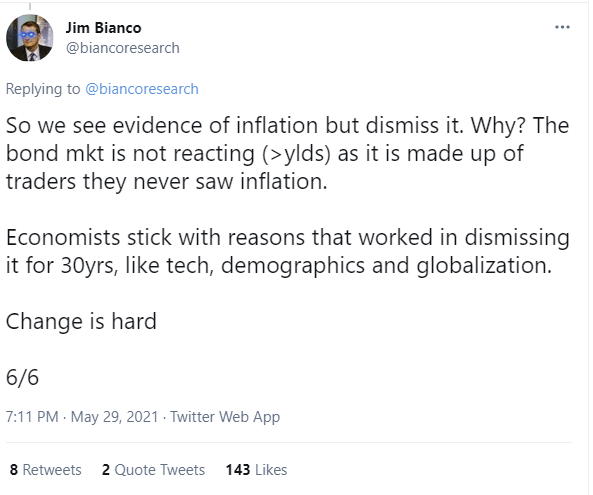
However, while I very much respect his opinion, I am not sure I entirely agree. Such is where the analysis of rates and the dollar suggests a different story.
The Inflation Premise
We previously discussed that inflation might indeed be more transitory given the drivers of increased prices were artificial. (i.e., stimulus, semi-conductor shortages, and pandemic-related shutdowns.) To wit:
“Inflation is and remains an always ‘transient’ factor in the economy. As shown, there is a high correlation between economic growth and inflation. As such, given the economy will quickly return to sub-2% growth over the next 24-months, inflation pressures will also subside.”
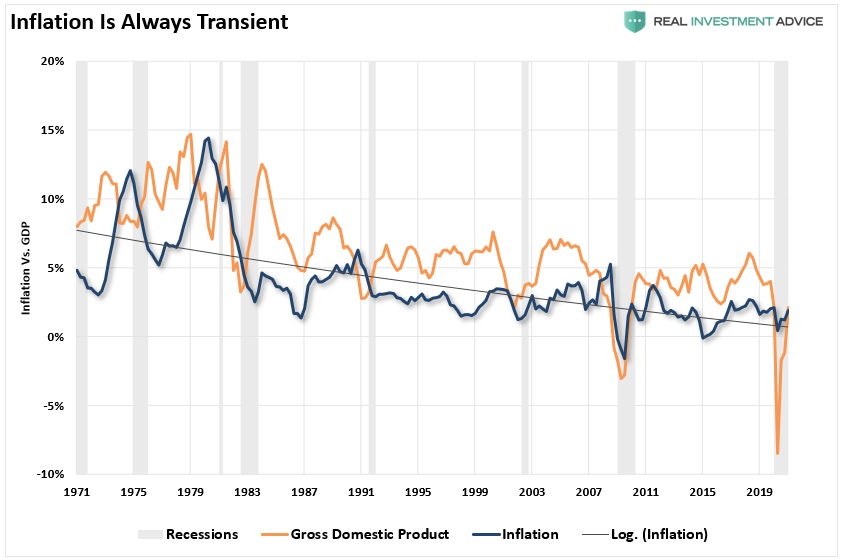
“Significantly, given the economy is roughly comprised of 70% consumption, sharp spikes in inflation slows consumption (higher prices lead to less quantity), thereby slowing economic growth. Such is particularly when inflation impacts things the bottom 80% of the population, which live paycheck-to-paycheck primarily, consume the most.”
However, another important factor behind inflationary pressures is an individual’s actions. As noted last week by Société Générale’s Albert Edwards:
“Surveys suggest that inflation fears have become investors’ number one concern. But why look at it that way? We could equally say it is investors’ own bullishness on the strength of this economic cycle that is driving prices sharply higher in the most cyclically exposed equity sectors and industrial commodities.”
Bloomberg’s John Authers discussed the same, noting a “reflexivity” to investors’ belief in rising inflation.
“In inflation, as in many other areas of economic life, perceptions can form reality, and that is certainly true of inflation. The University of Michigan monthly survey of consumers’ expectations perennially shows shoppers foreseeing more inflation than will in fact arrive. The important factor here is the direction of travel. If they are more worried about inflation, they will do more to guard against it, which will tend to push up prices.”
Psychological Inflation & China
Such is an important point, as Albert notes:
“When investors pile into commodities as an investment vehicle to benefit from rising inflation, they create substantial upstream cost pressures. Beyond the cascading effect of upstream commodity price pressures, headline CPIs are also quickly impacted as food and energy prices rip higher.”
In other words, investors cause inflation by their actions. However, this is where Albert keys in on another critical driver of inflation.
“In addition to this, the observation by investors that industrial commodity prices are rising only serves to reaffirm their belief about cyclical strength and rising inflation, most especially ‘Dr. Copper.” Many investors see copper as extremely sensitive to economic conditions.The circular, or as George Soros terms it, ‘reflexive’ nature of financial markets makes them extremely vulnerable to being whipsawed. Yet because of the current extreme momentum, it would take a very heavy weight of evidence to convince this market to reverse direction.We continue to highlight that commodity prices are at high risk of a major reversal because of the steep downturn in the Chinese Credit Impulse. We have highlighted this before and we are not alone. Julien Bittel of Pictet Asset Management posted the following chart.”

“When commodity prices do start to fall, expect a major reversal in inflation sentiment. Furthermore, expect momentum to become as self-reinforcing and reflexive on the way down just as it was on the way up.”
As we discussed previously, this is something the bond market already expects.
What Rates Are Saying About Inflation
While investors expect surging inflation, the bond market continues to price in weaker future economic growth. As noted in “No, Bonds Aren’t Over-Valued.”
“The correlation between rates and the economic composite suggests that current expectations of sustained economic expansion and rising inflation are overly optimistic. At current rates, economic growth will likely very quickly return to sub-2% growth by 2022.”
Note: The “economic composite” is a compilation of inflation (CPI), economic growth (GDP), and wages.
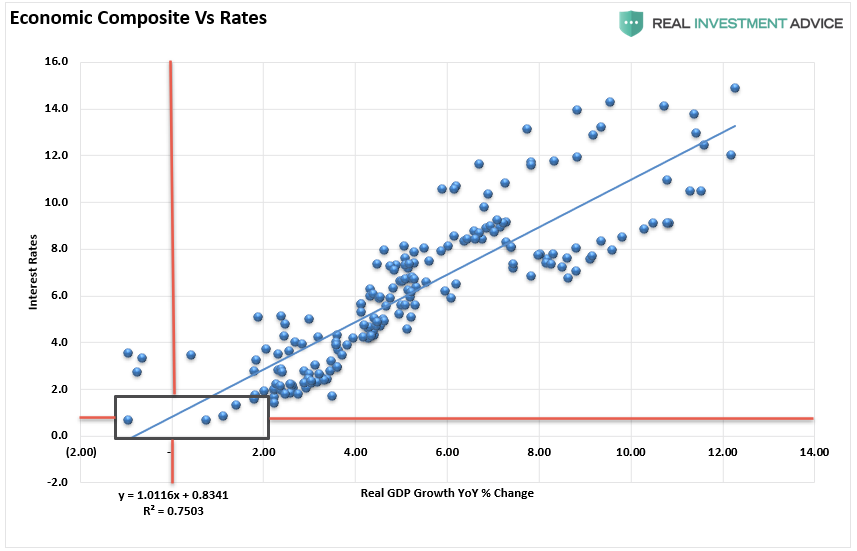
There is a fundamental reason why the bond market is pricing in deflation currently.
“The correlation should be surprising given that lending rates get adjusted to future impacts on capital.
The Fed Will Push Deflation
The problem for the Federal Reserve is that the fiscal and monetary stimulus imputed into the economy is “dis-inflationary.”
“Contrary to the conventional wisdom, disinflation is more likely than accelerating inflation. Since prices deflated in the second quarter of 2020, the annual inflation rate will move transitorily higher. Once these base effects are exhausted, cyclical, structural, and monetary considerations suggest that the inflation rate will moderate lower by year end and will undershoot the Fed Reserve’s target of 2%. The inflationary psychosis that has gripped the bond market will fade away in the face of such persistent disinflation.” – Dr. Lacy Hunt
The point here is that while economic growth may be booming momentarily, inflation, which is destructive when not paired with rising wages, will be transient. Given the massive surge in prices for homes, autos, and food, the reversal will cause a substantial disinflationary drag on economic growth.
The most considerable risk is a divergence among Fed policymakers which possibly leads to a policy mistake of tapering too quickly or even hiking rates.
The majority of the inflation and economic growth pressures are artificial, stemming from the stimulus injections over the last year. However, with those inputs fading as year-over-year comparisons become more challenging, the “deflationary” impact could be more significant than expected.
There is also one other point about the Fed tapering the purchases. As shown in the chart below, rates rise during phases of QE as money rotates from bonds to stocks for the “risk-on” trade. The opposite occurs when they start to taper, suggesting a decline in rates if “taper talk” increases.

The Story Of The Dollar
While many view the US Dollar as a proxy for economic strength, there is very little correlation between the currency on a short-term basis. However, as shown below, there is a long-term trend of the dollar’s value as compared to economic growth. In other words, the value of the dollar does reflect economic strength over the longer term.
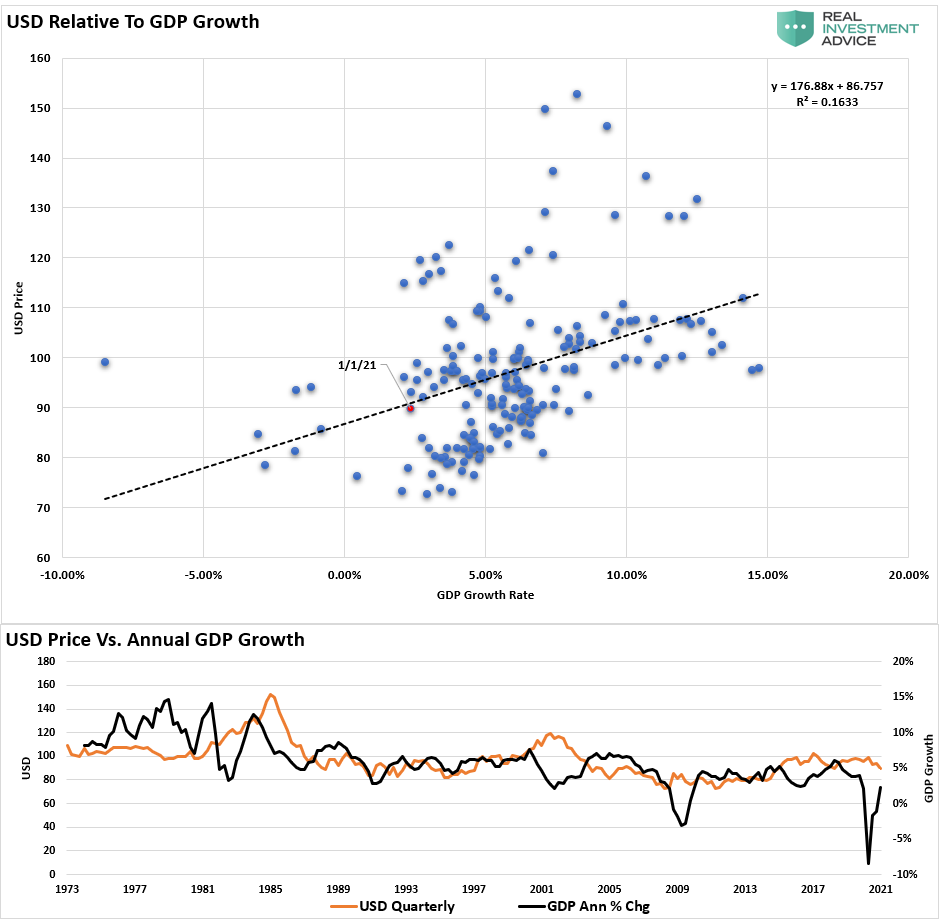
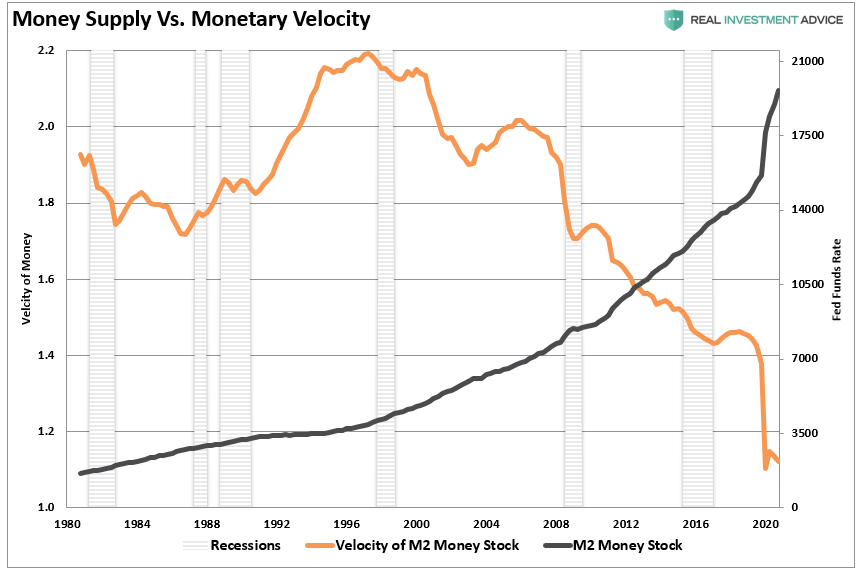
Currently, the U.S. dollar is weakening as the Government is flooding the system with liquidity. Now, the money supply is spiking, but given the relative surge in debt, the injections fail to spur an increase in monetary velocity.
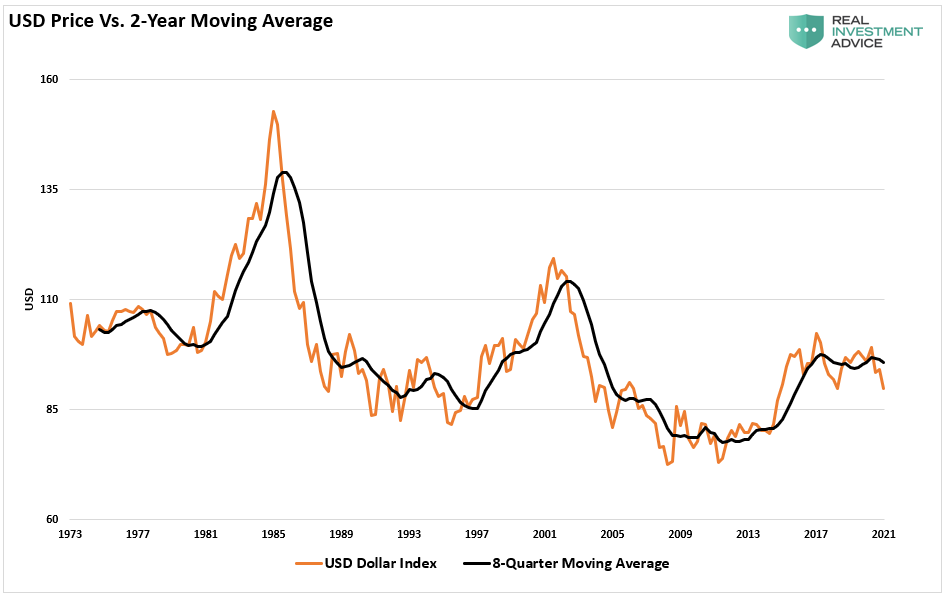
With the US dollar breaking down to the lowest level since 2014 and trading below its 2-year moving average, the risk of the dollar retrenching to “Financial Crisis” lows is not out of the question.
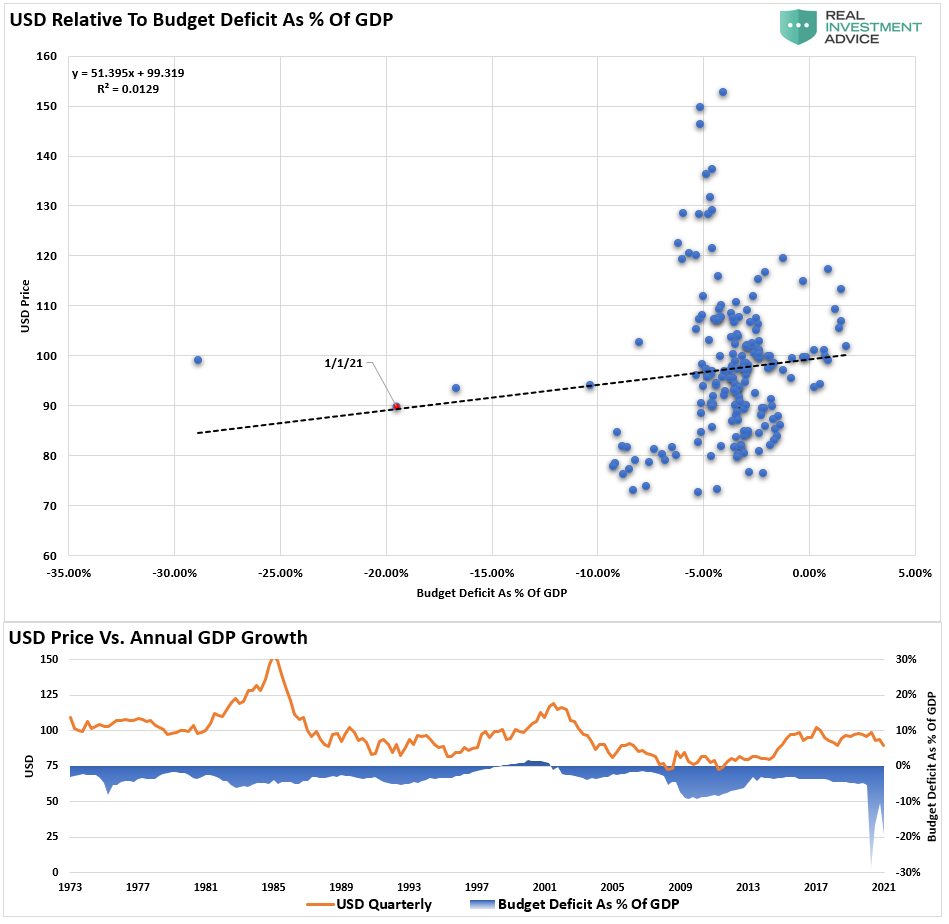
The massive increase in the US budget deficit as a percent of GDP also suggests that “deflationary” pressures weigh both on economic growth and the dollar. As Bryce Coward of Gavekal recently noted:
“The ballooning budget deficit suggests a level of 70 or 80 on the US dollar index over the coming years would not be out of the realm of possibilities. That would equate to a further decline of 11% to 22% from here. If the US dollar drops below $90 such would have fairly large ramifications for equities.”
The Fed May Be Right For The Wrong Reason
With double-digit rates of change in essential items like transportation (going back to work), food, goods and services, and energy, the impact on disposable incomes will come much quicker than expected. If we strip out “housing and healthcare,” which are fixed budget items (mortgage and insurance payments), we see that “household” inflation is pushing 5.86% annualized.
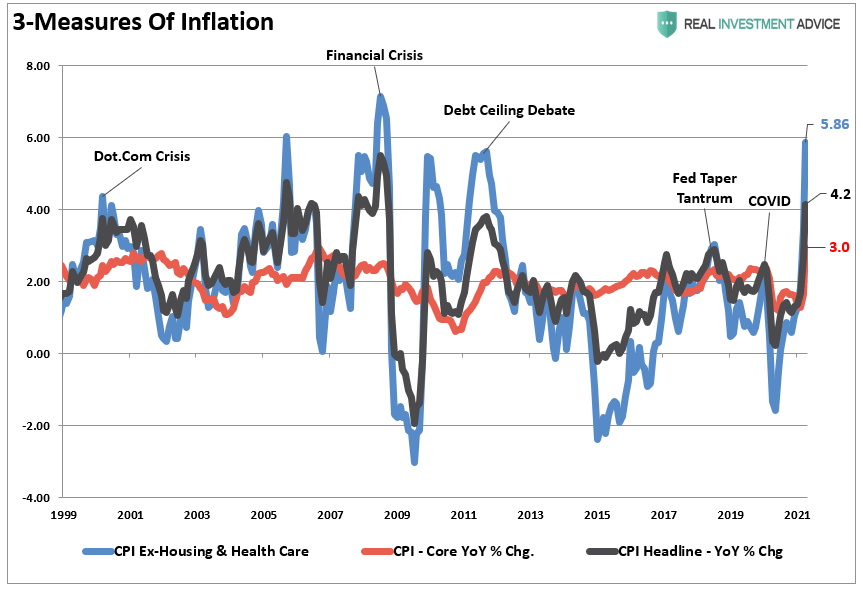
Such is particularly problematic when wages aren’t keeping up with inflation.
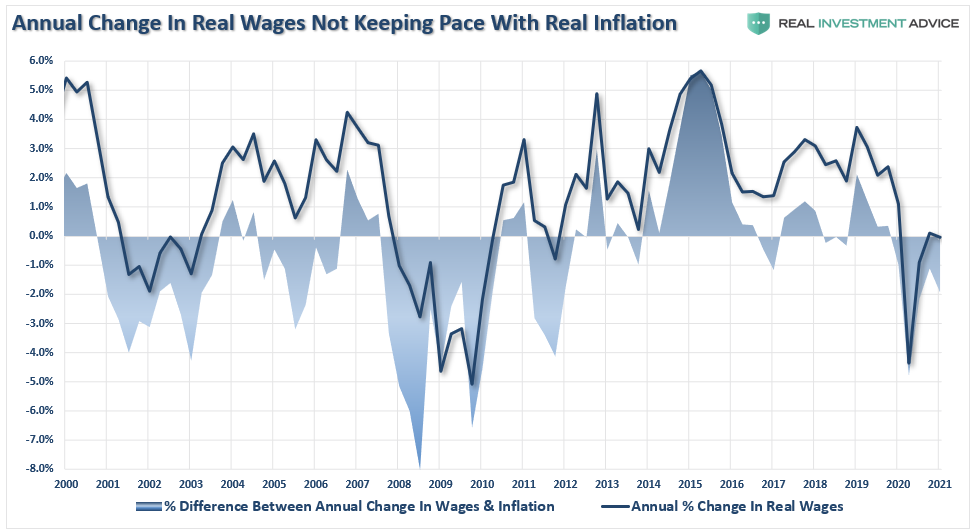
The Fed is probably right. Inflation will be transitory, but for all the wrong reasons.
Conclusion
There is a significant difference between a “recovery” and an “expansion.” One is durable and sustainable; the other is not.
Those expecting a significant surge in inflation will likely be disappointed for the one reason which seems to get mostly overlooked.
“If the economy was growing organically, which would create stronger rates of wage growth and inflation, then there would be no need for zero interest rates, continued monetary interventions by the Federal Reserve, or deficit spending from the Government.”
The obvious problem is that not all “spending” is equal. Pulling forward consumption through stimulus is indeed short-term inflationary but long-term deflationary. Since 1980, there has been a shift in the economy’s fiscal makeup from productive to non-productive investment.
As we have pointed out previously, you can not overstate the impact of psychology on an economy’s shift to “deflation.” When the prevailing economic mood in a nation changes from optimism to pessimism, participants change. Creditors, debtors, investors, producers, and consumers change their primary orientation from expansion to conservation.
- Creditors become more conservative and slow their lending.
- Potential debtors become more conservative and borrow less or not at all.
- Investors become more conservative, and they commit less money to debt investments.
- Producers become more conservative and reduce expansion plans.
- Consumers become more conservative, and save more, and spend less.
As we have been witnessing since the turn of the century, these behaviors reduce the velocity of money. Consequently, the decline in velocity puts downward pressure on prices. Given the massive increases in debt and deficits, the deflationary drag continues to increase as stimulus fades from the system.
Likely, the dollar and rates already figured this out.
Saudi Aramco Borrows Again to Fund Dividend Pledge Despite Oil Recovery
Ownership arrangement has led oil giant to stick by its commitment to make quarterly payments as rivals cut dividends
Saudi Aramco’s return to the global debt markets this week demonstrated the oil giant’s need to raise cash despite high energy prices, as it issued its inaugural dollar-denominated Islamic bond to meet a dividend pledge and complete a costly acquisition.
Saudi Arabian Oil Co., as the world’s largest listed oil company is officially called, raised $6 billion in Islamic bonds, or sukuk, on Wednesday, according to people familiar with the issue. It last sold $8 billion in conventional bonds in November when oil prices were floundering due to the coronavirus pandemic.
An Aramco spokesperson said the company was raising funds for general corporate purposes.
Oil prices have rebounded in recent months, easing some pressure on Aramco, but it would still need to borrow to meet its commitments, analysts said.
Aramco pledged to pay an annual $75 billion dividend in a bid to lure investors to an initial public offering in 2019. It also agreed to pay $69 billion for a majority stake in Saudi Arabia’s national petrochemicals firm in a deal encouraged by the Saudi government, which owns 98% of Aramco and relies on the dividends for much of its funding.
That ownership arrangement has led Aramco to stick by its commitment to make quarterly payments even as other big oil companies, such as Royal Dutch Shell PLC and BP PLC, cut their dividends last year to preserve cash, amid sharply falling oil demand and prices thanks to the pandemic.
The collapse in prices last year hit Aramco’s profits hard, forcing it to cut jobs, weigh the sale of assets, and review plans to expand at home and abroad, The Wall Street Journal has reported. Profits dropped 44% in 2020, and the company’s dividend payments dwarfed its free cash flow of $49 billion.
Oil prices have recovered significantly since the depths of last year, with Brent crude trading above $72 a barrel on Friday. A sustained rebound could help ease pressure on Aramco to borrow by improving its balance sheet.
Free cash flow in the first quarter of 2021 was $18.3 billion, just shy of the $18.75 billion dividend for the period. Strong oil prices helped beat analysts’ forecasts with a 30% rise in net profit, and net income rose to $21.7 billion from $16.7 billion a year earlier.
Yet Aramco’s debt levels still rose substantially, mainly because of its acquisition of chemicals maker Saudi Basic Industries Corp. Gearing—a measure of debt as a percentage of equity—increased from 0.2% at the end of 2019 and minus 5% in early 2020 to 23% by March this year, above the company’s self-imposed cap of 15%.
Aramco’s free cash flow is expected to end up between $66 billion and $70 billion for all of 2021, depending on “reasonable expectations” of oil price and production, said Mazen al-Sudairi, head of research at Riyadh-based Al Rajhi Capital. That would require the company to borrow $5 billion to $9 billion to meet its dividend obligation.
Mr. Sudairi said the government could adjust the share of its dividend in future years according to its budgetary needs and Aramco’s financial capacity.
Aramco sold a small sliver of itself on the local Saudi exchange in December 2019 after repeated delays over valuation and the venue for an international listing that was eventually scrapped. Earlier that year, it raised $12 billion via its debut international bond sale.
Analysts said investors who would normally be concerned about a company raising debt to help fund dividends are more acceptable to Aramco’s issuances, as it remains the world’s largest oil producer with one of the lowest costs of extracting oil among its peers.
Sukuk are structured to abide by Islam’s ban on interest payments, often by incorporating assets or cash flow in the underlying transaction. Issuers as a result are able to tap a wider pool of investors than with more conventional bonds.
Fresh Covid-19 Outbreaks in Asia Disrupt Global Shipping, Chip Supply Chain
Outbreak at one of the world’s busiest ports leads to global shipping delays; infections in chip supply chain worsen global shortage
HONG KONG—As Western economies roar back to life, a fresh wave of Covid-19 clusters in Asia—where vaccination campaigns remain in their early stages—is creating new bottlenecks in the global supply chain, threatening to push up prices and weigh on the post-pandemic recovery.
An outbreak at one of the world’s busiest ports in southern China has led to global shipping delays, while infections at key points in the semiconductor supply chain in Taiwan and Malaysia are worsening a global chip shortage that has hindered production in the auto and technology industries.
The new headaches add to inflation concerns, after China and the U.S. this week recorded their biggest annual jumps in factory-gate prices and consumer prices, respectively, in more than a decade. If such problems continue—and get worse—they could weigh on global growth.
For much of last year, China, Taiwan and many other parts of Asia kept the pandemic in check better than the U.S. and Europe and limited some of the economic damage. But as vaccination rates have risen in the West, governments have started rolling back restrictions and economies are revving up.
Immunization efforts in Asia, meanwhile, have lagged behind and authorities have largely kept in place tougher border controls to keep the virus out. Still, Covid-19 has spread. Thailand has been battered over the past two months by its worst ever surge of new cases, while Vietnam—an increasingly popular manufacturing hub that largely avoided earlier infection waves—has also suffered.
Low vaccination rates across Asia could keep in place social distancing rules and travel bans, which would disrupt manufacturing and suppress consumer spending.
“This is coming at a really fragile time when we’ve just started to see the global trade recovery pick up,” said Nick Marro, the Hong Kong-based lead analyst for global trade at the Economist Intelligence Unit.
At Yantian, a container port in the southern Chinese city of Shenzhen, an outbreak among dockworkers has brought traffic to a virtual standstill, putting more strain on an international shipping industry that has struggled with a persistent shortage of empty containers and a weeklong blockage in the Suez Canal earlier this year.
Some ships have had to wait up to two weeks to take on cargo at Yantian, with roughly 160,000 containers waiting to be loaded, according to brokers. The price of shipping a 40-foot container to the West Coast of the U.S. has jumped to $6,341, according to the Freightos Baltic Index—up 63% since the start of the year and more than three times the price a year earlier.
Yantian handled nearly 50% more freight last year than the Port of Los Angeles—the busiest American container port—and in the first quarter of this year it saw container volume surge by 45% from a year earlier. Activity at the port, which handles more than 13 million containers a year, is now at 30% of normal levels and the delays could persist for several weeks, says Hua Joo Tan, a Singapore-based analyst at Liner Research Services.
Lars Mikael Jensen, head of network for A.P. Moller-Maersk A/S, the Danish shipping giant, said the backlog in Shenzhen would be felt globally, affecting goods sold at Walmart Inc. and Home Depot Inc., companies that have established logistics bases around the port.
“It’s a huge and very active port and when you get delayed there, it has ripple effects on supply chains across the world,” said Mr. Jensen, whose firm is diverting 40 container ships from Yantian to other ports, including Hong Kong. The blockage of the Suez Canal lasted a week and it took 10 days to clear the backlog, he said.
“Here there is no end in sight. The Chinese will keep everything closed until they are certain Covid won’t spread,” he said.
Meanwhile, Taiwan, which accounts for a fifth of the world’s chip manufacturing capacity—including a significant proportion of the chips used in the automotive industry—is suffering its worst Covid-19 outbreak since the pandemic began.
At King Yuan Electronics Co. , one of the island’s largest chip testing and packaging companies, more than 200 employees have tested positive for the virus this month, while another 2,000 workers have been placed in quarantine—cutting the company’s revenue this month by roughly a third.
Meanwhile, other semiconductor companies nearby have been grappling with their own workplace outbreaks, according to officials in Taiwan’s Miaoli county, where the recent clusters have been concentrated.
Taiwan Semiconductor Manufacturing Co. , which alone accounts for 92% of the output of the world’s most sophisticated chips, says it has not yet been impacted, but the outbreak is happening next door to its headquarters in Hsinchu, Taiwan.
Given the already crippling global shortfall in the chip industry, the outbreaks in Taiwan’s tech sector “of course…will worsen the shortages,” says Brady Wang, a semiconductor analyst at Counterpoint Research.
Malaysia, home to a number of foreign-owned factories involved in chip making and producing capacitors, resistors and other key modules used in consumer electronics and cars, has also seen its production activity snarled by a wave of Covid-19 cases.
Infineon Technologies AG , a German semiconductor manufacturer with two factories in Malaysia, was told by health authorities to shut down one of its plants earlier this month, which has delayed some chip deliveries. The company’s other global factories are running at high capacity and aren’t able to pick up the slack, according to Gregor Rodehueser, a company spokesman.
After employees tested positive for Covid-19 at another Malaysia factory operated by Taiyo Yuden Co. , a Japanese manufacturer of electronics and semiconductor parts, the plant extended a holiday shutdown by 10 extra days, until Monday, as a precaution.
All told, the Malaysia Semiconductor Industry Association says the lockdown will reduce output by between 15% and 40%.
“It will disrupt the supply chain, somewhere, somehow,” said Wong Siew Hai, the group’s president.
The semiconductor shortage has trickled down to small businesses, who are feeling the impact of slower deliveries and higher prices.
“I got three cars with electrical problems and the parts are back-ordered with no release date,” said Hector Martinez, who runs Rye Auto Care in Rye, N.Y. “Everything that has to do with electronic parts comes in late. Tires are in short supply and parts prices have gone up by 20% over the past two months.”
Beyond hitting companies in the technology and automotive supply chains, the disruptions could add headwinds to China’s export sector—one of the strongest pillars in its economic recovery—and add to global inflationary pressures.
China has played a key role in suppressing global inflationary pressure as manufacturers have largely absorbed growth in input costs so far, said Shen Jianguang, chief economist at online retail marketplace JD.com Inc.’s finance unit in Beijing. But the latest port disruptions risk spilling over into higher consumer prices around the world.
The outbreak in Shenzhen’s home province of Guangdong, China’s most populous, which is responsible for roughly a tenth of the country’s economic output, has pushed some manufacturers there to raise prices and even temporarily halt production to avoid further erosion to their profit margins.
“It’s quite terrifying,” said Zhu Guojin, a consultant at logistics firm Jizhi Supply Chain Service Yiwu Co. “This is the first time that we’ve seen a decline in port capacity at such scale in China.”
While shipping prices to the U.S. have surged, Mr. Zhu says most of his clients, including Amazon.com Inc. vendors and some American importers, are paying up.
“Last year, many clients delayed shipping in the hope that the cost could come down. But that’s no longer the case,” said Mr. Zhu. “Most do not seem to care about prices anymore.”
Some government officials and analysts have played down the impact so far.
On Thursday, China’s Commerce Ministry spokesman Gao Feng said Guangdong province’s Covid-19 resurgence hadn’t yet led to a pronounced impact on foreign trade. Among the province’s roughly 2,000 exporters, more than half said new orders were still higher they were a year earlier.
Mr. Wang, the semiconductor analyst, is optimistic that the impact of the Taiwan outbreak on chip production will prove minimal, presuming things don’t get substantially worse.
It isn’t clear when the strains will subside. Because many governments in Asia are aiming to eradicate their Covid-19 cases, even if that means shorter-term economic pain, the situation for supply chains could get worse before it gets better.
“Right now the most important issue is to contain the outbreak at these specific companies and keep it from further spreading out,” said Patrick Chen, head of Taiwan research for CLSA, a brokerage. “If they cannot, then we will face a much more severe disruption.”
Some companies could also benefit from the snarled supply chains. Shares of several Chinese shipping companies, including Chinese state-owned Cosco Shipping Holdings Co. , one of the world’s largest cargo ship operators, saw its Hong Kong-listed shares surge by as much as 14% on Thursday to their highest levels in more than a decade on hopes for a sustained rise in container-shipping rates.