The Verge : Facebook plans first smartwatch for next summer with two cameras, he

Facebook plans first smartwatch for next summer with two cameras, heart rate monitor

A detachable display with cameras for capturing video without your phone

Facebook is taking a novel approach to its first smartwatch, which the company hasn’t confirmed publicly but currently plans to debut next summer. The device will feature a display with two cameras that can be detached from the wrist for taking pictures and videos that can be shared across Facebook’s suite of apps, including Instagram, The Verge has learned.

A camera on the front of the watch display exists primarily for video calling, while a 1080p, auto-focus camera on the back can be used for capturing footage when detached from the stainless steel frame on the wrist. Facebook is tapping other companies to create accessories for attaching the camera hub to things like backpacks, according to two people familiar with the project, both of whom requested anonymity to speak without Facebook’s permission.

The idea is to encourage owners of the watch to use it in ways that smartphones are used now. It’s part of Facebook CEO Mark Zuckerberg’s plan to build more consumer devices that circumvent Apple and Google, the two dominant mobile phone platform creators that largely control Facebook’s ability to reach people.

The planned device is Facebook’s first stab at releasing hardware specifically for the wrist, opening up another area of competition with Apple at a time when the two tech giants are already at odds on other fronts. Apple has aggressively positioned itself as a protector of privacy by limiting the kinds of data that apps like Facebook can collect, while Facebook has for years been besieged by scandals regarding its handling of user data. That dynamic could create an uphill battle for Facebook to convince people to buy its forthcoming Apple Watch competitor, especially since it plans to also position the watch as a fitness device with a heart rate monitor.

Facebook is working with the top wireless carriers in the US to support LTE connectivity in the watch, meaning it won’t need to be paired with a phone to work, and sell it in their stores, the people familiar with the matter said. The watch will come in white, black, and gold, and Facebook hopes to initially sell volume in the low six figures. That’s a tiny sliver of the overall smartwatch market — Apple sold 34 million watches last year by comparison, according to Counterpoint Research.

In future versions of the watch, Facebook is planning for it to serve as a key input device for its planned augmented reality glasses, which Zuckerberg thinks will one day be as ubiquitous as mobile phones. The company plans to use technology it acquired from CTRL-labs, a startup that has demonstrated armbands capable of controlling a computer through wrist movements.

Facebook aims to release the first version of the watch in the summer of 2022 and is already working on second and third generations for subsequent years. Employees have recently discussed pricing the device at roughly $400, but the price point could change. While it’s unlikely, Facebook could also scrap the watch altogether, as the device has yet to enter mass production or even be given an official name.

Facebook’s track record for making hardware is spotty. Its 2013 phone with HTC was a spectacular flop, and it has yet to disclose sales for its Oculus VR headsets or Portal video chat device for the home. In recent interviews, executives have said that sales for the Oculus Quest 2 headset have surpassed all previous Oculus headsets combined.

Facebook’s interest in building a smartwatch dates back at least a few years. It looked at acquiring Fitbit in 2019 before Google bought the fitness wearable maker. Since then, the social network has spent roughly $1 billion to develop the first version of its watch and has hundreds of people working on the effort, according to one of the people with knowledge of the matter.

A Facebook spokesperson declined to comment for this story. The Information earlier reported that Facebook was building a smartwatch with health and messaging features, but details about its cameras and other specifics in this story are new.

Using a custom version of Google’s Android operating system, Facebook plans to lean on its suite of apps and external partnerships to create compelling experiences for the watch, which will include a companion app for phones. Even still, Facebook’s wrist wearable resonating with people is far from guaranteed. Smartwatches with cameras on them have so far failed to catch on, and Apple has cornered the high end of the market already.
WWD : Lanvin’s Chinese Parent Is the New Owner of Sergio Rossi

Lanvin’s Chinese Parent Is the New Owner of Sergio Rossi
Fosun Fashion Group acquired 100 percent of the luxury shoemaker from European investment house Investindustrial.

China’s Fosun Fashion Group has beefed up its luxury holdings with its second Italian acquisition, snapping up storied footwear specialist Sergio Rossi — and plotting an expansion drive in Asia.

Divulging the transaction exclusively to WWD, Fosun said it acquired 100 percent of Sergio Rossi SpA from Absolute Luxury Holding Srl, an independently managed subsidiary of European investment house Investindustrial, adding to a portfolio that includes French house Lanvin, Austrian hosiery specialist Wolford, Italian men’s wear company Caruso and American fashion brand St. John.

Financial terms were not disclosed.

The development suggests that Fosun Fashion Group is still on the lookout for acquisitions — and carefully constructing its luxury portfolio. It also underscores heightened investor interest in the footwear category, with Christian Louboutin, Birkenstock and Dr. Martens all involved in recent deals or initial public offerings, and Adidas in the process of seeking a buyer for Reebok.

“This acquisition not only completes a more well-rounded strategic brand ecosystem for FFG, but also creates potential synergies between brands through Sergio Rossi’s fully owned and state-of-the-art factory,” Fosun said in a statement, trumpeting itself as “one of the first movers to create a global luxury fashion group in China.”

It is understood FFG beat out a long list of suitors with its commitment to develop the brand for the long term, and its formidable muscle in China. In recent years, Sergio Rossi chief executive officer Riccardo Sciutto has succeeded in reorganizing the company, modernizing its manufacturing plant in Italy’s San Mauro Pascoli, a key footwear district, and giving a precise identity to the product in sync with the late namesake founder of the brand.

In an interview on Wednesday, FFG chairman Joann Cheng said she spies many potential synergies.

“We can foresee the product development and production of shoe products for Lanvin and St. John by utilizing Sergio Rossi’s state-of-the-art manufacturing plant and the team of over 150 experienced artisans working on prototyping and shoemaking,” she said. “We can also foresee interesting collaborations between the brands, whether it’s Sergio Rossi x Lanvin, St. John or Wolford, as these four brands are all known for their dedication to the femininity, elegance and confidence of contemporary women, with a strong focus on craftsmanship.”

Cheng noted that Sergio Rossi is the first vertically integrated luxury accessories brand in FFG’s portfolio, and echoes its penchant for companies with strong savoir-faire and integrated factories, as is the case for Wolford, Caruso and St. John.

Among development priorities for Sergio Rossi are:

• enhancing local teams and strategies for the Greater China market, just as FFG did for Lanvin and its other brands;

• reinforcing Sergio Rossi’s digital and omnichannel business, which was initiated in 2018 and still has “huge room for improvement,” according to Cheng;

• burnishing brand awareness globally with an upgraded marketing spend, and other tactics.

“We believe Sergio Rossi has a solid ground for exponential growth in the coming phase,” Cheng told WWD, touting its “beautiful brand name and heritage, its first-class production know-how and facility, and its established product collections and distribution channels.”

At present, Sergio Rossi counts eight directly operated stores in mainland China and four in Hong Kong, plus a few franchised stores in the region.

Over Zoom, Cheng described “huge potential” for the brand in Greater China, given its “very strong DNA,” reputation for elegance and comfort, and haute craftsmanship. She also highlighted that leather goods are well suited for online distribution, and Sergio Rossi has plenty of “untapped” potential to expand in this channel.

Wearing a striking Lanvin blouse with billowing sleeves, Cheng explained that FFG has been looking at footwear and leather goods firms since 2018, and visited numerous manufacturers in France and Italy.

She noted there would be no changes in Sergio Rossi management.

“The current leadership of the company has demonstrated their strong commitment and ability to develop the brand,” she said. “They will continue leading the company with the support from FFG, which — besides capital — can also bring vast expertise and resources in the Asian market and digital space, the two major growth pillars for the brand in the next years.”

Cheng touted Sergio Rossi’s rich heritage, describing the company’s archive of more than 6,000 shoes and 13,000-plus digitalized documents as “luxuriant material and inspiration for the design of Sergio Rossi’s current products.”

“Going forward, the DNA and positioning of the brand will remain unchanged, which is a core thesis for us to cultivate any brand under FFG,” she explained. “But we will aim to bring more innovation and excitement to it in terms of how the collections are structured on top of its classic lines, how the story is told in a digital atmosphere among today’s consumers, as well as how to play with a localized strategy in different markets.”

She noted newness could come from updates of the brand’s classic lines, new collections, “experiments by collaborating with different creative talents or a different way of storytelling that’s adapted to today’s environment and consumers.”

Investindustrial ran Sergio Rossi since 2015, when it acquired the Italian shoemaker from French luxury group Kering.

Michael Guan, chairman of Asia at Investindustrial, noted that due to its globalization efforts, “sales in Asia, and in particular China, grew significantly to become the key region for Sergio Rossi. We believe FFG, with its strong position in China and Asia, is an ideal new owner to help Sergio Rossi expand in the region.”

Rothschild served as adviser to Investindustrial.

“I strongly believe in this project, which will be developed in continuity,” said Sciutto, who told WWD he is a co-investor in the vehicle Fosun set up to acquire Sergio Rossi. “While the agreement opens ups a new phase of the company, my staying on is also a sign of this consistency.”

The executive, who joined Sergio Rossi in 2016, highlighted the uniqueness of it manufacturing plant, which produces around 200,000 pairs of shoes per year. Sciutto spearheaded a return to the origins of the company, when Sergio Rossi produced for the likes of Azzedine Alaïa, Versace, Moschino, Dolce & Gabbana, Gucci, Yves Saint Laurent and Bottega Veneta, by inking new manufacturing agreements with other brands, such as Bottega Veneta and Amina Muaddi for spring.

Cheng thanked Investindustrial for its “investment, commitment and leadership over the past five years and we look forward to carrying the legacy of Sergio Rossi forward into this new chapter.”

Sergio Rossi, which closed 2020 with revenues of 60 million euros, operates 64 boutiques, of which 45 are directly owned flagship stores in prime luxury locations across EMEA, Japan and Greater China, and the balance franchise locations.

A footwear legend who built one of Italy’s most admired luxury shoe brands and who inspired generations of designers, including his son Gianvito, Sergio Rossi died last year at age 84 of COVID-19. Since founding his brand in 1951, Rossi developed a number of groundbreaking styles, such as the Opanca sandal with its curved sole.

Launched in 2017 and based in Shanghai, Fosun Fashion Group is the fashion arm of the Chinese multinational conglomerate Fosun International Limited. In 2018, the group entered the luxury game by acquiring a majority stake in Lanvin.

Underscoring its expertise in Asia, FFG recently formed a strategic alliance with e-commerce firm Baozun, Activation Group and other industry players to strengthen its ability to capture China’s fast-growing demand for luxury brands. As part of the partnership, Baozun and Activation became minority shareholders in Fosun Fashion Group, and the preferred partners for all brands in FFG’s portfolio, as well as in exploring new business models and solutions for brand expansion, as reported.

Fosun International is a consumer conglomerate that has operated in tourism, sports, food, entertainment, health care, pharmaceuticals, insurance and other sectors since it was founded in 1992. It is present in more than 20 countries and manages more than $117 billion in total assets.

FT : Altice buys £2bn stake in BT

Altice buys £2bn stake in BT
Patrick Drahi’s group becomes the largest shareholder in the UK telecoms operator

Altice, the telecoms investor controlled by billionaire Patrick Drahi, has taken a 12.1 per cent stake in BT, worth £2bn, in a move aimed at backing the UK telecoms company’s fibre push.

The acquisitive company, which has bought telecoms networks in France, Israel, Portugal and the US in the past, has established a UK company separate from its main operations to make the investment in BT.

It said it does not intend to make a bid for the British company, meaning that under the takeover code it cannot make an unsolicited buy out offer for six months without the approval of BT’s management.

Altice bought the shares this week through banks but only informed BT’s management on Wednesday that it had become the largest shareholder in the company. Deutsche Telekom owns a 12 per cent stake in BT.

Drahi believes that BT is best placed to take advantage of the huge investment in upgrading Britain’s broadband networks to full-fibre that is not reflected in its share price.

“BT has a significant opportunity to upgrade and extend its full-fibre broadband network to bring substantial benefits to millions of households across the UK,” said Drahi. “We fully support the management’s strategy to deliver on this opportunity.”

BT’s chief executive Philip Jansen has said that the company needs long-term investors as it embarks on capital expenditure-heavy network upgrade.

The move comes as BT searches for a chair to replace Jan du Plessis who is due to step down in the summer after a boardroom fracas.

“We welcome all investors who recognise the long-term value of our business and the important role it plays in the UK,” BT said in a statement on Thursday. “We are making good progress in delivering our strategy and plan.”

Altice delisted its shares in Amsterdam last year after arguing they were undervalued.

>>> Europe : Brokers Upgrades & Downgrades - 10th of June 2021 V2(+)

>>> Up
* Alrosa Raised to Buy at Citi
* Remy Cointreau Raised to Buy at Goldman; PT 190 euros
* SpareBank 1 SR Raised to Buy at Arctic Securities; PT 123 kroner
* Stroeer Raised to Overweight at Morgan Stanley; PT 82 euros
* Telefonica Raised to Buy at Berenberg; PT 4.80 euros
* Wacker Neuson PT Raised to 161 euros from 131 euros at Barclays (+)
* Warimpex Finanz Raised to Buy at Raiffeisen Bank; PT 1.50 euros
* Whitbread Raised to Add at Peel Hunt; PT 3,600 pence

>>> Down
* Ageas Cut to Neutral at Mediobanca SpA; PT 53 euros (+)
* Amadeus Cut to Neutral at Goldman; PT 65 euros
* BMW Cut to Hold at Stifel; PT 116 euros
* CA Immo Cut to Hold at Raiffeisen Bank; PT 40.50 euros
* Clinigen Cut to Hold at Stifel; PT 680 pence (+)
* Dios Cut to Hold at Pareto Securities; PT 92 kronor
* KWS Saat Cut to Hold at Stifel; PT 82 euros
* Orange Cut to Underweight at Barclays; PT 9.50 euros
* Pennon Cut to Neutral at Citi; PT 1,072 pence
* Pennon Cut to Sector Perform at RBC; PT 1,075 pence
* S Immo Cut to Hold at Raiffeisen Bank; PT 22.50 euros

>>> Initiation
* Air Liquide Rated New Underperform at Wolfe; PT 144 euros
* Darktrace Rated New Buy at Berenberg; PT 450 pence
* Darktrace Rated New Buy at Jefferies; PT 500 pence
* Kid ASA Cut to Hold at Arctic Securities; PT 120 kroner (+)
* Nilar International Rated New Buy at Berenberg; PT 80 kronor
* Seco Rated New Buy at Goldman; PT 5.20 euros
* Seco Rated New Outperform at Mediobanca SpA; PT 4.25 euros (+)
* Senior Resumed Add at Peel Hunt; PT 168 pence

>>> Call
* Amadeus Downgraded With Goldman Seeing Shares as Fully Valued (+)
* CMC Markets’ Strong Performance Seeing Continuing in FY22: RBC (+)
* Darktrace Gets Buy Ratings on Good Positioning in Cyber Market
* Go-Ahead Trading Robust, Peel Hunt Raises Profit Estimates (+)
* Halma FY Results ‘Nicely Ahead’ of Expectations, Jefferies Says (+)
* Nilar International to Benefit From Energy Transition: Berenberg
* Pennon Downgraded at RBC and Citi on Valuation Grounds
* Remy Raised to Buy at Goldman on Cognac Potential in U.S., China (+)
* Telefonica Shares ‘Overly Hated,’ Berenberg Upgrades to Buy
* Whitbread Raised at Peel on Market Share Opportunity, IHG Reduce

(ZH) "We're On Fire": Amidst NYC Exodus, Demand For Commercial Office Space In P

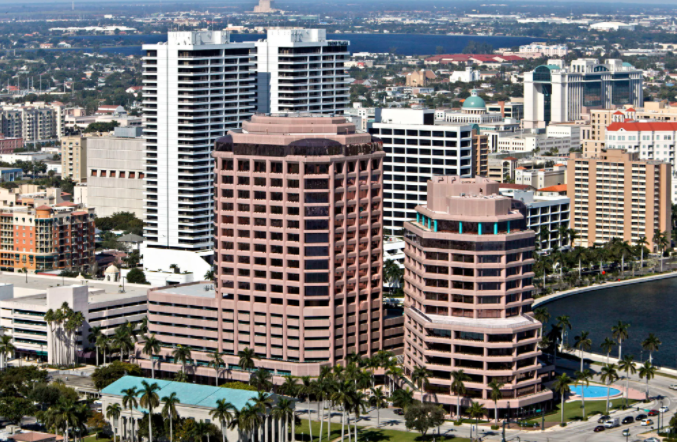
"We're On Fire": Amidst NYC Exodus, Demand For Commercial Office Space In Palm Beach Is Off The Charts

With Wall Street firms tripping hand over foot to get out of New York, where taxes and crime are both on the rise, places like Palm Beach, Florida, are the beneficiaries. We have noted numerous firms, including names like Point 72 and Goldman Sachs, branching out and/or leaving New York altogether in favor of greener pastures in Florida, since the pandemic started.
Amidst the Wall Street exodus, Palm Beach office space demand is off the charges. The city has officially become a "hot market" for commercial real estate, according to a new report from BNN Bloomberg. As a result of the boom, Manhattan developer Related Cos. "has been accelerating investments in West Palm Beach and now controls about a third of its downtown office stock," the report notes. Related is the company behind NYC developments Hudson Yards and the Columbus Circle tower.
Now, the company is betting on a continued boom in South Florida even after Covid restrictions are lifted.
Kelly Smallridge, president of the Business Development Board of Palm Beach County, told BNN: “The pandemic has really showed executives that they could do business anywhere, Developers are at the drawing board right now to develop more space to accommodate all of this growth. We’re on fire.”
Related has bought three buildings in West Palm Beach this year, including one that will house Point 72. It'll now own 1.6 million square feet (149,000 square meters) of offices in the area.
New York-based Cohen Brothers Realty has also proposed a 400,000 square foot office tower in West Palm, the report notes. Developer Jeff Green has a mixed use project called One West Palm currently under construction, as well.
Gopal Rajegowda, a partner at Related Southeast, said: “We feel West Palm is one of the fastest-growing commercial markets. With more people thinking about lifestyle now, a lot of these companies say, ‘hey, we want to be in South Florida, so why don’t we put a stake in the ground now?’”
BNN estimates that about 59,000 people from the New York area spent "at least eight weeks" in Southeast Florida last year. 42% of those went to Palm Beach County, which gained 11,000 new residents during 2020.
The city's 360 Rosemary tower is now more than 95% leased, compared to 30% six months ago. Mark Pateman, managing principal with Cushman & Wakefield Plc’s West Palm Beach and Boca Raton offices, said: “It would normally take way longer to lease. I am seeing a lot of non-local brokers walking through our buildings dragging Florida brokers in tow.”
One of the reasons Palm Beach is filling up so quickly is because of its small size. It has about 2.9 million square feet of office space, compared to 253 million square feet in Midtown Manhattan. Because of its small size, it's also tough to consider West Palm's boon as a major sea change.
Pateman concluded: “We’ve got a good run here, we have another two years of tailwinds from Covid, but is New York going away? Absolutely not. It’s overstated to say this is a paradigm shift.”

(ZH) Goldman Explains Why The Economy Won't Overheat, No Matter What Tomorrow's

Goldman Explains Why The Economy Won't Overheat, No Matter What Tomorrow's CPI Shows

Yields on 10-year Treasuries dipped below 1.50% today for the first time since early March amid a furious short squeeze discussed earlier...
... and as post-pandemic inflation concerns appear to be waning as quickly as they flared up.
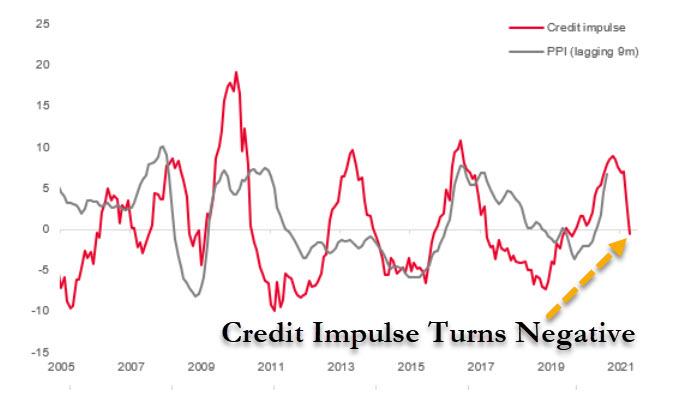
This is a point we first brought up last month when observing the collapse in China's credit impulse, arguably the most important variable for the entire global reflationary narrative (see "China's Credit Impulse Just Turned Negative, Unleashing Global Deflationary Shockwave")...
... and it's a point that Goldman's chief economist Jan Hatzius reiterated in a note published on Tuesday titled simply "Why the Economy Won’t Overheat,” in which he argues - the same as the Fed - that the inflation we are seeing so far is likely to be temporary and prices will normalize again as we leg further away from unprecedented pandemic activity curtailments.
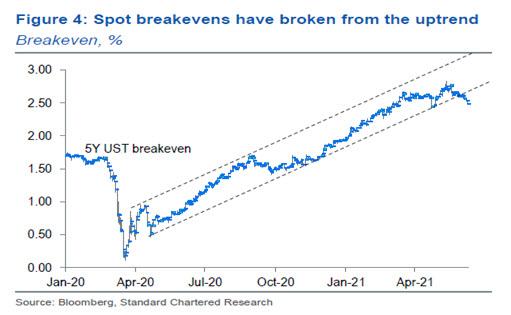
While we disagree - and so does Deutsche Bank, which sees nothing short of Weimar hyperinflation being unleashed by the Fed soon, something we first predicted in March 2009 as the ultimate endgame - it is interesting that today, at least, markets appear to be adopting this view judging by the collapse in 10Y nominal rates and the recent breach of the upward trendline in breakevens...
... this even as China's PPI printed at a Lehman Sept 2008 high of 9.0% overnight.
So what, according to Goldman is the reason for receding inflation fears? As Hatzius and strategist Chris Hussey explain, the past 2 payrolls reports have been underwhelming as the rush back to work "is being slowed by generous stimulus as well as an inability — perhaps — to simply process so many new workers. On the one hand, fewer available workers should push up wages as companies compete to attract new workers. But a more orderly stream of employment in the post-pandemic recovery may also allow for a more extended reopening period and perhaps a bit less top-line pressure on prices."
Another reason for receding inflation fears may also simply be time. According to Goldman, as Americans become more accustomed to getting back to their daily routines, the strangeness of such activity recedes. And it is perhaps easier for investors to envision what‘normal’ will look like. And perhaps that vision is collectively coalescing around a‘new normal’ that looks surprisingly similiar to the pre-pandemic ‘old normal’.
Hatzius then elaborates why the recent inflation pickup will remain transitory: "On the wage side, labor supply should increase dramatically over the next 3-6 months as fear of the virus diminishes further and the $300/week benefit top-up expires—over the next few weeks in most Republican-controlled states and on September 6 in the remaining states."
In other words, employers will likely hold out another 3 months until the end of emergency benefits expire at which point they expect a flood of workers to reverse the calculus in the labor market, from one of no labor supply to a flood of supply.
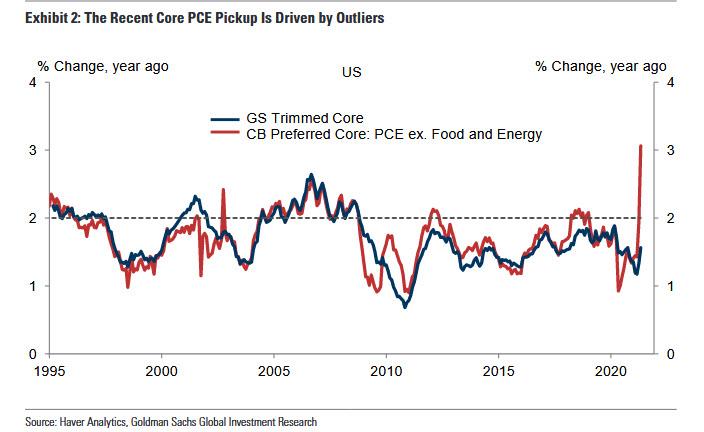
On the price side, Goldman's trimmed core PCE—which excludes the 30% most extreme month-to-month price changes, and as a reminder the surge in inflation last month was largely driven by soaring used car prices and transportation services, or as Goldman puts it "outliers" — remains at just 1.56% year-on-year, half the standard core PCE rate. This gap illustrates the unprecedented role of outliers in the recent inflation pickup.
Ultimately, to Goldman, the biggest question in the overheating debate remains whether US output and employment will rise sharply above potential in the next few years. If the answer is yes, then inflation could indeed climb to undesirable levels on a more permanent basis. Predictably, Goldman's answer continues to be no, and here's why: "Even though real GDP is nearly back to the pre-pandemic level, we still see significant slack in the economy based on the remaining jobs shortfall of nearly 8 million and the pandemic-driven productivity gain of 4.1% year-on-year in Q1. Moreover, we think sequential GDP growth has probably already peaked in monthly terms and will trend down from here as the fiscal impulse wanes, modestly at first and then more sharply in late 2021 and 2022."
Here JPMorgan also chimes in and in a recent note from economist Dan Silver writes that as we prepare for the CPI print, it is worthwhile to consider the impacts of the removal of federal unemployment benefits and increasing hourly wages. In Silver's note, he illustrates the growth in job openings among low-income jobs.
JPM then asks the right question: "will wage increases remain durable if business owners know that supply is coming back online?" A question we have asked previously, and the answer is a decisive not. To JPM, if the answer is indeed no, "we see a quicker than expected deceleration in wage growth, spending, and CPI." Although, alternatively, it seems more likely that we will also see a surge in jobs taken and potentially another leg higher in absolute macro data.
With that in mind, what's next on the inflation catalyst front and what will tomorrow's critical CPI print show? Here, Goldman estimates a 0.50% increase in May core CPI (in line with consensus), which will boost the year-on-year rate by six tenths to 3.55%, up from 3.0% which however is largely impacted by the base effect collapse of last year. Goldman's monthly core inflation forecast "reflects reopening-driven strength in airfares, hotel prices, and recreation prices." Additionally, Goldman expects strong monthly readings in used cars (+6%) and new cars (+0.5%), reflecting "one-time" supply chain disruptions and microchip shortages.
And while the Fed is more concerned with PCE inflation rather than CPI, Goldman concludes that even though the inflation burst is transitory, "it will be interesting to see how markets react to a 3.5%+ inflation report in a monetary regime that presumably is focused on keeping inflation around 2%."

>>> Stoxx 600 Pre-Market Indications

  • BT (BTQ TH) +1.7%
    • Billionaire Drahi Makes $3.1 Billion Bet on BT’s Internet Plan
  • Rio Tinto (RIO1 TH) +1.6%
  • CTS Eventim (EVD TH) +1.1%
    • Statement by CTS EVENTIM concerning the judgment by the Munich District Court
  • Freenet (FNTN TH) +0.8%
  • Commerzbank (CBK TH) +0.8%
  • Thyssenkrupp (TKA TH) +0.7%
  • Nel (D7G TH) -1%
  • BMW (BMW TH) -1.1%
    • BMW Cut to Hold at Stifel; PT 116 euros
  • Shell (R6C TH) -1.1%
  • Shop Apotheke (SAE TH) -1.2%
  • Legal & General (LGI TH) -2.5%

>>> TradeGate Pre-Market Indications

DAX:
  • BMW (BMW TH) -0.7%
    • BMW Cut to Hold at Stifel; PT 116 euros
MDAX:
  • CTS Eventim (EVD TH) +1.8%
    • Statement by CTS EVENTIM concerning the judgment by the Munich District Court
  • Thyssenkrupp (TKA TH) +1.2%
  • Fraport (FRA TH) +1.2%
  • Commerzbank (CBK TH) +0.9%
  • Freenet (FNTN TH) +0.8%
SDAX:
  • Home24 (H24 TH) +2.3%
    • Stock fell 4.8% yesterday
  • Talanx (TLX TH) +1.3%
  • Suess MicroTec (SMHN TH) +1.3%
  • Kloeckner (KCO TH) +1.3%
  • SGL (SGL TH) +1.3%
  • KWS Saat (KWS TH) -1.7%
    • KWS Saat Cut to Hold at Stifel; PT 82 euros