>>> Europe : Brokers Upgrades & Downgrades - 17th of June 2021 V2(+)

>>> Up
* Alfen PT Raised to 81 euros from 76 euros at Berenberg
* CropEnergies Raised to Buy at LBBW; PT 12.60 euros
* Deutsche Wohnen Raised to Hold at Bankhaus Metzler; PT 52 euros (+)
* EDF Raised to Add at AlphaValue
* Getlink Raised to Buy at Goldman; PT 16 euros
* Morrison Raised to Buy at BofA; PT 210 pence (+)
* Sievi Capital Raised to Buy at Inderes; PT 1.65 euros (+)

>>> Down
* Anpario Cut to Hold at Peel Hunt (+)
* Catena Cut to Hold at DNB Markets; PT 500 kronor (+)
* Nel Cut to Hold at Arctic Securities; PT 18 kroner (+)
* Novo Nordisk Cut to Hold at DNB Markets; PT 560 kroner
* Seplat Nigeria Cut to Hold at Meristem Securities
* Virbac Cut to Hold at Stifel; PT 285 euros

>>> Initiation
* Alphawave IP Rated New Buy at Liberum; PT 420 pence
* Apontis Pharma Rated New Buy at M.M. Warburg; PT 41 euros (+)
* Grupo Ecoener Rated New Buy at SocGen; PT 9.10 euros
* PRS REIT Rated New Equal-Weight at Barclays; PT 100 pence
* Sinch Re-Initiated Hold at Handelsbanken; PT 155 kronor
* Sivers Semiconductors Rated New Buy at Nordea; PT 36 kronor (+)

>>> Call
* Alphawave’s Differentiated Technology Gets New Buy From Liberum
* Bachem PT Lifted to Street High at Mirabaud on Earnings Outlook (+)
* ‘Cheap’ Meyer Burger’s PT Is Lifted to Street High at Jefferies (+)
* NCC Group Beats on Profit, While Revenue In Line: Peel Hunt (+)
* Sinch Outlook Strong, But Some Work Left, Handelsbanken Says (+)
* Whitbread’s Update Shows Building Momentum, Jefferies Says (+)
* Zur Rose CMD Shows Opportunity, Margin Potential: Morgan Stanley

FT : Spac pitfalls illuminated by family feud at Velodyne

Spac pitfalls illuminated by family feud at Velodyne
Brothers-in-law wage war at US maker of sensors for self-driving vehicles

David Hall and Brad Culkin are inventors, longtime colleagues and brothers-in-law.

But after a Spac deal and a boardroom bust-up at their company, Velodyne Lidar, they are now, in the words of Hall, locked in a “fight to the death”.

Hall, who founded the 3D sensor business, was ousted as chair earlier this year but remains the largest shareholder and is now determined to strike back against Culkin, who took over as chair, and anyone else on the board who helped remove him.

Last week, Hall wielded his majority voting power to install Eric Singer, an activist investor, on to the board. “He’s going to drive those cockroaches out of there,” said Hall, in an interview with the Financial Times. “I want them gone and to never hear from them again for the rest of my life, and my children’s lives as well.”

The developments at Velodyne are another example of the pitfalls of special-purpose acquisition companies, which have provided a quicker route to public markets compared to traditional listings, but which have also been used by high-risk, founder-controlled businesses. The company’s share price has fallen more than 50 per cent this year during the public dispute.

A spokesperson said the company continues to execute “a strategy designed to drive long-term growth for the company [ . . . ] with the highest standards of corporate governance”.

Falling revenues
Velodyne is the leading US manufacturer of lidar systems, the rotating laser devices used by self-driving vehicles to “see” roads and obstacles. Ahead of its arrival on the public markets, through a $1.6bn deal with a Spac called Graf, regulatory filings described it as a “fast growing business with strong momentum”.

But the company’s troubles stretch back for years, according to regulatory filings and people familiar with the company.

Hall set up Velodyne in 2016, raising an initial $150m from Ford and China’s Baidu. The investors also became important customers, buying millions of dollars worth of products. 

Velodyne made more than $180m in revenues in 2017, according to filings, largely from one-off sales to research teams at companies such as Uber that were developing self-driving cars. That year, Velodyne’s lidar sensors sold for a weighted average price of nearly $18,000 each.

But as rivals flooded the market, the price of lidar sensors fell sharply. Velodyne said it had proactively cut its prices to increase the adoption of the technology, but by 2019 its revenues had fallen by more than 40 per cent.

In 2018, the company accused Hesai, a Chinese rival that also received funding from Baidu, of reverse engineering its spinning lidar sensors. Last year, it settled the dispute with Hesai and with another Chinese company, in exchange for licensing and royalty fees.

But Hall said the alleged theft of Velodyne’s designs had “ruined” the market for lidar.

‘A family business’
Meanwhile, several people familiar with the company accused Hall of running it as a family business, at times employing his relatives and friends in senior roles.

Regulatory filings showed that Hall and his wife Marta, who remains on Velodyne’s board, borrowed from the company to fund the $23.4m purchase of a building in San Jose, California, that served as its headquarters. A company owned by the couple then charged Velodyne millions of dollars in annual rent for the use of the building.

Last month, the Halls sold the property for $51.4m, returning more than 200 per cent on their initial investment. Hall said the deal had been “dumb luck” and that he charged the company below-market rent.

Responding to questions about the jobs held by his family members, Hall said: “It is marginal nepotism, and it is getting a little out of control. I am going to rein that in some day.”

The road to the public markets
In January 2020, Hall stepped back from day-to-day management, promoting Anand Gopalan to chief executive as the company began to consider an IPO. Hall said at the time that Gopalan was “the right executive to lead Velodyne in its next growth phase”.

Velodyne held preliminary discussions about an IPO, but investors had difficulty valuing the company after several years of revenue declines, said two people familiar with the process.

As the pandemic hit, another option presented itself: Spacs, or blank-cheque vehicles raised for the purpose of merging with a company and bringing it to public markets. 

Graf Industrial Corp, which had already abandoned talks with a polypropylene recycling company, began discussions with Velodyne in May. By June, the companies had begun soliciting investors for additional backing to add to the Spac’s cash contribution, aided by advisers at Bank of America and Oppenheimer.

An investor presentation predicted Velodyne’s revenues would begin growing again and reach more than $680m in 2024, with more than half of business coming from new multiyear agreements, software sales and subscriptions. In 2020, the company had revenues of $94m.

The deal was announced in July, and in the weeks leading up to Velodyne’s listing in September, the vehicle’s share price briefly reached $32. Culkin, who co-founded with Hall an audio company from which Velodyne was spun out, emerged with millions of shares and a seat on the board.

Ford, meanwhile, negotiated an exemption to lock-up agreements that typically restrict insiders from early trading, and sold its entire stake in Velodyne in the fourth quarter. Ford, which is still using Velodyne’s technology, has said the sales were “consistent with our efforts to make the best, highest use of capital”.

The battle for control
In the months after going public, Hall pushed for changes to the board that would have allowed him to appoint six out of eight directors and fire the chief executive, according to Velodyne.

The board’s audit committee began investigating Hall and his wife, claiming in February that they “behaved inappropriately with regard to board and company processes”. Velodyne removed Hall as chair without publicly providing specifics of the investigation’s findings.

In a statement to the FT, Velodyne said the alleged misconduct by David and Marta Hall “dramatically increased” after Hall’s board proposals were rejected. Velodyne said every member of the board other than Marta Hall rejected Hall’s claims, which it said contained “unsupported accusations”.

Following his removal, Hall accused Culkin of taking “several liberties with the truth” and acting as a “rubber stamp”. Culkin did not respond to requests for comment.

One day after the annual shareholder meeting last week, Velodyne announced it had begun arbitration proceedings against Hall, alleging breach of contract and the theft of trade secrets. 

In a separate statement, the company said Hall had copied “hundreds of thousands” of Velodyne documents on to at least one external hard drive before returning his company laptop. Through a spokesperson, Hall declined to comment on the arbitration.

Hall said he had been misled by lawyers and Spac executives during the merger process, which he believed would allow him to retain control over the company. Graf and Gunderson Dettmer, the law firm that represented Velodyne during the Spac discussions, declined to comment.

Investors nurse losses
Meanwhile, investors have posted complaints on the message board Reddit, and have called in recent weeks for the Halls to abandon their battle with the company. Shares were trading at about $11 on Wednesday.

Outside observers predicted that several companies that have struggled since merging with Spacs may become prime targets for activist shareholders. Many have yet to find commercial success for futuristic technologies and are still led by relatively inexperienced teams.

“That’s all the ingredients you need for volatility and activist interventions,” said Ethan Klingsberg, a partner at the law firm Freshfields who advises boards on corporate governance matters.
>>> Stoxx 600 Pre-Market Indications

  • UPM-Kymmene (RPL TH) +1.7%
  • CD Projekt (7CD TH) +1.6%
  • Carnival Plc (POH1 TH) +1.5%
  • Stora Enso (ENUR TH) +1.4%
  • Commerzbank (CBK TH) +0.7%
    • Commerzbank Promotes CFO Bettina Orlopp to Second-in-Command
  • Deutsche Bank (DBK TH) +0.7%
    • Watch Bank Stocks as Fed Dot Plot Shows Two Hikes By End-2023
  • Deutsche Telekom (DTE TH) -1%
  • Delivery Hero (DHER TH) -1.1%
  • Bayer (BAYN TH) -1.2%
  • Porsche SE (PAH3 TH) -1.2%
  • Shop Apotheke (SAE TH) -1.5%
  • Thyssenkrupp (TKA TH) -1.7%
  • AstraZeneca (ZEG TH) -1.9%
    • Australia Raises Recommended Age for AstraZeneca Vaccine to 60
  • IAG (INR TH) -2%
  • OMV (OMV TH) -2.3%
  • Voestalpine (VAS TH) -3%

>>> TradeGate Pre-Market Indications

DAX:
  • Deutsche Bank (DBK TH) +1.1%
    • Fed Spurs Goldman, Deutsche Bank to Abandon Bullish View on Euro
  • Fresenius Medical (FME TH) -0.8%
  • Daimler (DAI TH) -0.8%
    • Europe’s Car-Sales Recovery Continues to Lag Pre-Pandemic Levels
  • Bayer (BAYN TH) -1.2%
MDAX:
  • Commerzbank (CBK TH) +1.2%
    • Commerzbank Promotes CFO Bettina Orlopp to Second-in-Command
  • Lufthansa (LHA TH) +0.8%
  • Telefonica Deutschland (O2D TH) +0.7%
  • Thyssenkrupp (TKA TH) -1.7%
  • Varta (VAR1 TH) -1.8%
SDAX:
  • Schaeffler (SHA TH) +0.8%
  • Metro (B4B TH) -2.2%

>>> Europe : Brokers Upgrades & Downgrades - 17th of June 2021

>>> Up
* Alfen PT Raised to 81 euros from 76 euros at Berenberg
* CropEnergies Raised to Buy at LBBW; PT 12.60 euros
* Getlink Raised to Buy at Goldman; PT 16 euros

>>> Down
* Novo Nordisk Cut to Hold at DNB Markets; PT 560 kroner
* Seplat Nigeria Cut to Hold at Meristem Securities
* Virbac Cut to Hold at Stifel; PT 285 euros

>>> Initiation
* Alphawave IP Rated New Buy at Liberum; PT 420 pence
* Grupo Ecoener Rated New Buy at SocGen; PT 9.10 euros
* PRS REIT Rated New Equal-Weight at Barclays; PT 100 pence
* Sinch Re-Initiated Hold at Handelsbanken; PT 155 kronor

>>> Call
* Alphawave’s Differentiated Technology Gets New Buy From Liberum
* Zur Rose CMD Shows Opportunity, Margin Potential: Morgan Stanley

>>> What to look at today - 17th of June 2021

Asian stocks and U.S. futures declined Thursday after Federal Reserve officials sped up their expected pace of policy tightening. The dollar and Treasury yields held gains.
An MSCI gauge of Asian shares was on track for its biggest slide in a month, though the number of stocks that rose and fell was evenly split. Japanese stocks underperformed, while Hong Kong shares fluctuated and Chinese equities ticked up. S&P 500 futures slipped after the benchmark closed off its lows as Fed Chair Jerome Powell downplayed the risk of an immediate rate increase.
Policy makers disclosed in their June communications that they are starting a discussion about scaling back bond purchases, and two hikes are likely by the end of 2023.
Bond yields jumped in Australia and New Zealand, following the move in Treasury yields as the market repriced the timing of rate increases. Asian currencies tumbled, led by the South Korean won, after a dollar index had its biggest jump in a year. Yield premiums on investment-grade dollar bonds from borrowers in Asia ex-Japan widened.
Elsewhere, the Australian dollar pared its overnight losses after employment data beat estimates. Crude oil declined as the strengthening dollar reduced the appeal of commodities priced in the currency.
US After Hours CVAC -49% falls sharply as its vaccine candidate did not meet prespecified statistical success criteria; LEN +0.4% up slightly on earnings

Nikkei -0.93% Hang Seng +0.09% CSI +0.11% Shanghai -0.06% Shenzen +0.69%

Eur$ 1.1995 CNH 6.4255 CNY 6.4219 JPY 110.72 GBP 1.3993 CHF 0.9087 RUB 72.5237 TRY 8.6111 WTI$ 71.75 -0.55% Gold 1,822.24 +0.59% BTC 38;870 +200 ETH 2,440 +45

S&P -0.37% NAsdaq -0.48% EuroStoxx -0.41% FTSE -0.46% Dax -0.36% SMI -0.21%

Macro:
- Economy May Be Too Hot for the Fed - or Stock Market - to Ignore
- CNBC: Intel CEO sees '10 good years' of chip industry growth https://t.co/V3nKRMbfHT
- U.K. Considers Opening Travel for Vaccinated People: Telegraph
- UST 10-Year Yield Tests 50-DMA, Remains in Channel Downtrend

Spacs :
- SPAC Fortress Value Rises After Approval of ATI Physical Merger

Keep an eye on :
- ADP FP : ADP May Passengers 1.89M Boeing 737 Max Faces New Safety Checks Mandated by Regulators
- AIR FP : FAA mandates Boeing 737 MAX inspections for key automated flight system
- ALV GY : Pimco Parent Allianz to Join Rush for Asset Management Deals
- BFSA GY : Befesa to Buy American Zinc Recycling for $450m, Offers Shares
- BFSA GY : Befesa Share Offering Order Book Is Covered: Terms
- CBK GY : Commerzbank Names Orlopp Deputy CEO, Extends COO Board Spot
- EKATB SS : Elekta Harmony Linear Accelerator Cleared by U.S. FDA
- ELOPAK IPO : Elopak IPO priced at NOK28 per Offer Share, Gross Proceeds EU50m
- HELN SW : Helvetia Swiss Property Fund Plans Capital Increase of ~CHF200m
- JMAT LN : Ex-Millennium Trader Faces Off With Old Firm on Johnson Matthey
- LINK NO : Link Mobility Buys U.S. Based Message Broadcast for EV $260m
- MAS SM : Spain’s Competition Agency Approves Masmovil, Euskaltel Deal
- MTO LN : Mitie Holder Offers 99.4m Shares
- MITRA BB : Mithra Sees Top-Line Data From Covid-19 Phase II Study in Summer
- MOLN SW : *MOLECULAR PARTNERS OPENS AT $20, IPO AT $21.25
- MOR GY : Morphosys Begins Cash Tender Offer for Constellation Shares
- NOVN SW : CNBC: Novartis prostate cancer drug receives FDA breakthrough designation https://t.co/QW0TBnMjA9
- ORPHA DC : Orphazyme Spikes, Triggers Halts on 5th Day of Heavy U.S. Volume
- PEAN SW : Peach Property Lifts Mandatory Convertible Bond Offer to CHF150M
- RNO FP : Renault to Expand Car Sharing on Post-Lockdown Demand Burst
- SNBN SW : SNB Says Corporate, Public Debt Vulnerable to Rate Shocks
- SZU GY : Suedzucker Prelim 1Q Operating Profit About EU49M
- DG FP : Vinci Construction Gets EU491m Contract With U.K. Government
- VOW3 GY : Volkswagen's One-Two EV Punch Can Challenge Tesla, BYD in China
- VOW3 GY : Europe’s Car-Sales Recovery Continues to Lag Pre-Pandemic Levels
- YCA LN : Yellow Cake Offers 25m Shares at 250p/Share
- ROSE SW : Zur Rose Climbs to Three-Month High on Capital Markets Day

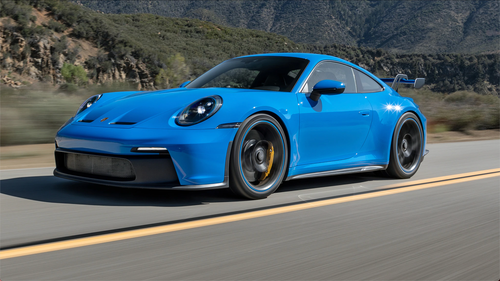
>>> California Bans Porsche From Selling 2022 911 GT3 With Manual Transmission

California Bans Porsche From Selling 2022 911 GT3 With Manual Transmission

Well, maybe the birds and deer will feel comfortable in California that the liberal-run state has banned Porsche from selling the 2022 911 GT3 with manual transmission because it's just too damn loud.
Porsche informed Car and Driver this week that the optional six-speed manual transmission of the supercar will not be sold in the state due to the state's sound regulations.
Porsche will contact those who have already ordered the GT3 with the opportunity to switch to the standard dual-clutch automatic gearbox.
Porsche tells us that California's Code of Regulations (CCR) 1046 references the Society of Automotive Engineers (SAE) test procedure J1470 for its exterior-noise criteria, which was last revised in 1998. There's a newer SAE standard for pass-by noise, J2805, which presumably the GT3 was designed to and meets, and Porsche expected California to update its regs to this latest standard before the GT3 went on sale. But, for now, the GT3 is stuck in limbo, awaiting that change.
Porsche says that it's working with California State Highway Patrol to come to a solution but has no estimated timeline of when that might happen. Somewhere in the details of those two SAE testing procedures is why the manual fails one but not the other; we're digging into those specifics and will update this story when we have a more complete explanation. -Car and Driver
The GT3 is an absolute beast, pumping out 502-hp from its naturally aspirated 4.0-liter flat-six and screams at 9,000 rpm.
So the ban on these GT3s will only be a handful of cars because of their rarity. Still, the state is turning a blind eye to the tens of thousands of automotive enthusiasts who mount aftermarket parts on their vehicles for performance gains that make some areas of the state sound like a Fast & Furious sequel on any given day.
Instead of banning these cars from the street in the UK, noise cameras were placed on certain roads that would ticket drivers if their vehicles made sounds over 80 decibels.

FT : Hong Kong tycoon Richard Li’s FWD to raise up to $3bn in US IPO

Hong Kong tycoon Richard Li’s FWD to raise up to $3bn in US IPO
Insurance group has expanded aggressively across Asia

FWD, the Asian insurer founded by the son of Hong Kong tycoon Li Ka-shing, has filed for a US initial public offering in what would be one of the year’s biggest listings.

The company launched by Richard Li in 2013 said on Thursday that it had confidentially submitted filings for the IPO to the US Securities and Exchange Commission. That allows it to submit documents to the SEC before filing a prospectus publicly.

FWD said the number of American depositary shares to be offered and the price range for the IPO had not yet been determined and the timing of the listing was subject to regulatory approval. But the company could seek $2-3bn from the share sale, according to people familiar with the situation.

FWD has expanded aggressively across Asia, rapidly rolling out a network across 10 countries including Japan, the Philippines, Vietnam, Singapore, Malaysia, Thailand and Cambodia.

The insurer has almost 10m customers, more than $63bn in assets and about 6,100 employees as well as 33,000 agents.

Richard Harris, a fund manager at Hong Kong-based Port Shelter Investment Management, said FWD “has made enormous gains [in market share] because it’s got a lot of firepower behind it”.

As with Li Ka-shing’s Cheung Kong conglomerate, FWD “takes a strategic view on industries and invests very heavily in them”, Harris said.

He added that it was “interesting” that the insurer had chosen to list in New York over Hong Kong, but US investors “will be interested [in FWD] and there does seem to be a slight thawing with the view towards Chinese companies — and this will be recognised in New York as a Chinese company”.

Li started FWD with the $1.2bn acquisition of ING’s pension and insurance businesses in Thailand, Hong Kong and Macau. The expansion strategy of Huynh Thanh Phong, FWD’s chief executive, has focused on pairing moves into new Asian markets with the use of technology to reduce the paperwork and complexity common to the industry in the region.

The group has swallowed up competitors as rival financial groups have retreated from the region, including MetLife’s Hong Kong business and the insurance business of Thailand’s Siam Commercial bank, the industry’s largest-ever takeover in south-east Asia.

“[SCB was] the prize asset that everybody wanted to go after,” Phong told the Financial Times in an interview this year. FWD eventually acquired SCB for about Bt93bn ($3bn) in 2019, giving it a 36 per cent market share in Thailand in bancassurance terms, bigger than the next three groups combined.

FT : The Fed nailed it

The Fed nailed it
But its policymakers can’t see the future, and neither can you

The Fed did a very good job
The job of the US central bank stinks right now. Inflation is above target, employment is below target and asset prices are very high. Whatever worries its officials have about setting the right monetary policy for optimising jobs and prices, precipitous stock, bond and real estate values represent a third nasty risk to the US economy.

If the Fed tightens policy soon because it is worried about inflation, policymakers risk cracking asset prices, which could kill the economic momentum. If they let inflation run because they care more about employment, they risk inflating an asset bubble certain to pop later, creating a recession in the style of 2001 or 2008. Not fun.

Coming into this week’s Federal Open Market Committee meeting, the financial markets expected the Fed to absolutely nail this balance — to bet on inflation subsiding, and to win. The expectation seems to be that interest rates will increase only in a long while and just a little bit, economic growth will remain healthy, asset prices will rise moderately and there will be peace in the kingdom, Amen.

A few indicators of the market’s confidence in the Fed’s precision and good fortune:

  • Stock indices, while they have been moving broadly sideways for two months, are moving sideways at their all-time highs in prices and near all-time highs in valuations;

  • Bond yields (an admittedly imperfect indicator) have not responded to hot inflation data;

  • The run-up in bank stocks, perhaps the companies most positively correlated with inflation and rising rates, has topped out;

  • Market-derived expectations for inflation from 2026-31 (the “five-year five-year”) seem to have stabilised at about 2.25 per cent in the past month or so. Fed data:

  • Market expectations for the timing and number of rates rises has been growing more dovish for a few months. A chart from Morgan Stanley:

  • The Vix, a measure of expected volatility derived from options markets, keeps on hitting post-pandemic lows:
A report from Mark Haefele of UBS Global Wealth Management a few weeks ago summed up the market sentiment perfectly:

“With the Fed handling any policy transition with care, we think global equities should continue to receive support in their next leg-up amid accelerating earnings and economic growth.”

Boy, that sounds nice.

To sustain those kinds of expectations, while at the same time maintaining their credibility by demonstrating that they take the inflation data seriously, Jay Powell and his merry band had to get the message just right. It looks like they did.

The language in yesterday’s statement was all but identical to the one from April, excepting a little verbiage about where we are with the virus. Policy, and the official outlook for future policy, are unchanged. 

The dot plots, which show where individual FOMC members expect monetary policy to go, moved up for 2022 and 2023:

The significance of this is that the mean committee member’s expectation is for two rate increases in 2023, more than expected. The committee’s average core inflation expectations for this year also rose sharply, from 2 per cent to 3 per cent, which looked hawkish, too.

So has the Fed changed its stance? Is it leaning hawkish now? In his press conference after the two-day FOMC meeting, Powell said that the Fed was “talking about talking about” tapering its asset purchases, but emphatically not actually talking about it yet. And he played down the significance of the dots: 

These are of course individual projections, they’re not a committee forecast, they’re not a plan, and we did not actually have a discussion of whether lift off is appropriate at any particular year. Because discussing lift off now would be highly premature, it wouldn’t make any sense . . . the dots are not a great forecaster of future rate moves and that’s because it’s so highly uncertain, there is no great forecaster of future rates, so [the] dots have to be taken with a big grain of salt.

This threads the needle. The dot plot and inflation expectation averages demonstrate that the committee members are not blind. They see the data and adjust their expectations. But the statement and Powell’s comments tell you that as a group they are sticking with their bet. Inflation looks transitory, and for the bit of the future that can be foreseen, monetary policy does not need to change.

Both pundits and the market responded with a bit of a wobble initially. The S&P 500 fell 1 per cent. Five-year Treasury yields hopped. Before the press conference, Aberdeen Standard economist James McCann summed up the mood:

This is not what the market expected. The Fed is now signalling that rates will need to rise sooner and faster, with their forecast suggesting two hikes in 2023. This change in stance jars a little with the Fed’s recent claims that the recent spike in inflation is temporary. If price volatility is temporary then there’s no obvious reason why they need to raise rates sooner than planned, especially with the labour market having disappointed of late.

But by the end of the day stocks, at least, had clawed back most of those losses. Tomorrow may bring a different consensus, but it seems to me the Fed did as well as it could have against high expectations and a difficult economic set up. 

For what little it may be worth, my own guess is that the Fed will win its inflation bet, for the simple-minded reason that the price spikes I see are in things that one would expect to spike after a pandemic. Hence my argument about lumber prices yesterday (which to my amusement Powell more or less repeated on Wednesday). Lumber is theoretically linked to easy monetary and fiscal policy, by way of hot housing demand. But a closer look at lumber’s particular supply/demand issues shows how pandemic specific they are, and prices are rolling over now, as you would expect.

I am more worried about a growth disappointment than inflation, given what is priced into markets and the coming deceleration in fiscal stimulus and the money supply.

My confidence about these guesses? Low, and I hope the FOMC feels the same way. As Powell said yesterday: “Forecasters have a lot to be humble about; it’s a highly uncertain business.”

>>> US After Hours Summary: CVAC -49% falls sharply as its vaccine candidate did

After Hours Summary: CVAC -49% falls sharply as its vaccine candidate did not meet prespecified statistical success criteria; LEN +0.4% up slightly on earnings

After Hours Gainers:

Companies trading higher in after hours in reaction to earnings/guidance: LEN +0.4%

Companies trading higher in after hours in reaction to news: STSA +16.2% (announces positive results from a Phase 1 trial of STS101), TWO +4.7% (to join S&P SmallCap 600), THC +3.5% (sells five hospitals in Florida to Steward Health for $1.1 bln), PSN +2.6% (awarded $2.2 bln Missile Defense Agency contract), NVAX +2.4% (in reaction to CVAC news), WKHS +2.3% (files formal complaint regarding US Postal Service NGDV contract), FSK +1.5% (completes merger with FSKR; announces $100 mln share repurchase program), MRNA +1.4% (in reaction to CVAC news), BNTX +1.2% (in reaction to CVAC news), GSL +1.1% (announces purchase of four Panamax containerships for $148 mln), DMTK +0.6% (names three new leadership appointments including new CMO), AES +0.5% (PUCO approves AES Ohio settlement agreement), TRIN +0.4% (increases dividend), WLTW +0.4% (US antitrust officials sue to stop AON's acquisition of WLTW, AON and WLTW issue statement that disagrees with decision), EFC +0.2% (reports estimated book value of $18.23/sh), PFE +0.1% (announces publication of "positive" findings from STOP-COVID study; also in reaction to CVAC news)

After Hours Losers:

Companies trading lower in after hours in reaction to earnings/guidance: HNST -2.3%

Companies trading lower in after hours in reaction to news: CVAC -49% (provides interim update on Phase 2b/3 trial of COVID-19 vaccine candidate CVnCoV; did not meet prespecified statistical success criteria), NOVN -9.7% (stock offering), TRCH -4.7% (stock offering), AQN -4.2% (announces plans for $900 mln public offering), NOG -4% (to acquire non-operating interests in Texas and New Mexico; also commences 5 mln share offering), SNCR -3.7% (CFO to depart), CYCN -1.1% (stock offering), ERF -0.8% (files for $2 bln mixed securities shelf offering), SB -0.5% (acquires Panamax class, dry-bulk vessel for $22 mln), CLPT -0.5% (installs version 2.0 software at neurosurgery clinic in Poland), MSFT -0.4% (names Satya Nadella as board chair), BA -0.2% (FAA mandates 737 MAX operators to conduct further inspections for automated flight system, according to Reuters), GM -0.2% (seeking longer-term chip supply contracts, according to Reuters), BIIB -0.1% (announces topline results from Phase 2 study of Gosuranemab), KRC -0.1% (announces three strategic acquisitions)