Closing Stock Market SummaryThe S&P 500 (-0.04%) closed flat on Thursday in a mixed session that included pronounced weakness in value/cyclical stocks and notable strength in growth stocks. The Nasdaq Composite gained 0.9%, while the Dow Jones Industrial Average (-0.6%) and Russell 2000 (-1.2%) underperformed in negative territory.
The divergence between growth and value was more plainly manifested in the 1.1% gain in the iShares S&P 500 Growth ETF (IVW 70.77, +0.74, +1.1%) and the 1.3% decline in the iShares S&P 500 Value ETF (IVE 146.34, -1.91, -1.3%). This disparity was exacerbated when the 10-yr yield took a precipitous intraday drop.
The 10-yr yield briefly fell 12 basis points to 1.47% before settling the session at 1.51%, or just above where it was trading prior to the FOMC statement yesterday. This retracement was interpreted as an acceptance of the Fed's view that a lot of inflation pressures have been, and should be, transitory and a complementary view that inflation/growth rates could be peaking.
Likewise, inflation pressures via commodity prices continued to deflate. Futures contracts for copper ($4.18/lb, -0.21, -4.7%), gold (1775.00/ozt, -87.00, -4.7%), and WTI crude ($71.07/bbl, -0.99, -1.4%) fell sharply amid a stronger U.S. dollar (91.94, +0.81, +0.9%).
Cyclical stocks, which really ran with the reflation story prior to June, took it on the chin today as investors continued to take profits given the unfavorable price action in Treasury yields and commodities. The S&P 500 energy (-3.5%), financials (-2.9%), materials (-2.2%), and industrials (-1.6%) sectors posted noticeable declines, while every other sector closed higher.
The mega-caps within the information technology (+1.2%), communication services (+0.6%), and consumer discretionary (+0.6%) sectors provided key support for the market amid the decline in long-term interest rates. The Vanguard Mega Cap Growth ETF (MGK 225.16, +2.80, +1.3%) rose 1.3%.
The health care sector (+0.8%) also outperformed, supported by 1) the Supreme Court upholding the Affordable Care Act, 2) news the U.S. will invest $3.2 billion on pills to treat COVID-19 and other viruses, and 3) Danaher (DHR 257.08, +12.34, +5.0%) agreeing to acquire Aldevron for $9.6 billion in cash.
The Fed-sensitive 2-yr yield increased one basis point to 0.22%, clinging onto the possibility that the Fed could hike rates sooner than previously indicated. One bit of news that likely didn't cause the Fed to want to rush policy changes, though, was the latest report on weekly initial claims, which unexpectedly increased to 412,000 (Briefing.com consensus 350,000).
Reviewing Thursday's economic data:
- Initial claims for the week ending June 12 increased by 37,000 to 412,000 (consensus 350,000) from last week's downwardly revised level of 375,000 (from 376,000). Continuing claims for the week ending June 5 increased by 1,000 to 3.518 million from last week's upwardly revised level of 3.517 million (from 3.499 million).
- The key takeaway from the report is that it underscores the volatile nature of the current labor market, as claims jumped against expectations for a drop to a new low since the start of the pandemic.
- The Conference Board's Leading Economic Index (LEI) increased 1.3% in May (consensus 1.2%) after increasing a revised 1.3% (from 1.6%) in April.
- The key takeaway from the report is that overall growth remained widespread with only two components of the index making small negative contributions.
- The Philadelphia Fed Survey for June fell to 30.7 (consensus 30.0) from 31.5 in May.
There is no economic data of note scheduled for Friday.
- Russell 2000 +15.8% YTD
- S&P 500 +12.4% YTD
- Dow Jones Industrial Average +10.5% YTD
- Nasdaq Composite +9.9% YTD
How much can Lina Khan do to rein in Big Tech?
New head of US regulator FTC favours working through regulation than having court battles
As Democrats in Washington made their final preparations for an assault on the power of Big Tech, it looked like a decisive one-two punch.
A week ago, the House of Representatives proposed a clutch of new antitrust laws. This followed public hearings and a damning Congressional report last year that owed much to the behind-the-scenes work of Lina Khan, an academic who has been influential in shaping the response to tech power.
Then, this week, it emerged that Khan will become the next head of the Federal Trade Commission, setting her up as one of Washington’s foremost trustbusters.
The natural questions that follow: will Congress follow through with new legislation? If not, will a Khan FTC go it alone in trying to set new rules to rein in the tech giants? And if it does, how much could it hope to achieve under existing antitrust laws?
The legislative agenda is ambitious. Inevitably, most attention has fallen on a bill to break up the big tech companies.
Forcing a complete restructuring of America’s most conspicuously successful — and still generally popular — industry sounds like a tall order, even in a period less riven by partisan politics. A degree of Republican backing for the House bills has been notable. But getting to a filibuster-proof 60 votes in the Senate will be hard.
A less drastic law would prevent the companies giving unfair preference to their own services. This fits closely with the approach that Khan has advocated through her scholarly work, most notably on Amazon, where she showed a preference for non-discrimination rules of the kind applied to essential utilities.
Yet many see little chance of any of this getting into law. There may be a consensus in Washington about restraining the tech companies, but opinions about legislation to do it are all over the map, making it more likely the Biden administration will go for quick action under the existing laws, according to Nicholas Economides, a New York University economics professor.
At the FTC, Khan inherits an action against Facebook and investigation into Amazon. But she made it clear she would prefer to work through regulation rather than the courts. Last year, she co-authored a paper in favour of a significant rethink of how the agency wields its powers to prevent “unfair methods of competition”, advocating sweeping, industry-wide rules. The FTC has already taken steps in this direction, creating a new centralised staff group this year to come up with rulemaking proposals.
There are likely to be other influential voices calling for swift action outside Congress. Tim Wu, a Columbia law school professor (like Khan) who was named an adviser to the White House this year, has been influential in arguing that current laws give the trustbusters some powerful weapons, they just need to be enforced more aggressively.
Not that unilateral regulatory action would be plain sailing. Moving ahead without the backing of Congress would leave Khan politically exposed. Legal challenges would be inevitable.
Even if the FTC tries to set sweeping new non-discrimination rules for tech platforms, meanwhile, there are serious questions about how effective these could be.
Europe’s efforts on the issue have been underwhelming. These included forcing Microsoft to offer new PC customers a choice of their default internet browser, and requiring Google to prompt Android users to select their preferred search engine. Neither action had any noticeable effect on competition.
How to give internet users real choice on today’s dominant platforms presents huge design challenges. At this stage, it is questionable how many iPhone customers would jump at the chance of using a non-Apple App store, or how many Android users would welcome the choice of a non-Google search engine.
Despite all this, some investors are already looking ahead to an opening up of the platforms that will give a new lease of life to a set of specialised internet services. Since November’s presidential election — and even before Democrats gained narrow control of the Senate — shares in Yelp, the local search company that has been a longtime critic of Google, have more than doubled. Travel company Expedia, another arch-foe of the search company, is up 77 per cent.
Investors in these and many similar companies will be hoping that Khan, after doing much to set the agenda for the Democrats’ assault on Big Tech, can deliver the goods.
Early premarket gappers
- Gapping up:
- STSA +7.3%, NVAX +6.5%, TWO +5.9%, BNTX +3.3%, PSN +2.6%, TRIN +2.4%, MRNA +2.3%, FSK +1.5%, WKHS +1.3%, NKLA +1.3%, SB +1%, WLTW +1%, THC +0.7%
- Gapping down:
- CVAC -45.7%, NOVN -12.6%, NOG -5.7%, HNST -4.6%, AQN -3.8%, TARS -3.2%, IAG -2.8%, GDX -2.7%, GOLD -2.4%, TRCH -2.3%, SLV -2.2%, FCX -2.1%, ARGX -2%, BHP -2%, GLD -1.7%, MX -1.4%, RIO -1.4%, CONE -1%, CCCC -1%, MSFT -0.7%
US car rental prices could double by August amid nationwide shortage
It’s going to be a scorcher of a summer when it comes to car rental prices, The Post has learned.
The average daily cost to rent a car in the US jumped to a record $63.75 last month — up 50 percent in some cases — as the nation’s economy revved back to life, according to data collected by Jefferies, a New York investment bank.
What’s more, demand is getting so hot — with fees for August already trending above $100 a day — that many vacationers can expect to pay more than double what they would have before the pandemic, according to data on summer reservations.
“You may see consumers resort to mass transit,” Jefferies analyst Hamzah Mazari predicted.
The Wall Street analyst has been collecting daily vehicle rental prices from all of the major rental companies — Avis, Hertz and Enterprise — going back to 2015. In that time, he said, he’s never seen US rental costs soar as high as they are now.
The median price for an Avis car rental jumped to $68.07 in May — up a whopping 50 percent from the median cost Avis charged its May renters between 2015 and 2019, before the pandemic hit, the data show.
People wait in line at an Avis car rental agency at Miami airport
The median price for an Avis car rental jumped to $68.07 in May.
Getty Images
Avis prices for June and July, meanwhile, have leaped to $81.59 and $94.51 a day, respectively. For August, the median is $103.40 a day, a staggering 104 percent increase over that month’s pre-pandemic levels.
The data is similar at other major car rental companies, with the daily median price at Hertz coming in at $114.49 for August — 147 percent above pre-pandemic prices. Enterprise, meanwhile, is charging a median of $100.85 a day for a car in August, or 57 percent more than its traditional end-of-summer rates.
The skyrocketing prices come as demand for rental cars outstrips supply. Desperate to survive pandemic lockdowns that halted global travel last year, many rental companies sold off their fleets for cash. Now, as newly vaccinated Americans are ready to travel again, car rental services have been hard-pressed to rebuild their fleets.
Supply-chain woes driven partly by a microchip shortage have sent new car prices soaring, and car-rental companies — which typically buy their cars from manufacturers in bulk and at a discount — have been pushed to the back of the line amid spotty availability, according to industry sources.
The new car shortage also has sent the cost of used cars and trucks soaring — up 29.7 percent in the last 12 months through May, the Labor Department reported last week.
Earlier this month in Park Slope, Brooklyn, Aaron Epstein said his wife looked at rental prices at a Hertz location and thought they were pricey. But when she booked a car a few days later, the price had doubled. They ended up paying $176, not including taxes, to rent the car for a single day’s drive to upstate New York.
“If it was just me, I would take the train or the bus,” he told The Post.
“It’s really expensive for the weekend,” agreed Callan Ideau, who paid roughly $300 to rent a car for the weekend to drive to a friend’s New Jersey bachelorette party. She said she had been hoping the total would be closer to $200, but there were no more cars left to even consider. The manager of the Hertz branch said they were sold out for the weekend.
Mazari says prices aren’t likely to ease until next year because new car production isn’t expected to normalize until the fourth quarter. “When this will get fixed is when car rental companies start adding cars back to their fleets,” Mazari said.
The only way car rental companies might be pressured to lower prices earlier, he said, is if consumers get fed up enough and ditch the car rentals for taxis or public transportation. To some extent, that’s already happening.
Brooklyn resident Gordon Price said he flew to Puerto Rico for a weeklong vacation last month and ended up using Uber to get around the island because car rental prices were so outrageously high.
“I’m accustomed to driving a nice rental when I travel. Sometimes even a nice upgrade,” he told The Post.
“I was dismayed to find every rental agency was completely without cars. I finally found a KIA Sorento for $400. Not how I usually roll, but anyway I finally read the part that explained it was per day.”
“I was not amused,” he said. “I also wasn’t paying it.”
A Senate proposal for a new US agency to protect Americans’ data is back
Democratic Senator Kirsten Gillibrand has revived a bill that would establish a new U.S. federal agency to shield Americans from the invasive practices of tech companies operating in their own backyard.
Last year, Gillibrand (D-NY) introduced the Data Protection Act, a legislative proposal that would create an independent agency designed to address modern concerns around privacy and tech that existing government regulators have proven ill-equipped to handle.
“The U.S. needs a new approach to privacy and data protection and it’s Congress’ duty to step forward and seek answers that will give Americans meaningful protection from private companies that value profits over people,” Sen. Gillibrand said.
The revamped bill, which retains its core promise of a new “Data Protection Agency,” is co-sponsored by Ohio Democrat Sherrod Brown and returns to the new Democratic Senate with a few modifications.
In the spirit of all of the tech antitrust regulation chatter going on right now, the 2021 version of the bill would also empower the Data Protection Agency to review any major tech merger involving a data aggregator or other deals that would see the user data of 50,000 people change hands.
Other additions to the bill would establish an office of civil rights to “advance data justice” and allow the agency to evaluate and penalize high-risk data practices, like the use of algorithms, biometric data and harvesting data from children and other vulnerable groups.
Gillibrand calls the notion of updating regulation to address modern tech concerns “critical” — and she’s not alone. Democrats and Republicans seldom find common ground in 2021, but a raft of new bipartisan antitrust bills show that Congress has at last grasped how important it is to rein in tech’s most powerful companies lest they lose the opportunity altogether.
The Data Protection Act lacks the bipartisan sponsorship enjoyed by the set of new House tech bills, but with interest in taking on big tech at an all-time high, it could attract more support. Of all of the bills targeting the tech industry in the works right now, this one isn’t likely to go anywhere without more bipartisan interest, but that doesn’t mean its ideas aren’t worth considering.
Like some other proposals wending their way through Congress, this bill recognizes that the FTC has failed to meaningfully punish big tech companies for their bad behavior. In Gillibrand’s vision, the Data Protection Agency could rise to modern regulatory challenges where the FTC has failed. In other proposals, the FTC would be bolstered with new enforcement powers or infused with cash that could help the agency’s bite match its bark.
It’s possible that modernizing the tools that federal agencies have at hand won’t be sufficient. Cutting back more than a decade of overgrowth from tech’s data giants won’t be easy, particularly because the stockpile of Americans’ data that made those companies so wealthy is already out in the wild.
A new agency dedicated to wresting control of that data from powerful tech companies could bridge the gap between Europe’s own robust data protections and the absence of federal regulation we’ve seen in the U.S. But until something does, Silicon Valley’s data hoarders will eagerly fill the power vacuum themselves.
Italy’s M&A Evolution
Alongside acquisitions such as Fosun's recent takeover of Sergio Rossi, M&As in Italy have also included those aimed at protecting the country's manufacturing pipeline and craftsmanship.
MILAN — Ahead of Milan Men’s Fashion Week, the mergers and acquisitions scene in Italy has been picking up speed, but it is also evolving from the traditional big-fish-eats-small-fish deal making into more nuanced partnerships and platforms meant to support a manufacturing pipeline that is increasingly relevant, yet more at risk in the wake of the COVID-19 pandemic.
More run-of-the-mill acquisitions are still making headlines, such as the recent takeover of 100 percent of Sergio Rossi by Fosun Fashion Group, but there are new players in the fashion industry, such as Ferrari owner Exor taking stakes in Shang Xia and Christian Louboutin, or Gruppo Florence, which buys Italian producers with the goal of developing a platform to supply high-quality Made in Italy products to major luxury fashion brands, working with the founders and the existing management of those specialist manufacturers.
Similarly, the Ermenegildo Zegna Group has been steadily building its own textile supply chain, most recently by buying 60 percent of Tessitura Ubertino, a leading manufacturer of high-quality women’s fabrics, based in Prativero, near Biella.
Chief executive officer Gildo Zegna pointed to additional acquisitions and one in particular this summer, but underscored that “we never enter these companies as dominators but as partners. We let the founders manage the business and we are by their side, respecting them as we deal with the commercial services, logistics and marketing. The companies we partner with are not financially troubled.”
In addition to its own Lanificio Zegna, the group’s textile supply chain includes Lanerie Agnona, Tessitura di Novara, Bonotto and Dondi, all acquired over the years, helping to raise its position in the country in terms of variety and size. In 2018, the family-owned group also finalized the acquisition of a controlling stake in Pelle Tessuta, which specializes in the weaving of leather, and bought a majority stake in Cappellificio Cervo, a historic men’s hat brand based in Biella.
Zegna said these acquisitions are made to protect suppliers and their unique know-how and specialization, and to gain scale and competitive advantage at the same time.
“We are now working more on projects rather than seasonal collections, depending on the moments and the wishes of consumers, with dedicated events, promotions and limited editions,” said Zegna, noting that this is even more demanding given the group’s international network of stores. Flexibility has become key and better control of the pipeline also helps now that customization has become so important for a brand. Also, speed is essential and this can be more effective when a company is in control of its suppliers.
“You can no longer wait six months for a collection, and an innovative and faster flow is even more relevant in formalwear,” he contended.
The acquisition of Tessitura Ubertino comes at a particularly delicate time for Italian textile firms, which have increasingly joined forces by way of acquisitions and collaborative ventures in light of declining sales, shortages of financial resources and more difficult access to credit lines, as reported.
Zegna trumpeted Tessitura’s “spectacular” jacquards, as this agreement helps Zegna strengthen its standing in women’s fabrics.
In a different kind of takeover, seeking external growth, Zegna in 2018 bought a majority stake in the Thom Browne company, and the executive touted that acquisition, praising not only the namesake designer, but also the brand’s CEO, Rodrigo Bazan. “The brand is now fully integrated and growing significantly. They buy our fabrics and I see other opportunities to consolidate and develop the label,” Zegna offered.
Also very active on the M&A front, Renzo Rosso has been consistently expanding OTB’s portfolio through a slew of acquisitions, from Maison Margiela and Marni to Jil Sander last March, and he told WWD that he is also now eyeing specialized manufacturers. This strategy allows a company to “become more solid and build know-how,” he explained.
Consolidation comes in many different forms, and Rosso also sees significant changes in the attitude of Italy’s Camera della Moda members. “There is more cohesion among executives and brands, joining forces to speak up and present industry issues to the government,” requesting investment following the health emergency, Rosso noted. “Competing brands used to be seen as the enemies, but now presenting a united front is a must or you are dead because big investments are needed and information must be exchanged. The French teach us — they are compact across the board, even in the wine arena.”
Concurring with Rosso, Carlo Capasa, president of the Camera della Moda, sees a true “cultural change in the mentality” of entrepreneurs and executives of Italian companies and brands, which is not merely a result of financial troubles. “In the past, joining forces was seen as a taboo, but that’s over, as they realize they must work together not only for business reasons but to share and exchange ideas, to train the new generations of artisans and to develop the digitalization of their companies, for example.”
Capasa believes that this cultural change is an opportunity to “take a major leap” into the future.
Size matters more than ever at this complicated moment and joining forces allows companies to have more power in negotiating rents, for example, or to band together to draw the government’s attention, continued Capasa. “I have never seen such a strong response in finding ways to help the fashion system from within, with big brands leading the smaller ones, supporting the pipeline and its suppliers. If we keep this up, it could lead to a real revolution,” he contended.
Armando Branchini, deputy chairman of Milan-based consultancy InterCorporate, said controlling the manufacturing pipeline has become key since timely deliveries and flexibility are increasingly essential for companies. “In men’s wear in particular, given the kind of fabrics employed, time-to-market is about 11 months and this is penalizing, so it’s important for brands to be able to plan ahead and be in control without being too dependent on outside suppliers,” observed Branchini.
“M&A will be a popular sport between the second half of the year and 2023, and we’ll surely see a consolidation of brands,” he predicted, emphasizing how digitalization is having the same impact that tourism had for more than 30 years.
Tomaso Galli, founder of JTG Consulting, also believes there will be additional consolidation in the future, although he thinks it’s “too late for an Italian luxury group that could rival the three existing ones,” referring to LVMH Moët Hennessy Louis Vuitton, Kering and Compagnie Financière Richemont.
“Some companies are struggling to survive in the current pandemic-affected world. And the new world in which we shall live post-pandemic requires a long-term vision, financial resources and talents that are difficult to put together for many medium-size, family-owned Italian companies,” Galli said. “Therefore, it is understandable that some companies think about consolidating resources or forming surprising alliances, whilst others need to find investors or sell in order to save their brand. In the meantime, new ideas and new formations emerge.”
Among these, for example, is Moncler taking over Sportswear Company SpA, owner of the Stone Island brand, in a deal valued at 1.15 billion euros. However, at the time Remo Ruffini, chairman and CEO of Moncler, shied away from the idea that he was setting up a fashion group, saying that “to be an aggregator has never excited me. I would rather create uniqueness beyond the market logics, and create strong synergies. I don’t see a pole [in the future]; I want to create value for the brand,” offering to new generations “a new concept of luxury, far from the traditional stereotypes in which young people no longer recognize themselves.”
Lifestyle Investment Capital Fund, which was launched last year by private equity fund Antares Advisor, is aimed at supporting Italian luxury fashion and lifestyle companies with the goal of creating a platform that will protect “the incredible know-how of the manufacturing pipeline,” explained managing partner Giovanni Mannucci, also in light of the polarization of the bigger fashion groups.
The scope of the project has grown with the global pandemic as the fund offers an opportunity for midsized brands that have a more family-driven culture to join forces and form new entities to be more competitive. Mannucci believes it makes sense for companies to create a vertical structure, bringing specific skills in-house, for additional competitive advantage. While underscoring the importance of this strategy, Mannucci sees “very low interest” in Italy’s men’s wear segment from investors, given the country’s tradition in classic and formalwear, which is not on trend now.
In this context, impacted by COVID-19, bigger scale allows firms to be more resilient. From his point of view, many entrepreneurs are still unprepared to tackle the changes sweeping through the fashion industry. “The business model is changing, you need to invest in digitalization, sustainability and internationalization. If you don’t, you are no longer competitive.”
Mannucci, who is a former CEO of Isaia, Boglioli and Pal Zileri, said the fund has identified two categories of entrepreneurs, those who have adapted to the times and are more open, also helped by their children, who have a contemporary take on the changes affecting the industry today, and those who are in “a haze,” confused and worried because they don’t know how to respond to the new world. “They view the company they have founded as their child and they reason instinctively and not thinking things over.” However, he admitted that, in some cases, selling did not lead to “brilliant results.”
Financial aid can help but there must be a strategic vision to support the development of the company and entering with a minority stake makes it harder to reach pre-set objectives and is a limit for investors, he continued.
The gap with the smaller brands has accelerated and he sees this as a concern for those companies that are in danger of being swept away. “The fashion industry used to be ahead of the curve, but in this rapidly changing moment, it has lost ground,” Mannucci believes. “We aim for brands with a purpose to see how much value we can add, and help them with a managerial structure.” Fashion veteran Isabelle Harvie-Watt has recently joined the fund as part of the management team with former Calvin Klein and Ralph Lauren executive Gaetano Sallorenzo and Isaia board member Guido Vesin.
Francesco Trapani, chairman of luxury production pole Gruppo Florence, believes luxury brands need to know they can depend on their network of highly specialized suppliers — more today than ever — and these need to be protected for the long-term.
The group was established last October, as reported, with the goal of developing a platform to supply high-quality Made in Italy products to major luxury fashion brands, leveraging competitive prices, guaranteeing prompt and flexible deliveries and solutions, while safeguarding the technical and cultural know-how of small and medium-sized family-owned Italian companies.
Trapani is also chairman of VAM Investments, the private equity fund that together with Fondo Italiano d’Investimento and Italmobiliare created Gruppo Florence, acquiring four storied Italian manufacturers that have long worked for major international brands: Giuntini SpA, Ciemmeci Fashion Srl and Mely’s Maglieria Srl, all based in Tuscany, and, most recently, Manifatture Cesari, based in Umbria and specialized in the production of jersey apparel since 1988.
Gruppo Florence, which is eyeing the acquisition of another six to eight more firms at the moment, is not looking to buy companies that are financially troubled. On the contrary, these are all solid and technically advanced companies that “are starting to understand it’s good to be part of a bigger group” but whose size can represent a risk for big brands that need to feel safe, Trapani explained. Brands demand a level of service increasingly more sophisticated and controlling their suppliers can help them achieve this. Also, a more established brand can help overcome generational change by setting up or supporting training courses and academies.
In December, Onward Holdings Co. Ltd. sold its European subsidiary Onward Luxury Group, and, through a management buyout, entrepreneur Franco Pené, together with Fabio Ducci and Antonello Orunesu Preiata, CEO and chief financial officer of OLG, respectively, took full control of the company, renaming it HIM Co SpA — High Italian Manufacturing. Under the agreement, the new company also became parent of handbag and small leather goods manufacturer Frassineti Srl and fine knitwear manufacturer Erika Srl.
At the time, further elaborating on the rationale behind the OLG buyout, Pené said he sees “an increased interest in manufacturing activities in Italy. I believe the industrial part of the business has a future, if it is well organized. I have always believed in this.”
The World's Most Popular Soccer Teams Are Launching Their Own Crypto-Tokens For Fans
Cryptocurrency has smashed head first into the world of international soccer, but its unclear whether or not fans are on board just yet.
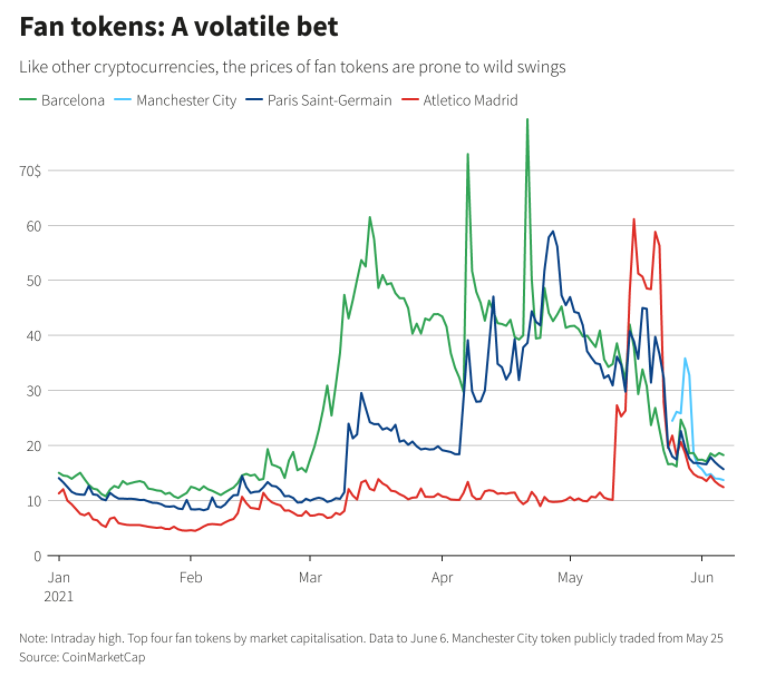
A number of soccer teams worldwide are experimenting with launching their own digital tokens, which allow fans to vote on mostly inconsequential club decisions, such as what music plays after a goal, according to Reuters.
While some fans have heralded the idea, others have called the tokens nothing more than "superficial participation" that adds to club costs.
So far, major international clubs like English Premier League champions Manchester City and Italy’s AC Milan have launched the tokens. Spain's national team is also planning on launching them.
The tokens can be traded on exchanges, just like other cryptocurrencies, and their prices can be just as volatile. Clubs have been teaming up with crypto technology firms that launch the tokens and shares in the revenue from their initial sale. Many clubs launched their tokens at about $2 each.
Malcolm Clarke, chair of the Football Supporters’ Association, which represents fans in England and Wales called the tokens "not a good look". He says they are indicative of clubs “trying to squeeze extra money out of supporters by making up inconsequential ‘engagement’ online polls.”
Sue Watson, chair of West Ham United Independent Supporters’ Association, asked: “Why should you have to pay to have any sort of say in the club?”
But the tokens have helped generate revenue at a time where Covid has brutalized ticket sales. Sales at Europe's Top 20 clubs were down 12% in 2020, the report noted.
Giorgio Ricci, chief revenue officer at Italy’s Juventus, said the tokens “[were] beneficial for clubs and fans.”
Juventus supporter Giuseppe Bognanni said: “It’s nice that the song you voted for is the one you hear, and you think ‘I participated in that'.”
Roma supporter Katia Gigliotti said it helped her engage with her club when she couldn't make it to the stadium: “Not being able to go to matches was traumatic because for me soccer means stadiums.”
One firm that teams have been teaming up with is Chiliz, a unit of Malta-based Mediarex Enterprises Ltd. The company's CEO, Alexandre Dreyfus, says the company shares in revenue from the initial sale of tokens and that his company is targeting $200 million in revenue this year. His company has helped launch 20 tokens with various soccer teams.
The adaptation of digital technology in sports has also taken hold as items like non-fungible tokens (NFTs) for things like NBA highlights.
Iran Moves Toward a One-Party State
The Supreme Leader is willing to risk the legitimacy of an election to consolidate monolithic hard-line control.
Two years after a popular uprising ended two millennia of dynastic rule in Iran, the revolutionary leader Ayatollah Ruhollah Khomeini scolded the country’s squabbling politicians for “biting one another like scorpions.” Four decades later, on the eve of a Presidential election, on Friday, Iranian politics are no less contentious. At the first of three campaign debates, the former Revolutionary Guard commander Mohsen Rezaei vowed that his first act, if elected, would be to charge the leading centrist candidate, Abdolnaser Hemmati, who was seated a few feet away, with betraying the revolution. “If I become President, I will ban Hemmati and a number of other officials of the Rouhani government from leaving the country, and I will prove in court which treacherous roles they played,” he said, during a three-hour televised debate with six other candidates. Rezaei, who is making his fourth run for President, has been popularly mocked as “General Botox,” owing to the recent transformation of his face. The atmosphere was so fraught that Hemmati, a former Central Bank chief who holds a black belt in karate, made an appeal to a third candidate, the judiciary chief Ebrahim Raisi. “Mr. Raisi, can you give me assurances that no legal action will be taken against me after this event?” It was hard to tell whether Hemmati was joking or serious—or both.
The election marks the political end for President Hassan Rouhani, a centrist who won two landslide elections in 2013 and 2017, and who can’t run again because of term limits. It may also mark the end, for the foreseeable future, of a reform movement that had struggled to ease rigid restrictions at home and open Iran to the world. Rouhani had dared to run on a platform of engaging with the United States. During his first term, his team negotiated a nuclear deal with the world’s six major powers. But, during his second term, President Trump’s decision to abandon the deal—and impose more than a thousand new sanctions on Iran—doomed Rouhani and his political ilk. His popularity plummeted. Last year, hard-liners swept parliamentary elections, albeit with the lowest turnout since the 1979 revolution.
Last month, almost six hundred Iranians, including forty women, registered to run for President. Only seven were approved by the conservative, twelve-man Guardian Council; even regime loyalists were shocked. It rejected a former President, a current Vice-President, a long-serving former speaker of parliament, and the current mayor of Tehran. Five of the seven candidates approved were hard-liners deeply hostile to the West. “Goodbye reforms?” headlined one Tehran newspaper.
Raisi—the judiciary chief who came in second in the 2017 election, and who has led in polls of likely voters for this election—was sanctioned by the U.S. Treasury Department in 2019. It cited his involvement in the so-called Death Commission, which ordered extrajudicial executions of thousands of political prisoners in 1988, and his senior positions, since then, in a judicial system that executes minors. “Raisi is a pillar of a system that jails, tortures, and kills people for daring to criticize state policies,” Hadi Ghaemi, the executive director of the Center for Human Rights in Iran, said before the first Presidential debate. “Instead of running for president, he should be tried.” Last year, the U.S. also sanctioned Rezaei, noting his suspected involvement in a 1994 terrorist attack on a Jewish community center in Argentina that killed eighty-five people; Interpol still has an active warrant out for his arrest. “I am proud to be sanctioned by America,” Rezaei replied.
Hemmati, a centrist backed by many reformists, could pull off an upset if the turnout is high, Iranian and foreign analysts told me. He was gaining in the final week of the campaign. All three Presidents since 1997 have been dark horses who beat the candidates expected to win. To energize moderate voters, Hemmati announced on Wednesday that he would keep the current foreign minister, Mohammad Javad Zarif, who led the negotiations in the 2015 Iran nuclear deal, in his post or make him a Vice-President. In another boost for Hemmati, the only other reformist candidate, Mohsen Mehralizadeh, withdrew from the race on Wednesday. Yet, over the past two years, the public mood has soured on the country’s élite, analysts say. Apathy runs deep, polls show. “There’s confusion about how to deal with the massive candidate suppression,” Hadi Semati, a former professor at Tehran University, told me. “People are exhausted, but they haven’t given up completely. There’s a sense of bewilderment about whether to vote or how to vote.” The campaign is also only three weeks long—one of the shortest in the world.
Friday’s vote is about far more than the Presidency. The timing intersects with three pivots that could shape Iranian politics for decades. The first is the succession to the Supreme Leader, Ayatollah Ali Khamenei, who is now eighty-two; he has been Iran’s ultimate power for more than three decades. He had been President before he became Supreme Leader, the single precedent for a transfer of power. Iranians know that they may be voting for a man—and, in the case of Raisi, the only cleric—who could be Khamenei’s successor, and in power for longer than four or eight years.
VIDEO FROM THE NEW YORKER
The Pandemic Through the Eyes of a Three-Year-Old
The second driver is a generational shift. Forty-two years after the Revolution, the majority of the early revolutionaries are senior citizens—or dead. The majority of Iran’s eighty-five million people (and voters) were born after 1979. For decades, Iranian politics have been divided among hard-line and reformist factions; each had its own internal divisions. (One of my favorite Iranian jokes is “Wherever there are five Iranians, there are six parties.”) Hard-line factions could usually count on up to a quarter of voters; centrists and reformists usually rallied roughly as much. The middle forty to fifty per cent decided the outcome of elections.
But the next generation of Iranians is more diverse and not so neatly categorized. The new guard is also eager to push out the old guard, Semati said. Younger conservatives are often more hard-line and more ideological than their elders, partly because they didn’t experience the hardships that came in the wake of the Revolution and the eight-year war with Iraq, which forced pragmatic compromises. Many young centrists and reformists have been depoliticized. The movement has failed to produce, politically or economically, and it now lacks coherence and a post-Rouhani leader. “Mobilizing them is harder than ever,” Semati said.
The third driver is the increasing dysfunction of Iran’s hybrid political system. The Islamic Republic uniquely blends the Western principles of a republic (borrowing heavily from the Napoleonic Code) with Islamic law. Almost every dispute over domestic and foreign policy has, at its core, reflected the internal tensions over whether revolutionary Iran is first and foremost a republic, where man’s law and the public’s electoral choices are supreme, or whether it is an Islamic state, where God’s law and the clergy have the final word. Since 1989, when a constitutional amendment introduced an executive Presidency, the President—whether hard-line or reformist—has been at odds with the Supreme Leader on how much control the elected government really has. Two former Presidential candidates—the former Prime Minister Mir-Hossein Mousavi and the former speaker of parliament Mehdi Karroubi—are still under house arrest, a decade after supporting the 2009 Green Movement’s mass protests against alleged election fraud. This year, the list of approved candidates reflects a clear attempt by conservatives to direct the future of the country at an epic juncture in this debate.
Iran is also notoriously corrupt. It was bad under the monarchy; it is hideous under the theocracy. In 2019, Rouhani’s brother was sentenced to five years for corruption and bribery. Raisi initially resonated with voters because he has championed—at least rhetorically—a crackdown on corruption ever since the Supreme Leader appointed him to be Iran’s chief justice, in 2019.
Given Iran’s myriad challenges, Khamenei may be trying to influence more than the succession, Ali Vaez, the Iran project director for the International Crisis Group, told me. The Supreme Leader is willing to risk the legitimacy of the election—which would be reflected in a large turnout—in order to consolidate monolithic control by hard-line politicians loyal to rigid revolutionary principles. “He is doing this because he wants a pliant President and a pliant parliament to bring reforms that insure a pliant system that will minimize resistance to transformational changes and protect his legacy,” Vaez said. Khamenei hopes to orchestrate a political overhaul that could effectively remove the republican aspects from Iran’s political system. His goals may include weakening, potentially even eliminating, the Presidency by returning to a parliamentary system, which was used during the first post-Revolution decade. The President was then only a titular position unable to challenge the Supreme Leader. “After three decades as Supreme Leader, Khamenei understands that the system is dysfunctional,” Vaez said. “The Supreme Leader cares more about outcome than turnout because he is laying the groundwork for structural changes in the Islamic Republic.”
Barring a surprise upset by Hemmati, or a runoff election if none of the candidates gets over half the votes, Iranian politics are moving to a single-party system dominated by conservatives, Semati said. In a bid to boost Raisi, the hard-line lawmaker Alireza Zakani and Saeed Jalili, a member of the Supreme National Security Council, withdrew from the race on Wednesday. More than two hundred members of parliament also issued an appeal calling for other hard-line candidates to pull out, too. Yet creating a monolithic political bloc that endures indefinitely will be as difficult as it was in the past. The early revolutionaries splintered into dozens of factions, forcing Khomeini to dissolve the single Islamic Republican Party, in 1987. “Iran can’t be run by a single party,” Semati said. “They would love to do it, but Iranian political culture is more developed than anywhere else in the region. It’s not easy for any party to dominate.” The scorpion analogy still holds.
Investors should prepare for impact of green stress tests on banks
Central bankers look at powerful tool to nudge financial system to address climate risks
The world’s central banks are going green. At a recent “Green Swan” conference for regulators, the world’s top central bankers agreed they had a clear role to play in tackling climate change. But which measures are the most important? And how much would their actions shift the cost of capital for high and low carbon companies? I suspect that climate stress tests may prove the most powerful tool to nudge the financial system.
Over the coming year, a dozen central banks will run climate transition stress tests on banks, insurers and pension funds, following the Bank of England’s lead. They include the European Central Bank as well as authorities in Australia, Canada, Japan and Singapore. These tests could be highly catalytic in repricing the cost of capital between companies. Investors will want to get ahead of these exercises.
Stress tests have been the single most consequential change in financial regulation since the financial crisis. They set the pace for capital and operational planning for banks simulating crises as a way to protect against them. They were central to the banks’ resilience during the pandemic.
Will climate stress tests be as effective? Central bankers are not climate policymakers, but requiring data and scenario analysis is likely to change risk management practices to assess climate risk as a financial risk. That was the reason I recommended them to the Bank of England in 2019: to provide a road map for integrating climate metrics into risk and governance.
We just got a sneak-peak of some of the implications in a recent exercise undertaken by the French central bank. First, insurers were far more affected than banks. The exercise suggested that extreme weather could quintuple the cost of related insurance claims by 2050. According to the Banque de France, covering these losses would require premiums to increase by 130-200 per cent. The tests also raise the spectre of insurance gaps emerging as it becomes uneconomic to insure.
Another lesson is about managing the transition. Risks for banks were considered “moderate”. Depending on the scenario, tests suggest loan losses could treble by 2050, compared with the doubling during the pandemic. But given that just 10 per cent of their portfolios were in the most sensitive sectors overall losses might only increase by 25-33 per cent.
Already, credit markets are starting to reprice firms in the transition to a lower carbon economy. According to a new study by Ben Caldecott and colleagues at Oxford university, the cost to finance new fossil-fuel infrastructure, especially coal, is rising, while the cost for renewables is falling fast.
Over the past decade, the cost of finance, measured by the interest rate spread for loans over benchmarks, for coal mines went up 38 per cent and 54 per cent for coal-fired power plants. Meanwhile renewables saw a drop in their loan spread, with onshore and offshore wind declining by an average of 24 per cent and 12 per cent respectively.
What could investors expect next? Higher capital requirements for banks and insurers with higher risk loans are plausible over the next 5 years. Most central banks have said the first crude exercises are exploratory and would not impact banks’ capital buffers. However, the ECB has already signalled that individual firms may be held to qualitative or quantitative requirement.
A steepening in the cost of longer term finance compared with short-term debt is also likely for carbon intensive issuers. The transition will probably drive dispersion of returns both at a sector and company level. But as firms respond to market and investor pressures, and mitigate their carbon footprints, analysis by company will prove more important than simply by sector.
And these tests are likely to go mainstream. “There’s a lot to like about climate stress tests,” Jay Powell said at the recent Green Swan conference. I think the Fed may look to explore climate scenarios as early as 2022 or 2023. They are likely to become standard for pension funds too.
Of course, there are caveats. The models are still in their early phases. A priority for policymakers and investors must separate signals from noise. And weighing up the interactions between climate science, public policy, markets, and firms’ strategic responses, is far from straightforward.
“A thoughtful estimation of the cost of capital is a little like hygiene: There’s not much upside in getting it right, but there is a lot of downside in getting it wrong,” investment researcher Michael Mauboussin has argued. Climate stress tests will influence the cost of capital and investors will want to get ahead of them.