NY Times : As Money Launderers Buy Dalís, U.S. Looks at Lifting the Veil on Art

As Money Launderers Buy Dalís, U.S. Looks at Lifting the Veil on Art Sales
Secrecy has long been part of the art market’s mystique, but now lawmakers say they fear it fosters abuses and should be addressed.

The federal agents who raided a drug dealer’s house in a suburb of Philadelphia found marijuana and, to their surprise, $2.5 million in cash stashed in a secret compartment beneath a fish tank.
But they were even more surprised to discover so much art — 14 paintings on the walls and another 33 stacked in a storage unit a few miles away from the home of the dealer, Ronald Belciano. The artists included Renoir, Picasso and Salvador Dalí.
“That jumped out at us,” said Brian A. Michael, special agent in charge for Homeland Security Investigations Philadelphia. “That amount of artwork was not something you come across in every investigation.”


Image
When investigators raided the house of a suspected drug dealer in the Philadelphia suburbs in 2011, they found cash in sealed plastic bags hidden beneath a fish tank.Credit...Homeland Security Investigations
It turned out, Mr. Belciano used the art to launder some of his drug cash, purchasing the works from an established gallery near Philadelphia’s Museum Row.
In 2015, he was sentenced to more than five years in prison for dealing drugs and for laundering the illicit proceeds by taking advantage of one of the art market’s signature features — its opacity.
Billions of dollars of art changes hands every year with little or no public scrutiny. Buyers typically have no idea where the work they are purchasing is coming from. Sellers are similarly in the dark about where a work is going. And none of the purchasing requires the filing of paperwork that would allow regulators to easily track art sales or profits, a distinct difference from the way the government can review the transfer of other substantial assets, like stocks or real estate.
But now authorities who fear the Belciano case is no longer an oddity, but a parable of how useful art has become as a tool for money launderers, are considering boosting oversight of the market and making it more transparent.
In January, Congress extended federal anti-money laundering regulations, designed to govern the banking industry, to antiquities dealers. The legislation required the Department of the Treasury to join with other agencies to study whether the stricter regulations should be imposed on the wider art market as well. The U.S. effort follows laws recently adopted in Europe, where dealers and auction houses must now determine the identity of their clients and check the source of their wealth.
“Secrecy, anonymity and a lack of regulation create an environment ripe for laundering money and evading sanctions,” the U.S. Senate’s Permanent Subcommittee on Investigations said in a report last July in support of increased scrutiny.


Image
Pennsylvania police discovered $1.18 million in cash hidden in a vehicle they stopped in 2011. The cash was part of an operation that transported marijuana cross-country from California.Credit...Homeland Security Investigations
To art world veterans, who associate anonymity with discretion, tradition and class, not duplicity, this siege on secrecy is an overreaction that will damage the market. They worry about alienating customers with probing questions when they say there is scant evidence of abuse.
“We are in the paranoid-terrified phase of what’s going to come down the pike,” Andrew Schoelkopf, then the president of the Art Dealers Association of America, said at an industry panel this year. “It’s going to be a whole lot of paperwork and a whole lot of compliance and I don’t think we will extinguish much of a problem.”
Their concerns are great enough that lobbyists for the dealers’ association and major auction houses have been trying in Washington to shape the evolving policy on this and other regulatory measures. Since 2019, the lobbying bill for Christie’s, Sotheby’s and the dealers’ association has approached $1 million.
Still, there is no question the art market has exploded in value and scope from the sleepy days when its customs were created. Paintings routinely sell for $10 million, $20 million, often as much as the penthouses in which they hang. Though the profits from art sales are subject to the robust capital gains tax on luxury goods of 28 percent, the I.R.S.’s ability to track who is accurately reporting windfalls is something of a struggle. Even figuring out who sold what is a hurdle. Half the purchases are in private, not at public auction, so many prices never become public.
Recent studies have projected substantial tax evasion by the richest Americans, which led to President Biden’s plan to boost audits. While there is no evidence of widespread cheating involving art, experts say it’s clear the secrecy of the market creates vulnerabilities for an enforcement system that rarely conducts audits and relies heavily on the willingness of collectors to make plain their profits.
“The only ones who know,” said Khrista McCarden, a professor at Tulane Law School who specializes in the tax code, “are you, the art gallery and God.”
A Long History of Whispered Names
The secrets of the art world sometimes tumble out at places like the Eden Rock hotel on St. Barts, where in a lunch in 2014 overlooking the turquoise waters of St. Jean Bay, the Russian billionaire Dmitry E. Rybolovlev, a collector, was introduced to Sandy Heller, a New York art adviser. Naturally, the conversation turned to art, and money.


Image
Dmitry E. Rybolovlev, Russian businessman and art collector, at his apartment in Monaco.Credit...Benjamin Bechet for The New York Times
Mr. Rybolovlev had paid $118 million for a Modigliani nude from an unknown seller. Mr. Heller confirmed that the seller had been his client, the hedge fund manager Steven A. Cohen. But something was off. Mr. Cohen had charged only $93.5 million, Heller said.
Mr. Rybolovlev had used an art adviser, Yves Bouvier, to make that and many other purchases, totaling nearly $2 billion. It turned out Mr. Bouvier was buying the works at one price and flipping them at huge markups to his client.
Mr. Bouvier has said it was always clear he was operating as an independent seller who could buy the art and resell on his own terms. But in the legal battle that has ensued, Mr. Rybolovlev has castigated not only his former adviser, but the art world itself.
“If the market were more transparent, these things wouldn’t happen,” he said.


Image
Yves Bouvier, an art adviser and dealer, helped Mr. Rybolovlev purchase artworks, but sometimes he bought the works first and then resold them to him at huge markups.Credit...Jerome Chatin/Expansion-Rea, via Redux
What is the origin of such secrecy? Experts say it likely dates to the earliest days of the art market in the 15th and 16th centuries when the Guilds of St. Luke, professional trade organizations, began to regulate the production and sale of art in Europe. Until then, art was not so much sold as commissioned by aristocratic or clerical patrons. But as a merchant class expanded, so did an art market, operating from workshops and public stalls in cities like Antwerp. To thwart competitors, it made sense to conceal the identity of one’s clients so they could not be stolen, or to keep secret what they charged one customer so they could charge another client a different price, incentives to guard information that persist today.


Image
Frans Francken the Younger and Cornelis de Baellieur painted this 17th century depiction of a collector’s gallery, evidence of an art market that had emerged in step with a flourishing merchant class. Credit...Erich Lessing/Art Resource, NY
The market is less secretive than it once was. Auction houses, for example, today publish estimates of prices they expect artworks to achieve. But so much about it remains opaque, which lends an air of mystery and romance to a world where values and profits can rely on something as capricious as a fleeting consensus on genius.
Auction catalogs say works are from “a private collection,” often nothing more. Paintings are at times brought to market by representatives of owners whose identities are unknown, even to the galleries arranging the sale, experts and officials say. Purchasers use surrogates, too. When Mr. Rybolovlev sold Leonardo da Vinci’s “Salvator Mundi” to Crown Prince Mohammed bin Salman of Saudi Arabia, for example, it was bought by a friend of the prince, which obscured who was shopping.
In these circumstances, the galleries rely on the integrity of the agents, with whom they have long done business. Sometimes the buyers and sellers are not individuals at all, but shell companies, opaque investment structures often designed to conceal identity.
“Very rarely is anybody buying a $5 million painting as a person because they don’t buy anything else that way,” said Cristin Tierney, a New York gallerist.
And once works are purchased, many of them, including some of the world’s most expressive and expensive, end up hidden away in cavernous, nondescript, tax-sheltered free ports, their whereabouts largely unknown.
“The variety of frauds in the art world is almost infinite and that is facilitated by the fact that the art world operates with a secrecy that no other investor would dream of operating in,” said Herbert Lazerow, a professor at the University of San Diego School of Law.
Following Europe’s Lead
Now the federal government is considering using a law designed to combat money laundering at financial institutions to further regulate the art market. The law, the Bank Secrecy Act, requires banks to report cash transactions of more than $10,000, highlight suspicious activity and understand the identity of their customers and where their wealth comes from.
Congress has already authorized Treasury officials to tailor the regulations to fit the antiquities market, which has long been burdened by worries about illicit artifacts trafficked from countries like Syria and Iraq. Now dealers of ancient treasures like Roman marble statues or Egyptian reliefs will be treated like financial institutions, and federal regulators will study whether the restrictions should be extended to the broader art market.
Antiquities dealers are concerned about the cost of complying with the so-called AML (anti-money laundering) regulations. They say they already know their customers well enough to know they are not engaged in illicit activities.
Randall Hixenbaugh, a New York antiquities dealer, complained that small businesses would be forced to hire compliance officers. “I can’t even afford to hire a full-time assistant in this horrible economic climate,” he said in an email.


Image
Leonardo da Vinci’s “Salvator Mundi” has not been seen in public since it sold for $450.3 million in 2017, shattering auction records.Credit...Timothy A. Clary/Agence France-Presse — Getty Images
If the new strictures are extended to the much broader art market, dealers and auction houses would likely be required by law to determine who the actual owners are, even pierce the veils of shell companies.
Christie’s said it “welcomes the opportunity to work with U.S. regulators on appropriate and enforceable” guidelines. Sotheby’s said it “has long-established due diligence procedures and will comply with all applicable laws and regulations.”
Auction houses have already responded to the changes in Europe with more thorough vetting of their customers in the United States, too. Christie’s says sellers at its New York auctions must fully disclose their identity. For buyers, it says it verifies the identity of any agent and works to identify the sources of funds when there is any suggestion of risk.
But last year, Senate investigators found gaps in the policies the art market now has in place. Auction houses and dealers were cited for having allowed two Russian oligarchs, close to President Vladimir V. Putin and under sanctions, to buy and sell art using shell companies fronted by an art adviser. The subcommittee concluded that the auction houses, in transactions between 2011 and 2019, did not determine who the real owners were despite professing to have adopted safeguards.
Senator Rob Portman, an Ohio Republican and a sponsor of the report, said “the art industry cannot be trusted to self-police.”
“While the auction houses claimed to have robust anti-money laundering programs, we found that the actual employees who facilitated the transactions never asked who the art intermediary was buying the painting for or where the money was coming from,” he said in a statement.
Even if the tighter rules were adopted, the names of buyers and sellers would not become public. But dealers and auction houses would need to determine who they are dealing with in case of law enforcement inquiry.


Image
Authorities, who fear art may have become a tool for money launderers, are considering proposals to track sales more closely.Credit...Max Loeffler
Are Authorities Aiming a Cannon at a Mouse?
How much money laundering involves art? No one seems to have quantified it, though many experts agree the art market is a natural place for it to flourish. “Pieces are portable, there is a high level of secrecy around who owns what and the value that they’re paying, and it’s debatable in some ways,” said Nienke Palstra, a researcher at Global Witness.
Still, the number of prosecutions that have been made would not, by itself, suggest the problem is ubiquitous.
In a typical case, someone uses illicit profits to purchase art, parking the money there until a later sale results in “clean” money with a legitimate pedigree. A famous case concerns the financier Jho Low, who prosecutors say helped siphon billions of dollars from a Malaysian government fund employing a network of bank accounts and shell companies. He then laundered the money, prosecutors say, via a spending spree on things like art. In 2014, a Cayman Island company he owned received a $107 million loan from Sotheby’s using some of the art as collateral. (Mr. Low denied any wrongdoing and remains at large.)


Image
Many of the world’s most celebrated artworks are not hanging in museums, but hidden away in the storage vaults of free ports, like the Geneva Free Port in Switzerland.Credit...Fred Merz for The New York Times
Sotheby’s and Christie’s said they stopped doing business with him once they knew he was under investigation. They were not accused of wrongdoing.
Some experts say enforcement efforts have simply been too anemic to detect laundering, and that the size of the problem will become apparent if dealers and auction houses are required to report suspicious activities.
“You don’t know what you don’t know,” said Peter D. Hardy, a former U.S. prosecutor.
Advisers to collectors say they also do not believe that the opacity of art transactions has led to major cheating on the reporting of capital gains, even though dealers have no obligation to provide independent reporting of sales to the government.
“Collectors are savvy business people of prominent standing in their communities,” said Michael Plummer, principal at an art management and investment firm in New York, “and advised by sophisticated tax and legal professionals — saving tax dollars by not reporting capital gains and committing outright tax fraud is just not worth the risk to their other business and social interests.”
In cases where people fail to report the profits from art sales, some advisers think the banking system is able to flag possible tax evasion. But other experts said the ranks of I.R.S. and other regulators were too thin to follow up on the millions of banking alerts that come in each year.
“They get so many reports, they could not possibly follow up on all of them,” said Julie A. Hill, a University of Alabama School of Law professor.
Her Money Smelled Like Pot
Four months after his arrest, Ronald Belciano returned to I. Brewster & Co., the Philadelphia gallery where, investigators said, he had bought the art he used to launder money.
But he was not there to shop for himself. Instead, he introduced the gallery owner, Nathan Isen, to Lisa, who he identified as a drug dealer with lots of cash to spend on art, according to court records.
Lisa said she had concerns.
“Like, I’m willing to invest in stuff like this, but this I don’t know,” she said, according to a transcript of their conversation. “I don’t know how to sell this. Cars, other things I can get rid of easy. Like this I’m nervous about.”
Mr. Isen provided his perspective on art market transactions.
“It’s different than selling a car,” he said, “’cause car has to have the registration, the title, and this and that and everything. … These are nothing. … These could have been, these could have been your grandmother’s. You follow me?”
“So I can say, ‘hey, this is stuff that I inherited not that I bought,’” Lisa asked.
“Right. ‘I found it at a thrift store, they were $10 a piece,’” Mr. Isen replied.
Mr. Isen had not been accused of wrongdoing in Belciano’s case and has denied knowing Mr. Belciano was using the art to launder money, but as a result of his conversations with Lisa, who was an undercover agent wearing a wire, he would later be charged with money laundering and plead guilty in 2015. He was sentenced to 320 hours of community service and received a $15,000 fine.
A week after their first conversation, Lisa returned to Mr. Isen’s gallery to buy 12 Salvador Dalí lithographs for $20,000. She had the cash in a brown paper bag. It smelled of drugs, she told the gallerist, because she kept it with her marijuana stash.
He told her she was not getting an invoice for her purchases, according to the court papers.
“No invoices? Cool,” she replied. “No receipt, no invoice, I’m good with that. That’s the way I like to do business.”
“We never saw you before,” Mr. Isen said.

(ZH) Powell Just Made A Huge Error: What The Market's Shocking Response Means Fo

Powell Just Made A Huge Error: What The Market's Shocking Response Means For The Fed's Endgame

Back in December 2015, just days before the Fed hiked rates for the first time since the global financial crisis, in its first tightening campaign since June 2004, we said that Yellen was about to engage in a great policy error, one which like the Ghost of 1937, would end in disaster...
... and sure enough it did, when after 9 rate hikes, Powell realized that a rate of 2.50% is unsustainable for the US economy which first cracked during the summer of 2019 repo crisis when the Fed cut rates three times, only to cut rates to zero from 1.75% in a matter of days after covid conveniently emerged on the global scene and led to an overnight shutdown of the US economy and "forced" the Fed to nationalize the bond market as well as inject trillions of liquidity into the market.
But what is it that prompted us to predict - correctly - that any rate hike campaign is doomed to fail (similar to the Fed's ill-conceived plan to hike rates in 1937, which brought the already reeling country to its knees and only World War 2 saved the day, giving FDR a green light to unleash a fiscal stimulus tsunami the likes of which we hadn't seen until the covid response)?
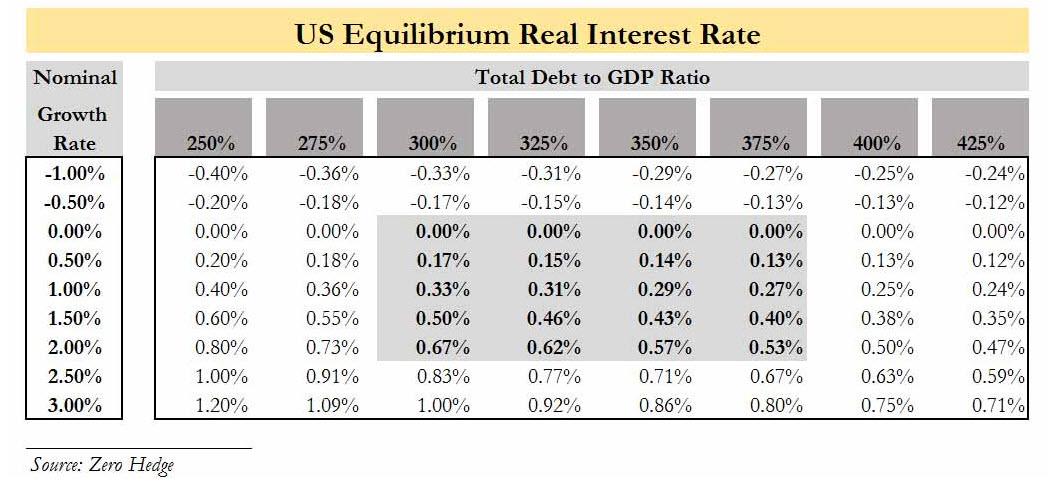
Simple: as we explained back in Dec 2015, the equilibrium growth rate in the US, or r* (or r-star), was far far lower than where most economists thought it was. In fact, as the sensitivity table below which we first constructed in 2015 showed, the equilibrium US growth rate was right around 0%.
As we explained then making the case for a far lower r-star, "if nominal growth is 3 percent and the debt GDP ratio is 300 percent, the implied equilibrium nominal rates is around 1 percent. This is because at 1% rates, 100% of GDP growth is necessary to service interest costs."
In this case, real growth would slow in response to rate hikes because productivity would stay weak at full employment and companies would be profit/price constrained around paying higher wages. Moreover, nominal growth would then slow even more than real growth does because inflation would fall to 1 percent or below.
As we concluded then, "this is the important policy error scenario because even a very shallow path of rate hikes might drive the real Funds rate well above the short-term equilibrium real rate, further depressing demand. It is then plausible that the economy would be driven into recession, and the Fed would quickly be forced to abort the hiking cycle. As an aside, such a policy error could reinforce itself by causing structural damage that puts additional downward pressure on the equilibrium real rate. In this case the yield curve would flatten meaningfully, at least until the Fed actually reversed course by cutting rates."
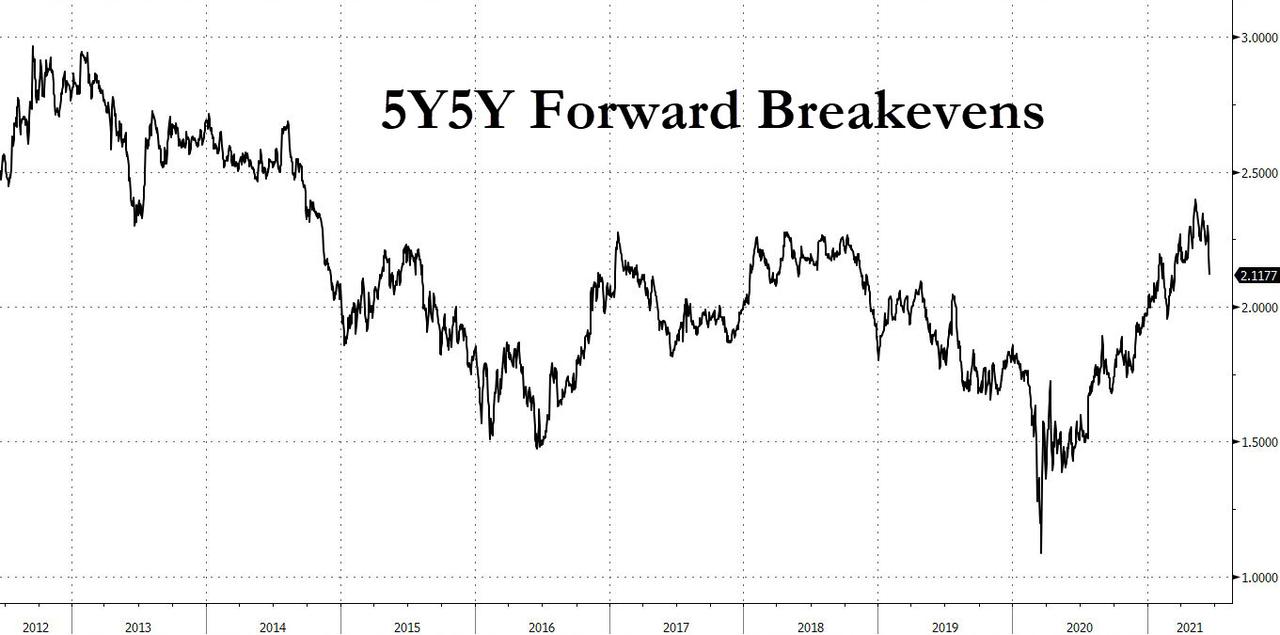
As the chart at the top shows, this is precisely what happened, only instead of World War II - which is what short-circuited the Ghost of 1937 rate hike policy error, it was the covid crisis that gave the Fed and the US government a green light to unleash an unlimited monetary and fiscal stimulus, delaying the inevitable recession and kicking the can a few years.
* * *
Why is all of this relevant? Because according to some of the smartest people on Wall Street, the market's reaction to last week's unexpected Fed announcement suggests that r* now is even lower - which makes intuitive sense in light of the surge in debt and decline in growth excluding government stimulus - and that the next tightening cycle, which may start as soon as next year according to Bullard - will be the shallowest one yet as the US economy can hardly afford tighter financial conditions.
In a note written late last week, and certainly after the market's remarkable reversal following the hawkish Fed, DB's chief FX strategist George Saravelos wrote that the day after the Fed meeting "was extraordinary by any measure: the biggest daily rally in the dollar index since the March global shutdown, a big drop in long-end US yields to the lowest since February, the biggest drop in some commodity prices since March of last year but a new record high in the NASDAQ all happening at the same time."
How to square it all up?
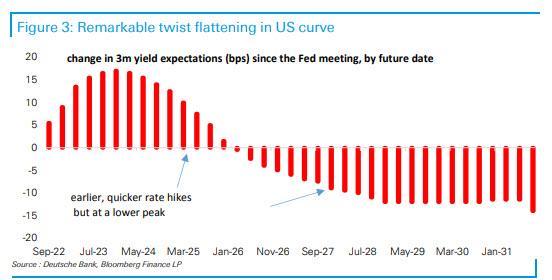
According to Saravelos, the Fed made a big policy error as evidenced by the flattening in the yield curve...
... which according to the DB FX strategist "boils down to a very pessimistic market view on r*" or in other words, the same argument we made 6 years ago when we predicted that the Fed's hiking cycle would end in disaster.
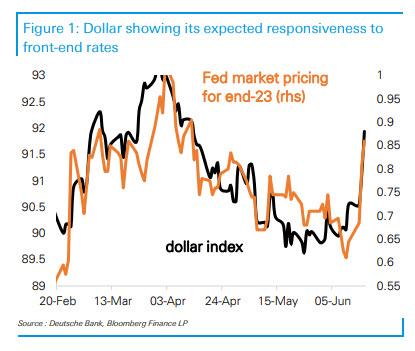
First, the easy part. The big dollar rally is entirely with the conventional wisdom that what matters for the greenback is front-end real rates. Fed tightening expectations have repriced sharply higher over 2023 and support more near-term dollar strength (chart 1). There should be no surprise that the dollar has rallied strongly even if 10-year yields have not made new highs.
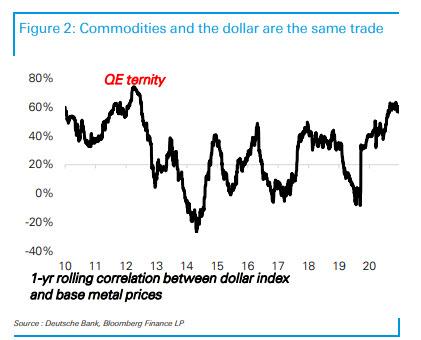
Second, the commodity part. As the DB strategist notes, the role the Fed has played in inflating commodity prices should not be underestimated and is perhaps seen best in the very high correlation between the dollar and base metal prices at the moment:
Our fixed income colleagues have shown there is an extremely powerful link between the Fed balance sheet, commodity prices and inflation expectations: the taper of 2013 marked the peak in inflation expectations back then too.
On a similar note, economists have shown that even survey-based measures of inflation expectations such as Michigan exhibit a high correlation to commodity prices. All of this reinforces the point that the Fed can be far more powerful in influencing inflation expectations via
the dollar and commodities than is commonly assumed.
Finally, and most importantly, we get to the bond and r* part.
As the chart below shows, the market has undergone a remarkable twist flattening over the last 48 hours which according to Saravelos is extremely unusual given that the Fed has not even started hiking rates yet. And in a repeat of the aborted hiking cycle of 2015-2019, while market pricing for hikes in 2023 and 2024 has gone up, yields beyond that have gone down as the market is saying that the best the Fed can do is less than 2-years of rate hikes.
This has also coincided with a notable drop in inflation expectations - indeed Fed has shown a hawkish pivot even before market breakevens have reached their pre-2014 normal range.
What all of the above is telling us, according to Saravelos, is that unlike 2015 when we were the only ones warning about how low real r* is, the market now is taking an extremely pessimistic view on real neutral rates, or r*.
Said otherwise, if the Fed decides to go early - as first Powell hinted and then Bullard doubled down on Friday sending stocks plunging - the market is saying that it won’t be able to go very far before inflation and growth hit a speed limit, pushing yield expectations after the initial hike lower.
This very pessimistic view on r*, first laid out here in 2015, is also in line with market behavior beyond the bond market. First, as DB's Saravelos notes, it is aligned with the very high dollar responsiveness we have seen to even small shifts in Fed stance: huge pent-up demand for yield from investors across the planet forces a stronger dollar and a bigger disinflationary impact quicker than assumed.
In other words, a low global r* (remember the rest of the world still has massive current account surpluses, or excess savings) pushes US r* even lower.
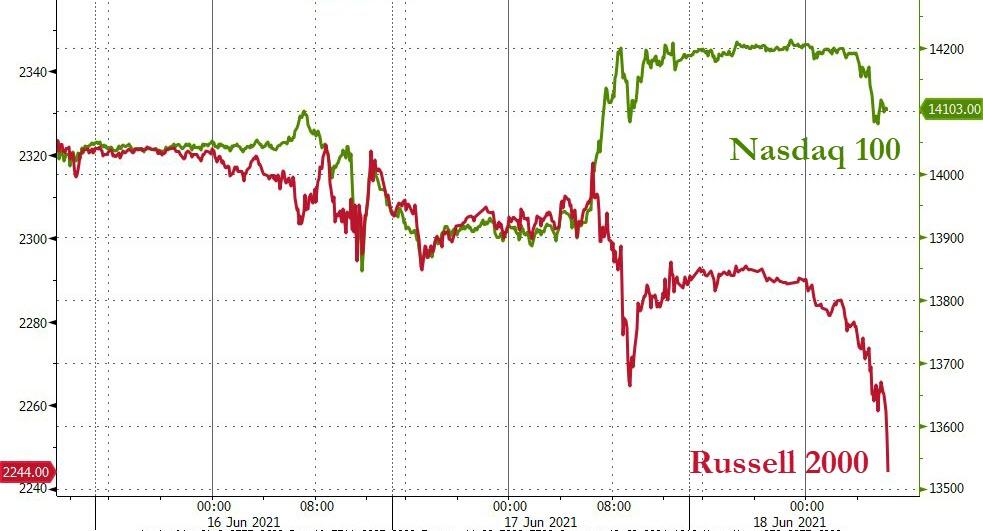
Second, a low r* is consistent with continued equity resilience, especially in growth stocks heavily reliant on a low medium-term discount rate. That the equity moves in the past two days were led by huge relative rotation from the Russell to the NASDAQ should not be a surprise. This, as Deutsche Bank ominously warns, is 2010-19 secular stagnation pricing, version 2.
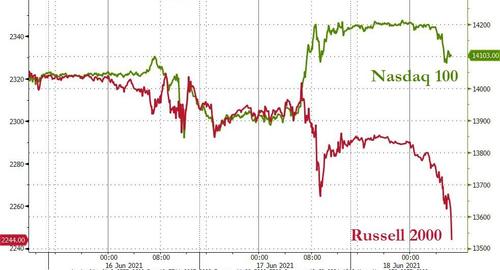
Bottom line: while a day’s price action (or even two) does not a trend make, the market is sending some peculiar signals that need to be monitored. Meanwhile, Saravelis has been emphasizing in recent weeks that the transition away from the v-shaped part of the recovery to the new post-COVID steady state will start raising all sorts of uncomfortable questions, including the structural damage COVID has left on private-sector saving rates as well as the new level of equilibrium real rates. One can only imagine the sorry state of the economy when the fiscal stimulus is gone and turns from a tailwind to a headwind. Historical evidence has shown a huge negative impact of pandemics on r* for example. For a big dollar up cycle, the Fed needs to be able to get very far. The market is not so sure, although for now the paradoxical divergence between the surging dollar and tumbling yields has yet to be addressed by the market.
A bigger question is will the US even be able to sustain positive GDP growth absent trillions in new stimulus each and every year? And even more ominous: what happens to inflation if the Fed is forced to cut rates well before the inflationary burst is extinguished? These are among uncomfortable questions markets will have to answer in the coming months.
Perhaps the biggest question facing the Fed now is whether it is about to do another huge "ghost of 1937" error. As a reminder, the Fed believed the US economy had turned the corner in 1937 and started to raise rates – and was wrong, bringing the economy to its knees again. Only the massive fiscal reflation sparked via World War 2 saved the day.
The problem is that this time we already had the covid "war" which pushed both the US debt and deficit to wartime levels, so what else left absent all out war with China? How else can the US government justify tens of trillions more in stimulus at a time when the market is already discounting the US economy hitting a brick wall in 2024 when the next rate hike cycle comes to an end. And how will Powell's replacement (the Fed chair will certainly take the first opportunity to get the hell out of Dodge) combat inflation when some time in 2024 the economy enters recession even as prices continue to rise?
Because while Saravelos is right that the market freaked out as a result of a "very pessimistic" take on r*, a far more appropriate question is whether we are on the precipice of non-transitory runaway inflation as the Fed's hands will soon be tied and its attempt to stem soaring prices will push the US into economic depression?

(ZH) World's Third Largest Diamond Unearthed In Botswana

World's Third Largest Diamond Unearthed In Botswana

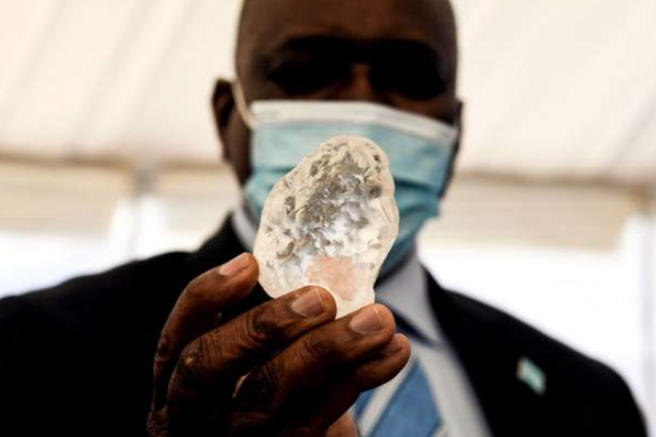
An enormous diamond has been unearthed in Botswana, according to a series of tweets by the Botswana government.
On Wednesday, the government of Botswana tweeted that 1,098-carat stone, believed to be the third-largest diamond ever found, was presented to President Mokgweetsi Masisi by Debswana Diamond Company's acting managing director Lynette Armstrong.
Debswana is a mining company located in Botswana and is the world's top producer of diamonds by value. The company is a joint venture between the government of Botswana and the South African diamond company De Beers; each party owns an equal share of the company.
"The diamond which is the third-largest in the world after the first and second that were discovered in South Africa and Lucara Botswana respectively, was discovered on June 1st from Jwaneng mine's South Kimberlite pipe, making it the largest diamond in the company's history since diamonds were discovered in Botswana in 1967," the government said.
Masisi said the diamond would be sold, and "proceeds will be used to advance national development in the country."
He added, "Debswana should use this latest discovery as an inflection point, for the mine to use its technology to realize more of these large discoveries."
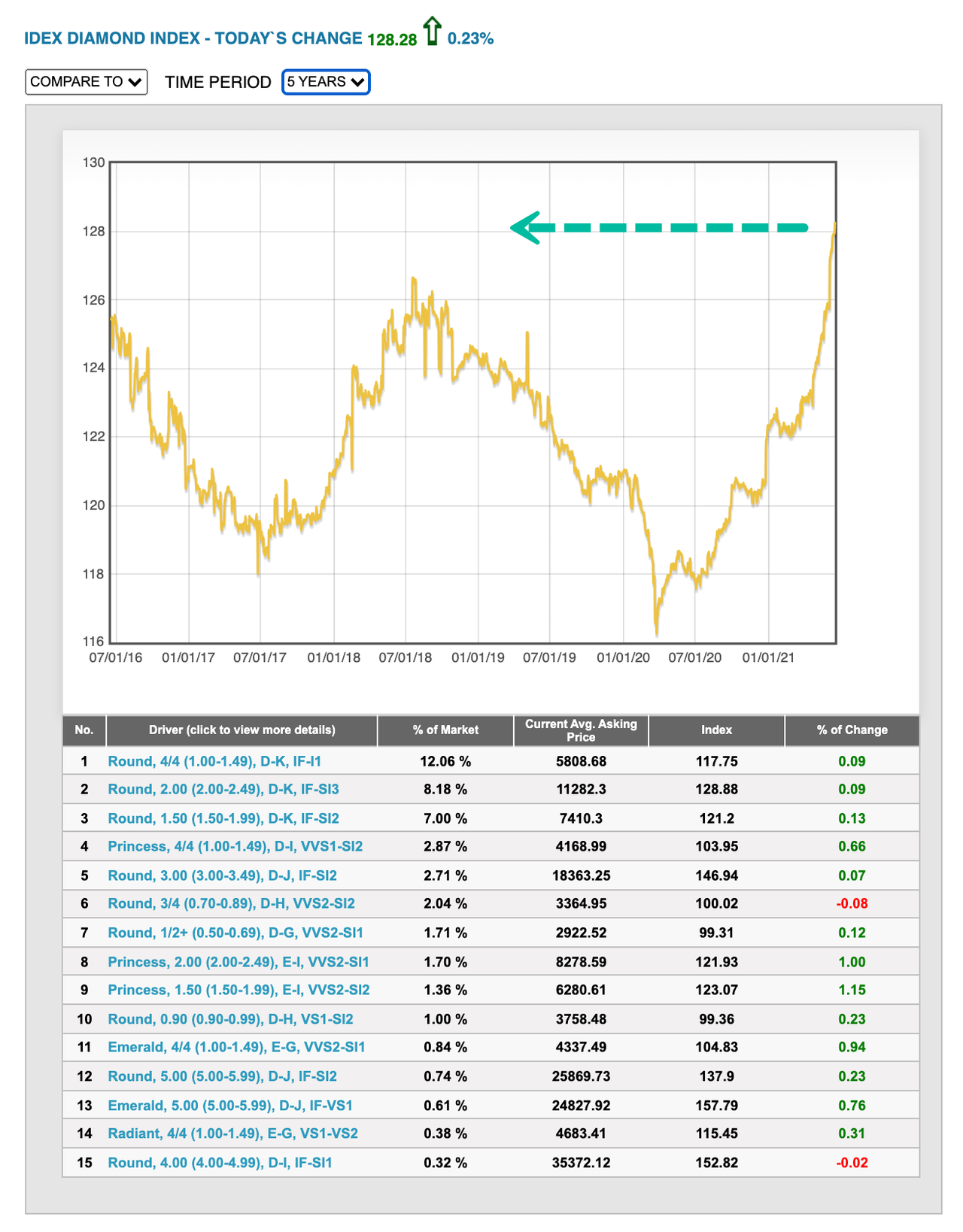
The announcement of the diamond's discovery comes as IDEX Diamond Index, real-time global diamond asking prices, has risen to a five-year high.
For years, we've noted diamonds have become unpopular as millennials were saturated with debt, unable to realize the American dream of marriage and a house. But thanks to global central banks and governments worldwide pumping trillions of dollars into the global economy, diamond demand has surged, and prices are way up.

WWD : Brunello Cucinelli Concerned About No-Vax Choice

Brunello Cucinelli Concerned About No-Vax Choice
Brunello Cucinelli expressed his worries about the small percentage of employees who will choose not to be vaccinated.

JAB WORRIES: Brunello Cucinelli proudly revealed that 1,174 employees of his namesake company will be vaccinated against COVID-19 by Sunday, an initiative accomplished over three days.

At the presentation of his spring men’s wear collection, Cucinelli raised an issue that has been on his mind over the past few days. “What to do with those employees that will refuse the vaccine? I know their colleagues will worry about this decision and will not easily work near them,” Cucinelli told WWD, while estimating the no-vax group to be a minority.

To flag these concerns, Cucinelli has written to Italy’s Prime Minister Mario Draghi and COVID-19 Emergency Commissioner Francesco Paolo Figliuolo, who at the end of May visited Cucinelli’s headquarters in Solomeo, where the entrepreneur has established a vaccination hub.

His decision is “for the time being, to ask non-vaccinated employees to stay at home with a paid leave for six months. But what will happen after that? I feel I am a custodian of the company and it’s not my job to try and convince them to get their injections, but this is an ethical, moral, civil and religious problem.”

The vaccination hub is not limited to protecting Cucinelli’s employees. It is open every day until midnight also to the general population and can distribute 500 jabs per day.

Other Italian fashion companies have been active in setting up vaccination centers, including Gucci, Prada and OTB to Giorgio Armani, Ermenegildo Zegna and OVS.

After an initial slowdown in the rollout of vaccines, the government has increased the pace of the injections in the country. As of June 19, 50.2 percent of the population has received a first dose and fully vaccinated citizens total 15.3 million, or 25.8 percent of the population, according to Il Sole 24 Ore Lab 24.

WWD : Exor Invests in Italy’s Consumer Goods Excellence

Exor Invests in Italy’s Consumer Goods Excellence
Exor is investing in consumer goods excellence by supporting the global development of medium-sized Italian companies, partnering with Hong Kong's World-Wide Investment Company Ltd.

MILAN — Exor is further expanding its reach, investing in consumer goods excellence by supporting the global development of medium-sized Italian companies specialized in this sector.

The Agnelli family’s holding Exor, which owns Ferrari, has recently invested in Hermès International’s China project Shang Xia, and in a minority stake in Christian Louboutin, has partnered with The World-Wide Investment Company Ltd., of the Hong Kong Pao family, setting up a new company called Nuo SpA.

As per the agreement, Exor and a WWICL company will invest 300 million euros, and each own 50 percent of Nuo. Exor’s investment will be entirely provided by capital while the partner’s quota includes a 30 percent stake in Ludovico Martelli SpA.

Founded in 1908, the Fiesole, Italy-based Ludovico Martelli is a personal care products company known for its storied brands including Marvis, Sapone del Mugello, Valobra and Proraso, and is an example of the excellence Nuo is planning to invest in.

Tommaso Paoli has been appointed chief executive officer of Nuo.

“We believe that Italy’s wealth of high quality, dynamic medium-sized enterprises, with their wonderful products and tradition, have true potential to become great companies of tomorrow,” said John Elkann, chairman and chief executive officer of Exor. “And we very much share with Stephen [Cheng, managing director of WWICL] and Tommaso, the ambition of helping to make the very best high-end Italian products available more globally.”

On its web site, Exor detailed the reasoning behind the investment, highlighting how “Nuo will unite the knowledge, experience and networks of its founders, to help its companies make their Italian expertise, creativity and authenticity available to global consumers, and especially in fast-growing Asian markets.”

Cheng touted the “perfect alignment of vision and values” between the partners, and said “Nuo promises to leverage on the very best of ourselves to create prosperity for all future stakeholders. There is such a unique history of entrepreneurship in Italy, rooted in human stories and emotion, and we are honored to invest in this everlasting tradition of passion and creativity.”

Nuo has “a clear purpose,” continued Exor, as well as “values and long-term investment horizon as well as a deep understanding of family and owner-operated companies. It will provide not only capital but also support on how to achieve greater scale while continuing to nurture the culture and uniqueness that differentiate its companies.”

While rumors continue to swirl around Exor or Ferrari and a possible interest in the Giorgio Armani group, waved away and even denied by both parties, and around the idea that the former could be eyeing to create a luxury pole, in March a spokesman told WWD that the holding “invests in single companies, not in sectors, and in exceptional businesses and founders with shared values and where it can add value and build great companies. It is the quality of the company, its team and culture and its attractive prospects that are the key drivers of the decision to invest.”

Exor is a long-term investor, working with founders and entrepreneurs in partnership.

Exor has grown into a giant holding company, reporting revenues of 143.8 billion euros in 2019. In January, after more than a year of negotiations, its controlled Fiat Chrysler Automobiles group and French automotive group PSA completed their merger, combining into a company called Stellantis comprising brands ranging from Fiat and Alfa Romeo to Chrysler, Jeep, Peugeot, Citroen and Maserati. It was a combination masterminded by Elkann, who has been leading the family holding company for 16 years. In addition, the holding spans from PartnerRe, a leading global pure-play reinsurer to The Economist and another range of newspapers, to CNH Industrial, which designs and produces agricultural and construction equipment.

WWD : LVMH Takes Full Control of Emilio Pucci

LVMH Takes Full Control of Emilio Pucci
The family sold its remaining stake and Laudomia Pucci will dedicate herself to archives and heritage promotion.

LVMH Moët Hennessy Louis Vuitton said Friday it now owns 100 percent of Florentine fashion house Emilio Pucci, having bought the 33 percent stake still held by the founding family.

Financial terms were not disclosed.

In tandem with the transaction, Laudomia Pucci will relinquish her role as vice president and image director after more than 20 years in that capacity.

She is to dedicate herself to the archives and promoting the heritage of her late father, Emilio Pucci, who founded the brand in 1947, initially designing skiwear out of jersey fabrics.

“I would like to thank the Pucci family, and Laudomia in particular, for their friendship and collaboration over the years,” Toni Belloni, LVMH’s group managing director, said in a statement. “Laudomia has been a precious guardian of the brand, bringing insight, passion and energy to the teams. We look forward to supporting her work on archives and heritage in the future.”

“I started in 1985, so I’ve been in this business for 36 years, bringing forward my father’s legacy, and with LVMH we’ve had a 21-year run. It’s been a beautiful experience and I am glad I consolidated the company and gave it a future,” she told WWD on Friday. “It’s been fantastic, a long, long ride, but now I want to focus on the more cultural and historical part of the Emilio Pucci brand.”

LVMH took a 67 percent stake in Emilio Pucci SRL in 2000 amid a luxury acquisition spree in Europe. At the time, the Italian company had annual sales of about $10.5 million.


Considered one of Italy’s fashion pioneers in outfitting the jet-set, Emilio Pucci’s colorful, graphic motifs on silk jersey quickly became the signature of the house and were originally derived from Renaissance and local Italian art.

LVMH said recently Pucci would return to its roots as a resort-focused brand after experimenting with a range of creative configurations.

The brand recently took the guest-designer route, inviting Christelle Kocher of France and Japan’s Tomo Koizumi for a season. Earlier this month, Pucci revealed a Supreme collaboration that splashed its bold prints on windbreakers, track pants, hoodies and camp shirts.

There have been a variety of permanent Pucci designers over the years, including Julio Espada, Christian Lacroix, Matthew Williamson, Peter Dundas and MSGM’s Massimo Giorgetti, as well as studio configurations.

While boutiques in New York, Milan and Paris were recently shuttered, it is understood that sales at Pucci boutiques in resort locations have been roaring ahead. These include Saint-Tropez in France, Palm Beach and Miami in the U.S., and Portofino and Capri in Italy. The brand is also popular in Russia and the Middle East, where it boasts boutiques in Dubai and Doha, Qatar.

9to5 : A specific network name can completely disable Wi-Fi on your iPhone


Here’s a funny bug: a security researcher has found that a carefully crafted network name causes a bug in the networking stack of iOS and can completely disable your iPhone’s ability to connect to Wi-Fi.
On Twitter, Carl Schou showed that after joining a Wi-Fi network with a specific name (“%p%s%s%s%s%n”), all Wi-Fi functionality on the iPhone was disabled from that point on.

Once an iPhone or iPad joins the network with the name “%p%s%s%s%s%n”, the device fails to connect to Wi-Fi networks or use system networking features like AirDrop. The issue persists after rebooting the device (although a workaround does exist, see below).

Although Schuo does not detail exactly how he figured this out, any programmer should notice a pattern in the funky network name required to trigger the bug.

Here’s the likely explanation: the ‘%[character]’ syntax is commonly used in programming languages to format variables into an output string. In C, the ‘%n’ specifier means to save the number of characters written into the format string out to a variable passed to the string format function. The Wi-Fi subsystem probably passes the Wi-Fi network name (SSID) unsanitized to some internal library that is performing string formatting, which in turn causes an arbitrary memory write and buffer overflow. This will lead to memory corruption and the iOS watchdog will kill the process, hence effectively disabling Wi-Fi for the user.

Obviously, this is such an obscure chain of events that it is highly unlikely that any person accidentally falls into this, unless a load of Wi-Fi pranksters suddenly pop up in the wild with open Wi-Fi networks using the poisoned name. Until Apple fixes this edge case in a future OS update, just keep an eye out for any Wi-Fi networks with percent symbols in their name.

Nevertheless, If you are somehow affected by this, the bug does not appear to permanently damage your hardware.

You should be able to reset all network settings and start over. In Settings, go to General -> Reset -> Reset Network Settings. This resets all saved Wi-Fi networks on the iPhone (as well as other things like cellular settings and VPN access), thereby removing the knowledge of the malicious network name from its memory. You can then join your standard home Wi-Fi once more.

FT : Digital euro will protect consumer privacy, ECB executive pledges

Digital euro will protect consumer privacy, ECB executive pledges
Fabio Panetta admits some oversight by regulators is necessary to avoid misuse

The introduction of a digital euro would boost consumers’ privacy and protect the eurozone from the “threat” of competing cryptocurrencies that could undermine the bloc’s monetary sovereignty, according to the central banker overseeing its development.

Fabio Panetta, an executive board member at the European Central Bank, told the Financial Times that one of the project’s key aims was to combat the spread of digital coins created by other nations and companies.

“If the central bank gets involved in digital payments, privacy is going to be better protected . . . because we are not like private companies,” he said. “We have no commercial interest in storing, managing, let alone abusing, data of users.”

“Of course there is the potential threat that could come from others issuing a digital means of payment . . . If people do want to pay digitally and we do not offer them a digital means of payment, somebody [else] would do that.”

He contrasted the digital euro — an electronic version of cash issued by the central bank — with “unstable coins” such as Diem, Facebook’s planned digital currency which would let users send money as easily as text messages.

The ECB’s recent consultation on a digital euro found that people’s greatest concern was that it would erode their privacy. But Panetta said the central bank had tested ways to separate people’s identities from their payment details. “The payment will go through, but nobody in the payment chain would have access to all the information,” he said. 

The central bank has also tested “offline payments for small amounts, in which no data is recorded outside the wallets of payer and payee”, he said; transfers of up to €70 or €100 could be done using a Bluetooth link between devices. 


“For very small amounts, we could permit really anonymous payments, but in general, confidentiality and privacy are different from anonymity,” Panetta said, adding that some checks would be needed on most transactions to avoid money laundering, terrorism finance or tax evasion.

“A payment can be reconstructed [after the event] if the police want to assess whether there’s been any illicit activity,” he said.

Nearly two-thirds of the world’s central banks are running practical experiments on whether to launch digital currencies, according to the Bank for International Settlements.

But commercial banks worry that central bank digital currencies could erode their deposits, especially in a crisis. Morgan Stanley estimated as much as €837bn, or 8 per cent of eurozone bank deposits, could switch to digital euros.

It could also crowd out cash, some critics have argued; more than half of German households surveyed recently by the Bundesbank expressed scepticism about a digital euro and frequent cash users were the most dubious.

Panetta said a digital euro would lead to “a fundamental change in the way in which payments, the financial system and society at large will function”, for example by being “programmable” to allow automated payments, such as road tolls or in a cinema.

But he said the ECB was determined to make sure the digital euro did not undermine the commercial banking system, replace cash, crowd out innovation or become a shadow currency in smaller countries.

To achieve this, it is planning to either cap the amount anyone can hold at €3,000 each or impose “disincentivising remuneration” above that threshold, Panetta said.

The ECB’s governing council will meet next month to decide whether to push ahead with the preparations and Panetta said it could be ready for use in about five years’ time. 

The central bank will also complete its new oversight framework for private digital currencies and crypto asset providers by the end of this year, he said.


Crypto assets such as bitcoin are “very dangerous animals” that are “largely used for criminal activities” and consume “a huge amount of energy”, Panetta warned. 

So-called stablecoins such as Diem are meant to be safer as they are backed by fiat currency reserves, but Panetta said the potential volatility of those reserves created “an inherent instability in the function of these coins — and for this reason they are still unstable coins”.

Regulating and supervising crypto assets is hard “because there is no responsible legal entity,” he said. “It is decentralised. They could be in China. They could be in Switzerland or in South America . . . But to the extent that intermediaries are involved in the supply of those crypto assets, then we would have regulation and oversight in place.”

The digital euro should be made available in limited amounts for tourists visiting Europe, Panetta said, but the ECB would “have to reflect very carefully on access, and up to which limit, for foreign users”. 

Major central banks are in talks to ensure their digital currencies are kept “interoperable”, Panetta said, as this would help to “make cross-border payments more efficient and much cheaper”.

FT : Delta variant begins to spread, threatening EU’s Covid progress

Delta variant begins to spread, threatening EU’s Covid progress
Covid strain that swept UK has become dominant in Portugal and appeared in clusters across Germany, France and Spain

The Delta coronavirus variant that swept the UK has become dominant in Portugal and appeared in clusters across Germany, France and Spain, prompting European health officials to warn further action is needed to slow its spread. 

While the new strain, which first emerged in India, still only accounts for a fraction of the total coronavirus cases in mainland Europe, it is gaining ground, according to a Financial Times analysis of global genomic data from the virus tracking database Gisaid. It accounts for 96 per cent of sequenced Covid-19 infections in Portugal, more than 20 per cent in Italy and about 16 per cent in Belgium, the FT’s calculations show.

The small but rising number of cases have raised concerns that the Delta variant could halt the progress the EU has made over past the two months in bringing new infections and deaths down to their lowest level since at least the autumn. 

“We are in the process of crushing the virus and crushing the pandemic, and we must in no way let the Delta variant get the upper hand,” France’s health minister, Olivier Véran, told reporters at a Paris vaccination centre on Tuesday. 

Véran said that 2 per cent to 4 per cent of virus samples being analysed in France were showing as the Delta variant: “You might say this is still low but it is similar to the situation in the UK a few weeks ago.” The FT’s analysis of Gisaid’s data suggests this figure could be higher.


In Portugal, community transmission of the variant has been detected in the greater Lisbon area, where more than 60 per cent of the country’s new coronavirus cases in the past week have been identified. Non-essential travel to and from the city has been banned in an effort to prevent the spike in cases spreading to the rest of the country.

Scientists across the continent are now looking to the UK — where Covid-19 cases have tripled in the past month and the Delta variant accounts for about 98 per cent of all new infections — for clues about what may happen next and which measures may need to be taken.

After official data showed the Delta variant appeared to increase the risk of hospitalisation by 2.2 times compared with the Alpha variant, the UK government this week imposed a one month delay to the removal of its remaining coronavirus restrictions.

“The decisions the UK makes to reopen life and society will serve as a laboratory for us in Europe,” said Bruno Lina, a virologist in Lyon who advises the French government and helps co-ordinate variant sequencing in the country.

Whether the clusters of Delta infections peppering the EU turn into bigger outbreaks will depend in part on how many people have been fully vaccinated, scientists said, as well as people’s behaviour now that many restrictions on life and business are being lifted.


Recent UK government research has highlighted the need to complete vaccination programmes as quickly as possible. According to data gathered by Public Health England, the first dose of a Covid-19 vaccine is generally less effective against the Delta variant than with the previous strains. Two doses increases protection against symptomatic infection with Delta from 33 per cent to 81 per cent. 

While in the UK about 46 per cent of the population has been fully immunised, vaccination rates in most countries in mainland Europe are hovering at between 20 per cent and 30 per cent. About 26 per cent of the population in France has been fully vaccinated.

French authorities are currently trying to contain an outbreak in the Landes region, near the Spanish border, where 125 cases of the Delta variant have been confirmed by genetic sequencing and another 130 are suspected, representing about 30 per cent of recent infections in the area. Clusters of the Delta variant have also been identified in recent weeks in the southern suburbs of Paris and an art school in Strasbourg. 

In each case health officials have responded with the same formula: increased contact tracing and a renewed push to vaccinate people in the affected areas.

“If we keep vaccination going at a good pace, and some non-pharmaceutical interventions like masks indoors, we can still repress the circulation of the virus this summer,” said Lina, the French virologist. “This variant will displace the other ones — we must keep that in mind — but it doesn’t mean that it will lead to a new epidemic wave.”

Some scientists fear the Delta variant may have already spread further but gone undetected given that less of the genomic sequencing needed to identify variants has been completed in mainland Europe. While the UK has sequenced more than 500,000 Sars-Cov-2 genomes, Germany, France and Spain have sequenced about 130,000, 47,000 and 34,000 respectively.

“It’s costly, it’s time consuming and it was neglected,” said Antoine Flahault, director of the Institute of Global Health at the University of Geneva.

Denmark, however, has sequenced a high proportion of cases and still only identified a small number of Delta infections, even though the variant arrived in the country at approximately the same time as in the UK.

This could be explained partly, experts said, by differences in demographics and movement, including the number of cases imported into the country from regions with a high prevalence, such as India, and the living conditions in the communities into which it is seeded.

The difference in the pace of Delta’s spread across European countries remained “a little bit of a mystery”, said Jeff Barrett, director of the Covid-19 Genomics Initiative at the Wellcome Sanger Institute in Cambridge.

Still, many experts believe that wherever the Delta variant is introduced, it will eventually become dominant. The key, they say, will be to increase the proportion of fully vaccinated people, while slowing transmission of the virus as much as possible.

“We have to keep the messaging very clear,” said Lina in Lille. “This is not over.”