(ZH) Forget Everything You Know: Morgan Stanley Reveals The Only Metric That Det

Forget Everything You Know: Morgan Stanley Reveals The Only Metric That Determines What The Market Will Do Next

Traders of a certain age may recall that back in 2013, around the time the Fed's "Taper Tantrum" sparked a surge in yields and led to a risk asset selloff, a big (if entirely artificial) debate emerged within financial media, where the Fed muppets and their media puppets would argue that "tapering is not tightening" while anyone with half a brain realized knew that this was total BS.
Fast forward to today when Morgan Stanley's Michael Wilson opens up an old wound for clueless Fed apologists, saying in his latest Weekly Warm Up note that "Tapering is Tightening"... but then adds that contrary to the market's shocked reaction to last week's Fed meeting, tightening actually began months ago.
Elaborating on this point, Wilson - who several months ago turned into Wall Street's most bearish strategist (again)- writes this morning that while the Fed's pivot to "begin" the tightening discussion caught most by surprise, in reality markets began discounting this inevitable process months ago as price action had indicated. It's exactly this discounting of the coming tightening, that is what Michael Wilson's mid-cycle transition is all about, and as the strategist adds, "fits nicely with our narrative for choppier equity markets and a 10-20% correction for the broader indices this year."
Or to paraphrase Lester Burnham, "it's all downhill from here"... and as Wilson predicts, that won't change until M2 growth is done decelerating; or in other words, until the Fed unleashes another liquidity burst into the system "the transition is incomplete."
* * *
Highlights aside, Wilson then elaborates on each point, noting that while last week's Fed meeting brought more uncertainty to markets one thing is becoming more obvious: "we are on the other side of the mountain with respect to monetary accommodation for this cycle."
Furthermore, having repeatedly warned that the US is now mid-cycle...
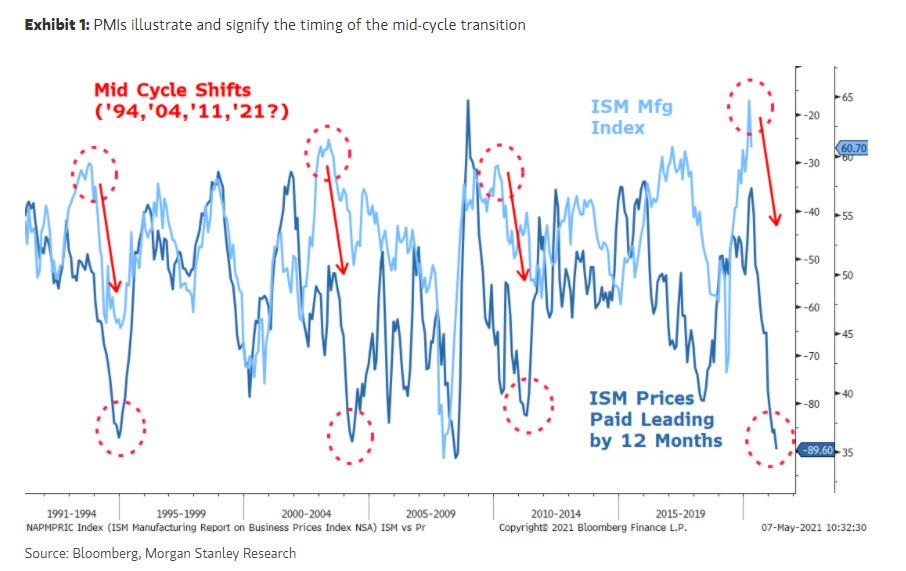
... Wilson then takes a victory lap writing that what the Fed is doing is "classic mid cycle transition behavior so investors really shouldn't be too surprised that the Fed would try to begin the long process of tightening."
After all, the US economy is booming and expected to grow close to 10 percent this year in nominal terms, a feat last witnessed in 1984. Meanwhile, no matter what one's view is on inflation being transient or not, prices are up significantly and likely higher than what the Fed, or most others were expecting 6 months ago. In other words, the facts and data have changed; therefore, so should Fed policy.
Nevertheless, as discussed here extensively, markets reacted as if this was a complete shock with both bonds and stocks trading as if the Fed had hiked rates already (instead of leaving over $2TN in QE still on deck) after the Fed meeting. Starting with bonds, both nominal 10 year yields and breakevens fell significantly. However, breakevens fell more leaving 10 year real rates higher by almost 20 bps Wednesday afternoon.
While real rates did settle back a bit on Thursday and Friday, they have formed what appears to be a very solid base from which they are likely to rise as the economy continues to recover and the Fed appropriately pivots. In Wilson's view, "this looks very similar to 2013, the year after Peak Fed. Back then, Peak Fed was QE3 which was announced on September 12, 2012. This time Peak Fed was the announcement of Average Inflation Targeting last summer."
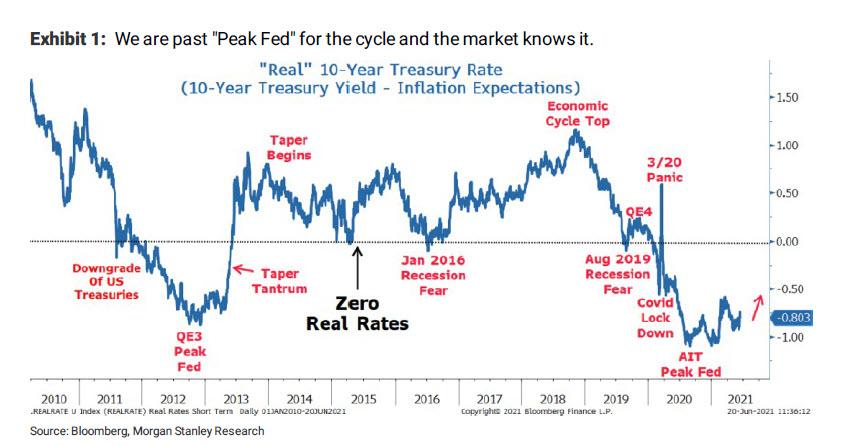
That said, there is one notable difference between the taper tantrum and today: in 2013 "tapering" QE was a novel concept to markets and it came more abruptly with Bernanke's surprise mention during his congressional testimony on May 22, 2013. This time, the markets understand what tapering is and see its arrival as inevitable as the economy recovers. Therefore, while the path higher for real rates is unlikely to be as dramatic as witnessed in 2013, it is still likely to be higher from here and that is a change that will affect all risk markets, including equities, in Morgan Stanley's view.
Wilson makes one final observation from the chart above, which is how real rates moved substantially before Bernanke's testimony in May 2013, prompting Wilson to notes that "perhaps it wasn't as much of a surprise as believed, at least to markets. We think it's the same situation today."
In our view, the data has been so strong, it would be naive not to think the Fed wasn't moving closer to tapering over the past several months. In fact, the idea that the Fed hasn't been thinking and/or talking about it seems absurd. Surely the market understands this, making the events of the past week not so much of a surprise. It's all part of the mid cycle transition that has been ongoing for months and fits with the choppier price action and unstable market leadership we have been witnessing.
The underperformance of early cycle stocks is another classic signal the market "gets it." Nevertheless, in talking with clients the past few days, this view is still out of consensus. Most haven't been ready for tighter monetary policy, nor did they think it's something they needed to worry about, until now.
Wrapping up the Fed "surprise" part of his note, Wilson writes that contrary to the FOMC shock, monetary tightening actually began months ago if one is looking at the right metric, which to the top Morgan Stanley equity strategist - who emerges as yet another closet Austrian - is money supply growth:
In a world where all of the major developed market central banks are stuck at the zero bound, or lower, the primary metric that determines if monetary policy is getting more or less accommodative is Money Supply Growth.
Realizing that to most Keynesian this will be a controversial statement to say the least, Wilson digs in and says that "it's absolutely the case and financial markets seem to agree." He explains:
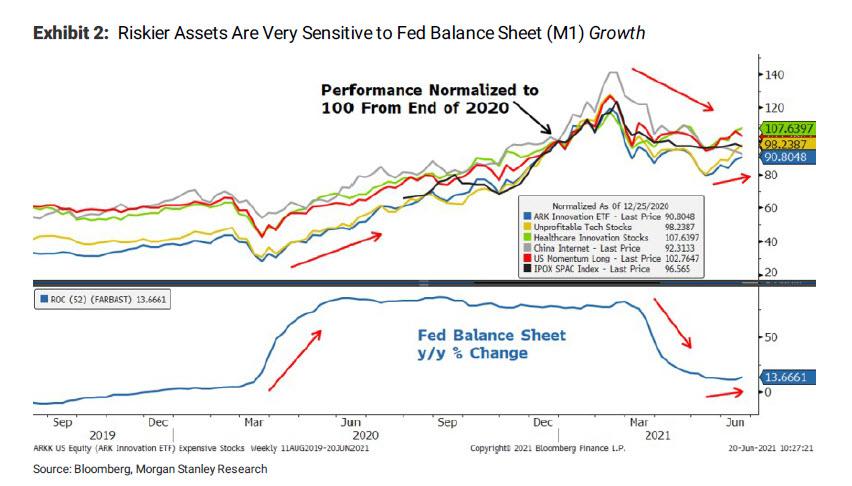
When money supply is accelerating, the more speculative / riskier assets tend to outperform and when it's decelerating these assets have more trouble. As noted here several times over the past few months, the Fed's balance sheet (M1) growth peaked in mid February and that coincided with a top in many of the most expensive/speculative stocks in the equity market just like the acceleration in the Fed's balance sheet in the prior 12 months contributed to their spectacular performance. Interestingly, the recently flattening out of the growth in M1 has coincided with more stability in these stocks, although they remain well below prior highs (Exhibit 2).
And visually:
But wait there's more, and also an explanation why the Fed has made it virtually impossible to track the weekly change in M2 (the aggregate is now updated only monthly).
Taking Wilson's argument a step further, M2 growth might be even more important to monitor than M1 because that's the net liquidity available to the economy and markets. On that front, the deceleration also began at the end of February but has not yet flattened out and appears to have much further to fall to a more "normal" level of annual growth — i.e., 7-8%
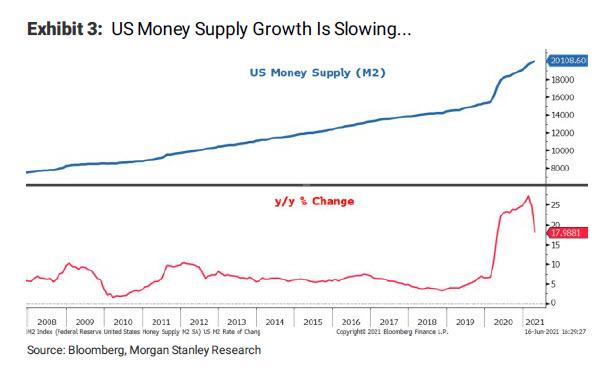
More ominously, this also suggests liquidity is likely to tighten further from here whether the Fed's begins tapering later this year or next.
Finally, when we look at M2 data on a global basis, we get the same picture.
Wilson concludes that even ahead of last week's "shock" FOMC, the market had already started to de-rate lower into a mid-cycle transition as Fed balance sheet growth has materially slowed. Meanwhile, M2 is slowing just as rapidly and has further to fall, especially when the Fed begins to taper later this year or early next. Finally, global money supply growth is also slowing from elevated levels and every major region is contributing.
This to Wilson "looks reminiscent of 2014 and 2018 when markets went through a rolling correction of risky assets" and he thinks 2021 will prove to be similar in that regard with the highest beta regions falling first (Kospi, China, Japan) and ending with the most defensive (US).
Putting it all together, the MS strategist writes that "tapering is tightening but the tightening process began with the rate of change in money supply growth. The good news is that the market already knows it. The bad news is that a majority of investors seem to be just catching on with the Fed's "surprise" announcement this past week. This means asset prices are far from done correcting as witnessed with the more cyclical, reflationary assets taking their turn the past few weeks."
And while we completely agree with Wilson's newly discovered Austrian view of markets - funny how on a long enough timeline everyone turns Austrian - the real question is what will catalyze the next M2 boosting cycle, how high will it push stocks, and will the Fed be forced to come out and start buying equities this time after having nationalized the bond market back in 2020.
We expect that the answer will be revealed after the next 20% drop at which point all of the Fed's hawkishness will evaporate, and Powell (or his replacement Kashkari) will shift to an uber dovish mode as they prepare to unleash the final and biggest asset bubble of all...


(ZH) New Study Links Ivermectin To "Large Reductions" In COVID-19 Deaths

New Study Links Ivermectin To "Large Reductions" In COVID-19 Deaths

A recent pre-print review based on peer-reviewed studies has found that using antiparasitic drug ivermectin could lead to “large reductions” in COVID-19 deaths and its use could have a “significant impact” on the pandemic globally.
A health worker shows a bottle of Ivermectin as part of a study of the Center for Paediatric Infectious Diseases Studies, in Cali, Colombia, on July 21, 2020. (Luis Robayo/AFP via Getty Images)
For the study (pdf), published on June 17 in the American Journal of Therapeutics, a group of scientists reviewed the clinical trial use of ivermectin, which has antiviral and anti-inflammatory properties, in 24 randomized controlled trials involving just over 3,400 participants. The researchers sought to assess the efficacy of ivermectin in reducing infection or mortality in people with COVID-19 or at high risk of getting it.
Using multiple methods of sequential analysis, the researchers concluded with a moderate level of confidence that the drug reduced the risk of death in COVID-19 patients by an average of 62 percent, at a 95 percent confidence interval of 0.19-0.79, in a sample of 2438 patients.
Among hospitalized COVID-19 patients, the risk of death was found to be 2.3 percent among those treated with the drug, compared to 7.8 percent for those who were not, according to the review.
“Moderate-certainty evidence finds that large reductions in COVID-19 deaths are possible using ivermectin. Using ivermectin early in the clinical course may reduce numbers progressing to severe disease,” the authors wrote.
A health worker shows a box containing a bottle of Ivermectin as part of a study of the Center for Pediatric Infectious Diseases Studies, in Cali, Colombia, on July 21, 2020. (Luis Robayo/AFP via Getty Images)
Since the start of the pandemic, both observational and randomized studies have evaluated ivermectin as a treatment for, and as prevention against, COVID-19 infection.
“A review by the Front Line COVID-19 Critical Care Alliance summarized findings from 27 studies on the effects of ivermectin for the prevention and treatment of COVID-19 infection, concluding that ivermectin ‘demonstrates a strong signal of therapeutic efficacy’ against COVID-19” the researchers wrote, referring to one recent review, which was based on data from both peer-reviewed studies and preprint manuscripts.
They cited another recent review that concluded that ivermectin reduced deaths by as much as 75 percent, while noting that neither the National Institutes of Health in the United States nor the World Health Organization (WHO) have recommended the use of ivermectin outside clinical trials for use in the fight against COVID-19.
[ZH: Meanwhile in India]
The Food and Drug Administration (FDA), in a note on “Why You Should Not Use Ivermectin to Treat or Prevent COVID-19,” warns that it has received “multiple reports of patients who have required medical support and been hospitalized after self-medicating with ivermectin intended for horses.”
“Using any treatment for COVID-19 that’s not approved or authorized by the FDA, unless part of a clinical trial, can cause serious harm,” the FDA said in the note, adding that it has not reviewed data to support the use of ivermectin in COVID-19 patients.
The WHO said in March that “the current evidence on the use of ivermectin to treat COVID-19 patients is inconclusive” and that, until more data becomes available, the agency recommends that “the drug only be used within clinical trials.”
The authors of the ivermectin efficacy study argued, however, that the drug has an “established safety profile through decades of use” and “could play a critical role in suppressing or even ending the SARS-CoV2 pandemic.”
The apparent safety and low cost suggest that ivermectin is likely to have a significant impact on the SARS-CoV-2 pandemic globally,” they argued in the study abstract.
The authors noted in their publication that all the studies on which they based their conclusions have been peer-reviewed.

>>> Stoxx 600 Pre-Market Indications

  • Rio Tinto (RIO1 TH) +1.9%
  • Carnival Plc (POH1 TH) +1.8%
    • U.K. Ministers to Relax Travel Restrictions From August: Times
  • Thyssenkrupp (TKA TH) +1.4%
  • BP (BPE5 TH) +1.3%
    • Watch Europe Energy Stocks with Brent Above $75 on Tight Market
  • BHP Group PLC (BIL TH) +1.2%
  • Repsol (REP TH) +1.1%
  • Nibe (NJB TH) +1.1%
  • EssilorLuxottica (ESL TH) +0.9%
    • Essilor Likely to Seek GrandVision Deal Renegotiation: Analysts
  • ASML (ASME TH) +0.9%
  • Shell (R6C TH) +0.8%
  • Delivery Hero (DHER TH) -0.8%
  • AUTO1 (AG1 TH) -0.9%

>>> TradeGate Pre-Market Indications

DAX:
  • Munich Re (MUV2 TH) +0.7%
    • Munich Re Raised to Buy at SocGen; PT 270 euros
  • Infineon (IFX TH) +0.7%
  • RWE (RWE TH) +0.7%
MDAX:
  • Nordex (NDX1 TH) +2.8%
    • Nordex Raised to Buy at SocGen; PT 27 euros
  • K+S (SDF TH) +2.4%
  • Varta (VAR1 TH) +1.5%
    • Varta to Supply Batteries to Porsche, Handelsblatt Reports
  • Thyssenkrupp (TKA TH) +1.3%
  • Lufthansa (LHA TH) +1.3%
  • Commerzbank (CBK TH) -0.7%
SDAX:
  • Draegerwerk (DRW3 TH) +4.4%
    • Draegerwerk Boosts FY Ebit Margin Forecast
  • ElringKlinger (ZIL2 TH) +3.7%
  • Kloeckner (KCO TH) +2.4%
  • Deutz (DEZ TH) +1.7%
  • ADVA Optical (ADV TH) +1.4%
  • Home24 (H24 TH) -1.7%

>>> Europe : Brokers Upgrades & Downgrades - 22nd of June 2021

>>> Up
* British Land Raised to Overweight at JPMorgan; PT 600 pence
* Couche-Tard Raised to Buy at Goldman; PT C$52
* EasyJet Raised to Neutral at Citi
* F-Secure Raised to Buy at SEB Equities; PT 4.70 euros
* Italgas Raised to Hold at Deutsche Bank
* Land Sec. Raised to Overweight at JPMorgan; PT 850 pence
* Nordex Raised to Buy at SocGen; PT 27 euros
* Noreco Raised to Buy at SpareBank; PT 165 kroner

>>> Down
* ADP Cut to Sell at Citi; PT 101 euros
* Aker BP Cut to Neutral at SpareBank; PT 280 kroner
* Altri Cut to Hold at Bestinver; PT 6.25 euros
* BW Energy Cut to Neutral at SpareBank; PT 30 kroner
* DNO Cut to Neutral at SpareBank; PT 12 kroner
* Ence Cut to Hold at Bestinver; PT 3.45 euros
* Galp Cut to Sector Perform at RBC; PT 11.50 euros
* Gulf Keystone Cut to Neutral at SpareBank; PT 224 pence
* Klepierre Cut to Underweight at JPMorgan; PT 20 euros
* Sonova Cut to Hold at Stifel; PT 370 Swiss francs
* Zurich Airport Cut to Sell at Citi; PT 143 Swiss francs

>>> Initiation
* Antares Vision Rated New Equal-Weight at Morgan Stanley
* Antares Vision Rated New Overweight at JPMorgan; PT 14.30 euros
* Bossard Rated New Buy at Berenberg; PT 340 Swiss francs
* Deutsche Industrie REIT Rated New Hold at Jefferies; PT 19 euros
* Montana Aerospace Rated New Buy at Berenberg; PT 49 Swiss francs
* Norsk Titanium Rated New Buy at SEB Equities; PT 15 kroner
* Sirius Real Estate Rated New Buy at Jefferies
* Technotrans Rated New Buy at LBBW; PT 32 euros
* VIB Vermoegen Rated New Buy at Jefferies; PT 44 euros

>>> Call
* ADP, Zurich Airport Cut to Sell at Citi, Sector Risks Looming
* Bossard a Buy as Model is ‘Misunderstood,’ Berenberg Says
* CNH Buying Raven Positive for Ag Growth Unit, National Bank Says
* Europe Airlines Face Mixed Recovery Path, Easyjet Upgraded: Citi
* EU Telecoms to Rerate on NGEU Funds, But Still Lack EPS Momentum
* Morrison Has ‘Material Valuation Upside’ Above CD&R’s Bid: Quest
* VIB, Sirius RE Are Jefferies’s German Logistics Property Picks

>>> What to look at today - 22nd of June 2021

Asian stocks rose Tuesday, tracking a U.S. equity rebound, as concerns over the Federal Reserve’s hawkish tilt were tempered by the prospect that policy tightening would be gradual. Treasuries steadied after a retreat.
Japanese shares outperformed, helping a gauge of Asia-Pacific stocks to the biggest climb in about three weeks. S&P 500 contracts edged up after the index rallied overnight, aided by a revival of the value trade in sectors like energy and financials. European equity futures were in the green.
Yields on longer-dated Treasuries rebounded in the U.S. session Monday, even as short-end rates remained firmly anchored. That undid some of the curve-flattening that swept across markets after Fed officials last week accelerated their expected pace of policy tightening.
Brent oil hit $75 a barrel for the first time in more than two years on signs of a rapidly tightening market. The dollar trimmed some of its slide from U.S. hours. Bitcoin sank closer to $30,000 after China intensified its cryptocurrencyclampdown.
US After Hours Fed provides testimony; Biden says bank regulators say financial system is in strong condition; SCVL +3.2% higher on stock split, nice guidance

Nikkei +3.01% Hang Seng -0.22% CSI +0.40% Shanghai +0.61% Shenzen +0.39%

Eur$ 1.1910 CNH 6.4685 CNY 6.4645 JPY 110.41 GBP 1.3914 CHF 0.9192 RUB 73.0825 TRY 8.7882 WTI$ 73.74 +0.11% BTC 32,850 +675 ETH 1969 +44

S&P +0.17% Nasdaq +0.03% EuroStoxx +0.44% FTSE +0.36% Dax +0.32% SMI

Macro :
- Brent Oil Edges Above $75 as Investors Assess Tightening Market
- Bitcoin’s Drop Closer to $30,000 Stirs Fears of a Deeper Selloff
- Several Chinese Banks Reduce Evergrande Funding on Debt Risk
- U.K. Is Still Deeply Split on Brexit Five Years After Referendum
- Hedge Funds Cut Bullish Bets on Commodities From Soy to Copper

Keep an eye on :
- ANA SM : *ACCIONA ENERGIA GETS COMMITMENTS WORTH EU1.6B FOR IPO: CONFI
- ADD GY : Adler Modemärkte AG Expects Offer to Conclude Zeitfracht Pact
- AG1 GY : Used-Car Dealer IPOs Stall as Competition Heats Up: ECM Watch
- AIR FP : Boeing’s Top Lobbyist Leaves Company, Defense One Reports
- AF FP : Air France-KLM CEO Smith Expects Dutch Equity Boost This Summer
- CS FP : AXA to Sell Malaysia Insurance Ops to Generali for About EU140M
- BAVA DC : Bavarian CEO Says Denmark Delays Covid-Vaccine Talks: Borsen
- BMW GY : BMW Targets 25% Cut in Production Cost Per Vehicle by 2025: HB
- BT/A LN : Murdoch’s News UK Eyes Bid for BT Sport Partnership: Telegraph
- CAST SS : Castellum Invests SEK 1B in Project With Port of Gothenburg
- CDR SM : Codere Units to Merge Online Ops With DD3 Acquisition Corp. II
- COLR BB : Colruyt Buys Back EU8.55m of Stock June 16 to June 18
- DBK GY : Deutsche Bank Executive Seeks Injunction on Wirecard Report: FT
- DRW3 GY : Draegerwerk Boosts FY Ebit Margin Forecast
- ECOWVE SS : Eco Wave Power Sees U.S. IPO Price $10.00-$12.00 per ADS
- EDF FP : EDF Cuts 1.7GW Nuclear, Hydro Power Capacity Due to Strike: RTE
- EL FP : Essilorluxottica Is Reviewing Options on Grandvision Deal
- EL FP : Essilor Likely to Seek GrandVision Deal Renegotiation: Analysts
- G IM : Generali Agrees to Buy Malaysia Insurance Assets
- HELN SW : Helvetia Aims to Disburse Dividend of >CHF1.5B Over Next 5 Years
- IBE SM : *IBERDROLA, ENDESA MULL SHUTTING 2 NUCLEAR PLANTS: ECONOMISTA
- ILTY IM : Illimity Approves Strategic Plan, Sees 2021 Net at EU60-70m
- KAHOT NO : Kahoot Sees Clever Acquisition to Complete in 2H of 3Q
- KESKOB FH : Kesko Invests in Automating Collection of Online Grocery Orders
- LBK SM : Liberbank Plans Early Retirement for About 750 Staff: Expansion
- MRO LN : Melrose to Announce GBP125M Power Gen Unit Sale: Sky
- MRW LN : Under Fire Over Pay, Morrison Chiefs May Bank Buyout Windfall
- NEL NO : Ovako, Nel, Volvo to Partner for Sweden Hydrogen Facility (1)
- NKLA US : Nikola Registers Up to 18m Shares for Holder Tumim Stone Capital
- ORPHA DC : Orphazyme Extends Drop as Guggenheim Sees Risk of Wind-Down
- Revolut IPO : Revolut Said to Eye Fundraising at Over $20 Billion Valuation
- ROCKB DC : Rockwool Builds New Low-Carbon Production Facility in France
- RR/ LN : Bain, Cinven Are Said to Compete for Rolls-Royce’s ITP Aero Unit
- RR/ LN : UK aviation sets short-term targets in 2050 zero emissions pledge
- SAN FP : Sanofi, Translate Bio Start Phase 1 Trial mRNA Influenza Vaccine
- SNR LN : Senior Plc Seen as Likely to Reject Lone Star’s $1.2 Billion Bid
- TNG FP : Transgene Seeks About EU32m in Accelerated Share Offering: Terms, Sold 13.9m Shares At EU2.45/Share, Raising ~EU34.1M
- VAR1 GY : Varta Shares Reverse Losses on Report Co. to Supply Porsche
- WBD IM : Webuild Signs EU1.075b Contract for Italy High-Speed Rail
- WDI GY : Deutsche Bank Executive Seeks Injunction on Wirecard Report: FT

WSJ : Fed’s Williams Not Ready to Pare Aid, but Other Officials Talk Tapering

Fed’s Williams Not Ready to Pare Aid, but Other Officials Talk Tapering
New York Fed chief John Williams says the central bank is a ways off from achieving its job and inflation goals

Federal Reserve Bank of New York leader John Williams said he isn’t ready for the U.S. central bank to dial back the support it is giving the economy amid uncertainty about the recovery from the pandemic.

“It’s clear that the economy is improving at a rapid rate, and the medium-term outlook is very good,” Mr. Williams said in a virtual appearance Monday. “But the data and conditions have not progressed enough for the [Federal Open Market Committee] to shift its monetary policy stance of strong support for the economic recovery,” he said.

Earlier Monday, the leaders of the Dallas and St. Louis Fed banks said that the day for paring back the central bank’s bond-buying stimulus is growing closer.

Mr. Williams’s comments were his first public remarks since last week’s rate-setting FOMC meeting, at which officials held their short-term interest-rate target at near zero and pressed forward with monthly purchases of $80 billion in Treasurys and $40 billion in mortgage bonds.

Even as it maintained its policy stance, the central bank, heartened by a rapid economic recovery and seeing a rise in inflation, moved forward the timing of when it expects to raise rates, penciling in two increases in 2023. It also acknowledged opening the door to pulling back on its bond-buying stimulus.

Speaking with reporters after his formal remarks, Mr. Williams acknowledged that officials are talking about paring asset purchases, but said that he isn’t ready to call for such a move and that policy makers haven’t yet discussed the tactics of slowing the bond buying.

“We’ve made some progress for sure. We’ve seen progress in employment; we’ve definitely seen a big increase in inflation,” Mr. Williams said. But, “from my perspective, we are quite a ways off from achieving my interpretation of substantial further progress” on the central bank’s job and inflation goals that the Fed said would need to be attained before slowing the asset buying, he said.

The New York Fed leader also rejected the idea that financial markets had reacted adversely to the central bank’s policy meeting in a replay of the so-called 2013 taper tantrum in which yields surged when the Fed discussed a pullback in bond buying.

“I definitely would not describe this as a mini taper tantrum of any kind,” and markets are just reacting to what the Fed has said and reflecting their own assessment of the economic outlook, he said.

Mr. Williams said Monday in his formal remarks that the recovery process is being buffeted by various disruptions and shifts. He said he expects to see a blistering 7% growth this year and that supply bottlenecks and shortages are driving up inflation, which could rise to 3% this year before ebbing back to the Fed’s target of 2% next year. But he added, “There is a great deal of uncertainty about the inflation outlook, and I will be watching the data closely.”

Mr. Williams said demand for labor is strong, adding, “I am confident that we will see continued strong job gains going forward.” He also said there is a lot of churn in the hiring process now.

Before Mr. Williams spoke, Robert Kaplan of the Dallas Fed and James Bullard of the St. Louis Fed said the time for the central bank to rethink its strong support for the economy is getting closer, if it hasn’t already arrived. They didn’t specify when the central bank should act during a joint virtual appearance.

Mr. Kaplan, reiterating a view he has held for some time, said, “I’ve been more of a fan of doing some things, maybe, to take our foot gently off the accelerator sooner rather than later so that we can manage these risks” around the recovery process, in a bid to “avoid having to press the brakes down the road” with a more abrupt shift in monetary policy.

Meanwhile, Mr. Bullard said that when it comes to asset buying “the debate is open, and I think it’s appropriate” that the Fed is considering when to pull back. He added that the process of getting to such a tapering decision won’t happen super quickly, saying, “The committee is only now starting to talk about tapering, and that will take some time to get that organized.”

Neither Messrs. Bullard or Kaplan holds a vote on the rate-setting FOMC this year, but Mr. Williams does given his role as vice chairman of that body. On Friday, Mr. Bullard said in a television interview that he now believes the Fed would need to raise rates by late next year, roiling markets. Meanwhile, Fed Chairman Jerome Powell stressed at his press conference after the FOMC meeting that officials aren’t actively debating a shift in rates at all and are instead focused on the outlook for asset purchases.

Mr. Bullard also said in the Monday appearance that the Fed should give special consideration to its mortgage bond purchases given that they are happening in an economy with a strong housing market, adding that “there’s a good question there about whether it’s time to retire our intervention” into housing finance.

Mr. Kaplan concurred and said, “At this stage we’re questioning whether the housing market really needs this Fed support of $40 billion a month” in mortgage bond purchases.

Mr. Williams, in his comments to reporters, played down any concerns about massive sums of money flowing into the central bank’s reverse repo facility. As he has in the past, Mr. Williams said the facility is working as expected. Money has flowed into the facility amid a shortage of short-term investments, with usage surging after the central bank raised the rate on the facility from zero to 0.05% at the FOMC meeting.

FT : Shipping boss warns EU carbon plans threaten to raise industry’s emissions

Shipping boss warns EU carbon plans threaten to raise industry’s emissions
Head of MSC says the commission’s move to cut CO2 will have the opposite effect

EU plans to slash carbon emissions threaten to drive up CO2 produced by the shipping industry, the head of the world’s second-largest container carrier has warned.

Soren Toft, chief executive of the Mediterranean Shipping Company, told the Financial Times EU measures, which are still under consideration, would have the reverse effect of their intentions unless low carbon fuels were readily available.

This is because operators would be forced to slow down their vessels to meet the demand for cuts, creating the need for more new ships to maintain service levels.

“For us, it’s very clear that what they are proposing in absence of carbon neutral fuels will add more capacity, more containers, all of which needs to be financed, built in Asia, which will produce more emissions,” he said.

However, Tristan Smith of the UCL Energy Institute said the notion that EU carbon measures would increase the industry’s emissions was “not credible”.

A ship’s emissions from burning bunker fuel are far higher than those produced in construction, and other economic factors such as the oil price and freight rates determine ship speed, he added.

Comments by MSC, set to overtake Maersk as the world’s largest container group in capacity terms with the biggest order book for new ships, come at a critical juncture as the EU prepares proposals to revise its carbon market next month.

It is also significant that Toft, who joined MSC from Maersk in December, has spoken out, as the group has rarely courted publicity since its founding in 1970 by Gianluigi Aponte.

A big question for the shipping industry is the scope of voyages the EU will target in its revised emissions trading system as policymakers attempt to cut CO2 emissions by 55 per cent by 2030.

Shipping, which produces 2.4 per cent of global CO2 emissions, is difficult to decarbonise because low-carbon fuels such as green ammonia or hydrogen are not widely available.

Dierderik Samsom, the European Commission official who heads the team in charge of the EU’s green deal, said the emissions trading system would be the main mechanism used to help lower CO2 in the shipping sector. 

Carbon pricing, which allows emitters to buy permits to meet CO2 targets, would provide a “real incentive for the [maritime] industry to decarbonise their fuel and decarbonise their whole operation”, Samsom told the FT’s Future of Europe conference last week.

He added that the industry could cope with the new obligations by using different types of ships and differentiated speeds of sailing to reduce its carbon footprint. 


Toft has joined MSC with the industry facing mounting scrutiny on two fronts: its response to climate change and efforts to restore service reliability, which has crashed during the pandemic.

MSC’s ships have lost 10,000 sailing days this year from waiting at congested ports, up about a third on last year.

“We are struggling to deliver the service we believe our customers are entitled to,” Toft said.

But he insisted the current global supply chain disruptions, which he thinks will probably continue into next year, “are not caused by the carriers”.

Another worry for the industry is the possibility of a patchwork of regional levies on emissions. “The EU will take that approach and then before we know it, we will have 10 different approaches to deal with,” said Toft.

But some smaller operators such as Torvald Klaveness and Maersk Tankers say the industry should accept the EU will legislate on shipping’s emissions and work to influence the regional initiative rather than prevent it.

FT : US medicines watchdog accused of cozy ties with Big Pharma

US medicines watchdog accused of cozy ties with Big Pharma
FDA approval of Alzheimer’s drug shows it is too close to industry it regulates, say critics

The US Food and Drug Administration’s approval of a controversial Alzheimer’s drug has prompted calls for its commissioner to be removed amid criticism that the medicines regulator is too close to Big Pharma.

This month, the FDA approved the first new Alzheimer’s drug in nearly two decades, offering hope to the roughly 35m people worldwide who live with the disease. But the decision has angered scientists who say the treatment does not work and should not have been approved, and that the regulator ignored scientific advice.

“The agency has long held this esteemed position in the world of drug regulators . . . That is threatened with this case,” said Peter Lurie, president of the Center for Science in the Public Interest, an independent advocacy group.

Aducanumab, which costs $56,000 a year, is the first drug claiming to slow the progression of the disease itself rather than treat its symptoms.

Three members of the FDA’s advisory panel quit in rapid succession following the decision, saying the regulator’s decision lowered its standards. Last year the panel unanimously opposed approval of aducanumab.

Aaron Kesselheim, one of the members who resigned, said it was “probably the worst drug approval decision in recent US history”.

The contentious endorsement is reminiscent of similar decisions made by the FDA in recent years where medicines with questionable efficacy were given the go-ahead. In 2016, the regulator faced criticism for its approval of eteplirsen, a treatment for people with Duchenne muscular dystrophy — a debilitating illness where muscles waste away over time.

In 2015, the FDA authorised pink Viagra, a libido enhancer for women, despite twice rejecting it over concerns that the benefits did not outweigh the side effects.

“This is very reminiscent of [eteplirsen],” said Bruce Ovbiagele, a member of the FDA’s advisory committee who opposed the approval of both the Alzheimer’s and muscular dystrophy drugs. He said both decisions relied on weak scientific evidence.

“The FDA might have caved to the pressure from community advocates and the fact that these devastating diseases have no even modestly effective treatments,” he added.

Several members of the scientific group point to an unusually close collaboration between Biogen and the FDA as an example of the regulator becoming too entwined with the companies it oversees.

The FDA and Biogen released a joint briefing document for the company’s application, a curious move between a regulator and its regulated company. “Little by little the barriers start to drop and pretty soon you’re co-authoring a briefing document together,” said Lurie, adding that “in small increments” the agency has grown too close to the pharmaceutical industry.

The agency said: “The FDA often works closely with industry to help foster drug development, understand emerging data, and advise on best approaches to development plans, especially in areas where there is a significant need for treatments for devastating diseases.”

Some critics have blamed Janet Woodcock, the head of the FDA, for allowing this close relationship to be cultivated. She also oversaw the approval of many painkillers while the opioid epidemic raged across the US.

Woodcock was appointed acting commissioner this year while the search for a permanent head continued. She is considered a shoe-in for the role and some believe that such a major drug approval would not have been made without a nod from her.

“A decision of this magnitude with this kind of potential controversy would ultimately have to be greenlighted at a higher level than Dunn,” said Ovbiagele, referring to Billy Dunn, head of the FDA’s neuroscience unit.

The FDA said the data submitted for aducanumab “was very complex, and our review has been thorough.” All drug reviews “are a team effort. No one person makes decisions in isolation on any approval, policy or safety matters,” it added.

Woodcock did not respond to a request for comment on calls for her removal or claims that she is too close to the industry.

One healthcare investor, who declined to be named said: “In the industry, everyone is keeping their mouth shut. The Big Pharma companies have been totally quiet on it, because they know if they say something in support of Janet, she would be toast. But everybody’s like: ‘Listen, you know with Janet at least we know what to expect’.”

On Thursday, Joe Manchin, the senator from West Virginia, wrote a letter to president Joe Biden urging him not to appoint Woodcock as permanent head of the regulator. “Dr Woodcock is not the right person to lead the FDA,” he wrote, adding that she “repeatedly ignored public health concerns” regarding the opioid epidemic.

Michael Carome, director of the health research group at Public Citizen, said the agency “is too often making decisions that are in the best interest of pharma companies and their shareholders rather than the best interest of public health and their patients.”

Last week, Carome wrote to the US health secretary urging the removal of Woodcock, as well as Patrizia Cavazzoni, director of the Center for Drug Evaluation and Research and Dunn, director of the FDA’s Office of Neuroscience. 

“The damage caused by the FDA’s reckless approval of aducanumab to the agency’s credibility as a science-based regulatory agency . . . cannot be overstated,” he wrote, adding that “regulatory capture of the agency by the industry” had occurred.

The FDA was accused of fostering a revolving door environment this month when it emerged that former commissioner Stephen Hahn would take a job at Flagship Pioneering, the investor that founded Moderna. Hahn was head of the FDA when Moderna’s Covid-19 vaccine was approved last year.

The green light for aducanumab may set a precedent for future drug approvals and comes as the FDA seeks to regain trust in itself and its science following controversies during the pandemic — such as the endorsement then rejection of using hydroxychloroquine to treat Covid-19 patients.

“This was a chance for the agency to say we got pushed around during Trump but it’s back to business as usual, meaning the FDA is the gold standard for scientific rigour,” said Lurie. “This [approval] sets the agency back . . . they dropped the ball.”