Early premarket gappers
- Gapping up:
- OTLK +31.9%, TBIO +29.1%, HOLI +18.2%, ZI +11.4%, SEDG +9.8%, UIS +8.4%, OTTR +7.5%, BP +5.8%, STLA +5.3%, PLXP +5%, BCC +4.6%, FLR +4.4%, COLM +4%, KMT +3.7%, CLR +2.9%, VSTM +2.5%, ABCL +2.4%, PXD +2%, GOCO +1.8%, DD +1.7%, KNBE +1.4%, ESEA +1.4%, MOS +1.4%, SPG +1.4%, HLIT +1.4%, ROAD +1.2%, RRD +1.2%, IT +1.1%, FATE +0.8%, PFE +0.8%, NVS +0.8%
- Gapping down:
- NEWT -11.1%, RNA -6.7%, ADUS -5.2%, TTWO -4.6%, DRVN -4.1%, EVER -3.8%, REYN -3.6%, LDOS -3.1%, LDOS -3.1%, VRNS -2.9%, SANM -2.9%, RMBS -2.6%, WWD -2.3%, LI -2.2%, UCTT -2.1%, LIVN -1.6%, ISBC -1.5%, KRYS -1.5%, HMN -1.1%, RARE -1%
China Takes Aim at Auto Chip Dealers With Global Supplies Low
Top market regulator probes those it suspects are driving up prices
China’s top market watchdog said it is investigating auto chip dealers that it suspects are driving up prices during the global chip shortage.
On Tuesday, the State Administration for Market Regulation said it would enhance market scrutiny and crack down on illegal practices like hoarding, price gouging and collusion. The regulator didn’t name any companies that were being investigated.
Car makers were among the first and hardest hit by the ongoing chip shortage in recent months. Soaring demand for semiconductors after Covid-19 lockdowns ended in many regions coincided with widespread chip manufacturing disruptions. Ford Motor Co. , General Motors Co. and Volkswagen AG VOW -0.42% , among others, shut down some production lines as a result.
While China’s auto market incurred less damage, the country’s auto industry officials have recently blamed the semiconductor shortage for declining sales. In June, China’s car sales ended an 11-month growth streak with a 5.1% decline when compared with a year earlier. Semiconductors are essential in powering various electronic systems in cars.
The world-wide race to secure chips in the automotive sector and beyond has led to price increases and booming business for the middlemen who distribute electronic components. It has also created an ideal environment for fraud and bad actors, according to a variety of experts including industry groups, chip brokers and counterfeit researchers.
Chinese authorities have vowed to establish semiconductor supply chains that rely less on imports and have said they are engaging with auto manufacturers and chip makers to match supply and demand.
While stockpiling in the first half of the year contributed to the hype that exacerbated the shortage, the overall situation in China has improved, said Edison Yu, an auto analyst at Deutsche Bank. However, the balance of supply and demand is unlikely to return to normal until later this year or next, he said.
More car makers are placing orders directly with chip makers, bypassing suppliers in the middle, secretary general of the China Passenger Car Association Cui Dongshu has said.
Last month, Mr. Cui said Chinese car makers that were flexible in dealing with supply chains have gradually adapted to the chip shortage.
Beyond autos, the chip crunch has spread to consumer goods, leading to short supplies and price increases on some electronics like laptops and printers. Even companies like Apple Inc. and Tesla Inc. have started to feel the pain, warning of potential effects on highly anticipated products in the coming months.
Some of the recent price increases have come directly from chip makers, which are struggling to meet demand and face rising raw material costs. Buyers that procure parts from brokers and unauthorized distributors can face even steeper price increases for hard-to-find parts like auto chips.
Taiwan Semiconductor Manufacturing Co. , the world’s largest contract chip maker, said it expects the auto-chip shortage will begin easing this quarter, as it allocated more capacity to producing parts needed for new cars. The company has also noted that it is seeing more clients stock up on inventory to cushion their supplies.
However, analysts and company executives expect the broader supply crunch to extend into next year. Intel Corp. Chief Executive Pat Gelsinger said last month that the shortage could stretch into 2023.
In China, the auto chip industry joins many other sectors under greater scrutiny from regulators in recent months, including food delivery, financial technology, e-commerce and after-school tutoring.
PepsiCo to sell Tropicana and Naked juice brands to private equity
Deal with France’s PAI will ‘free’ group to focus on calorie-free drinks and healthier snacks
PepsiCo has agreed to sell a controlling stake in its Tropicana and Naked juice brands to the French private equity firm PAI Partners for $3.3bn, as it seeks to focus instead on calorie-free drinks and products it claims are better for the environment such as SodaStream.
PAI, which also owns the Häagen-Dazs and Mövenpick ice-cream brands in a joint venture with Nestlé, will buy a 61 per cent stake in a new company holding the brand rights for the juices. Pepsi will own the remaining 39 per cent.
The deal will “free” Pepsi to focus on growth in other areas such as healthier snacks, zero-calorie drinks and SodaStream products, its chief executive Ramon Laguarta said in a statement. It bought SodaStream, which makes a device that carbonates water, in a $3.2bn deal in 2018.
Tropicana and Naked are “both on the right side, and the wrong side” of a shift towards healthier products, Frédéric Stévenin, a managing partner at PAI, told the Financial Times.
“The juice category has seen lower growth in the last couple of years because of the sugar content,” he said. “There’s a lot of natural sugar in juice, but there are good things too in terms of vitamins and fibre.”
However, he said, sales had risen during the pandemic because consumers were eating breakfast at home, and were trying to boost their immune systems with products high in vitamin C. This could give the brands “momentum,” he said.
The juice businesses’ net revenue was about $3bn in 2020, Pepsi said.
Pepsi will use the sale proceeds to “strengthen its balance sheet”, it said.
The shift towards a healthier portfolio was initiated by Pepsi’s former chief executive Indra Nooyi and continued by her successor Laguarta.
Large consumer brands such as Pepsi and its rival Coca-Cola are seeking to cut their more sugary products, as younger consumers increasingly opt for healthier alternatives.
However, the US consumer group has also been shifting its attention to expanding its portfolio of energy drinks. Pepsi acquired Rockstar Energy Beverages last year for $3.85bn, adding a fast-growing brand to its existing stable of energy drinks, which includes Mountain Dew Kickstart, Game Fuel and AMP.
PAI, which manages about €15bn in private equity funds, will buy the business from its seventh private equity fund, a €5.1bn fund.
Tesla ‘big battery’ fire fuels concerns over lithium risks
Latest incident comes as utilities around the world increasingly rely on lithium-ion to store renewable energy
A fire at one of the largest Tesla battery installations in the world has drawn fresh attention to the risks of batteries used to store renewable energy for electricity grids.
It took three days for the blaze to be extinguished after it started during testing in a shipping container holding a 13 tonne lithium-ion battery, at Moorabool near Geelong in Australia, and spread to a second battery pack.
The “Victorian Big Battery” project using the Tesla Megapack is the largest in the country, with 210 packs capable of storing up to 450 megawatt-hours of energy for the electricity grid.
Owned and operated by the French renewable energy developer Neoen, it was scheduled to begin operating before the peak summer demand period this year. Neoen said it was too soon to tell how the commission would be affected and testing would resume only once safety conditions were met.
The incident comes as utilities around the world from Australia to California increasingly rely on large lithium-ion batteries to store renewable energy from the wind and the sun. The same type of batteries as those used in electric cars, they can deliver power quickly to the electricity grid.
The amount of energy storage deployed last year rose 62 per cent, according to consultancy Wood Mackenzie, and the market is set to grow 27-fold by the end of the decade.
Yet there have been a total of 38 large lithium-ion battery fires since 2018, according to Paul Christensen, a professor at Newcastle University.
In Beijing, a fire at a lithium-ion battery installation in April killed two firefighters and took 235 firefighters to control. Last September, a large lithium-ion battery in Liverpool, owned by Danish renewable energy company Orsted, caught fire in the middle of the night.
Lithium-ion batteries can catch fire after a process called “thermal runaway”, which results when a battery is overcharged or crushed. Heat as well as a mixture of gases are produced, which when released form a vapour cloud that can ignite or cause an explosion.
In 2019 in Arizona, a grid-scale lithium battery fire threw a firefighter more than 20 metres from the container door, leaving him with a brain injury and broken ribs. That fire started after a short circuit in one lithium-ion battery cell, according to a report released after the incident.
Because of the release of gases “we don’t have a definitive answer of what is the best way to deal with an EV [electric vehicle] fire or energy storage fire,” Christensen said.
“They [lithium-ion batteries] are essential to the decarbonisation of this planet but their penetration into society has far outstripped our actual knowledge of the risks and hazards associated with them,” he said.
The risks will only increase as individual households increasingly install lithium-ion batteries to store energy from solar panels, or to reduce reliance on electricity grids following a spate of extreme weather events, he said.
In Australia, fire crews wore breathing apparatus and hazmat suits as they attempted to contain the flames, Fire Rescue Victoria said. Drones were also deployed.
Matt Deadman, lead officer for alternative fuels and energy systems at the National Fire Chiefs Council in the UK, said lithium-ion battery fires burn for much longer than usual fires and water only reduces their spread.
“It’s about cooling the batteries and you can extinguish the flame but lithium-ion batteries will produce their own oxygen as they break down — they will keep catching fire again, we just take as much as heat as we can out of them,” he said.
“At the moment we rely on tried and tested firefighting methods using water which is effective but it’s not a golden bullet for solving these things as quickly as you possibly can,” Deadman said.
Tesla said last month revenues from its energy storage and generation business, which includes sales of its Megapack batteries, more than doubled in the latest quarter to $801m.
Elon Musk, Tesla’s chief executive, said safer variants of lithium-ion technology such as lithium-iron phosphate batteries — which use iron and phosphate instead of the metals nickel and cobalt — are suitable for its large battery installations.
Gavin Harper, a research fellow at the University of Birmingham, said: “It is essential that we don’t stifle new innovation as it is imperative that we decarbonise rapidly, but at the same time, we need to take a precautionary approach as we deploy new technologies at scale.”
Singapore to grant first crypto licence in bid to lure digital asset groups
Australia’s Independent Reserve receives green light ‘in principle’ to operate in city-state
Singapore is set to grant formal regulatory approval to a cryptocurrency exchange for the first time as the Asian city-state steps up its challenge to rival Hong Kong as a digital finance hub.
Australian exchange Independent Reserve has garnered approval “in principle” from the Monetary Authority of Singapore allowing it to operate as a regulated provider of digital payment token services after applying for a licence in April last year.
The company is the first such provider to be awarded the approval from Singapore’s regulator of about 170 applicants, including global exchanges Binance and Gemini. Some groups, including Binance, have already been given an exemption to provide services to retail and institutional investors in the city while they await a formal licence.
“We have been waiting more than a year for this day,” said one foreign crypto exchange that operates in the city. “Now everyone is wondering who will get approval next.”
Global cryptocurrency groups have been expanding rapidly in Singapore thanks to the city’s friendly regulatory environment, which contrasts sharply with other markets that have taken a tougher approach to the industry.
Regulations vary widely between jurisdictions, meaning that several large global exchanges are seeking licences in various countries as watchdogs begin more closely scrutinising their operations.
Singapore’s resource-poor economy is heavily reliant on financial services and the city’s appeal as a business hub has increased as Hong Kong, a competing Asian financial centre, has been perceived as less attractive under a national security law.
The digital asset industry has emerged as another front in the rival cities’ competition.
As in mainland China, Hong Kong has taken a stricter stance on the freewheeling cryptocurrency industry. The city is set to limit crypto trading to accredited or institutional investors under a new law.
Singapore, meanwhile, has made it easier for foreign crypto groups to establish offices and serve residents and businesses, albeit with restrictions including limits on transaction volumes. It introduced a payments law in January 2020 under which companies could apply for a licence. About 90 digital asset companies applied and are operating under an exemption.
On Monday night, Independent Reserve, founded in 2013, was given approval to operate, sending ripples of excitement through the industry in anticipation of more go-aheads to come. The company has 200,000 customers across Singapore, Australia and New Zealand.
“All eyes are on Singapore and their regulatory regime,” said Raks Sondhi, Independent Reserve’s Singapore-based managing director.
The MAS wants to establish the city-state as a global hub for the blockchain ecosystem and the “long process” to get the licence was due to the regulator’s focus on ensuring consumer protections and anti-money laundering measures, he added.
These included implementing the “travel rule”, which requires crypto companies to share personally identifiable information for transactions over a certain value. All successful applicants in Singapore need to implement the rule, per MAS guidance.
Eric Anziani, chief operating officer of Crypto.com, a digital currency exchange platform that has a large presence in Hong Kong but is growing quickly in Singapore, said that the geopolitical risk in Hong Kong had escalated. “Singapore is also more favourable to retail investors,” he said. “I think there are now more opportunities there in terms of talent as well.”
The head of another global exchange in the city-state said the “China overhang” had made Hong Kong less enticing as a crypto destination, especially for custodian services. “A lot of our customers were worried Chinese officials could come across and take their assets sitting in offline vaults.”
Sanofi buys partner Translate Bio for $3.2bn in mRNA push
French pharma group tries to catch up with rivals who used the technology to create Covid vaccines
French pharmaceutical group Sanofi will acquire its partner Translate Bio for $3.2bn, as it makes a big bet on the future of mRNA as a transformative technology for vaccines and therapeutics.
Paul Hudson, Sanofi’s chief executive, said the deal would allow the companies to accelerate existing development programmes, including for Covid-19 and flu vaccines, and pursue new opportunities.
“Our goal is to unlock the potential of mRNA in other strategic areas such as immunology, oncology, and rare diseases in addition to vaccines,” he said.
Translate Bio, based in Massachusetts, has potential drugs for cystic fibrosis and other rare lung diseases in its early stage pipeline and is examining areas such as liver conditions and oncology.
Sanofi is trying to catch up with rivals Pfizer, BioNTech and Moderna, after their Covid-19 vaccines proved that mRNA could create highly effective vaccines. They used the pandemic to win the first approvals for mRNA vaccines and expand production facilities.
Sanofi’s Covid-19 vaccine efforts are lagging behind. Its development of a recombinant protein vaccine, boosted by an adjuvant from GlaxoSmithKline, is in a phase 3 trial, while its programme with Translate Bio is in an earlier phase 1/2 study, with results expected in the third quarter.
Sanofi created a war chest for potential deals last year when it sold half its 20.6 per cent stake in Regeneron for $6.1bn. Hudson, who took over in 2019, set out a new strategy for Sanofi focusing in growth areas such as oncology and rare diseases.
The boards of Sanofi and Translate Bio have unanimously agreed the deal. Sanofi will start a cash tender offer to acquire all outstanding shares of Translate Bio at $38, about a 10 per cent premium to its closing price on Monday. Sanofi said it was a 56 per cent premium to the volume-weighted average share price over the past 60 days.
The Baupost Group, a Boston-based hedge fund that is the company’s largest shareholder, has signed a binding commitment to support the tender offer, as has Translate Bio’s chief executive, Ronald Renauld.
Renauld said the acquisition would help Translate Bio achieve mRNA’s full potential.
“With Sanofi’s longstanding expertise in developing and commercialising vaccines and other innovative medicines on a global scale, Translate Bio’s mRNA technology is now even better positioned to reach more people, faster,” he said.
"An Environmental Disaster": An EV Battery Metals Crunch Is On The Horizon As The Industry Races To Recycle
If there's one thing about the growing demand for EVs that we have tried to point out over the last month, it's the fact that the rhetoric about the "green" vehicles being perfect for the environment with little consequence isn't exactly 100% accurate.
Just over the last two months, we've written not only about how much driving needs to be done in EVs to make them better for the environment than internal combustion engine vehicles, but we've also noted that EV carbon footprints aren't necessarily as better than ICE vehicles as many people think.
Now, more questions are starting to be raised about the potential unintended consequences of the EV revolution. Notably, how can the metals used for EV batteries be recycled and reused as part of a circular economy before a materials crunch - or environmental impact from mining - negates the "green" label affixed to EV vehicles. That's the question FT delved into this week in a new report.
And who better to make it clear that recycling is an issue than former Tesla executive JB Straubel. He started a company called Redwood Materials in 2017 that is focused on trying to break down used batteries and reconstitute them into a fresh supply of metals for new ones.
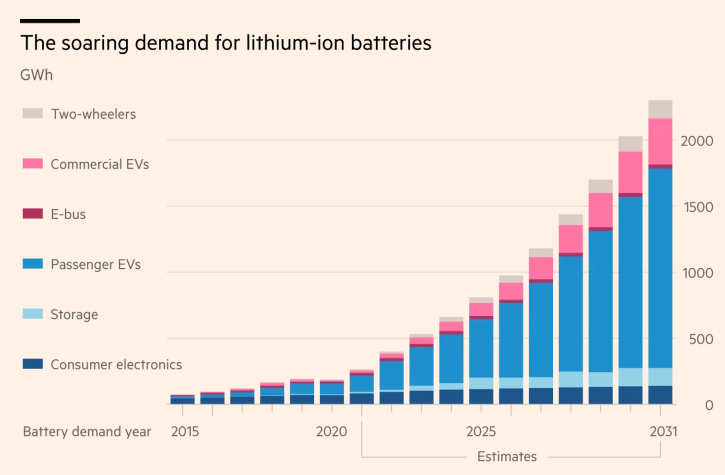
Despite EVs bring zero emission while being driven, the "mining, manufacturing and disposal process for batteries could become an environmental disaster for the industry," FT wrote.
Straubel said to FT: “It’s not sustainable at all today, nor is there really an imminent plan — any disruption happening — to make it sustainable. That always grated on me a little bit at Tesla and it became more apparent as we ramped everything up.”
His company takes batteries from old smartphones, power tools and scooters, and turns them back into metals like nickel, cobalt and lithium so they can re-enter the supply chain. His goal is to stop mining from places like the Democratic Republic of Congo, Australia and Chile, and start mining household waste. Straubel says there's about 1 billion used batteries sitting around in households.
Gene Berdichevsky, chief executive of battery materials start-up Sila Nano, noted that there's a material amount of cobalt in smartphones compared to EV batteries: “So for every 300 smartphones you collect, you have enough cobalt for an EV battery.”
Cobalt mining is particularly resource intensive. "Cobalt can travel more than 20,000 miles from the mine to the automaker before a buyer places a 'zero emission' sticker on the bumper," FT points out.
Straubel says that EV emissions can be halved even further from where they are if batteries and metals can be continually recycled.
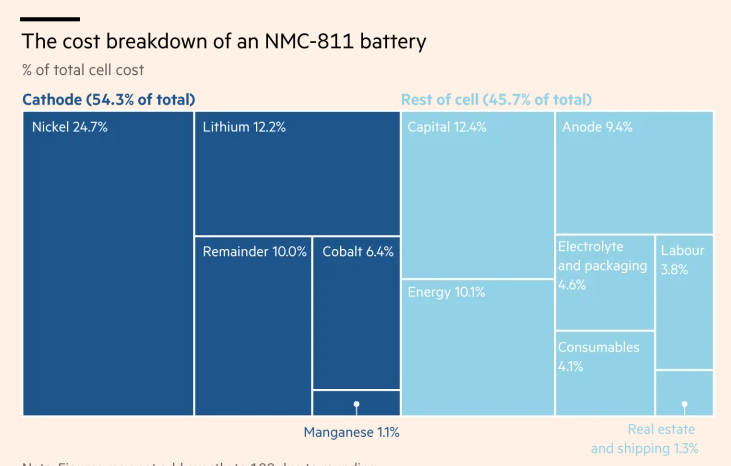
Redwood has raised more than $700 million from investors to hire 500 people and expand its operations. This year it'll process 20,000 tons of scrap and has already recovered enough material to build 45,000 EV battery packs.
Redwood already has partnerships with companies like Panasonic and Amazon. And companies like Apple are getting on board with the circular economy idea, which CEO Tim Cook aspiring to “not to have to remove anything from the earth to make the new iPhones”.
A circular economy with EV batteries would give the world a significant push forward to meeting net zero emissions goals. Kunal Sinha, head of copper and electronics recycling at miner Glencore, said: “For the world to hit net zero — by 2050 you can’t do it with just resource efficiency, switching to EVs and clean energy, there’s still a gap. That gap can be closed by driving the circular economy, changing how we consume things, how we reuse things, and how we recycle."
As EV adoption grows, demand for nickel, cobalt and lithium will continue to rise. Paul Anderson, a professor at the University of Birmingham, said: “There is going to be a mass scramble for these materials. Everyone is panicking about how to get their technology on to the market and there is not enough thought [given] to recycling.”
A "crunch" for the materials will likely happen as a result of demand surpassing supply, which will take place in 2 to 3 years, according to Monica Varman, a clean tech investor at G2 Venture Partners.
Berdichevsky concluded: “In the future we’ll replace the car, but not the battery; of that I’m very confident. We haven’t even scratched the surface of the battery age, in terms of what we can do with longevity and recycling.”
Société Générale reports best first-half performance in 5 years
Paris-based bank’s €1.4bn second-quarter net income is 68% ahead of analysts’ forecasts
Société Générale has continued its resurgence from last year’s steep trading losses, reporting its best first-half performance in five years on Thursday morning.
The Paris-based lender, which was hit by the implosion of its equity derivatives products last spring as companies cancelled dividend payments during the first wave of the pandemic, said it had made €1.4bn of net income for the second quarter of 2021.
This was up from a €1.3bn loss for the same period last year and 68 per cent higher than analysts had predicted.
SocGen’s net banking income rose 18 per cent to €6.3bn, reflecting a strong performance across its business lines.
Frédéric Oudéa, chief executive, said the bank had worked to anticipate customer needs and had taken action to “improve the operational efficiency of the group and maintain the excellent robustness of the loan portfolio and risk management”.
The strong results come after a period of turbulence for SocGen. The bank was one of the worst-performing banks in Europe’s stress tests, announced last week.
Regulators used the scenario of a 3.6 per cent fall in EU gross domestic product and unemployment reaching 12.1 per cent to test how banks’ balance sheets would fare.
Under the scenario, which was heavily influenced by the impact of the pandemic, SocGen’s ratio of common equity to risk-weighted assets fell from 13.16 per cent to 7.54 per cent, well below the sector average of just over 10 per cent.
SocGen agreed to sell Lyxor, its fund management arm, in June to French investment group Amundi in a cash deal worth €825m.
The deal excludes about €16bn of Lyxor’s assets under management in areas such as structured products, which will be retained by SocGen.
The bank said it expected to book a capital gain of about €430m once the transaction was completed.