(ZH) After 188 Days Without a 5% Drop, Goldman Says Stagflation Risk Rising, Hed

After 188 Days Without a 5% Drop, Goldman Says Stagflation Risk Rising, Hedge For "Large Equity Drawdown"

On one hand, it appears that nothing can shake this market which is so controlled by gamma, technicals - and expectations that the Fed will never again allow a correction - that the 4,400 level has proven to be an "incredible anchor."
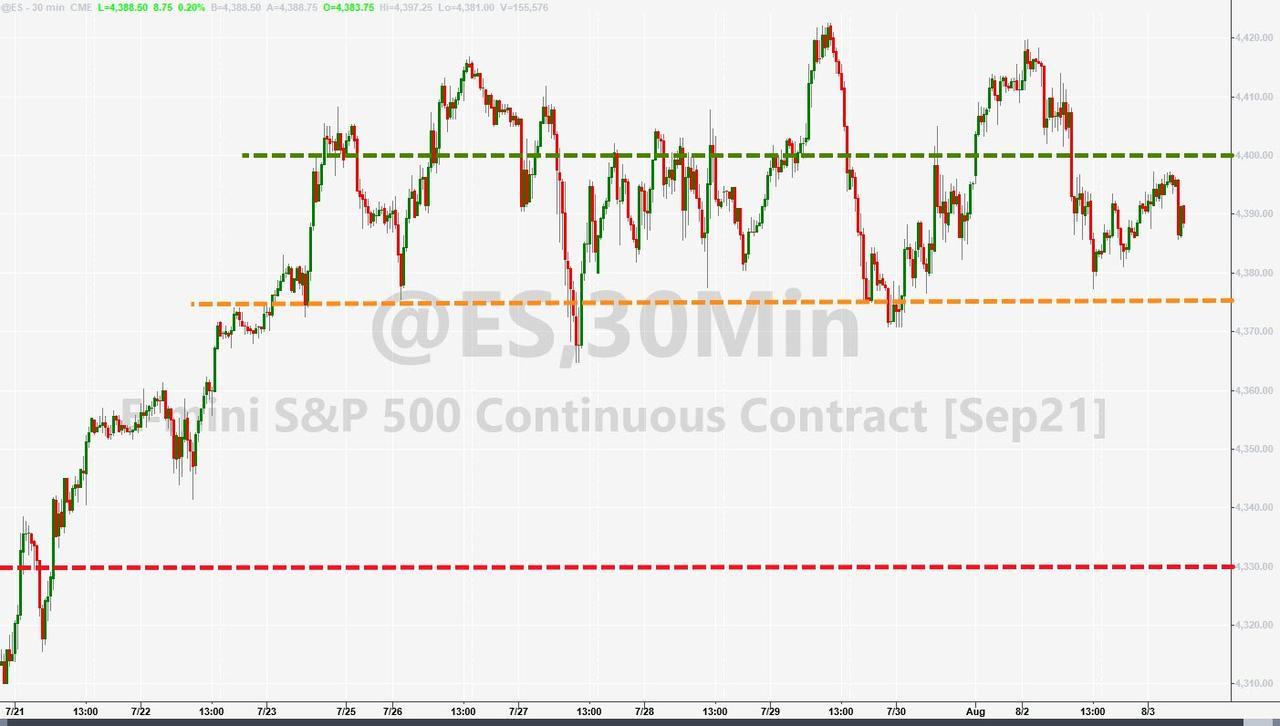
On the other hand, the big banks are starting to sweat with first Morgan Stanley warning that a 10% correction is imminent, and now Goldman strategist Christian Mueller-Glissmann joining and warning that with 187 days without a 5% drawdown in S&P 500 - one of the longest uninterrupted stretches in the last 100 years - the market is starting to look quite precarious...
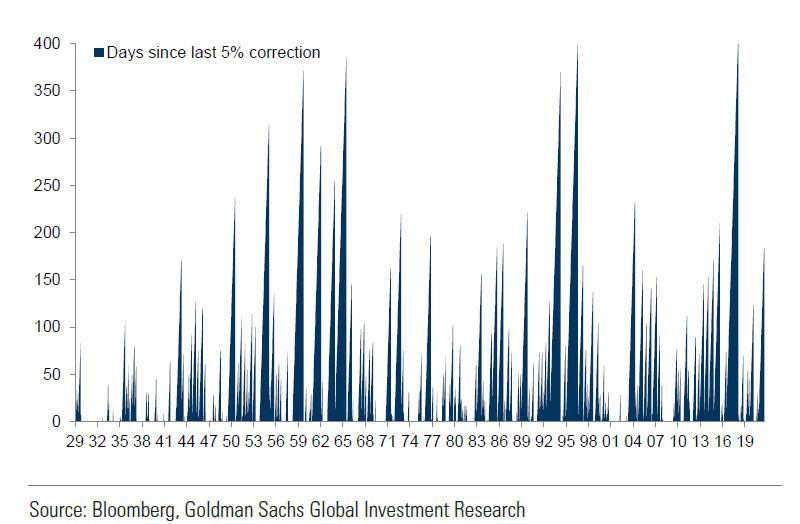
... and with "both equities and bonds getting more expensive, multi-asset portfolios are becoming more vulnerable to rates and growth shocks."
While we will get into the details behind Goldman's bearish reversal, the strategist takes a close look at recent ominous moves in inflation indicators, starting with Germany where he notes that last week European breakeven inflation outperformed other ‘procyclical’ assets.
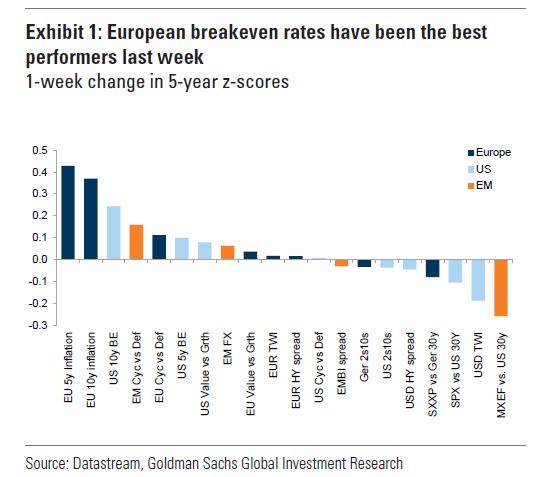
Curiously, the move in breakevens has outpaced that of cyclical vs. defensive equities, which have historically been closely related. To be sure, there appears to be a growing divergence between inflation breakevens and their various historical correlations, with Mueller-Glissmann noting that while in Europe, breakevens have outperformed since Q2...
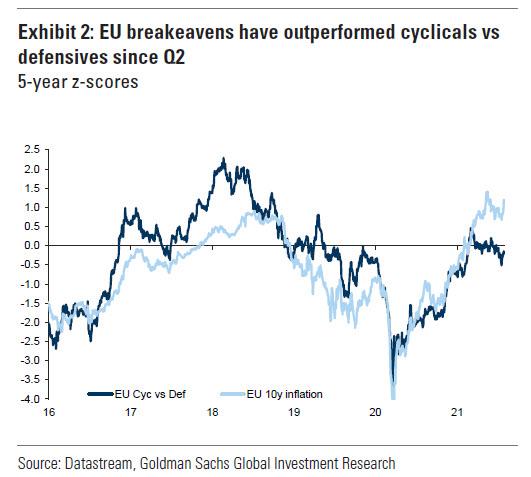
... in the US they have recovered much faster from the Covid-19 bear market and have increasingly decoupled in 2H with markets fading the reflation trade.
This has been particularly true recently - US cyclicals have closed the week flat vs. defensives despite rising breakevens.
Yet the rise in breakevens has not been mirrored by even more important real rates, and instead as breakeven inflation has risen, it has been accompanied by falling real rates across the term structure...
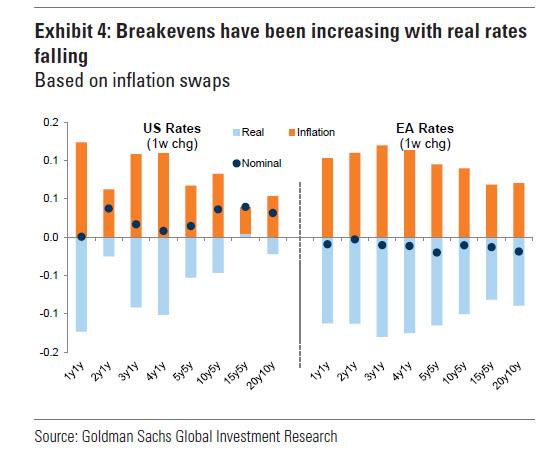
...and 10-year real rates have reached new lows in both Europe and the US.
Such low levels of real rates, the Goldman strategist warns, "point towards markets pricing stagflation risk, which seems somewhat inconsistent with an economic recovery" that in the view of Goldman economists still broadly on track (despite the bank taking a machete to its 2022 US GDP forecasts) and inflation pressures that should eventually ease, to wit:
At the center of the reflation reversal have been bonds, which have rallied strongly since June with yield curves flattening, pointing not just to concerns of a near-term growth slowdown but the risk of continued secular stagnation in the new cycle as monetary and fiscal support fades. Also, most of the decline in long-dated bond yields has been driven by real yields, with breakeven inflation sticky – that points to growing stagflation concerns.
So with stagflation risk rising, is Goldman turning outright bearish? Of course not: no bank makes money by telling its clients to sell and Goldman is no different. Instead Mueller-Glissman is far more diplomatic, saying that while he remains "pro-risk in our asset allocation into 2H", a view which would by far more justified if US real rates were to push higher - he does caution that "catalysts are likely to be needed for markets to reprice rates higher - a strong jobs report this week might help clarify the trajectory from here", the Goldman strategist warns the "risk of an equity correction has increased" and adds that "the widening gap between S&P 500 returns and changes in bond yields over the past 6 months coupled with very low levels of real yields and elevated equity valuations make equities more vulnerable to both growth and rates shocks."
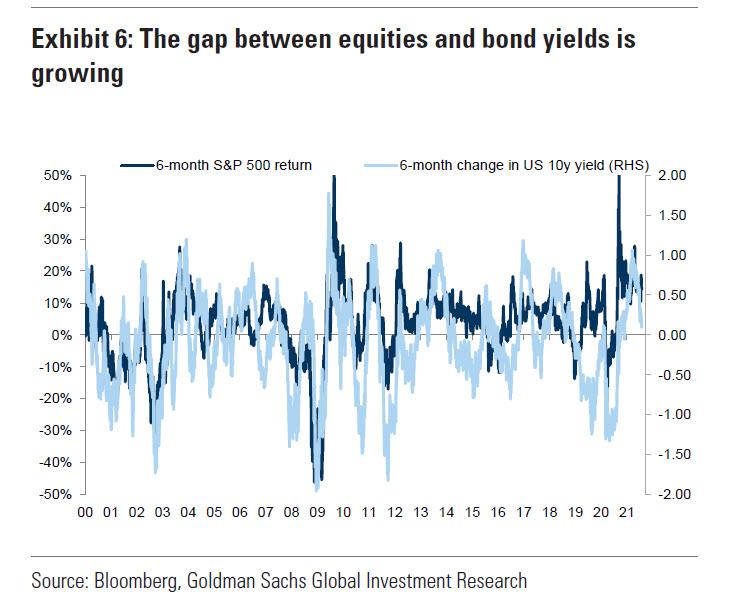
There were similar equity-bond gaps in 2014, 2016 and 2019, usually after a dovish Fed pivot and all ended poorly for stocks. Incidentally, as we noted previously when discussing the remarkably narrow breadth in the market, the current equity-bond disconnect has been due to the boost to long-duration secular growth stocks - i.e., Amazon, Apple, Microsfot, etc - from declines in real bond yields. This also helped broad indices, which have a larger weight in those stocks. But if and when the "generals" stumble.... watch out.
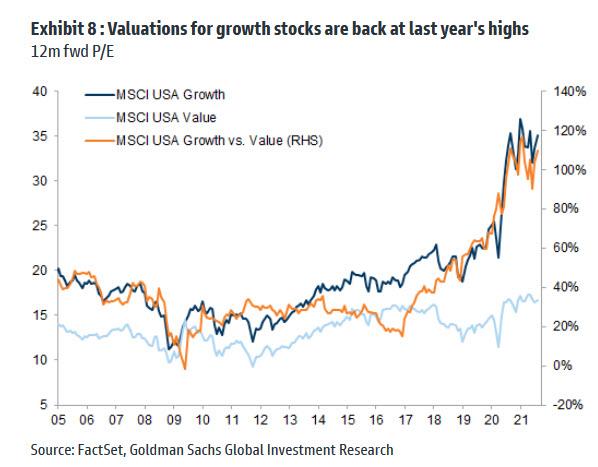
While Mueller-Glissman jovially inserts that this gap might "linger for longer" or close in a "friendly" way, with bond yields gradually increasing, such an event is unlikely and the risk of a correction in the event of either a rate shock or a growth shock has increased. Just look at the recent past when we had a similar outcome in 2015 with the China growth shocks and in 2020 with the COVID-19 shock; indeed, only in 2016 did the gap close with the bond sell-off and higher equities post the election of President Trump. So fast forward to today when not only is the current rally without even a 5% drawdown one of the longest in the past decade, but as Goldman warns, "valuations for US growth stocks have expanded significantly again and are back to last year's highs "
There's more. The strategist then lists several other reasons behind the bank's increasingly bearish view, starting with the recent plunge in Goldman's Risk Appetite Indicator (which we flagged two weeks ago)...
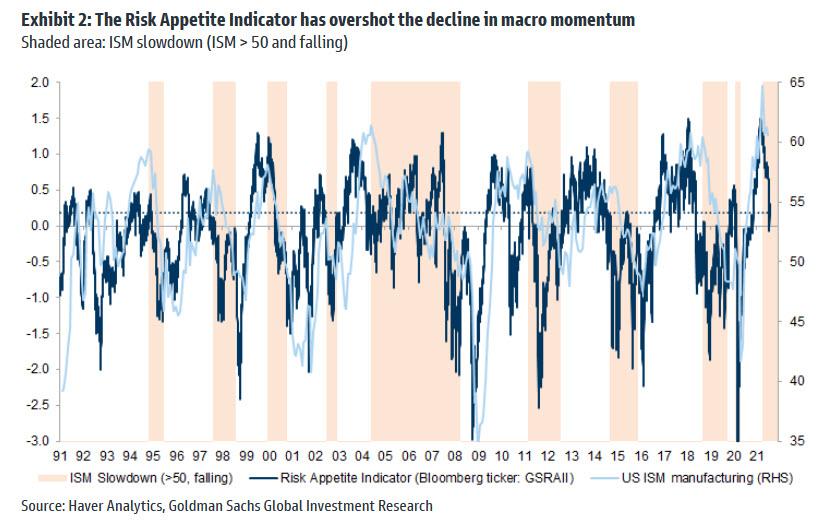
... and whose current level Mueller-Glissman says is consistent with an ISM manufacturing index in the low 50s.
The Goldman strategist then looks at various popular factors and notes that while cyclicals vs. defensives have reversed little of their COVID-19 recovery performance, the moves have been more about value vs. growth, EM vs. DM and financials vs. staples.
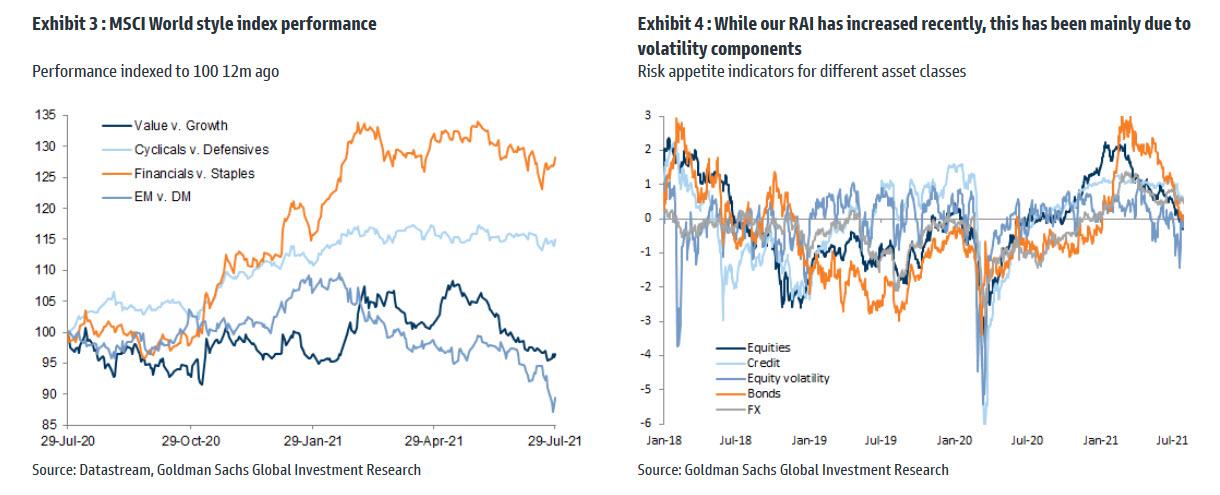
This according to Goldman, highlights that investors are "not necessarily repricing the near-term growth outlook but more a worsening medium-term growth inflation mix in a post-COVID world. In the last few days the RAI has started to pick up but this was mainly due to a reset in the volatility components – across the other assets, there is little sign of a reversal."
One more observation on Goldman's Risk Appetite Indicator: peeking under the hood at the index components shows that growth optimism (RAI PC1) remains under pressure and is close to zero.
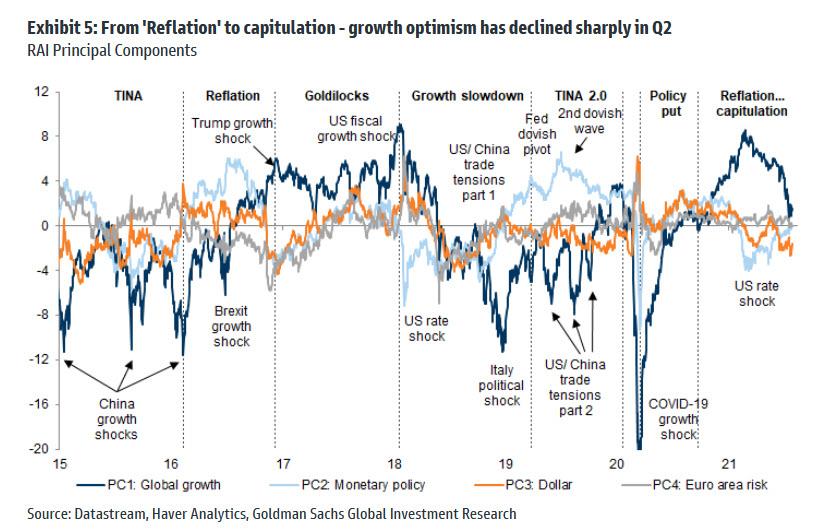
This means that while backward-looking earnings seasons in Europe and the US have generally been strong, "markets still appear unconvinced that there will be more positive growth impulses into year-end and the new cycle, with US fiscal stimulus starting to disappoint and drags on consumption from COVID disruptions."
Almost as if the market demands another stimulus... and is well aware that to get that, another round of Code Red lockdowns will have to be ordered.
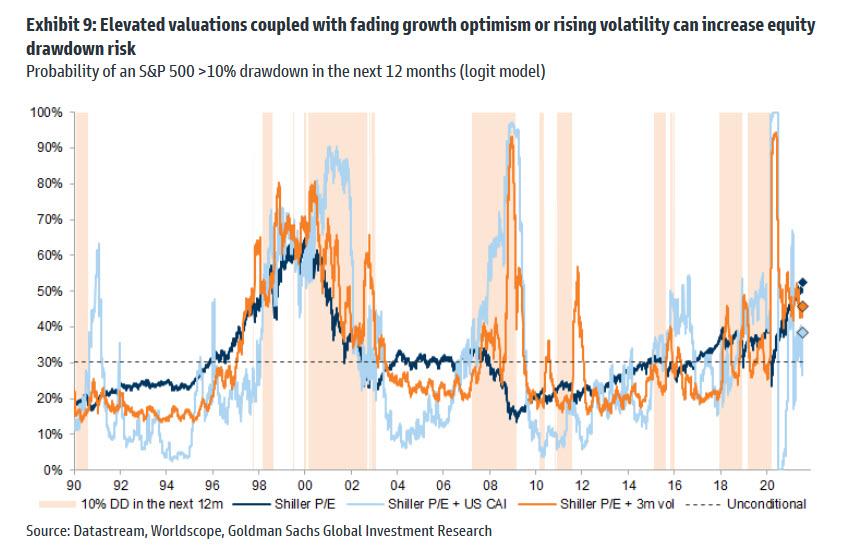
There is another reason why Goldman is turning skeptical: "elevated equity valuations coupled with a worsening growth/inflation mix increase equity drawdown risk." As Mueller-Glissmann points out, "while valuations alone are not a good signal for market timing, combining them with information about the macro backdrop helps assess equity drawdown risk better. One way to combine the signals is a logit model that relates the risk of a 10% S&P 500 drawdown over the next 12 months to levels of Shiller P/E and growth or realized volatility as an indicator of the macro backdrop."
And this is where Goldman and Morgan Stanley agrees: as the bank's strategist writes, "currently, a purely valuation-based signal indicates somewhat elevated risk of a 10% drawdown,which is not surprising with equity valuations nearing Tech Bubble levels ."
With all that, Goldman's advice to clients is simple: "look at equity correction hedges or ways to reduce equity risk in the near term."
As we recently wrote, option markets are pricing higher equity drawdown risk than normal during an ISM slowdown phase, with particularly large left tails – S&P 500 put skew and other convexity risk premia in equities are at multi-decades highs, reflecting investor concerns about sharp and large drawdowns. We continue to like shorter-dated put spreads which, with elevated skew, can offer cheaper correction hedges – they look particularly attractive in Europe
To this all we can add is that since Goldman tends to always be wrong, the very fact that the most important investment bank in the world is telling its clients to brace for a correction is why the S&P may continue levitating without a 5% correction for years to come...
(ZH) $12 Billion Hedge Fund Suffers $1.5 Billion Loss On Massive Treasury Short

$12 Billion Hedge Fund Suffers $1.5 Billion Loss On Massive Treasury Short Squeeze

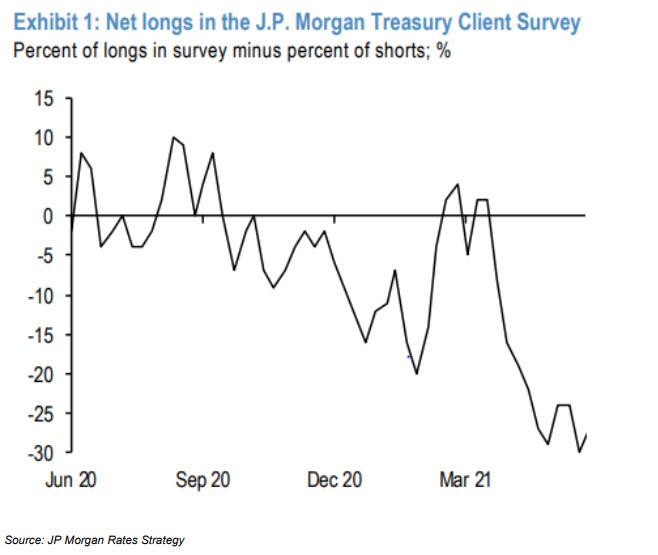
Last November, when we first looked at the monstrous short exposure in the rates complex, we said that a short squeeze of a lifetime in rates was on deck.
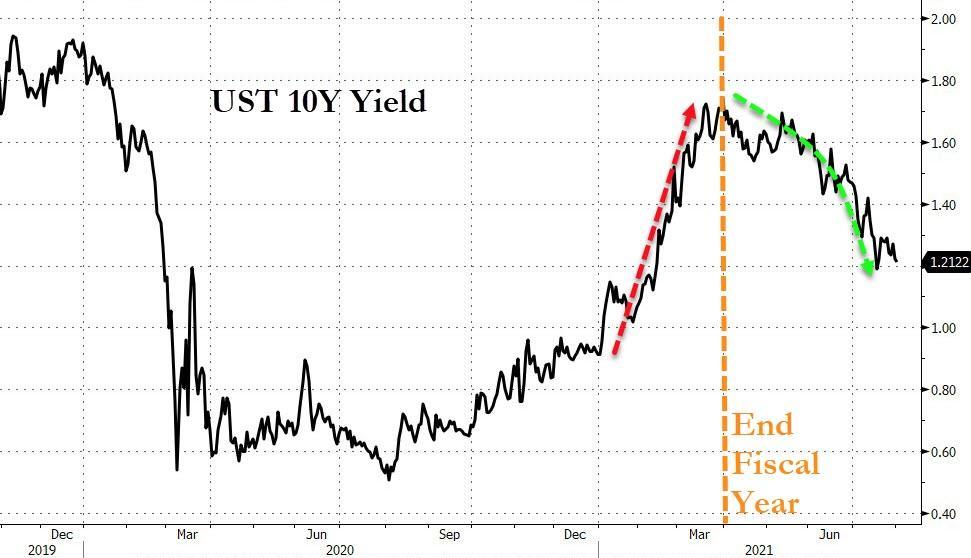
Six months later, in June with yields first spiking - and benefitting all the shorts - thanks to what we now know was Japan's massive pension fund, the GPIF dumping billions in Treasurys, and then sliding rapidly, we observed that a "record short squeeze was accelerating"...
... the only thing we did not know was who was the unlucky fund suffering massive losses as yields ground ever lower.
We now know: Bloomberg just reported that hedge fund Alphadyne Asset Management has "emerged as one of the biggest casualties from a short squeeze in the global bond market", with its $12 billion macro trading strategy suffering massive losses as a result of a relentless short squeeze that pushed yields as low as 1.15% on Monday, and resulting in losses of $1.5 billion as the fund crashed head-on into what now is the "short squeeze of a lifetime."
Alphadyne's funds plunged through July, Bloomberg sources reported, noting that the flagship Alphadyne International Fund lost about 10%. It also manages a leveraged version with about the same amount of assets; needless to say the losses there were even worse.
Curiously, just as we were pointing out the record short squeeze to our readers in June, the Alphadyne flagship was actually suffering through them, and the fund tumbled 4.3% that month, its worst month ever, after its managers positioned had positioned for a steeper U.S. yield curve and higher interest rates broadly. In retrospect all the fund was doing was reacting to the late March surge in yields, which we noted yesterday was the cause of GPIF's Treasury liquidation ahead of its historic reallocation which slashed holdings of TSYs from 47% to 35%, and which they mistook for confirmation of a secular reflation trade.
Oops.
Waiting in vain for a reversal higher in yields, the fund eventually capitulated and by July, CIO Philippe Khuong-Huu was continuing to pare back wagers, decreasing directional short bets and relative-value plays in the U.S. and Europe and closing out busted Treasury curve trades, according to a person familiar with the matter. All told, it lost another 2.5% in July.
Some background on the pedigrees behind Alphadyne which are so impressive memories of LTCM come to mind:
Alphadyne was founded by Khuong-Huu and Bart Broadman, who were colleagues at JPMorgan Chase & Co. Its investors include pensions, insurance companies and sovereign wealth funds, according to its website. In 2017, Alphadyne spun off its Asia team into Astignes Capital Asia Pte, which focuses on trading interest rate and currency instruments in the region. Broadman is now CIO of Singapore-based Astignes.
Khuong-Huu, who the New York Times described in a May article as a Frenchman of Vietnamese descent, was Goldman Sachs Group Inc.’s head of interest rates in the early 2000s before forming Alphadyne. During his time at the Wall Street bank, he overlapped with Glenn Hadden, who spent more than a decade there trading global government bonds and U.S. Treasuries before leaving in 2011 to run interest-rate trading at Morgan Stanley.
Hadden joined Alphadyne in 2014 and is considered one of its top portfolio managers, according to people familiar with his trading. That’s largely paid off -- Alphadyne posted double-digit gains in each of the previous four years.
Well at least we know the names of the geniuses who were behind the relentless grind lower in yields as they were covering their increasingly money losing Treasury shorts.
Of course, Alphadyne is hardly the only fund to suffer huge losses on Treasury shorts, although other speculators broadly scaled back bets against Treasury futures during the first five months of 2021, after offloading securities earlier in the year according to Bloomberg, and by the start of June, leveraged funds had built up their largest net long position in 10-year note futures since 2013, according to Commodity Futures Trading Commission data. Alas, Alphadyne held on and now faces huge losses.
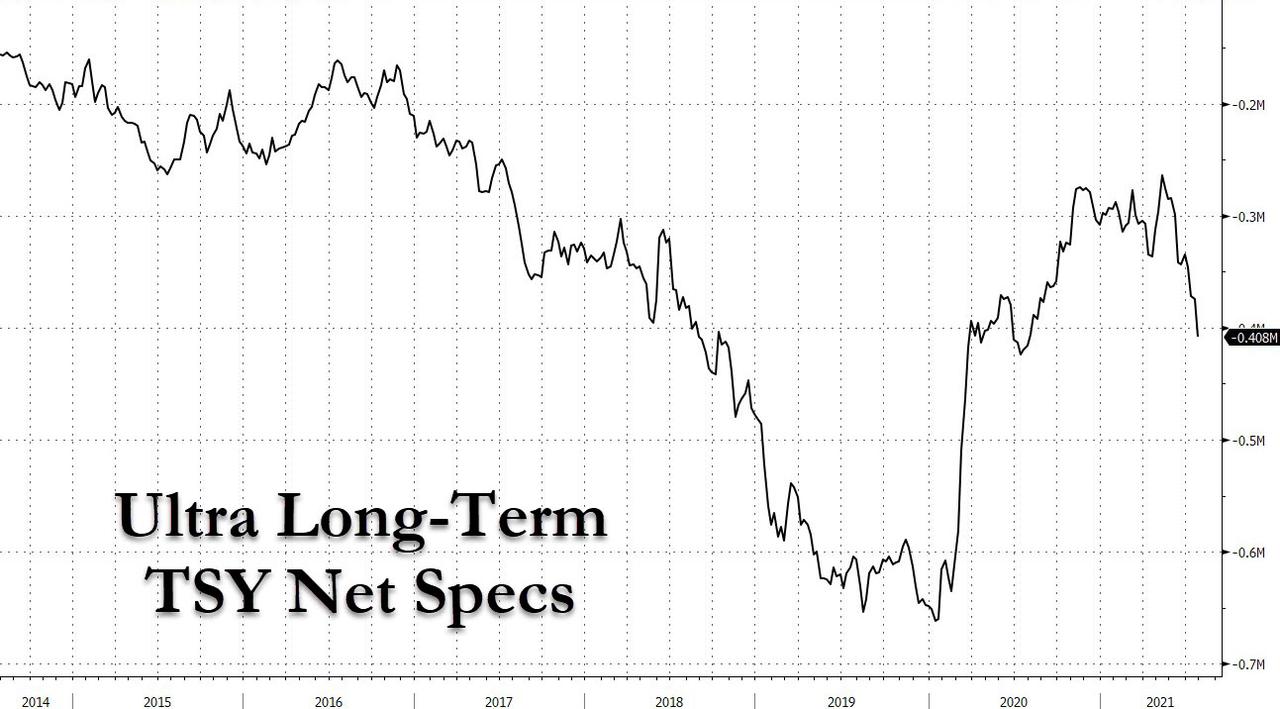
But in an ironic twist, since June, specs have again taken a bearish turn, especially in long-dated ultra bond futures, where yields just tumbled to February levels.
And since leveraged funds now have the biggest net short position in those contracts in almost a year, it's just a matter of time before we learn of even more losses in the days to come as more funds are forced to cover, first pushing yields even lower before - after all the technical overhang is cleared up - yields spring right back up again.

(ZH) Delta Is The Latest Risk Facing Chinese Stocks, Goldman Warns

Delta Is The Latest Risk Facing Chinese Stocks, Goldman Warns
BY TYLER DURDEN
TUESDAY, AUG 03, 2021 - 05:05 PM
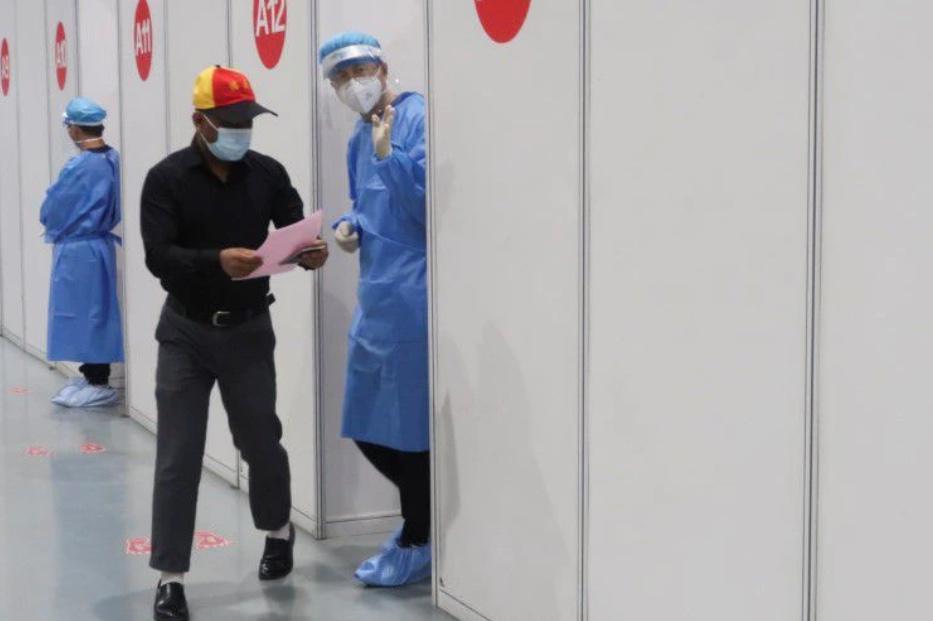
One of the biggest COVID-related stories of the week (outside the US, where the media has decided to fixate on the fact that one-third of new cases are coming from three states that represent roughly one-third of the US population) is the arrival of the delta variant in China, which has called into question the efficacy of its domestically produced vaccines.
But outside of China, the delta variant is driving, hospitalizations and deaths higher across Southeast Asia, which has far less vaccination penetration than the US and China. According to the IMG, close to 40% of the population in advanced economies has been fully vaccinated. The percentage for emerging-market economies is less than half of that. In many countries in the region, the rate is even lower. Only about 8% of the Indonesian and Philippine populations have been fully vaccinated, and around 6% in Thailand.
Ultimately, the impact of the resurgence of delta in Asia will be borne mostly by China. And as a team of Goldman analysts in Hong Kong pointed out in a note to clients, this is only one of a handful of growing headaches for the CCP. China's domestic markets have been roiled by the government's crackdown on everything from the country's biggest tech firms, to purveyors of private tutoring services, to video games and beyond.
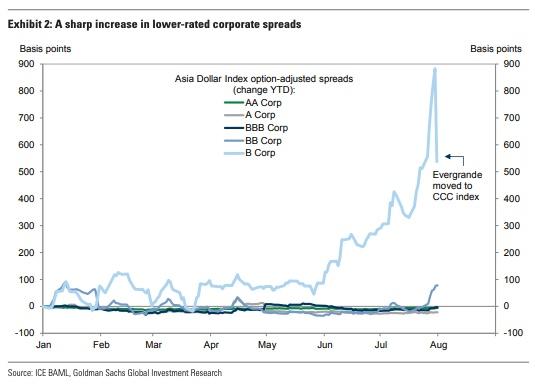
Separately, China's property sector remains under pressure due to the problems at Evergrande, one of the country's largest property developers, which is struggling with its worst liquidity crisis yet.
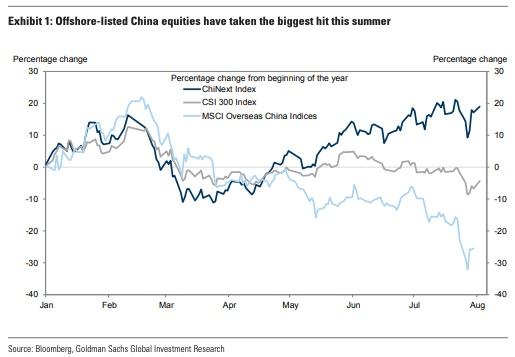
Offshore-listed stocks have taken a massive hit this summer, the analysts pointed out.
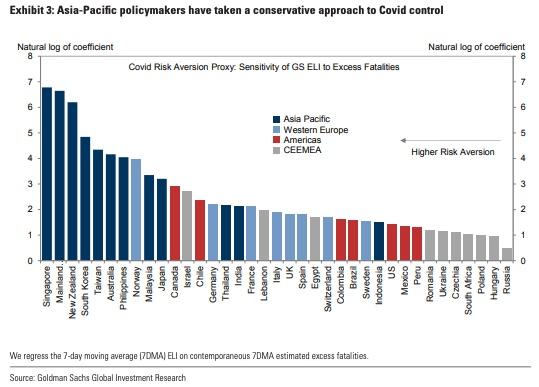
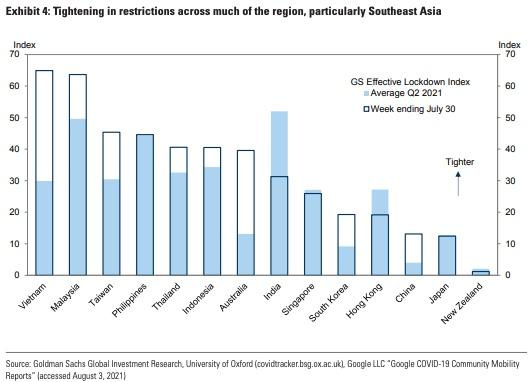
"Several downside risks exist for China's second-half growth outlook," the analysts said. "Some long anticipated, some new". The spread of the delta varaint, combined with Asia's low-tolerance approach to battling COVID, has led to "significantly tighter restrictions in most countries, most notably in Australia.
Using its proprietary "Effective Lockdown Index", Goldman illustrated how some southeast Asian nations currently have tighter COVID restrictions than they had last year.
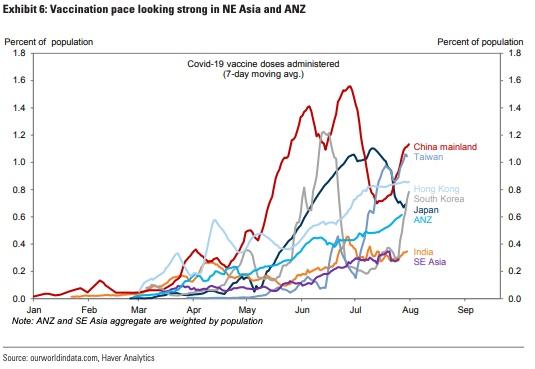
As far as vaccinations go, the picture is changing as more emerging market economies in the region get their hands on more supplies of the jabs, and not just from China.
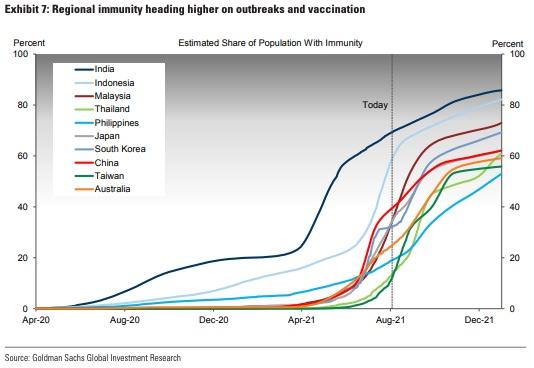
Regional immunity is also heading higher too, with hard-hit India notably leading the pack.
Ultimately, the biggest blowback in the markets will likely be borne by Chinese firms, particularly Chinese companies who are listed abroad, which are vulnerable to all of these headwinds, from COVID-related disruptions, to the government's own hostility.

WSJ : Crypto ‘Wild West’ Needs Stronger Investor Protection, SEC Chief Says

Crypto ‘Wild West’ Needs Stronger Investor Protection, SEC Chief Says
Gary Gensler highlights platforms that allow investors to borrow against cryptocurrencies

WASHINGTON—The Securities and Exchange Commission will regulate cryptocurrency markets to the maximum extent possible using its existing authority, Chairman Gary Gensler said Tuesday, while also calling on Congress to grant the agency more scope and resources to oversee the sector.

Calling the asset class rife with “fraud, scams and abuse,” Mr. Gensler signaled the SEC is likely to become more active in policing crypto trading and lending platforms, as well as so-called stablecoins.

“We just don’t have enough investor protection in crypto. Frankly, at this time, it’s more like the Wild West,” Mr. Gensler said in prepared remarks to the Aspen Security Forum. “We have taken and will continue to take our authorities as far as they go.”

U.S. financial regulators have struggled to get their arms around the fast-growing world of cryptocurrency and related financial technologies. Unlike in the securities and derivatives markets, no single regulator oversees crypto exchanges or brokers. As the market value of the asset class has exploded to more than a trillion dollars, so have scams.

Mr. Gensler said large parts of the sector operate outside of regulatory frameworks that seek to protect investors and consumers, reduce crime, promote financial stability and protect national security.

“If this innovation has any chance of surviving into the, you know, late 2020s and 2030s, it can’t stay astride of the public policy,” said Mr. Gensler, a veteran Democratic regulator who taught a course on cryptocurrency at the Massachusetts Institute of Technology.

Mr. Gensler’s speech comes amid growing recognition from some lawmakers and Biden administration appointees that the crypto market has become large enough and important enough to require more oversight.

In May, Sen. Elizabeth Warren (D-Mass.) wrote to Mr. Gensler asking about the commission’s ability to protect investors. This week, Rep. Don Beyer (D-Va.) introduced a bill that would create laws around the entire digital-asset sector.

“We’re going to see more enforcement activity, I think it’s inevitable,” said Stephen Palley, a partner at the law firm Anderson Kill whose clients include crypto companies. “My thinking is people who get ahead of it and engage may end up doing better.”

Mr. Gensler has told House lawmakers that investor protection rules should apply to crypto exchanges, similar to those that cover equities and derivatives. Regulated exchanges are required by law to have rules that prevent fraud and promote fairness.

In his speech Tuesday, Mr. Gensler highlighted a range of areas in which the SEC could expand its purview.

One of them is decentralized finance, or DeFi, software applications that allow users to borrow, lend, earn interest and trade assets and derivatives. Some DeFi developers say the technology shouldn’t face federal oversight because the automated programs aren’t controlled by people or companies and don’t hold traders’ assets. The services are often used by people seeking to borrow against their cryptocurrency holdings to place larger bets.

Investors have poured tens of billions of dollars into DeFi over the past 12 months, often seeking yields on their crypto assets far greater than they could achieve through dollar-based interest rates. The assets deposited as collateral with DeFi projects have swelled to $85 billion from around $3 billion a year ago, according to data provider DeBank.

DeFi advocates say they are building an innovative alternative to traditional finance, but the space is also riddled with scams. From January to April, DeFi frauds cost investors $83.4 million, according to CipherTrace, an analytics firm.

“The world of crypto finance now has platforms where people can trade tokens and other venues where people can lend tokens,” Mr. Gensler said. He said he believes these platforms can be subject to securities laws and may also be subject to commodities and banking laws.

Mr. Gensler said stablecoins—digital assets pegged to the value of national currencies—also may meet the definition of securities or investment companies, which would also put them within the SEC’s jurisdiction.

Traders typically use stablecoins to exchange one crypto asset for another, Mr. Gensler said, noting that, in July, almost three-fourths of trading on cryptocurrency platforms occurred between a stablecoin and some other token.

“The use of stablecoins on these platforms may facilitate those seeking to sidestep a host of public policy goals connected to our traditional banking and financial system: anti-money-laundering, tax compliance, sanctions and the like,” Mr. Gensler said.

There are $113 billion worth of stablecoins in circulation, according to the Block, a crypto news and research firm. Nearly half of that is in tether, a stablecoin pegged to the U.S. dollar. In February, the companies behind tether and an affiliated bitcoin exchange agreed to pay $18.5 million to resolve an investigation by the New York attorney general’s office over alleged public misrepresentations on the reserves underpinning tether. The companies neither admitted nor denied wrongdoing.

Mr. Gensler on Tuesday hinted at the possibility of additional enforcement actions against crypto assets and trading platforms that the SEC deems to be securities. To make that determination, regulators look at whether the investment was made in a “common enterprise” and whether anticipated profits depend on the efforts of others.

“Folks buying these tokens are anticipating profits, and there’s a small group of entrepreneurs and technologists standing up and nurturing the projects,” Mr. Gensler said. “I believe we have a crypto market now where many tokens may be unregistered securities.”

Because they aren’t registered with the SEC as broker-dealers, U.S. crypto trading platforms generally permit trading only in assets they believe aren’t securities. Coinbase, a crypto exchange that went public earlier this year, said in an SEC filing that it could face penalties if regulators conclude that its platform is used to trade unregistered securities.

Mr. Gensler said it is unlikely that, of the more than 50 tokens offered by a typical crypto-trading platform, none constitute securities.

“I do encourage those platforms to come in and talk to us. Register. Probabilities are you’ve got securities on your platforms,” Mr. Gensler said.

FT : UK weighs national security concerns over Nvidia’s $40bn move for Arm

UK weighs national security concerns over Nvidia’s $40bn move for Arm
Ministers consider grounds for rejecting deal following competition authority report

The future of Nvidia’s planned $40bn takeover of Arm, the British chip designer, is being considered by Boris Johnson’s government as UK ministers take an increasingly active interest in such deals.

Oliver Dowden, UK digital secretary, received an initial report from Britain’s competition authority on July 20. His office said he would make a decision “on the next phase of the investigation in due course”.

Bloomberg News cited a person familiar with government discussions as saying that the assessment by the Competition and Markets Authority contained worrying implications for national security and that the UK was currently inclined to reject the takeover.

The CMA does not undertake its own national security assessment in such reports but rather passes on third-party concerns. The watchdog did assess the deal on competition grounds, however, which the government is also considering.

Dowden’s spokesman on Tuesday declined to discuss the minister’s current view on the deal but said he wanted to see a decision taken “as soon as reasonably practicable to reduce uncertainty” on next steps.

Dowden must next decide whether to let the deal proceed, possibly with conditions attached regarding new undertakings from Nvidia. Even if the government decided there were no national security issues, the CMA could still launch a more detailed “phase 2” probe based on any competition concerns.

In the event that the government uncovers no public interest issues, but the CMA has uncovered competition concerns that cannot be remedied without an in-depth probe, the case would be handed back to the watchdog to handle as a phase 2 merger case.

Johnson’s government has become ever more concerned at the number of takeover bids for strategic British companies. Even Thatcherite ministers such as Kwasi Kwarteng, business secretary, are said by government officials to be “worried”.

Kwarteng has in a handful of days taken an “active interest” in two US bids to buy British defence groups amid worries over national security and the impact on UK jobs, investment and skills.

Johnson’s government is committed to defending manufacturing in key sectors, while the Covid-19 pandemic and Brexit — with its disruption of European supply chains — have focused ministers’ attention on the need to develop domestic capacity in critical sectors.

In the case of Nvidia’s bid for Arm, the deal has raised potential security concerns because semiconductors underpin defence-related technologies. Arm declined to comment.

Dowden said in April: “We want to support our thriving UK tech sector and welcome foreign investment, but it is appropriate that we properly consider the national security implications of a transaction like this.”

Arm is being sold by SoftBank of Japan, which initially bought the semiconductor business in 2016. SoftBank’s decision to sell the group to Nvidia has raised concerns over whether the US group would keep its headquarters in Cambridge beyond the short term.

Jensen Huang, chief executive of Nvidia, has said he intends to retain Arm’s name while also expanding its base in Cambridge and keeping its intellectual property registered in the UK.

Nvidia said: “We continue to work through the regulatory process with the UK government. We look forward to their questions and expect to resolve any issues they may have.”

The CMA said: “As confirmed on July 20, we have submitted our findings on competition issues, and a summary of the responses we received on national security grounds, to the DCMS secretary of state.”

Meanwhile, Kwarteng is monitoring the proposed £7.1bn takeover of UK aerospace and defence company Meggitt by US rival Parker Hannifin.

The minister wants to retain jobs, R&D and other specialist operations in the UK. The jobs-related commitments made by Parker last for one year, while those around R&D spending are valid for five years.

Aerospace and defence analysts were confident that the Parker Hannifin takeover of Meggitt would go through despite the potential risk of government intervention.

Only a few days earlier Kwarteng signalled that he might intervene in the proposed £2.6bn bid by US private equity-backed Cobham for UK defence group Ultra Electronics after worries surfaced on national security grounds.

Under the 2002 Enterprise Act, ministers can intervene in takeovers deemed to threaten national security, media plurality or financial stability. A new National Security and Investment Act, with new powers, comes into force in January 2022.

>>> US close Dow +0.80% S&P +0.82% Nasdaq +0.55% Russell +0.37%

Closing Stock Market Summary

The S&P 500 advanced 0.8% on Tuesday and closed at a record high. The Dow Jones Industrial Average kept pace with its own 0.8% gain, followed by more modest gains in the Nasdaq Composite (+0.6%) and Russell 2000 (+0.4%). 

The market faded a positive start like yesterday, but today buyers appeared to step in after the 10-yr yield was able to hold above yesterday's intraday low (1.14%). It touched 1.15% before settling the session unchanged at 1.18%. 

The equity gains were relatively broad-based at the large-cap level, as ten of the 11 S&P 500 sectors closed higher and the Invesco S&P 500 Equal Weight ETF (RSP 153.73, +1.28, +0.8%) gained 0.8%. Still, Apple (AAPL 147.36, +1.84, +1.3%), Microsoft (MSFT 287.12, +2.30, +0.8%), and Amazon.com (AMZN 3366.24, +34.76, +1.0%) pulled their weight and some. 

The energy (+1.8%), industrials (+1.4%), health care (+1.4%), and financials (+1.1%) sectors stood atop the leaderboard with gains over 1.0%. Eli Lilly (LLY 255.99, +9.39, +3.8%) supported the health care sector following its mixed earnings report. 

The communication services sector (-0.2%) was the lone holdout, pressured by weakness in Take-Two Interactive (TTWO 159.86, -13.35, -7.7%) after the company issued disappointing full-year guidance. On a related note, Chinese gaming stocks were hit by regulatory concerns. 

Robinhood Markets (HOOD 46.80, +9.12, +24.2%) was another story stock, surging 24% on no specific news. HOOD shares closed the session up 41% from its low on IPO day last Thursday. 

Overall, it was a resilient day given that declining issues slightly outnumbered advancing issues at the Nasdaq and given the uncertainty surrounding the Delta variant, infrastructure, and the Treasury market. The CBOE Volatility Index (18.04, -1.42, -7.3%) declined to the 18 level. 

The 2-yr yield was unchanged at 0.17%. The U.S. Dollar Index was unchanged at 92.07. WTI crude futures decreased 1.0%, or $0.74, to $70.57/bbl.

Tuesday's economic data was limited to Factory Orders for June, which increased 1.5% ( consensus +1.0%) following a revised 2.3% increase in May (from +1.7%).

Looking ahead, investors will receive the ISM Non-Manufacturing Index for July, the ADP Employment Change report for July, the final IHS Markit Services for July, and the weekly MBA Mortgage Applications Index on Wednesday. 

  • S&P 500 +17.8% YTD
  • Dow Jones Industrial Average +14.7% YTD
  • Nasdaq Composite +14.5% YTD
  • Russell 2000 +12.6% YTD

FT : Stellantis increases profit forecasts in ‘blowout’ debut earnings

Stellantis increases profit forecasts in ‘blowout’ debut earnings
Higher demand and chip shortages drive up car prices for newly merged auto group

Stellantis has joined a spate of carmakers that have increased their full-year profit forecasts, as higher customer demand and chip shortages drive up the price of cars.

The Dutch-headquartered carmaker posted what one analyst called a “blowout” first-half earnings debut on Tuesday, with an 11.4 per cent adjusted operating income margin.

It raised its full-year margin guidance to about 10 per cent, from 5.5 to 7.5 per cent. Analysts had forecast an 8 per cent margin in the first half of the year.

The results prompted a 4 per cent increase in the company’s share price to €17.09 by early afternoon on Tuesday.

Thomas Besson, an analyst at Kepler Cheuvreux, described Stellantis’s results as a “blowout”, but cautioned that carmakers’ margins were “not sustainable at this level”. He added that investors were aware “pricing is very, very high and at some point it is going to erode”.

Peugeot and Vauxhall owner PSA and Fiat Chrysler merged to form Stellantis in a $50bn tie-up late last year, creating the fourth-largest carmaker in the world and overtaking General Motors and Hyundai-Kia. The merger was completed in mid-January.

Stellantis’s results follow the trend of a return to high margins in the automotive sector, partly because of inflation in vehicle prices.

The continuing dearth of semiconductors has limited supply and forced manufacturers to be more selective about which cars they build, often driving them to prioritise more profitable models.

Prices have also been bolstered by the rising share of sales for electric vehicles, which enjoy strong government subsidies in many large markets.

Ford, Volkswagen and Nissan all posted stronger than expected results last week and increased their full-year forecasts.

VW chair Herbert Diess told the Financial Times last week that “the semis shortage probably has helped the entire industry to improve profitability”, referring to the prioritisation of the production of higher-end models.

Stellantis’s pro forma group revenues stood at €75.3bn in the first half of 2021, above consensus estimates of €73.1bn, while pro forma net profit stood at €5.9bn.

The chip shortage has, however, had significant downsides, holding back revenues and earnings for auto suppliers. It has also made investors wary of a drop-off in profitability when the shortage eases and car production increases again.

Stellantis said on Tuesday that it forecast no improvement in the supply of chips before the fourth quarter and estimated that the group’s production would decrease by 1.4m cars.

Separately, Germany’s BMW reported on Tuesday earnings before interest and tax of more than €5bn for the second quarter, compared with a loss in the same period last year, which beat analysts’ expectations. The carmaker said its results were boosted more by strategic “inventory management” of semiconductors than the prioritisation of certain models.

However, its chief financial officer Nicolas Peter warned that the chip shortages would “continue in the second half of the year” and have a “corresponding impact on sales volumes”.

>>> US Gapping down

Gapping down
In reaction to earnings/guidance
:

  • CLX -9.8%, CRSR -6.6%, OMI -5.3%, ADUS -5.2%, BHC -4.6%, EVER -4.5%, TTWO -4.4%, REYN -3.5%, ROCK -3.5%, LDOS -3.4%, SANM -2.9%, TREX -2.9%, ARNC -2.6%, WWD -2.3%, LLY -2.2%, ANET -2.1%, ZBH -1.9%, HSIC -1.5%, FIS -1.4%, HMN -1.1%, RARE -1%

Other news:

  • NEWT -14.7% (to acquire National Bank of New York City for $20 mln)
  • RNA -7.9% (stock offering)
  • DRVN -4.9% (stock offering)
  • IVA -3% (stock offering)
  • LI -2.5% (stock offering)
  • LDOS -2% (wins US Army contract)
  • KRYS -1.5% (initiates dosing in PEARL-1 trial)
  • MAA -1.1% (prices offering of 1,100,000 shares of common stock)

Analyst comments:

  • YOU -2.6% (downgraded to Neutral from Overweight at JP Morgan)

>>> US Gapping up

Gapping up
In reaction to earnings/guidance
:

  • SEDG +12.1%, ZI +12%, MYGN +10.2%, IGT +8.1%, OTTR +7.5%, CLR +6.9% (also resumes share repurchase program), UIS +6.5%, HLIT +5.8%, BP +5.7%, STLA +5.2%, ATKR +5%, BCC +4.6%, UAA +4.5%, COLM +4%, KMT +3.7% (also authorizes $200 mln share repurchase program), PBI +3.4%, MTRN +3.4%, MOS +3.3%, SPG +2.8%, KKR +2.3%, DD +2.2%, WLTW +2.2%, OPCH +2.1%, ETRN +2%, IT +1.9%, IAA +1.9%, AQUA +1.7%, ZBRA +1.6%, PSXP +1.6%, INGR +1.4%, DISCA +1.4%, AME +1.3%, WMB +1.2%, WLK +1.2%, BLD +1.2%, SEE +1.2%, COP +1.1%, LGIH +1%, ESPR +0.9%, CMI +0.9%, MAR +0.8%

Other news:

  • OTLK +43.4% (top-line results from its pivotal Phase 3 NORSE TWO safety and efficacy trial)
  • TBIO +29.6% (to be acquired by Sanofi (SNY) for $38.00 per share in cash)
  • HOLI +19.4% (in process of evaluating offers from consortiums)
  • GTBP +7.5% (preclinical results for GTB-5550 B7H3 TriKE)
  • ARCT +6.7% (received approval for a Clinical Trial Application from the Singapore Health Sciences Authority to enable the advancement of two STARR mRNA vaccine candidates into the clinic)
  • MRNS +6.3% (collaboration with Orion Corporation for commercialization of ganaxolone in Europe; submits NDA for the use of ganaxolone to treat seizures associated with CDKL5 deficiency disorder)
  • PLXP +5% (3 SKUs of VAZALORE will be available in nearly 8,000 CVS stores later this month)
  • FLR +4.4% (JV selected for Phase 2 of Interstate 35E expansion project in Texas)
  • CECE +4% (authorizes $5 mln share repurchase program)
  • GDRX +3.2% (GOCO announces exclusive Medicare agreement with GDRX)
  • LPLA +2.1% (lowers advisory account minimums in OMP platform)
  • GOCO +1.8% (GOCO announces exclusive Medicare agreement with GDRX)
  • ABCL +1.5% (AbCellera Biologics & Tachyon collaborate to develop novel antibody therapeutic targeting TGF-31)
  • ESEA +1.4% (announces a new time charter contract)
  • ROAD +1.2% (acquries Good Hope Contracting and Daurity Springs Quarry)
  • RRD +1.2% (responds to Chatham 13D filing)
  • SEE +1.2% (to increase prices)
  • ISBC +1.1% (ISBC receives approval from FDIC to acqurie certain branches of BHLB)

Analyst comments:

  • BLMN +3.6% (upgraded to Outperform from Neutral at Credit Suisse)
  • DXC +3.2% (upgraded to Outperform from Market Perform at BMO Capital Markets)
  • XPO +2% (upgraded to Buy from Neutral at Goldman)
  • ABNB +1.7% (upgraded to Overweight from Sector Weight at KeyBanc Capital Markets)
  • PLNT +1.7% (upgraded to Buy from Hold at Stifel)
  • HSBC +1.6% (upgraded to Buy from Hold at DBS Bank)
  • WDAY +1.5% (upgraded to Overweight from Equal Weight at Barclays)