FT : ECB weighs slower bond purchases as economy rebounds

ECB weighs slower bond purchases as economy rebounds
Monetary policy hawks fear rising inflation while doves seek to maintain stimulus

“Go big or go home,” is how Christine Lagarde likes to describe the European Central Bank’s response to the economic carnage caused by the pandemic. 

Now that Europe’s economy is rebounding from the Covid-19 crisis, the challenge facing the ECB president is how the central bank should unwind its massive monetary stimulus without cutting short the recovery or spooking the bond market, especially for southern European borrowers.

The delicate task has intensified divisions within the ECB and, on Thursday, economists expect to get a first glimpse of how it might wind down its €1.85tn pandemic emergency purchase programme (PEPP), its flagship bond-buying policy to shield financial markets from the crisis.

While investors expect Lagarde to announce a dialling down of its PEPP purchases, economists say the bigger question confronting the central bank is inflation. This has risen to a decade high in large part because of shortages of goods as well as resurgent demand.

“From a macroeconomic perspective, whether they go from €80bn of PEPP purchases a month to €70bn or €60bn doesn’t really matter,” said Silvia Ardagna, chief European economist at Barclays. “The key questions are what happens to asset purchases after PEPP ends . . . and what they expect on inflation.”

The possibility of rampant inflation is fuelling tensions between conservative “hawks” on the ECB governing council and the more numerous “doves”, who want to keep a sizeable stimulus to support recovery.

For the past 18 months, hawks such as Jens Weidmann of Germany, Klaas Knot of the Netherlands, and Robert Holzmann of Austria have stoically supported the ECB’s crisis response. 

But they have become more vocal since eurozone gross domestic product expanded by 2 per cent in the second quarter, overtaking China and the US for the first time since the pandemic hit. Inflation also rose to a decade-high level of 3 per cent in August, well above the ECB’s target of 2 per cent.


Hawks worry that inflation will continue to outstrip expectations, fuelled by supply chain bottlenecks, resurgent demand and households spending excess savings built up during the pandemic. They fear that if the ECB is too slow to respond it will have to tighten policy suddenly to prevent economic overheating.

“The risks are tilted to the upside right now,” Bundesbank president Weidmann warned in a speech last week. “If these transitory factors lead to higher inflation expectations and accelerated wage growth, the rate of inflation could rise perceptibly over the longer term.”

The ECB will publish updated forecasts on Thursday. Most analysts expect it to raise its predictions for inflation this year and coming years, even though they also expect inflation to fall sharply next year and remain below the ECB’s target throughout 2023.

Katharina Utermöhl, senior economist at Allianz, said that the recent surge in eurozone inflation looked more modest if averaged over two years, which reduces it to below 1.5 per cent. She added: “Reflation is not inflation — mind the rollercoaster base effects.”

Economists add that there are few signs yet that inflation is feeding into higher wages, although Germany’s Verdi union recently asked for a 5 per cent pay rise for 1.1m public sector workers. Bars and restaurants in Paris and Berlin have also boosted pay to fill vacancies. 

“Right now there is a disconnect between wage data, which remains flat, and the anecdotal evidence of some higher wage demands and pockets of staff shortages,” said Jacob Nell, head of European economics at Morgan Stanley.

The debate over the trajectory of inflation will be crucial in deciding the other big question hanging over the ECB: how much stimulus to pump into the economy by buying bonds when PEPP finishes next year.

While other major central banks, such as the US Federal Reserve and the Bank of England, are preparing to “taper” their asset purchases to reduce them to zero, the ECB will continue buying bonds with its traditional purchase programme. This is still running at €20bn a month and is expected to be doubled or tripled when PEPP ends.


The size of the boost is unlikely to be decided before December, but a more controversial question is how much of the extra flexibility of PEPP will be transferred to the ECB’s ongoing asset purchase programme.

This flexibility would allow the ECB to exceed its self-imposed limit on owning more than a third of any country’s eligible bonds, something it is close to doing already in Germany and the Netherlands.

So far, governments have been able to vastly increase their debt levels without worrying too much about the cost. But if the ECB’s firepower to buy more bonds is restricted, investor anxiety could push yields sharply higher.

Meanwhile, hawks worry that raising the limits on sovereign bond purchases will open up the ECB to accusations of breaching the EU’s ban on monetary financing of governments, a charge partly upheld by Germany’s constitutional court last year.

“This is the key discussion they are having: not whether to beef up their ongoing asset purchase programme to follow PEPP but how much flexibility there will be,” said Spyros Andreopoulos, senior European economist at BNP Paribas.

FT : US retail investors drive summer surge in stocks

US retail investors drive summer surge in stocks
JPMorgan warns of ‘melt-up’ in stocks because of runaway demand


Record levels of stock buying by retail investors have helped to keep US equities marching higher through the summer months, and been the “dominant force” powering a relentless rally in the market, according to analysts at JPMorgan.

US retail investors’ net purchases of stocks and exchange traded funds surged to record levels during the summer, after posting substantial inflows throughout the year, according to a measure calculated by the bank to focus on retail activity.

The S&P 500 index of blue-chip US stocks is up 20 per cent so far this year. “As long as this retail flow continues, the equity market will keep going up,” said Nikolaos Panigirtzoglou, cross-asset research analyst at JPMorgan.

“If that flow stops and we start seeing material outflows — from equity ETFs in particular — then we should start getting worried about the equity market because it would mean that the attitude of retail investors towards equity markets is changing,” he said.

Global equity fund inflows, which analysts view as another indicator of retail buying, have pushed past $689bn so far this year, smashing the previous annual record set in 2017. 


Retail investors grabbed widespread attention early this year when thousands of traders, organised on the social media platform Reddit, pumped up the prices of historically unloved stocks, such as the video game retailer GameStop and cinema chain AMC Entertainment, generating spectacular rallies. 

The frenzy of buying and selling around these so-called meme stocks prompted a spike in the volume of retail trades, but the net amount of cash flowing into the markets from retail investors reached its peak during the summer boom, according to JPMorgan’s data.

“If anything, that retail flow has been accelerating recently. It looks more like a melt-up,” said Panigirtzoglou. “The problem with melt-ups is that they don’t continue forever.”

FT : Why airline schemes for easing guilt over flying are dodgy

Why airline schemes for easing guilt over flying are dodgy
Prices for carbon offsets offered by carriers are unrealistically low

Forget Ryanair. British Airways is the real low-cost airline, at least for carbon offsets. The UK flag carrier offers these to passengers at almost half the price charged by its Irish rival for some of the same trips.

Both are pricing carbon at big discounts to what industrial companies pay to cover excess emissions. The airlines say they are giving passengers the chance to “fully offset” flights and go “carbon neutral” via payments to environmental projects.

Superficially, it is a triple win. Environmental charities need the money. Airlines want passengers to share the cost of giving aviation a greener gloss. Many travellers yearn to avoid what is called in German “flugsham” — the guilt of contributing to climate change.

The snag is that prices are unrealistically low. If offsets were marketed as financial products, regulators would be asking questions about the promises made.

Carbon calculators are at the heart of the issue. You can see why an increasing number of airlines, from JetBlue in the US to Lufthansa in Europe and Cathay in Asia, build these into online sales systems. For customers, it feels nice to hit a button and generate an offset price they can add to their flight package. Particularly when prices are so affordable.

BA, for example, was last week quoting £1.72 (€2) to offset a return trip in economy class from London to Alicante. Ryanair’s website quoted €5.67. BA’s offsets for long-haul trips are even cheaper per mile than short-haul offsets — under £10 to fly to Hong Kong and back

I calculate BA is pricing carbon at about €8 to €10 a tonne. I reckon Ryanair is closer to €18 per tonne. EU and UK industrial companies are, meanwhile, paying about €56 per tonne via emissions trading schemes.

Defenders of carbon offsets complain I am comparing apples and pears. They say governments limit the supply of permits to make emissions to push up prices. Quite so — unless prices are higher, there is no chance climate change will be arrested.

It is questionable whether many of the carbon sequestration projects that provide cheap offset certificates have the financial heft to lock up as much of the stuff as claimed.

One scheme I looked at provides clean drinking water in Africa, for example. Sinking boreholes and digging wells are great projects that are well worth backing. But I am unconvinced by the argument that these qualify as offsets by reducing heavily the amount of wood burnt to sterilise drinking water. Years ago, I lived in an Indian village as a development volunteer. People there did not have the fuel or the time to boil drinking water.

Forestry schemes look like a clearer way to reduce carbon, by turning it into trees. But in developed nations these often “preserve” woodlands which might not be cut down anyway. Planting trees where they are absent looks like a better bet. After all, a tree supposedly sequesters upwards of 10kg of carbon a year, getting it to a running total of about a tonne in a century.

Logic peters out, however, when you ponder the task facing latter-day Johnny Appleseeds. Suppose they sought to plant enough trees to soak up all aviation’s yearly emissions. My back-of-an-envelope figuring suggests these gallant arboriculturists would need to cover an area roughly the size of Norway with saplings before protecting them from loggers, drought and wildfires for the requisite 100 years. I doubt you can do that for €10 per tree.

Sola Zheng, of the International Council on Clean Transportation, a US non-profit organisation, argues airlines should focus on alternative fuels and using them efficiently.

Airlines would riposte that they are already doing that. My feeling is that voluntary carbon offset schemes could help build public awareness of the cost of arresting climate change — if they used credible numbers and were more transparent.

First, airlines need to disclose clearly the assumptions behind their online calculators. Second, these gizmos need to spit out a carbon price somewhere roughly in the same postcode as the figure produced by emissions trading schemes. Aviation bodies can help by setting tougher guidelines.

There is at present no push for carbon offsets to be regulated like financial products. That is just as well given the likely overheads. But it is time for the industry to be far more realistic about what it is marketing and for how much.

NYT : Crypto’s Rapid Move Into Banking Elicits Alarm in Washington

Crypto’s Rapid Move Into Banking Elicits Alarm in Washington
The boom in companies offering cryptocurrency loans and high-yield deposit accounts is disrupting the banking industry and leaving regulators scrambling to catch up.

BlockFi, a fast-growing financial start-up whose headquarters in Jersey City are across the Hudson River from Wall Street, aspires to be the JPMorgan Chase of cryptocurrency.

It offers credit cards, loans and interest-generating accounts. But rather than dealing primarily in dollars, BlockFi operates in the rapidly expanding world of digital currencies, one of a new generation of institutions effectively creating an alternative banking system on the frontiers of technology.

“We are just at the beginning of this story,” said Flori Marquez, 30, a founder of BlockFi, which was created in 2017 and claims to have more than $10 billion in assets, 850 employees and more than 450,000 retail clients who can obtain loans in minutes, without credit checks.

But to state and federal regulators and some members of Congress, the entry of crypto into banking is cause for alarm. The technology is disrupting the world of financial services so quickly and unpredictably that regulators are far behind, potentially leaving consumers and financial markets vulnerable.

In recent months, top officials from the Federal Reserve and other banking regulators have urgently begun what they are calling a “crypto sprint” to try to catch up with the rapid changes and figure out how to curb the potential dangers from an emerging industry whose short history has been marked as much by high-stakes speculation as by technological advances.

In interviews and public statements, federal officials and state authorities are warning that the crypto financial services industry is in some cases vulnerable to hackers and fraud and reliant on risky innovations. Last month, the crypto platform PolyNetwork briefly lost $600 million of its customers’ assets to hackers, much of which was returned only after the site’s founders begged the thieves to relent.

“We need additional authorities to prevent transactions, products and platforms from falling between regulatory cracks,” Gary Gensler, the chairman of the Securities and Exchange Commission, wrote in August in a letter to Senator Elizabeth Warren, Democrat of Massachusetts, about the dangers of cryptocurrency products. “We also need more resources to protect investors in this growing and volatile sector.”

The S.E.C. has created a stand-alone office to coordinate investigations into cryptocurrency and other digital assets, and it has recruited academics with related expertise to help it track the fast-moving changes. Acknowledging that it could take at least a year to write rules or get legislation passed in Congress, regulators may issue interim guidance to set some expectations to exert control over the industry.

BlockFi has already been targeted by regulators in five states that have accused it of violating local securities laws.

Regulators’ worries reach to even more experimental offerings by outfits like PancakeSwap, whose “syrup pools” boast that users can earn up to 91 percent annual return on crypto deposits.

Treasury Secretary Janet L. Yellen and Jerome H. Powell, the chair of the Federal Reserve, have also voiced concerns, even as the Fed and other central banks study whether to issue digital currencies of their own.

Mr. Powell has pointed to the proliferation of so-called stablecoins, digital currencies whose value is typically pegged to the dollar and are frequently used in digital money transfers and other transactions like lending.

“We have a tradition in this country where, you know, where the public’s money is held in what is supposed to be a very safe asset,” Mr. Powell said during congressional testimony in July, adding, “That doesn’t exist really for stablecoins.”

The cryptocurrency banking frontier features a wide range of companies. At one end are those that operate on models similar to those of traditional consumer-oriented banks, like BlockFi or Kraken Bank, which has secured a special charter in Wyoming and hopes by the end of this year to take consumers’ cryptocurrency deposits — but without traditional Federal Deposit Insurance Corporation insurance.

On the more radical end is decentralized finance, or DeFi, which is more akin to Wall Street for cryptocurrency. Players include Compound, a company in San Francisco that operates completely outside the regulatory system. DeFi eliminates human intermediaries like brokers, bank clerks and traders, and instead uses algorithms to execute financial transactions, such as lending and borrowing.

“Crypto is the new shadow bank,” Ms. Warren said in an interview. “It provides many of the same services, but without the consumer protections or financial stability that back up the traditional system.”

“It’s like spinning straw into gold,” she added.

Lawmakers and regulators are worried that consumers are not always fully aware of the potential dangers of the new banklike crypto services and decentralized finance platforms. Crypto deposit accounts are not federally insured and holdings may not be guaranteed if markets go haywire.

People who borrow against their crypto could face liquidation of their holdings, sometimes in entirely automated markets that are unregulated.

From Pawnbroker to Bank
BlockFi’s extraordinary growth — and the recent crackdown by state regulators — illustrates the fraught path of cryptocurrency financial services companies amid confusion about what they do.

Sign Up for On Politics With Lisa Lerer A spotlight on the people reshaping our politics. A conversation with voters across the country. And a guiding hand through the endless news cycle, telling you what you really need to know. Get it sent to your inbox.
BlockFi’s business is not dissimilar to that of a regular bank. It takes deposits of cryptocurrencies and pays interest on them. It makes loans in dollars to people who put up cryptocurrency as collateral. And it lends crypto to institutions that need it.

For consumers, the main allure of BlockFi is the chance to take loans in dollars up to half of the value of their crypto collateral, allowing customers to get cash without the tax hit of selling their digital assets, or to leverage the value of holdings to buy more cryptocurrency. The company also offers interest of up to 8 percent per year on crypto deposits, compared with a national average of 0.06 percent for savings deposits at banks in August.

Editors’ Picks

The Navy SEAL Who Went Rogue

13 Delicious, Original Ways to Eat Eggs for Dinner

‘Sexist,’ ‘Racist,’ ‘Classist’: Georgia 8th Grader Challenges School Dress Code
Continue reading the main story
How can BlockFi offer such a high rate? In addition to charging interest on the loans it makes to consumers, it lends cryptocurrency to institutions like Fidelity Investments or Susquehanna International Group that use those assets for quick and sometimes lucrative cryptocurrency arbitrage transactions, passing on high returns to customers. And because BlockFi is not officially a bank, it does not have the large costs associated with maintaining required capital reserves and following other banking regulations.

Also unlike a bank, BlockFi does not check credit scores, relying instead on the value of customers’ underlying crypto collateral. The company’s executives argue that the approach democratizes financial services, opening them to people without the traditional hallmarks of reliability — like good credit — but with digital assets.

The model has worked for BlockFi. It is hiring employees from London to Singapore, while prominent investors — like Bain Capital, Winklevoss Capital and Coinbase Ventures — have jumped in to fund its expansion. The company has raised at least $450 million in capital.

But to regulators, BlockFi’s offerings are worrying and perplexing — so much so that in California, where BlockFi first sought a lender’s license, officials initially advised it to instead apply for a pawnbroker license. Their reasoning was that customers seeking a loan from BlockFi hand over cryptocurrency holdings as collateral in the same way that a customer might give a pawnshop a watch in exchange for cash.

Ms. Marquez of BlockFi called the sheriff’s office in San Francisco about a pawnbroker license, only to be redirected again. “No, pawnbrokers’ licenses are only for physical goods,” she recounted being told. “And because crypto is a virtual asset, this license actually does not apply to you.”

Undeterred, she returned to the state’s banking regulators and persuaded them BlockFi qualified as a lender, albeit of a new variety. The company now has licenses in at least 28 states to offer dollar loans and transacts in cryptocurrency with more than 450,000 clients — many of whom are outside the United States. In the first three months of this year, the value of crypto held in BlockFi interest-bearing accounts more than tripled to $14.7 billion from $4.4 billion, a jump driven in part by the rise in the price of Bitcoin and other cryptocurrencies.

As the company has expanded, regulators have become increasingly concerned. New Jersey’s attorney general sent it a “cease and desist” letter in July, saying it sells a financial product that requires a securities license, with all the associated obligations, including mandated disclosures.

“No one gets a free pass simply because they’re operating in the fast-evolving cryptocurrency market,” the acting attorney general, Andrew J. Bruck, said.

BlockFi does not adequately notify customers of risks associated with its use of their cryptocurrency deposits for borrowing pools, including the “creditworthiness of borrowers, the type and nature of transactions,” officials in Texas added in their own complaint, echoing allegations made by state officials in Alabama, Kentucky and Vermont.

Zac Prince, BlockFi’s chief executive, said that the company was complying with the law but that regulators did not fully understand its offerings. “Ultimately, we see this as an opportunity for BlockFi to help define the regulatory environment for our ecosystem,” he wrote in a note to customers.

Breaking the Banking Mold
The regulatory challenge is even greater when it comes to other emerging crypto finance developers in the world of DeFi, such as Compound, SushiSwap and Aave as well as PancakeSwap.

They are all essentially automated markets run by computer programs facilitating transactions without human intervention — the crypto-era version of trading floors. The idea is to eliminate intermediaries and bring together buyers and sellers on the blockchain, the technology behind cryptocurrency. The sites do not even collect users’ personal information.

Founders of those kinds of platforms argue that they are just building a “protocol” ultimately led by a community of users, with the computer code effectively running the show.

Robert Leshner, 37, started Compound in 2018 after spending a year in a tiny attic office sublet in the Mission district in San Francisco with five colleagues, experimenting with a computer program that would become part of the foundation of the DeFi movement.

Compound — backed by prominent crypto venture capitalists like Andreessen Horowitz and Coinbase Ventures — now has more than $20 billion in assets. Each of the nearly 300,000 “customers” is represented by a unique 42-character list of letters and numbers. But Compound does not know their names or even what country they are from.

Mr. Leshner and others who helped set up Compound own a large share of its self-issued cryptocurrency token — known as COMP — which has surged in value, making him worth, at least on paper, tens of millions of dollars.

Mr. Leshner has been startled by the rapid growth. “At every juncture, the speed at which decentralized finance has just, like, started to work, has caught myself and everybody off guard,” he said.

Industry executives say concerns about the safety and stability of digital assets are overblown, but federal financial regulators are still working to get a handle on the latest developments.

DeFi protocols largely rely upon stablecoins, cryptocurrencies that are ostensibly pegged to the United States dollar for a steady value but without guarantees that their value is adequately backed.

The overall market of stablecoins has ballooned to $117 billion as of early September from $3.3 billion in January 2019. That has regulators worried.

“These things are effectively treated by users as bank deposits,” said Lee Reiners, a former supervisor at the Federal Reserve Bank of New York. “But unlike actual deposits, they are not insured by F.D.I.C., and if account holders begin to have concerns that they cannot get money out, they might try and trigger a bank run.”

One option worth considering, Ms. Warren said, is to ban banks in the United States from holding cash deposits backing up stablecoins, which could effectively end the surging market. Another possibility that some say could undermine the entire crypto ecosystem is the creation of a government-issued digital dollar.

“You wouldn’t need stablecoins, you wouldn’t need cryptocurrencies if you had a digital U.S. currency,” Mr. Powell, the Fed chairman, said in July. “I think that’s one of the stronger arguments in its favor.”

(ZH) Can The Bulls Defy The Odds Of September Weakness?

Can The Bulls Defy The Odds Of September Weakness?

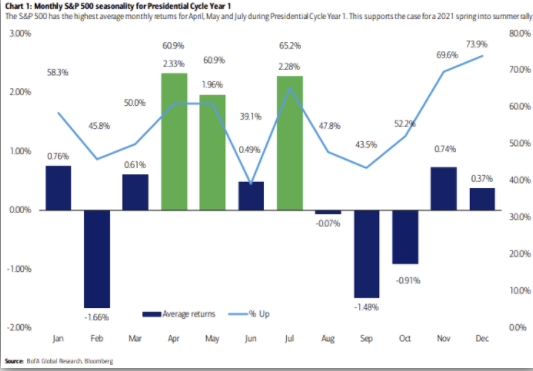
While we had previously discussed that August tends to be one of the weaker months of the year, the bulls defined that weakness posting an almost 3% gain. However, as discussed in our Daily Market Commentary on Wednesday:
“August seasonality was a bust with the market advancing 2.6%. Will September seasonality prove to be more accurate?”
For now, the bullish bias remains strong as a barrage of weaker than expected economic data from GDP to manufacturing and employment give hope the Fed may forestall their “tapering” plans. But, as we will discuss in a moment, we think the bulls may be correct for a different reason.
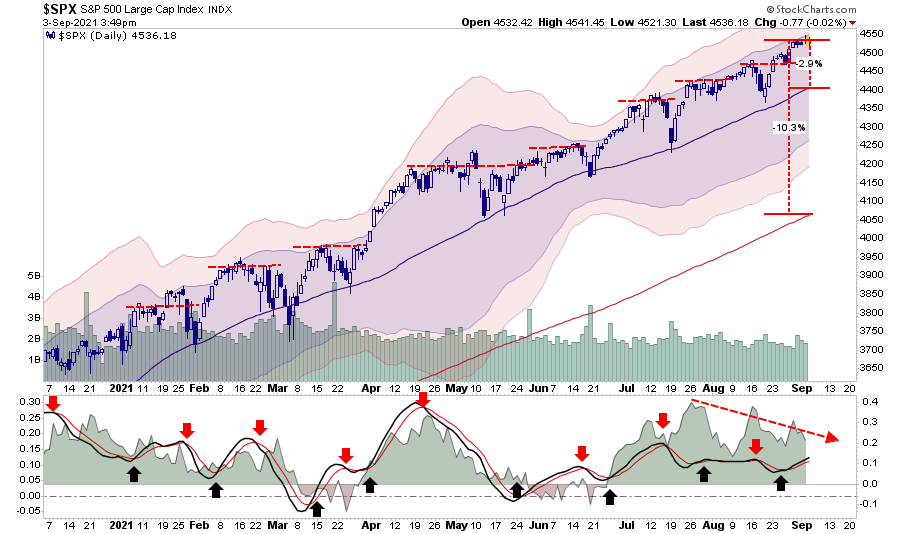
However, in the meantime, the “stairstep” advance continues with fundamentally weak companies making substantial gains as speculation displaces investment in the market. Thus, while prices remain elevated, money flows weaken, suggesting the next downturn is roughly one to two weeks away. So far, those corrections remain limited to the 50-dma, which is approximately 3% lower than Friday’s close, but a 10% correction to the 200-dma remains a possibility.
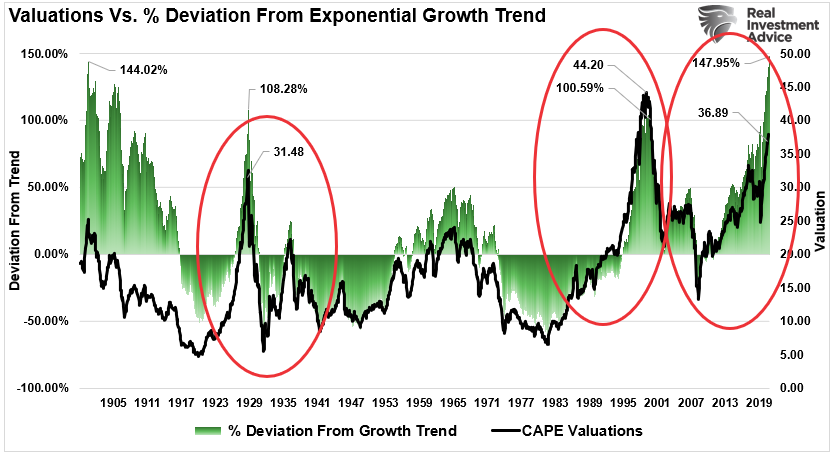
While there seems to be little concern relative to the market’s advance over the last year, maybe that should be the concern given the sharpness of that advance. I will discuss the history of “market melt-ups” and their eventual outcomes in an upcoming article. However, what is essential to notice is the corresponding ramp in valuations as earnings fail to keep up with bullish expectations.
Significantly, investors never realize they are in a “melt-up” until after it is over.
Breadth Remains Weak As Market Advances
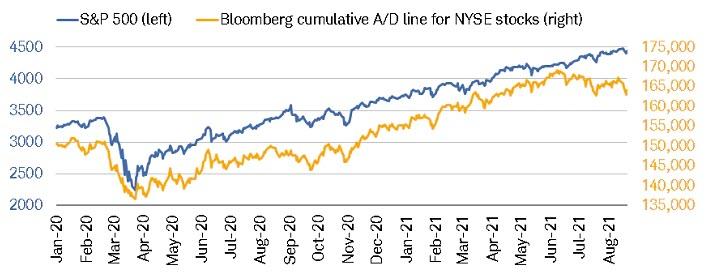
At the moment, the bullish trend continues, and we must respect that trend for now. However, there are clear signs the advance is beginning to narrow markedly, which has historically served as a warning to investors.
” As shown in the chart below, although the S&P 500 traded at an all-time high as recently as last week, the cumulative advance/decline (A/D) line for the broader NYSE universe peaked on June 11 this year. The divergence between the two looks similar to early-September last year—the point at which it was mostly the “big 5” stocks within the S&P 500 (the “generals”) that had powered the S&P 500 to its September 2, 2020 high.” – Charles Schwab
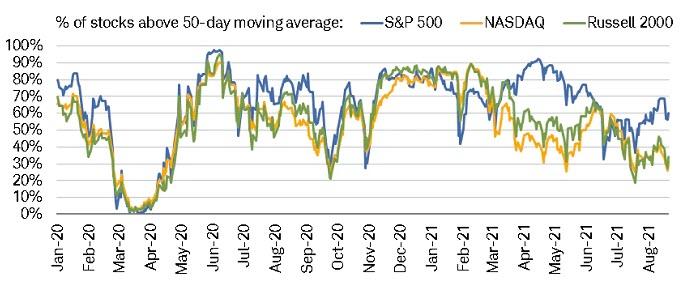
“The percentage of S&P 500 stocks trading above their 50-day moving averages peaked in April, troughed in June, improved until recently, but has come under pressure again. The same can’t be said for the NASDAQ and Russell 2000, which both peaked in early February, since which time they’ve generally been descending.”
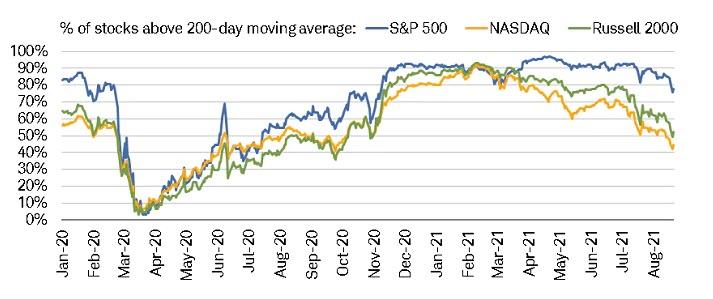
“Relative to their 200-day moving averages (DMA), all three indexes have been generally trending lower since April, as shown in the second chart below.” – Charles Schwab
Of course, as we repeat each week, while we are pointing out the warning signs, such does not mean selling everything and going to cash. However, it does serve as a visible warning to adjust your risk exposures accordingly and prepare for a potentially bumpy ride.
“Just because you put on a seatbelt when the plane is landing, doesn’t mean you are going to crash. But is a logic precaution just in case.”
Can The Fed Really Taper?
We have noted the rising number of Fed speakers discussing the need to begin “tapering” the Fed’s balance sheet purchases in recent weeks. With employment returning well into what is historically considered “full employment,” surge in job openings, and rising inflation, the need to taper is evident. As noted in our daily market commentary:
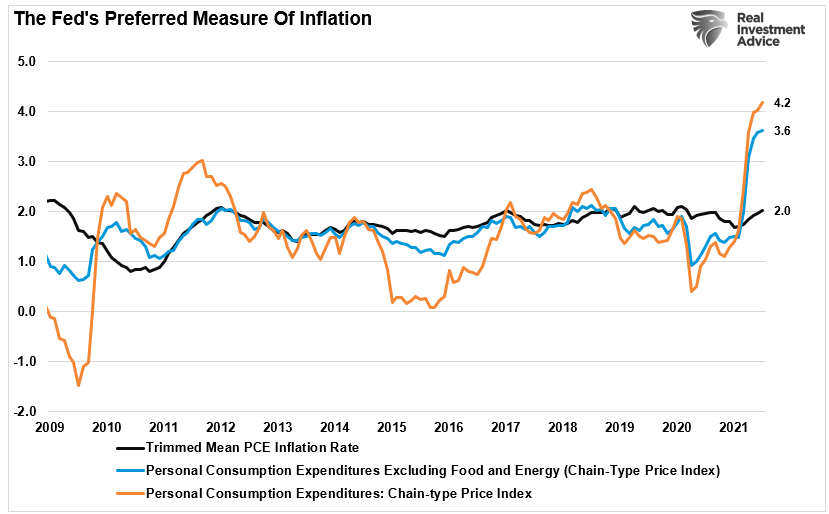
“PCE, met expectations rising 0.4% in July. The level was 0.1% below the June reading. The year-over-year rate is 4.2%, which is more than double the Fed’s 2% inflation target. Importantly it suggests the Fed should be moving to tighten monetary policy. However, the trimmed-mean PCE was inline at 2% giving the Fed some “wiggle-room” for now, but likely not for long.
While the Fed may have some wiggle room short-term, the trimmed-mean PCE will catch up with PCE over the next month.
The point is that the Fed is now getting pushed into needing to tighten monetary policy to quell inflationary pressures. However, a rising risk suggests they may be “trapped” in continuing their bond purchases and risking both an inflationary surge and creating market instability.
That risk is the “deficit.”
Who Is Going To Fund The Deficit
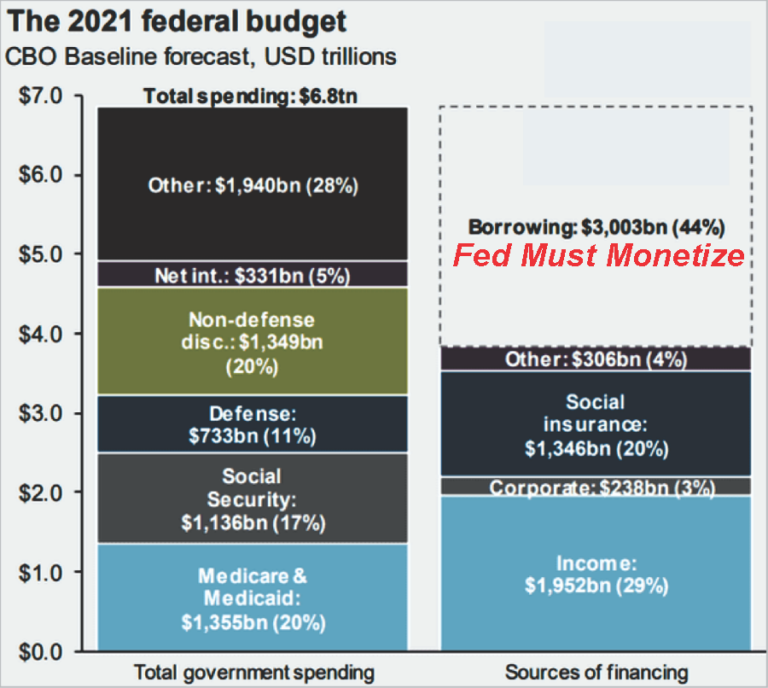
As discussed recently, the current mandatory spending of the Government consumes more than 100% of existing tax revenues. Therefore, all discretionary spending plus additional programs such as “infrastructure” and “human infrastructure” comes from debt issuance.
As shown, the 2021 budget will push the current deficit towards $4-Trillion requiring the Federal Reserve to monetize at least $1 Trillion of that issuance per our previous analysis.
The scale and scope of government spending expansion in the last year are unprecedented. Because Uncle Sam doesn’t have the money, lots of it went on the government’s credit card. The deficit and debt skyrocketed. But this is only the beginning. The Biden administration recently proposed a $6 trillion budget for fiscal 2022, two-thirds of which would be borrowed.” – Reason
The CBO (Congressional Budget Office) recently produced its long-term debt projection through 2050, ensuring poor economic returns. I reconstructed a chart from Deutsche Bank showing the US Federal Debt and Federal Reserve balance sheet. The chart uses the CBO projections through 2050.
The federal debt load will climb from $28 trillion to roughly $140 trillion at the current growth rate by 2050.
The problem, of course, is that the Fed must continue monetizing 30% of debt issuance to keep interest rates from surging and wrecking the economy.
Let than sink in for a minute.
If that is indeed the case, the Fed will not be able to “taper” their balance sheet purchases unless they are willing to risk a surge in interest rates, a collapse in economic growth, and a deflationary spiral.
As Expected Q3-GDP Gets Slashed
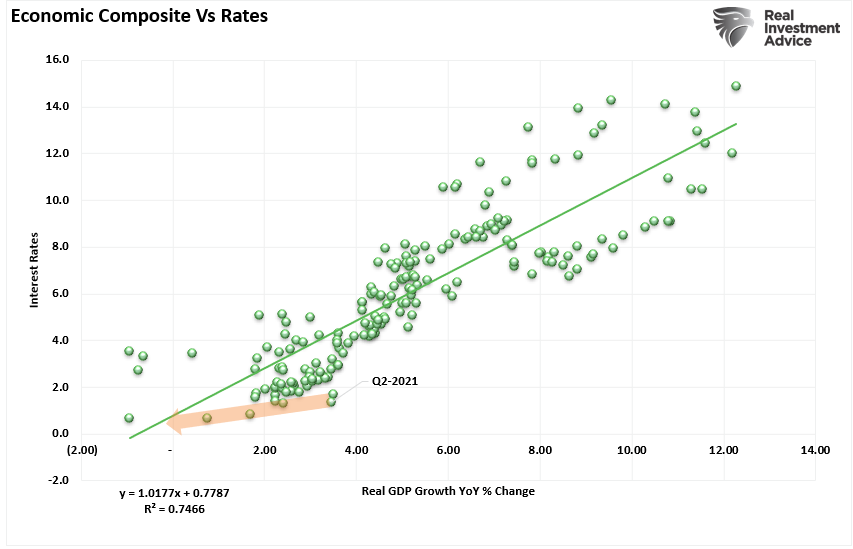
Since the beginning of this year, we have penned several articles stating that economic growth would ultimately disappoint when fueled by an artificial stimulus. Specifically, we noted that “bonds were sending an economic warning.” To wit:
As shown, the correlation between rates and the economic composite suggests that current expectations of sustained economic expansion and rising inflation are overly optimistic. At current rates, economic growth will likely very quickly rturn to sub-2% growth by 2022.”
The disappointment of economic growth is also a function of the surging debt and deficit levels, which, as noted above, will have to be entirely funded by the Federal Reserve.
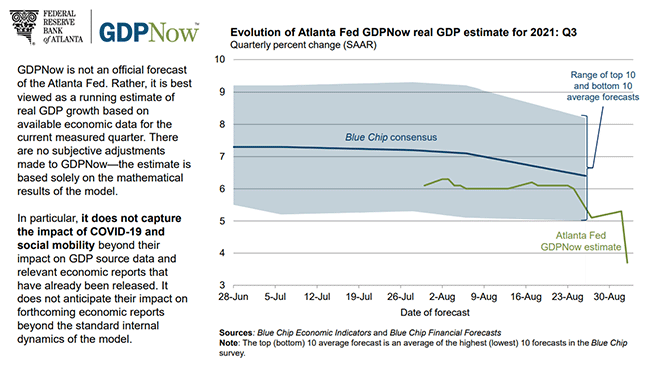
On Thursday, both the Atlanta Fed and Morgan Stanley slashed their estimates for Q3 growth as economic data continues to disappoint.
“The GDPNow model estimate for real GDP growth (seasonally adjusted annual rate) in the third quarter of 2021 is 3.7percent on September 2, down from 5.3 percent on September 1.” – Atlanta Fed
Notably, there were significant downward revisions to consumption and investment, declining from 2.6% and 23.4% to 1.9% and 19.3%, respectively. However, as we noted previously, such is not surprising as “stimulus” leaves the system, and the economic drivers return to normalcy.
Morgan and Goldman As Well
As stated, Morgan Stanely also slashed their estimates:
We are revising down 3Q GDP tracking to 2.9% from 6.5%, previously. Our forecast for 4Q GDP remains at 6.7%. The revision to 3Q implies full year 4Q/4Q GDP at 5.6% (5.7%Y) this year – 1.4pp lower than the Fed’s forecast of 7.0% in its June Summary of Economic Projections (SEP), and 0.7pp below Bloomberg consensus of economists at 6.3%.
An examination of the data reveals that the slowdown is not broad-based and primarily reflects payback from stimulus spending as well as continued supply chain bottlenecks. The swing factor is largest in spending on big-ticket durable goods that benefited most from stimulus checks and are affected most by lack of inventory and price increases due to supply shortages, for example motor vehicles.”
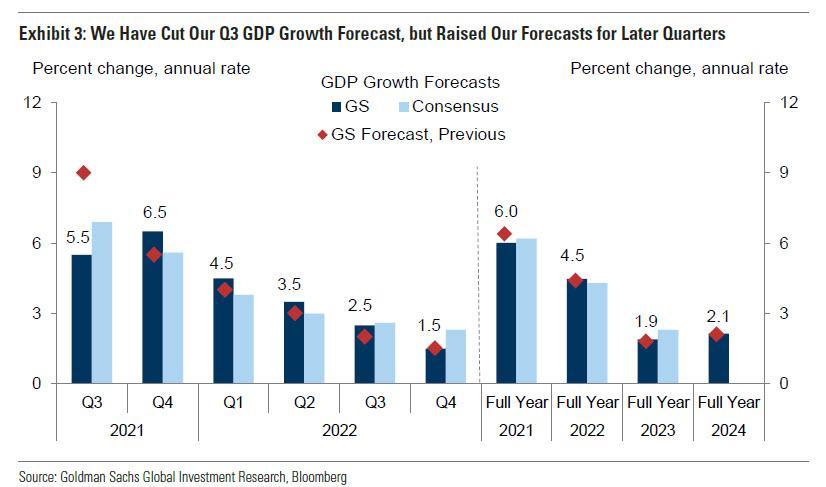
As we discussed previously, these two downgrades were playing catchup to our previous analysis and Goldman’s downgrade two weeks ago. To wit:
“We have lowered our Q3 GDP forecast to +5.5%, reflecting hits to both consumer spending and production. Spending on dining, travel, and some other services is likely to decline in August, though we expect the drop to be modest and brief. Production is still suffering from supply chain disruptions, especially in the auto industry, and this is likely to mean less inventory rebuild in Q3.” Goldman Sachs
Investors should not overlook the importance of these downgrades.
Earnings Estimates At Risk
In our post on“Peak Economic And Earnings Growth,” we stated that corporate earnings and profits ultimately get derived from economic activity (personal consumption and business investment). Therefore, it is unlikely the currently lofty expectations will get met.
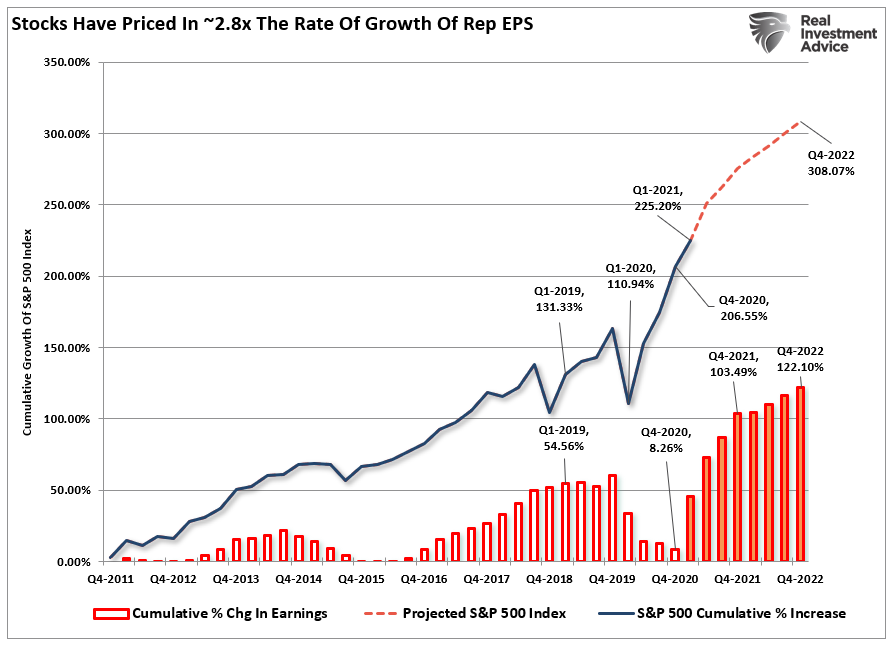
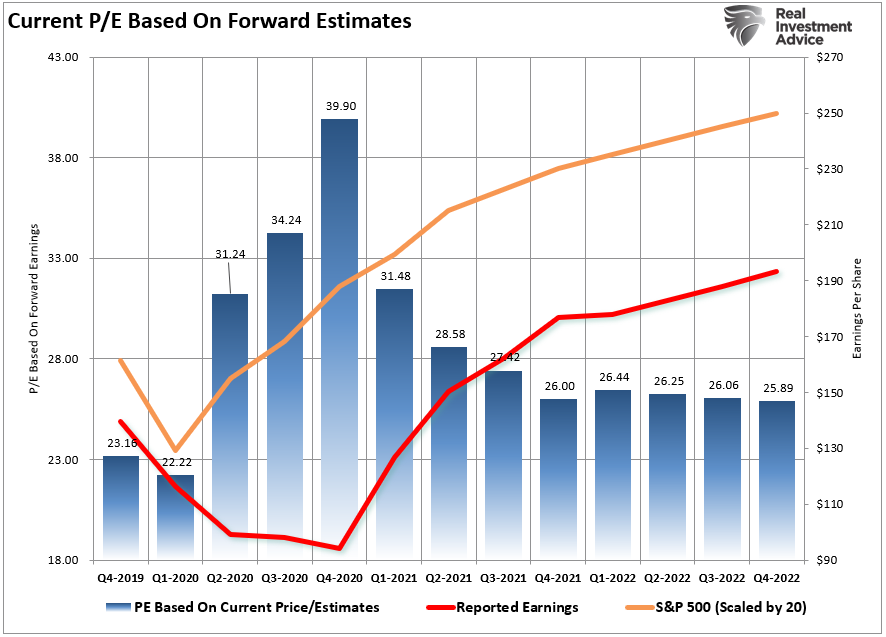
The problem for investors currently is that analysts’ assumptions are always high, and markets are trading at more extreme valuations, which leaves little room for disappointment. For example, using analyst’s price target assumptions of 4700 for 2020 and current earnings expectations, the S&P is trading 2.6x earnings growth.
Such puts the current P/E at 25.6x earnings in 2020, which is still expensive by historical measures.
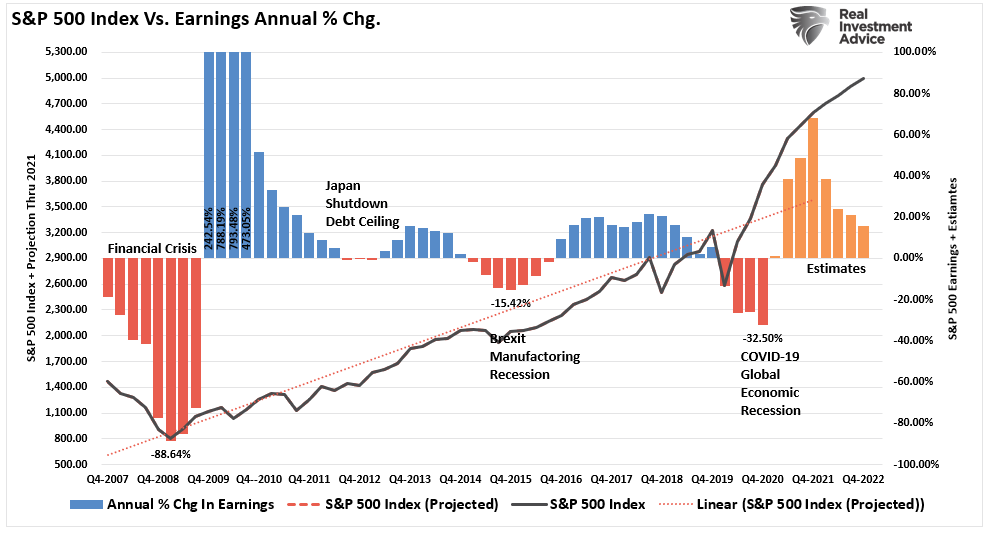
That also puts the S&P 500 grossly above its linear trend line as earnings growth begins to revert.
Through the end of this year, companies will guide down earnings estimates for a variety of reasons:
  • Economic growth won’t be as robust as anticipated.
  • Potentially higher corporate tax rates could reduce earnings.
  • The increased input costs due to the stimulus can’t get passed on to consumers.
  • Higher interest rates increasing borrowing costs which impact earnings.
  • A weaker consumer than currently expected due to reduced employment and weaker wages.
  • Global demand weakens due to a stronger dollar impacting exports.
Such will leave investors once again “overpaying” for earnings growth that fails to materialize.

(ZH) Italian Supercar Makers Look To Sidestep EU's Planned Internal Combustion E

Italian Supercar Makers Look To Sidestep EU's Planned Internal Combustion Engine Ban

Of all the auto manufacturers feeling the forced business pivot of shifting from ICE vehicles to EVs, it may not hit harder than at manufacturers who make the world's supercars.
Perhaps that's why Italy is now lobbying the EU to shield automakers like Ferrari and Lamborghini from the area's planned phase-out of combustion engines, which is set to take effect by 2035.
Roberto Cingolani, minister for ecological transition, said in an interview with Bloomberg that "in the gigantic cars market there is a niche, and there are ongoing discussions with the EU Commission" on how new rules could affect supercar makers.
Cingolani continued: “Those cars need very special technology and they need batteries for the transition. One important step is that Italy gets autonomous in producing high performance batteries and that is why we are now launching the giga-factory program to install in Italy a very large scale production facility for batteries.”
The EU announced the plan to phase out new combustion vehicles by 2035. The timeline is far tougher for supercar automakers whose entire business models revolve around advanced engineering of engines that are far more powerful than average vehicles. They sell far less units and experience fewer benefits from economies of scale.
Cingolani said: “This is something we are discussing with other partners in Europe and I am convinced there will be not be a problem.”
Ferrari sold just 9,100 cars in 2020 and Lamborghini sold about 7,400.
“This is a global policy problem. There is a clear awareness about the need of a transition toward the electric mobility. On a century scale transformation this is not a problem, ” Cingolani concluded.

WSJ : U.S. Ports See Shipping Logjams Likely Extending Far Into 2022

U.S. Ports See Shipping Logjams Likely Extending Far Into 2022
With record volumes of goods reaching the U.S., port executives expect a crush of container imports beyond the holidays

Leaders of some of the busiest U.S. ports expect congestion snarling maritime gateways to continue deep into next year, as the crush of goods from manufacturers and retailers looking to replenish depleted inventories pushes past shipping’s usual seasonal lulls.

Ports are already swamped by record numbers of containers reaching U.S. shores during this year’s peak shipping season, and the number of vessels waiting for berth space at Southern California’s gateways is growing as logjams stretch into warehouses and distribution networks across the country.

Port leaders, such as Mario Cordero, executive director at the Port of Long Beach, Calif., who have spoken with shipping lines and their cargo customers say the slowdown in container volumes that usually coincides with the Lunar New Year in February, when factories in China typically shut down, is unlikely to offer much relief.

“I don’t see substantial mitigation with regard to the congestion that the major container ports are experiencing,” Mr. Cordero said. “Many people believe it’s going to continue through the summer of 2022.”

Griff Lynch, executive director of the Georgia Ports Authority, which operates one of the nation’s largest ocean gateways at the Port of Savannah, said: “We think at least midway through 2022 or the entire 2022 could be very strong.”

Major U.S. ports were forecast to handle the equivalent of some 2.37 million imported containers in August, according to the Global Port Tracker report produced by Hackett Associates for the National Retail Federation. The figure is the most for any month in records dating to 2002, and NRF projects overall inbound volumes for the year will reach 25.9 million containers, measured in 20-foot equivalent units. That would break the record of 22 million boxes in 2020.

Ports have emerged as one of many bottlenecks in global supply chains as ships fill up with boxes carrying electronics, home furnishings, holiday decorations and other goods.


Hundreds of thousands of containers are stuck aboard container ships waiting for a berth or stacked up at terminals waiting to be moved by truck or rail to inland terminals, warehouses and distribution centers. When the boxes do move, they are often snarled at congested freight rail yards and warehouses that are full to capacity.

Bob Biesterfield, chief executive of C.H. Robinson Worldwide Inc. the largest freight broker in North America, said shortages of truck drivers and warehouse workers are making shipping delays worse as the need to replenish inventories is at an all-time high. “I don’t think that’s something that just gets fixed in the next four to five months in accordance with the Lunar New Year,” he said.

The congestion has contributed to a world-wide shortage of shipping containers and to spiraling costs for ocean freight. The logjam prompted the Biden administration to appoint a ports envoy last month to address how to improve cargo movement following complaints from U.S. businesses facing inventory shortages, shipping delays and rising costs.

Congestion has been worst at the neighboring ports of Los Angeles and Long Beach, which account for more than a third of all U.S. seaborne imports. Forty or more ships have been waiting at anchor off the coast there on any given day in recent weeks, according to the Marine Exchange of Southern California, a pandemic-era record. Before the pandemic, a single ship at anchor was unusual.

Gene Seroka, executive director of the Port of Los Angeles, said the oceanside congestion could worsen as the peak holiday-shipping season continues. The port has broken container-handling records for 13 consecutive months. Mr. Seroka said terminals expect to handle 35% more inbound containers the week beginning Sep. 5 and 80% more inbound containers the following week compared with the same periods last year.

The surge is being driven by Americans shifting their spending away from services, such as restaurants and vacations, to home improvements, office equipment and other consumer goods. Port leaders say importers are also stocking up on additional inventory after the shortcomings of just-in-time supply chains were exposed in the early weeks of the pandemic.

Sam Ruda, port director at the Port Authority of New York and New Jersey, said the logjams may only break when the Covid-19 pandemic winds down. “That’s really what will inform the duration of what we are seeing on the ground today,” he said.