Early premarket gappers
- Gapping up:
- VSTM +27.9%, MRTX +13.7%, VXX +5.8%, SPPI +4.9%, SRNE +4%, AZN +2.4%, GLD +0.5%, SLV +0.4%
- Gapping down:
- LI -3.7%, JD -3.6%, FXI -3.1%, BABA -2.9%, ASHR -2.3%, USO -2.2%, IWM -1.9%, BIDU -1.8%, DIA -1.5%, SPY -1.2%, QQQ -0.9%

>>> Up
* Belimo Raised to Buy at Berenberg; PT 645 Swiss francs
* Colgate-Palmolive Raised to Buy at Deutsche Bank; PT $86
* Elkem Raised to Buy at SpareBank; PT 44 kroner
* Equinor Raised to Reduce at AlphaValue/Baader
* Kion Raised to Buy at Hauck & Aufhaeuser; PT 101 euros (+)
* Rockwool Raised to Hold at SocGen; PT 3,450 kroner
* Sika Raised to Buy at SocGen; PT 410 Swiss francs
* Tryg Raised to Neutral at Credit Suisse; PT 145 kroner (+)
* Visteon Raised to Buy at Jefferies; PT $116
>>> Down
* Anglo American Cut to Equal-Weight at Barclays; PT 2,700 pence
* ASMI Cut to Equal-Weight at Barclays; PT 370 euros
* Autoliv Cut to Hold at Handelsbanken; PT $90
* BHP Group PLC Cut to Hold at Berenberg; PT 2,300 pence
* BorgWarner Cut to Hold at Jefferies; PT $47
* Generali Cut to Market Perform at KBW; PT 18.50 euros
* HeidelbergCement Cut to Underweight at JPMorgan; PT 70 euros
* Holcim Cut to Neutral at JPMorgan; PT 57 Swiss francs
* Lear Cut to Hold at Jefferies; PT $171
* Maersk Cut to Hold at Berenberg; PT 22,000 kroner
* Naked Wines Cut to Sell at Liberum; PT 750 pence
* Novartis Cut to Sell at Deutsche Bank; PT 70 Swiss francs
* Stabilus Cut to Hold at Hauck & Aufhaeuser; PT 63 euros (+)
* Veoneer Cut to Hold at Handelsbanken; PT $37
>>> Initiation
* Cellnex Rated New Outperform at RBC; PT 65 euros
* Vitesco Technologies Group Rated New Neutral at JPMorgan (+)
* Water Intelligence Rated New Outperform at RBC; PT 1,500 pence
>>> Call
* Anglo American Cut at Barclays With ‘Turbulence’ Seen Ahead (+)
* Belimo Gets Only Buy as Berenberg Upgrades ‘Structural Winner’
* BHP Cut to Hold With Limited Catalysts Seen Ahead: Berenberg
* Cellnex Started at Outperform by RBC on Growth Opportunities
* Holcim, HeidelbergCement Cut at JPMorgan on Soaring Energy Costs
* Maersk Cut at Berenberg on Risk of Peaking Container Rates
* Naked Wines Cut to Sell, Discounting Limits Profit: Liberum
* Novartis Down to Sell on More Challenging Outlook: Deutsche Bank
SoftBank and Tencent invest in Indian used-vehicle platform Cars24
Funding round doubles valuation of online car retailer to $2bn in less than a year
SoftBank’s Vision Fund and Tencent are among the international funds investing $450m in Indian online used-vehicle seller Cars24 as the global chip shortage forces manufacturers to cut production of new vehicles in one of the world’s largest markets.
Yuri Milner’s DST Global and the US’s Falcon Edge are also investing in a round that values the six-year-old company at almost $2bn, doubling its valuation in less than a year.
The market for new cars in India, the world’s fifth-largest, has been roiled by production issues during the pandemic. Investors say this is creating opportunities for second-hand vehicles, particularly the relatively young online market. Cars24 is India’s largest website for used vehicles.
Maruti Suzuki, India’s largest carmaker, reported an almost 20 per cent drop in car sales in August after it cut output because of a parts shortage, while other companies are reporting lengthy delays for new vehicles.
“The world over we’re seeing the same thing happening with pre-owned cars,” Vikram Chopra, chief executive and co-founder of Cars24, told the Financial Times. “We have seen a significant rise in the consumer readiness to buy and sell cars online. We believe that’s how it will be in times to come. It’s clearly accelerated.”
Individuals including DoorDash chief executive Tony Xu and US hedge fund billionaire Dan Och are investing in the round. Ritesh Agarwal and Yashish Dahiya, chief executives of SoftBank-backed Indian companies Oyo and Policybazaar respectively, are also participating.
SoftBank has invested in a number of online used-car vendors around the world, including China’s Chehaoduo, Mexico’s Kavak and Carro in south-east Asia.
It is the latest in a record-breaking year of fundraising for Indian start-ups, as deep-pocketed venture capitalists and foreign investors pour funds into young companies doing business online. Indian start-ups raised a record $7.2bn in the quarter that ended in June, according to data provider Tracxn.
It is a trend that has been bolstered by a regulatory crackdown on technology companies in neighbouring China, with the uncertainty prompting international investors to scout for more opportunities in India. They hope that rising incomes and internet usage among the 1.4bn population will make it one of their most lucrative markets for years to come.
“There is significantly more interest than what I have seen in the last four or five years combined,” Chopra said, adding that investor demand to participate in the round outstripped supply by three times. “These guys are big believers in the fact that cars [will] get sold online.”
Tencent is participating through a European entity. Tough restrictions on foreign direct investment from China introduced amid geopolitical tension with India last year killed off much Chinese investor activity. But Tencent has become increasingly active in recent months, including through debt deals.
Brookfield makes $7bn takeover bid for Australian energy group AusNet
Canadian asset manager’s unsolicited offer follows series of infrastructure deals in the country
Brookfield Asset Management, the alternative Canadian asset manager, has made a A$9.6bn (US$7bn) takeover offer for Australian energy group AusNet Services, as global investment groups continued their sweep of the country’s infrastructure.
AusNet said on Monday it had received an unsolicited bid of A$2.50 a share, representing a 26 per cent premium on its closing price on Friday. The sweetened overture followed two previous proposals in August of A$2.35 and A$2.45 a share.
The deal would see Brookfield purchase AusNet in its entirety, buying out its two biggest shareholders, state-backed groups Singapore Power and China State Grid.
AusNet, which runs the electrical transmission network in the state of Victoria, said it would allow Brookfield to conduct due diligence on an exclusive basis, and that it considered the deal to be “in the best interests” of its shareholders and would recommend it unanimously.
AusNet’s Sydney-listed shares rose 20 per cent on Monday.
Global investment groups have made a series of bids for Australian infrastructure in recent months, with acquisition attempts for the country’s motorways, power networks and airports totalling at least $36bn, according to data from Dealogic.
A consortium led by US private equity group KKR struck a $3.7bn deal in August to buy Spark Infrastructure, which owns stakes in power networks in Victoria and South Australia, while the board of Sydney’s airport accepted a bid this month from Melbourne-based IFM investors.
The proposed AusNet takeover would also end a Chinese state-backed investment in a big Australian infrastructure group at a time of heightened tensions between the countries over trade and investment.
Any deal would be subject to a shareholder vote, which means it would have to be approved by at least one of the main shareholders, Singapore Power and China State Grid, which hold 32.2 per cent and 19.9 per cent stakes, respectively.
AusNet said it had related the terms of the bid to the two companies, but noted there was “no certainty” that granting Brookfield access would result in a deal, which would also be subject to approval from Australia’s Foreign Investment Review Board.
The energy company said in a statement that it had an asset base of more than A$11bn “as the owner and operator of 100 per cent of its assets”, and it was “uniquely positioned for growth” as Australia transitions to lower carbon energy sources.
Brookfield declined to comment while the deal was pending. AusNet did not provide further comment for the same reason.
AusNet’s financial advisers are Adara Partners and Citigroup, and its legal advisers is Allens.
The US Desperately Needs To Rethink Its Middle East Strategy

Is the Middle East still important?

This is a seemingly absurd question, yet some are asking this in Washington. The Middle East is the source of massive reserves in oil and gas. Much of the fuel to produce goods and trade from Asia and the EU comes from the Middle East. Much of the world economy relies on Middle East energy. The region has strategic chokepoints like the Strait of Hormuz, The Suez Canal, and The Bab al Mandab. It is a source of some of the more significant threats in the world, such as from ISIS, Al Qaeda, and other groups. It contains some of the most important security connections in the world. Consider the neighbors of the Middle East and not just the Middle East. The Middle East is a crossroads for energy and security. It also could be one of the generators of change and improvement, if it is allowed and supported to do so.
However, as the U.S. becomes more focused on “The Great Powers Conflict” in Asia, especially with China, it is becoming clearer that the U.S. is losing the plot in the Middle East.
Consider the slow to no reaction to the shipping of Iranian fuel with the help of Hezbollah and Syria to Lebanon.
The U.S. could have done many different things to help the Lebanese with this without handing a massive public relations and political victory to its adversaries. But, in some ways, Washington’s sanctions have painted it into a corner on such issues. Consider how the U.S. took the anti-missile batteries from Saudi Arabia as the Houthis are still attacking Saudi Arabia with missiles. The Saudis made a deal with the Russians in response to this and other moves by the U.S. The U.S. handed leverage to the Russians. These are just two of many examples of how the plot is being lost.
The U.S. could have done many different things to help the Lebanese with this without handing a massive public relations and political victory to its adversaries. But, in some ways, Washington’s sanctions have painted it into a corner on such issues. Consider how the U.S. took the anti-missile batteries from Saudi Arabia as the Houthis are still attacking Saudi Arabia with missiles. The Saudis made a deal with the Russians in response to this and other moves by the U.S. The U.S. handed leverage to the Russians. These are just two of many examples of how the plot is being lost.
Indeed, China is a threat in the Pacific to Taiwan and others. It is a threat to the freedom of navigation in the Western Pacific. It is an economic and technological threat to the US and has been for a very long time. It is a cyber threat to the US. It is developing leverage in many countries with its Belt and Road Initiative. It is now the largest trading partner with almost all Middle East countries. It is building significant diplomatic, economic, and even military leverage in the Middle East. China is moving into the region as the U.S. moves in other directions. By the way, it is getting more likely that China could have a piece of the nuclear power pie in Saudi Arabia.
Russia has also been creating greater leverage in the region. Its recent big defense deals with Saudi Arabia are just one example. The U.S. basically opened the door to them. Similar things happened when the U.S. cut back on defense aid to Egypt a few years back. The Egyptians were in Moscow in quick order to make defense and other deals. Russian advisors are back in Egypt. The Russians are building a huge nuclear power complex on the north coast of Egypt. There is no doubt that the Russians have far more clout and leverage in the region than before. Much of this is due to missteps by the U.S. or simply U.S. neglect of this vital region.
The U.S. should be in the running on nuclear power plant exports and other crucial leverage-giving exports in the region. We could export small modular rectors to the region. These have much lower proliferation and safety risks than older, larger plants. We could further develop the safety of this trade by applying 123 agreements as we did in the UAE. The UAE has the gold standard nuclear power agreement with the US even though the plants were built by a Korean company.
Why am I mentioning nuclear power plants? Because whoever exports a nuclear power plant to another country can develop 80 to 100 years of leverage and clout in that country. Nuclear power plant exports are dominated by Russia with China second. The U.S. is not even in the running.
We have seen above some examples of how the Russians and Chinese are building leverage and clout in the region. If the U.S. wants to turn more to the “Great Powers Conflict”? Then it should realize that the “Great Powers Conflict” is not just in Asia, but also in the Middle East (and Asia begins in the Sinai). The Middle East is a contested space.
One cannot win a backgammon and chess game by letting the other sides, one’s adversaries, make clever moves while we do not have good counter moves and we do not think many moves ahead.
The U.S. seems to be losing the plot of the 4D chess game in the Middle East. It is not too late to rethink strategies. The U.S. needs to be in the game for the long run and think in the long run. The U.S. needs to regain the plot in the region and how it connects with the big pictures in geopolitics, geo-economics, energy, security, and much more. It is not too late.
Hong Kong Stocks Crash, Futures Slide As Markets Finally Freak Out About Evergrande Default Contagion
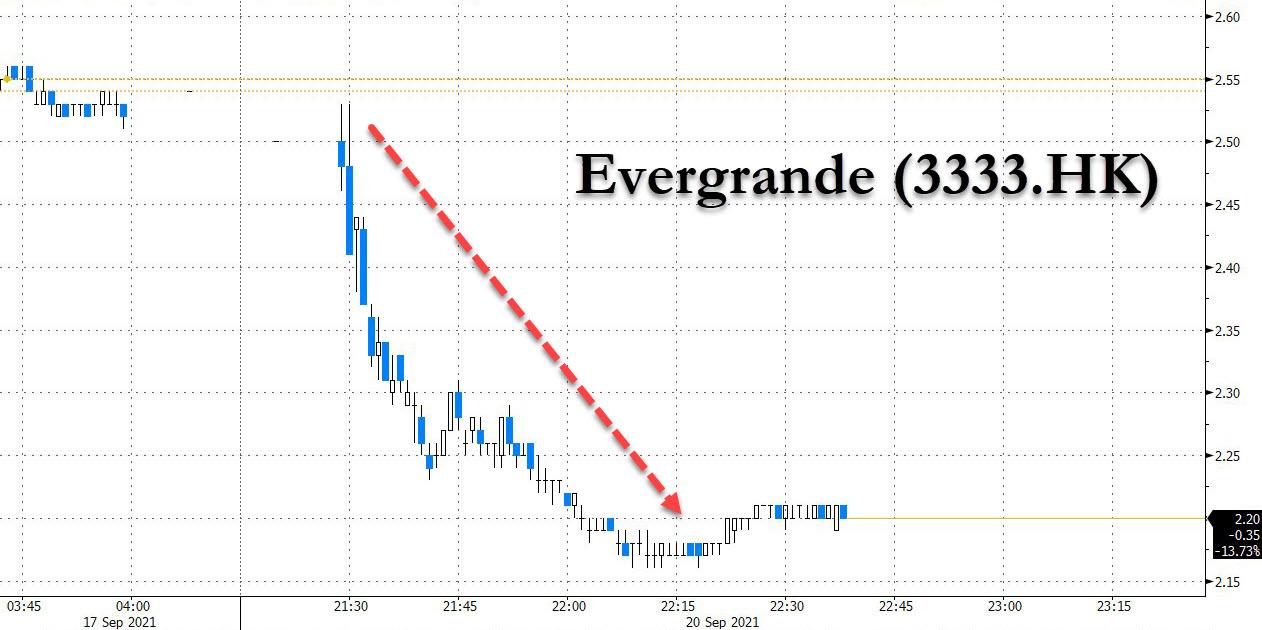
Well, as we warned, the Evergrande contagion has finally arrived and with China closed for holiday traders are getting out while they can and where they can, and on Monday morning in Asia that means Hong Kong, where Evergrande - which is about to default - has crashed by another 13% this morning and is on track to close at its lowest market cap ever (to be expected ahead of a bankruptcy that will wipe out the equity)...
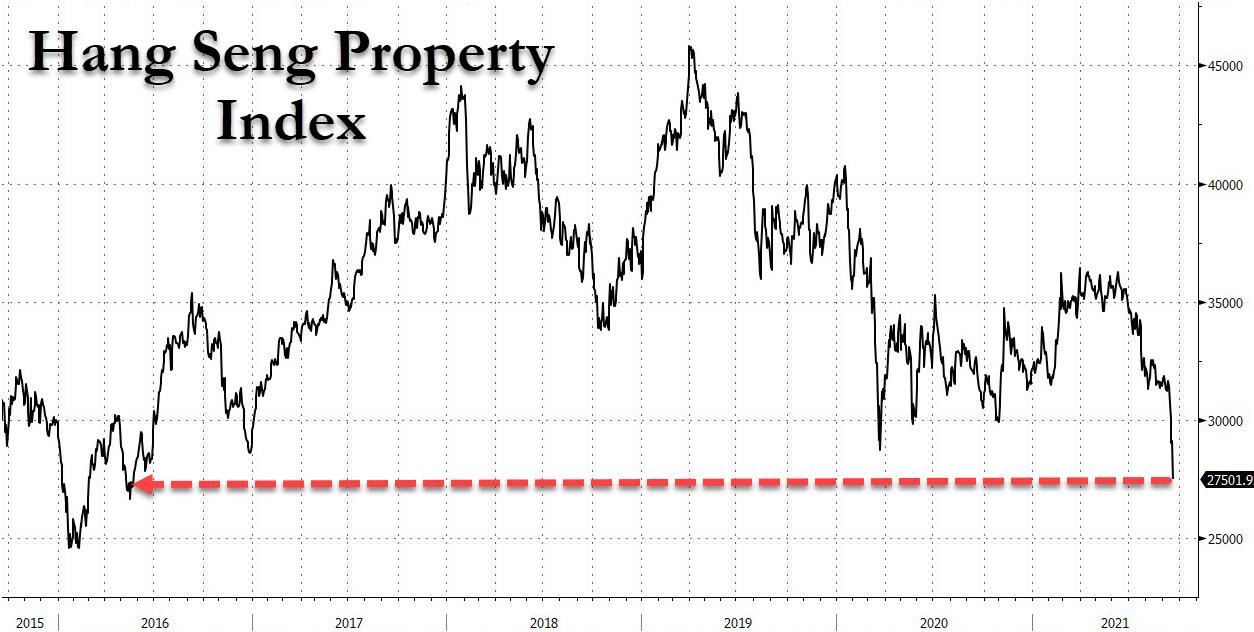
... and with Evergrande property development peers such as New World Development & Sun Kung Kai Properties both down over 8%, and Sunac China and CK Asset plunging over 7%, the Hang Seng property index has crashed more than 6%, its biggest drop since 2020 to the lowest level since 2016...
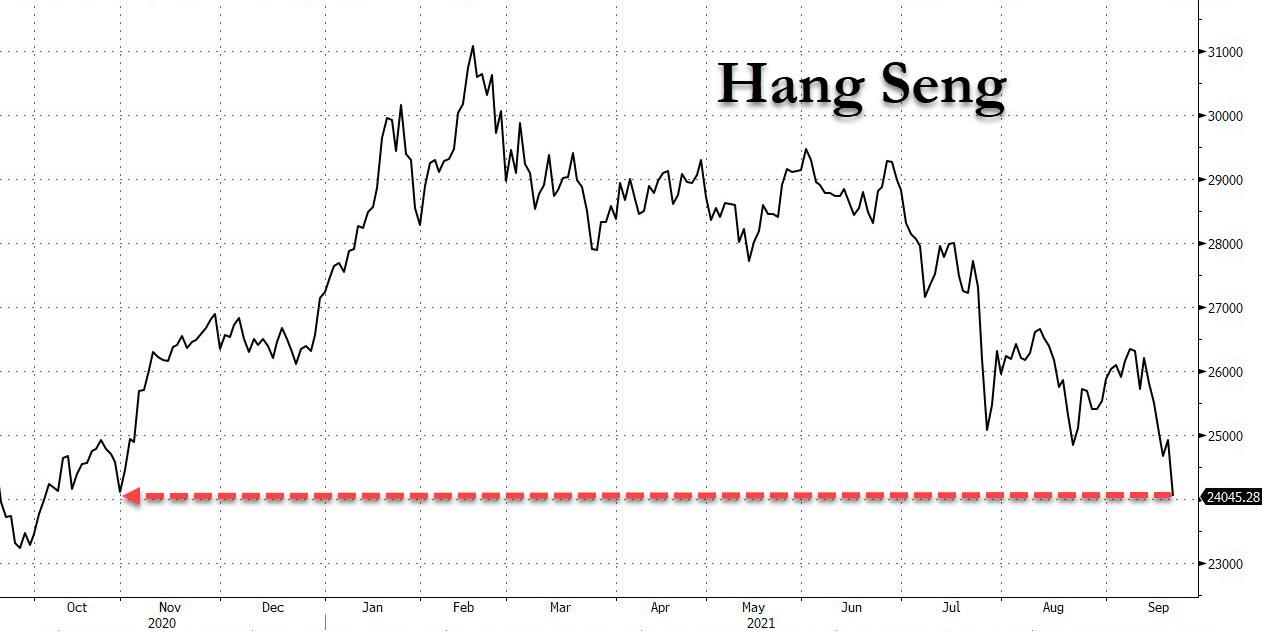
... and the broader Hang Seng index is down 3.5% in early trading, to the lowest level since November 2020.
And with traders on edge about the rapidly spreading contagion (as we described earlier) even sectors supposedly immune to China's property woes, such as the Hang Seng Tech Index are plunging, sliding as much as 2.7%.
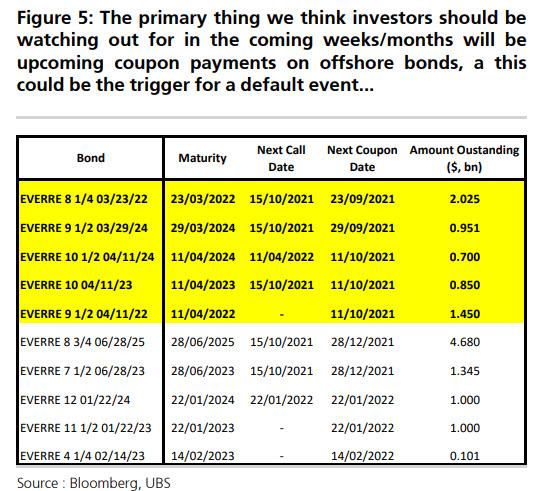
And speaking of Evergrande's imminent default, we noted earlier that while the company is scheduled to pay $83.5 million of interest on Sept. 23 for its offshore March 2022 bond, and then has another $47.5 million interest payment due on Sept. 29 for March 2024, the day of reckoning may come as soon as Tuesday: that's because Evergrande is scheduled to pay interest on bank loans Monday, with a one-day grace period. In other words, should it fail to arrange an extension, it could be in technical default as soon as Tuesday (for a much more detailed analysis of next steps please see "This Is How Contagion From Evergrande's Default Will Spread To The Rest Of The World".) Spoiler alert: a default is coming because Chinese authorities have already told major lenders not to expect repayment.
Incidentally, as Bloomberg's Mark Cranfield notes, Hong Kong stocks can't blame low liquidity for the meltdown as "trading volumes on the Hang Seng and H shares indexes are running well above the 10-day average on Monday as both drop by ~4%."
There's more: junk-rated Chinese dollar bonds slid by as much as 2 cents, according to credit traders, pushing their yield to just shy of 15%, the highest since 2011.
Other sectors are also getting hammered, such as Ping An Insurance, China’s largest insurer by market value, which plunged 7.3% in Hong Kong.
“Investors may be concerned about highly-geared names and don’t care about valuation nowadays,” said Philip Tse, head of Hong Kong & China Property Research at Bocom International Holdings Co Ltd. “There will be further downside” unless the government gives a clear signal on Evergrande or eases up on its clampdown on the real estate sector, Tse said.
Meanwhile, pouring gasoline on the fire, Goldman's China anlyst Hui Shan published a note (available for professional subs in the usual place) on Sunday in which it discussed the rising risks from the property market, writing that even without the Evergrande debacle "housing activity fell sharply in July and weakened further in August" largely in response to China's structural reforms in the property sector (such as the "3 Red Lines"). At the same time, "concerns over Evergrande are rising and signs of financing difficulties spreading to other developers are emerging."
In the note, Goldman also estimates the potential impact of the coming property market crash on Chinese growth under different scenarios, which can be described as bad, worse, and terrible, with the bank expecting a GDP hit anywhere from just over 1% to as much as 4.0%. Needless to say, such an outcome would be devastating not only for China but for the world.
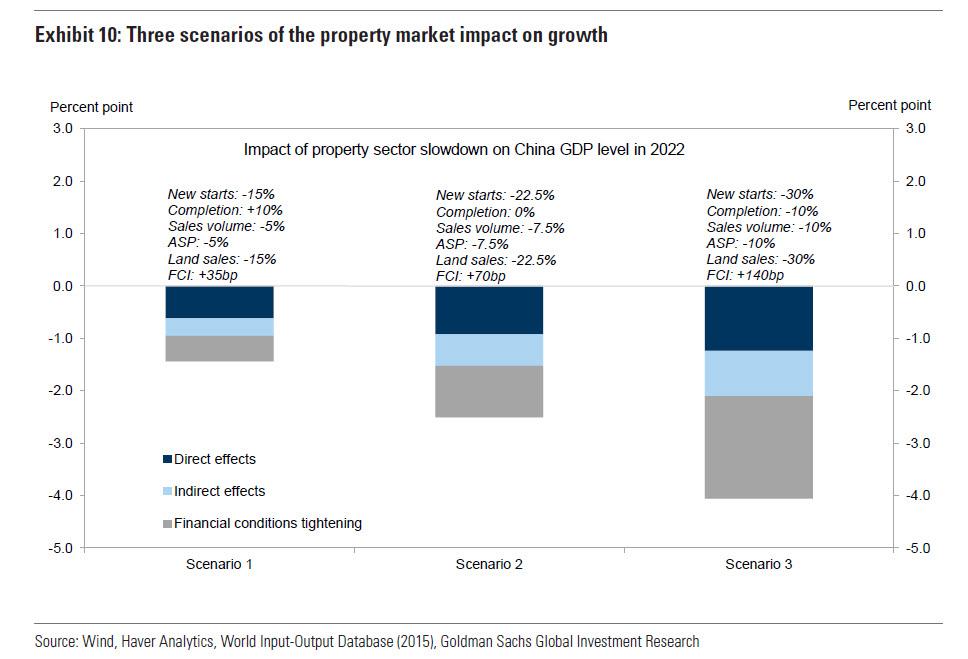
Looking ahead, Goldman notes that while for now, its baseline remains that any potential default or restructuring of Evergrande would be carefully managed by the government with limited contagion effect in both financial and property markets "this would require a clear message from the government soon to shore up confidence and to stop the spillover effect, the absence of which we think poses notable downside risk to growth in Q4 and next year."
In short, as we explained previously, it all depends on Beijing whether the current selloff accelerates, or if we see a furious surge as Beijing directly or indirectly injects another cool trillion or 10.
Meanwhile, as Bloomberg's bloggers write echoing what we said yesterday while traders may have been hoping there would be some clarity on the road ahead for the company, given it has bond payments due this week, "the complexity of the case may be the reason for a lack of communication from the authorities. That compounds the uncertainty for investors, and with China on holiday, the momentum for lower Hong Kong stocks are picking up pace."
So while contagion is clearly hammering Hong Kong in lieu of the shuttered China, it is also spreading to Australia where the Aussie dollar is mining stocks have slumped as iron ore prices continue to collapse, with the industry group falling 4%. Among the biggest movers, Champion Iron fell as much as 12.5% in early trade Monday, continuing a four-day losing streak while Fortescue Metals dipped as much as 7%, falling to the lowest price since July last year.
Contagion has also moved beyond merely stocks, with US equity futures trading as low as 4380..
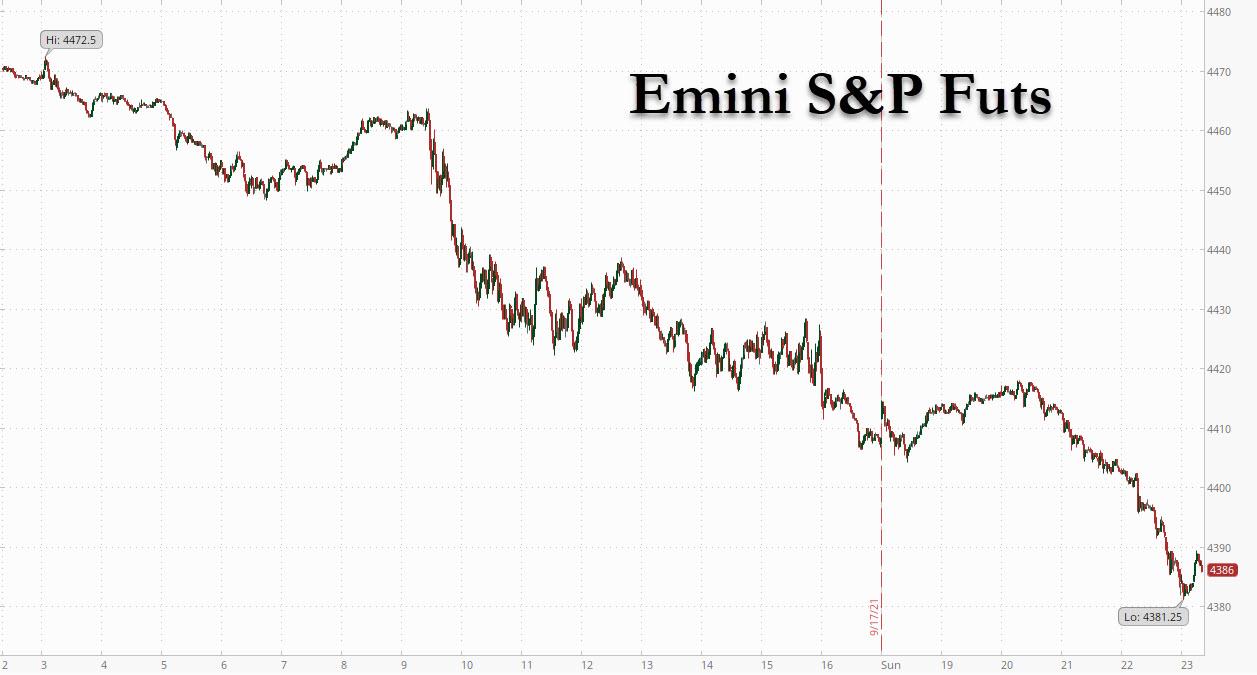
... and is starting to impact both commodities, with Iron Ore tumbling more than 10% on fears a Chinese property crisis will lead to collapsed demand for steel, as well as FX, with the dismal mood lifting USD/HKD to the highest for September, and while USD/CNH is firmer, but for now, that is in line with broad dollar strength. Should EUR/CNH start trending higher, Bloomberg notes, "that would be a signal traders have become anxious about the health of the yuan amid the equities slump."
Incidentally, it is hardly a secret that the bigger the market crash, the more likely Beijing is to do something to bail out the market and tens of millions of very angry Chinese investors who may soon show Nancy Pelosi what an insurrection really looks like. But should the silence out of Beijing persist, it's only a matter of time before the "anxiety" hits levels not seen since Sept 2008 as an outcome most traders thought impossible becomes inevitable.