Closing Stock Market SummaryThe S&P 500 fell 0.9% on Friday, as investors digested some negative-sounding headlines and hedged for further weakness. The Nasdaq Composite declined 0.9%, and the Dow Jones Industrial Average declined 0.5%. The Russell 2000, however, increased 0.2% amid the quadruple witching-options expiration activity into the close.
Ten of the 11 S&P 500 sectors closed lower, with the materials (-2.1%), information technology (-1.5%), utilities (-1.6%), communication services (-1.3%), and industrials (-1.1%) sectors losing more than 1.0%. The health care sector (+0.1%) was saved by Thermo Fisher (TMO 596.80, +36.36, +6.5%), which provided upbeat FY22 EPS guidance.
Risk sentiment seemed to be partially influenced by news that President Biden was unable to get Senator Manchin (D-WV) on board with the $3.5 trillion infrastructure plan, a warning from the White House that not increasing the debt limit could cause a recession, and the FDA advisory committee voting against Pfizer's (PFE 43.88, -0.59, -1.3%) COVID-19 booster vaccine for people 16 and older.
While none of the news was viewed as surprising, they presumably reminded investors about some of the growth-oriented headwinds the market is facing. The S&P 500 breached support at its 50-day moving average (4436) on a closing basis.
The tech sector weighed on the market amid weakness in its top-weighted components and the semiconductor stocks. BofA Securities downgraded both Cree (CREE 85.70, -2.60, -2.9%) and Cirrus Logic (CRUS 84.73, -3.45, -3.9%) to Underperform from Neutral. The Philadelphia Semiconductor Index declined 1.5%.
Separately, the consumer sentiment report showed a smaller-than-expected gain following last month's shocking decline. The preliminary September reading for the University of Michigan Index of Consumer Sentiment increased to 71.0 (Briefing.com consensus 72.0) from 70.3 in August.
The negative backdrop seemed to provoke some cash-raising efforts. The U.S. Dollar Index rose 0.3% to 93.21 while the 10-yr yield increased four basis points to 1.37% amid increased selling interest. The CBOE Volatility Index (20.81, +2.12, +11.3%) closed above the 20.00 level.
The 2-yr yield was unchanged at 0.23%. WTI crude futures decreased 1.0%, or $0.70, to $71.92/bbl.
Reviewing Friday's economic data:
- The preliminary September reading for the University of Michigan Index of Consumer Sentiment increased to 71.0 (consensus 72.0) from the final reading of 70.3 for August.
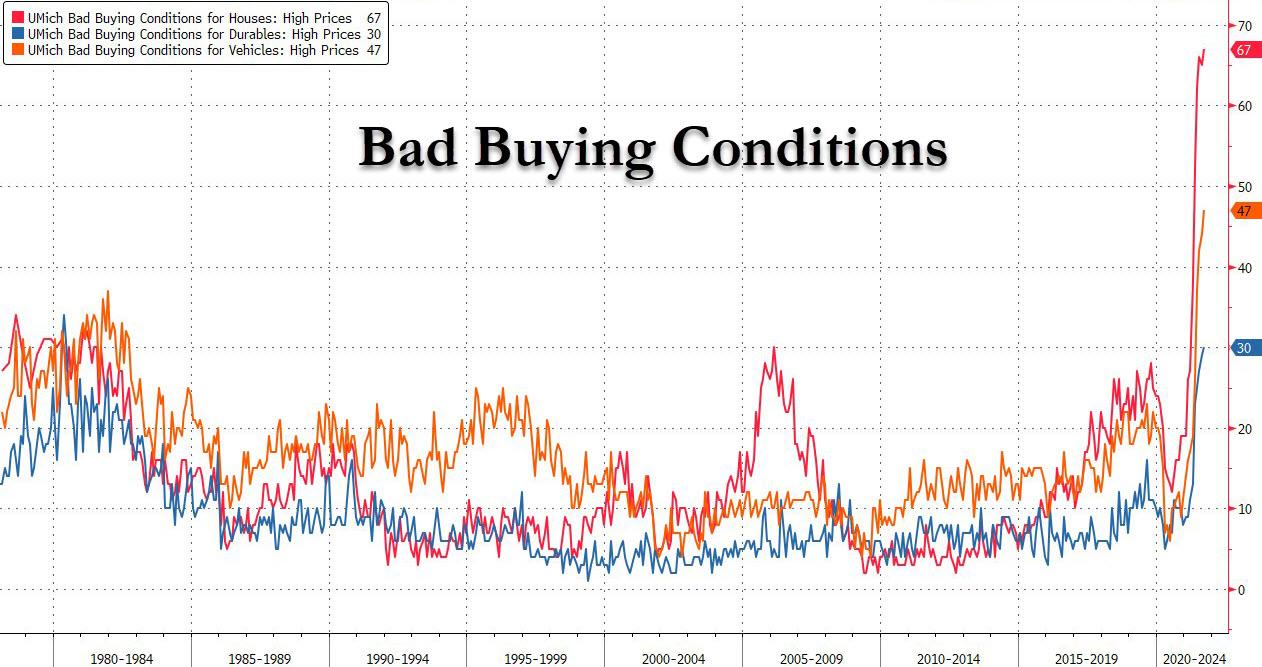
- The key takeaway from the report is the recognition that high prices have led to a decline in assessments of buying conditions for homes, vehicles, and household durables. That could lead to slower spending activity in the future if consumers hold off on purchases either because they think prices will come down if they wait longer or if they resist paying persistently high prices altogether in the absence of offsetting income gains.
Looking ahead, investors will receive the NAHB Housing Market Index for September on Monday.
- S&P 500 +18.0% YTD
- Nasdaq Composite +16.7% YTD
- Dow Jones Industrial Average +16.0% YTD
- Russell 2000 +13.3% YTD
Ex-Mylan Executive Pleads Guilty Over Insider-Trading Allegations
Dayakar Mallu received illicit tips on drug approvals, earnings and merger
WASHINGTON—A former technology executive of generic drugmaker Mylan NV pleaded guilty Friday to allegations that he illicitly traded in the company’s securities using tips from another company insider.
Dayakar Mallu, a former vice president of global operations information technology, earned $4.2 million by trading on lucrative information from Mylan’s former chief information officer, who was his boss at the company, according to a charging document filed in federal court in Pennsylvania. Mylan merged with Pfizer Inc.’s Upjohn business last year to form a new company, Viatris Inc.
Mylan’s former chief information officer, who wasn’t named in court records, shared with Mr. Mallu undisclosed news about drug approvals, quarterly earnings announcements and Mylan’s plans to merge with Upjohn, according to the Securities and Exchange Commission, which also sued Mr. Mallu in federal civil court.
Mr. Mallu, 51 years old, traded options to profit on the tips and shared income with the former chief information officer, the SEC said. He tried to conceal the payments by making them overseas in Indian rupees, according to authorities. The two swapped information using messaging apps that were supposed to keep their communications secret, according to the SEC.
Mr. Mallu pleaded guilty to one count of conspiracy to commit securities fraud and one count of filing a false tax return. He is scheduled to be sentenced in January and faces a maximum prison term of 25 years for the conspiracy offense and three years for the tax charge, according to the Justice Department. An attorney for Mr. Mallu, who left Mylan in 2017, declined to comment.
The SEC said its investigation is continuing. For years the regulator has refined its ability to use technology to identify suspiciously well-timed trades in market data. Regulators maintain several databases that allow them to pick out trades and even identify groups of traders who might be involved in a scheme.
“This case highlights the agency’s ability to use sophisticated data analysis to detect suspicious trading patterns and identify the traders behind them,” said Scott Thompson, acting co-regional director of the SEC’s Philadelphia office.
Harbin, We Have A Problem: Chinese Junk Bond Yields Hit 11 Year High
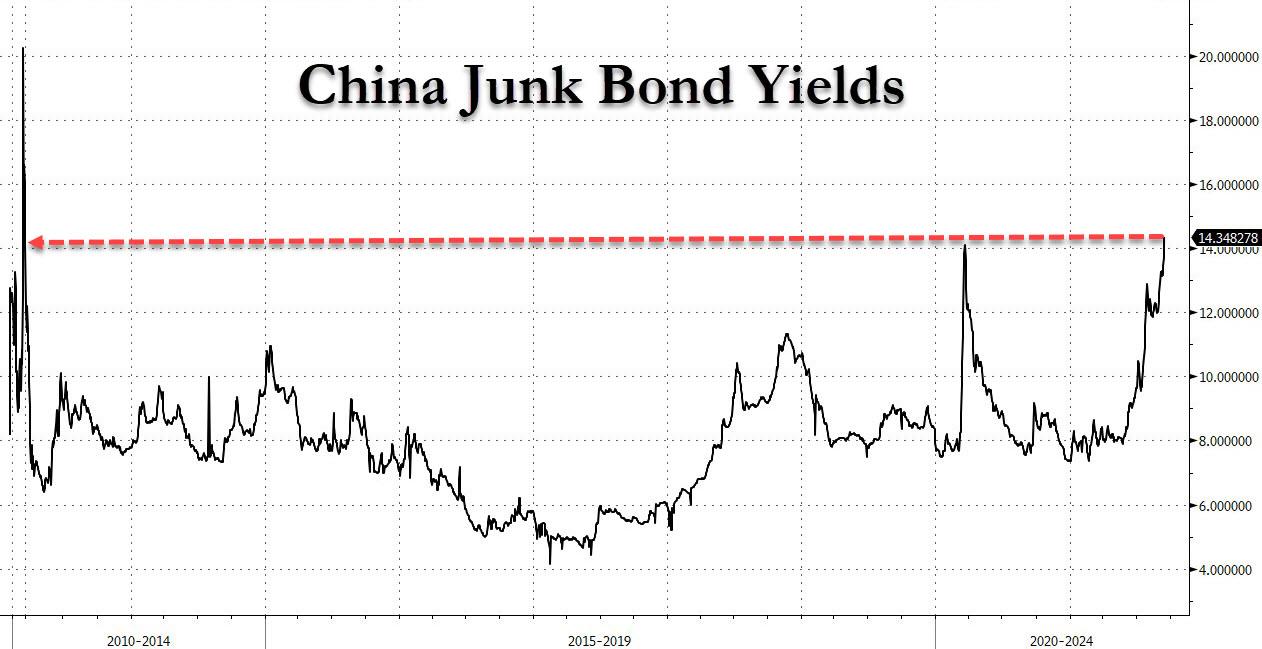
Back in March 2020, when China's junk bond yields doubled effectively overnight from 7% to 14%, the catalyst was the unprecedented lockdown of China's economy in response to the covid pandemic, which credit investors speculated could lead to a tidal wave of defaults but Beijing's aggressive response which culminated with trillions in new debt injected into the economy, ended up being a tempest in a teapot and over the next few months, China's junk bond yields gradually faded back to normal.
Fast forward to today when after weeks of tentatively creeping higher, China's junk bond yields not just surged higher overnight, but have just surpassed the 2020 highs, printing 14.34% overnight, and the highest level since the great repo rate crisis of 2011.
Well, in a word - and the only word that matters - it's Evergrande, and while contagion is clearly present (finally, as investors realize that the $300 billion creditor is about to default) it really is mostly Evergrande. Consider the following stunning facts:
Evergrande is the largest high-yield dollar bond issuer in China, accounting for 16% of outstanding notes, according to Bank of America. Should the company collapse, that alone would push the default rate on the country’s junk dollar bond market to 14% from 3%.
It's not just the dollar bond market: the stakes are even higher on the mainland, where as Bloomberg calculates, the yuan-denominated credit market is about 15 times the size at $12 trillion. While Evergrande is less of a whale onshore, a collapse would force banks to cut their holdings of corporate notes and even freeze money markets, the plumbing of China’s financial system. We are already seeing signs of that with China's 7-day repo rate which spiked to the highest since June, forcing the PBOC to inject the most liquidity, some 90BN yuan, overnight - the most since February.

If the Evergrande spillover leads to a freeze in the interbank market, the government or central bank would be forced to act, an outcome which Evergrande's investors are desperately hoping for as it is the only hope they have of recouping some of the money. Banks involved in property lending may come under pressure, leading to an increase in soured loans. Smaller banks exposed to Evergrande or other weaker developers may face “significant” increases in non-performing loans in the event of a default, according to Fitch Ratings.
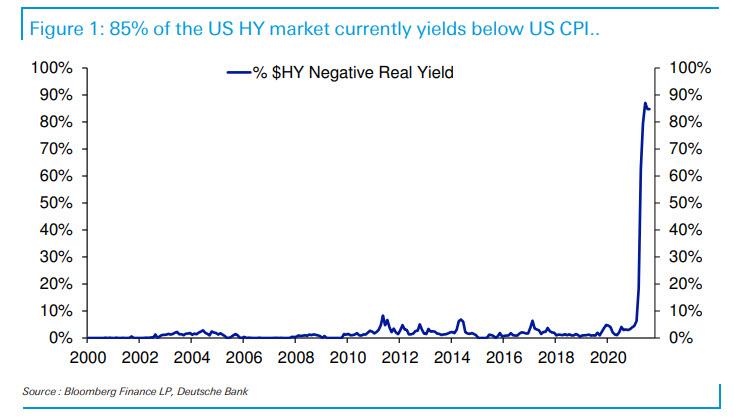
Which brings up another point: in a world where 85% of US junk bonds now have a negative real rate...
... and where there is virtually no real yield to be found across the entire USD-denominated credit spectrum, yield-starved investors should be sprinting into China, to buy their 14% junk bonds.
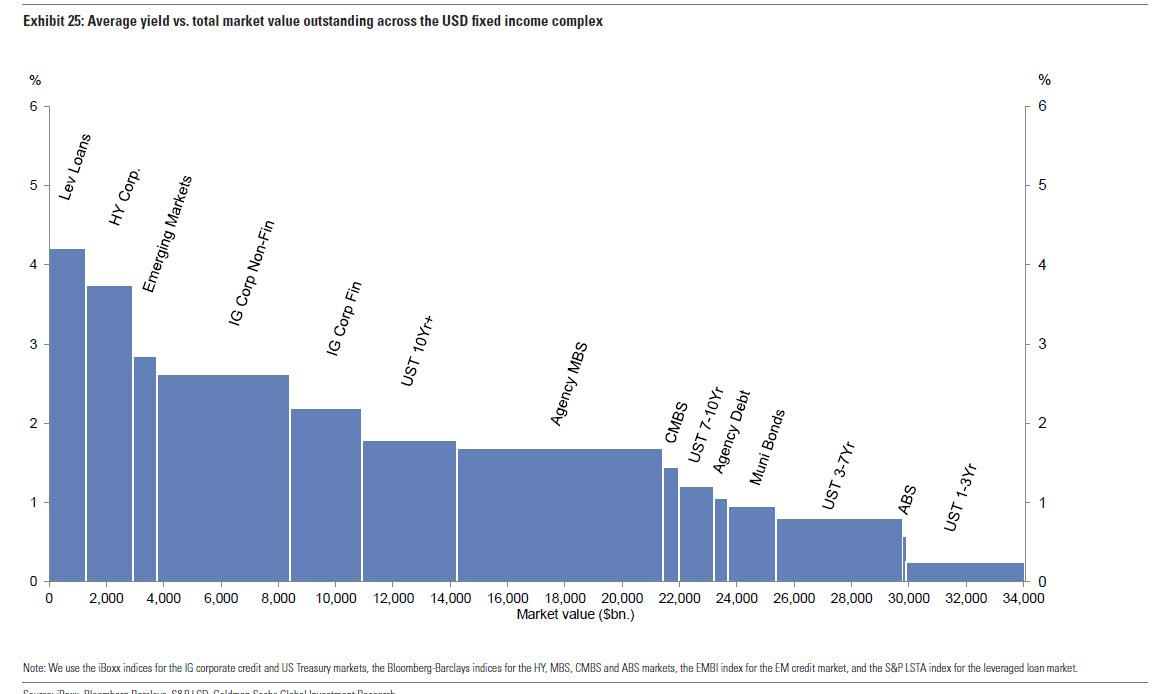
Why aren't they? Simple: unlike in the west where they know central banks will bail them out, a rather socialist approach to what once were "capital markets" but are now "capital Marxists, in China they have no such guarantees, which is actually rather ironic - for all its "socialist characteristics", China may be the only place where true market capitalism - where failure means failure, if not for state-backed companies of course - can still be found.
Americans Panic Over Soaring Inflation, Buying Conditions Hit The Worst On Record
One month ago, when looking at the internals of the UMich report, we noted that there was "A Sudden Negative Change In The Economy" as consumer spending intentions collapsed. One month later, it has only gotten worse.
While overall consumer sentiment staged a modest rebound from last month's dismal plunge...
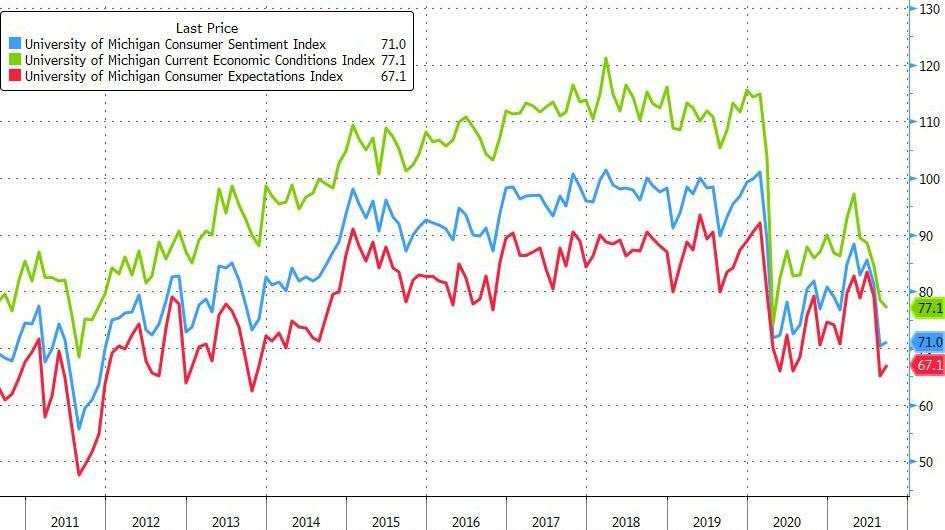
... the internals went from bad to worse, and as survey director Richard Curtin explained, "buying attitudes for household durables fell again in early September to a low reached only once before" - during the galloping inflation of 1980 when Volcker hikes rates to 20% while - "long term economic prospects fell to a decade so low." It wasn't just durables: as shown in the chart below, sentiment for buying conditions of vehicles and homes was similarly the worst in over 40 years. As a result, "the decline in assessments of buying conditions for homes, vehicles, and household durables left all three near all-time record lows" with the declines due to spontaneous references to, what else, high prices.

This, according to Curtin, is consistent with an ongoing spending shift from goods to services, although the gains in service spending have been recently slowed sharply by the Delta variant, and according to Goldman, souring expectations for future service spending is why the bank recently slashed its GDP forecasts.
While some anticipated that the August plunge in confidence, one of the worst on record, would quickly disappear since "it was driven by emotions", the subsequent reality has shown that there is something greater at play here, namely the US consumer being tapped dry with no stimmy cash left and with prices still soaring.
It gets worse: with consumers freaking out over soaring inflation we are about to enter a buyer's strike because with the Fed repeating over and over that hyperinflation is transitory, consumers would rather hold on to their cash which means the all important spending which drives 70% of the US economy is about to grind to a halt:
There was a complete rout of net favorable views of buying conditions: household durables fell to the lowest level since 1980, vehicles fell to the lowest level since 1974, and homes to the lowest level since 1982. These record drops were all due to complaints about high prices: homes had the highest negative ratings of home prices ever recorded, vehicles had the most negative price references since 1974 (in response to the first oil embargo), and durables had the worst price rating since 1980.
And speaking of galloping inflation, UMich found that "although declining living standards were still more frequently cited by older, poorer, and less educated households, over the past few months, complaints about rising prices have increased among younger, richer, and more educated households. Recent income gains rose slightly, and net household wealth rose, especially among those with incomes in the top third." In other words, the "transitory" hyperinflation is now crushing everyone, rich and poor, dems and republicans, young and old, cis and transgender, he, she and its.
Curtin then drifted into a philosophical discussion of the three potential reactions to inflation:
Consumers have initially reacted by viewing the rise in inflation as transitory, believing that prices will stabilize or even fall in the future. As a result, postponing purchases is seen as a viable strategy. This implies a slowdown of spending in the months ahead and a more robust rebound later in 2022.
Here, however, the UMich sentiment chief admits that "the main alternative is that inflation will not be transient but will rise further due to an unprecedented expansion in fiscal and monetary policies. The resulting rise in inflationary psychology will lessen resistance to rising prices and stiffen demands for increased wage gains."
Of course, this would also be the moment the Fed officially loses control of inflation expectations, although as Curtin notes, "this reaction takes a long time to fully develop, and is contingent on significant increases in long-term inflation expectations, which have yet to be observed." Here we completely disagree with the UMich assessment because as even the NY Fed's own survey showed this week, 3 year inflation expectations are now the highest on record.
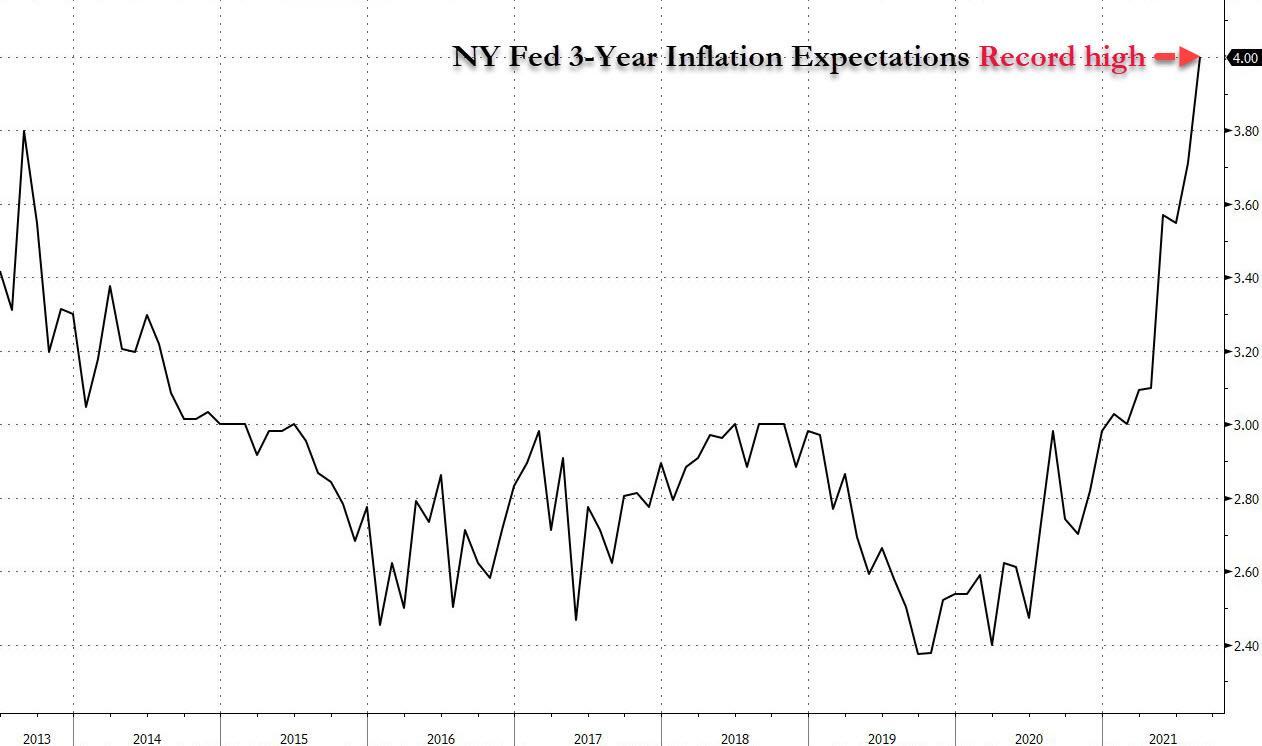
Which means that with every month that "transitory" inflation keeps rising, and the realization that transitory is in fact permanent , we near the "final alternative" for how consumers view inflation, which is the following:
The final alternative is that consumers may believe that the most effective strategy to maintaining their purchasing power is to emphasize increases in their incomes, net of taxes and transfers. The effectiveness of pandemic transfers were shown to be successful in offsetting hardships among those most vulnerable to economic disparities. Transfers to offset the inflationary erosion of living standards would be justified in a similar manner.
In theory this is wonderful; in practice with the US economy sliding into stagflation, what will actually happen is a collapse in real wages which prompts consumers to shift from cautious to euphoric, and buy anything they can to preserve what purchasing power they still have. This is also the first step in the progression to hyperinflation.
Buffett of the airline business is in for the long haul
Bill Franke is considered by some to be the most successful airline investor in history
Bill Franke has spent 20 years disproving Warren Buffett’s adage that airlines are a “death trap for investors”.
But as a novice private equity executive touting his first fund in 2002, he struggled to persuade big investors and pension funds to pour money into a notoriously cyclical and unpredictable industry. “They were all like ‘not in the airline industry’,” Franke recalled in an interview with the Financial Times.
Two decades later, the 84-year-old Franke is considered by some to be the most successful airline investor in history after buying stakes in a clutch of small carriers and pushing them into rapid growth by installing the ultra-low-cost business model pioneered by Southwest Airlines in the US and Ryanair in Europe.
While passengers often chafe at the no-frills model, which includes piling seats into aircraft and charging for add-ons, this part of the industry is expected to emerge strengthened by the pandemic, reinforcing Franke’s reputation further as the Buffett of the airline business.
Franke’s Indigo Partners owns stakes in six airlines, including Frontier in the US, Volaris in Chile and Canada’s Enerjet. But it is Hungarian airline Wizz Air, which is 40 per cent owned by Indigo and chaired by Franke, that has caught the imagination of a battered industry.
Wizz hopes to use the crisis for a breakneck growth spurt, and its ambitions were underlined when an audacious bid for easyJet was revealed, and rejected, last week.
Franke would not discuss easyJet, but said Indigo was “actively considering opportunities” as the airline industry emerges from the chaos unleashed by Covid.
“It is a time for the industry to look at consolidation, and we would clearly want to be a consolidator [buyer],” he said.
Wizz chief executive József Váradi has also been offered an eye-catching £100m bonus if he can more than double the share price over the next five years.
“That’s typical Bill,” said John Leahy, the former head of sales for aircraft manufacturer Airbus, who has had first-hand experience in negotiations with Franke as a seller of passenger jets to his airlines. “It won’t pay out unless [Váradi] delivers and if he doubles the stock price, then Bill is willing to share,” he said.
Yet, surprisingly given his success, Franke never meant to end up in the airline business.
It was not until the early 1990s, when he was in his mid-50s, that he first took an interest in airlines after an approach from the Arizona state governor; the politician had followed the businessman’s successful but low-profile career turning round businesses in the paper and retail industries, and asked him to help save bankrupt carrier America West.
“I did not know up from down about Airbus or Boeing or any parts of the business . . . I had to get on a fast track to be educated, sometimes the hard way,” Franke said.
Helped by capital put up by private equity’s billionaire businessman David Bonderman, the novice airline boss again demonstrated his golden touch in restructuring, turning America West into a successful low-cost operator over the next decade.
He then left the airline and followed his friend Bonderman into private equity, founding Indigo Partners in 2002.
With early backing from Singapore’s sovereign wealth fund, which is still an investor today, the fund’s investments ranged across continents, but were always guided by the consistent approach of seeking assets where costs were kept low that served Franke well in his turnround days.
“In almost every case, the management had permitted the balance sheet to go to hell in a handcart,” he said of the companies he restructured, something he never forgot as he hunted out investments for his new private equity fund.
“There was a really good, relentless, focus on costs,” said Ben Baldanza, the chief executive of Indigo-backed Spirit Airlines between 2005 and 2016. “That’s the one thing an airline can really control.”
However, there have been missteps. Spirit, which Franke sold out of in 2013, was dogged by customer complaints about the no-frills model, while an investment in Russia failed.
And it is difficult to determine how well Indigo, and Franke himself, have done at his private equity group as it discloses almost no financial information.
Franke would go no further than saying Indigo would be “for sure in the top 10 per cent” of the industry for returns over the past 20 years. He also refuses to disclose his investors, although they are understood to include a European bank and high-net-worth individuals.
However, the group has clearly made money out of Wizz, an unmitigated success in terms of share price, which has rocketed to nearly £50 from £11.50 in 2015 when the airline listed in London. Over that period, Indigo has slowly reduced its stake in the carrier, including a £400m share sale this year.
Leahy, who sat across the table from Franke during the negotiations for one of the largest aircraft orders in history, is certainly impressed.
“He is a very tough negotiator, but he isn’t one of these guys who pounds the tables and gesticulates in the press. We found a compromise, I would like to say in the middle but maybe it was slightly more in his direction,” Leahy said, referring to Franke’s order of 430 aircraft on behalf of four of his airlines for a headline price of $49.5bn in 2017.
“I would say his batting average is very good, not too many disasters and an awful lot of successes. He has made a tonne of money.”
He also had a tendency of getting his way, Leahy added. “If you are one of Bill’s airlines, I don’t think you were stubbornly independent for long, you followed Bill’s directions or else.”
Baldanza agreed that Franke kept a tight grip on his airlines, playing off his chief executives against each other.
“I used to joke with Joe [Váradi, Wizz Air boss] that Bill would always tell Joe: ‘You guys are way behind, you have to be doing what Spirit is doing,’ and he would always tell me: ‘You guys are way behind, you have to do what Wizz is doing,’” Baldanza said.
Michael O’Leary, the outspoken boss of Ryanair, a tough airline deals negotiator himself, is impressed, too. “Very smart and very rich,” he said of Franke, who also has staying power and shows no signs of slowing down.
“It is an interesting, difficult business, but that is part of what keeps me intellectually engaged,” Franke said, clearly with an eye to continue making a mark on a business he has helped evolve over his decades-long career as an investor and turnround specialist.
Ten watches you can’t take your eyes off
Too good to be true? The choice is yours
