"Ice Is Coming": Morgan Stanley Warns Odds Of "Destructive" 20%+ Correction Are Rising
One month ago, we said that when Morgan Stanley's chief equity strategist Michael Wilson hiked his year-end price target from 3,900 to 4,000, he did so very "reluctantly", as if someone was tapping on his shoulder with an Uzi, because while the note was supposed to be cheerful and rosy, all Wilson could talk about was the downside scenario which included all the usual sorts of fire and brimstone.
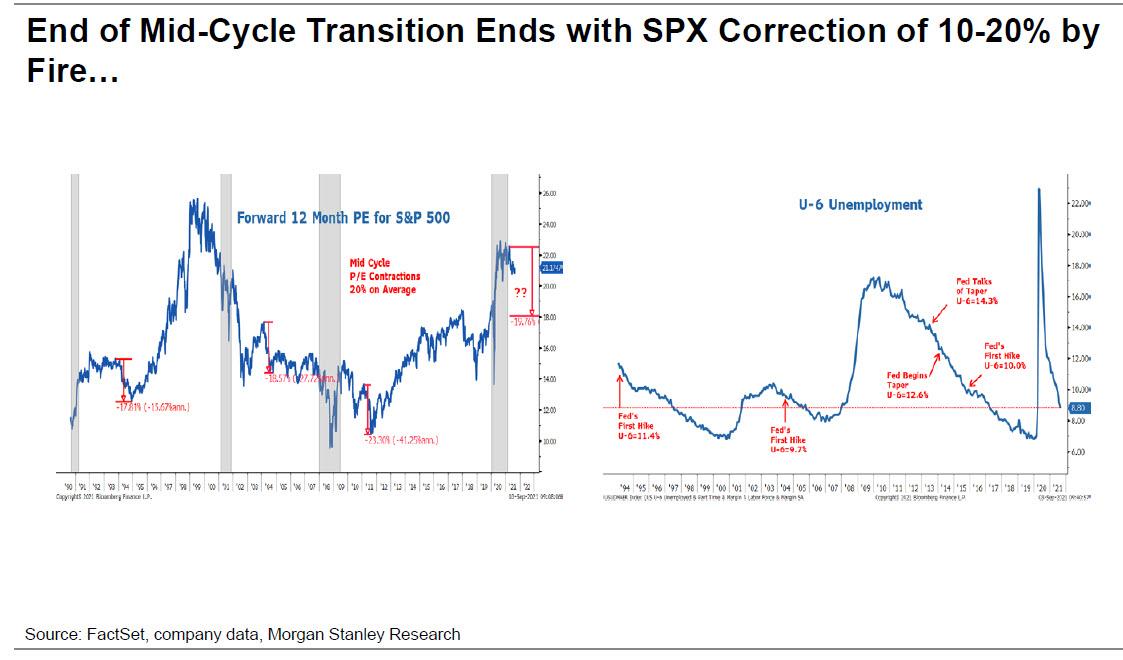
Well, fast forward to today when suddenly global markets are writing under the throes of Evergrande contagion sending spoos sharply below their 50DMA critical support level, and when early this morning, Michael Wilson is back in his prime as Wall Street's biggest bear, going back to his core thesis that the current Mid-cycle transition will end in either "Fire", i.e. a sharp market correction...
... or "Ice", with consumer spending grinding to a halt...
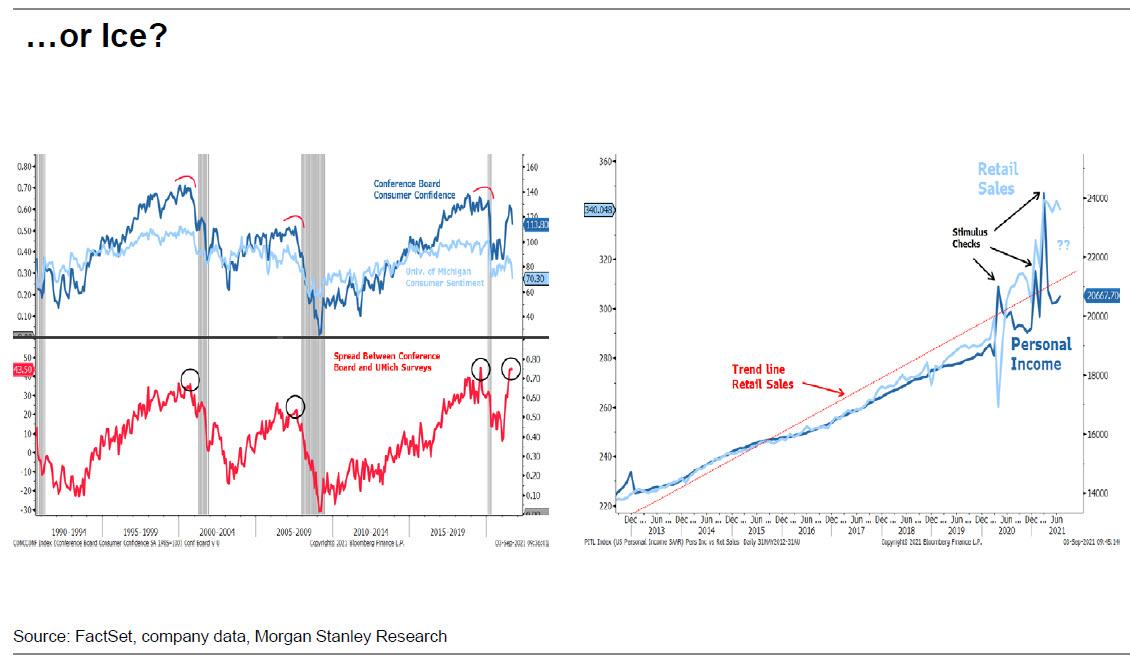
... and observes that "the ice scenario would be worse for markets and we are leaning in that direction given the fall in consumer confidence and reset lower in PMIs we expect."
Backing up a bit, for those unaware, since March, Wilson had been espoused a mid-cycle transition narrative for US Equity markets, which he says has played out to script for the most part, with large-cap quality outperforming while the average stock has materially underperformed the S&P 500, the exact opposite of what occurred during the early cycle phase of recovery.
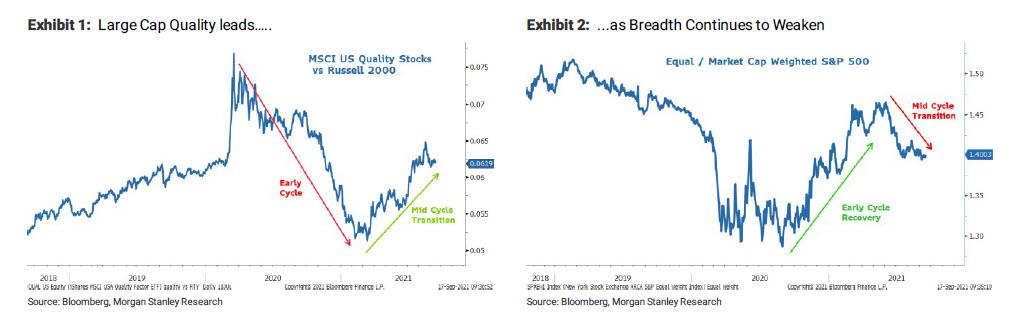
Relieved that he no longer has to hide his bearish views behind a facade of cheerful optimism (observed most recently during his August S&P target hike), Wilson than mocks the "many commentators and clients" who continue to point to the S&P 500 near all-time highs as a leading indicator and rationale for even higher prices ahead, and cautions that in his view, "the relative strength of the S&P 500 and Nasdaq 100 is further confirmation that the market understands the mid-cycle transition narrative and has bought into it hook, line and sinker. After all, the S&P 500 is the highest quality large cap index in the world. In short, it should be outperforming right now."
The question, as Wilson puts it, whether the mid-cycle transition will end with a correction in this index as it typically does, or whether it's different this time? His prediction: "With our year end target 10% below current levels, our view is clear: the mid-cycle transition will end with the rolling correction finally hitting the S&P 500."
And so, for the benefit incredulous bulls who can't believe all the red they are seeing this morning, Wilson explains that "the mid-cycle transition will end with the rolling correction finally hitting the S&P 500." He then reminds MS clients that he has laid out two near-term risk paths that could lead to this outcome: "fire" (the Fed begins to remove monetary accommodation in response to an overheating economy) and "ice" (earnings revisions and higher frequency macro data points decelerate amid demand pull forward, supply chain issues and margin pressure)."
And while in his weekly note he dives deeper into both of these paths and points "to accelerating risks on both the policy and growth fronts" the emphasis is on the "Ice" scenario which could result in "a mode destructive outcome, i.e., a 20%+ correction." Here's why:
The typical mid-cycle "fire" outcome would lead to a modest and healthy 10% correction in the S&P 500. However, the "ice" scenario is starting to look more likely, and could result in a more destructive outcome – i.e. a 20%+ correction. As a result, we continue to recommend a barbell of more defensively oriented quality (Healthcare and Staples) to protect from the "ice" scenario while keeping a leg in Financials to participate in the "fire" outcome as higher rates materialize.
The next question is what would catalyze the upcoming correction, whether it is the 10% "fire" or 20% "ice" drop. Wilson responds:
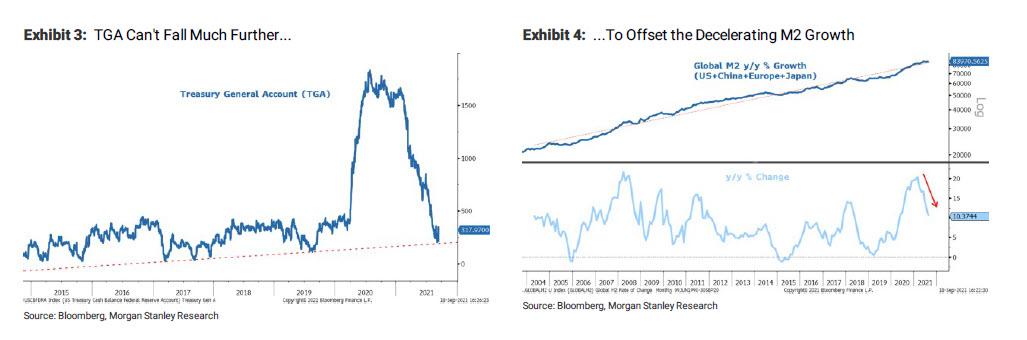
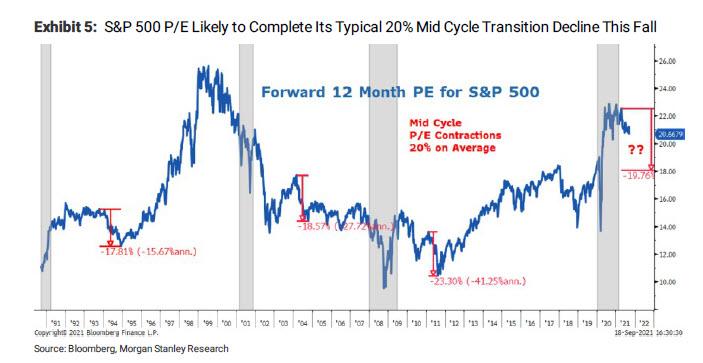
We have presented two potential scenarios for why / how the correction will ensue. The more traditional ending to a mid-cycle transition is a "fire" outcome whereby the recovery overheats and the Fed begins to remove accommodation. In the 1994 and 2004 transitions, that meant raising the Fed Funds Rate. In 2011, it was simply the ending of QE2. This time we think it is the tapering of asset purchases later this year/early next year. Given that the taper was effectively pre-announced at Jackson Hole 3 weeks ago, is it a coincidence that equity markets have been softer in September? Under this scenario, the economy reaccelerates from the summer slowdown but not enough to offset the tightening of financial conditions from higher back end rates and less liquidity in the system. In addition to the anticipated tapering of asset purchases later this year, we point to the fact that the Treasury's General Account (TGA) has fallen by $1T since March (Exhibit 3).While this has been a good offset to the decelerating M2 growth (Exhibit 4), that offset is probably finished now. Bottom line, this is the time of the mid cycle transition when P/Es for the broader index properly contract (Exhibit 5).
Piling on the pessimism, Wilson then notes that "there are several key variables we are monitoring that currently support a view for a worse than expected growth deceleration."
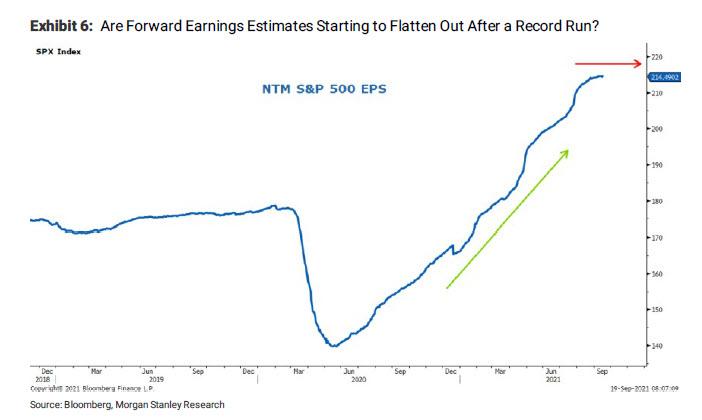
- First is NTM earnings estimates. Even if the economy rebounds in 4Q from the slowdown this summer, it likely won't translate into higher earnings estimates as incremental margins rollover due to higher costs and taxes. This is the mirror image of the past year when costs were being eliminated as revenues benefitted greatly from the fiscal stimulus. Indeed, NTM EPS estimates for the S&P 500 appear to have been flattening out over the past month after a record recovery to levels that are 20% above the prior peak (Exhibit 6). This will be critical to watch as we enter 3Q earnings season and companies update investors on costs/margins and potential payback in demand from the consumption binge earlier this year.
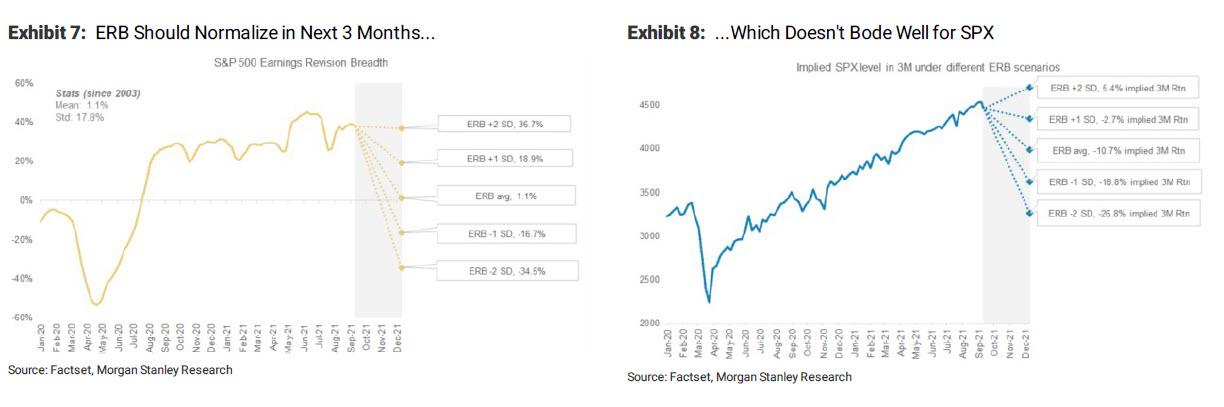
Another way to analyze this rate of change on earnings momentum is to look at earnings revision breadth (or ERB), which Wilson thinks is vulnerable to a simple reversion to the mean from today's very elevated levels of +2 standard deviations (Exhibit 7). If earnings revision breadth (ERB) normalizes to its average over the next 3 months, the S&P should fall approximately 11%. If the ERB falls toward 1 standard deviation below average, the S&P 500 should fall 19%, and at -2 standard deviations, the S&P 500 falls 27% (Exhibit 8).
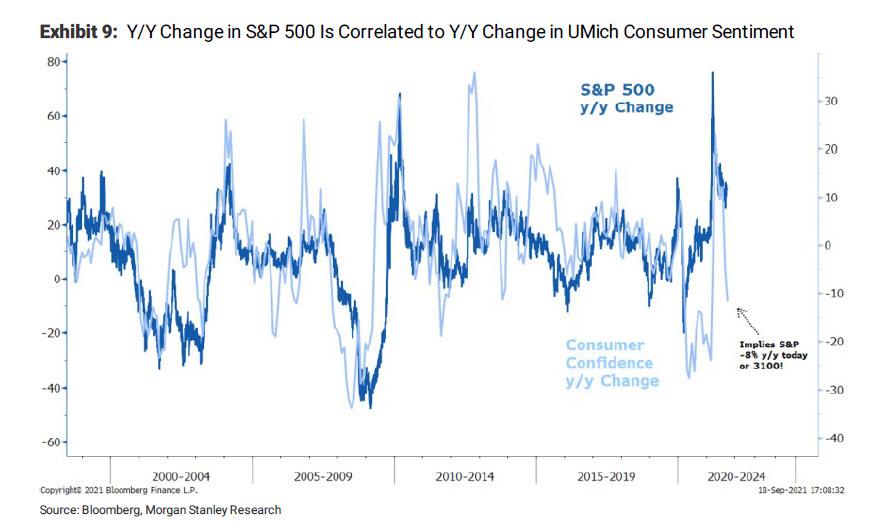
- Second, and as discussed here most recently on Friday, consumer confidence has recently fallen sharply. It started with the University of Michigan survey plummeting in August to lower levels than we witnessed during the entire pandemic and recession last year. While the Conference Board Consumer Confidence Survey remained elevated in July, it saw a big catch up to the downside in August as well. According to Wilson, these surveys are important variables because they have strong positive correlations to the y/y change in the S&P 500. In other words, based on the UMich survey, the S&P 500 appears vulnerable to at least a 10-20% correction if the survey doesn't improve next month.
Here, Morgan Stanley's view is that "consumers aren't as naïve as they are often made out to be. They know the last year has been a bit of a bonanza working from home while receiving stimulus checks from the government that many didn't need (85% of all Americans received stimulus checks)." Meanwhile, prices of everything are up a lot just as the extra money has stopped going out. That's a bad combo for sentiment and supports not only our stagflation thesis, but also Morgan Stanley's expectation of payback in demand view and underweight on Consumer Discretionary stocks, particularly goods-related ones.
Finally, while Wilson concedes that many businesses have done extremely well during the pandemic, "the trends here are also likely to subside" and the best way to gauge the fadiing momentum in businesses will come from the Purchasing Manager Surveys. While earlier this year we reached record highs in many of the subcomponents, much like economic surprise indices and earnings revision breadth measures, the PMIs are mean reverting. Indeed, as Wilson - who used PMI data to cement his mid-cycle thesis - the peak rate of change was in April just as the PMIs peaked as well. Most importantly, as we observed previously, the prices paid component (inverted) leads the headline by approximately 12 months and suggests the decline in the PMIs will likely be worse than typically witnessed during the mid-cycle transition phase – i.e., back toward 50, if not lower (Exhibit 10). This, as Morgan Stanley points out, would imply the Headline PMI is down 10-20% y/y by December: "Given a tight relationship with the y/y change in the S&P 500, the implication is that the S&P could see at least a 10-20% decline over the next 3 months (Exhibit 11)."

Bottom line according to Wilson, the typical "fire" outcome would lead to a modest and healthy 10% correction in the S&P 500, but "the "ice" scenario is starting to look more likely, in our opinion, and could result in a more destructive and unexpected outcome." As a result, we continue to recommend a barbell of more defensively oriented quality (Healthcare and Staples) to protect from the "ice" scenario while keeping a leg in Financials to participate in the "fire" outcome should higher rates materialize.
Goldman Issues A Dire Warning On China's Property Sector
No matter how the Evergrande drama plays out, whether it culminates with an uncontrolled, chaotic default and/or liquidation which sparks a crash in real estate values, or with Beijing blinking and bailing out the core pillar of China's housing market, remember that Evergrande is just a symptom of the trends that have whipsawed China's property market in the past year, which has seen significant contraction as a result of Beijing policies seeking to tighten financial conditions as part of Xi's new "common prosperity" drive which among other things, seeks to make housing much more affordable to everyone, not just the richest.
So before we go further, a quick reminder of the sharp deterioration observed in the past few months which has been a direct (if reflexive) contributor to Evergrande's downfall and which we touched on last week in "Chinese Data Dump Confirms Hard Landing Imminent" in which we noted something stunning: according to WIND, growth in land sales in value terms in the 100-city sample, a proxy for land purchases by property developers, slumped to -90.4% Y/Y during 1-12 September form -65.0% in August. In volume (floor space) terms, it also dropped sharply to -38.3% y-o-y from -21.9%.
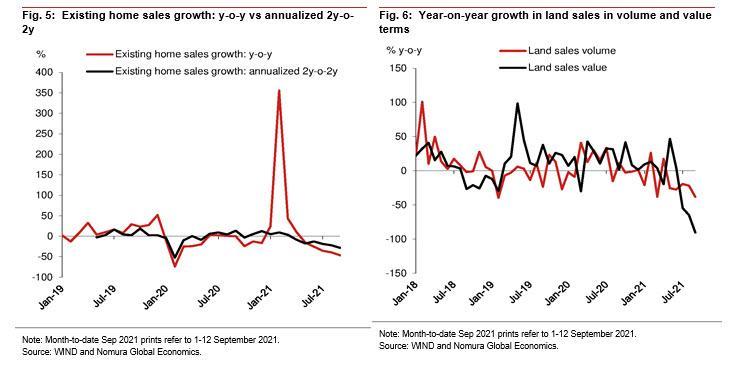
Picking up on this weakness in the property market, Goldman notes that after housing activity turned significantly more negative from June to July, August registered another sequential declines in housing starts and property sales. And although idiosyncratic factors such as floods, typhoons, and virus related mobility restrictions likely played a role, the unrelenting policy tightening over the past year probably was the key driver, from the “3 Red Lines” to property loan caps, from land auction reforms to local home purchase restrictions.

Indeed, the fact that property developers’ bond issuance has plunged suggests policy tightening has been a more significant driver than those idiosyncratic factors. It is here that Evergrande, whose ponzi-like business was reliant on ever greater access to debt to perpetuate its growth, fell smack in the crosshairs of Beijing's tightening campaign.
And with policymakers (still) showing no signs of wavering on property market deleveraging, Goldman warns that latest development regarding Evergrande which may default as soon as today on a bank loan, "likely suggest that housing activity may deteriorate further in the absence of the government providing a clear path toward an eventual resolution for Evergrande." The bank adds:
As our credit strategy team points out, Evergrande is large (total assets of RMB2tn, or 2% of China’s GDP) and complex (with over 200 offshore and nearly 2000 onshore wholly and non-wholly owned subsidiaries). But it accounts for only 4% of China’s total property sales and its 123,000 employees and 3.8 million contractors make up a fraction of China’s over 400 million urban labor force. In the event of an orderly default of Evergrande and limited spillovers to both the financial market and broader property sector, the macro impact should be manageable.
Of course, as we discussed extensively over the weekend, and as markets are realizing rapidly this morning, the danger is precisely the contagion effect, should a default occur without clear “ring-fencing” of spillovers to other parts of the real economy or financial sector.
Ominously, Goldman warns that "events over the past week suggest risks of inching toward that direction" with equities and bonds issued by other developers with high leverage have sold off, while protests at Evergrande offices across China may cause reluctance among potential homebuyers more broadly.
Meanwhile, a surge in yields and rising financing pressure faced by property developers has contributed to failed land auctions in a number of cities.
* * *
So now that we know where we are, the question is where we go from here, and it is here that Goldman has a rather dire forecast about the future of the Chinese property market. As the bank's China analysts write in a Sunday note titled "Rising risks from the property markets", they examine the implications for the economy in three different scenarios, given the property market’s connection with both upstream and downstream sectors, its dominance on Chinese households’ balance sheet (40% of household assets), and its important linkages to the banking system (40% of bank loans are backed by properties).
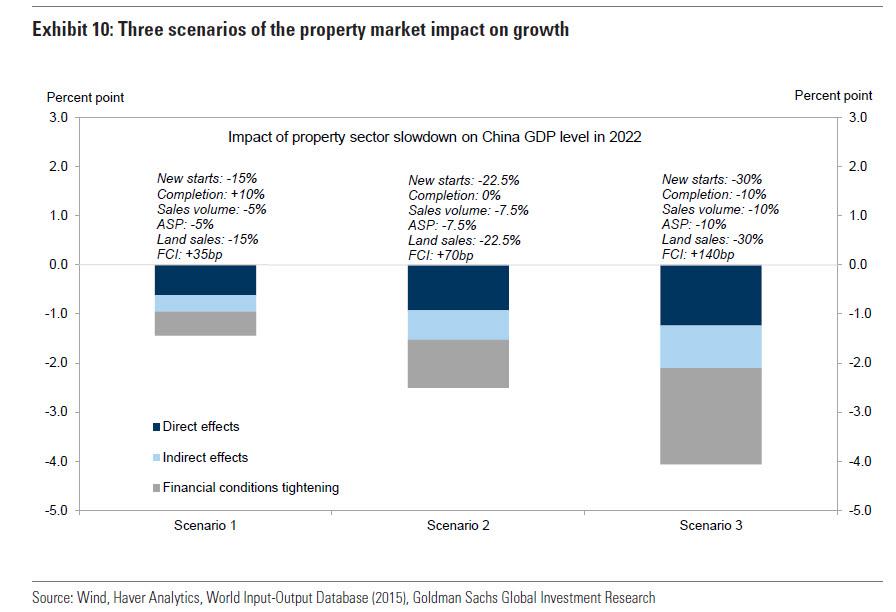
- In the first and base case, Goldman uses its property team’s forecasts for 2022 (land sales and housing starts down 15% and property sales and house prices down 5%) combined with a moderate tightening in financial conditions as equity market sells off and credit spreads widen. Goldman analysts expect completions to increase 10% as completions should follow previous presales. This scenario effectively assumes that the property market deleveraging would continue but at a gradual pace, and Evergrande related risks would not generate significant negative spillover effects on the financial system and other developers.
- In the second and more severe scenario, land sales and housing starts fall 23%, property sales and house prices decline 8%, and completions stay flat from 2021 to 2022. The tightening in financial conditions is similar to the credit tightening in 2014H2.
- In the third and most bearish scenario, land sales and housing starts fall 30% and property sales, house prices and completions drop 10% from 2021 to 2022. The tightening in financial conditions doubles that in the second scenario. Note that in this scenario, the tightening is of the same magnitude as the tightening in Goldman's China Financial Conditions Index (FCI) from November 2017 to June 2018 when domestic credit tightening and the US-China trade war rattled the financial market significantly.
To link these three scenarios to economic growth, Goldman considers both financial (e.g., through financial conditions) and real impact, and within real impact, both direction (e.g., lower construction activity and less local fiscal revenue from land sales) and indirect effects (e.g., lower demand for upstream products such as cement and steel and downstream products such as furniture and home appliances). The table below outlines the mechanisms the bank considers in its calculation, to estimate the impact on GDP.
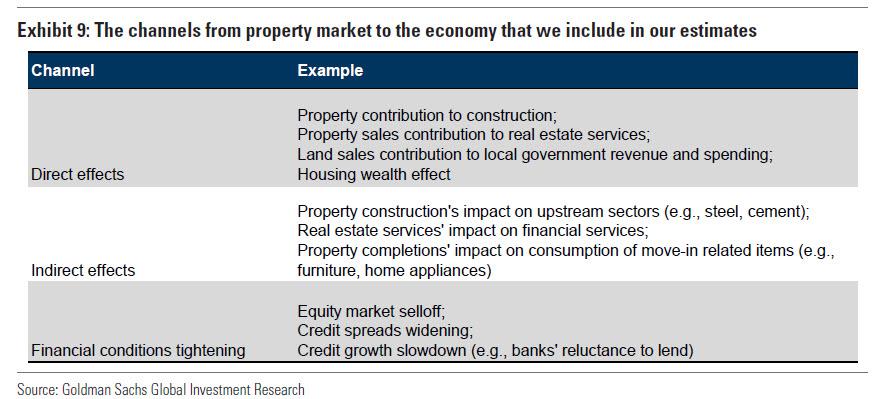
Next, Goldman quantifies the impacts of these three scenarios (this is a partial equilibrium exercise which does not take into consideration potential monetary and fiscal policy easing in response to the property market declines):
- In the first scenario, the total negative impact would depress the level of output by 1.4% of GDP, with the direct impact playing the most important role.
- In the second scenario, the total negative impact increases to 2.5% of GDP.
- In the third scenario, the total negative impact is as large as 4.1% of GDP, with the financial conditions channel contributing the most to the total impact, highlighting the importance of the financial spillover effect on the economy in this most bearish scenario.
It goes without saying that a 4.1%,or even 2.5% hit to China's GDP, would have catastrophic consequences not only on China's economy which could then rapidly spiral into a recession, but the deflationary shockwave which quickly spreads across the globe, would devastate risk assets in most developed nations.
* * *
That said, what is the bigger picture impact of these adverse impacts to China's GDP? Here we take a step back again to evaluate why China has been aggressively implementing its regulatory tightening and structural shifts in the post-Covid era.
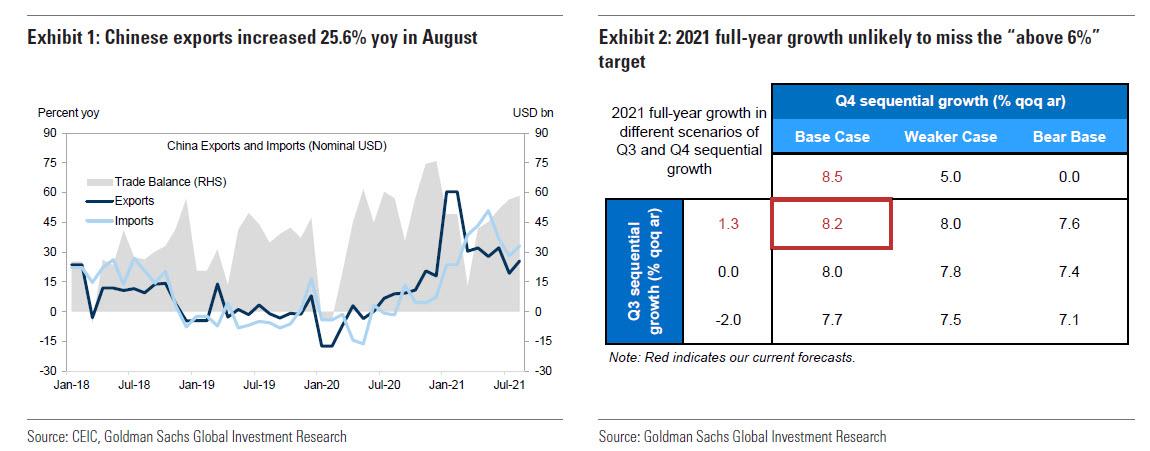
As Goldman notes, the past year offered policymakers a rare “window of opportunity” to implement regulatory tightening and structural shifts without worrying too much about missing the growth target. A rebound in domestic activity as lockdowns eased, and strong demand for Chinese exports from other countries, both provided considerable economic momentum without the need for large policy stimulus. In August, Chinese exports increased 25.6% yoy (Exhibit 1), significantly higher than the Bloomberg consensus expectation of 17.3%. The strong exports data seem to suggest the tailwind from robust external demand continues to blow, extending the runway for the Chinese government to tighten domestic policy.
At the same time, this year’s GDP growth is unlikely to miss the low bar of the “above 6%” target (Exhibit 2). Goldman's base case is a weak Q3 (1.3% qoq ar) followed by a sequential, not year-on-year, rebound in Q4 (8.5% qoq ar), which implies 8.2% full-year growth. Even in the bear case where an exceedingly weak Q3 (-2% qoq ar) is followed by no sequential recovery in Q4 (0% qoq ar), a rather extreme assumption given the strict lockdowns implemented in August had been mostly lifted by September, 2021 full-year growth would still reach 7%. The combination of exports continuing to surprise to the upside and a non-binding growth target this year would seem to suggest that the window for policymakers to focus on structural issues remains open.
However, in light of recent events, Goldman warns that this “window of opportunity” has closed. First, the recent strength is exports is primarily driven by higher prices rather than stronger volumes. Although we expect the level of external demand to stay strong, the room for further increases is limited. Second, with the more contagious Delta variant and the “zero tolerance” COVID policy, consumption recovery is likely to feature a “start and stop” pattern, capping the upside as well. Third, continued semiconductor shortages may persist for months to come, if not quarters, and weigh on auto production and sales. These three forces are mostly beyond the government’s control.
So putting together the exogenous slowdown in China's economy due to forces beyond Beijing's control, coupled with the endogenous shock emanating from the property sector in general (due to policy tightening) and Evergrande in particular (whose implosion has accelerated due to Beijing's insistence not to bail out the company), Goldman's conclusion is simple: an aggressive policy response is needed, and here's why:
After the cleanup of the shadow banking sector, the Chinese banking system is in a stronger position to withstand shocks than a few years ago, the bank's analysts contend. Regulators have gained experience with Anbang, the Tomorrow Group and Huarong previously, although Evergrande is arguably a much bigger and more complicated case. On the other hand, the importance of the property sector to the economy is certainty not lost on Chinese policymakers. Therefore, Goldman's baseline remains that the authorities will not allow a situation where a disorderly default of Evergrande spirals into a crisis as they head into the Sixth Plenum in November, although a potential restructuring of Evergrande would probably take a while and negative headlines and operational hiccups are likely along the way.
Yet even Goldman's optimism is suddenly far more muted than it was just a few weeks ago (when the bank anticipated virtually no adverse consequences from Evergrande) and cautions that as financial markets begin to worry about the contagion effect and financing challenges begin to emerge for other developers, it is imperative for the government to provide clear communication on the plan regarding Evergrande and to shore up confidence among homebuyers, suppliers and contractors, banks and other non-bank financial institutions. "Without such communication, particularly if market tensions worsens significantly in the coming days and weeks, the hit to economic growth in Q4 and next year from the property market would look more like scenarios 2 or 3 than our current base case."
Looking beyond the immediate risks and uncertainties around Evergrande, Goldman adds that two other policy adjustments are also needed.
- First is the overall macro policy stance. Despite the recent increases in on-budget and off-budget fiscal spending and more MLF/OMO liquidity operations than market expected in September, the overall domestic policy stance still appears too tight. Additional easing on both fiscal and monetary fronts is needed in Q4 to ensure sufficient growth momentum as we head into 2022 (we agree with this, as it is imperative for China to force its credit impulse out of contraction territory and that can only happen with a substantial monetary and fiscal stimulus).
- Second is the pace of structural changes. When it comes to long-term goals such as de-carbonization and property market deleveraging, the pace of policy implementation is as important as the ultimate policy objectives. In the case of deleveraging, both the 2018 experience and the recent turn of events in the property market illustrate that, if the push to lower debt is compressed into too short a timeframe, growth may slow significantly and we may end up with a higher, not a lower, macro leverage.
Goldman's bottom line:
Housing activity fell sharply in July and weakened further in August. At the same time, concerns over Evergrande are rising and signs of financing difficulties spreading to other developers are emerging. We estimate the potential impact on growth under different scenarios. For now, our baseline remains that any potential default or restructuring of Evergrande would be carefully managed by the government with limited contagion effect in both financial and property markets.This would require a clear message from the government soon to shore up confidence and to stop the spillover effect, the absence of which we think poses notable downside risk to growth in Q4 and next year.
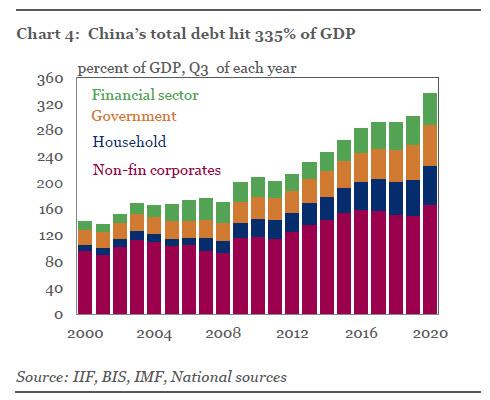
In short, and as we concluded last night, being's dilemma is simple: do nothing and watch as the economy crumbles, potentially with dire socio-economic consequences, or step in and stabilize markets at the expense of once again losing all credibility in its (failed) ongoing attempts to delever... which is to be expected for an economy which has 350% debt/GDP according to the IIF, a number which is too big to shrink on its own.
Balenciaga and Fortnite Are a Match Made in the Metaverse
The collaboration spans virtual and physical clothes, as well as a marketing campaign that will appear on billboards in cities like New York and Tokyo, as well as in Fortnite itself.
Balenciaga and Fortnite have teamed up to bring the physical and virtual worlds closer together.
The companies today unveiled a collaboration including virtual clothes and accessories, an immersive destination within Fortnite inspired by Balenciaga’s design, and a physical line of products that will go on sale at Balenciaga’s stores and e-commerce sites. The first partnership between a luxury fashion house and Fortnite, a giant in the gaming world with 400 million registered accounts, its aim is to span online and real-world spaces.
“We have the same marketing assets happening in both places, the same look and feel and product lines launching in the physical and digital world at the same time,” said Adam Sussman, president of Epic Games, the game developer behind Fortnite.
The in-game clothing will include outfits for four of Fortnite’s popular characters — Doggo, Ramirez, Knight, and Banshee — inspired by real-world looks from recent Balenciaga collections. Unlike the originals, a few of the digital versions will react in the game, changing colour in response to damage inflicted during battle for example. Fortnite players will be able to unlock some of the Balenciaga products by performing tasks in the game. Other items will have to be purchased using V-Bucks, Fortnite’s in-game currency. The most expensive items cost 1,500 V-Bucks, roughly equivalent to $12.

One hoodie worn by Doggo, an anthropomorphised dog, bears both Balenciaga and Fortnite branding, and physical versions will be available for purchase in different colours through Balenciaga. The brand will also sell items such as T-shirts, hats, dress shirts and a denim jacket as part of its line with Fortnite.
The companies are putting up 3D billboards featuring a hoodie-clad Doggo in Tokyo, Seoul, New York and London. The same billboard will appear inside the game in what Fortnite is calling the “Strange Times” hub in the game’s creative mode, where players can interact without battling. Fortnite launched as a battle-royale game in 2017, but half of its users now spend time in this creative mode, according to the company. Last year, players even staged their own fashion show. At the centre of the hub sits a recreation of a Balenciaga store, while billboards will showcase looks created by the Fortnite community.

“Fortnite at the end of the day is obviously a tech company, but it’s really about self-expression and agency,” Sussman said, referring to the agency of players to choose what skins or costumes they want to wear.
For Balenciaga, a brand known for pushing boundaries under creative director Demna Gvasalia, the collaboration serves multiple purposes. It’s a way to engage with gaming, which has become a key part of modern society, Cédric Charbit, the company’s chief executive, told BoF in an emailed statement.
Balenciaga’s interest in gaming is also about “re-designing the lines between content and product,” Charbit said. “The Fortnite project allows us to push it even further, the product being the content itself.”
The Growing Romance Between Fashion and Gaming
The project isn’t the first time Balenciaga and Epic Games worked together. Last year, Balenciaga created a game called “Afterworld: The Age of Tomorrow” to showcase its Autumn/Winter 2021 collection. It used Epic’s 3D creation platform, Unreal Engine, to do it, sparking the relationship that led to the new collaboration.
The worlds of luxury fashion and gaming have been increasingly cozying up to each other as people spend more of their time and money in virtual worlds. Louis Vuitton was a pioneer in establishing ties with gaming, and other companies have shown growing interest. Gucci recently created an immersive space in Roblox, another popular game.
It’s not hard to understand fashion’s attraction. Globally, 2.7 billion people are gamers, according to an estimate by Accenture, a strategy and technology services firm. Many are happy to spend on in-game purchases. Accenture’s research has found the game types that prompt the most spending are online battle arenas, fighting and battle royale games, “which is interesting as they are game genres that generally offer a wide variety of purchasable skins and cosmetic upgrades,” said David Reitman, Accenture’s global gaming lead.
The popularity of these purchases is part of the reason Sussman believes Fortnite is a good partner for fashion companies interested in building a virtual presence in gaming.
“The whole business of Fortnite is surrounded in this business of cosmetics, which are players’ choice of how they want to express themselves within the community: what they want to dress as, what they want to look like,” he said. “These ideas of agency, fantasy and self-expression are very similar consumer themes around why fashion connects with people around the world.”
Gapping down
Briefing note - With US futures trading down ~1.5%, most stocks are trading lower. The following represents some stocks with specific catalystsSelect China related names showing weakness after Hong Kong fell 3.3%:
- JD -3.6%, ASHR -3.2%, BABA -3.2%, FXI -3.1%, BIDU -2.2%
Select ETFs showing early weakness:
- IWM -2.2%, USO -2.2%, DIA -1.7%, SPY -1.5%, QQQ -1.3%, .
Other news:
- LI -4.4% (lowers Q3 delivery outlook)
Analyst comments:
- LEA -4% (downgraded to Hold from Buy at Jefferies)
- BWA -3.9% (downgraded to Hold from Buy at Jefferies)
- PTGX -2.7% (downgraded to Neutral from Overweight at JP Morgan)
Gapping up
News:
- VSTM +22.5% (Updated Investigator-Sponsored Phase 1/2 FRAME Study Data of VS-6766 with Defactinib in Low-Grade Serous Ovarian Cancer Showing Encouraging Response Rates and Progression-Free Survival Presented at ESMO 2021)
- SYBX +10% (reports Phase 2 data demonstrating reduction in plasma phenylalanine levels in patients with phenylketonuria)
- VXX +7.4% (trading higher with US futures down 1.5%)
- MRTX +7% (Presents Positive Clinical Data with Investigational Adagrasib as Monotherapy and in Combination with Cetuximab in Patients with KRAS G12C-Mutated Colorectal Cancer; reports Phase 2 topline results for investigational Adagrasib in patients with KRAS G12C-Mutated Advanced Non-Small Cell Lung Cancer)
- SPPI +5.3% (Presents Late Breaker Oral Presentation of Poziotinib Data in First-Line NSCLC Patients with HER2 Exon 20 Insertion Mutations at ESMO Congress 2021)
- AZN +1.7% (IMFINZI Plus Chemotherapy Tripled Patient Survival at Three Years in the CASPIAN Phase III Trial in Extensive-Stage Small Cell Lung Cancer)
- MRNS +1.2% (FDA accepted for filing the company's New Drug Application for the use of ganaxolone in the treatment of seizures associated with CDKL5 deficiency disorder)
- CDXC +0.9% (reports new preclinical data shows positive effects of nicotinamide riboside in glaucoma, Alzheimer's disease, and cardiac ischemia-reperfusion injury mouse models)
Analyst comments:
- FCRD +2.5% (initiated with a Perform at Oppenheimer)