Gapping up
In reaction to earnings/guidance:
- MX +5.4%, OTIS +1.6%, QSR +1.2%, HSBC +0.6%
Select metals/mining stocks trading higher:
- GDX +1.2%, GOLD +1%, NEM +0.9%, RIO +0.7%, FCX +0.6%, .
Select oil/gas related names showing strength:
- HAL +0.9%, XLE +0.7%, SLB +0.7%, BP +0.7%, USO +0.6%, XOM +0.6%, OIH +0.5%, RDS.A +0.5%, .
Other news:
- PAE +67.8% (enters into agreement to be acquired by Amentum for $1.9 bln)
- PHUN +22.3% (continued volatility)
- BRPM +18.8% (FaZe Clan to become a publicly listed company through merger with B. Riley Principal 150 Merger Corp)
- PYPL +5.6% (In response to market rumors regarding a potential acquisition of Pinterest by PayPal (PYPL), PayPal stated that it is not pursuing an acquisition of Pinterest at this time)
- APEN +5.4% (MERIT-Trial meets its primary endpoints for safety and efficacy)
- DWAC +5.2% (continued volatility)
- AUPH +4.8% (report that Bristol-Myers Squibb has expressed interest in acquiring
- AUPH, according to Bloomberg)
- LEV +4.5% (received a conditional purchase order for 1,000 all-electric LionC school buses from Student Transportation of Canada)
- ALKS +3.4% (FDA grants Fast Track designation to nemvaleukin alfa (nemvaleukin) for the treatment of platinum-resistant ovarian cancer)
- HUT +3.1% (provides third site status update)
- BHIL +2.8% (files for 89,628,274 share common stock offering by selling shareholders)
- TCRR +1.9% (announces clinical trial collaboration agreement with Bristol Myers Squibb (BMY) to evaluate gavo-cel in combination with Opdivo and Yervoy)
- MTDR +1.3% (revises dividend policy; doubles quarterly dividend)
- OWLT +1.3% (suspends certain Smart Sock shipments as it relates to recent FDA Warning Letter)
- DRIO +1.1% (files for $200 mln common stock offering; contract with a U.S. National Employer to provide its full multi-condition suite digital therapeutic solutions)
- CWEN +1% (announces sale of its thermal business to KKR)
Analyst comments:
- FIVN +1.8% (upgraded to Overweight from Sector Weight at KeyBanc Capital Markets)
- KNX +1.8% (upgraded to Buy from Neutral at UBS)
The Squid and the Whale
Capital will be the next frontier of the US-China conflict
Some Swampians may know that this title was taken from the movie of the same name, in which two brothers endure the divorce of their Brooklyn parents in somewhat comic style (half of the movie involves looking for parking after dropping off the kids; the enormous fighting squid and whale that hang in New York’s Natural History Museum represent the parents).
But I digress. The squid that I’m referring to here is Goldman Sachs, and the whale is China. Am I the only one amazed by the juxtaposition of China testing hypersonic weapons and Nato’s new mission to fend off the Middle Kingdom, with Goldman Sachs joining JPMorgan as the second independent bank to be allowed to operate freely in China without a local partner?
Well, freely may be an exaggeration. I’m quite sure that the Chinese Communist party makes it known what its desires and limits are, and that American financial institutions, like US tech giants, abide by them. But I find it rather incredible that even as decoupling is happening in the industrial and trade space, US financial institutions seem to be embedding more deeply in China.
The first question here is, why? For the US institutions, it’s clear. Desperate for fees, they are looking to do wealth management in what must be the most delicious greenfield market in the world. But for the Chinese, it seems to me more complicated. Sure, they have plenty of wealthy people who would like to be serviced by global blue-chip firms. And the country as a whole is still looking to improve its understanding and experience with the financial services market.
But China is also in the midst of a major debt crisis. I have actually been rather impressed by the country’s handling of Evergrande. Rather than waiting for a bubble to burst and bring the real economy down with it, as the US government did during the great financial crisis, Beijing is trying to deflate things in advance of that. The jury is out on whether it will work, but the effort is impressive.
Which brings me to the role of US financial institutions in China’s debt problems. Is the country hoping that US banks, but also entities like BlackRock (which told clients to triple down on China), are going to provide fresh cash to paper over the debt bubble, which has grown faster than any in history? And what might this mean for these firms’ Western investors, as well as the US government, which now views China as a major strategic adversary?
It’s hard for me to imagine that the US can have an entity list full of Chinese companies that can’t engage in cross-border trade, or have US investors, and yet it’s somehow OK for the country’s largest financial firms to move deeper into the orbit of Beijing (particularly as they claim to be focused on ESG). I’m already hearing rumblings about this in both conservative and progressive policy circles. (As per usual, it’s the neoliberal middle on both sides of the aisle that doesn’t think it’s a problem).
For my money, I think it is a problem. I expect that capital will be the next frontier of the US-China conflict. China has made it very clear that it wants to move away from a dollar system. It wants to encourage the adoption of the renminbi and weaken the ability of the US to use its own currency as the single global reserve, which of course gives America incredibly outsized power — we can run higher debts than usual, sanction countries that need to do business in the dollar-based capital markets (on that note, see the Treasury’s report on how virtual coin could weaken that power), and so on.
I can’t imagine how, in this context, we aren’t going to see more limits on the ability of US financial institutions to engage in China — or at least much more scrutiny of whether they are breaking any existing entity list rules in doing so.
Readers, I’d love to hear how you all think this will play out.
Early premarket gappers
- Gapping up:
- BRPM +17.8%, PYPL +6.8%, APEN +4.3%, PHUN +3.3%, BHIL +2.8%, HUT +2.8%, AUPH +1.8%, GDX +1%, GOLD +0.9%, TELL +0.8%, FCX +0.8%, NEM +0.8%, XLE +0.8%, SLB +0.8%, HSBC +0.8%, DWAC +0.7%, RIO +0.6%, BP +0.6%, AZN +0.6%, XOM +0.5%, MTDR +0.5%
- Gapping down:
- ERYP -33%, PINS -11.6%, DRIO -5.4%, TPTX -2.1%, ONDS -1.9%, NVS -1.4%, HON -0.8%
Drilling shutdown would mean end of green transition, Norway PM warns
Labour leader Jonas Gahr Store tells FT that country’s $1.4tn oil fund is ‘political’
Norway’s new prime minister has defended his country’s oil and gas industry by emphasising its shutdown would scupper the transition to greener industries such as renewable energy.
In his first newspaper interview as prime minister, Jonas Gahr Store told the Financial Times that if Norway, the biggest provider of gas to Europe behind Russia, were “out of business shortly” then the continent would struggle to reach its green goals too.
“If we were to say from one day to the other that we close down production from the Norwegian shelf, I believe that would put a stop to an industrial transition that is needed to succeed in the momentum towards net zero . . . So we are about to develop and transit, not close down,” he added.
The return to power of Store’s Labour party in Norway means all five Nordic countries have left-leaning prime ministers for the first time since 1959 and caps a centre-left revival that includes the victory of Social Democrat Olaf Scholz in Germany.
Store said he had been and remained in close contact with Scholz, who is discussing the terms of a coalition with Green and liberal parties, and emphasised their similarities as part of the “recovery in social democracy”.
“One reason is that people are seeing this growing inequality, they are seeing the insufficiency of right-leaning governments in managing the social part of the political agenda but also the technological and modern part of the energy transition,” Store said. “The other part is that social democracy has needed to find back its roots of representing the interests of people doing decent work.”
Norway is western Europe’s largest petroleum producer but it is also ploughing significant money into green technologies such as electric cars, carbon capture and storage, and offshore wind.
Store agreed that this represented “a paradox” but argued it was not a Norwegian one but a global one as the world left behind “a couple of centuries of fossil fuel production”.
He stressed that Norway would meets its climate targets and obligations but claimed that the country of 5m people could make a bigger difference by developing green industry. “That will be important in Norway but it will have huge importance in Europe’s transition, in India’s transition, in Asia’s transition,” he added.
The new centre-left minority government is also keen to make its $1.4tn oil fund, the world’s largest sovereign wealth fund, more active in environmental matters. The government platform said it should become the leading asset manager in responsible investment as well as climate risk. The coalition also said it wanted more forceful regulation on the sale of shares in companies breaching human rights and International Labour Organization rules.
Store told the FT that the fund was “political”, a statement that marks a shift in a country where politicians have strived to say that it is not a tool of Norway’s foreign policy.
He stressed that it was run by professional managers, whose goal was to make “high returns within acceptable risk”.
But he added it was “the property of the Norwegian people, and it is up to the Norwegian government and parliament to set the framework. That makes it political, in my sense.”
The government was “clearly not picking winners or directing the details”, he said however.
Officials at the fund have long thought its biggest risk is being seen abroad as an arm of the Norwegian state. They have sought to counteract that by stressing that its responsible investment framework — which includes bans on producers of tobacco, nuclear weapons, and coal from the fund — is based on widely accepted international principles.
Store said that as the fund was owned by the Norwegian people and structured to “last for eternity”, “we would like to see the objectives and values of Norway reflected in the management of the fund”.
Store, a former foreign minister, showed a more internationalist inclination than his centre-right predecessor Erna Solberg, saying he would make an early trip to Brussels to discuss how Norway could help in the EU’s energy transition, and giving his first interviews to three European publications.
But he also criticised a European Commission suggestion to ban all oil and gas activity in the Arctic, which would affect Norway more than almost any other country due to activity in the Barents Sea.
“Resolutions coming out of continental Europe saying that everything north of the Polar Circle should arbitrarily be stopped — it doesn’t work like that. Norway is a coastal state from north to south, we have our rights and obligations to look after our economic zone and the activities in that zone,” he said.
But he added that his government would emphasise oil and gas exploration in “more mature areas and activities close to existing infrastructure”. This meant that the largely unexplored Barents Sea would be less in focus than the North and Norwegian Seas below the Arctic. Large oil companies, including state-controlled Equinor, have said they are scaling back their plans for the Barents Sea after a series of disappointing search results.
EUTELSAT 9B satellite selected by Zeonbud to extend Its broadcast coverage throughout Ukraine
Zeonbud Limited is the nation-wide licensed Digital Terrestrial Television operator transmitting Ukraine’s 33 major channels covering a wide range of quality broadcast content. Launched in 2010, it reaches approximately 40% of the population and covers 95% of the territory. Through this long-term contract it will leverage the unparalleled coverage of the EUTELSAT 9B satellite over Ukraine to feed its DTT network, and potentially extend its offer to a DTH service beyond the reach of its existing tower infrastructure.
The 9° East orbital location is home to a powerful satellite optimized for broadcast services and representing an ideal platform for channels seeking maximum reach into satellite homes and to terrestrial head-ends in the high-growth digital TV markets within its footprint, notably Ukraine.
TOP NEWS
Anima Holding
Read-across from the breakdown of negotiations between UCG and the MEF on BMPS
Banking sector
Update note: 3Q21 expected to be in line with previous quarters. We confirm our positive view on the sector
BB Biotech
While taking partial profits Moderna represents 13% of NAV. Target unchanged
BP Sondrio
3Q21 Preview: good quarter ahead. 2021E EPS +9% 2022-23E EPS +7%. TP +7% at 4.3ps
BPER Banca
Preview 3Q21: strong quarter on the commissions side. TP +4% at 2.3ps
Cattolica Assicurazioni
Berkshire Hathaway joins takeover bid on Cattolica
Credem
Investment in the US start-up Noonum
Datalogic
3Q21 Preview: double-digit organic growth with pressure on margins
Exor
The option of PartnerRE divestiture is back on the table
Intesa SanPaolo
Preview 3Q21: wide room achieve the guidance
IVS
Preliminary agreement of business combination with Liomatic Group
Leonardo
DRS has signed a $950mn contract (30% of DRS`s one-year order book, 6% of LDO`s)
Saes Getters
Acquisition of 51% of SAES RIAL Vacuum
Snam Rete Gas
Italgas
According to Il Sole, the EU may update the taxonomy regulation to include gas and new-generation nuclear power
How Bitcoin Hedges Both Inflation And Deflation
In the 1970’s, Saturday Night Live had a mock commercial for Shimmer Floor Wax, tagline: “It’s a floor wax AND a dessert topping!”
Between supply chains, rising prices, and falling growth, we’re living in hazy times, economically. Investors don’t know whether we’re due for a stretch of serious inflation or if, instead, we’ll get socked by a deflationary stagnation either as prelude or as crash. They don’t know if they need the wax or the snack.
As people struggle to protect against both, there is one hedge that actually covers them all: runaway inflation, runaway stagnation, even the “Goldilocks” scenario that historically burns gold investors. And that one hedge is Bitcoin.

Crystal balls cracking
One Hedge for All Seasons
Universal hedge is counterintuitive, since inflation and deflation are opposites, while Goldilocks is the opposite of the opposites. But the universality hinges on two mechanisms that are only present in Bitcoin: central banks addicted to printing, combined with Bitcoin’s dot-com levels of secular growth that approach historical levels of bona fide money replacement.
First, let’s sketch the economy at the moment.
Fed chair Powell is still predicting medium-term disinflation, but a substantial minority of macroeconomists are predicting “significantly higher” inflation. Meanwhile, growth figures are trending down worldwide, partly as a result of chaotic supply chains causing shortages from groceries to Christmas trees to aluminum chassis – I wrote about this last week. This drama is reaching into GDP statistics, with Atlanta Fed’s “GDPNow” estimate now limping along at 0.5% – flat per capita.
Into this chaotic world strides Bitcoin to heal all worries, to hedge all fears.
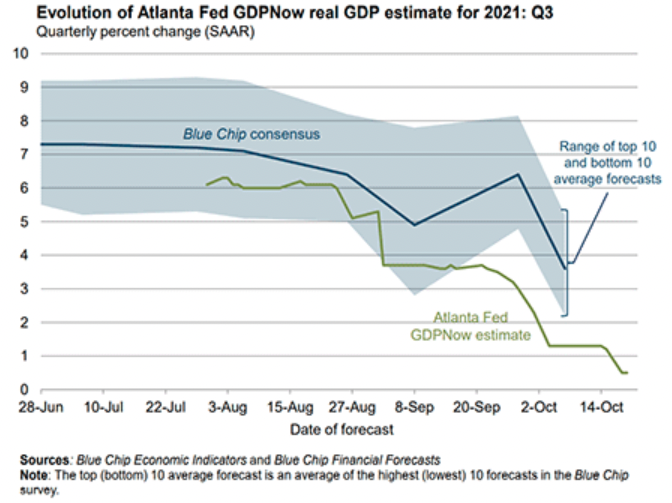
Atlanta Fed watching it melt
Hedging Inflation
Hedging both inflation and deflation may seem odd – make up your mind. But the key here is that, like an incontinent dog that pees when startled, today’s central banks print money in response to any sudden movement. They print when they’re happy – the economy can soak it up. And they print when they’re scared – the economy needs it.
One might think central banking has become an elaborate hoax to print as much money as possible no matter what, which is basically true. Of course, they print not because it’s the correct thing to do, but because legal counterfeiting is their business — barbers are paid to cut hair, central bankers are paid to print money.
To be sure, happy-printing and scared-printing lead to different collateral damage for the economy. Printing in good times sparks a “tissue fire” boom that creates malinvestments -- investments that only happened because money was so cheap. While printing in bad times slows the liquidation of those malinvestments until some become “zombies” like Japan has endured for decades. If you’re interested, there was a whole “liquidationism” debate in the 1930’s which, obviously, the good guys lost.
Still, what both stages of printing do have in common is they dilute your money. This automatically benefits anything priced in dollars, like Bitcoin or, say, donuts. And it can reinforce since dollars, having no intrinsic value, float on expectations about how much the central bank will magic up in future. So it’s possible that even a small printing can lead to a large drop in purchasing power if people expect the printing to go nuts. While the more usual is that a large printing, like the 40% jump in dollars in 2020, leads to a small change in value since people don’t expect it to last or don’t expect all those dollars to circulate “in the wild” for long.
Hedging Deflation
What about deflation, shouldn’t that do the opposite? After all if Bitcoin is priced in dollars, then a stronger dollar should reduce Bitcoin’s price. And here the key is where the deflation is coming from. It it’s healthy deflation driven by technology or productivity improvements then it would be inherently neutral to the Bitcoin price in dollars. So before the deflation, Bitcoin might be worth $60,000, which buys 3 months at a luxury resort. And after the deflation Bitcoin might still be worth $60,000, which now buys 4 months at that luxury resort. Good for Bitcoiners, just as it’s good for dollar owners.
Alas, this “healthy” deflation is rare nowadays, because central bankers stop it — no sense leaving money-printing opportunities on the table.
So, instead, deflation today is more likely to come from the kind central bankers actually create: debt deflation. This is where a lot of credit evaporates overnight — it won’t be repaid. We saw this in the 1930’s, and again in the 2008 crisis. Of course, in 2008 it didn’t turn to full-blown deflation, because the Fed stepped in – well, it flopped in – with $1.6 trillion of fresh money, of which $1.2 trillion went directly into the banking system.
The Fed has never regretted that 13-figure bail-out, nobody went to jail for it, and they repeated that script in Covid. So we can be fairly certain they’ll do it again next time.
The Dreaded Goldilocks
Now the final possibility, the one that keeps goldbugs up at night: Goldilocks. A scenario where governments and central bankers steer the ship of economy through the shoals and hurricanes until we end up with pretty good growth and pretty good inflation. Say, 2% on both.
The reason for focusing here is because Goldilocks scenarios have been terrible for gold these past 50 years. Indeed, gold’s three big losing streaks since the 70’s have been the early 80’s, the late 90’s, and the early 2010’s. All periods of economic calm where people relaxed, stopped worrying about the future, were happy enough to leave it to government, and sold their boring gold for exciting plastics, dot-coms, or electric car stonks.
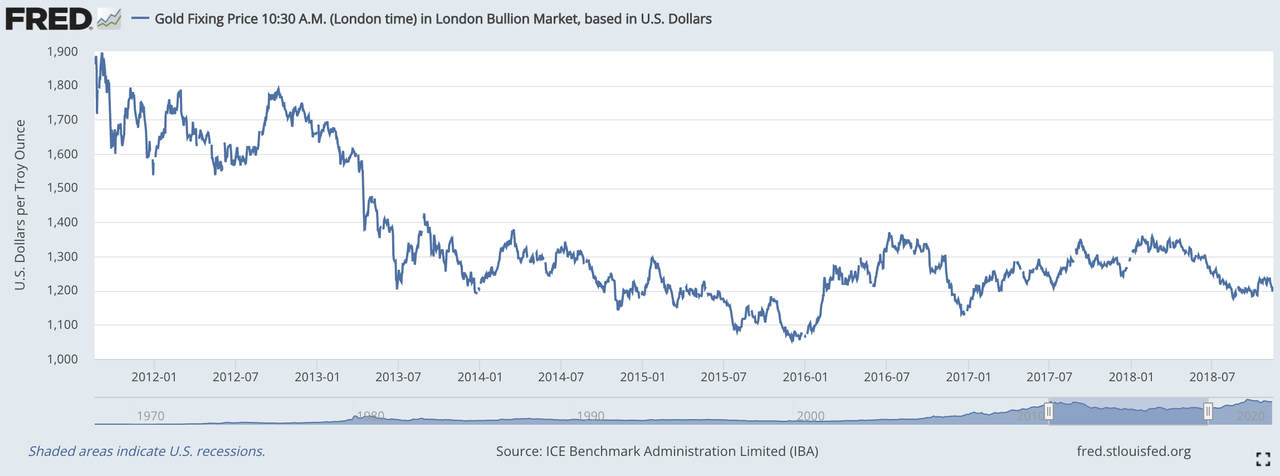

Gold vs Bitcoin: Goldilocks has a favorite
Setting aside how unlikely Goldilocks is given the gang in charge, even in that doldrums scenario Bitcoin is likely to do just fine. Because, unlike gold, Bitcoin has enormous underlying user growth – currently running 40% year-on-year in the number of wallets in existence.
Indeed, remember that up until Covid we’d been in roughly a decade of Goldilocks, during which gold dropped from $1,900 to under $1,200, while Bitcoin went from one five-thousandth of a Papa John’s pizza to $8,000 on the eve of Covid.
I’ve written about some reasons why this secular growth might actually accelerate in the years to come, including El Salvador’s legal tender law that raises Bitcoin’s odds of replacing fiat, and rapid growth in Bitcoin’s Lightning Network that make it a superior daily-use money. One could imagine other reasons – demographics, regulation, company and investor learning curves. And the punchline is even in the classic macro doldrums scenario, Bitcoin’s got a lot else going on besides macro.
Conclusion
Boiling it down, inflation is always good for money hedges, and in this crisis Bitcoin has so far replaced gold as the hedge of choice. If we instead get deflation, it’s good-to-neutral for Bitcoin but, given today’s Fed, will probably be converted to inflation anyway. And in that last “Goldilocks” scenario, Bitcoin’s underlying growth is likely to carry any slack, sparing it gold’s humiliating plunge into periodic obscurity.
Finally, which macro outcome is most likely? You’d make a lot of money guessing that correctly, and there are excellent arguments for both inflation, stagnation, and even their demon offspring, stagflation. For now, unless you actually enjoy existential speculation, I think the prudent hedge is simply buy and hodl Bitcoin.
Australia Backs $1.6 Billion Buy of Pacific Mobile Networks
Deal is latest effort to own telecommunications infrastructure in region where China is seeking influence
SYDNEY—Australia is backing the purchase of mobile networks in six Pacific countries, a move that foreign-policy experts say is designed to block a military rival from buying the strategically important assets.
The government said its export-finance arm agreed to provide $1.33 billion in funding to support the $1.6 billion purchase by Telstra Corp. , Australia’s biggest communications provider, of the networks in Papua New Guinea, Fiji, Nauru, Samoa, Tonga and Vanuatu. The networks, being bought from Jamaica-based Digicel Group, are adjacent to subsea cables that carry communications between Australia and its neighbors.
“It’s ensuring that a potential adversarial power doesn’t own infrastructure which would impact on not just Australia’s communications capabilities, but also its military capabilities,” said John Lee, a senior fellow at the United States Studies Centre at the University of Sydney. “Underwater warfare is increasingly important and these cables are directly relevant to that.”
Australia has been seeking to raise its profile in the Pacific and invest more in a region dominated since World War II by the U.S. and its allies but increasingly courted by China. Three years ago, Australia said it would offer Pacific Island nations more than $2 billion for infrastructure projects while bolstering military cooperation.
Telecommunications infrastructure has been a particular concern. In 2018, Australia said it would build an undersea high-speed internet cable to the Solomon Islands, shutting out China’s Huawei Technologies Co. from the project. Australia had earlier banned Huawei from involvement in its own 5G mobile network.
It isn’t known whether China was interested in acquiring Digicel Group’s mobile networks in the Pacific, and China’s Australian Embassy didn’t respond to requests for comment.
However, the Australian government’s outlay on the deal is larger than its annual aid budget for Papua New Guinea and the Pacific, estimated at 1.44 billion Australian dollars, equivalent to US$1.08 billion, for the 12 months through next June. That indicated the transaction was driven by geostrategic concerns and a desire to build the presence of Australian businesses in the Pacific, said Jonathan Pryke, Pacific Islands director at the Lowy Institute, a think tank in Sydney.
Australia’s Department of Foreign Affairs and Trade said funding for the deal was part of the government’s Pacific Step Up initiative, meant develop secure and reliable infrastructure in the region. The government-owned Export Finance Australia will help to manage financial and other risks associated with the acquisition, it added.
“Telstra’s acquisition sends an important signal about the company’s potential and about wider business confidence in the future of the Pacific region,” the department said.
The Australian government first approached Telstra about pursuing a deal around 10 months ago, said Andrew Penn, Telstra’s chief executive. The company considered the Digicel Pacific business to be a commercially attractive asset that would boost its earnings, but the transaction also strengthened its relationship with the Australian government, he said.
Mr. Pryke, of the Lowy Institute, said the deal is an opportunity for Telstra to work with the government ahead of the likely privatization of Australia’s National Broadband Network. Telstra and other providers currently lease access to the network, which was a government stimulus program following the global financial crisis more than a decade ago.
Confirming the deal, Digicel Group said the Digicel Pacific brand would remain in all markets and the current management team would remain with the company.
October 25, 2021

MAKOR: DAI GY - TRUCKS SPIN OFF
The Daimler Trucks spin-off requires making several assumptions and we are still missing a lot of details including:
• How and when the Mobility division will be split
• How and when the pension liabilities will be split
• Precise details on the respective balance sheets.
Daimler Trucks Capital markets day is on November 11th , and we hope to gain more understanding on the various details mentioned above and others.
We come up with the following NAV per DAI share:
• Actual Daimler NAV per DAI share at €111
• Expected Mercedes Benz NAV per DAI share at €88 (pre holding discount)
• Expected Daimler Trucks NAV per DAI share at €22 (NAV of €37,024, 826m shares outstanding, 0.5 ratio)
In our opinion, several trades could be considered:
• Hoping for a reduction of the holding discount
o When considering our central scenario of a Mercedes Benz’s holding discount of 12%, the combined value of Mercedes Benz and Daimler Trucks could be €100 per DAI share, hence a 21% upside
o We would set up the trade by going long DAI and by shorting 62% of your position in BMW and 38% in a basket of VOLVB and PCAR (no need to hedge the mobility business)
o You would theoretically have no directional exposure
• Playing the Mercedes Benz re-rating
o If Mercedes Benz were to trade on 5.8x EV/EBIT 22E versus the multiple we use of 3.8x, you would have 22% upside
o We would set up the trade by going long DAI and by shorting 38% of your position in a basket of VOLVB and PCAR to protect yourself from a contraction of Trucks’ multiples
o You would be directionally exposed to the auto business
• Buying Daimler Trucks on the spin-off date
o The upside will depend on how far down will Daimler Trucks trade down on spin-off day
o Indeed, Daimler Trucks will not immediately be included in the DAX and that will trigger a significant flowback following the spin-off
o This is a short-term trade but probably one of the safest and most interesting
o We would set up the trade by going long Daimler Trucks and by shorting $/$ your position in a basket of VOLVB and PCAR.
We elaborate further below on the various aspects of the Spin-off including Timing, Structure , Taxes and other matters.


Makor Capital
11 Menachem Begin St., 26th FL
Ramat Gan 52681
ISRAEL
Tel +972 3 5453 762Fax +972 3 7162 680
Research Disclaimer
This publication has been prepared by Makor Capital Limited (“Makor Capital”) and is intended for professional or qualified investors only. Makor Securities London Ltd (“Makor Securities”)is distributing this material to its clients who are Eligible Counterparties or Professional Clients under FCA Rules. It may also be disseminated to persons who are Investment Professionals within the meaning of the Financial Services and Markets Act 2000 (Financial Promotion Order 2005). In the United States, Makor Capital only distributes this material to major US institutional investors (as that term is defined in Rule 15a-6 of the Securities and Exchange Act of 1934) and to SEC-registered broker-dealers or banks acting in a broker–dealer capacity. This material is not intended for distribution to any other persons and should not be redistributed. If you do not fall into any of these categories you should disregard it.
This material is a marketing communication. It is not investment research and has not been prepared in accordance with legal requirements designed to promote the independence of investment research. It is not subject to any prohibition on dealing ahead of the dissemination of investment research under U.K. law. This material is not a research report and is not intended to be a research report as defined under U.S. securities laws and regulations. This material is not intended to provide information reasonably sufficient upon which to base any investment decision.
This material does not take into account the particular investment objectives, financial situation or needs of individual clients or other recipients. Before acting on this material, clients and other recipients should consider whether it is suitable for their particular circumstances and, if necessary, seek professional advice.
This material should not be construed in any circumstances as an offer to sell or solicitation of any offer to buy any security or other financial instrument, nor shall it, or the fact of its distribution, form the basis of, or be relied upon in connection with, any contract relating to such action.
In the United States, Makor Capital does not offer securities services to U.S. persons except pursuant to SEC Rule 15a-6 only to major US institutional investors and SEC registered broker-dealers or banks acting in a broker–dealer capacity. Transactions in the United States must be effected through the U.S. broker-dealer, Oscar Gruss & Son Incorporated. Oscar Gruss & Son has not prepared, reviewed or distributed this material.
Some of this material is produced by providers which Makor Securities believes to be reliable, but Makor Securities does not warrant or represent (expressly or impliedly) that it is accurate, complete, not misleading or as to its fitness for the purpose intended and it should not be relied upon as such.
Opinions expressed will be the current opinions of those producing this material as of the date appearing on this material only. We expect those producing the material in this publication to update it on a timely basis but can give no undertaking that they will do so and regulatory compliance or other reasons may prevent them from doing so (or us from disseminating updated material).
Members and employees of Makor Securities London Ltd, employees of Makor Capital, Makor Capital Markets may from time to time have long or short positions in securities, warrants, futures, options, derivatives or other financial instruments referred to in this material. For Makor Securities, this information is set out in our Conflicts of Interest Policy which is available on request. Policies for the production of research from other research providers are available on request. Unless otherwise stated, share prices provided within this material are as at the close of business on the day prior to the date of the material.
Neither the whole nor any part of this material may be duplicated in any form or by any means. Neither should any of this material be redistributed or disclosed to anyone without prior consent. This material is issued for general information and discussion purposes only. None of Makor Securities, Makor Capital, Makor Capital Markets accepts liability whatsoever for any direct, indirect or consequential loss or damage of any kind arising out of the use of all or any of this material.
The services, securities and investments discussed in this material may not be available to, nor are suitable for all investors. Investors should make their own investment decisions based upon their own financial objectives and financial resources and it should be noted that investment involves risk, including the risk of capital loss. Past performance is no guide to future performance. In relation to securities denominated in foreign currency, movements in exchange rates will have an effect on the value, either favourable or unfavourable.
All investors. Investors should make their own investment decisions based upon their own financial objectives and financial resources and it should be noted that investment involves risk, including the risk of capital loss. Past performance is no guide to future performance. In relation to securities denominated in foreign currency, movements in exchange rates will have an effect on the value, either favourable or unfavourable.
Entities
Makor Securities London Ltd is authorised and regulated by the Financial Conduct
Authority (FCA registration number 625054)
Makor Capital, company number 514456466, is incorporated in Israel and is a 100% held
subsidiary of Makor Holdings Pte Ltd incorporated in Singapore.
Makor Capital Markets SA, company number CH-660.2.999.011-0 is incorporated in Switzerland
and is also a 100% held subsidiary of Makor Holdings Pte Ltd.
Having trouble viewing this email? Click here
Powered by


>>> Up
* EasyJet Raised to Hold at Stifel; PT 600 pence
* Fraport Raised to Buy at Kempen & Co; PT 73 euros
* Fraport Raised to Buy at Kempen & Co; PT 73 euros
* Intershop Comms Raised to Buy at Quirin Privatbank AG
* MTU Aero Raised to Buy at Stifel; PT 230 euros
* Provident Raised to Add at Peel Hunt; PT 377 pence
* Rexel Raised to Buy at Kepler Cheuvreux; PT 22 euros
>>> Down
>>> Down
* ADP Cut to Sell at Kempen & Co; PT 107 euros
* Carnival Cut to Neutral at Citi
* Equinor Cut to Hold at Arctic Securities; PT 240 kroner
* Erytech Pharma Cut to Underperform at Oddo BHF; PT 5.80 euros (+)
* Falck Renewables Cut to Neutral at Kempen & Co; PT 8.90 euros
* James Fisher Cut to Hold at Investec; PT 710 pence (+)
* MDxHealth SA Cut to Neutral at Kempen & Co; PT 1.20 euros
* MDxHealth SA Cut to Neutral at Kempen & Co; PT 1.20 euros
* N Brown Cut to Hold at Jefferies; PT 50 pence
* Munters Cut to Hold at ABG; PT 65 kronor
* Technip Energies Cut to Hold at SocGen; PT 14.60 euros
* Verkkokauppa.com Cut to Reduce at Inderes; PT 8.50 euros
* Whirlpool Cut to Underperform at RBC; PT $190
* Zurich Airport Cut to Neutral at Kempen & Co
>>> Initiation
* E-Pango SAS Rated New Buy at Gilbert Dupont; PT 15.60 euros
>>> Initiation
* E-Pango SAS Rated New Buy at Gilbert Dupont; PT 15.60 euros
* Huhtamaki Raised to Buy With Risk-Reward Now Positive: Jefferies
* Norwegian Cruise Rated New Buy at Citi
* PhosAgro GDRs Reinstated Buy at Raiffeisen Bank; PT $34.30
>>> Call
>>> Call
* Darktrace Shares Have 50% Downside on Competition: Peel Hunt (+)
* Oncopeptides PT Removed at HC Wainwright on Bankruptcy Risk
* Oncopeptides PT Removed at HC Wainwright on Bankruptcy Risk
* UniCredit Failed Talks Puts Focus on M&A Alternatives: Jefferies
* Weir at ‘Compelling’ Entry Point, Exane Upgrades to Outperform