
DAX:
- Infineon (IFX TH) +1.5%
- Infineon Forecasts ‘Strong’ 2022 on Back of High Chips Demand
- Delivery Hero (DHER TH) +0.9%
- Delivery Hero Overweight at Morgan Stanley on Orders Momentum
- VW (VOW3 TH) +0.9%
- VW Plots New German Electric Car Factory to Counter Tesla
- Allianz (ALV TH) +0.6%
- Allianz 3Q Operating Profit Beats Estimates
- E.On (EOAN TH) +0.6%
- EON’s Profit Jumps as Cold Weather Boosts Power Demand (1)
- Siemens Energy (ENR TH) -0.5%
- Siemens Energy Vows to Improve on Profit After Losses Narrow
- Adidas (ADS TH) -3.1%
- Adidas Hit by Supply-Chain Woes as Asia Snags Delay Shoe Sales
MDAX:
- Evotec SE (EVT TH) +1.1%
- Evotec Says $40M Payments from Bristol Myers Squibb Triggered
- ProSieben (PSM TH) +1%
SDAX:
- Home24 (H24 TH) +5.7%
- Home24 Sees FY Rev. Ex-FX +28% to +32%, Saw +28.0% to +38%
- SMA Solar (S92 TH) +4.1%
- SMA Solar 9M Ebitda EU52.9M Vs. EU41M Y/y
- Synlab (SYAB TH) +2.7%
- Synlab Sees FY Adjusted Ebitda Margin Above 30%, Saw About 30%
- Deutz (DEZ TH) +2.3%
- Deutz 3Q Adjusted Ebit EU14.1M Vs. Loss EU15.7M Y/y
- flatexDEGIRO (FTK TH) +1.4%
- Hensoldt (HAG TH) -0.4%
- Hensoldt Sees FY Adjusted Ebitda Margin Above 18%, Saw About 18%
- VERBIO Vereinigte (VBK TH) -0.9%
- LPKF (LPK TH) -1%
- Schaeffler (SHA TH) -1.4%
- Shares gained 12% yesterday
Comment Anne Hidalgo, LVMH et les marques de luxe veulent relancer les Champs-Elysées
Attentats, gilets jaunes, pandémie. Après une série d'années noires, les Champs-Elysées ont vu leur trafic fondre. Mais à la faveur de la nomination de Jean-Marc Jamet, secrétaire général de LVMH, à la présidence du Comité Champs-Elysées, les enseignes de l'avenue sont bien décidées à redorer son blason. Avec l'aide d'Anne Hidalgo?

Comme un symbole. Il y a onze ans, le mois d’octobre avait un goût de victoire pour H&M. Après cinq ans de négociations, la mairie de Paris l’autorisait enfin à inaugurer son premier magasin sur une avenue phare… les Champs-Elysées. Une consécration pour l’enseigne de fast fashion, alors au faîte de sa gloire. Une décennie plus tard, son étoile a pâli… Et celle de l’avenue parisienne aussi. Alors que le suédois a annoncé le 27 octobre la fermeture imminente de son flagship sur la plus belle avenue du monde, la question se pose: aurait-elle perdu de son prestige?
Ces dernières années, la boîte de nuit Queen, les américains Gap et Abercrombie ou encore le britannique Marks & Spencer ont plié bagage. A qui la faute? "Les violences liées au mouvement des “gilets jaunes” ont terni l’image des Champs-Elysées en France et dans le monde", assure Yohann Petiot, directeur général de l’Alliance du commerce. Du jour au lendemain, les commerçants, qui avaient déjà subi l’effet des attentats de 2015 sur le tourisme et les manifestations contre la loi Travail, ont dû fermer plusieurs samedis pour éviter d’être vandalisés. Au même moment, ils continuaient de débourser des loyers exorbitants, dépassant 10 millions d’euros pour 2.500 mètres carrés. L’irruption de la crise sanitaire n’a fait qu’aggraver leur situation, les contraignant à tirer leurs rideaux, alors que les visiteurs internationaux désertaient et que les salariés parisiens passaient au télétravail.
Trafic en baisse, vacance commerciale en hausse
Résultat, l’an dernier, hors période de fermeture, selon le panel Retail Int., l’avenue a subi une baisse d’activité de 38%. Et cette année, entre janvier et juillet, son chiffre d’affaires a chuté de 52% par rapport à la même période en 2019, selon Procos. Par comparaison, celui de la rue de Rivoli n’a baissé que de 32%, et celui du boulevard Haussmann, de 36%. "Avant les “gilets jaunes”, entre 100.000 et 300.000 personnes passaient chaque jour sur les Champs-Elysées", rappelle Eric Costa, président de Citynove, la foncière des Galeries Lafayette, installées sur l’avenue depuis 2019. "Aujourd’hui, c’est 75.000." La vacance commerciale a bondi de 1% à 6,8% depuis 2015. De là à reléguer les Champs au second plan? Non. Car quand certains commerçants ferment boutique, d’autres se précipitent. "La vacance est liée à la transformation de l’avenue, à des opérations immobilières", avance Eric Costa. "Le départ de plusieurs enseignes, et en particulier des constructeurs automobiles et des cinémas, a permis de restructurer des surfaces pour créer des flagships qui correspondent mieux aux attentes des grandes marques internationales comme Apple ou Nike."

Le pire serait-il derrière nous? L’été a permis de renouer avec les visites touristiques, confirmées par la reprise économique de la rentrée. "Nous n’avons pas encore retrouvé la fréquentation de 2018, mais en quelques mois, nous sommes déjà revenus à celle de 2019", rassure Marc-Antoine Jamet, du Comité Champs-Elysées, qui regroupe 180 acteurs. Les marques de luxe Carven, Moncler, L’Oréal ou encore l’Occitane ont rejoint les Champs, tandis que Lacoste a prévu d’agrandir sa boutique. La maison de couture Saint Laurent (groupe Kering) devrait confirmer son arrivée prochaine. Groupama a lancé un vaste projet de rénovation au numéro 150, à l’emplacement des anciens cinémas George V, qui seront transformés en bureaux, boutiques et hôtel, et les trois galeries commerciales de l’avenue sont en travaux.
Un enjeu de taille pour LVMH... et Anne Hidalgo
Pour LVMH (actionnaire de Challenges), les Champs-Elysées restent plus que jamais un axe stratégique. "Quoi qu’on pense de son état actuel, c’est un lieu intemporel avec une force théâtrale unique, une scène qui offre une visibilité et un porte-voix puissants", confirme Marc-Antoine Jamet, qui est aussi secrétaire général du numéro un mondial du luxe. Le groupe de Bernard Arnault fait donc le pari que les Champs-Elysées resteront un rendez-vous incontournable du tourisme mondial. Pas moins de neuf marques de LVMH y sont présentes, dont Dior, qui en rachetant le siège de HSBC, au numéro 103, a décidé d’y établir son quartier général mondial. Louis Vuitton, présent sur l’avenue depuis plus de cent ans, vient de renouveler son bail pour dix-huit ans en mai avec Gecina et entame en 2022 une rénovation de son magasin phare, pour le doter notamment d’une immense terrasse sur le toit. Marc-Antoine Jamet, qui gère aussi l’immobilier de LVMH, a pris en juin dernier la présidence du Comité Champs-Elysées.
Un signe de plus de l’intérêt que porte le groupe de luxe à l’avenir des Champs. Cet homme clé, élu socialiste en Normandie, dispose d’un puissant carnet d’adresses auprès des foncières et des politiques, en particulier à la mairie de Paris. Sa priorité? Réenchanter les Champs-Elysées, leur redonner une forme d’attractivité surtout auprès des Parisiens (seulement 5% des visiteurs). Une réflexion a bien été lancée sur la refonte complète de l’artère. Le Comité Champs-Elysées a mandaté en 2020 l’architecte Philippe Chiambaretta, réputé entretenir de bonnes relations avec la mairie. Son esquisse a permis de définir des principes généraux: réaménager les espaces verts du bas de l’avenue, repenser l’éclairage, piétonniser certains abords et réduire la voirie. Un cahier des charges est en cours d’élaboration. Sa mise en œuvre, pour environ 3 millions d’euros, pourrait être cofinancée par le privé et la mairie, avec un comité de pilotage coprésidé par Emmanuel Grégoire, premier adjoint d’Anne Hidalgo, et Marc-Antoine Jamet.
D’ici aux jeux Olympiques de 2024, la mairie commencera un premier relifting: rénovation de la voirie, retour des grilles au pied des arbres, homogénéisation des terrasses. "Des annonces seront faites d’ici la fin de l’année", prévient l’Hôtel de Ville. Les travaux de grande ampleur seraient remisés après les Jeux, dont le périmètre, en discussion, intégrerait l’avenue de la Grande-Armée. Les grandes lignes budgétaires sont posées: autour de 200 millions d’euros. Mais des sujets majeurs ne sont pas tranchés: faut-il intégrer la Concorde et l’avenue Winston Churchill? Les rendre tout ou partie piétonnes ? La maire candidate à la présidentielle, Anne Hidalgo, veut pousser le sujet durant la campagne et compte sur les marques de luxe pour financer son plan. Pas gagné.
Stocks and equity futures fell Wednesday as Chinese data fueled concerns about inflationary pressures in the global economy. Treasury yields climbed ahead of a report on U.S. consumer prices.
Shares fell in Japan, Hong Kong and China, where factory-gate prices grew at the fastest pace in 26 years and consumer-price inflation topped estimates. China’s property sector also continues to damp sentiment: developer Fantasia Holdings Group Co. plunged after resuming trading, while indebted China Evergrande Group faces its biggest payment test on a clutch of dollar bonds.
U.S. and European futures retreated after the S&P 500 declined for the first time in nine sessions, hurt by financial shares. The Nasdaq 100 underperformed, in part on Tesla Inc.’s loss of $199 billion in value on a host of negative news.
Longer maturity U.S. Treasuries pared a climb and the dollar ticked up. Earlier, the 30-year yield reach the lowest since July, with bonds supported by an unwinding of bearish bets.
Traders are awaiting Wednesday’s U.S. consumer-price inflation data, which may deliver the highest print since December 1990. Persistent price pressures that accelerate monetary-policy tightening are among the key risks for global stocks, which remain near record levels.
Oil was steady, while iron ore tumbled on dimming prospects for steel demand owing to China’s real-estate troubles. In cryptocurrencies, Bitcoin was trading below $67,000.
US After Hours Summary: PUBM +22.8%, RNG +22.4%, DASH +18.9%, SAIL +10.8%, DNUT +6.7% higher on earnings; POSH -26.1%, PRPL -25.3%, UPST -18.5%, COIN -12.8% lower on earnings; DASH also to acquire Wolt
Nikkei -0,61% Hang Seng -0.74% CSI -0.81% Shanghai -0.67% Shenzen -0.54%
Eur$ 1.1585 CNH 6.3921 CNY 6.3930 JPY 112.94 GBP 1.3558 CHF 0.9125 RUB 70.8148 TRY 9.7883 WTI$ 84.46 +0.37% Gold 1825.22 -0.36% BTC 66,400 -1.98% ETH 4,720 -1.65%
S&P -0,13% Nasdaq +0.01% EuroStoxx -0,02% FTSE -0,12% Dax -0,01% SMI-0.02%
Macro :
- Pfizer Asks U.S. to Make Covid Boosters Available to All Adults
Macro :
- Pfizer Asks U.S. to Make Covid Boosters Available to All Adults
- Fed Bubble Warning Mostly a Domestic Affair
Keep an eye on :
Keep an eye on :
- AALB NA : Aalberts Reports 10-Month Organic Rev Growth of 17.1% Y/Y
- ADS GY : Adidas FY Gross Margin Forecast Misses Estimates
- AED BB : Aedifica Boosts FY Dividend Per Share Forecast
- AGS BB : Ageas 3Q Net Income Beats Estimates
- AH NA : Ahold Delhaize Boosts FY Adjusted Operating Margin Forecast
- ALC SW : Alcon 3Q Core EPS Beats Estimates
- ALV GY : Allianz 3Q Operating Profit Beats Estimates
- AKE FP : Arkema Boosts FY Ebitda Forecast
- BARN SW : Barry Callebaut FY Sales Meet Estimates
- BEN FP : Beneteau 3Q Sales At Constant Exchange Rates -10.6%
- BCART BB : Biocartis 3Q Cartridge Volumes +29% Y/y
- BPOST BB : Bpost 3Q Adjusted Ebit Beats Estimates
- CA FP : Carrefour CFO Malige Says Grocer Doesn’t Need Consolidation
- CRI FP : Chargeurs 3Q Revenue EU172.9M Vs. EU169.7M Y/y
- COFLE IPO : Cofle to List on Euronext Growth Milan, IPO Price Set at EU13
- CCAP GY : Corestate 9M Adjusted Ebitda EU61M Vs. EU46.1M Y/y
- COIN US : Coinbase 3Q Rev. $1.31B, Est. $1.57B
- ACA FP : Credit Agricole Beats Estimates as Bad-Loan Provisions Decline
- DEZ GY : Deutz 3Q Adjusted Ebit EU14.1M Vs. Loss EU15.7M Y/y
- EDF FP : EDF 9M Organic Revenue +15.7%
- EOAN GY : EON’s Profit Jumps as Colder Weather Boosts Energy Demand
- EQT SS : *EQT STRIKES SECOND ACQUISITION SINCE IPO WITH DEAL TO BUY LSP
- EBS AV : Wellington Reveals Erste Group Stake as Syndicate Holding Falls
- EVT GY : Evotec Says $40M Payments from Bristol Myers Squibb Triggered
- SFER IM : Ferragamo’s Norsa Says FY Sales Analysts Estimates ‘Reasonable’
- GLJ GY : Grenke Boosts FY Net Income Forecast
- HAG GY : Hensoldt Sees FY Adjusted Ebitda Margin Above 18%, Saw About 18%
- H24 GY : Home24 Sees FY Rev. Ex-FX +28% to +32%, Saw +28.0% to +38%
- ICA SS : ICA-Handlarnas Forbund, AMF to Buy ICA for SEK534 a Share
- INDV LN : Indivior Shareholder Scopia to Sell 3.0% Stake Via Placing
- IFX GY : Infineon Sees 1Q Segment Result Margin About 21%, Est. 19.3%
- JEN GY : Jenoptik 3Q Ebitda Beats Estimates
- JUN3 GY : Jungheinrich Maintains FY Ebit EU340M to EU370M
- LEG GY : LEG Immobilien Sees 2022 FFO I EU450M to EU460M
- LEO GY : Leoni 3Q Adjusted Ebit EU29M Vs. Loss EU8.0M Y/y
- LUN DC : Lundbeck 3Q Core Ebit Beats Estimates
- DRLO DC : Noble, Maersk Drilling to Combine in All-Stock Transaction
- NEOEN FP : Neoen 3Q Revenue EU77.7M Vs. EU66.9M Y/y
- PPGN SW : PolyPeptide Group Holder Draupnir Offers ~1.33M Shares: Terms
- PPGN SW : PolyPeptide Group Holder Draupnir Offers ~1.33M Shares: Terms
- ROTH FP : Rothschild & Co 3Q Revenue EU666.7M Vs. EU403.7M Y/y
- RUI FP : Rubis 3Q Revenue EU1.20B
- S92 GY : SMA Solar 9M Ebitda EU52.9M Vs. EU41M Y/y
- SO FP : Somfy Appoints Tobias Schaper as CFO
- SF SS : Stillfront 3Q Ebit Misses Estimates
- SAX GY : Stroeer 3Q Adjusted Net EU56.2M Vs. EU35.7M Y/y
- STLN SW : Swiss Steel Group 3Q Revenue EU765.0M Vs. EU509.4M Y/y
- SYAB GY : Synlab Sees FY Adjusted Ebitda Margin Above 30%, Saw About 30%
- UBI FP : Unity to Buy Weta Digital
- VIV FP : Vivendi to Expand in TV and Movies, Publishing, Advertising: CEO
- VOE GY : Voestalpine 2Q Ebitda Misses Estimates
- VOW3 GY : VW Plots New German Electric Car Factory to Counter Tesla
- WAWI NO : Wallenius Wilhelmsen 3Q Total Revenue Misses Estimates
>>> Up
* Bakkafrost Raised to Hold at Pareto Securities; PT 620 kroner
* Bakkafrost Raised to Hold at Pareto Securities; PT 620 kroner
* Bakkafrost Raised to Hold at ABG; PT 675 kroner
* GE Upgraded as Deutsche Bank Sees Upside to Current Price
* H-Farm Raised to Outperform at EnVent S.p.A.; PT 34 euro cents
* Lloyds Raised to Buy at AlphaValue/Baader
* Norway Royal Salmon Raised to Buy at SEB Equities; PT 210 kroner
* NRC Raised to Buy at DNB Markets; PT 40 kroner
>>> Down
>>> Down
* Ambu Cut to Sell at ABG; PT 161 kroner
* Babcock Cut to Equal-Weight at Barclays; PT 352 pence
* Basic-Fit Cut to Neutral at Citi
* OVB Holding Cut to Accumulate at SRC Research; PT 28 euros
>>> Initiation
* Oxford Nanopore Rated New Neutral at Citi; PT 660 pence
* OVB Holding Cut to Accumulate at SRC Research; PT 28 euros
>>> Initiation
* Oxford Nanopore Rated New Neutral at Citi; PT 660 pence
* Oxford Nanopore Rated New Overweight at Barclays; PT 700 pence
* Oxford Nanopore Rated New Buy at Berenberg; PT 662 pence
>>> Call
>>> Call
* Delivery Hero Overweight at Morgan Stanley on Orders Momentum
* EON Results ‘Marginally Positive,’ Net Debt the Highlight: RBC
* Ferragamo 3Q Mixed Amid Concerns on China Covid Resurgence: Citi
* UBS Sees Japan, European Equities Catching Up With U.S. in 1H22
* UBS Sees Japan, European Equities Catching Up With U.S. in 1H22
Beijing Is Trapped: Chinese Producer Prices Soar At Fastest Pace In 26 Years
China's trade balance may have just hit a record on the back of resurgent exports and slowing inflation, but the favorable impact to China's mercantlist economy was more than wiped out by the just released record PPI and resurgent CPI.
China's National Bureau of Statistics reported that in October, CPI rose 1.5% Y/Y, higher than the 1.4% expected, and a 0.7% sequential increase from the September print; the CPI increase was evenly split between base effect and sequential growth.
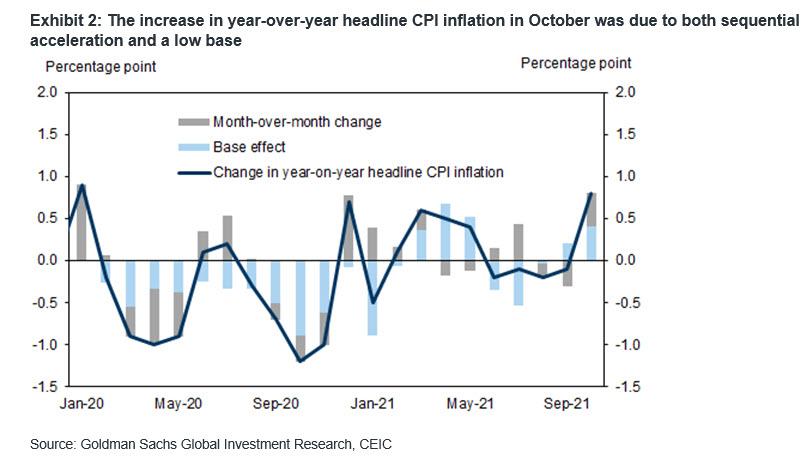
At the same time factory gate, or PPI, inflation hit a fresh all time high of 13.5%, steamrolling the 12.4% consensus estimate, and rising at the fastest pace since records began in November 1995.

While the gradual increase in CPI is alarming, and the NBS said that it was affected by weather, commodities demand and costs - it was the producer price inflation that was far more alarming, soaring as a result of a tight supply of energy and resources. In reality, however, there was just one key variable - thermal coal, which as we said last month indicates that PPI will continue rising far higher, although judging by the recent sharp reversal in the price of Chinese thermal coal (if only for the time being), this may be as high as PPI gets.
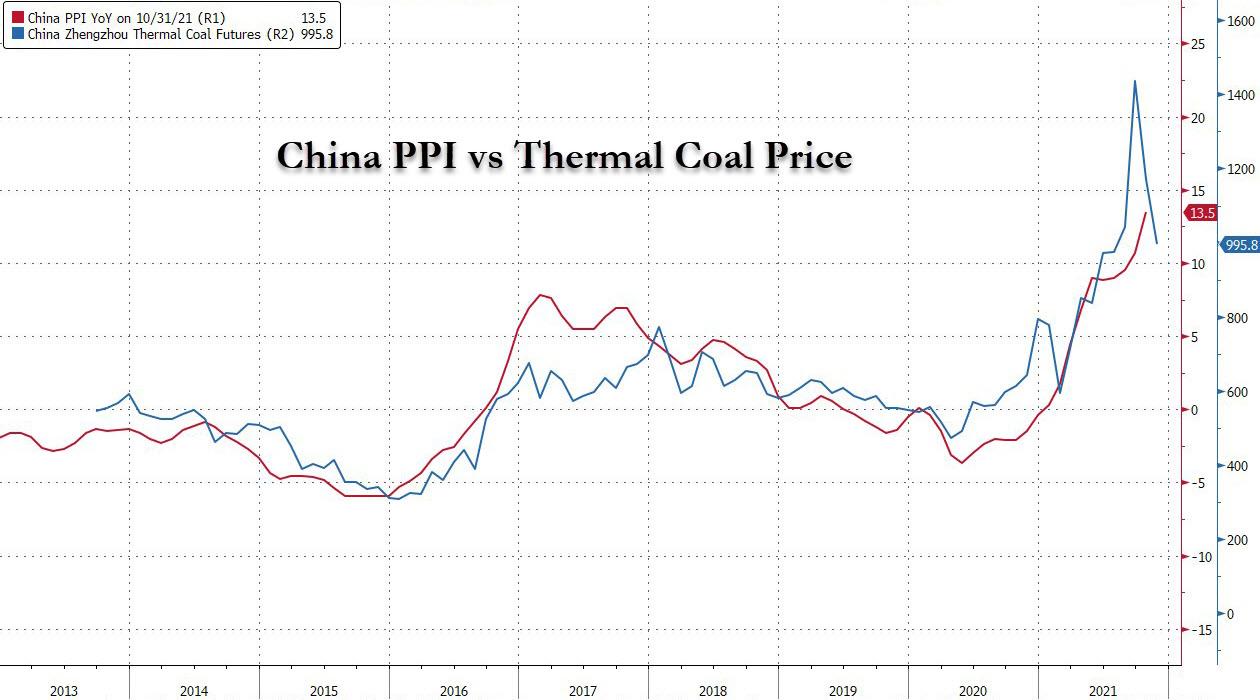
Or so Beijing should hope because with the spread between PPI and CPI hitting a new all time record, virtually no Chinese companies that use commodity inputs - which in China is a vast majority - are making any profits.
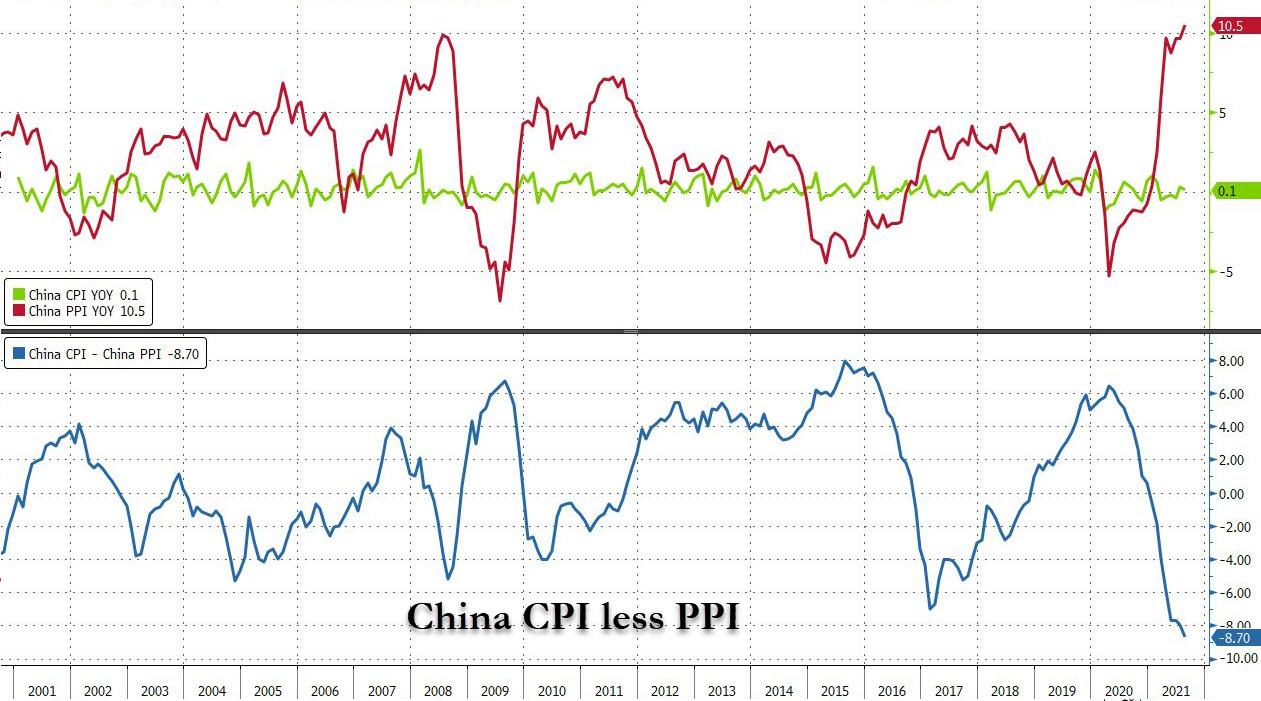
The gap between upstream and downstream prices “continues to highlight weak consumer demand in the economy and the immense pressure on profit margins downstream firms are facing,” said Michelle Lam, greater China economist at Societe Generale SA in Hong Kong.
The latest price jump comes against the backdrop of a weakening economy as electricity shortages, a slump in the property sector and virus outbreaks weigh on activity. Rising inflation will likely reignite the debate over whether the central bank can provide more policy easing to help support growth.
Some more details on the latest data:
- In year-over-year terms, food inflation rose to -2.4% yoy in October from -5.2% yoy in September, due to both a low base and a sequential increase in prices month-on-month. The increase of food inflation in October was broad-based (particularly an extreme increase in vegetable prices). Pork prices, a big driver of CPI, continued to decline in October, and that helped to mask a rise in other food costs. Deflation in pork prices eased slightly to -44.0% yoy in October from -46.9% yoy in September, primarily on a favorable base effect. Overall CPI would have risen almost 2.5% if not for the effects of falling pork prices, according to the NBS.
- Inflation in fresh vegetables rose to 15.9% yoy in October from -2.5% yoy in September, contributing 0.33 percentage point to the increase in CPI while the price of fresh fruits increased to 0.5% yoy in October (vs. -0.8% in September), both primarily on the back of sequential increases in prices. Prices of freshwater fish, eggs and edible vegetable oil also rose sharply in October from a year ago. Vegetable prices have jumped since mid-October following supply disruptions, prompting the government to crack down on hoarders.
- Non-food CPI inflation increased to +2.4% yoy in October from +2.0% yoy in September, primarily on a sequential increase (especially fuel costs). Fuel costs increased by +31.4% yoy in October (vs. +22.8% yoy in September).
- Core CPI inflation (headline CPI excluding food and energy) edged up to +1.3% yoy in October (vs. +1.2% in September), with inflation in services flat at +1.4% yoy in October. In other words, producers are passing on a growing part of their own surging costs on to consumers, but nowhere near all as the record gap between CPI and PPI shows.
- And speaking of PPI, producer price inflation rose to +13.5% yoy in October from +10.7% yoy in September, largely on strong sequential growth. PPI inflation in producer goods rose to +17.9% yoy in October from +14.2% yoy in September, and PPI inflation in consumer goods edged up to +0.6% yoy in October (vs. +0.4% yoy in September). Among major sectors, in seasonally adjusted non-annualized month-over-month terms, inflation in coal mining increased the most (+17.2% in October from +10.5% in September), followed by upstream sectors, such as petroleum/coking and chemicals. In year-over-year terms, coal mining picked up the most due to both high sequential growth and a low base.
Looking ahead, Goldman predicts that headline CPI inflation is likely to continue rising in the coming months as high frequency data suggest that the year-on-year decline in pork prices tightened in early November, and year-on-year inflation in fresh vegetables and fruits picked up. Needless to say, PPI inflation is expected to stay elevated in the near term, although as noted above, October may be the peak given the recent decline in coal prices.
Xing Zhaopeng, China strategist at Australia & New Zealand Banking Group agrees and writes that while the impact of vegetable prices might be short-lived, rising demand before the upcoming Chinese New Year might drive CPI higher in the next couple of months.
Or maybe not, because while Beijing has succeeded in dragging coal prices lower now, it is only at the expense of a far bigger surge in coal in the future. And while China may be facing its first "galloping inflation" PPI print since the early 90s, it's only downhill from there, because as Citigroup wrote recently, power cuts (with over 20 provinces, making up >2/3 of China’s GDP, have rolled out electricity-rationing measures since August) and contractionary PMI "seem to suggest China could enter into at least a short period of stagflation."
Local stocks were certainly not happy, with China’s CSI 300 Index sliding as much as 1.3% amid signs that producers are passing on higher costs to consumers, and that the PBOC may have no choice but to tighten financial conditions at the expense of risk assets. Several food companies have already announced price hikes of up to 15%, including Haixin Foods, Anjoy Foods and Jiajia Food, due to rising costs for raw materials.
The stronger than expected inflation data is “bad news for the A-share market,” according to Ken Chen, an analyst at KGI Securities Co., referring to the stocks of companies listed on mainland exchanges. “The market is expecting some policy support to help the weak economy, but the CPI data may give limited room” for any stimulus, he said echoing what Zhang Zhiwei, chief economist at Pinpoint Asset Management, said last month: “We think the risk of stagflation is rising in China as well as the rest of the world. Persistent inflationary pressure limits the potential scope of monetary policy easing.”
Liu Peiqian, China economist at Natwest Markets expects policy makers to keep prioritizing stabilizing supplies and prices of commodities and raw materials to tame PPI inflation, while the People’s Bank of China is unlikely to tighten monetary policy, as CPI remains well below target.
Commenting on the latest inflation data, Bloomberg's China economist David Qu said that "the acceleration in China’s inflation in October is probably a bit of a side show for the central bank -- we don’t expect the People’s Bank of China to take its eye off the need to cushion a slowdown in the economy. We still expect it cut banks’ required reserve ratio by another 50 basis points in the next month or so."
And so, Beijing is now trapped: if it eases, inflation - already at nosebleed levels - will soar further crushing margins and sparking a deep stagflationary recession; if it does not ease, the property market - already imploding - will crater.
Chinese Developer Fantasia Says Lenders Seek Repayment; Shares Plunge
Company says it is still working with advisers on its liquidity problems
Fantasia Holdings Group Co., the property developer whose surprise bond default last month helped heighten market concerns about Chinese real estate, said some lenders were asking for loans to be repaid early.
The company’s stock, which resumed trading after being halted since late September, plunged 37% Wednesday in Hong Kong to 36 Hong Kong cents a share, the equivalent of about 5 U.S. cents. That put the stock on course for its lowest close in its 12-year history, according to FactSet.
“The company has received notices from certain lenders requesting repayment for loans that are not due,” Fantasia said late Tuesday, adding that it was talking to these lenders about settlement arrangements.
Fantasia added that it was still working with advisers from Houlihan Lokey HLI 0.62% (China) Ltd. and Sidley Austin on its liquidity problems. “The group will continue to implement measures to ease its liquidity issue,” it said, adding that the company’s business could suffer if it failed to repay debt on time or couldn’t reach agreements with creditors.
The Shenzhen-based developer last month failed to repay about $205.7 million of principal due on a maturing bond. It is one of at least six Chinese developers that have recently either defaulted on their debt or asked investors to wait longer for repayment.
Fantasia is also dealing with a steep decline in sales. Last week, it said contracted sales for October totaled about 2.11 billion yuan—the equivalent of about $330 million, and a roughly 62% fall versus the same month a year earlier.
Fantasia was founded in 1996 by Zeng Jie, also known as Baby Zeng, a niece of former Chinese Vice President Zeng Qinghong. The company is known for building high-end residential projects and luxury apartments. Fantasia has dozens of real-estate projects in major metropolitan areas across China, in cities including Beijing, Wuhan, Tianjin and Ningbo.
Fantasia’s 9.875% bonds due 2023 were quoted at 30.5 cents on the dollar on Wednesday in Hong Kong, according to Tradeweb, not far off record lows plumbed late last month. Fantasia has dollar bonds with a face value of about $1.7 billion due between December and the end of next year, according to an October report from Moody’s Investors Service.
More broadly, investors have dumped Chinese property debt, pushing down prices and sending yields soaring. The yield on an ICE BofA index of dollar-denominated Chinese junk bonds, which is dominated by developers, last week leapt above 25% for the first time since the global financial crisis. It stood at 27.9% as of Tuesday’s close.
Kaisa Group Holdings Ltd. , a major borrower in international markets, has become a recent focus of concern after revealing it was on the hook to pay off investors in investment vehicles known as wealth-management products, which it had guaranteed. Earlier this week, Kaisa apologized to investors, pleading for patience and saying it would speed up asset disposals.
In a subsequent statement late Tuesday, Kaisa said that a subsidiary had guaranteed WMPs issued by a company called Shenzhen Jinheng Wealth Management Co., and that Jinheng hadn’t paid back investors when the products came due. Kaisa said it was “ascertaining the amount involved and exploring remedial measures to address the issue.”
While the selloff was initially centered on China Evergrande Group and other developers with lower credit ratings, it has recently widened to include financially stronger developers, which in many cases are also reporting falling sales.
On Wednesday, S&P Global Ratings downgraded Shimao Group Holdings Ltd. , one of China’s larger developers, to junk, saying “challenging operating conditions” mean Shimao’s sales would be weaker than it had previously forecast. S&P cut Shimao by one notch to BB+ and said its outlook on the rating was negative. Shimao’s contracted sales dropped 32% year-over-year in October.
Rivian targets $66.5bn market value with blockbuster IPO
Amazon-backed electric carmaker prices shares at top of range ahead of one of biggest US listings in a decade
The electric vehicle maker Rivian has priced its initial public offering at $78 a share, significantly above expectations, setting the stage for one of the largest US stock market debuts of the past decade.
The company said it had sold 153m shares in the offering, more than the 135m it had expected. Before deductions, the company will raise approximately $11.9bn, the biggest IPO haul since Facebook’s flotation in May 2012.
The Amazon-backed company’s stock is due to first trade on the Nasdaq exchange on Wednesday morning, a filing confirmed on Tuesday evening. At $78 a share, Rivian would have a market value of $66.5bn, or approximately $77bn on a fully-diluted basis.
The offering price represents a significant jump on the initial $52-$62 a share range it had stated at the start of this month, and above its revised offer of $72-$74 announced as recently as Monday.
The elevated target reflects the sky-high expectations for Rivian, which is yet to record any revenue, and has incurred almost $1bn in losses in the first half of this year.
Rivian has just over 50,000 pre-orders for its R1T pick-up truck and R1S sport utility vehicle, as well as an order from Amazon for 100,000 trucks to be delivered by 2025. The ecommerce group participated in several multibillion-dollar funding rounds for Rivian, and owns 22 per cent of the company.
Bullish investors see an opportunity to buy into a company some feel has the potential to emulate the success of Tesla, which in October surpassed a market capitalisation of $1tn.
“The dream they’re selling is pretty extraordinary,” remarked a person who worked on Rivian’s IPO.
“If you think about Rivian’s predecessor in Tesla, and what has been accomplished in that stock, and how it has disrupted that industry and sustained that disruption, the dream around Rivian is pretty real too. It’s captivating.”