>>> TradeGate Pre-Market Indications

DAX:
  • MTU Aero (MTX TH) +3.4%
    • Watch Travel Stocks Again; Citi Says Variant Downside Priced In
  • Airbus (AIR TH) +2.2%
  • Allianz (ALV TH) +2.2%
  • HelloFresh (HFG TH) +2.1%
  • Munich Re (MUV2 TH) +2%
  • HeidelbergCement (HEI TH) -0.4%
    • HeidelbergCement Cut to Hold at Jefferies; PT 65.30 euros
MDAX:
  • Lufthansa (LHA TH) +4.3%
    • Omicron Curbs From Japan to Spain Wreak Havoc on Air Travel
  • Gerresheimer (GXI TH) +2.6%
  • Fraport (FRA TH) +2.3%
  • Lanxess (LXS TH) +2.1%
  • Telefonica Deutschland (O2D TH) +1.7%
  • Software AG (SOW TH) -1.2%
  • Vantage Towers (VTWR TH) -1.8%
SDAX:
  • Synlab (SYAB TH) +7.3%
  • Bilfinger (GBF TH) +4.5%
  • Home24 (H24 TH) +2.7%
  • Traton (8TRA TH) +2.6%
  • Dermapharm (DMP TH) +2.5%
  • Nordex (NDX1 TH) -1%
  • Siltronic (WAF TH) -1%
  • About You (YOU TH) -1.6%

>>> Europe : Brokers Upgrades & Downgrades - 29th of November 20

>>> Up
* British Land Raised to Buy at Panmure Gordon; PT 828 pence
* BW Energy Raised to Buy at SpareBank; PT 30 kroner
* Forterra Raised to Buy at Citi
* GB Group Raised to Overweight at Barclays; PT 1,000 pence
* Homeserve Raised to Hold at HSBC; PT 980 pence
* Hyatt Raised to Overweight at JPMorgan; PT $101
* Maersk Raised to Overweight at JPMorgan; PT 26,965 kroner
* Telenor Raised to Buy at SpareBank; PT 160 kroner
* Xplora Technologies Raised to Buy at SpareBank; PT 30 kroner

>>> Down
* abrdn plc Cut to Underweight at Morgan Stanley
* Amundi Cut to Equal-Weight at Morgan Stanley
* BW Energy Cut to Hold at ABG; PT 21 kroner
* ContextVision AB Cut to Neutral at SpareBank; PT 22 kroner
* Continental Cut to Sell at Goldman; PT 100 euros
* Hargreaves Lansdown Cut to Underweight at Morgan Stanley
* HeidelbergCement Cut to Hold at Jefferies; PT 65.30 euros
* DNB Bank Cut to Underweight at Morgan Stanley
* Sparebanken Vest Cut to Hold at Arctic Securities; PT 99 kroner
* Swedbank Cut to Equal-Weight at Morgan Stanley

>>> Initiate
* Allegro Rated New Underperform at Oddo BHF; PT 40 zloty
* Asos Rated New Neutral at Oddo BHF; PT 3,000 pence
* Byggfakta Group Nordic Holdco Rated New Buy at Jefferies
* Byggfakta Group Nordic Holdco Rated New Equal-Weight at Barclays
* Ctek Rated New Hold at Carnegie; PT 190 kronor
* Evotec SE Rated New Buy at Jefferies; PT 55 euros
* Hemnet Resumed Neutral at Citi; PT 185 kronor
* Saga Pure ASA Rated New Buy at SpareBank; PT 5 kroner
* Stellantis Resumed Buy at Citi

>>> Call
* Continental Down to Sell on Lower Volumes, Higher Costs: Goldman
* Evotec Initiated Buy at Jefferies on Differentiated Platform
* Kingspan Raised at Jefferies, Among 2022 Picks in Construction
* VW Cut to Neutral, Selective Upside at Stellantis, Renault: Citi

>>> What to look at today - 29th of November 2021

U.S. and European equity futures climbed Monday along with crude oil and Treasury yields as investors tried to calibrate economic risks from the omicron coronavirus strain, bringing some calm back to markets.
S&P 500, Nasdaq 100 and European contracts jumped, WTI oil rallied back to around $71 a barrel and the 10-year U.S. Treasury yield rose past 1.50%. Asian stocks fell but the moves were smaller than during Friday’s global equity selloff, which wiped out more than $2 trillion in market value. 
The euro slipped and a dollar gauge was steady. The currency of South Africa, where the variant was identified, climbed against the greenback. While much remains unanswered about the new strain, two South African health experts suggested it’s presenting with mild symptoms so far. The World Health Organization urged caution, saying it will take time to assess the pathogen. 
Traders have pushed back the expected timing of a first 25-basis-point rate hike by the Federal Reserve to July from June. Fed Bank of Atlanta President Raphael Bostic played down economic risks from a new variant, saying he’s open to a quicker paring of asset purchases to curb inflation.
Investors are trying to work out if the omicron flareup ends up being a relatively brief scare that markets eventually rebound from, or a bigger blow to the global economic recovery. The prospect of tighter monetary policy to tackle price pressures was already complicating the outlook.
Japan led declines in the Asian equity session after the government shut borders to visitors. The region’s reopening stocks such as restaurants, department stores, train operators and travel shares also suffered some losses. 

Nikkei -1,63% Hang Seng -1,20% CSI -0,50% Shanghai -0,31% Shenzen +0,18%

Eur$ 1,1278 CNH 6,3855 JPY 113,29 GBP 1,3336 CHF 0,9262 TRY 12,6585 RUB 74,86 WTI 71,37 Gold 1795,5 BTC 57,400 +1000 ETH 4335 +80

S&P +0,90% Nasdaq +1,17% EuroSToxx +1,61% FTSE +1,19% SMI

Macro :
- Lagarde Says Expect Inflation to Start Easing From January: FAS
- Risk Appetite Recovers as Traders Rethink Omicron: Macro Squawk

Keep an eye on :
- 24STOR SS : TIAA Agrees to Buy 24Storage for SEK76 a Share (1)
- AZN LN : AstraZeneca Studying New Covid Variant’s Impact on Vaccine
- EN FP : France to Provide EU150M for ‘Compex’ Rural Fiber Connections
- BP/ LN : BP Plans Green Hydrogen Base in U.K. as Transition Speeds Up
- BT/ LN : Private Equity Sizes Up BT’s Openreach: Mail on Sunday (Nov. 27)
- IAG LN : British Airways Temporarily Halts Hong Kong Flights, SCMP Says
- ROO LN : Deliveroo Expected To Pick Goldman, Barclays as Brokers: Sky
- DBK GY : Deutsche Bank ‘Appreciates’ Increased Stake by Capital Group
- D>IA SM : FDA Approves QuantiFERON-TB Gold Plus on LIAISON XS: Diasorin
- EAS2P NA : Ease2pay Agrees to Buy Involtum for 10.7M Newly Issued Shares
- ENI IM : Eni Sells Snam Stake in Algeria Pipelines for 385 Million Euros
- FB US : U.K. Regulator Expected to Block Meta’s Giphy Deal: FT
- EO FP : Faurecia SE Sees FY Sales EU15B to EU15.5B, Saw About EU15.5B
- HAFNI NO : Hafnia CEO Says Green Transition May Lead to Consolidation: JP
- INGA NA : SocGen Still Favorite to Buy ING’s French Retail, Les Echos Says
- INTC US : Intel Should Announce EU Chip Site Within Days, Breton Says
_ KBX GY : Knorr-Bremse Sees Annual Rev. Growth of 5.5% to 6.5% Until 2025
- LHA GY : Lufthansa CEO Says Germany Earned ~EU1B on Stakeholding: WAZ
- MMH LN : MCH Considering a Possible Sale of Entire Stake in MMH
- MRNA US : Moderna to Advance Omicron-Specific Booster Candidate
- ORA FP : France to Provide EU150M for ‘Compex’ Rural Fiber Connections
- ROTH FP : SNCF Hires Rothschild for Potential Sale of Akiem Stake: Echos
- SRG IM : Eni Sells Snam Stake in Algeria Pipelines for 385 Million Euros
- SRG IM : Snam Is Said to Receive Approaches for Gas Storage Business
- GLE FP : SocGen Still Favorite to Buy ING’s French Retail, Les Echos Says
- TECH NO : Techstep Sells VCC Businesses to Zisson, Soluno for NOK65.5m
- TEL NO : Telenor Says Appeal Rejected on NOK788 Million Antitrust Fee
- TIT IM : Telecom Italia Names Labriola General Manager After CEO Resigned

(ZH) Is Peak Social Media Already Behind Us?

Is Peak Social Media Already Behind Us?

The growth of social media's influence in our daily digital lives has been astounding over the last few years. According to figures in the latest Statista Digital Economy Compass, the global average time spent using social media platforms per day is 142 minutes in 2021 - far higher than the 90 minutes recorded in 2012.
However, as Statista's Martin Armstrong details below, this growth has plateaued in recent years and the latest figure even represents a year-over-year decrease of three minutes.
You will find more infographics at Statista
So, 17 years after the birth of Facebook, is peak social media already behind us?
This is a question analysts and investors have been pondering for a few years already. While specific platforms will experience fluctuations in user numbers, and some will become obsolete (see Myspace), the market potential still not fully unlocked in developing economies should mean that social media will be able to find at least one more gear to shift into before the peak is truly reached.
Nevertheless, the figures don't lie and imply that for a fair share of users, the social media shine has perhaps worn off. A trend likely accelerated by the increasing volume of evidence regarding the negative impact it can have on our mental health, as well as concerns about data collection and its vulnerability to being exploited to sew social and political instability.
If you ask Mark Zuckerberg though, this is only the beginning of the social media story. The Meta CEO has lofty plans to build a 'metaverse', described by the company as "a set of virtual spaces where you can create and explore with other people who aren’t in the same physical space as you”.
Only time will tell if we've really reached peak social media, or if we're merely at the foot of the mountain.

(ZH) Goldman Slams Omicron Panic: "This Mutation Is Unlikely To Be More Maliciou

Goldman Slams Omicron Panic: "This Mutation Is Unlikely To Be More Malicious; No Reason For Portfolio Changes"

One look at the ridiculous plunge across asset markets on Friday, which sent oil into one of its biggest tailspins in history (which as Goldman calculated would only make sense if the Omicron lockdowns are twice as bad as anything observed so far), and one would think that the Omicron variant - which as Edward Snowden so aptly put it "sounds like the name of an 80s movie's evil Robot King" (of course, the WHO had no choice but to skip the Xi variant, located right before Omicron in the Greek alphabet for obvious propaganda reasons) - is several times more aggressive and far more deadly than the Delta or any other Covid variant to date. Neither is the case, and in fact, as even Tom Peacock, one of the original Imperial College narrative-setters admitted, "it may turn out to be an odd cluster that is not very transmissable."
Alas, that would not help politicians who kill a lot of birds with just one brand new and "horrifying" variant, including getting a carte blanche for trillions in new vote-buying stimmies, enforcing even more ruthless and authoritarian government restrictions a dream come true for all liberal fans of big government, and most importantly forcing another round of mail-in ballot elections one year from today.
And yet, perhaps the pandemic apocalypse is not just around the corner. On one hand, Angelique Coetzee, the chairwoman of the South African Medical Association said today that the new Omicron variant of the Coronavirus results in MILD disease, WITHOUT prominent symptoms.” On the other, none other than the most important bank on Wall Street - Goldman "Vampire Squid" Sachs - which sets the narrative that all other banks dutifully follow, has decided that it's not worth starting a panic crash over this mutation and in a note published late on Friday writes that "this mutation is unlikely to be more malicious and that the existing vaccines will most likely continue to be effective in preventing hospitalizations and deaths" and as a result, while Goldman "would monitor the situation in Gauteng closely over the next month, we do not think that the new variant is sufficient reason to make major portfolio changes."
Translation: brace for a face-ripping rally come Monday when carbon-based traders finally take over from the idiot algos.
Below are more details from Goldman's London trader Borislav Vladimirov who penned his "Initial thoughts on risks from the B.1.1.529 variant and market implications."
Main points
  • While we do not have sufficient information to forecast a global B.1.1.529 wave, a high rate of transmission almost inevitably leads to a variant’s dominance.
  • Nevertheless, the South Africa NICD (link to their Q&A here) note that this mutation is unlikely to be more malicious and that the existing vaccines will most likely continue to be effective in preventing hospitalizations and deaths. The current PCR and antigen tests are expected to continue to identify the mutation.
  • As such, while we would monitor the situation in Gauteng closely over the next month, we do not think that the new variant is sufficient reason to make major portfolio changes.
  • Having said that, given the time of the year and liquidity as well as policy risks in December, investors could consider short term hedges for growth sensitive risky assets.
We would start from what we know:
  • The variant has a large number of mutations
  • It has the P681 H spike protein mutation associated with the higher transmissibility of Delta
  • Currently no unusual symptoms have been reported following infection with the B.1.1.529 variant and as with other variants some individuals are asymptomatic.
  • It is easy to identify and hence monitor - The B.1.1.529 lineage has a deletion (△69-70) within the S gene that allowed for rapid identification of this variant in South Africa and will enable continued monitoring of this lineage irrespective of available sequence data.
  • Most likely current PCR and Antigen test will continue to identify it well.
Potentially high transmissibility has triggered market concern:
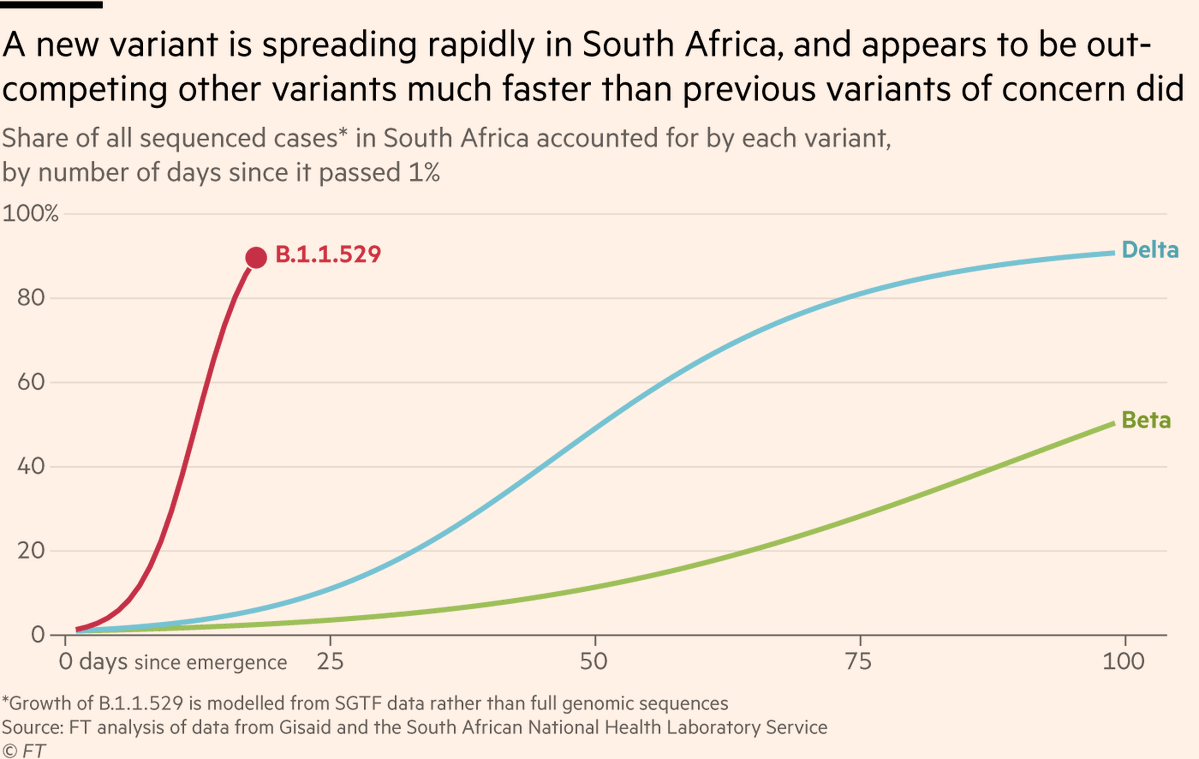
  • It is gaining pace rapidly sequencing 90% of new cases just 2 weeks since emergence. For comparison the Delta needed 3 months to reach that intensity. This is the most concerning data point that has attracted market attention.
  • One caveat is that the fast acceleration data could be skewed by location. The virus is spreading in Gauteng which is the largest and most densely populated province of SA. (15.2mio people with population density that is 17.3x higher than the country average)
  • The level of restrictions in SA at the moment (measured by the government stringency index) is low (relative to Israel or Austria for example, see chart below). This can be helping faster spread that isn’t necessarily driven exclusively by the virus characteristics
  • Cases of B.1.1.529 have been identified in Botswana, Israel and Hong Kong. If the variant is highly transmissible, it is most likely that it will eventually spread despite travel restrictions.
What we still do not know...
  • We have no information on the variant’s impact on hospitalizations and mortality. A careful monitoring of the Gauteng data over the next two weeks is essential.
  • There are reports that two of the cases were fully vaccinated. This is a very small sample to make any conclusions and we do not know for how long the patients were vaccinated. What we know from Delta is that antibody levels wear off between 6 and 9 months after the second vaccine and that while the vaccines are less effective in preventing infection, they are still highly effective in preventing hospitalization and death. For the time being there is no reason to believe that this variant will be different in that respect.
  • Will the Pfizer pill be effective against the new mutation?
  • Is the European wave driven by the new variant?
  • While the new variant could be present in Europe, the rapid rise in cases is driven by the Delta variant (see information below)
  • The European data comes with about a month delay from sequencing time so we should know more by the third week of December (unless the process accelerates due to the attention on the new variant)
  • Efforts to limit the current Delta wave in a number of European countries could help preventing the spread of B.1.1.529, if already present.
Is the above a reason to be concerned?
  • A very broad press focus in the past 24h has received high market attention.
  • It will take weeks before we get additional official information and scientific evidence about the potential risks.
  • This comes at a time when investors have been surprised by some of the lockdown measures announced in Europe
  • And also when real growth is likely to fall meaningfully on higher inflation (even though nominal growth is likely to stay well above average)
  • At this time of the year positions in risky assets, especially after strong YTD gains, could be vulnerable to short term corrections (ie 2018 template)
  • Travel restrictions will delay the process of logistics network normalization which would imply that the supply capacity constraints easing anticipated for H2-2022 might take longer to materialize.
  • Meanwhile, monetary policy has recently shifted gears to signal faster removal of accommodation which could add to a short-term risk aversion into the December FOMC.
Conclusion: while we do not have sufficient information to forecast a global B.1.1.529 wave, a high rate of transmission almost inevitably leads to a variant dominance. Nevertheless, we can have reasonable degree of confidence that this mutation is unlikely to be more malicious and that the existing vaccines will most likely continue to be effective in preventing hospitalizations and deaths. As such, while we would monitor the situation in Gauteng closely over the next month, we do not think that the new variant is sufficient reason to make major portfolio changes.