In a Less-Globalized World, Be Careful Where You Park Your Plane
Western firms will likely lose almost all of the $10 billion worth of planes they own in Russia
There may be no better illustration of globalization’s retreat than investors getting burned for owing planes in the wrong place.
This week, Moscow claimed that almost 800 commercial aircraft have already been re-registered from Bermuda and Ireland into its own aeronautical records—implying it has appropriated them—in response to the European Union requiring lessors to terminate contracts with Russian airlines by March 28. Western lessors have repatriated only 78 of their jets in Russia, officials said. Roughly 480—worth around $10 billion—are stuck there, according to research firm Ishka.
Ireland’s AerCap has the most jets in Russia, 145 in service, analytics company IBA said. In relative terms, though, U.S.-based Fortress Transportation and Infrastructure Investors tops the list with 23% of its portfolio affected by the war. The stocks are down 17% and 16%, respectively, this year. Investors also own 67 Russian planes through asset-backed securities managed by the likes of Carlyle and Castlelake. Senior notes in some Russian-heavy ABS have traded as low as 70 cents in the dollar, Ishka analysts said.
Aircraft owners are often insured against physical damage, wars and confiscations. Fitch Ratings said Monday that insurers—most of them belonging to Lloyd’s of London—could foot almost all of the bill, with 30% to 40% covered in turn by reinsurers. It expects the impact to be manageable.
So why aren’t investors buying the dip in lessor shares and ABS? Perhaps because the aircraft-finance ecosystem is unprepared for years of legal battles. Despite emerging in the 1970s, the aircraft-leasing model didn’t take off until the 1990s, eventually expanding to include half of the world’s fleet. Lessors have grown up in an era of globalized aviation and geopolitical calm, in which treaties like the 2001 Cape Town Convention regarding movable property gave them a false sense of security.
Common sense suggests that Moscow has broken the rules by refusing to return planes. However, Russian officials are offering to pay the leases or even buy the jets; it is the Western firms that aren’t allowed by their governments to accept payments from Russia. So the legal situation is unclear and may depend on factors like the timing of insurance cancellations or even who operates the jets: Claiming nationalization could be easier with a state-owned airline like Aeroflot, some lessors said.
Part of the solution, banks and insurers hope, is that a sizable part of the lost assets could one day be recovered. They will probably be disappointed.
A jet’s worth is tied to the integrity of the technical records allowing operators and financiers to determine its airworthiness. Tracking back gaps in records often costs about $3 million a plane, New York University professor David Yu estimates, and stepping outside the scrutiny of Western regulators will make the entire fleet suspect. Also, Russian aircraft will need to be cannibalized for parts, and bankruptcy procedures show that this takes years and tens of millions of dollars to reverse. Being operated even for a while in such circumstances could mark planes down close to scrap value.
This mess may ultimately lead to higher insurance premiums and lower aircraft values. The broader lesson is that international law may be no match for rising geopolitical risks. Adding to the complications, Western investors are exposed to Russia through their financing of Chinese lessors, which own 75 Russian jets, Cirium data shows. Not to mention that foreign leasing firms have 806 jets worth $20 billion in China itself, so would have an even bigger problem if that country gets entangled in the sanctions against Russia.
Even assets that can fly can’t always keep above the fray of a fragmenting world.
The Fed Bets on a ‘Soft Landing,’ but Recession Risk Looms
Central bankers have been clear that they will do what it takes to control inflation. They are betting on a soft landing, but a bumpy one is possible.
Jerome H. Powell, the Federal Reserve chair, emphasized this week that the central bank he leads could succeed in its quest to tame rapid inflation without causing unemployment to rise or setting off a recession. But he also acknowledged that such a benign outcome was not certain.
“The historical record provides some grounds for optimism,” Mr. Powell said.
That “some” is worth noting: While there may be hope, there is also reason to worry, given the Fed’s track record when it is in inflation-fighting mode.
The Fed has at times managed to raise interest rates to cool down demand and weaken inflation without meaningfully harming the economy — Mr. Powell highlighted examples in 1965, 1984 and 1994. But those instances came amid much lower inflation, and without the ongoing shocks of a global pandemic and a war in Ukraine.
The part Fed officials avoid saying out loud is that the central bank’s tools work by slowing down the economy, and weakening growth always comes with a risk of overdoing it. And while the Fed ushered in its first rate increase this month, some economists — and at least one Fed official — think it was too slow to start taking its foot off the gas. Some warn that the delay increases the chance it might have to overcorrect.
The Fed has touched off recessions with past rate increases: It happened in the early 1980s, when Paul Volcker raised rates in a campaign to bring down very rapid inflation and sent unemployment rocketing painfully higher in the process.
“There is no guarantee that there will be a recession, but you have high inflation, and if you’re serious about bringing it down quickly, you have to hike a lot,” said Roberto Perli, the head of global policy at Piper Sandler, an investment bank, and a former Fed economist. “The economy doesn’t like that. I think the risk is substantial.”
It is no surprise that it can be difficult to cool down inflation while sustaining an economic expansion. Higher borrowing costs trickle through the economy by slowing the housing market, discouraging big purchases and prompting companies to cut expansion plans and hire fewer workers. That broad pullback weakens the labor market and slows wage growth, helping inflation to moderate. But the chain reaction plays out gradually, and its results can be seen only with a delay, so it is easy to lay on the brakes too hard.
Fed officials are hoping that today’s strong economy will help them avoid a rough landing. They point to the fact that labor markets are booming and consumer demand is solid, so lifting rates and tempering voracious buying might help supply to catch up and chill the economy without giving it freezer burn. Mr. Powell has argued that with so many open jobs per unemployed worker, the Fed might be able to slow down the labor market a bit without pushing the unemployment rate up.
Loretta J. Mester, the president of the Federal Reserve Bank of Cleveland, said the Fed was not at a point where it had to decide between fighting inflation or pummeling growth.
“Given where the economy is now, and where the risks are, to my mind the major economic challenge is inflation,” Ms. Mester told reporters on a call Wednesday. “I don’t see it as being a trade-off at this point.”
James Bullard, the president of the Federal Reserve Bank of St. Louis, said in an interview that he thought the fact that the central bank had credibility as an inflation fighter — and was raising rates to defend that credibility — could allow it to adjust policy in a way that allowed demand to moderate without causing major economic disruptions.
In the 1980s, when Mr. Volcker was the Fed chair, the central bank had to convince the world that it was prepared to wrestle inflation under control after more than a decade of rapid price gains.
“Do whatever it takes — I guess that’s the mantra of the day. I do think inflation is our No. 1 concern,” Mr. Bullard said. “I don’t think, however, that it is a Volcker-like situation.”
Near-term consumer and market inflation expectations have shot higher over the past year as inflation has hit a 40-year high and continued to accelerate, but longer-term price growth expectations have nudged only slightly higher.
If consumers and businesses anticipated rapid price increases year after year, that would be a troubling sign. Such expectations could become self-fulfilling if companies felt comfortable raising prices and consumers accepted those higher costs but asked for bigger paychecks to cover their rising expenses.
But after a year of rapid inflation, it is no guarantee that longer-term inflation expectations will stay in check. Keeping them under control is a big part of why the Fed is getting moving now even as a war in Ukraine stokes uncertainty. The central bank raised rates a quarter point this month and projected a series of interest rate increases to come.
While officials would usually look past a temporary pop in oil prices, like the one the conflict has spurred, concerns about expectations mean they do not have that luxury this time.
“The risk is rising that an extended period of high inflation could push longer-term expectations uncomfortably higher,” Mr. Powell said this week.
Mr. Powell signaled that the Fed might raise interest rates by half a percentage point in May and imminently begin to shrink its balance sheet of bond holdings, policies that would remove help from the U.S. economy much more rapidly than in the last economic expansion.
Some officials, including Mr. Bullard, have urged moving quickly, arguing that monetary policy is still at an emergency setting and out of line with a very strong economy.
But investors think the Fed will need to reverse course after a series of rapid rate increases. Market pricing suggests — and some researchers think — that the Fed will raise rates notably this year and early next, only to reverse some of those moves as the economy slows markedly.
“Our base case has the Fed reversing quickly enough to avoid a full-blown recession,” Krishna Guha, the head of global policy at Evercore ISI, wrote in a recent analysis. “But the probability of pulling this off is not particularly high.”
So why would the Fed put the economy at risk? Neil Shearing, the group chief economist at Capital Economics, wrote that the central bank was following the “stitch in time saves nine” approach to monetary policy.
Raising interest rates now to reduce inflation gives the central bank a shot at stabilizing the economy without having to enact an even more painful policy down the road. If the Fed dallies, and higher inflation becomes a more lasting feature of the economy, it will be even harder to stamp out.
“Delaying rate hikes due to fears about the economic spillovers from the war in Ukraine would risk inflation becoming more entrenched,” Mr. Shearing wrote in a note to clients. “Meaning more policy tightening is ultimately needed to squeeze it out of the system, and making a recession at some point in the future even more likely.”
Instacart Lowers Its Own Valuation From $39B to $24B

Delivery company Instacart said Thursday that it will slash its valuation by nearly 40 percent as tech stocks continue to feel turbulence in the public markets.
The cut, first reported by Bloomberg, brings Instacart’s valuation to $24 billion, down from the $39 billion price tag the company minted last year.
The move comes as tech stocks in general have been hammered by the public markets. Rising interest rates, inflation concerns and geopolitical issues have all contributed to a roller coaster for tech stocks.
Instacart saw a boom in business at the onset of the pandemic, as customers turned to grocery delivery to avoid leaving home. The company was also considered a candidate to go public soon, but IPO activity so far this year has been pretty quiet.
Founded in 2012, Instacart raised nearly $3 billion in funding as a private company.
It became a unicorn somewhere around 2015, with its valuation jumping from around $400 million in 2014 to more than $2 billion with a $220 million Series C in January 2015.

Since then, its valuation climbed to nearly $40 billion, before Thursday. Valuations were up across the board, but Instacart lowering its own valuation—an uncommon move by a company—follows valuations of publicly traded companies falling and more shares of startups selling for lower prices on the secondary markets.
Utility tool
Dubai is pumping water into its IPO desert. The floatation of utility Dubai Electricity and Water Authority (DEWA) promises to be the largest local listing in 15 years. That said, the $34 billion price tag looks quite cheap, reflecting the emirate’s wider stock-market ambitions.
DEWA’s bosses and bankers are under pressure to ensure that the initial public offering is a roaring success. The deal is the opening move in a campaign to persuade more companies to list in Dubai. The emirate missed out on the IPO party enjoyed last year by rivals Abu Dhabi and Riyadh, which together raised more than $7 billion from investors. After a four-year listing hiatus, the government hopes to sell stakes in nine more state-owned companies, including its flag-carrying airline, Emirates.
Ruler Sheikh Mohammed bin Rashid al-Maktoum is therefore enticing investors with a juicy opening course. DEWA is selling a 6.5% stake at 2.25 dirhams to 2.48 dirhams per share. At the top end of the range, and after adding $7.5 billion of net debt, the company will have an enterprise value of $41 billion. That’s less than 11 times this year’s expected EBITDA, assuming DEWA’s growth sticks on last year’s trajectory. By contrast, European and Gulf water and energy providers like Snam, Elia, National Grid, United Utilities, Tabreed and Qatar Fuel trade on an average 13 times multiple.
Arguably, the Dubai firm is in a stronger position. DEWA benefits from the large number of foreigners living on its patch, most of them with pockets deep enough to pay a premium for utility services. Its adjusted EBITDA margin in 2021 was a juicy 51%, compared to 25% at UK power utility National Grid. Demand for its services may even jump if Western sanctions against Russia prompt an influx of wealthy Muscovites. Even without that potential boost, DEWA’s 5% dividend yield looks attractive against the 3.6% average of other European or regional utilities.
Of course, offloading a chunk of DEWA at a knock-down price is a short-term miss for the government. However, if the plan works, the longer-term prize will be worth far more.
The Russian crew aboard Putin’s suspected superyacht have abandoned their jobs on the $700 million boat
The Russian crew aboard a $700 million yacht named Scheherazade with potential links to President Putin have abandoned their jobs aboard the ship, as first reported by The New York Times.
Allegedly, due to obligations and personal conflicts related to the ongoing Russian war, all employees vacated their posts. Following the departure of all the Russian crew members, a British crew has stepped in instead.
The ship's captain, Guy, who is also British, previously denied to The New York Times that the Scheherazade was owned by Putin and alleged that the Russian president had never been aboard the ship.
The ship has not been legally seized by Italian or European Union authorities, but is under scrutiny. Officials will not make further comments until the conclusion of an investigation by the Italian authorities, according to The New York Times.
Superyacht under scrutiny
The Scheherazade is currently docked at the Marina di Carrara in Italy, and does not have a publicly identified owner. Before Russia’s invasion of Ukraine, the 459 foot superyacht was manned by at least 20 crew members which included approximately 10 Russian officers, since the fall of 2020.
Some of the ship’s employees were identified as FSO—or Federal Guard Service— personnel, who are tasked with protecting the Russian President, according to a YouTube video posted by two activists, investigative journalist Maria Pevchikh and the anti-corruption activist Georgy Alburov, on Monday. The yacht itself is enormous, and contains two helipads, a spa, three saunas, a swimming pool, and other luxury amenities.
Luxury yachts like the Scheherazade are being seized all over Europe, with countries like Italy and France impounding the nautical status symbols as a part of sanctions against Russia, following its invasion of Ukraine. France has seized several Russian yachts worth hundreds of millions of dollars, and Germany has also impounded multiple luxury Russian yachts, with one notable seizure being valued at nearly $600 million. Italy has also seized Russian yachts valued at over $500 million.
In Italy, France, and Germany, $1 billion in Russian boats have been taken from sanctioned individuals so far.
Sanctions hitting yachts, jets, and mansions.
While Putin is being widely criticized as a “war criminal,” and facing mounting public backlash, he is not alone in facing social and financial consequences.
The sanctions imposed against Russia are meant not only to hurt the Russian president, but his inner circle of oligarchs as well. The private jets, mansions, and yachts that are seized by worldwide governments are considered frozen assets but could ultimately lead to financial gains for Ukraine.
In a bipartisan bill called the “Yachts for Ukraine Act,” the authorities would be permitted to seize the assets of Russian elites valued over $5 million and sell them to provide humanitarian support, weapons and refugee assistance to Ukraine.
When Is Ramadan 2022? First Sighting Of Crescent Moon Will Begin Annual Fast And Set Up A ‘Pink Moon’
When is Ramadan 2022? Ramadan will this year begin on Saturday, April 2, 2022. and will finish on Sunday, May 1, 2022.
However, these dates are not confirmed. The exact dates Ramadan, the auspicious month-long festival of the Muslim calendar, are tied to the movements of the Moon.
So the start and end of Ramadan is something you can actually watch happening.
All you have to do is stand outside and look to the west at dusk on Saturday, April 2, 2022 and you’ll see —if you have keen eyes, a low horizon and perhaps a pair of binoculars or a small telescope—the appearance of a 2.4% Crescent Moon just 1.5 days after being a New Moon.
It’s this first sighting of the “Youngest Moon”—or the “Ramadan Moon,” if you will—that signifies the end of the month of Islamic month of Shaban and the beginning of the month of Ramadan, the fasting month.
During Ramadan up to 1.8 billion Muslims across our planet will fast between sunrise and sunset.
The holy month of Ramadan has no fixed dates. It’s due to start and end on the dates mentioned, but that does rely on a successful observation by clerics of that super-slim Crescent Moon.
Technically it’s all about the first sighting of the Crescent Moon over Mecca in Saudi Arabia, the birthplace of Muhammad.
A New Moon is precisely between the Earth and the Sun so it’s invisible. As the Moon moves away from the Sun it becomes just about visible as a slim crescent a little above the western horizon after dusk, though it takes at least 15 hours after the instance of New Moon to become visible at all.
The next full Moon—the full “Pink Moon”—will occur on Sunday, April 16, 2022. It will be the first full Moon of spring 2022 in the northern hemisphere and it will signify the middle of Ramadan. But when will Ramadan 2022 finish?
That will happen on Sunday, May 1, 2022, when Ramadan finishes with the three-day feasting festival of Eid al-Fitr (the “festival of breaking the fast”).
However, Eid al-Fitr will only begin with the sighting of a New Moon—called the “Shawwal Moon”—likely on either Sunday, May 1, 2022 or Tuesday, May 2, 2022.
That’s because on Sunday, May 1, 2022 the Crescent Moon will only be 0.7% illuminated and 0.9 days old, which could prove impossible to see. The next evening it will be 3.4%-lit and 1.8 days old, so a little bigger, brighter and higher in the sky.
The Islamic calendar is a lunar calendar based on the phases of our satellite. Many of the world’s major religions use the lunar cycle to determine the dates of at least some of their festivals; Chinese New Year is also referred to as Lunar New Year and is also dictated by the Moon’s orbit of Earth.
The lunar calendar is a calendar based on the monthly cycles of the Moon’s phases, though the lunar month lasts 29.5 days.
A lunar year lasts 354.3 days, so it all gets all out of whack with the solar calendar, where a year—the time it takes for the Earth to orbit once around the sun—lasts 365.25 days.
Wishing you clear skies and wide eyes.
Demand Destruction Has Begun
One month ago, Brent jumped above $100/bbl for the first time in eight years as Russia executed a full-scale invasion of Ukraine, and it became clear that western governments would impose sanctions. The oil market has been in triple digits for practically the entire time since.
And, after a month of oil prices we have not seen in nearly a decade and weeks of record-high fuel prices, JPMorgan has published a research report (available to pro subs) which finds that high-frequency data suggest that consumers are beginning to react resulting in what the Fed has desperately wanted to achieve all along: commodity demand destruction.
That said, high prices are clearly not the only demand-destructive force in the world at the moment, however. The crisis in Ukraine, crippling financial sanctions in Russia, and the continued spread of the highly infectious Omicron variant in China have an even more direct impact on regional fuel consumption than high prices.
As a result, JPMorgan has cut 1.1 mpd off its 2Q22 demand forecasts, followed by about 0.5 mbd cuts to both 3Q and 4Q. On net, this trims 420 kbd on average from the bank's expectations for 2022 global oil demand as high prices, COVID restrictions, and geopolitical conflict drive demand destruction in Russia, China, India, and Europe.
While the US has been relatively isolated so far (despite the highest gasoline prices on record), JPM's demand revisions are heavily concentrated in Europe, which remains the epicenter of the geopolitical shock. Since the start of the Russia-Ukraine war, the bank's economists have downgraded the growth in the region by over 2%-pts and have raised inflation forecasts by nearly 3%-pts.
Moreover, after sliding sharply in February and bottoming in early March, COVID infections are up over 40% in the past two weeks across Europe with large increases across the UK, Germany, France, and Italy. Zero-tolerance COVID policy, combined with less effective vaccines and lack of natural immunity, presents a challenge to China's growth outlook.
As a result, JPM now sees activity contracting in March and April, prompting a 1.1%-pts cut to China’s 2Q GDP growth. With the downward revisions to the Euro area and China, the largest US commercial bank now projects 1H22 global growth dipping below potential. Displaying limited sensitivity to near-term downside growth risks, major central banks continue to tilt hawkish. Chair Powell reiterated prospects for an accelerated pace of hikes and reinforced the notion that the Fed could soon start moving in 50bp increments. EM central banks also remain on the move.
The clearest example of demand destruction can be seen in Eurasia, a region which includes both Russia and Ukraine, where mobility has fallen to its lowest level since early 2021.
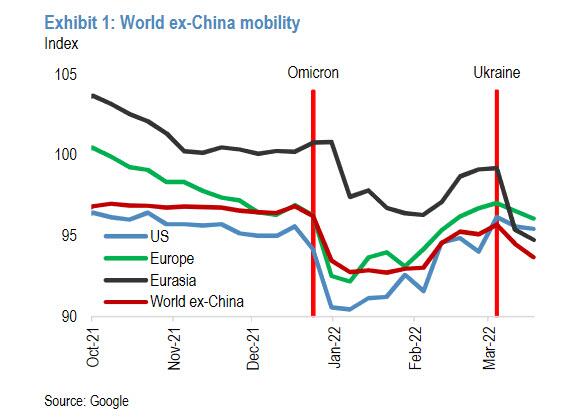
And in Europe, while mobility trends have reversed after a recovery from Omicron-driven lows earlier this year, they are now once again declining.
Consequently, JPM has cut its expectations for 2022 Eurasia oil demand by 270 kbd due to sanctions imposed on Russia. Eurasia demand for jet fuel will come in 130 kbd lower than the previous estimate as roughly half of Russian civil aircraft will end up grounded as a result of airspace bans and shortages of parts. JPM also revised Europe oil demand down by 160 kbd on average for 2022 due to sensitivity to high prices and lower expectations for economic growth in the region
The good news is that for now, US mobility has been relatively resilient in spite of higher oil prices, but here too we are seeing the first signs of hampered driving demand recovery in California, where on-road fuel prices are more than $1.50 above the national average. California vehicle miles traveled (VMT) has been tracking closely to 2018-19 levels since late last year, but has deviated from the 2019 trend twice so far this year: once, as Omicron cases spread through the state, and again starting at the end of February.
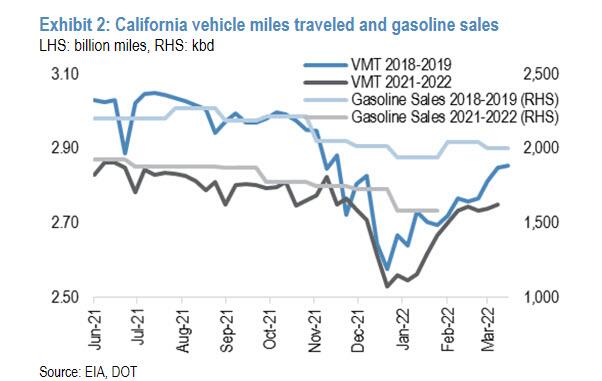
This flattening in VMT growth is likely due to the increase in gasoline prices following the Russian invasion and, while if this trend persists or spreads to other regions in the US, JPM said that it will likely revisit its assumptions for US fuel demand for 2022 as well.
JPM then does a similar exercise for China and India, and likewise cuts its forecasts for Q2 2022 oil demand there too (by 520kb/d and 120lb/s, respectively), and turns its attention to the mounting concerns over stability of Russian supplies.
Here, as reported previously, JPM finds that large quantities of Russian oil continue to be boycotted by Western refiners. Meanwhile, logistical issues are becoming entrenched as transport remains a significant challenge for Russian sales, with UK and European ports banning vessels flagged, operated or owned by Russia from docking at their ports. Reports of Saudi Arabia actively discussing pricing some of its oil sales to China in Yuan further point to difficulties facing Russia in shifting large volumes from Western consumers to China, where Saudi Arabia is a main supplier of crude. Given that Russia has very limited onshore storage capacity, a halt in exports would trigger production shut-ins within weeks, perhaps on an even larger scale than seen in April 2020.
Equally important are the developments in Kazakhstan— a country that ships around 1 mbd of its crude oil production through the CPC pipeline to the Russia’s Black Sea port of Novorossiysk. The pipeline was "damaged" on Tuesday, impacting around 1 mbd of export volumes for up to two months. The supply interruption was timed to coincide with the EU's meeting on Thursday, prompting speculation that Moscow was prepared to retaliate against western sanctions by curbing both its own and Kazakh energy supplies, possibly leading to significantly larger disruptions than the current consensus base case assumes. Needless to say, finding alternative routes for all CPC volumes would be difficult, likely forcing the shut-in of fields in Kazakhstan. For now, JPM has removed 1 mbd from Kazakhstan’s April production.
Despite the nascent demand destruction, JPM writes that its baseline still assumes that the market's current extreme aversion to Russian oil will subside. Volumetrically, this means that stranded Russian oil barrels will decline from 3.0-3.5 mbd in March to 2 mbd
in April and a perpetual 1 mbd thereafter, leading to Brent oil price averaging $114/bbl in 2Q22 and $101/bbl in 2H22, with prices rising over $120 in the interim.
in April and a perpetual 1 mbd thereafter, leading to Brent oil price averaging $114/bbl in 2Q22 and $101/bbl in 2H22, with prices rising over $120 in the interim.
That said, the bank's commodity strategist recognize that the European consumer could force the governments’ hand as the human toll from Russia's invasion mounts. Ominously, JPM cautions that as the single largest buyer of Russian oil, "the more rapidly Europe seeks to cut Russia’s imports, the higher global oil prices will rise" and in the event of a full 3.8 mbd drop in Russian exports, crude oil prices could soar to $185/bbl.
Of course, all of the above is predicated upon an "all else equal" framework, however as we have reported recently, it now appears that developed government such as the US, UK and Europe are planning to offset demand destruction with what gas stimmies or cutting gas taxes, what some have called "demand construction" which will achieve just the opposite of what it hopes to achieve as Bloomberg's Kavier Blas noted two days ago: "Exactly the opposite that the current market requires. Rather than support poorer families, it goes for a blanket, regressive tax policy."
Russian Superyachts 'Go Dark' To Avoid Tracking
Since the invasion of Ukraine, Russian oligarchs have been panic-moving private jets, superyachts, and other trophy assets away from Western countries to avoid sanctions.
Marine data compiled by Bloomberg show at least nine superyachts owned by Russian tycoons have switched off tracking systems. These devices, also known as automatic identification systems or AIS, are required for all passenger ships to broadcast positions for other vessels and coastal authorities.
"There's no reason why their AIS transmissions should be off for days," said Gur Sender, a program manager at Windward Ltd., which specializes in maritime risk and intelligence.
"Even if you're in the middle of the ocean you have a satellite picking up your transmission once in at least eight hours. If you're a big yacht, it's in your interest to have it on so everyone can see the ship to prevent accidents," Sender said.
Most of the yachts went dark on Feb. 24, the day Russia invaded Ukraine. Then more went dark after President Biden announced sanctions on Russian oligarchs on Mar. 11. The oligarchs are all part of Russian President Vladimir Putin's inner circle.
Russian oligarchs who have been sanctioned have either had their yachts commandeered by European authorities (like Rosneft CEO's $120mln superyacht) or have sailed to more friendly waters out of the Mediterranean and Northern Europe to the Indian Ocean and or the Middle East.

According to vessel data, at least eight ships were last seen near the United Arab Emirates, Oman, or Saudi Arabia.
Meanwhile, two superyachts owned by Russian businessman Roman Abramovich fled from Western Europe for Turkey.
French Sustainable Label Circle Sportswear Raises 2.5 Million Euros
Investors include Bpifrance, AA & Sons and private investors drawn from the sports, fashion and tech spheres.
PARIS — French sustainable label Circle Sportswear has raised 2.5 million euros of funding, the company revealed this week.
The investment is earmarked to expand the team with experienced profiles in marketing and sales; accelerate its development of the wholesale business and expansion in new markets, such as the U.S., and continue materials research and development, especially on plant-based fibers.
After working for five years at L’Oréal in various positions from human resources to buying, and founding cloud-based talent platform Yoss, later sold to human resources firm Adecco, cofounder Romain Trébuil wanted to bring together his desire to work toward a circular economy and a personal passion for sports.
Launched via community fundraising platform Ululule in March 2020, Circle Sportswear hinges on Trébuil’s idea that “sportswear is everywhere but everyone is doing the same thing, manufacturing in Asia from petrol-based materials,” he said.
“The lockdown was an accelerator for the values that we support. People started looking closely at where clothes they are wearing were made and by whom, in the same way they did for food,” said Trébuil, who launched the brand with Alex Auroux, formerly general manager of health club aggregator Classpass, and Solène Roure, a designer who has worked for the likes of Hogan, Alexander McQueen, Nike and Lululemon.
Products are developed with performance in mind and tested by some of the 30 high-level athletes who are in the brand’s orbit, such as French Paralympic tennis player Stéphane Houdet, who won gold in the doubles at the 2020 Toyko Olympics, and ultra-trail specialist Stéphanie Gicquel, who was the first French person to run a marathon around the North Pole. “There’s bit of pressure when you hand someone like that a prototype of your leggings and they take off for a 24-hour run to test them out,” remarked Trébuil.
Interest from consumers was strong: within 48 hours of launching the six-week preorder campaign, the initial 200 orders the brand wanted to garner were filled. By the end of it, they had 600 preorders. A first round of investment, in the first quarter of 2021, yielded a million euros from business angels.
Two years on, the company posted a 300,000-euro turnover in 2021 and is aiming for the 1-million euro mark in 2022. “We’re aiming for strong growth backed by our sustainability and circularity credentials because that’s how we’ll have the greatest impact,” said Trébuil, pointing out that 20 percent of its business was already done internationally.
Among the investors of this second funding round are London-based venture capital fund AA & Sons, founded by Romain Afflelou, a scion of the French eyewear retail empire Alain Afflelou; the Bpifrance state-owned investment bank, as well as individual investors.
“We wanted business angels that could support us on specific angles,” he said, naming Déborah Janicek, who was formerly president of shirting specialist Figaret and general manager of contemporary label Pablo; Chantal Barrat Duc Dodon, whose track record includes sustainable footwear label Melissa and circular-economy projects; Arthur de Soultrait, founder of menswear brand Vicomte A, and Sébastien Borget, a cofounder of The Sandbox. Others hail from the tech and sports sphere.
In the next few months, Circle Sportswear’s product line will be expanded from 30 to more than 90 stock keeping units, and the brand will make its first steps with retailers, launching at Le Bon Marché in late April before heading to La Samaritaine and Galeries Lafayette Haussmann, in a new sports-centric space, from July.
Further on the horizon, the development of the brand in new territories is slated for 2023. Ahead of a full launch in the U.S., the brand has already signed a partnership with SoulCycle. Putting the newly developed materials in consumers’ hands is the best way to convince them and drum up interest, Trébuil said.
But making and selling products isn’t the largest part of the challenge ahead. Material development is. As it stands, the company uses regenerated materials such as Econyl polyamide and Newlife polyester, or organic-certified lyocell, which is made from wood fibers.
At the end of their life cycle — although very few products have gotten there yet, he admits — items can be returned to the brand, which then takes the back to its factories to be disassembled back to threads that can be reused for new products, except for the recycled elasthane, which cannot be reused and is transformed into insulation material in buildings. Still, avoiding consuming resources at each step “all adds up,” he said.
But the French sports label wants to take it one step further, replacing any recycled petrol-based materials with bio-based alternatives. It doesn’t plan on making any discoveries the company makes proprietary, either. “If we have a positive impact on the environment, say with a fiber that doesn’t give off any microplastics, that’s great. But our goal is to create solutions for ourselves and other brands. If tomorrow, it’s Balenciaga, Decathlon or Nike, it’s great. They have a very large impact so if their products are environmentally better, we’ll be glad to have contributed because it means that we all win,” he said.