(ZH) Omicron Selloff, Is It Over Yet?

Omicron Selloff, Is It Over Yet?

What’s Really Driving The Omicron Market Selloff
While the media is running around trying to pin headlines on the market moves from the Fed to the Omicron variant, the reality is that we are in the midst of mutual fund distribution season. As Michael Lebowitz noted:
We believe the rotation is not a sudden change in mindset but, likely the actions of mutual funds rebalancing their portfolios. Frequently at year-end mutual funds sell the winners which have become overweight positions and buy the losers which are below their proper weights. The large returns this year in certain sectors are making these actions more visible than normal.
There is still some sloppiness likely over the next week, but such should theoretically provide investors the entry point for a “Santa Rally.”
But such should not be a surprise. In mid-November, we discussed the need to reduce risk against a potential correction. To wit:
Does this mean the market will experience a significant contraction? A pullback to the short-term moving averages would not be surprising and would encompass about a 3-4% drawdown.
What would cause such a correction? I don’t know. However, we are entering the mutual fund distribution season where fund managers need to distribution capital gains, dividends, and interest. Given that most funds are carrying very low cash levels, they will likely have to sell holdings to make those distributions.
Then, on the 23rd of November, we added:
Investors’ “wish lists” are hung by the chimney with care, hopeful the “Santa Claus rally” will soon be there. While they remain “snug in their beds, the historical data dances in the heads.”
It certainly seems there is little to worry about.
Except that dip at the beginning of December.
But is the Omicron selloff over?
Omicron Selloff Tests 100-DMA
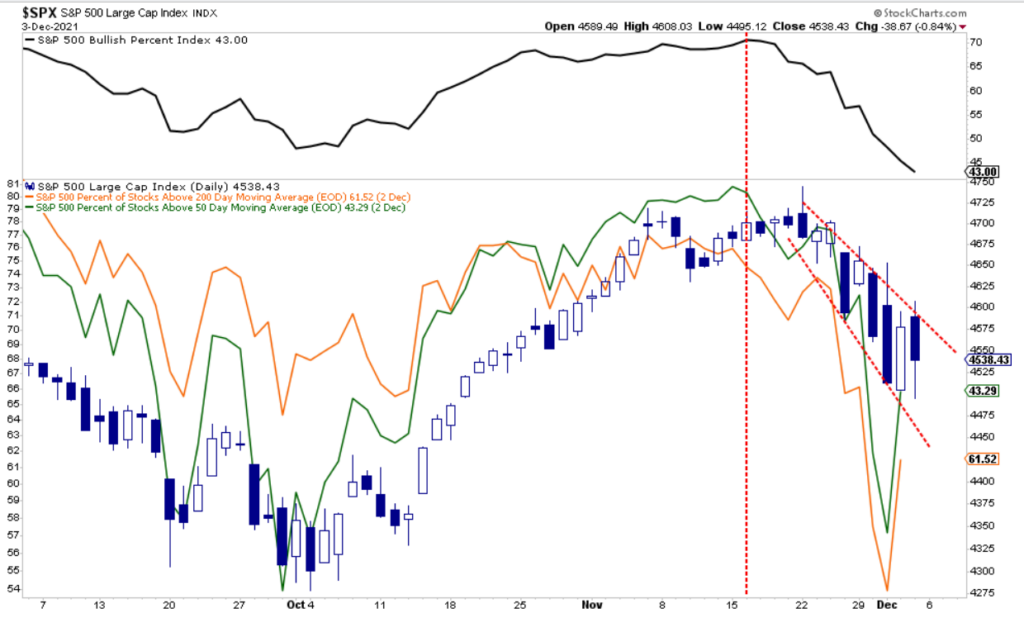
In the short term, selling pressure is starting to peak, and downside risk got reduced given the more extreme oversold conditions. As a result, volatility also spiked into excessive overbought levels, and the market held strong support at the 100-dma (orange line) on Friday.
We are using the more extreme oversold condition to add trading positions to our portfolio. The upside is likely limited to the bottom of the previous trend channel (blue dashed line) that began in 2020. However, we can take advantage of the rally back to those levels to bolster returns in portfolios.
Notably, any failure at that running lower trend line would be concerning. Such would suggest either a retest of current lows in January or, should that support fail, a very different market in 2022.
As noted above, while the media is frantic to pin sell-off on the “Omicronvariant,” it is all quite normal within the context of historical trends. Lastly, another of our technical indicators, the McClellan Oscillator, confirms our analysis of a deeply oversold market.
Please note that I am consistently speaking of “short-term” opportunities.
While the current decline could strengthen back into a longer-term trend, we treat each increase in equity exposure as a trade until proven otherwise.
One mistake individuals make is trying to “buy the dip” and not respecting the potential for much more significant downside “dipping.”
Always maintain your stop-loss levels.
No Guarantees
The current “Omicron selloff” in the markets, combined with distributions, will leave portfolios “offsides” heading into year-end. As a result, portfolio managers will begin to “window dress” portfolios for year-end reporting around mid-month. As shown in the seasonal chart above, that “buying” is what typically pushes markets higher.
Such was a point I discussed with Charles Payne on Fox Business yesterday.
Is a “Santa Claus” rally guaranteed? Absolutely not.
However, as noted, my Mom said I was a “good boy” this year, so I am hopeful I will get more than a “lump of coal” in my stocking.
Besides, I am not sure Santa Claus can afford coal this year anyway.
While I am optimistic as we head into year-end, I would be remiss not to point out the obvious risks.
Internal Measures Suggests Risk Remains Present
Over the last few weeks, we have discussed the continuing deterioration of market internals from breadth to volume to expanding new lows. At the same time, while market internals weakened, broad markets continued to rise. As shown, stocks trading above their 50- and 200-dma and the bullish percent index turned down in mid-November. Such suggested the market was at risk of a correction; all that was needed was an event to shift psychology.
That’s how you get the “Omicron selloff.”
However, as Sentiment Trader pointed out this week, other internal measures suggest that investors may see lower returns near term. To wit:
“New lows are one of the most critical breadth measures to monitor in a bull market, especially long-duration ones. When they expand to current levels with the market near a high, something is amiss with market participation. The shot across the bow is a warning that we should be alert to rising risks. As always, it’s essential to use a weight-of-the-evidence approach and not rely upon any single indicator.
The previous risk-off signal from October 2018 led to a substantial decline for the S&P 500.”
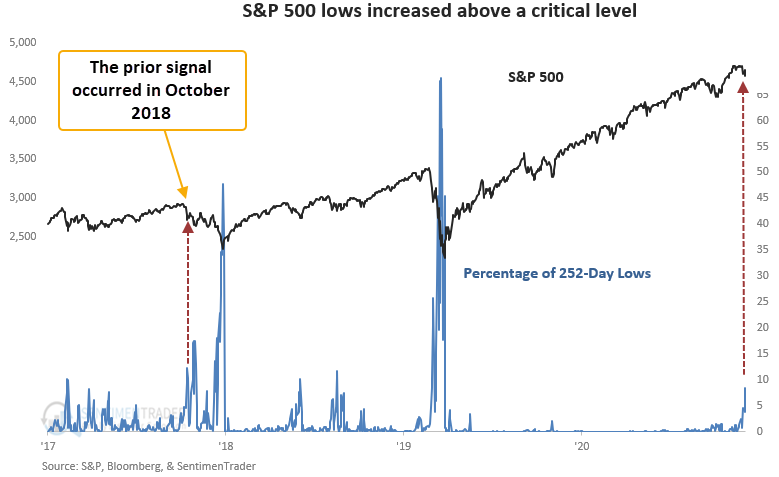
As they conclude:
“When new lows expand and the market is near a high, something is amiss with market participation, suggesting rising risks. Similar setups to what we’re seeing now have preceded weak returns and win rates on a short and medium-term basis.”
While the market is now very oversold, volume remains relatively weak along with money flows. Such suggests there is a risk of more selling pressure following any short-term bounce. So, as is always the case, be sure to manage your risk exposures accordingly.
There will be a time to become considerably more aggressive, but we need improvement to the underlying technicals first.
Will FANG Wind Up Like BRIC?
My colleague Albert Edwards had an excellent piece out this week answering a question I have had.
“It is the 20th anniversary of the invention of the BRIC acronym. BRICs, for those who need reminding, was dreamt up by the then Chief Economist at Goldman Sachs, Jim (now Lord) O’Neil, who predicted that the emerging economies of Brazil, Russia, India and China would enjoy superior economic growth and investment returns relative to the developed economies. A few days ago Jim O’Neil marked this anniversary with an update in theFinancial Times.”
Coincidently it is also exactly the 10th anniversary of my note that ridiculed ‘BRICs’ as an investment idea entitled ‘BRIC = Bloody Ridiculous Investment Concept’ – A. Edwards
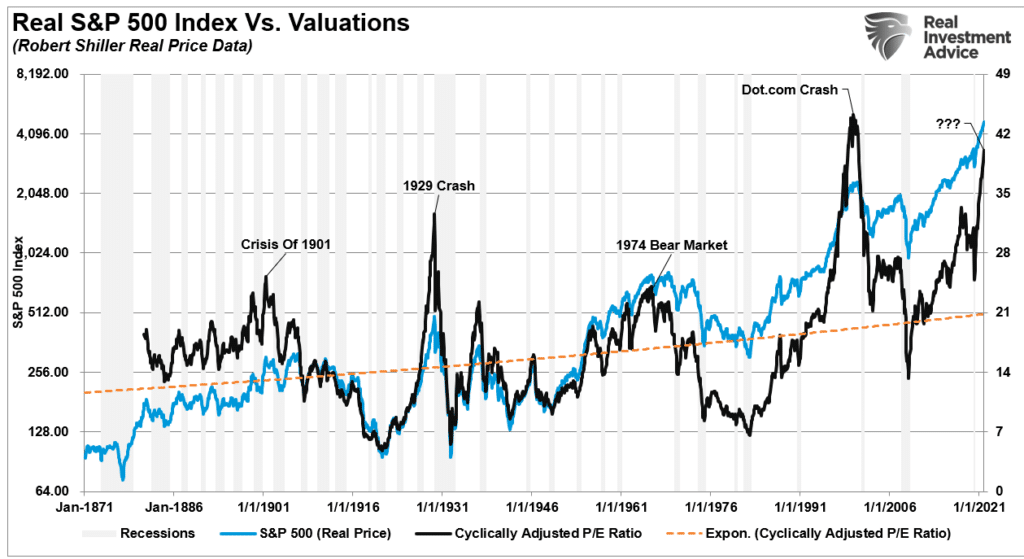
We should not overlook the importance of his commentary. In 1999, the “dot.com” bubble was in full swing, and valuations ran at nearly 42x trailing earnings on a CAPE ratio basis. Today, the top-10 stocks of the S&P 500 comprise almost 30% of the entire market capitalization of the index. With valuations once again approaching the dot.com levels of exuberance. (Valuations are just the reflection of investor psychology.)
The Next Crash
As Michael Lebowitz noted in“Is A 2000 Market Crash Possible?”
“P/E valuations are grossly extended, and in both calculations nearing or surpassing levels in 1999. The graph also show valuations are well above those of 1929.”
The point here is that valuations matter. The growth expectations for the FANG stocks far exceed any conceivable realistic outcome. As Allbert concludes:
“Investors are desperate to believe the EM and BRIC growth story, for they have so little alternative. The story of superior growth for the EM universe is as entirely plausible as it is entirely misleading. Valuation is what matters for investing in EM, not their superior growth story and certainly, EM equities are not relatively cheap. Yet investors persist in the BRIC superior growth fantasy. But it is no different from many of the other investment fantasies I have witnessed over the last 25 years only to see them end in severe disappointment.” BRICs have indeed been terrible investments over the past decade, underperforming both MSCI World and even the EAFE index by a very wide margin.
Put a date in your diary to look out for my Global Strategy Weekly on 2 Dec 2031. For I have a similar feeling that in a decade’s time FAANGs (and US tech generally) will go the way of the BRICs as another example of acronym investing going horribly wrong. Indeed, only recently I noted that despite US IT’s EPS relative now declining sharply, its nosebleed PE valuation at 30x looks vulnerable vs the market’s 22x – the widest gap since the Nasdaq bubble.”
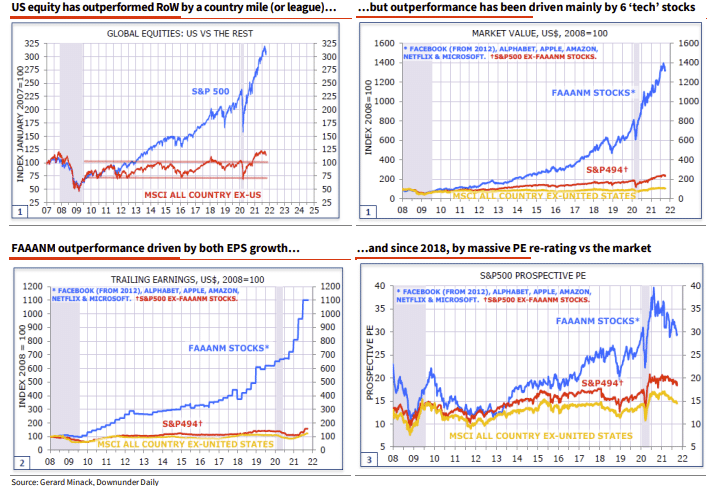
Valuations always matter, and they matter a lot. The problem is that investors don’t learn this lesson until it is often far too late to matter.

>>> Barron’s Weekend Summary

Barron’s Weekend Summary: Are we nearing a housing peak? “No, say the housing bulls on Wall Street


Cover Story:
-Are we nearing a housing peak? “No, say the housing bulls on Wall Street, who argue that this is an upturn that could last for a decade. Millions of millennials are now at a point in their lives when they are seeking single-family homes in the suburbs and exurbs. They are entering a market still chastened by an unprecedented collapse in housing more than a decade ago.”

Tech Trader:
-The Metaverse is not just about Meta Platforms’ vision. There are other interesting plays to consider. Enter Zwift. “Zwift is an all-encompassing experience, one with meetups, communication features, and a virtual currency. You need a road bike, a smart trainer, and a laptop or tablet with a decent internet connection. Zwift founder and CEO Eric Min sees room to grow his budding alternative world, and plans to raise more capital to make it happen. One of Min’s ideas is to provide developers access to the same tools Zwift uses to create its virtual environments. That’s Zwift meets Roblox, which is poised to generate $2.7B in sales this year, by making tools that let its users create games and virtual worlds.”

The Trader:
-The Federal Reserve is scaring investors more than the Omicron coronavirus variant. ‘Omicron was bad enough on its own—no one knows how much it will hurt the economy—but then Fed Chairman Jerome Powell had to go and acknowledge that inflation isn’t transitory after all and the taper might have to go faster than expected. “He leaned on that message so strongly, it tells you some strategy change is coming,” says Dave Donabedian, chief investment officer at CIBC Private Wealth US.
- Few pharma companies have been hit as hard as Bristol-Myers Squibb. The stock has dropped 11% so far this year amid concerns that it will lose exclusivity on drugs like multiple-myeloma treatment Revlimid in 2022, and cancer treatment Opdivo and blood-clot preventer Eliquis later this decade. But if pharma is cheap, then Bristol, at just seven times 2022 earnings, looks like a bargain—especially if those concerns are overblown. BofA Securities analyst Geoff Meacham points to Bristol drugs like Abecma, Reblozyl, and others. “The biggest value driver going forward will be good commercial and regulatory execution for its newer launches,” writes Meacham, who has a $78 price target on the stock, up 38% from Friday’s close of $56.32. If pharma is ready to rally, Bristol might be the prime beneficiary.
-“The recent selloff in industrial stocks has left some names looking particularly cheap. Deere (DE), for instance, trades at 14.7 times its next 12 months’ expected free cash flow per share, below its five-year average of 20.7 times. That’s despite the fact that the $107 billion agriculture and construction equipment manufacturer is expected to grow free cash flow in the high teens over the next two years.’

Features:
-Analyst ratings for Rivian are expected to arrive this week. But Rivian isn’t exactly ailing. The company is valued at about $100 billion, more than Ford Motor (F) or General Motors (GM). Still, its shares are down about $2 from where they opened for trading on Nov. 10. Investors who bought shares when Rivian made its Nasdaq debut are down, even though the stock is still significantly higher than its $78 IPO price.
-The Japanese videogame giant Nintendo is still making games that are adored by its fans. But investors have spent much of the year looking for companies making big promises about the “metaverse”—the idea of virtual worlds that enable social interaction and commerce. That has powered stocks like Roblox and Nvidia to huge gains. Roblox is up 160% since it went public via a direct listing in March.
Meanwhile, Nintendo remains as conservative as ever about its ambitions. In a 48-page earnings presentation last month, it didn’t mention the metaverse.
-The Japanese attack on Pearl Harbor on December 7, 1941 was not just the event that brought the US into World War II. “It was the event that effectively gave birth to the US defense industry as we understand it today. But the mightiest force set in motion by the attack on Pearl Harbor was America’s military-industrial complex. Powered by a new national sense of mission, this massive force would win the war and then, over the following decades, turn the U.S. into a globe-spanning superpower.”

Europe:
-The hot jobs market has helped boost British recruiter Robert Walters as companies bounce back from the pandemic and hire more workers. Shares in the employment group, which places accountants, legal, and technology staff, have jumped almost 68% in the past 12 months to 7.60 pounds sterling ($10.11). A shortage of white-collar workers in some of Robert Walters’ 31 markets means companies have hiked salaries to woo the best talent.

Emerging Markets:
“Brazil’s public health system has been a leader since HIV days, and there’s very little vaccine hesitancy there,” says Thomas Kenyon, chief health officer at global medical NGO Project HOPE. Latin America in general is outperforming developing Asia on vaccinations. Chile is a global star at 84%, Mexico just went over 50%. Whether these numbers translate into investment opportunity might depend on your time frame. Verena Wachnitz, a portfolio manager for Latin American equities at T. Rowe Price. “Anyone with a medium-term horizon should find a lot of good ideas in Brazil.”
-“The pandemic has exacted a particularly heavy toll on the emerging-market economies. Not only did these economies suffer deep economic recessions and high unemployment rates. They also found their public finances were highly compromised. According to the IMF, never before have the emerging-market economies been as indebted as they are today. And seldom before have their budget deficits and their gross financing needs been as large as they are today.”

Commodities:
-“Palladium looks to post its first yearly price decline in six years, and platinum is ready for its first loss in three years. Both metals are defying overall strength in the commodities sector, which is on track to see its benchmark index score its strongest performance since 2009. The negative impact on demand for both metals, due to the global shortage of semiconductor chips, “heavily influenced investor sentiment and positioning” on the Comex futures market, says Trevor Raymond, director of research at World Platinum Investment Council.”

Streetwise:
“UBS calls artificial intelligence (AI) a top investment theme for the coming decade. So, where are all the attractively priced stocks? Don’t suggest using AI to search for them—I spoke with a guy who’s doing just that, and it’s off to a slow start. Schmidt says machines will cure our diseases and enrich our lives, and they probably won’t annihilate us Terminator-style. But they might trick us into annihilating each other; he recommends making some modifications while we can.”

>>> Weekend Papers Summary

Weekend Papers Summary

NEW YORK TIMES
-South African researchers are engaging in an effort to stop new mutations. They say that people with untreated HIV who get Covid may give the virus more chances to mutate, as it stays in their bodies longer.
-South Africa’s high rate of HIV infection has given the country an added urgency, and unique expertise, in trying to root out the evolving coronavirus.
-A Lab in Nebraska is tracking the spread of omicron in the US. More states are discovering cases of the new variant. Tracking its spread, experts say, is crucial to understanding what threat it poses.
-Oxford High School let Ethan Crumbley back into a classroom despite concerns about his behavior. First, a teacher found Ethan Crumbley searching online for ammunition. The next day, there was an alarming note on his desk: “The thoughts won’t stop. Help me.” School officials met with Mr. Crumbley, 15, and his parents, informing them that he needed to begin counseling within 48 hours. After his parents resisted bringing him home, administrators allowed him to stay in school.
-Republicans plan to carry their push to reshape the nation’s electoral system into next year, with Democrats vowing to oppose them but holding few options in GOP-led states.
Members of the special House committee investigating the Capitol riot are among those arguing for an overhaul of a more than century-old statute enacted to address disputed elections.
-US intelligence claim the Russians could be preparing to invade Ukraine. An invasion force could include 175,000 troops, but U.S. officials stress that President Vladimir V. Putin’s intentions remain unclear.
-An Israeli company’s spyware has been used to monitor the activities of US Embassy staff in some African capitals. The hack is the first known case of the spyware, known as Pegasus, being used against American officials.
-A cream cheese shortage is affecting N.Y.C. bagel shops. Supply chain problems have hit businesses across the US and now, they are even threatening to prevent the production of the quintessential New York treat.
The Belgian port city of Antwerp is struggling to manage a cocaine epidemic. The city has become the main port of entry into Europe for cocaine, which is being blamed for a surge of violence that has prompted some Belgian officials to call for a war on drugs.

FINANCIAL TIMES
-Russian President Vladimir Putin and President Joe Biden are set to hold a phone call next week amid heightened military tensions on the border between Russia and Ukraine, with Washington warning that Moscow could launch an invasion in early 2022.
The two leaders will discuss this matter following a meeting this week of US and Russian diplomats, where warnings were traded about the military situation on the border.
-South African epidemiologists were becoming alarmed by a rapid rise in Covid cases in Gauteng province, including in Johannesburg and Pretoria. They immediately linked this sudden surge to the appearance of a hyper-mutated new variant, which scientists called B.1.1.529 and the World Health Organization then named Omicron.
-Valérie Pécresse, who heads the Ile-de-France region around Paris, has been chosen as the candidate of the conservative Les Républicains party in next year’s French presidential election.
-French President Emmanuel Macron brokered a call on Saturday between Saudi Arabia and Lebanon’s leaders to end a diplomatic dispute that led to the imposition of sanctions on Beirut by Gulf States. Macron, the first western leader to visit the kingdom since the 2018 murder of Saudi journalist Jamal Khashoggi, pushed for the call during a meeting with Crown Prince Mohammed bin Salman in Jeddah, during a tour intended to underline France’s influence in the region.
-A sharp drop in the US unemployment rate has set the stage for the Federal Reserve to accelerate the scaling back of its stimulus program this month, economists said, giving it greater flexibility to raise interest rates sooner next year if necessary.
-When Major League Baseball locked out its players as the clock struck midnight on Thursday, its ninth work stoppage in more than a century, it was as if the game’s biggest stars just disappeared.
-More than a month after a coup, the soft-spoken Abdalla Hamdok was reinstated through what he called a “workable agreement” with the army to avoid “a catastrophic situation”. Dozens have been killed in mass protests against the military takeover. But far from quelling anger at the coup, Hamdok’s deal with the generals has jeopardized support for the technocrat.
-Investors retreated from US stocks on Friday, dumping shares in large technology companies and sending the tech-heavy Nasdaq Composite index sharply lower.
-Financial markets have been whipsawed over the past week, with the Omicron coronavirus variant sweeping the globe just as the Federal Reserve signaled its willingness to accelerate US monetary policy tightening.
-France has secured its biggest overseas order for its Dassault Rafale combat jet with the United Arab Emirates as President Emmanuel Macron looks to deepen ties with an important Middle Eastern ally.
-Evergrande chair Hui Ka Yan was summoned by Chinese government officials on Friday after the property developer warned it might not be able to meet its financial obligations and that it planned to restructure its offshore debt.
-Having spent months making excuses about stock shortages to American consumers, retailers are now trying to lure them back into the store or on to the website with promises of extended sales, discounts and faster deliveries. But it seems the buying public are no longer so interested.
-US job growth slowed in November while the unemployment rate fell to its lowest since the pandemic began, painting a complex picture of the labor market’s recovery as the Federal Reserve moves to consider whether to speed up its withdrawal of stimulus support.
-A top Federal Reserve official has warned that the Omicron coronavirus variant threatens to fuel soaring inflation in the US by putting further pressure on supply chains and worsening worker shortages.

NEW YORK POST
-“President Biden is having a series of worrisome episodes that seem to be a mix of his trademark plagiarism (adopting episodes from other public figures’ lives as his own in addition to appropriating their words) and what we sometimes euphemistically call a ‘senior moment.’”
-China’s Communist leaders offered an acid denunciation of western-style democracy in advance of President Biden’s two-day democracy summit next week.
Democratic systems, like those in the United States, are “doomed to fail,” top Chinese officials said.
-President Joe Biden vowed the U.S. would make it “very, very difficult” for Russia to take military action in Ukraine. The commander-in-chief’s comments came amid fears of a possible Russian invasion of Ukraine early next year. New findings from US intelligence estimated 175,000 troops would be involved, according to the Washington Post, which cited an intelligence document and U.S. officials.
-The current market is “even crazier than the dotcom era” and China made the right call when it banned cryptocurrencies, according to Warren Buffett’s right-hand man Charlie Munger.

Barrons : The Housing Boom Could Last for a Decade. Buy These Stocks.

The Housing Boom Could Last for a Decade. Buy These Stocks.

Housing is booming. Just take a look at Century Communities ’ development in Tumwater, Wash., where more than 140 homes, at prices as high as $500,000, have been sold this year. Tumwater is viewed as a suburb of Seattle—even at 60 miles away. It’s a scene that has been repeated over the past two years in markets all across the country.

Are we nearing a peak?

No, say the housing bulls on Wall Street, who argue that this is an upturn that could last for a decade. Millions of millennials are now at a point in their lives when they are seeking single-family homes in the suburbs and exurbs. They are entering a market still chastened by an unprecedented collapse in housing more than a decade ago.

“This market is primarily driven by a lack of supply, not excess demand,” says Stephen Kim, a housing analyst at Evercore ISI. “The supply shortage built up over 10 years, and it won’t go away quickly.”


The numbers support Kim’s assertion. Inventories of existing homes remain near historically low levels. Construction starts on new single-family housing, meanwhile, will finally top one million this year after averaging fewer than 750,000 in the previous 10 years. That would still be below the 1.6 million annual starts from 2004 to 2006, the peak years of the housing bubble.

“The industry would need to sustain a two-million-starts pace for a decade to bring the industry out of its current underbuilt situation,” Kim argues.

The large home builders— D.R. Horton (ticker: DHI), Lennar (LEN), PulteGroup (PHM), and Toll Brothers (TOL)—are well positioned to benefit from the demographic trends. Their stocks trade for an average of just seven times projected 2022 earnings, among the lowest multiples in the stock market.

Small-cap builders Century Communities (CCS) and Meritage Homes (MTH) are even cheaper, fetching about five times forward earnings. The S&P 500 index trades at more than 20 times estimated 2022 profits.

“The industry is completely different than it used to be,” says Bill Smead, a manager of the Smead Value fund, which holds D.R. Horton and Lennar. “It’s going from being fragmented to being aggregated in a relatively small number of publicly traded hands, and there is a secular growth story due to demographics that mutes a lot of the normal cyclicality.”

Nineteen publicly traded builders now command more than 30% of the new-home market, against 21% a decade ago. The builders have strong balance sheets and less land inventory, and are poised to ramp up capital returns to investors in the coming years. Dividends, now averaging just 1% across the industry, should rise along with share repurchases.

In the past, home builders plowed profits into land purchases to enable future construction. That kept a lid on valuations, as investors worried that land-heavy balance sheets would become liabilities in a downturn.

Home builders are now reaching deals with land developers that give them the option to purchase home-building lots rather than buying and holding land. At Horton, the percentage of owned lots has fallen to 24% from 43% since 2018.

“It’s not like the top of the last cycle, when home builders owned a ton of lots purchased with borrowed money,” Smead says. The companies, he says, have gone from being “land developers” to “home manufacturers”—increasing returns and lowering risk. Pulte has scarcely any net debt, and Horton has little net debt at its core home-building business.

J.P. Morgan analyst Michael Rehaut has estimated that the average net debt-to-capital ratio on home builders’ balance sheets will fall to a negative 4% by the end of 2023 from 15% today.

He sees the companies as capable of buying back 20% of their shares in the next two years. The repurchases have already ramped up. Pulte bought back 4% of its stock in the first nine months of 2021, and D.R. Horton repurchased 2% in its just-completed fiscal year.

Most public builders focus on entry-level and move-up buyers on the outskirts of major cities with average selling prices around $400,000. Toll, however, focuses on the high end and has an average selling price of close to $900,000.

Smead sees annual earnings growth of 10% to 15% on average for the home builders over the next decade, although the gains could be lumpy.

Evercore’s Kim says that 2022 Street earnings estimates are too low, arguing that current earnings reflect homes ordered several quarters ago, when prices were lower and the cost of lumber, a major input, much higher.

“The supply-chain disruptions have pushed some of the upside into next year,” he says.

The stocks aren’t trading as cheaply based on price-to-book ratios, a popular valuation measure for home builders. The group now averages about 1.4 times projected 2022 year-end book value. Bulls argue that earnings are more durable than in the past and that the stocks should trade based on earnings and not book value.

Smead’s view is that the persistently low valuations reflect the searing investor memories of the 2004-07 housing bubble and subsequent crash, when stocks like Toll and D.R. Horton fell as much as 85%.

“If you compare this with the 2007-to-2009 period, you have two large demographic groups—millennials and baby boomers—looking for housing and not finding a lot of supply out there,” says Jay McCanless, the housing analyst at Wedbush Securities.

The work-from-home trend is another favorable trend, as Americans move out of apartments and into single-family homes, while homeowners seek larger houses with home offices and other amenities.

The bear case for housing is that slowing population growth will limit demand, according to Zelman & Associates, the firm headed by the influential housing analyst Ivy Zelman.

The firm projects that the U.S. population will grow at just 4% in the current decade, down from 7.4% in 2010-20, which was the second-slowest percentage gain in history. “Population growth—the crucial underpinning of incremental housing demand—is on a troubling trajectory,” the firm wrote in a report this summer. “The current pace of production already surpasses demographically supported normalized demand.”

More near term, there is concern that the critical spring selling season next year may not be as robust as 2021’s, particularly if ultralow 30-year mortgage rates, now just over 3%, rise toward 4%. The rally in housing prices may have already stalled. The S&P CoreLogic Case-Shiller U.S. National Home Price NSA Index showed a 19.5% annual gain in September, down from 19.8% in August.

Industry executives say they aren’t worried. “I think it’s pretty clear that the market is not as white hot right now as it was in the spring, but we’re still seeing very strong demand,” said Michael Murray, co-chief operating officer at D.R. Horton, on an earnings conference call in November.


Dale and Robert Francescon, the co-CEOs of Century Communities, tell Barron’s, “With interest rates still at historic lows, demand has been consistently strong throughout our national footprint of more than 40 markets.”

And a bit of a cool-off may not be such a bad thing for the red-hot housing market, says Larry Pitkowsky, manager of the GoodHaven fund, which owns Lennar shares. “A more normalized pace of demand might be better, as Lennar and its brethren are striving to balance very strong demand with higher raw materials and tight labor markets, and a sensible desire to protect margins,” he says.

Here’s a closer look at six home builders:

D.R. Horton
The industry leader constructs roughly one in 10 new homes in the country—over 80,000 in its latest fiscal year. It has the industry’s largest market value at $37 billion and one of the highest returns on equity at 31%. Entry-level homes account for about half of its business.

“Horton has done a superb job bringing down debt levels while at the same time growing the business and positioning itself for the future,” says Wedbush’s McCanless. Horton now controls over 500,000 lots—enough for more than five years of building at 2022’s expected pace.

Its shares, at a recent $103, trade for about seven times the current earnings consensus of $14.22 a share for the company’s fiscal year ending in September. The shares yield 1%.

Kim of Evercore ISI sees earnings of about $18 a share, arguing that Horton’s gross margins, now about 27%, can hit 30%. He has an Outperform rating and a price target of $163.

Lennar
The No. 2 home builder in terms of market value has done the best job among its peers of developing related businesses. These include multifamily and single-family rental housing ventures and investments like a stake in Opendoor Technologies (OPEN), the online home buyer.

Lennar plans to spin off a group of noncore businesses, although it hasn’t yet provided details. Shares, at about $113, trade for 7.7 times projected 2022 earnings of almost $15 a share.

Chairman Stuart Miller says that “the best of times” for home builders still have a way to go. “Since new-home construction cannot ramp quickly enough to fill the void of the production deficit that persisted over the past decade, short supply is likely to remain for some time to come,” he said on the company’s latest earnings conference call.

Investors can invest alongside Miller in the company’s supervoting B shares, which trade at $92, a big discount to the more-liquid Class A shares.

GoodHaven’s Pitkowsky also favors the B shares, and they are probably the best way for retail investors to play Lennar, given the possibility that the share classes combine.


Toll Brothers
With its luxury focus, Toll is the most differentiated of the major home builders, and its competitive position is probably the strongest, since it competes primarily with smaller private builders.

Toll shares, at about $68, trade for 7.6 times projected earnings of $9 a share in the company’s fiscal year ending in October 2022.

“The higher end of the market has seen the biggest reversal of fortune—in a good way,” says Kim, noting weakness before the pandemic. Toll is benefiting from a larger prepandemic land position than peers. He has an Outperform rating and a price target of $86.

Higher-income white-collar workers—Toll’s core customer base—tend to have more work-from-home flexibility, and that is translating into strong demand, with the average buyer spending $160,000 on extras like home offices and multigenerational suites. And with longer construction periods than peers on its homes that can stretch a year or more, Toll’s earnings gains could play out deep into 2022.

The company has developed what it calls “affordable luxury” homes in less expensive markets like South Carolina, with homes that sell on average for about $740,000 and make up about 40% of its business.

PulteGroup
The No. 3 U.S. home builder caters mainly to first-time and move-up buyers. Through its Del Webb and DiVosta brands, it builds “active adult” communities catering to those near, and in, retirement.

Its shares, at about $52, are among the cheapest of its large-cap peers at under six times projected 2022 earnings.

As more of a build-to-order company than D.R. Horton and Lennar, Pulte’s earnings have more upside potential, since its current closings reflect older orders. And sales prices on new orders were up 26% year over year in the third quarter, pointing to higher 2022 earnings.

The company has one of the best balance sheets among its peers, with minimal net debt. J.P. Morgan’s Rehaut is bullish on the company, citing its financial strength and a return on equity of more than 25%. He has a price target of $71.


Century Communities
Since going public seven years ago, the Colorado home builder has expanded to 17 states and become the country’s ninth-largest builder.

The bulk of Century’s sales go to entry-level buyers. Its Century Complete brand offers low-price homes with no options—the average selling price is just $207,000—around smaller cities like Jacksonville, Fla., and Louisville, Ky.

“Century is leveraging its buying power to enter smaller markets where it can build homes to be competitive with the local resale market,” says Wedbush’s McCanless.

Shares, at about $72, trade for five times projected 2022 earnings of about $15 a share. McCanless has an Outperform rating and a $110 price target on the stock.

Meritage Homes
The high-growth Arizona-based builder is focused on the entry-level market in the Southeast and Southwest U.S., with an average selling price of about $400,000.

“We’re in the affordable part of the market,” Phillippe Lord, Meritage’s CEO, tells Barron’s. “Our part of the market will be more resilient” if interest rates rise, he says, adding that Meritage homes offer higher quality and better design than other entry-level rivals.

Meritage, whose shares trade for about $118, is expected to generate nearly 75% growth in earnings this year to $19 a share, and a 21% gain in 2022 to $23 a share. The stock trades for just five times projected 2022 earnings.

After its third-quarter results, the company “executed extremely well,” despite materials shortages, Kim said. He has an Outperform rating and a price target of $190 a share.

U.S. home builders have never been in better shape. Even after a strong 2021, their stocks could be poised for many years of gains.

Barrons : Hot Jobs Market Is Boosting This U.K. Recruiter. The Stock Is Up More

Hot Jobs Market Is Boosting This U.K. Recruiter. The Stock Is Up More Than 60%.

The hot jobs market has helped boost British recruiter Robert Walters as companies bounce back from the pandemic and hire more workers.

Shares (ticker: RWA.UK) in the employment group, which places accountants, legal, and technology staff, have jumped almost 68% in the past 12 months to 7.60 pounds sterling ($10.11). A shortage of white-collar workers in some of Robert Walters’ 31 markets means companies have hiked salaries to woo the best talent.

The company in October said in its third-quarter update through Sept. 30 that “profit for the full year is expected to be comfortably ahead of current market expectations.” Group profit was up 26% from the year-ago quarter to £91.8 million. Rivals SThree (STEM.UK), PageGroup (PAGE.UK), and Hays (HAS.UK) each raised earnings guidance as well.

But there’s another macro issue that has the potential to drive productivity and profit higher at Robert Walters: a digital transformation fueled by the pandemic. The company has developed an artificial-intelligence tool with a third-party technology party called Broadbean that matches suitable candidates with clients faster.

The company took an early leadership role during the pandemic to train clients to use technology to conduct virtual interviews, and hire and review employees remotely. More than 150 webinars produced by the company have been viewed almost 30,000 times, and 3,800 podcasts have been downloaded.

Other innovations include Gem, a customer-service management tool that helps headhunters track and manage passive contacts and future prospects. Gem generated a 30% response rate from potential job candidates compared with a 21% response rate on LinkedIn, according to the annual report.

Sanjay Vidyarthi, an analyst at broker Liberum, forecasts that the stock could rise 28.2% to £9.75. The investment in technology will drive productivity and margins over time, he wrote in a note, adding that the company has “stuck to its knitting and has plenty of longer-term growth potential across a broad range of markets.”

Asia-Pacific generates just under half of the profit, with Europe around 25%, the U.K. 20%, while North America, lumped into “other international” as a potential growth area, comprises the rest.

Robert Walters has a market value of £513 million, fetches a multiple of 15.9 times this year’s expected earnings, and trades at a 10% premium to its peers. The company employs 3,598, and hired 146 new consultants during the third quarter.

In 2020, pretax profit fell to £12.1 million on sales of £938.4 million, down from £47.4 million and £1.2 billion, respectively, in 2019.

Research presented at the company’s capital markets event pointed to the opportunity ahead—there are a record number of unfilled positions, with 10 million in the U.S. and 1.7 million in the U.K. On top of that, 41% of workers who have jobs are looking to make a change in the next 12 months.

Among the regional opportunities: In Asia, the company is recruiting talent to address the shortage in semiconductors. In Australia and New Zealand, the lack of job candidates has been exacerbated by a lack of immigration and professionals who are migrating overseas.

“The acceleration of candidate and client confidence, combined with a shortage of candidates, is leading to increased competition and wage inflation,” CEO Robert Walters told Barron’s. “We expect the market to continue to improve into next year with demand outstripping supply.”

FT : Second-hand fashion: turning cast-offs into money bags

Second-hand fashion: turning cast-offs into money bags
Depreciation barely features at the top end of this market

Looking too cool for school while saving the planet is fashion nirvana. Enter the flourishing world of second-hand handbags, which turns status symbols into badges of sustainability. Prada is the latest to see a moneymaking opportunity in this market.

Just don’t expect to bag a bargain. Hermès’ famed Birkin bag, named for stylish English actress Jane Birkin, illustrates the vagaries of bag economics.

The eponymous bags were born after Birkin griped that she was unable to find a bag able to hold that rather unglamorous accoutrement, the baby bottle. Today a brand new Birkin 35 in Togo leather costs £8,890. But buying one of its predecessors second-hand — or, as it has been rebranded, “pre-owned” or “preloved” — could cost multiples of that. Depreciation, assuming no scratches or blemishes, barely features at the top end of this market.


These bags are available at a range of shops, online platforms and auction houses. Vestiaire, an online site that specialises in resale, currently has just shy of 100 Birkin 25 bags on its site. Vendors in the US, Japan, UK and Hong Kong are all looking to offload their bags from around £13,000 to four times that. Auctions command still higher prices, particularly when the vendor is famous: a Birkin-owned Birkin bag went under the gavel for £119,000, earlier this year.

Nor is it just a fad in the developed world. China’s Gen Z is combining a nostalgia for goods enjoyed by previous generations with a thoroughly modern eye attuned to the investment potential of statement pieces. Marketplaces are mushrooming. The nation that led the way on livestreaming as ecommerce now boasts start-ups like Lets Lux Now which deploys AI to appraise and provide a value on goods in a matter of seconds.

At the other end of the spectrum, charity shops continue to parlay used clothes and accessories into cash for worthy causes. Just don’t expect to find a Birkin bag lurking round the corner.

>>> US Close Dow -0.17% S&P -0.84% Nasdaq -1.92% Russell -2.13% VIX 30.67 +9.73%

Closing Market Summary

The major averages finished the week on an uninspiring note with the Nasdaq (-1.9%) pacing a daylong retreat while the S&P 500 (-0.8%) and Dow (-0.2%) recorded slimmer losses. The three indices lost a respective 2.6%, 1.2%, and 0.9% for the week.

Small caps fared even worse with the Russell 2000 (-2.1%) falling 3.9% for the week.

The sharply lower finish represented a turn from the market's higher open, which followed the release of the Employment Situation report for November. The report missed headline estimates but also contained some positive elements like upward revisions to October figures and a drop in the unemployment rate.

The headline miss in the jobs report opened the door to an argument against accelerating the Fed's taper, but the market will need to see more before reversing its expectations for tighter policy in 2022, as the implied likelihood of a rate hike in June ticked up to 73.0% from 69.9% yesterday and 62.3% one week ago.

Eight sectors ended the day in negative territory with three losing 1.0% or more. The consumer discretionary sector (-1.8%) finished at the bottom of the leaderboard, right behind technology (-1.7%) and financials (-1.5%).

Growth stocks were among today's big losers with the likes of Microsoft (MSFT 323.01, -6.48, -2.0%), NVIDIA (NVDA 306.93, -14.33, -4.5%), Amazon (AMZN 3389.79, -47.57, -1.4%), and Tesla (TSLA 1014.97, -69.63, -6.4%) falling between 1.4% and 6.4%. NVIDIA's underperformance followed news that the FTC sued to block the company from completing its $40 bln acquisition of Arm Holdings.

Besides NVIDIA, roughly 2/3 of the components of the PHLX Semiconductor Index (-0.2%) finished in the red, but the but the index outperformed thanks to a spike to a fresh record in Marvell (MRVL 83.59, +12.56, +17.7%). The stock rallied after the company beat Q3 expectations and issued above-consensus guidance for Q4.

In other earnings, DocuSign (DOCU 135.09, -98.73, -42.2%) dove to its lowest level since mid-2020 after its Q3 beat was overshadowed by weak revenue guidance for Q4.

Treasuries faced some selling during the first hour of trade, but they reversed higher as stocks surrendered their starting gains. The 10-yr yield fell 11 basis points to 1.34%, reaching its lowest level since late September.

In commodities, crude oil fell $0.26, or 0.4%, to $66.38/bbl, surrendering $1.79, or 2.6% for the week.

Reviewing today's economic data:

  • November nonfarm payrolls increased by 210,000 (consensus 525,000). The 3-month average for total nonfarm payrolls decreased to 378,000 from 469,000 in October. October nonfarm payrolls revised to 546,000 from 531,000. September nonfarm payrolls revised to 379,000 from 312,000
    • November private sector payrolls increased by 235,000 ( consensus 500,000). October private sector payrolls revised to 628,000 from 604,000. September private sector payrolls revised to 424,000 from 365,000
    • November unemployment rate was 4.2% ( consensus 4.5%), versus 4.6% in October. Persons unemployed for 27 weeks or more accounted for 32.1% of the unemployed versus 31.6% in October. The U6 unemployment rate, which accounts for unemployed and underemployed workers, was 7.8%, versus 8.3% in October
    • November average hourly earnings increased 0.3% (consensus 0.4%) versus a 0.4% increase in October. Over the last 12 months, average hourly earnings have risen 4.8%, versus 4.8% for the 12 months ending in October
    • The average workweek in November was 34.8 hours (consensus 34.7), versus 34.7 hours in October. Manufacturing workweek increased 0.1 hours to 40.4 hours. Factory overtime was unchanged at 3.2 hours
    • The labor force participation rate increased to 61.8% from 61.6%. o The employment-population ratio increased to 59.2% from 58.8% in October.
  • The ISM Non-Manufacturing Index for November increased to a record high 69.1% (consensus 65.0%) from 66.7% in October. The dividing line between expansion and contraction is 50.0%. The November reading marks the 18th straight month of growth for the services sector
    • The key takeaway from the report is the understanding that demand shows no signs of slowing and services sector activity, which comprises the largest swath of economic activity, continues to run at a record pace even with the constraints of labor shortages, logistics problems, and difficulty in obtaining materials
  • The IHS Markit Services PMI rose to 58.0 in the final reading for November from 57.0 in the preliminary reading but was down from October's final reading of 58.7
  • Factory orders for manufactured goods increased 1.0% m/m in October (consensus +0.4%) following an upwardly revised 0.5% increase (from 0.2%) in September. Shipments of manufactured goods jumped 2.0% after increasing 1.0% in September
    • The key takeaway from the report is that the pace of order growth remained positive for nondefense capital goods, excluding aircraft -- a proxy for business spending

The market will not receive any notable data on Monday.

  • S&P 500 +20.8% YTD
  • Nasdaq Composite +17.1% YTD
  • Dow Jones Industrial Average +13.0% YTD
  • Russell 2000 +9.3% YTD