FT : Brussels calls for sanctioned oligarchs to lose EU citizenship

Brussels calls for sanctioned oligarchs to lose EU citizenship
So-called golden passport schemes allowed wealthy Russians permanent residency

Golden, no longer
The European Commission has had a long struggle with countries selling passports or offering permanent residency to wealthy investors in the country. Malta, Cyprus and Bulgaria in particular have come in the crosshairs during the past decade, though all of them have scrapped (or, in the case of Malta, suspended) the schemes by now.

Still, the commission yesterday issued a recommendation urging countries to fully abolish these regimes and even look into ways to revoke the citizenship or residency granted to the 30-odd Russian oligarchs who have been sanctioned by the EU in connection with Putin’s war in Ukraine, write Valentina Pop in Brussels, Eleni Varvitsioti in Athens and Peter Wise in Lisbon.

EU justice commissioner Didier Reynders said the schemes were in breach of the bloc’s treaties and posed security risks, as well as opened possibilities for corruption, money laundering and tax avoidance.

“All member states concerned should end their investor citizenship schemes immediately,” Reynders said. “In addition, they should assess whether they should revoke any ‘golden passports’ already granted to sanctioned individuals and others significantly supporting Putin’s war.”

In Cyprus, authorities confirmed that one sanctioned oligarch had previously acquired Cypriot nationality via its now defunct golden passport scheme that applied to people investing over €2mn in the country.

Russian agriculture billionaire Vadim Moshkovich, sanctioned by the EU and reportedly a beneficiary of the Cyprus golden passport scheme, fits the profile, but Cypriot authorities refused to confirm his name on privacy grounds. Moshkovich’s name was revealed in an Al Jazeera investigation in 2020 that obtained the records of the Cyprus golden visa scheme and led to street protests, high-level resignations and the abolition of the scheme.

When asked yesterday whether authorities would revoke the person’s passport, Cyprus president Nicos Anastasiades said “we will see”.

“Up until this point, Cyprus has fully supported [the sanctions regime based on] international law. Be sure that we will continue in the same direction,” Anastasiades said.

In Portugal, authorities are separately in the process of reviewing the naturalisation process of Russian billionaire Roman Abramovich, who has also been placed on the EU’s asset freeze and travel ban list because of his connections to the Kremlin.

Wealthy investors buying property in Portugal can be granted permanent residency in the country — and thus travel visa-free in the EU — but Abramovich acquired his Portuguese passport last year via a different process that enables the descendants of Sephardic Jews expelled from Portugal in the late 15th century to become citizens. He could still be stripped of it if the investigations disclose any wrongdoing.

Earlier this month, the Lisbon government altered its nationality legislation in relation to the descendants of Sephardic Jews, making it a requirement to demonstrate “a strong and lasting contemporary link to Portugal” in addition to Sephardic ancestry. This was “to prevent a generous and just law from being perverted by manipulation”, said Augusto Santos Silva, foreign minister in the outgoing government.

As a Portuguese passport holder, Abramovich cannot be prevented from entering the country, Santos Silva said. But he added that he was “very unlikely to do so” as EU sanctions meant he would be stripped not only of any assets he was found to own in Portugal, but also those he carried with him.

On its so-called golden visa scheme, Portugal has said that it only uncovered one pending application from someone in the sanctions list and suspended it. The residency scheme has been tightened and Portuguese authorities no longer issue those permits for Russian citizens. Of the roughly 430 Russian nationals who had already obtained permanent residency, none were on the sanctions list, according to Portuguese authorities.

In Sofia, the Bulgarian government is currently reviewing the roughly 200 golden passports already granted before the scheme was scrapped. “The sanctioned Russians are a clear case in point, I think their passports will be revoked faster,” said a Bulgarian official familiar with the matter.

And in Malta, a spokesman for the government yesterday said that no sanctioned Russian or Belarusian nationals had acquired Maltese citizenship under its currently suspended scheme.

Brussels’ renewed efforts to crack down on golden passports was welcomed in the north, with Sweden’s minister for integration and migration, Anders Ygeman, saying his government “has pushed for this” and that “people from outside the EU should not be able to buy civil rights in an EU country in exchange for money”.
>>> What to look at today - 29th of March 2022

Asian stocks rose Tuesday as a drop in oil and the prospect of more cease-fire talks between Russia and Ukraine helped sentiment. Bets on aggressive U.S. monetary tightening sapped shorter maturity Treasuries.  Shares climbed in Japan and Hong Kong but wavered in China. U.S. futures fluctuated and European ones advanced after the S&P 500 rallied for a third day. Oil extended a slide, taking West Texas Intermediate to about $105 a barrel, on concerns that China’s mobility curbs against Covid will sap demand. The U.S. 10-year Treasury yield edged up closer to 2.50%. Inversions along the bond curve, where some short-term rates exceed longer tenor yields, point to concerns about a looming economic downturn as the Federal Reserve hikes interest rates to quell high inflation.  The yen traded around a six-year low against the dollar on the divergence between the Fed and a dovish Japanese central bank. The latter continued with bond-market intervention to cap a surge in yields. Global shares are up about 8% from the lows reached after Russia invaded Ukraine. Such resilience contrasts with a rout in bonds and inverting yield curves, which are shaking economic confidence. Investors are trying to parse developments in the war, elevated commodity costs and the Fed’s fight against price pressures. Bitcoin traded above $47,000 after turning positive for 2022. The token’s rally is among the signs of improved appetite for speculative investments. US After Hours FDX +2.6% gets a new CEO; NEO -22.1% falls as CEO steps down, co lowers Q1 guidance; JEF +3.8% higher on earnings

Nikkei +0.78% Hang Seng +0.57% CSI +0.03% Shanghai -0.08% Shenzen -0.15%

Eur$ 1.0981 CNH 6.3839 CNY 6.3697 JPY 123.62 GBP 1.3091 CHF 0.9343 RUB 95.9740 TRY 14.8174 WTI$ 105.24 -0.67% Gold 1,923.18 +0.01% BTC 47,600 -0.75% ETH 3,400 -0.30%

S&P +0.24% Nasdaq +0.24% EuroStoxx +0.94% FTSE +0.60% Dax +0.95% SMI +0.44%

Macro :
- BlackRock Strategists Reduce European Equities on ‘Energy Shock’
- NATO Allies Are Split on Whether They Should Talk to Putin
- China Smartphone Stocks Drop on Apple Report; Xiaomi Sinks
- China Lockdowns Cost at Least $46 Billion a Month, Academic Says
- Billionaires, Private Equity Would See Tax Hikes in Biden Plan

Keep an eye on :
- YOU GY : About You Prelim 4Q Adjusted Ebitda Loss EU4M to EU15M
- AB FP : AB Science Fined EU1 Million for Publishing Key Information Late
- BAG LN : A.G. Barr FY Revenue Meets Estimates
- AAF LN : Airtel Africa CEO Carves Out Fiber Unit Ahead of Investor Hunt
- AAL LN : Anglo Looks to the Sea as Water Scarcity Hits Chile Copper Mines
- ANTO LN : Antofagasta CEO Sees Chile Averting Radical Changes to Mining
- MT NA : Four ArcelorMittal Plants Halted Due to Spanish Truckers Strike
- AT1 GY : Aroundtown Sees 2022 FFO I EU350M to EU375M
- BARC LN : Top Barclays Holder to Sell $1.1 Billion of Shares in Block Sale
- BAS GY : BASF’s Vassiliadis Says Russia Gas Cuts Would Halt Output: DLF
- CATE SS : WDP to Buy 9.09% Stake in Catena Through Directed Share Issue
- CLN SW : Clariant Wins 3 Petrochemicals Contracts For Lihuayi; No Terms
- CTEK SS : CTEK Holders Altor and Faustina Offers Up to 5.75m Shares: Terms
- DMP GY : Dermapharm Sees 2022 Revenue Up 10% to 13% Versus Prior Year
- FAST NA : Fastned FY Revenue Related to Charging EU12.4M Vs. EU6.25M Y/y
- HEM SS : Hemnet Share Sale By Holder General Atlantic Is Covered: Terms (8m shares)
- JEN GY : Jenoptik FY Dividend per Share EU0.25 Vs. EU0.25 Y/y
- MUL LN : Mulberry Sees Earnings Moderately Ahead of Expectations
- NESTE FH : Neste Studying Investment Into Waste Plastic Chemical Recycling
- NDX1 GY : Nordex 2022 Revenue Forecast Beats Estimates
- NOVOB DC : Novo Nordisk’s Ozempic 2.0 MG Approved in U.S. for Diabetes
- PFV GY : Pfeiffer Vacuum Sees 2022 Ebit Margin About 14%
- QDT FP : Quadient FY Ebitda Beats Estimates
- ROTH FP : Rothschild & Co. Names Javed Khan as Managing Partner Swatch Group: Mougahed Darwish to Retire on April
- SANN SW : Santhera, ReveraGen Start NDA Submission to FDA for Vamorolone
- SAN FP : Sanofi, IGM Biosciences to Develop IGM Antibody Agonists
- SOON SW : Sonova to Launch New 3-year Buyback Program of Up to CHF1.5B
- STLA IM : Stellantis to Cut Jobs at Illinois Jeep Plant Starting in May
- SAABB SS : Lockheed Beats Out Saab for $17 Billion Canada Warplane Fleet
- UHR SW : Swatch Group: Mougahed Darwish to Retire on April 1
- TEF SM : *TELEFONICA, DAZN SIGN EU1.4B SOCCER RIGHTS CONTRACT: EL CONFI
- UCG IM : UniCredit Backs CEO’s $2.7 Million Pay After Proxy Dissent
- WCH GY : Wacker Chemie Sees 2030 Sales Above EU10B
- WEW GY : Westwing Group SE Sees 2022 Rev. -12% to +3%

>>> Europe : Brokers Upgrades & Downgrades - 29th of March 2022

>>> Up
* Admiral Raised to Overweight at Barclays; PT 3,050 pence
* Bankinter Raised to Equal-Weight at Barclays; PT 5.50 euros
* Delivery Hero Raised to Neutral at Exane; PT 45 euros
* HelloFresh Raised to Outperform at Exane; PT 48 euros
* Kamux Raised to Buy at Handelsbanken
* Just Eat Takeaway Raised to Outperform at Exane; PT 40 euros
* Tullow Raised to Buy at Peel Hunt; PT 80 pence
* Valmet Raised to Buy at SEB Equities; PT 38 euros

>>> Down
* Direct Line Cut to Equal-Weight at Barclays; PT 323 pence
* Hapag-Lloyd Cut to Hold at Deutsche Bank; PT 305 euros
* Kuehne + Nagel Cut to Hold at Deutsche Bank; PT 300 Swiss francs
* Maersk Cut to Hold at Deutsche Bank; PT 22,500 kroner
* Royal Mail Cut to Sell at Deutsche Bank; PT 275 pence

>>> Initiation
* Alan Allman Associates Rated New Neutral at Oddo BHF
* AstraZeneca Rated New Buy at Goodbody; PT 11,250 pence
* GSK Rated New Buy at Goodbody; PT 1,950 pence
* J. Martins Rated New Neutral at Oddo BHF; PT 21.70 euros
* QuantumScape Rated New Neutral at SMBC Nikko; PT $20

>>> Call

(ZH) DoorDash Is Dominating The US Food Delivery Market

DoorDash Is Dominating The US Food Delivery Market

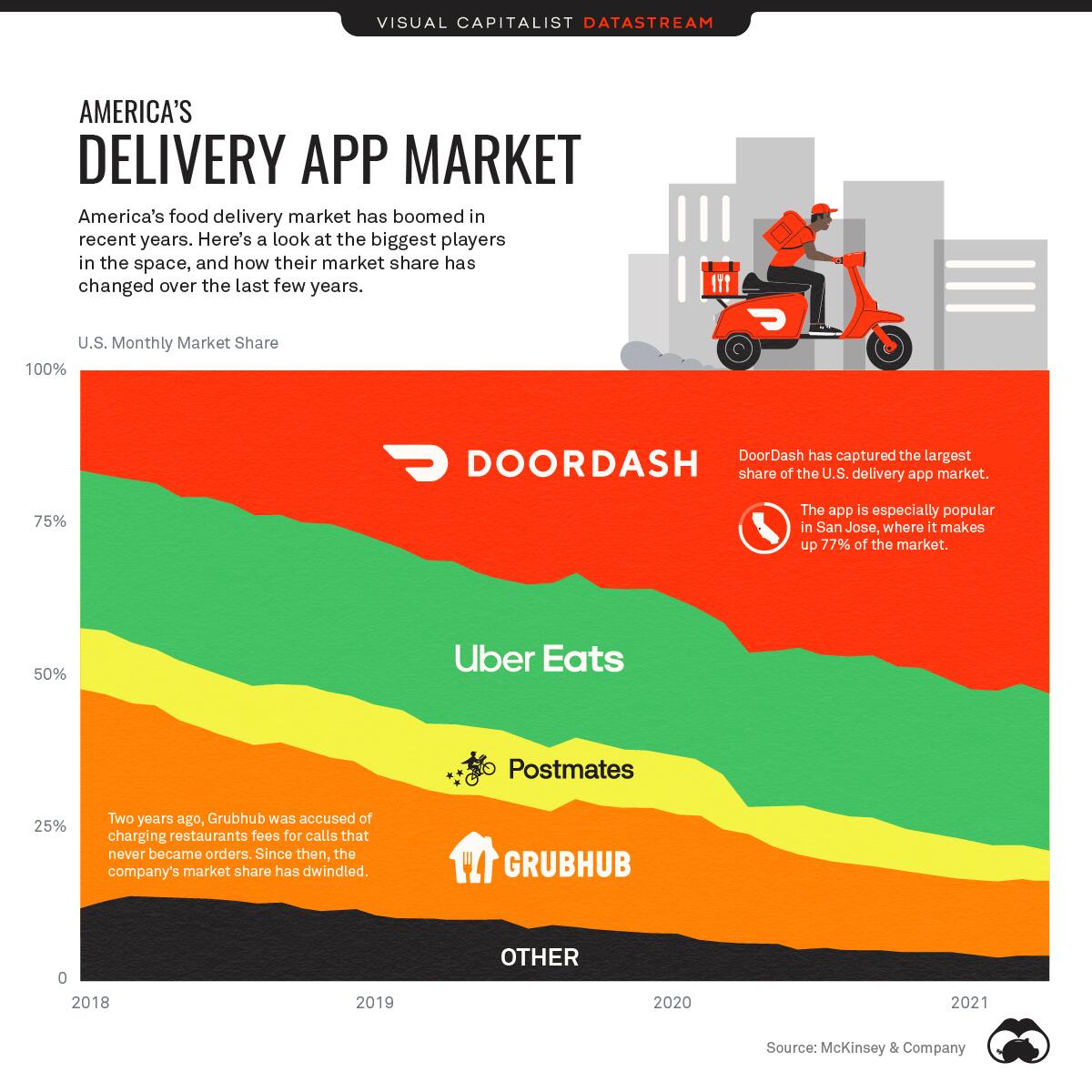
The food delivery app market in the U.S. is shifting from an oligopoly, where market control was shared amongst four companies, to more of a duopoly setting.
As Visual Capitalist's Carmen Ang details below, according to McKinsey & Company, two major players—DoorDash and Uber Eats—control close to 80% of the food delivery market as of 2021.
Here’s how the overall food delivery app market has shifted since 2018:

The Most Popular Food Delivery App in the U.S.
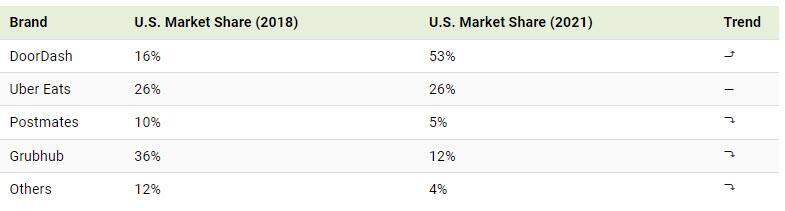
The COVID-19 pandemic has helped accelerate DoorDash’s rapid growth and market dominance. The food delivery company increased its market share from under 20% in 2018 to 53% in 2021.
As the world stayed indoors to weather the pandemic, the entire U.S. delivery app market grew 48.3% within the first couple months of 2020. And over the course of the year, DoorDash’s individual share of the market grew by about 12.5 percentage points, helping the company’s annual revenue to balloon from $0.85 billion in 2019 to $2.88 billion in 2020.
While an easy-to-use interface was a critical component of this success, many market analysts attribute DoorDash’s pandemic boom to a combination of superior customer data and brand positioning as an ally to struggling restaurants during the pandemic.
This success culminated in a widely-discussed IPO in December 2020, where in its first day of trading, DoorDash stock prices soared 86% to $190 per share.

DoorDash and Uber Eats Crowd Out the Competition
Throughout DoorDash’s growth, Uber Eats has remained their biggest competitor and maintained roughly 25% of the U.S. delivery app market since 2018.
These achievements have come at the expense of Postmates, Grubhub, and other smaller players, which have seen their market shares decrease substantially. It is worth noting that both Postmates and Grubhub have still seen increases in their annual revenue, in part due to the increasing size of the overall market.
That said, lesser-known platforms such as Delivery.com and ChowNow are decreasing in significance to the industry. As the delivery app market matures, control is increasingly consolidating in the hands of a smaller number of companies.

(ZH) "Sexual Get-Together": Rep. Cawthorn Says He Was Invited To DC Orgy, Has Wi

"Sexual Get-Together": Rep. Cawthorn Says He Was Invited To DC Orgy, Has Witnessed Lawmakers Doing Cocaine

Rep. Madison Cawthorn (R-NC) says that in the 14 months he's been in Washington DC, he's been invited to DC orgies and has witnessed lawmakers using cocaine, according to Just the News, citing the freshman lawmaker's recent appearance on the "Warrior Poet Society" podcast.
"I look at all these people, a lot of them that I’ve looked up to through my life, I've always paid attention to politics. Then all of the sudden you get invited to: 'Well hey we’re going to have kind of a sexual get together at one of our homes, you should come," said Cawthorn.
"I’m like: 'What did you just ask me to come to?" he continued. "Then you realize they are asking you to come to an orgy."
Link to Video :
Later, Cawthorn revealed that some of the very lawmakers who are "leading on the movement to try and remove addiction in our country" are on drugs themselves. "You watch them do, you know, a key bump of cocaine right in front of you and it’s like 'Wow, this is wild."

>>> US After Hours Summary: FDX +2.6% gets a new CEO; NEO -22.1% falls as CEO st

After Hoursaze Summary: FDX +2.6% gets a new CEO; NEO -22.1% falls as CEO steps down, co lowers Q1 guidance; JEF +3.8% higher on earnings

After Hours Gainers:

Companies trading higher in after hours in reaction to earnings/guidance: JEF +3.8%, DNA +3.8%

Companies trading higher in after hours in reaction to news: HBM +4.1% (provides annual reserve and resource update), FDX +2.6% (Raj Subramaniam to become new CEO), STNG +2.5% (enters into MoU with Carbon Ridge to develop onboard carbon capture), CWK +0.6% (to transfer business in Russia to local operator), RJF +0.5% (to acquire SumRidge Partners), AIG +0.2% (to rebrand Life & Retirement business as Corebridge Financial), BHLB +0.1% (expands partnership with FinTech firm Narmi to enhance its digital banking experience)

After Hours Losers:

Companies trading lower in after hours in reaction to earnings/guidance: AVAH -18.4%, ZEV -10.4%, PLAY -9.4%, LIDR -6.3%

Companies trading lower in after hours in reaction to news: NEO -22.1% (CEO steps down, co lowers Q1 revenue and EBITDA guidance), SKYH -3.8% (stock offering), SWX -1.9% (commences $400 mln common stock offering), ATER -1.6% (stock offering), BLL -1.5% (to reduce operations in Russia), AMBA -0.7% (names new CFO), NVO -0.4% (FDA approves 2.0 mg dose of Ozempic), LUV -0.1% (reaches tentative labor agreement with customer service employees union)

>>> US Close Dow +0,27% S&P +0,71% Nasdaq +1,31% Russell +0,00% VIX 19,62 -5,72

Closing Stock Market Summary

The S&P 500 gained 0.7% on Monday, as positive momentum and a hopeful-sounding geopolitical headline helped outweigh growth concerns. The Nasdaq Composite rose 1.3% while the Dow Jones Industrial Average rose 0.3%. The small-cap Russell 2000 (unch) finished flat.  

Eight of the 11 S&P 500 sectors closed higher, led by the consumer discretionary (+2.7%), information technology (+1.2%), and real estate (+1.3%) sectors. The energy (-2.6%), materials (-0.5%), and financials (-0.3%) sectors closed lower. 

Early on, the market was slowed down by growth concerns attributed to Shanghai announcing a two-phase Covid lockdown, The Nikkei reporting that Apple (AAPL 175.60, +0.88, +0.5%) plans to cut production of the iPhone SE and AirPods, the White House proposing tax increases in the FY23 budget, and the prolonged Russia-Ukraine situation.

The latter showed some progress in the afternoon after the Financial Times reported that Russia is prepared to allow Ukraine to join the EU as part of ceasefire talks as long as it doesn't join NATO. That report appeared to catalyze a late-session push, further supported by quarter-end rebalancing within the Nasdaq. 

While equities reacted positively, the growth concerns didn't necessarily go away. The cyclical sectors (except for the consumer discretionary sector) still underperformed, WTI crude futures still fell 6.5%, or $7.36, to $106.47/bbl, and the Treasury yield curve still flattened. 

The 2-yr yield rose five basis points to 2.34%, while the 10-yr yield decreased two basis points to 2.48%. On a related note, the $50 bln 2-yr note auction saw weak demand while the $51 bln 5-yr note auction was met with solid demand. 

The U.S. Dollar Index increased 0.4% to 99.14 amid relative weakness in the British pound (-0.7%) and Japanese yen (-1.5%). The yen fell after the Bank of Japan offered to buy an unlimited amount of JGBs at 0.25% as part of its policy to control the yield curve.

Separately, shares of Tesla (TSLA 1091.84, +81.20, +8.0%) jumped 8% after the company said it will ask shareholders to vote at this year's annual meeting to authorize additional shares for a stock split. 

Reviewing Monday's economic data:

  • The Advance report for International Trade in Goods for February showed a deficit of $106.6 billion, versus an unrevised $107.6 billion in January. The Advance report for Retail Inventories for February rose 1.1%, while the Advance report for Wholesale Inventories for February rose 2.1%.

Looking ahead, investors will receive the Conference Board's Consumer Confidence Index for March, the JOLTS - Job Openings report for February, the FHFA Housing Price Index for January, and the S&P Case-Shiller Home Price Index for February on Tuesday.

  • Dow Jones Industrial Average -3.8% YTD
  • S&P 500 -4.0% YTD
  • Russell 2000 -7.5% YTD
  • Nasdaq Composite -8.3% YTD

(ZH) Dumbphone Sales Are Soaring As People Revolt Against "Overwhelming" Smartph

Dumbphone Sales Are Soaring As People Revolt Against "Overwhelming" Smartphones

In a time when various "developed world" intelligence agencies are filling up petabytes of hard disk space with domestic phone recordings and tracking their own citizens who - in the pursuit of a "liberal" agenda - have been escalated to a greater terrorist threat than actual foreign terrorists, some people have had enough and are throwing their smart phones into the trash and replacing them with "dumbphones" instead.
One among them is seventeen-year-old Robin West, who according to the BBC is an anomaly among her peers: "she doesn't have a smartphone." Instead of scrolling through apps like TikTok and Instagram all day, she uses a so-called "dumbphone".
Those readers who had a cell phone in the late 1990s are all too familiar with these; for everyone else these are basic handsets, or feature phones, with very limited functionality compared to say an iPhone. For the most part, you can typically only make and receive calls and SMS text messages. And, if you are lucky, listen to radio and take very basic photos, but definitely not connect to the internet or apps.
Robin's decision to ditch her former smartphone two years ago was a spur of the moment thing. While looking for a replacement handset in a second-hand shop she was lured by the low price of a "brick phone". Her current handset, from French firm MobiWire, cost her just £8. And because it has no smartphone functionality she doesn't have an expensive monthly data bill to worry about.
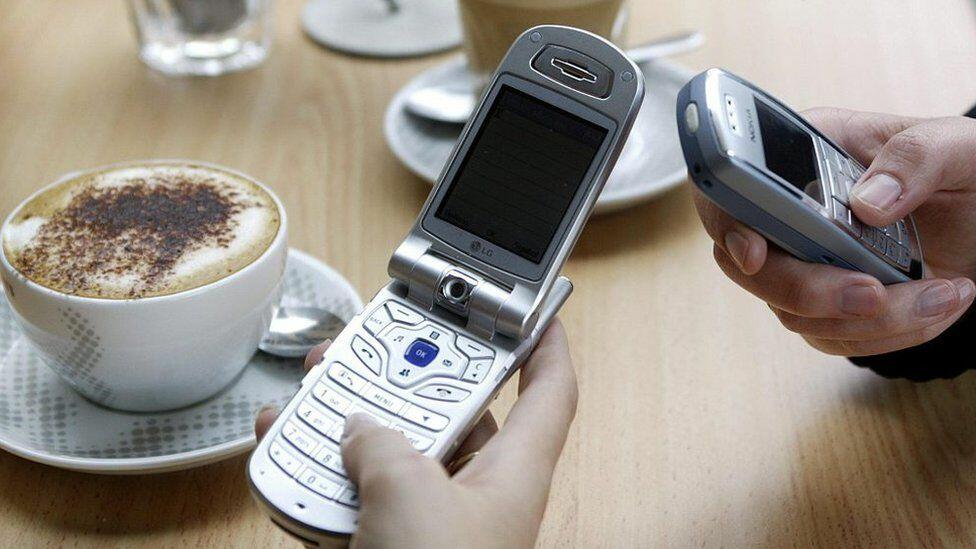
Two phones pictured in 2005, two years before Apple released its first iPhone, and 11 years before TikTok
"I didn't notice until I bought a brick phone how much a smartphone was taking over my life," she says. "I had a lot of social media apps on it, and I didn't get as much work done as I was always on my phone."
The Londoner adds that she doesn't think she'll ever buy another smartphone. "I'm happy with my brick - I don't think it limits me. I'm definitely more proactive."
According to BBC, dumbphones are enjoying a revival. Google searches for them jumped by 89% between 2018 and 2021, according to a report by software firm SEMrush. And while sales figures are hard to come by, one report said that global purchases of dumbphones were due to hit one billion units last year, up from 400 million in 2019. This compares to worldwide sales of 1.4 billion smart phones last year, following a 12.5% decline in 2020.
Meanwhile, a 2021 study by accountancy group Deloitte said that one in 10 mobile phone users in the UK had a dumbphone.
"It appears fashion, nostalgia, and them appearing in TikTok videos, have a part to play in the dumbphone revival," says Ernest Doku, mobiles expert at price comparison site Uswitch.com. "Many of us had a dumbphone as our first mobile phone, so it's natural that we feel a sense of nostalgia towards these classic handsets."
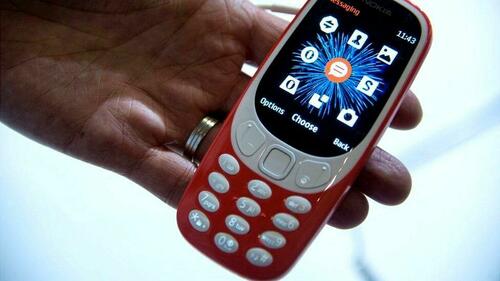
Doku says it was the 2017 relaunch of Nokia's 3310 handset - first released in 2000, and one of the biggest-selling mobiles of all time - that really sparked the revival. "Nokia pushed the 3310 as an affordable alternative in a world full of high-spec mobiles." He adds that while it's true that dumbphones can't compete with the latest premium Apple and Samsung models when it comes to performance or functionality, "they can outshine them in equally important areas such as battery life and durability".
The Nokia 3310 phone is one of the best-selling handsets of all time, selling 126 million units
Five years ago, Przemek Olejniczak, a psychologist, swapped his smartphone for a Nokia 3310, initially because of the longer-lasting battery. However, he soon realised that there were other benefits.
"Before I would always be stuck to the phone, checking anything and everything, browsing Facebook or the news, or other facts I didn't need to know," he says.
"Now I have more time for my family and me. A huge benefit is that I'm not addicted to liking, sharing, commenting, or describing my life to other people. Now I have more privacy."
However, Olejniczak, who lives in the Polish city of Lodz, admits that initially the switch was challenging. "Before I'd be checking everything, such as buses and restaurants, on my smartphone [when travelling]. Now that is impossible, so I have learned to do all those things beforehand at home. I got used to it."
One maker of dumbphones is New York company Light Phone. Slightly more clever that the norm for such products, its handsets do allow users to listen to music and podcasts, and link by Bluetooth to headphones. Yet the firm pledges that its phones "will never have social media, clickbait news, email, an internet browser, or any other anxiety-inducing infinite feed".
The company says it recorded its strongest year for financial performance in 2021, with sales up 150% compared with 2020. This is despite its handsets being expensive for dumbphones - prices start at $99 (£75).
Light Phone co-founder, Kaiwei Tang, says the device was initially created to use as a secondary phone for people wanting to take a break from their smartphone for a weekend for example, but now half the firm's customers use it as their primary device.
"If aliens came to earth they'd think that mobile phones are the superior species controlling human beings," he says. "And it's not going to stop, it's only going to get worse. Consumers are realising that something is wrong, and we want to offer an alternative."
Tang adds that, surprisingly, the firm's main customers are aged between 25 and 35. He says he was expecting buyers to be much older. Tech expert, Prof Sandra Wachter, a senior research fellow in artificial intelligence at Oxford University, says it is understandable that some of us are looking for simpler mobile phones.
"One can reasonably say that nowadays a smart phone's ability to connect calls and send short messages is almost a side feature," she explains. "Your smart phone is your entertainment centre, your news generator, your navigation system, your diary, your dictionary, and your wallet."
She adds that smartphones always "want to grab your attention" with notifications, updates, and breaking news constantly disrupting your day. "This can keep you on edge, might even be agitating. It can be overwhelming."
Prof Wachter adds: "It makes sense that some of us are now looking for simpler technologies and think that dumbphones might offer a return to simpler times. It might leave more time to fully concentrate on a single task and engage with it more purposefully. It might even calm people down. Studies have shown that too much choice can create unhappiness and agitation."
Yet back in London, Robin West says that many people are bewildered by her choice of mobile. "Everyone thinks it's just a temporary thing. They're like: 'So when are you getting a smartphone? Are you getting one this week?'."

The information : Apple’s Next Blow to the Ad Industry May Be Hiding in Plain Si

Apple’s Next Blow to the Ad Industry May Be Hiding in Plain Sight

Nearly a year after Apple implemented privacy changes that make it harder for digital advertisers to track how consumers use their smartphone apps, the iPhone maker has already introduced two other privacy features that mask the identity of Apple device users. Together, they threaten to further constrain the online ad industry’s ability to track customers, according to ad tech company executives and advertising consultants.

The two privacy features, which Apple launched last fall, are currently available only to people who pay for its iCloud+ storage service. Some ad industry executives fear, however, that Apple could expand or promote the features to more of its customers, similar to how it launched and expanded previous privacy features. That would cause further chaos or crimp revenue for incumbents such as Google and Facebook parent Meta Platforms, whose advertisers are only now starting to recover from the implementation of earlier iPhone ad-tracking restrictions.

“It’s got the industry holding their collective breath,” said Grant Simmons, a vice president at Kochava, which helps advertisers measure the performance of online ad campaigns.

THE TAKEAWAY
• Industry execs fear Apple will expand two new privacy features
• Such a move would block industry’s iPhone privacy workarounds
• The new features obscure or block users’ email, IP addresses

Released in September, one of the Apple features, called Private Relay, acts like a virtual private network, masking the iPhone user’s IP address and encrypting web traffic when the person uses Apple’s Safari browser. The net result is that the internet provider for the phone can see the person’s IP address but not which websites they visited, while the websites can’t tell who is visiting their pages because the IP address remains hidden from them. To enable the feature, Apple iCloud+ customers must manually turn it on in their device settings.

If the Private Relay service expanded beyond Safari to stop the transmission of user IP addresses across mobile apps, ad industry executives say it would hobble the efforts many ad networks and ad tech companies have made to adapt to Apple’s earlier changes, known as App Tracking Transparency. Many of the workarounds that firms including Meta, Snap and Google developed in the wake of Apple’s changes rely in part on having access to groups of user IP addresses to measure whether ads the users saw led to sales.

The second potential new Apple threat comes from a privacy feature made available in December to iCloud+ customers, Hide My Email. The feature creates a randomly generated email address they can provide an app or website rather than sharing their real email address. That way, they can hide who they are from any app that asks for their contact information. Without that information, it is harder for the app or website to know who bought its goods or services, and it complicates efforts to target that customer with ads in the future.

App and website developers also collect such information and share it with ad networks, like the one operated by Meta, to aid the developers’ ad campaigns targeting new and existing customers. When customers voluntarily share such data, businesses are free to use it to sell ads. Apple’s iPhone restrictions, which allowed users to block the trackers advertisers use to keep tabs on their activities, made it even more crucial for developers to collect visitors’ email addresses.

‘Tax’ on Advertisers

Apple for years allowed iPhone users to manually turn on a little-noticed privacy feature blocking ad trackers before rolling it out last year as a mandatory prompt within many apps across more than a billion devices. Ad industry executives and consultants anticipate the company will do the same for the new privacy features, which work on both iPhones and Macs, or promote them to all of its customers.

“They will just continue to take out different parts of advertising and marketing,” said Robert Jewe, a consultant who helps businesses with their marketing strategies. “You can almost think of it as a tax” on advertisers, he said.

An Apple spokesperson did not have a comment for this article.

Apple isn’t alone in creating services that mask consumer email addresses by autogenerating new addresses. Search engine DuckDuckGo offers its own “email protection” service, and the Firefox browser offers a feature that creates an alternative email for users to give companies when they don’t want to share their primary email address. But Apple, which has said it powers more than 1.8 billion active devices, could have a much greater impact.

Apple’s moves also could put pressure on Google to implement similar features in its Android mobile operating system as well as its Chrome browser, which has more users than Apple’s Safari. In response to the earlier iPhone ad-tracking restrictions implemented by Apple, Google is developing new ways to measure the effectiveness of digital ads to keep its ad machine humming for the next couple of years. At that point, it too will make changes to how advertisers can target users on Android and Chrome, The Information has reported.

Killing the Workarounds?

While Apple initially said it would pull apps from its App Store if they didn’t comply with its ATT privacy rules, so far it has not taken action against Snap, Facebook or other ad-tech companies that have developed workarounds to its privacy rules. Some of these firms are using IP addresses and other methods of gleaning who saw an ad and took an action based on it, such as buying goods or downloading an app. App developers that have adopted a stricter interpretation of the rules say some of those workarounds violate their spirit.

But if Apple expanded Private Relay, that would automatically block some of the more aggressive workarounds. Broadening the feature also could impact the growing market for ads on internet-connected TVs; internet providers and ad tech companies currently use IP addresses to track the performance of ads viewed by streaming-app customers. Eliminating information about Apple users and what they do online would make it harder for connected-TV developers to piece together who lives in a household, what devices they have and what their preferences are. (Digiday earlier reported on ad execs’ concern about the expansion of Private Relay.)

While Meta and the rest of the ad industry have been reeling from the earlier iPhone restrictions, Apple’s own ad business has benefited. AllianceBernstein analysts say Apple’s privacy changes and its role as an App Store gatekeeper give its ad network an advantage over rivals. They estimate Apple’s ad business generated about $4 billion in revenue last year, up from $300 million in 2017.

Analysts expect Apple to expand its ad business to include selling ads in non-Apple apps, which it tried to do years ago. That effort failed in part because it restricted how those apps could share user data with advertisers. By reviving that type of business, Apple could eventually generate at least another $10 billion in new revenue, the AllianceBernstein analysts estimate.

Despite Apple CEO Tim Cook’s long history of rhetoric that criticized ad-tracking practices similar to the ones used by Meta, Apple’s decision to implement last year’s iPhone restrictions actually bubbled up from its privacy team, The Information recently reported. The group wanted to clamp down on the most egregious forms of abuse on the iPhone—for example, weather apps that sold data about users’ locations to brokers.

For his part, Cook said in an October earnings call that consumer feedback about the iPhone ad-tracking restrictions was “overwhelmingly positive.” He said individuals own their data and should have the ability to decide whether to share it.

“There’s no other motivation,” Cook said.

Electrek : Porsche is reportedly working with Quantumscape to develop an electri

Porsche is reportedly working with Quantumscape to develop an electric 911 powered by solid-state batteries

After sharing long-term electrification goals during a recent financial report, new details of future Porsche EVs have emerged including plans for an electric 911. What might be even more mouth-watering (if true) is that the German automaker has been working with Quantumscape to integrate solid-state batteries into future Porsche EVs like the electric 911.

Dr.-Ing. h.c. F. Porsche AG, better known as Porsche, is a German sports car manufacturer with nearly a century of experience in going fast stylishly. Although it has become a globally recognized brand for combustion vehicles like the Cayenne, Boxster, and 911 Turbo, Porsche has recently turned its development to more electric vehicles.
This EV transition began with the ever-popular Taycan, which will soon be followed by an all-electric Macan. During a recent financial call, Porsche CEO Oliver Blume revealed that the automaker delivered just over 300,000 vehicles globally in 2021, and 41,296 of them were the all-electric Taycan – even outselling the combustion version of the Porsche 911.
Following this early EV success, Porsche’s CEO explained that the automaker updated its goal to electrify 80% of vehicles by 2030:
In 2025, half of all new Porsche sales are expected to come from the sale of electric vehicles – i.e. all-electric or plug-in hybrid. In 2030, the share of all new vehicles with an all-electric drive should be more than 80 percent.
In order to reach this goal, Porsche is going to have to release some electric vehicles beyond the Taycan and upcoming Maycan. Although Blume has previously shot down any chance of an electric 911 in the past, its potential success in a booming EV landscape may have changed his mind.
Now an electric Porsche 911 might soon be a reality thanks to help from Volkswagen Group and Quantumscape.
Some current ICE models of the 911 sports car / Source: Porsche AG
An electric Porsche 911 with solid state batteries? Yes please!
In a recent article from Manager Magazin out of Germany, Porsche is reportedly developing an electric version of the 911 that will be powered by at least some level of solid-state batteries. According to the report, Porsche has been working with US solid-state battery manufacturer Quantumscape on integrating this breakthrough technology into vehicles.
According to Porsche’s parent company Volkswagen Group, the new electrified 911 is being planned for sometime this decade. Speaking of Volkswagen, the German automotive conglomerate is non-coincidentally the largest shareholder in Quantumscape, investing $100 million in 2018, followed by another $200 million in 2020.
Following a SPAC merger in 2020 that brought in nearly $1 billion in financing, Quantumscape has been moving close to scaling its long-anticipated solid-state batteries – technology that has the potential to completely shift the range, charge speeds, and safety of future EVs.
One of those vehicles could very well be an electric 911 this decade, although, Porsche CEO originally said otherwise. Back in 2018, Blume said a 100% electric 911 would never be made. That still may be the case until we get official word from Porsche, but given its recent success in EVs and Blume’s commitment to BEVs by 2030, an electric 911 feels a lot more likely than it did four years ago.
Add viable solid-state technology and Porsche might see tremendous EVs sales this decade.
You’re reading Electrek— experts who break news about Tesla, electric vehicles, and green energy, day after day. Be sure to check out our homepage for all the latest news, and follow Electrek on Twitter, Facebook, and LinkedIn to stay in the loop. Don’t know where to start? Check out our YouTube channel for the latest reviews.