>>> Lions Gate Entertainment misses by $0.18, misses on revs

Lions Gate Entertainment misses by $0.18, misses on revs
  • Reports Q3 (Dec) earnings of $0.02 per share, excluding non-recurring items, $0.18 worse than the S&P Capital IQ Consensus of $0.20; revenues rose 5.9% year/year to $885.4 mln vs the $999.35 mln S&P Capital IQ Consensus.
  • Co added, "Though COVID-related production delays resulted in diminished subscriber growth relative to our expectations in the first half of the year, putting pressure on revenues and segment profit in the current quarter, Starz's programming is back on track and expected to translate into continued subscriber growth going forward."

>>> Unity Software beats by $0.02, beats on revs; guides Q1 revs below consensus

Unity Software beats by $0.02, beats on revs; guides Q1 revs below consensus; guides FY22 revs above consensus
  • Reports Q4 (Dec) loss of $0.05 per share, excluding non-recurring items, $0.02 better than the S&P Capital IQ Consensus of ($0.07); revenues rose 43.4% year/year to $315.86 mln vs the $295.71 mln S&P Capital IQ Consensus.
  • Co issues downside guidance for Q1, sees Q1 revs of $315 mln to $320 mln vs. $322.07 mln S&P Capital IQ Consensus.
  • Co issues upside guidance for FY22, sees FY22 revs of $1.485 bln to $1.505 bln vs. $1.45 bln S&P Capital IQ Consensus.

>>> Snap beats by $0.12, beats on revs; guides Q1 revs above consensus (24.50 -

Snap beats by $0.12, beats on revs; guides Q1 revs above consensus

  • Reports Q4 (Dec) earnings of $0.22 per share, excluding non-recurring items, $0.12 better than the S&P Capital IQ Consensus of $0.10; revenues rose 42.4% year/year to $1.3 bln vs the $1.2 bln S&P Capital IQ Consensus.
    • Adjusted EBITDA improved 97% to $327 million in Q4 2021
    • DAUs were 319 million in Q4 2021, an increase of 54 million, or 20%, year-over-year.
  • Co issues upside guidance for Q1, sees Q1 revs of $1.03-1.08 mln vs. $1.02 bln S&P Capital IQ Consensus.
    • Adjusted EBITDA is estimated to be approximately breakeven.

(ZH) "Downside Risks Here Are Material" - 'Mega' Positioning & 'Gamma Flip' Poin

"Downside Risks Here Are Material" - 'Mega' Positioning & 'Gamma Flip' Points Loom

AMZN's earnings after the bell today appear to be the last, best hope for rebound-betting-bulls as the index-level impact of the FB debacle is very significant for the broad Equities recovery which was being led higher by said Nasdaq “Mega-Cap Tech” again above-all in recent days...
Nomura's Charlie McElligott notes that the FB mess also hurts the immediate extension of the recent power bounce in Equities in a second-order fashion too, because at the US Equities cash close - and before numbers were released - a number of key Global Equities futures had traded just within striking-distance of CTA “buy triggers” (specifically for NKY, Eurostoxx, SPX and Russell 2k per the Nomura QIS model) as a potential next “upside flow” catalyst for the Equities in the day(s) ahead.
CTAs were "MEGA SHORT" Bonds and modestly short still in Equities (though reducing/covering). Trend 'flip' levels are as follows for that group:
  • Nikkei 225, currently -100.0% short, [27540.0], buying over 27373.25 (-0.61%) to get to -61% , more buying over 29241.19 (+6.18%) to get to 39% , flip to long over 29241.19 (+6.18%), max long over 29241.19 (+6.18%)
  • Euro Stoxx 50, currently -22.7% short, [4217.5], more selling under 3405.06 (-19.26%) to get to -61% , max short under 3404.63 (-19.27%), buying over 4260.21 (+1.01%) to get to 39% , more buying over 4260.63 (+1.02%) to get to 100% , flip to long over 4260.21 (+1.01%), max long over 4260.63 (+1.02%)
  • S&P 500, currently -22.7% short, [4577.25], more selling under 3721.28 (-18.70%) to get to -61% , max short under 3720.82 (-18.71%), buying over 4627.88 (+1.11%) to get to 39% , more buying over 4628.33 (+1.12%) to get to 100% , flip to long over 4627.88 (+1.11%), max long over 4628.33 (+1.12%)
  • Russell 2000, currently -100.0% short, [2025.0], buying over 2128.17 (+5.09%) to get to -61% , more buying over 2351.99 (+16.15%) to get to 39% , flip to long over 2351.99 (+16.15%), max long over 2351.99 (+16.15%)
  • HangSeng CH, currently -100.0% short, [8365.0], buying over 8805.44 (+5.27%) to get to -39% , more buying over 10647.85 (+27.29%) to get to 61% , flip to long over 8806.28 (+5.28%), max long over 10647.85 (+27.29%)
  • NASDAQ 100, currently -22.7% short, [15114.5], more selling under 13155.63 (-12.96%) to get to -61% , max short under 13154.12 (-12.97%), buying over 15993.0 (+5.81%) to get to 39% , more buying over 15994.52 (+5.82%) to get to 100% , flip to long over 15993.0 (+5.81%), max long over 15994.52 (+5.82%)
But now instead, spot Equities have gapped lower and further away from that new / incremental “buy flow” from CTA Trend - which matters here, because we have gradually “burned off” those obvious “first stage of mechanical rally” flows.
The Nomura strategist sets the scene for a potential worst case from here:
Funds sell Delta and grab back into Vol / Gamma as a reaction to FB on concerns it will knock-on into rest of Equities, just as funds had begun re-risking...
...because the fear is that so many funds are going to “take an L” here on the sheer magnitude of the $drawdown that it will cause liquidation that spills-over into other “liquid” Growth names...
...and then, AMZN releases absolutely blow-out +++ numbers later, forcing yet-another “lunge to the other side of the boat” as the aforementioned flows then reverse.
Finally, as SpotGamma highlights, "the downside risks here are material."
A fair amount of gamma is positioned at 4600, which adds resistance to a push higher in the S&P before Friday.
4500 should be viewed as a large support line, but if it is broken it may set off a fresh bout of extended volatility. Our models seem to suggest 4355 would be the next material support below 4500.
This rally was driven in large part by the reduction in put positions and/or put values (implied vol drop i.e. “vanna trade”) which drives dealer-delta buybacks. We’ve seen that put cover flow stall the last few days, which is not terribly surprising given the magnitude of the rally.
However, there has not been a demand for index (ie S&P or QQQ) calls. There was a voracious bid for single stock calls to start the week, but that faded sharply yesterday. Call buying is what can extend the rally when the put cover stalls out. This is because as stocks rise, dealers should be buying more stock (gamma hedging). This, along with the decline in implied volatility keeps a bid in markets.
Should demand for downside protection renew, it will add negative deltas to a weakened market.
This suggests dealers would be shorting futures with gamma at/on the negative gamma flip point, and implied volatility elevated.
This means that while we documented our view that ~4300 was a “lower bound” early last week, we’d estimate that something <=4200 may show as a lower bound for second leg down.

(ZH) Crypto Bank Silvergate's Acquisition Of Diem Assets A "Significant Positive

Crypto Bank Silvergate's Acquisition Of Diem Assets A "Significant Positive", Analysts Say

One of our favorite stocks, crypto friendly bank Silvergate, has officially acquired the Diem stablecoin assets that once belonged to Facebook.
And despite the appearance that it could have marked the end of Diem's road of progress, the move could actually be just the opposite: a net positive for the stablecoin, CoinDesk wrote this week, citing Wedbush.
Wedbush commented on the acquisition by Silvergate this week, calling it a "significant positive". Per CoinDesk, here are some of the key points of Wedbush's analysis of the acquisition:
  • The distinction about who controls the payment network is a significant positive, Wedbush said, and it puts Silvergate in "pole position" to develop distribution partnerships with marquee consumer brands, including Meta.
  • ”The purchase price represents good value for Silvergate given the sophisticated technology that is being acquired, and the acquisition should accelerate the launch of its stablecoin," the report said.
Analysts at B. Riley were also positive on the acquisition, per CoinDesk:
  • Silvergate's purchase of Diem’s technology and payment network "significantly accelerates" the company's strategic plans and "materially adds to revenue upside," B. Riley Securities said in a different research report published Tuesday.
  • The deal allows Silvergate to control the technology and build a payment network with greater revenue upside, B. Riley said.
  • It also allows Silvergate to charge higher fees on transactions and at a much higher rate versus the previous structure with Diem, B. Riley added.
  • The deal could also give the crypto-focused bank an advantage over other stablecoin issuers because the bank's stablecoin will be issued in a "regulatory friendly way" and can be integrated with the Silvergate Exchange Network (SEN).
  • Silvergate confirmed on Monday that it is buying the technology and other assets from Diem, the stablecoin project from Meta that was originally announced as Libra in 2019.
  • The company plans to launch a stablecoin by the end of this year, CEO Alan Lane said in an interview Monday.
In the fall of last year, we were happy to see other investment banks catching on to Silvergate. None other than Morgan Stanley's Ken Zerbe initiated on Silvergate Capital (SI) with an Overweight last fall, calling the company a "crypto-focused bank like no other."
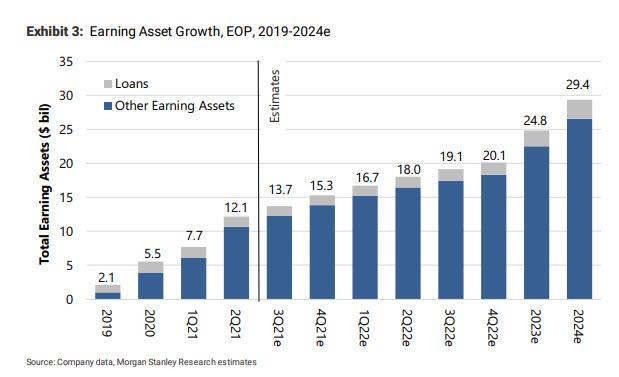
And indeed it is: not only does the company sport fundamentals which make it among the cheapest banks - in either the conventional or crypto universe...
... but the endgame for the $3.3BN market cap crypto intermediary may still be an acquisition by, or the becoming of, a major crypto-focused player.

FT : Households face worst squeeze on disposable incomes for 30 years, warns BoE

Households face worst squeeze on disposable incomes for 30 years, warns BoE
UK inflation set to rise to 7.5%, while economic growth will slow and unemployment and taxes go up

The Bank of England warned that households face the worst squeeze on their disposable incomes for at least 30 years, with inflation rising to 7.5 per cent, economic growth slowing, unemployment rising and taxes going up.

Setting out a dark picture for the economy, the BoE’s Monetary Policy Committee raised interest rates by a quarter point to 0.5 per cent, the first tightening of monetary policy in consecutive meetings since 2004.

The European Central Bank also voiced fears about inflationary pressures. Its president, Christine Lagarde, refused to rule out raising interest rates this year, citing what she said was “unanimous concern” about inflation.

In the UK, the squeeze on incomes will hit hardest in April when the typical gas and electricity annual bill rises 54 per cent to almost £2,000 from £1,277 today.

Chancellor Rishi Sunak, who announced a £9bn package of support to hold down bills, admitted at a Downing Street press conference that “energy markets are forecasting that prices go up further in October”.

Analysts expected the energy price cap could rise to as much as £2,450 per household in October. But Sunak said the support he was announcing was intended to last “over the year”. He said markets expected prices to fall “quite significantly” by spring next year.

BoE governor Andrew Bailey said the hit to household incomes was not sufficiently severe to bring inflation down. Delivering what he said was a “hard message” on the cost of borrowing, he admitted that the rate rise “will be felt by households and businesses across the UK”.

With a rise in national insurance and income tax also coming in April, BoE officials calculated that the real value of labour incomes after tax would fall 2 per cent in 2022, the tightest squeeze in any full year since equivalent records began in 1990.

Bailey urged the employed not to respond by seeking higher pay settlements because price rises would become ingrained in the economy and lead to “a longer period of high inflation”.

The BoE also cut the growth forecast for 2022 from 5 per cent to 3.75 per cent before settling at a “subdued” pace of only 1 per cent into the medium term.

Unemployment is forecast to rise from a low of 3.8 per cent to 5 per cent as the economy struggles to shed its inflationary tendencies.

Financial markets expect interest rates to rise faster and further, with traders pricing in an increase in official interest rates to at least 1 per cent by May, and 1.5 per cent by November.

To mitigate the pain, Sunak unveiled a £9bn package support for households with a £200 rebate on energy bills for all households coming in the autumn, but repaid over the following five years.

Those with properties in council tax bands A to D would also have a £150 reduction in their bills this year. The chancellor said this was a “fair, targeted and proportionate” package of support.

But opposition MPs and campaigners said the support would do little to offset the combined energy and national insurance increases that will leave typical households £1,300 out of pocket. Labour called the universal energy bills rebate a “buy now, pay later” scheme.

FT : Ken Griffin’s Citadel posts 5 per cent gain during January’s market slump

Ken Griffin’s Citadel posts 5 per cent gain during January’s market slump
Upbeat start to 2022 comes during a strong run for multi-strategy hedge funds

Ken Griffin’s Citadel has emerged as one of the biggest hedge fund winners from January’s financial market turmoil.

The firm, which manages $43bn in assets as one of the industry’s largest players, gained 4.7 per cent last month in its flagship fund, according to a person who had reviewed its performance data. Citadel’s global fixed income fund, meanwhile, gained 4.9 per cent.

The US S&P 500 share index fell 5.3 per cent during the month, having at one point been on track for its worst January on record. The fall came as investors dumped technology and other stocks that had been richly valued during the big rally from the pandemic-era lows hit in March 2020.

Hedge funds on average lost 1.5 per cent last month, according to data group HFR, their biggest monthly loss since the onset of the pandemic. Funds betting on equities fared worse, posting a fall of 2.1 per cent.

Citadel is one of a number of so-called multi-strategy funds that employ multiple teams of traders across a range of investing styles.

Such funds have been among the biggest winners during the pandemic, as their wide diversification across asset classes and their ability to increase their bets rapidly when markets are moving in their favour but slash positions when conditions sour has helped them navigate a series of major market upheavals.

Citadel, which made money across all its strategies last month, made 24.5 per cent in 2020, while last year it gained 26.3 per cent.

Rival Millennium International, meanwhile, gained around 1.7 per cent last month, according to people who had reviewed the fund’s performance data. It made 13 per cent last year and 25.6 per cent in 2020, its best performance in two decades.

Citadel and Millennium declined to comment.

Citadel’s profits last year equated to $8.2bn in dollar gains for investors, according to research by LCH Investments, leaving billionaire Griffin’s Citadel as the second best performing manager of all time, behind Ray Dalio’s Bridgewater.

The big gains posted by multi-strategy funds have fuelled a vicious talent war in the sector, pushing payouts for top traders sky-high. Payments just to compensate traders when they leave a rival can now reach $10mn and occasionally as much as $20mn.

Last month the Financial Times reported that Canadian investment giant Brookfield was expanding its multi-strategy hedge fund business into Europe, pitting it against the likes of Citadel and Millennium in the region.