>>> TradeGate Pre-Market Indications

DAX:
  • HelloFresh (HFG TH) +2.3%
  • Zalando (ZAL TH) +2%
    • Amazon Soars on Prime Price Hike, Huge Profit Beat on Cloud
  • Delivery Hero (DHER TH) +2%
  • Fresenius SE (FRE TH) +1.5%
  • Infineon (IFX TH) +1.4%
  • Siemens Energy (ENR TH) +0.1%
    • Siemens Energy Cut to Equal-Weight at Morgan Stanley
MDAX:
  • Talanx (TLX TH) +2.6%
    • Talanx Prelim FY Net Income EU1.01B
  • AUTO1 (AG1 TH) +2.2%
  • Bechtle (BC8 TH) +1.3%
  • Aixtron (AIXA TH) +1.2%
  • Thyssenkrupp (TKA TH) +1.1%
SDAX:
  • flatexDEGIRO (FTK TH) +3.4%
    • flatexDEGIRO Rated New Outperform at Exane; PT 29 euros
  • DWS (DWS TH) +1.1%
  • PVA TePla (TPE TH) +1%
  • Aareal Bank (ARL TH) +0.9%
    • Aareal Bank Investor Declares 11.00% Voting Rights on Jan. 31

>>> Europe : Brokers Upgrades & Downgrades - 4th of February 2022

>>> Up
* Alphabet Raised to Buy at Phillip Secs; PT $3,493
* Coloplast Raised to Buy at Carnegie; PT 1,100 kroner
* Hexagon Raised to Buy at Handelsbanken; PT 147 kronor
* Nordic Semiconductor Raised to Buy at Pareto Securities
* Ralph Lauren PT Raised to $156 from $141 at Truist Secs
* Rational Raised to Hold at HSBC; PT 760 euros
* S4 Capital Raised to Buy at HSBC; PT 760 pence
* Saras Raised to Overweight at Barclays; PT 90 euro cents
* Simcorp Raised to Buy at ABG; PT 760.04 kroner
* Tullow Raised to Overweight at Barclays; PT 75 pence

>>> Down
* Bavarian Nordic Cut to Market Perform at Cowen
* Boliden Cut to Hold at Handelsbanken; PT 410 kronor
* DEFAMA AG Cut to Hold at SRC Research; PT 29 euros
* EnQuest Cut to Equal-Weight at Barclays; PT 25 pence
* Holcim Cut to Sell at Berenberg
* Mercialys Cut to Neutral at Goldman; PT 10.40 euros
* Meta Platforms Cut to Hold at China Renaissance; PT $280
* Protector Forsikring Cut to Hold at Pareto Securities
* Siemens Gamesa Cut to Underweight at Morgan Stanley; PT 16 euros
* Siemens Energy Cut to Equal-Weight at Morgan Stanley
* Suominen Cut to Reduce at Inderes; PT 4.50 euros
* Swedbank Cut to Hold at SEB Equities; PT 190 kronor

>>> Initiation
* Bango Rated New Buy at Berenberg; PT 300 pence
* flatexDEGIRO Rated New Outperform at Exane; PT 29 euros
* Henkel Reinstated Neutral at Credit Suisse; PT 80 euros
* Shell ADRs Rated New Buy at TD; PT $62
* Shell Rated New Outperform at RBC; PT 2,700 pence

>>> Call

>>>What to look at today - 4th of February 2022

U.S. equity futures rose Friday as Amazon.com Inc. earnings soothed nerves about the technology sector, while a Hong Kong rally boosted Asian shares. A hawkish chorus from key central banks hurt bonds. Contracts on the tech-heavy Nasdaq 100 were up about 2% after e-commerce titan Amazon and Snap Inc. soared in late trading on strong earnings. An Asia-Pacific equity gauge pushed higher partly on a 3% jump in Hong Kong, which was catching up with global markets after reopening from a holiday. Amazon could add nearly $200 billion in market value if the stock’s 14% gain in after-hours trading holds to Friday’s Wall Street close. That brightened the mood after a historic, $251 billion wipeout for Facebook owner Meta Platforms Inc. on Thursday consigned the Nasdaq 100 to its worst drop since 2020. Hawkish comments from European Central Bank President Christine Lagarde and a Bank of England interest-rate hike underlined risks from inflation. The euro strengthened and the dollar retreated. West Texas Intermediate oil flirted with $91 a barrel in an ongoing rally. Volatility has become the hallmark of global markets this year. Investors are trying to come to grips with less favorable monetary conditions and a moderating global recovery but hoping company earnings will underpin stocks. The latest data showed U.S. service-sector growth pulled back in January to the slowest pace in nearly a year. Meanwhile, U.S. initial jobless claims fell more than expected last week to 238,000 ahead of data on payrolls Friday. 

Nikkei +0.71% Hang Seng +3.32% CSI Shanghai Shenzen Closed

Eur$ 1.1454 CNH 6.3534 CNY 6.3612 GBP 1.3592 CHF 0.9204 RUB 76.2535 TRY 13.5711 WTI$ 90.80 +0.59% Gold 1,806.26 +0.08% BTC 37,850 +2.40% ETH 2,795 +5%

S&P +1.25% Nasdaq +2.12% EuroStoxx +0.72% FTSE +0.78% Dax +0.62% SMI +0.35%

Macro :
- SEC Response to Meme Stock Mania Coming Next Week, Gensler Says
- Bitcoin, Ether Advance as Amazon Results Buoy Technology Stocks

Keep an eye on :
- ADS GY : Chief Reebok Designer Kerby Jean-Raymond to Leave Company -- WSJ
- AENA SM : Madrid Court Rejects Aena’s Petition on Lower Rents: EL Confi
- AFRY SS : AFRY AB 4Q Operating Profit Misses Estimates
- AI FP : Air Liquide to Build Biomethane Prod Unit in Illinois, U.S.
- MT NA : France to Help Arcelor in EU1.7B Decarbonization Plan (Feb. 3)
- CARLB DC : Carlsberg FY Adjusted Ebit Meets Estimates, SEES 2022 ORGANIC OPER PROFIT 0% TO +7%
- CENER BB : Cenergy’s Corinth Pipeworks Awarded Greek Pipeline Contract
- CURY LN : U.K.’s Currys Begins Search to Replace Livingston as Chair: Sky
- ENEL IM : Enel FY Adjusted Ebitda Beats Estimates
- ENI IM : Var Energi Oslo IPO Values Equity at as Much as $9.1b
- FSKRS FH : Fiskars 4Q Revenue Beats Estimates
- ISP IM : Intesa Sanpaolo 4Q Net Income Beats Estimates
- ISP IM : Intesa to Return More Than EU22B to Shareholders in 2021-2025
- LEHN SW : Lem Sees FY Sales About CHF360M, Est. CHF350M
- BMPS IM : Paschi Board to Meet Friday on New CEO Candidate: Messaggero
- MTRS SS : Munters 4Q Ebit Misses Estimates
- NEL NO : Nel Gets $5m Contract for Electrolyzer, Refueling Equipment
- OR FP : Estee Lauder Slides Amid ‘Rapid’ Slowdown in Asia Pac Growth
- PAH3 GY : Porsche Delivered More Than 300,000 Cars in 2021, CEO Tells RND
- SAN FP : Sanofi 4Q Business EPS Beats Estimates
- TLX GY : Talanx Prelim FY Net Income EU1.01B
- TKO FP : Tikehau Capital Exceeds Target With EU34.3B of AUM at End-Dec.
- TOM2 NA : TomTom 2022 Revenue Forecast Misses Estimates
- TRELB SS : Trelleborg 4Q Adjusted Ebit Beats Estimates
- UCB BB : UCB’s Phase 3 Zilucoplan Trial Meets Primary, Secondary Endpoint
- ULVR LN : Ex-Unilever CEO Polman Calls ESG Criticism ‘Incomprehensible’
- VLA FP : Valneva, Pfizer Report Positive Phase 2 Data for Lyme Vaccine
- VATT SS : Vattenfall Chairman Lars Nordstrom to Step Down After 11 Years
- DG FP : Vinci FY Ebit Beats Estimates
- VOW GY : Audi Weighs Green Energy Investment in China to Slash Emissions
RT : UN names Moscow best world city to live in

UN names Moscow best world city to live in
The Russian capital beat out major European and North American rivals to claim the top spot

The UN has published its global cities ranking for 2022, and has awarded Moscow the top spot among large cities for quality of life and infrastructure, commending the metropolis for its transportation and its citizens’ well-being.

A draft of the report, the full version of which will be released in March, was made available online on Wednesday. Experts analyzed the 50 largest cities globally and ranked 29 “world cities” according to six metrics: productivity, infrastructure development, quality of life, equity and social inclusion, environmental sustainability, and urban governance and legislation.

The Russian capital came out first in terms of “quality of life” and “infrastructure development,” and was third overall in the “City Prosperity Index,” which considered all the categories together. The first and second spots were taken by Singapore and Toronto respectively, and the fourth and fifth by Sydney and London.

The report defines quality of life as “how an individual’s life or society’s condition is in comparison to another person or society, i.e. how good (or bad) someone’s life is compared to other individuals’ lives. Therefore, this is the measurement of a city’s average achievements for ensuring general well-being and satisfaction of its citizens.”

Infrastructure development is defined as “the set of basic physical systems, organizational structures, facilities, and installations needed for the functioning of a society, or economy. The prosperity of a city largely depends on the development of infrastructure, including transportation, communication, or provision of [basic] services, among others.”

Among the 29 cities, Moscow was ranked 12th for productivity, 13th for equity and social inclusion, 17th for environmental sustainability, and 10th for urban governance and legislation.

Around 20 million people officially live in the Russian capital and its surrounding region, though measurements of the population vary according to methodology. Some estimates suggest the real figure is substantially higher.

By any accepted measure, with at least 13 million inhabitants, Moscow city proper is the largest wholly within Europe, beating out London, St. Petersburg, Paris and Berlin.

(ZH) JPMorgan's Trading Desk Scrambles To Contain The Fallout From Today's Crash

JPMorgan's Trading Desk Scrambles To Contain The Fallout From Today's Crash

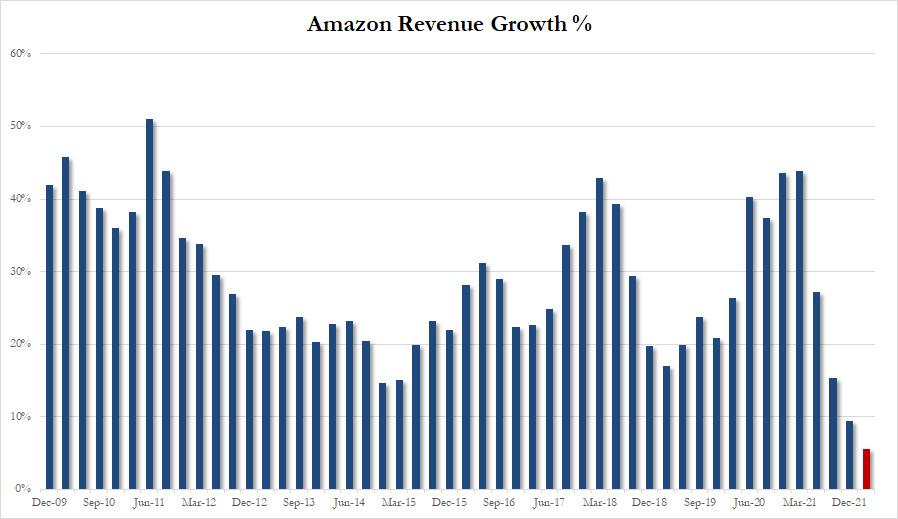
After a catastrophic day for markets, which saw the S&P suffer its worst one-day loss since 2021 and the Nasdaq tumble the most since 2020, Amazon arrived with what was a Hail Mary earnings report which sent its stock soaring, and helping cut the Nasdaq's nearly 4% loss in half, but as we noted earlier - aside for the Prime membership hike and the solid AWS results - the earnings report was actually not all that good, and the once legendary growth is now gone.
Indeed, as Bloomberg echoes our skepticism, Nasdaq futures have bounced hard in early trading, but some of the details coming through on Amazon’s business outlook seem a bit less exuberant than seen at first blush: while investors "may have been bracing for the worst, following Meta’s disappointing revenue forecast and surprising business pivot towards short form video. But Amazon’s e-commerce sales numbers are still mixed. Its online stores revenue growth rate is slowing and for the third quarter in a row the company gave a sales forecast markedly below Street expectations. Yes, the Prime Membership price hike and Amazon Web Services growth are a positive, but the company’s core e-commerce business is showing no sign of a rebound yet."
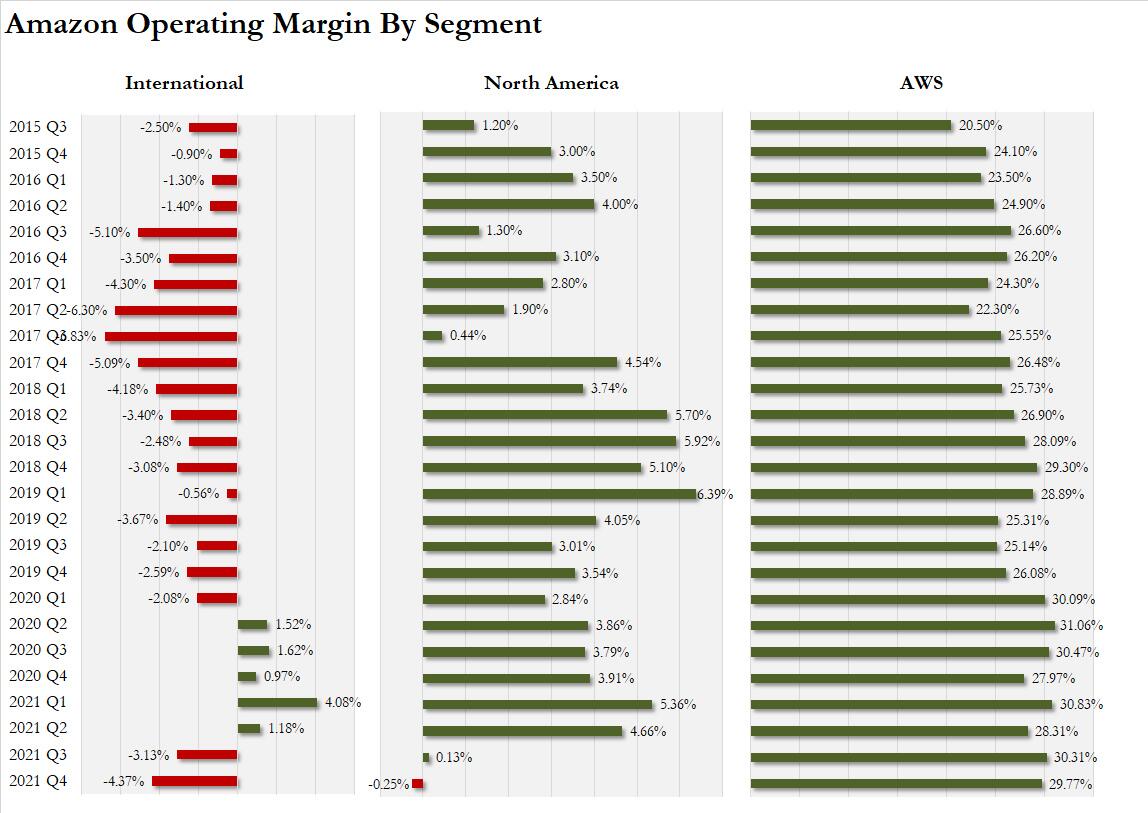
Worse, as we first showed, margins for both North America and International e-commerce are now negative and only AWS is keeping the company afloat.
Perhaps realizing the tenuous nature of the after hours bounce, JPMorgan's trading desk is out this afternoon with an attempt to contain the dismal mood that has gripped markets (now that not even Marko Kolanovic's weekly permabullish sermons do much to boost market optimism). Here is what the bank's trader Andrew Tyler wrote:
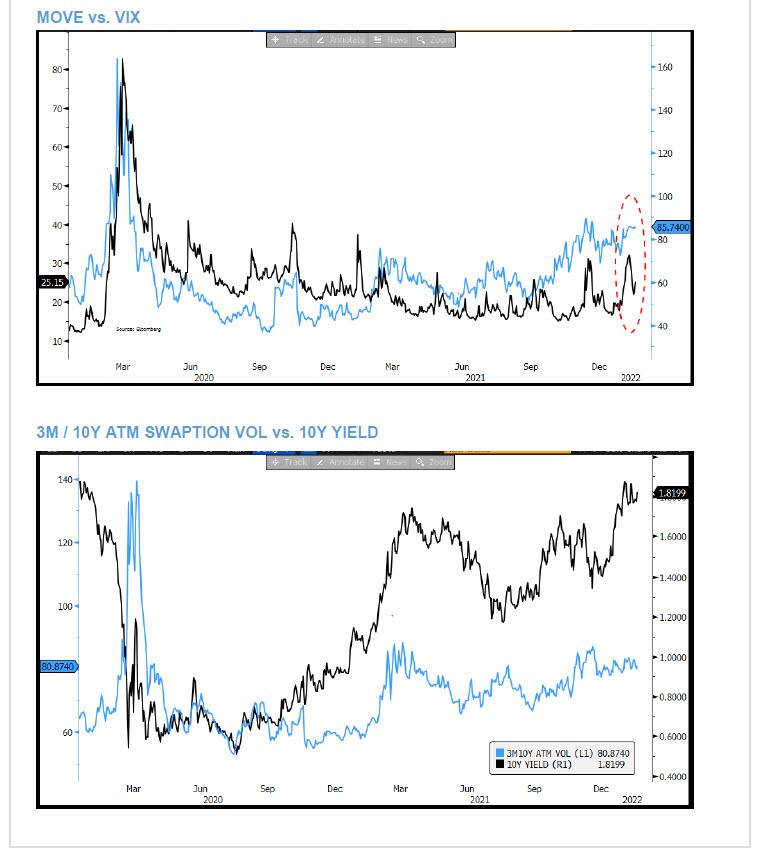
The FB-induced selloff took MegaCap Tech with it but what is interesting is the relatively muted reaction in Equity vol, especially considering the moves in the 10Y yield (product of BOE/ECB today).
For avid readers of this note, you will recognize the MOVE Index vs. VIX Index chart but there are some additional vol-related charts below.
My conclusion is that today’s action is expressing a view that this is idiosyncratic rather than systemic in nature. AMZN earnings can help stabilize the NDX. One part of the Bear thesis has been that Tech is in bubble territory. Marko points out that FB’s FY2022 P/E is now trading at 19% discount to that of the SPX (16.3x vs. 20.1x). FB’s forward PE is lower than any broad market at any point since 2014, ex-Mar 2020. This includes times when Fed Funds was at 2.5% vs. current ZIRP level.
His conclusion is that talk of a Tech Bubble seems misplaced, especially when we have Tech stocks that are now technically Value stocks.
Despite his uplifting undertone, Tyler concludes cautiously, writing the he remains of the view "that it is prudent to wait until you see the combination of Fed clarity (which may come post CPI print next Thursday) and VIX under 20." Those two conditions need to be satisfied before we can see a sustainable rally, according to the JPM trader.
Where to hide in the mean-time? His advice is to "consider commodities or commodity-related equities."

WSJ : Sculptor Director Resigns, Alleges Governance Failures at Hedge Fund

Sculptor Director Resigns, Alleges Governance Failures at Hedge Fund
Largest publicly traded U.S. hedge fund says letter from Morgan Rutman is misleading

A director resigned from the board of Sculptor Capital Management, alleging governance failures including “staggering” compensation awarded to the largest publicly traded U.S. hedge-fund firm’s CEO.

The allegations and resignation, detailed in a letter to the board Sculptor disclosed Thursday, have echoes of a past fight between firm founder Daniel S. Och and his onetime protégé, Chief Executive James Levin. Mr. Levin became CEO of the firm, formerly known as Och-Ziff Capital Management, SCU -2.53% after a pitched succession battle in 2018 that led Mr. Och to step back.

The director who resigned in late January, Morgan Rutman, was nominated to the board by Mr. Och and joined in 2019. Mr. Rutman, also the chief executive of Mr. Och’s family office, cited as examples of governance failures the board’s decision to award Mr. Levin 2021 pay that a consultant for the board’s compensation committee estimated could approach $200 million and dilute public shareholders to a rare degree.

Sculptor in its Thursday filing said the letter was “filled with significant factual inaccuracies, material omissions and baseless assertions that present a misleading view of board governance.”

The company also said the pay was “in the best interests of the Company and its shareholders.”

Mr. Rutman alleged the board didn’t do adequate work to determine whether Mr. Levin’s pay was merited or whether it would “reward mediocrity.” He also said Mr. Levin’s direct report, Wayne Cohen, also a board member, was allowed to vote on the compensation package over Mr. Rutman’s objections, reaching the five votes needed to approve the agreement.

“I must resign now because of the persistent failures of the board to grapple with the issues that led to that result and which make my continued service untenable,” Mr. Rutman wrote.

Sculptor as of Feb. 1 managed about $37.9 billion, according to an earlier company filing.

WSJ : Amazon Raises Prime Membership to $139 a Year, Citing Shipping, Labor Cost

Amazon Raises Prime Membership to $139 a Year, Citing Shipping, Labor Costs
Last increase for the subscription service was in 2018

America’s most-popular fast-delivery service is going up in price.

Amazon.com Inc. AMZN -7.81% said Thursday that it is raising the cost of its Prime membership in the U.S. to $139 a year from $119. Customers who pay monthly will see the price increase to $14.99 from $12.99. The price bump for new members will go into effect Feb. 18, while charges for existing customers will apply after March 25.

The tech giant’s shares rose by more than 14% after the market closed Thursday after the company reported that it nearly doubled its profits in the fourth quarter. Amazon saw gains due to its investment in electric vehicle-maker Rivian Automotive Inc. and surging revenue from its cloud-computing and advertising businesses.

Some analysts said increase in price for Prime membership played a significant role in investor enthusiasm for Amazon’s results.

The subscription service has become one of the central pillars of Amazon’s success since the company launched it in 2005. Prime membership has served as a gateway for Amazon to hook customers into its varied business lines while gleaning insights into consumer habits. Amazon has an estimated 150 million Prime subscribers in the U.S., according to Digital Commerce 360.

To explain the increase, the company cited rising costs related to wages and transportation, as well as continued expansion of benefits under membership. Memberships include access to Amazon’s fast delivery service, Amazon Prime video streaming and free photo storage.

The company this year is also adding to its bundle by gaining exclusive video rights to the National Football League’s “Thursday Night Football.”

Industry analysts had speculated that Amazon was due to raise prices. The company last increased the price in 2018, after raising it four years earlier.

Amazon added 30 million Prime members both in 2020 and 2021, and the company’s retention rates after one year and two years increased. The one-year rate reached 94% in 2021 and the two-year renewal rate increased to 98%. However, the 30-day renewal rate has fallen in recent years and reached 66% in 2021, down from 74% in 2017, according to Consumer Intelligence Research Partners.

FT : IMF defends deal with Argentina to restructure $44.5bn of debt

IMF defends deal with Argentina to restructure $44.5bn of debt
Kristalina Georgieva applauds initial framework of agreement to rescue struggling economy

The head of the IMF defended its outline deal with Argentina to restructure $44.5bn of debt from a record 2018 bailout, despite mounting criticism over the plan to rescue the country’s struggling economy.

Kristalina Georgieva, managing director of the IMF, on Thursday applauded the initial framework of the agreement, whose details need to be finalised and approved by the fund’s board of directors.

It also needs to be ratified by Argentina’s congress, where the opposition made big gains in midterm elections last year, and divisions within the government’s coalition have recently appeared after a crucial figure resigned in protest of the deal.

“We are confident that this is a pragmatic programme,” Georgieva told reporters. “It will help Argentina to deal with the most significant structural problems.”

The deal comes as the country grapples with a floundering economy beset by surging inflation, pressure on its exchange rate and dwindling dollar reserves. If the country’s congress agrees to ratify the latest IMF deal, it will be the 22nd in six decades.

Announced last week, the agreement follows nearly 19 months of inconclusive talks, and sketches out a plan for Argentina to reduce its primary fiscal deficit gradually from 2.5 per cent of gross domestic product this year to 0.9 per cent in 2024.

It also involves a proposal to raise real interest rates, which are currently strongly negative, to incentivise investment in local bond markets and to reduce distortions in the economy.

No spending cuts were announced as part of the agreement in principle presented by Argentina’s finance ministry. Instead the state would play “a moderately expansionary role”, said finance minister and chief IMF negotiator, Martín Guzmán.

Critics say the programme’s apparent reliance on growth, rather than reducing spending to improve public finances, raises concerns over whether it is sustainable.

Under the current terms, Argentina has a grace period of at least 4.5 years before debt repayments begin.

“We also recognise the limitations of what can be done over the next years,” said Georgieva on Thursday.

“We had to calibrate the programme to be implementable,” she said. “Our main goal is to get Argentina out of this very dangerous path of high inflation.”

Georgieva added that the IMF had learned its lesson from its previous $57bn bailout of Argentina in 2018, saying that one takeaway was the “importance of realistic expectations: don’t go only with your baseline because things may turn . . . worse”.

The earlier arrangement was “too fragile” to succeed, an internal IMF report published in December concluded.

The IMF also admitted it had accepted overly optimistic government projections and that the initial deal could have benefited from capital controls and a restructuring of private creditor debt.

A total of $44bn of the agreed $57bn was disbursed by the time Mauricio Macri, the then pro-investment president, was voted out of office in December 2019. But the deal quickly veered off track and was cancelled by the incoming Peronist government of President Alberto Fernández in July 2020.

The leftwing Peronists have always been heavily critical of the IMF’s decision to give Argentina such a large sum, with most of the repayments falling in 2022 and 2023. They also argued that the loan financed capital flight and was mainly done to help Macri’s failed re-election campaign.

Fernández, who travelled to Moscow this week as part of a diplomatic tour, on Thursday said his government wanted to release Argentina from the “grip” of its relationship with the IMF and Washington.

“I’m certain Argentina has to stop being so dependent on the fund and the United States and has to open up to other places, and that is where it seems to me that Russia has a very important place,” the president said during his lunch meeting with Vladimir Putin.

FT : Brussels quarrels over semiconductors rules

Brussels quarrels over semiconductors rules
EU commissioners in disagreement over regime to boost Europe’s chip sector

Chipped Chips Act
A fierce battle has broken in Brussels over plans to equip the European Commission with sweeping powers to address supply crunches in Europe’s semiconductor industry, write Andy Bounds, Mehreen Khan and Javier Espinoza in Brussels.

EU officials have told Europe Express that proposals in the forthcoming European Chips Act that would give regulators powers to ensure components are prioritised for the domestic production during a crisis are being heavily contested within the commission.

The EU’s industry commissioner, Thierry Breton, has been championing the new powers as part of proposals aimed at bolstering the EU’s semiconductor industry. Last week, he told reporters the forthcoming act, which was due for publication on Tuesday, would involve tools to help “shore up our security of supply” — referencing emergency US powers to prioritise domestic needs.

Chip supply shortages have hit the manufacturing of cars, aircraft and other products as industry rebounds from the pandemic. The EU wants a bigger share of the global chips market as part of its quest for “strategic autonomy”. It has 10 per cent of global production and wants to reach 20 per cent by 2030, with demand forecast to double in that time. It also wants to be able to make the most advanced chips.

European Commission president Ursula von der Leyen, who has strongly backed the Chips Act, yesterday called it a “game changer” and said it would leverage up to €12bn from the private sector and public money. In addition, member states had already committed €30bn, she said.

Among the companies that the EU is seeking to woo with subsidies is Intel, which is planning to announce a new chipmaking factory in Europe. One of the ideas that is still contested in the draft plans is to loosen state EU aid rules to allow the bloc to compete with rivals which offer public subsidies of up to 50 per cent of the cost of a new plant.

Von der Leyen said the EU would be “adapting” its state-aid rules, under a set of strict conditions, to permit public support for European “first of a kind” production facilities.

Margrethe Vestager, the EU’s liberal competition commissioner, has pushed back against the idea that semiconductor investment will require a loosening of the EU’s state-aid rules, arguing that the current regime is equipped to help promote investment.

Asked whether state rules should be changed, Vestager told the Financial Times: “No. We cannot tweak them, we already have provisions in the treaty that enable that support.” She also told the Digital Europe forum yesterday that “self-sufficiency is not our goal” and would cost €240bn-€320bn to achieve.

Officials said there was a clash between senior commissioners about the level of EU subsidies needed for the sector with some fearing that it would lead to a glut in international supply. The US, China and Taiwan all heavily support their microchip industries.

“Can we hope to compete on subsidies with China? And where are the billions coming from?” one official asked. Senior officials will meet today to settle their differences ahead of the publication of the rules next week.

FT : Regulators must act to rein in Wall Street risks as rates rise

Regulators must act to rein in Wall Street risks as rates rise
The Fed needs to reverse course on regulatory easing to ensure financial stability when borrowing costs increase

Much has been written about the US Federal Reserve’s challenge in combating persistent inflation, now running at 7 per cent. But in its role as regulator, the Fed has an even greater challenge: maintaining financial stability as it raises interest rates.

Recall that interest rate hikes helped catalyse the financial crisis of 2008 and 2009. Then, as now, easy money had led to high levels of borrowing and inflated asset valuations — conditions that could no longer be sustained as monetary policy tightened.

Total levels of indebtedness are even higher today, and the 2008 housing bubble arguably pales in comparison with the pervasive “everything bubble” we have now.

While banks are better capitalised than they were prior to the financial crisis, vulnerabilities that have long plagued the system remain. In recent years, regulatory policy — like monetary policy — has become too accommodative. The Fed, working with other regulators, must quickly reverse course.

A good place to start is the stress tests that are used by the Fed to make sure major banks can withstand severely adverse conditions. Over the strong dissents of Fed board governor Lael Brainard, the central bank has repeatedly weakened the tests.

For instance, banks no longer have to prove they can expand their balance sheets to support the economy in times of stress. They no longer have to pass one of the more rigorous tests of capital strength called the enhanced supplementary leverage ratio, or eSLR, that restricts how much they can borrow.

The Fed has also failed to apply stress scenarios where both interest rates and consumer prices are rising in a slowing economy, conditions that exist today and may well worsen. In 2018, it did require banks to stress rising rates along with deep corrections in asset prices. Not surprisingly, those with large trading exposures such as Morgan Stanley and Goldman Sachs were most affected, and struggled to pass the eSLR. The Fed has not stress tested rising rates since 2018.

This year, the Fed must restore the stress tests to their former rigour, and include scenarios that assume steep increases in interest rates, persistent inflation and major corrections across all markets.

The Fed’s own financial stability reports have recognised that a broad range of asset prices are vulnerable to significant declines. Stress tests should measure how falling prices could expose banks to losses directly and through their customers.

And the Fed should follow the lead of many developed countries and require banks to have a meaningful countercyclical capital buffer so they have excess capital available if the economy falls into trouble. This would help compensate for the many years when the Fed approved shareholder distributions that exceeded banks’ earnings, depleting their capital strength.

Regulators must also collectively finally address longstanding vulnerabilities that extend beyond the banking system. Kudos to Securities and Exchange Commission chair Gary Gensler for recently proposing reforms to address unstable prime money market funds, which had to be bailed out during the financial crisis and again during the pandemic.

Markets in repos — also a problem during the financial crisis — have improved somewhat as these sale and repurchase transactions are now primarily in US Treasuries. But they still malfunction. Common sense solutions such as centralised clearing as well as consistent collateral and capital requirements have been studied ad nauseam. It’s time to act.

Finally, reckless derivatives speculation remains a part of the market landscape. Archegos, a relatively small managed fund, subjected its bankers to more than $10bn in losses with highly leveraged long derivatives positions.

Big banks will argue that they did well during the pandemic so there is no need to toughen their oversight. In truth, they did well because of actions by the Fed and Congress to backstop debt markets, while providing trillions to help households and businesses.

Given sky-high federal deficits and the Fed’s swollen $9tn balance sheet, it will be harder for fiscal and monetary authorities to rescue the financial system again if its gets into trouble. Nor should they. Massive additional stimulus to rescue Wall Street would pour fuel on the flames of inflation, burdening household budgets and eroding real wage gains.

If there is another crisis, we cannot afford to prioritise Wall Street over Main Street, as we did during the financial crisis. This time around, regulators must make sure banks can stand on their own.