Barrons : How Much Is Bitcoin Worth? The Challenges Modeling an Unruly Asset.

How Much Is Bitcoin Worth? The Challenges Modeling an Unruly Asset.

investors may be breathing easier now that prices have recovered a bit. But its next move is only getting murkier. Strategists came out with widely divergent views on Bitcoin this past week, highlighting the challenges of trying to model an inherently unruly asset.

In the bearish camp, Stifel’s head of equity strategy, Barry Bannister, sees Bitcoin crashing to $10,000 in 2023, from a recent $43,000. Federal Reserve efforts to tame inflation will push up bond yields and siphon capital from high-risk assets. Bitcoin, he says, “will get crushed,” since it has historically responded to money-supply changes.

J.P. Morgan JPM-1.30% takes a more mixed view. Based on measures of Bitcoin’s volatility in relation to gold, the crypto could fall to $38,000 or rise to $50,000, says global markets strategist Nikolaos Panigirtzoglou. Demand and prices for Bitcoin would rise with lower volatility.

How much will Bitcoin be worth in a year? “That’s the last question I’d try to answer,” says Michael Cembalest, J.P. Morgan’s chairman of markets and investment strategy. He wrote a scathing report on crypto called “The Maltese Falcon.” The title refers to a 1941 movie about a detective who goes on a wild goose chase for a valuable statue that turns out to be worthless.

Bitcoin has appeal as a store of value, Cembalest says, notably in countries with foreign-exchange controls, dual-currency regimes, and governance issues. But it defies normal stock, bond, and real estate valuation tools. If he had to work with one tool, comparisons to gold would be a good start, he says, adding, “A starving man isn’t picky about what’s on the menu.”

Barrons : Why the British Stock Market Is Outperforming the U.S.

Why the British Stock Market Is Outperforming the U.S.

Over the past three months, the tech-heavy Nasdaq Composite COMP-2.78% and the S&P 500 SPX-1.90% both took a beating. Not so the FTSE 100 UKX-0.15% , which tracks the United Kingdom’s largest publicly traded companies.

It was a good place to invest when the U.S. markets were not. Even better, the U.K.’s outperformance could continue for a while. “It has to do with tech,” says Jack Ablin, chief investment officer at Cresset Capital. The London Stock Exchange LSEG-1.95% has no equivalents to the massive U.S. tech stocks such as Apple AAPL-2.02% , Netflix NFLX-3.68% , or Facebook parent Meta Platforms FB-3.74% . And tech has been the most notable underperforming sector in the U.S.

The U.K. market has a projected earnings yield of 13%, including dividends, over the next year, compared with 7.5% for U.S. large-caps, Ablin says. That means profits and dividends could add almost twice as much investment value in the U.K. If that happens, it will be a continuation of the outperformance of U.K.-listed stocks. In the three months through Feb. 7, the Nasdaq was down 12.2%, while the S&P 500 lost 4.5%. By contrast, the FTSE 100 gained 3.7% over the same period, according to Dow Jones Market Data.

In addition to the lack of tech exposure, the U.K. market’s outperformance reflects outsize weightings in hot sectors: energy, materials, and financials. Those three industry groupings account for 41% of the FTSE index. The same groupings account for a mere 15.9% of the S&P.

Energy stocks got buoyed on the back of rising oil prices. Materials have also been lifted by historically good prices for iron ore, copper, and aluminum. Meanwhile, financials, including banks, have benefited from rising interest rates.

“Higher interest rates are generally good for banks, and investors don’t mind inflation because that improves credit conditions,” Ablin says. Rising prices effectively reduce the real, inflation-adjusted value of loans, making them more affordable for borrowers to repay.

Even those who think tech will bounce back see the U.K. market rallying for a few more months. “The outperformance probably runs through the first half,” says Art Hogan, chief market strategist at National Securities.

The outlook for commodities markets, particularly energy and materials, remains solid as the global economy continues to recover from pandemic-related lockdowns. And financials should do well in line with a growing economy and increased demand for business loans.

The British stock market remains one of the cheapest in the developed world. The MSCI United Kingdom Index, which tracks London-listed mid- and large-caps, has a forward price/earnings ratio of 12, according to recent data from Yardeni Research. That’s far lower than the ratios for the U.S., Europe’s single currency area, and Japan, which had forward P/Es of 19.9, 14.4, and 13.5, respectively.

Investors may want to consider the iShares Currency Hedged MSCI United Kingdom HEWU-0.46% exchange-traded fund, which tracks a basket of British-listed companies. The fund generated total returns of 5.1% and 22.5%, respectively, in the past three months and 12 months.

The portfolio is hedged against moves in the value of the British pound, meaning non-British investors can profit from a rally in the U.K. market even if the pound falls. “For the average investor, removing the currency risk is probably a good thing to do,” Hogan says.

There are risks when making this trade. The energy and materials sectors are notoriously cyclical and have been known to slip into downdrafts with frightening speed. Similarly, the banking sector sees periodic busts. But given projected market conditions, giving these stocks a closer look seems worthwhile.

Barron,s : The Chip Shortage Will Linger. These 4 Stocks Are a Good Way to Stay

The Chip Shortage Will Linger. These 4 Stocks Are a Good Way to Stay Protected.

About a week ago, I spent a few hours at my local Chevy dealer buying out the lease on my 2018 Bolt, with brand new LG 066570-1.56% batteries—the old ones were recalled because they risked bursting into flames.

While working on the paperwork in the eerily quiet dealership, the salesman told me there were cars that had been sitting in the service department for weeks waiting for the arrival of parts—computer chips, in particular. He said sales at the dealership had dropped by about 90% from prepandemic levels, and most of the sales staff had been laid off. It’s all because they have almost no inventory. By now, you likely know the cause of the inventory shortage—auto makers can’t make cars if they don’t have chips. Cars used to be cars. Now cars are computers.

Some automotive experts have suggested the problem is easing. On an earnings call with analysts this month, General Motors GM-3.00% CEO Mary Barra said the company—which makes the Bolt—is seeing the chip situation improve. “By the time we get to [the] third and fourth quarter, we’re going to be really starting to see the semiconductor constraints diminish,” she said.

I’m skeptical. The chip shortage is complicated, and companies with capital to throw around can push their way to the front of the line. And the issues are more severe for some parts than others. So maybe GM has this figured out, and empty Chevy dealer lots will soon be filled with shiny new Bolts and Silverados. But Barra’s optimism runs counter to other data points suggesting the chip supply issue will be here for a long time.

I got a grim reading on the topic this past week from GlobalFoundries GFS-7.46% CFO David Reeder. GlobalFoundries fills a particular niche in the semiconductor supply chain. Like Taiwan Semiconductor Manufacturing TSM-2.97% , GlobalFoundries makes chips for others. But while Taiwan Semiconductor dominates the market for cutting-edge chips, GlobalFoundries specializes in a less sexy part of the business, focused on cheaper parts like microcontrollers, power amplifiers, and other items. They’re found in cars, phones, PCs, toys, and power tools, among other things. Demand is off the charts, but Reeder says the industry isn’t adding enough capacity to meet the growing need.

He estimates that demand is growing at about 8%. But he says that if you add up all of the known projects for expanded capacity, you only get 4% growth. And he points out that 1.5 percentage points of that is coming from new fabs in China. If you want to meet U.S. chip needs with domestic sourcing, the need is even higher. So either the industry picks up the pace on new factories, or we’re going to be hurting for parts for a while.

You could theorize that demand ebbs. Maybe you think PC demand is heading back to pre-Covid levels (I don’t), that the world is saturated with smartphones (doubt it), or that we’re all going to grow tired of cars jammed with electronics (even less likely).

Hassane El-Khoury, CEO of automotive chip specialist ON Semiconductor ON-7.02% , told investors on his company’s earnings call this past week that the supply-demand imbalance in the chip sector will persist through 2022 and continue into 2023. Meanwhile, Toyota Motor TM-0.87% recently cut its vehicle production forecast for 2022 by 500,000 units, citing both uncertainty related to Covid-19 and the ongoing chip shortage.

The bottom line? The case for owning chip fab stocks, including GlobalFoundries and Taiwan Semiconductor, is very compelling.

With supplies so tight, the system is particularly vulnerable to unexpected shocks. Last week, a joint memory-making venture between Western Digital WDC-0.67% and Japan’s Kioxia said that contaminated production was curbing output at two flash memory factories. Wall Street analysts estimate it could reduce global supply of those critical components by about 10% in the March quarter.

Spot prices for flash memory jumped on the news, and so did the shares of Western Digital rival Micron Technology MU-1.38% . Micron is really the market’s only pure play bet on memory, chips that go into absolutely everything—and they own their own fabs. I’d own Micron, too.

In related chip news this past week, Nvidia ’s NVDA-7.26% deal to buy the microprocessor design house Arm from SoftBank Group 9984-2.30% officially died in the face of extreme regulatory pressure. SoftBank now plans to take Arm public at some point in the next 12 months—and the result could be a badly needed windfall for the struggling Japanese holding company.

SoftBank bought Arm for $32 billion in 2016; Nvidia had agreed to pay $40 billion in cash and stock, although the value of the deal inflated to around $80 billion at one point as Nvidia’s shares rallied throughout 2021. As SoftBank CEO Masayoshi Son noted in reporting earnings this past week, Arm has long dominated the market for designs used in mobile phone microprocessors and has been making inroads into other large markets, including chips for cloud-based servers and autonomous cars.

New Street Research analyst Pierre Ferragu recently estimated that Arm could go public at a valuation of $45 billion, and he thinks the company could eventually be worth $60 billion.

You can’t buy Arm shares just yet, but SoftBank gives you a way in. SoftBank shares are down more than 50% from their peak, and the company is aggressively buying back stock. And now SoftBank is one of the cheapest ways to play the relentless demand for chips.

Barrons : The $22 Billion Wager: DraftKings and Others Are Reaching for a Piece

The $22 Billion Wager: DraftKings and Others Are Reaching for a Piece of the Sports-Gambling Prize.

Bookmakers have always been busy on Super Bowl Sunday, but this year will be a bonanza like never before. Bettors are on track to wager $7.6 billion on the game, up 78% from last year, and it’s not because the office pool is getting bigger.

Legal sports gambling has now spread to 30 states and Washington, D.C.—home to more than 130 million. In the four years that it has been legal, both the amount of money bet on sports and the amount counted as revenue by gambling companies have risen nearly 1,000%, to $57 billion and $4.3 billion, respectively, according to the American Gaming Association, or AGA.

In New Jersey, which led the way in allowing sports betting, $10.9 billion was wagered in 2021. That’s $1,200 for every man, woman, and child in the state.

Yet the business is still in its infancy in the U.S., as a handful of companies fight for position, flooding newly opened states with ads to grab customers.

DraftKings DKNG+2.41% , MGM Resorts International MGM-3.42% , Flutter Entertainment ’s FLTR+2.46% FanDuel, and Caesars Entertainment CZR-3.18% have collectively grabbed 80% market share, according to MoffettNathanson, though others like Penn National Gaming PENN-2.83% and Bally ’s BALY-0.77% are also in the mix.

MoffettNathanson analyst Robert Fishman likens the opportunity to the early days of movie streaming, with one crucial difference: Each state has become its own extremely competitive market.

“We are still in the very early stages of this war,” he writes.

Gambling companies spent $725 million on television ads in 2021, three times as much as on cereal ads, according to Nielsen. Such levels of spending, in addition to giveaways to bettors, mean that these companies could report losses for years, until consolidation winnows the field and a few winners emerge. DraftKings has said that online sports betting could be a $22 billion to $36 billion market when it matures, up from around $4 billion today.

In the near term, bettors can look forward to a bonanza of opportunities, but one that could also come with a steep societal price tag.

Gambling is taking off at a moment when speculation of all sorts has boomed, fueled by pandemic boredom and the growth of easy-access apps. Options trading, one of the riskiest ways to bet on stocks, has soared to record highs, and millions of people bet on cryptocurrencies promoted by celebrities.

Researchers have found that these various forms of speculation are connected behaviorally—and that some kinds of financial trading could even be classified under criteria that characterize gambling disorders.

While betting might seem to be everywhere, it is also largely hidden, because bettors can seamlessly connect the apps to their bank accounts and wager quietly at home on their phones. Even as banks track the industry’s growth and gambling companies gather reams of data on the financial behavior of their customers, it is difficult to find statistics on how many people are betting, and who might be getting into trouble doing it.
“My fear is that we will never know,” says University of Massachusetts professor Rachel Volberg, who has been leading research on gambling for more than 30 years. “There literally is almost no funding for conducting research on those impacts as they play out in real time.”

Companies say they are paying for more research, with DraftKings announcing “multiple financial commitments” last year, including a study on military veterans and gambling and a three-year prevalence study.

The few statistics that have emerged are worrisome. A survey taken last year on behalf of the National Council on Problem Gambling, which hasn’t yet been released publicly, found that the percentage of people needing to borrow money to pay bills or debts because of gambling has tripled since 2018.

Sports bettors, the council found, are at least twice as likely to develop problems as the average gambler.

Calls to the national gambling hotline soared 45% in 2021 to 257,000. In New Jersey, calls to the state’s gambling hotline about sports-betting concerns more than doubled in the past two years.

In the United Kingdom, a government report said that problem gambling has been lucrative for the industry, finding that “60% of its profits come from the 5% who are already problem gamblers, or are at risk of becoming so.”
The AGA says that companies have spent hundreds of millions of dollars on responsible-gaming initiatives. These include public-service campaigns, employee training to spot problem gambling, and money for studies.

Companies give people options to stay out of trouble, allowing them to set limits on what they can spend and how long they can gamble. Employees look for red flags like players spending beyond their means.

Casey Clark, senior vice president of strategic communications at the AGA, says the industry has no intention of targeting vulnerable people, noting “that’s not the way you build a sustainable market.”

Sports betting launched first in Nevada, but the modern era really began in New Jersey.

The U.S. had been slow to adopt online gambling. Australia passed rules regulating it in 2001, and the U.K. followed in 2005. Online casino games were considered illegal in the U.S. until 2011, when the Department of Justice gave it the OK, though federal law still prohibited sports wagering.

That changed in 2018, when New Jersey won a Supreme Court case that allowed states to decide whether they wanted sports betting or not. Three weeks after the ruling, a bill to authorize sports betting was passed by the New Jersey legislature.

Casinos were at the center of the action when the state launched sports betting in June 2018. Initially, people could bet only at physical locations. When online gambling started in August, any company that wanted to operate had to team up with a physical casino or racetrack. Atlantic City’s Resorts Casino, one of three initial operators, teamed up with DraftKings. That first month, the physical sports-betting market was three times the size of online. Now, in-person sports betting is dwarfed by the virtual variety—in 2021, people wagered $9.9 billion online in New Jersey and $987 million in person.

New Jersey was the test case for sports betting, and companies say it has clearly passed. DraftKings CEO Jason Robins had told investors that it would take two to three years for a state to become profitable. Last year, the company said that its “contribution profit” in New Jersey was $8 million in 2020, projected to be $65 million in 2021. “Every state that we’ve launched since is on a very similar, if not better, trajectory” than New Jersey, DraftKings’ chief financial officer, Jason Park, said in December.

On a per capita basis, New Jersey is becoming a cash cow. Gross gaming revenue per adult came to roughly $100 in 2021. In the U.K., a long-established and profitable market, it was $64, at least as of 2020, according to MoffettNathanson.

That’s no guarantee that every company will succeed. Today, competition in the Garden State is fierce—10 casinos and racetracks offer online betting under 23 brand names. But the top players have grown much faster than the also-rans. Big players have the technology and marketing to overwhelm the market, and some had head starts—FanDuel and DraftKings have been offering fantasy-sports betting for years.

“Though there is a lot negative written about the levels of marketing and promotional spending, this has driven a very concentrated market that only players of scale can really compete in,” wrote Morgan Stanley analyst Thomas Allen. In every state that releases data, the top five operators have at least 82% market share, he calculated.

In an interview, Allen notes another trend that benefits operators. When sports betting takes off, online casino gambling generally does, too. New Jersey offers a case in point. Online gambling has been legal there since 2013, and was a $246 million market in 2017. “So, then they legalized sports betting, and online gambling in New Jersey in 2020 was a billion dollars,” he says. “And it looks to have grown about 40% in 2021.”

That’s great news for the companies. The apps offer crossover products, making it easy for someone who likes baseball to also dabble in blackjack. And online casino gambling tends to have better margins and be more predictable for the companies. With sports betting, the house has an advantage, but strange outcomes in games can be very costly and lead to disappointing results.

Online casino gambling is legal in only seven states now, but analysts see it accelerating as public perceptions of gambling continue to change.

The tax dollars from gambling in New Jersey largely go to programs for seniors, and lawmakers are clearly happy for the revenue. Some aspects of the boom, however, have made supporters of sports betting in New Jersey uncomfortable.

“I’m not a prude when it comes to gambling,” says Assemblyman Ralph Caputo, an Essex County Democrat and a former casino executive who voted for the 2018 legalization. But he says he is concerned about the social costs and the marketing.

“We tried to take it out of the illegal arena,” he tells Barron’s, “and now we’re behaving worse than they did.”

Caputo introduced a bill in June to divert people with gambling problems who are accused of crimes to alternative kinds of prosecution.

States where gambling has been legalized usually hail the tax dollars the business brings in. New Jersey, with a tax rate of 14.25% for online sports wagers, appears to have opened its market on the cheap, compared with neighboring New York, which recently introduced a 51% rate and still drew enormous interest from companies and gamblers.

“We’ve got to look at that,” Caputo says. “We’ve got to make sure the state is getting enough out of it.”

In its first month, sports betting brought in $58 million in taxes to New York, more than half of New Jersey’s annual haul.

As they followed in New Jersey’s wake, states have taken different approaches to authorizing sports betting and online gambling. Regulations and tax rates diverge wildly.

In Illinois, for instance, bettors had to be physically present at a casino or racetrack to sign up, forcing Chicagoans to travel 160 miles to East Peoria to log in to their FanDuel accounts. States now compete over bettors, in the same way they woo businesses across state lines with tax breaks. Gambling companies use GPS to track customers and make sure they’re playing in a legal state.

Until betting became legal in New York last month, people drove across the George Washington Bridge to New Jersey and sat in parking lots to place wagers.

More states are expected to open their markets this year. California could legalize sports gambling in 2022, and Texas might not be far behind. MoffettNathanson projects that the opportunity from states where betting wasn’t legal yet as of last year is larger than it is from ones that already legalized it.

Yet states don’t always take into account the potential harm from gambling, says Daniel Umfleet, the CEO of Kindbridge, a telehealth company that offers counseling for gambling addiction in several states. Massachusetts has done the most to prepare, undertaking a major study before approving gambling and preparing to dedicate significant money to treatment, Umfleet says. New Jersey is training gambling counselors throughout the state. “In other states, they’re just not there,” he says.

While the states have taken into account the casino industry’s concerns about market share, researchers say there has been much less attention paid to social costs.

“What has been evident to me is the lack of due diligence,” says Robert Williams, a professor at the University of Lethbridge in Canada who has studied U.S. gambling for decades and is currently doing research for Massachusetts. He thinks most of the U.S. has been a “wasteland for gambling research” even as betting expands faster than it ever has before. In the past, new initiatives like expanded lotteries resulted in wide calls for independent research, he says.

This time, research is proceeding slowly, often after gambling has spread widely. The last national prevalence survey to examine how many people are gambling, and how many may be getting into trouble, was taken in 2018 when online sports betting had barely begun.

U.K. gambling company Entain ENT+1.10% is paying for a national prevalence survey through the National Council on Problem Gambling that is expected to come out next month. The council says the company had no input into the study design.

Countries that were early to online gambling, meanwhile, are considering rewriting their laws to try to combat its negative societal effects. The U.K.’s public health agency found more than one suicide a day was linked to gambling.

U.S. policy makers, in contrast, have so far been content to leave regulation and supervision to the states. The federal government does little more than collect a 0.25% excise tax.

That’s a big problem, says Brian Hatch, a 39-year-old from Connecticut who sought help in several states as he struggled through gambling addiction and personal bankruptcy. He now has a podcast about gambling addiction where he speaks to everyone from counselors to gambling executives.

“Until the federal government steps in, I don’t think anything’s going to change,” he says. “I would pray that the federal government comes in soon, because there’s just a lot of harm that will happen over the next few years until that happens.”

Industry executives, however, argue that the federal government doesn’t have a good record on the issue. “The federal government tried to oversee sports betting for a long time by prohibiting it,” says the AGA’s Clark. “All it did was enable a large, pervasive, and predatory illegal market to grow and thrive.”

Legalization, he says, brought sports betting out of the dark and gave Americans a “safer alternative.”

The face of problem gambling is changing as betting moves online.

The public’s image of it was once shaped by Off-Track Betting parlors—“cigarette-stained floors and very sad-looking people throwing their tickets in the air and screaming at TVs,” says Hugh Tallents, a consultant at cg42 who has worked with U.K. and U.S. gambling companies.

That no longer applies.

“Now it’s people with the newest iPhone sitting in their living room, placing bets with their friends,” says Tallents. “It becomes almost like a collegial experience.”

Indeed, the people who are gambling on sports, and sometimes getting into trouble, are more likely to be younger men, researchers said. And that sets up more problems later.

“We know that the younger people start gambling, the more likely they are to develop a problem down the road,” says Lia Nower, director of the Center for Gambling Studies at Rutgers University.

A U.K. government study published in 2020 classified 55,000 children ages 11 to 16 as problem gamblers. There hasn’t been a large study of adolescent gambling in the U.S. since 2010, researchers say.

Nower says it’s too early to tell if young people in the U.S. are getting in similar trouble, but her work in the court system and anecdotal evidence from clinical work raise red flags.

“A lot of kids as young as seventh and eighth grade are reporting that their parents are allowing them to place sports bets on their accounts,” she says.

Further legitimizing sports betting have been the professional sports leagues that once lobbied and even filed lawsuits to stop its spread. Now, National Football League icons like Peyton Manning appear in gambling ads, betting logos are digitally emblazoned on pitcher’s mounds, and betting kiosks have been set up at stadiums of teams like the National Basketball Association’s Phoenix Suns and Major League Baseball’s Washington Nationals.

Research shows that children are internalizing the gambling ads. “Very young children can remember the gambling terms from these ads, can sort of replicate the excitement in the ads, and indicate as soon as they can, they want to begin placing bets,” Nower says.

Among the biggest potential growth areas for U.S. gambling is in-game betting, which accounts for about three-quarters of revenue at U.K. sports books but is well below that in the U.S.

People don’t just bet on the outcome of games anymore, but on events within each game or competition, including something as immediate as the next team to kick a field goal. That kind of betting plays into some problematic gambling tendencies, Nower says.

“That really plays toward people’s impulsivity,” she says. “And there’s a lot of research to show that what you do when you’re in a hot emotional state is very different from what you would choose to do in a cold emotional state.”

The always-on nature of sports-betting apps means that people sometimes end up gambling on events they know nothing about, just for the thrill of the action.

Jeffrey Wasserman, the judicial outreach and development director for the Delaware Council on Gambling Problems, runs a gambling support group for about 90 people that meets on Zoom.

“I’ve spoken to people who bet on tennis matches in Romania at two o’clock in the morning our time because they needed the action,” says Wasserman. “It was nothing about the game itself. They just needed to have money on the line.”

When Wasserman himself was gambling obsessively a decade ago, he would have to plot out a series of lies to get out of the house and to the casino. Now, the people he helps can bet the same sums without those elaborate deceptions.

“You can sit next to the person that you’re hiding it from,” he says. “If they’re not looking at your screen, you could be gambling away, and nobody would think twice.”
>>> Baupost Group (Seth Klarman) discloses updated portfolio positions in 13F fi

Baupost Group (Seth Klarman) discloses updated portfolio positions in 13F filing: New NLOK FISV positions, Exits SJR EBAY

Highlights from 2021 Q4 filing as compared to Q3 2021:
  • New positions in: GRAB (~6.4 mln shares), NLOK (~5.78 mln), FISV (~3.05 mln), EHC (~0.72 mln)
  • Increased positions in: QRVO (to ~5.95 mln from ~5.08 mln), WTW (to ~1.25 mln from ~1 mln), VRNT (to ~3.75 mln from ~3.53 mln)
  • Maintained positions in: LBTYK (~53.97 mln shares), DBRG (~22.88 mln shares), VSAT (~16.29 mln shares) PSTH (~9.55 mln shares), ATRA (~8.48 mln shares), LBTYA (~7.66 mln shares), SSNC (~3.82 mln shares), VRTV (~3.56 mln shares),
  • Closed positions in: SJR (from ~7.53 mln shares), PCG (from ~7.22 mln), EBAY (from ~5.98 mln), IFF (from ~1.24 mln)
  • Decreased positions in: IS (to ~4 mln shares from ~8 mln shares), MU (to ~3.25 mln from ~7.16 mln), INTC (to ~18.04 mln from ~19.74 mln), DBX (to ~8.1 mln from ~9.29 mln), FB (to ~0.98 mln from ~1.55 mln), JOBY (to ~9.62 mln from ~10 mln), NXST (to ~1.71 mln from ~2.05 mln), CGEM (to ~1.54 mln from ~1.84 mln), FNCH (to ~1.13 mln from ~1.21 mln)

>>> Trian Fund (Nelson Peltz) discloses updated portfolio positions in 13F filin

Trian Fund (Nelson Peltz) discloses updated portfolio positions in 13F filing: Increases IVZ JHG positions, Lowers MDLZ PG holdings

 Highlights from 2021 Q4 filing as compared to Q3 2021:
  • Increased positions in: IVZ (to ~45.47 mln shares from ~36.76 mln shares), JHG (to ~28.27 mln from ~23.7 mln)
  • Maintained positions in: WEN (~25.33 mln shares), CMCSA (~19.99 mln shares), GE (~4.03 mln shares)
  • Decreased positions in: MDLZ (to ~0.45 mln shares from ~8 mln shares), PG (to ~0.24 mln from ~5.27 mln), SYY (to ~12.85 mln from ~13.38 mln)

>>> Soros Fund (George Soros) discloses updated portfolio positions in 13F filin

Soros Fund (George Soros) discloses updated portfolio positions in 13F filing: Confirms new RIVN BOWL HTZ positions; Exits VICI EQT

 Highlights from 2021 Q4 filing as compared to Q3 2021:
  • New positions in: RIVN (~19.84 mln shares), BOWL (~9.4 mln), CERN (~1.17 mln), AUR (~1 mln), HTZ (~0.4 mln), PTON (~0.37 mln), ONB (~0.34 mln), WRBY (~0.33 mln), BP (~0.3 mln)
  • Increased positions in: ARMK (to ~5.4 mln shares from ~3.07 mln shares), OPEN (to ~3.2 mln from ~1.34 mln), INDI (to ~3.5 mln from ~2.5 mln), MGP (to ~1.72 mln from ~0.98 mln), ELAN (to ~2.2 mln from ~1.65 mln), INFO (to ~2.95 mln from ~2.44 mln), UBER (to ~0.53 mln from ~0.08 mln) GM (to ~0.86 mln from ~0.8 mln), APTV (to ~0.16 mln from ~0.1 mln), CZR (to ~0.21 mln from ~0.15 mln)
  • Maintained positions in: NUAN (~2.85 mln shares), IGSB (~1.11 mln shares), LQD (~0.58 mln shares)
  • Closed positions in: VICI (from ~1.3 mln shares), HYZN (from ~0.95 mln), EQT (from ~0.53 mln), CPNG (from ~0.5 mln), PCG (from ~0.3 mln), SOFI (from ~0.18 mln)
  • Decreased positions in: MQ (to ~1.02 mln shares from ~4 mln shares), FIGS (to ~1.8 mln from ~3.12 mln), HAIN (to ~0.34 mln from ~1.22 mln), SYF (to ~0.19 mln from ~0.9 mln), DHI (to ~3.63 mln from ~4.32 mln), ATVI (to ~1.01 mln from ~1.4 mln), TMUS (to ~0.29 mln from ~0.54 mln), DIS (to ~0.1 mln from ~0.25 mln), JPM (to ~0.01 mln from ~0.11 mln), ASO (to ~0.34 mln from ~0.44 mln)

WSJ : BMW Takes Control of China Venture, Sees Big Profit Gains

BMW Takes Control of China Venture, Sees Big Profit Gains
German auto maker is the latest to take advantage of changes in China’s ownership rules

BERLIN—Bayerische Motoren Werke AG said it has taken majority control of its Chinese joint venture, securing its grip on its operations in the world’s biggest auto market.

The move is a further sign of Western auto makers using changes to Chinese rules to consolidate control over their businesses and boost profits in the giant market.

Under the deal, effective Friday, BMW BMW +2.94% said it is paying 3.7 billion euros, equivalent to $4.2 billion, to raise its stake in BMW Brilliance Automotive Ltd. to 75% from 50%, a move it flagged in 2018. BMW’s partner, Brilliance China Automotive Holdings Ltd., will retain 25% of the venture.

BMW said the move would create a one-off financial gain of €7 billion to €8 billion as a result of the higher valuation of the asset, as well boosting its cash flow and earnings significantly.

In the wake of trade tensions between the U.S. and China during the Trump administration, Beijing said four years ago that it would phase out previously strict ownership rules on joint ventures with foreign auto makers by 2022. In the past, foreign manufacturers weren’t allowed to own their businesses outright or have majority control, but under the new rules this became possible.

When Tesla Inc., the leading electric-car maker, opened its Shanghai factory in 2020, its first plant outside the U.S., it was able to have full ownership from the start. But other auto makers that have been in China for decades are still operating joint ventures with Chinese manufacturers, forcing them to share factories and profits with their partners.

“When Tesla exports from China they don’t have to share profits,” said Philippe Houchois, automotive analyst at brokerage Jefferies. “China could also be an interesting export base for BMW.”

Stellantis NV, which owns the Jeep, Chrysler, Peugeot and Fiat brands, said last month that it was planning to boost its stake in Guangzhou Automobile Group Co. , its vehicle joint venture in China, to 75% from 50%. Stellantis didn’t disclose financial details of the deal.

Some analysts say Western car makers need to take control of their joint ventures in China to boost profits and streamline decision making. But Mr. Houchois said such a move would be costly for large manufacturers. He said he didn’t expect foreign auto makers to rush to buy out their Chinese partners.

BMW said it delivered 846,237 vehicles from its BMW and Mini brands to customers in China last year, an increase of 21% from the previous year. China accounts for about 40% of BMW’s total auto sales. The BBA venture produced about 700,000 vehicles for BMW last year.

(ZH) This Time Is Different – The Fed's Next "Minsky Moment"

This Time Is Different – The Fed's Next "Minsky Moment"

“This time is different.”
Those are words usually uttered at the peak of bull markets throughout history for stock market investors. However, this time is likely different when it comes to the Fed and their current view of aggressively tightening monetary policy.
To understand why “this time is different” for the Fed, we also need to know why the next “Minsky Moment” almost certainly awaits them.
So, what exactly is a “Minskey Moment?”
Economist Hyman Minsky argued that the economic cycle is driven more by surges in the banking system and credit supply than by the traditionally thought more critical relationship between companies and workers in the labor market.
In other words, during periods of bullish speculation, if they last long enough, the excesses generated by reckless, speculative activity will eventually lead to a crisis. Of course, the longer the speculation occurs, the more severe the crisis.
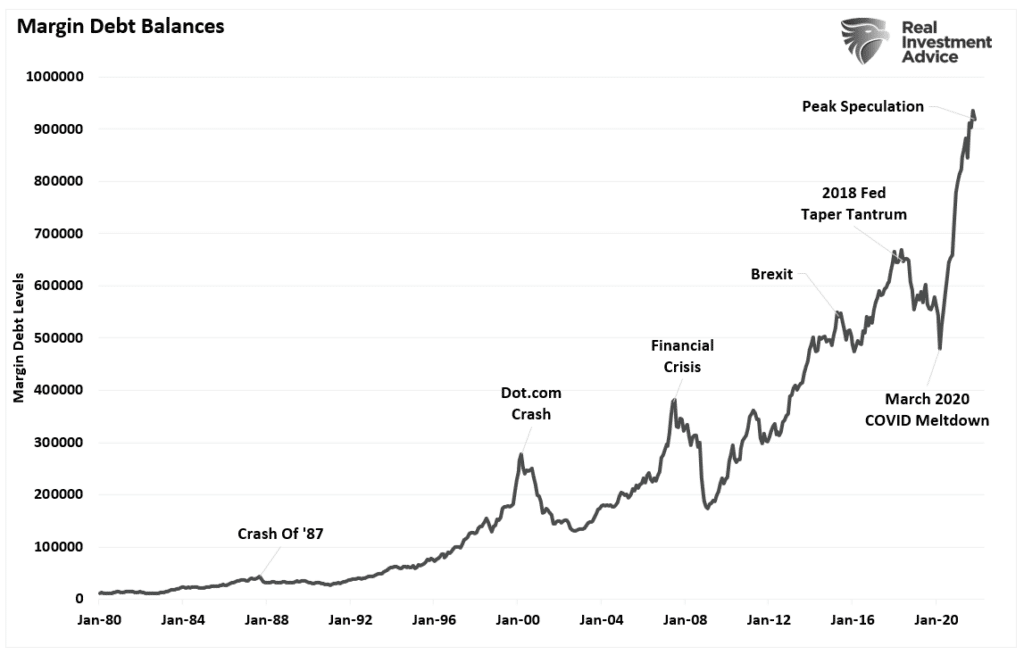
Hyman Minsky argued there is an inherent instability in financial markets. He postulated that an abnormally long bullish economic growth cycle would spur an asymmetric rise in market speculation, eventually resulting in market instability and collapse. A “Minsky Moment” crisis follows a prolonged period of bullish speculation, which is also associated with high amounts of debt taken on by both retail and institutional investors.
One way to look at “leverage,” as it relates to the financial markets, is through “margin debt.” In periods of “high speculation,” investors are likely to be levered (borrow money) to invest, which leaves them with “negative” cash balances.
This Time Is DIfferent
Understanding what a “Minsky Moment” is makes it easier to understand why “this time is different” for the Fed as they approach their current monetary policy tightening cycle.
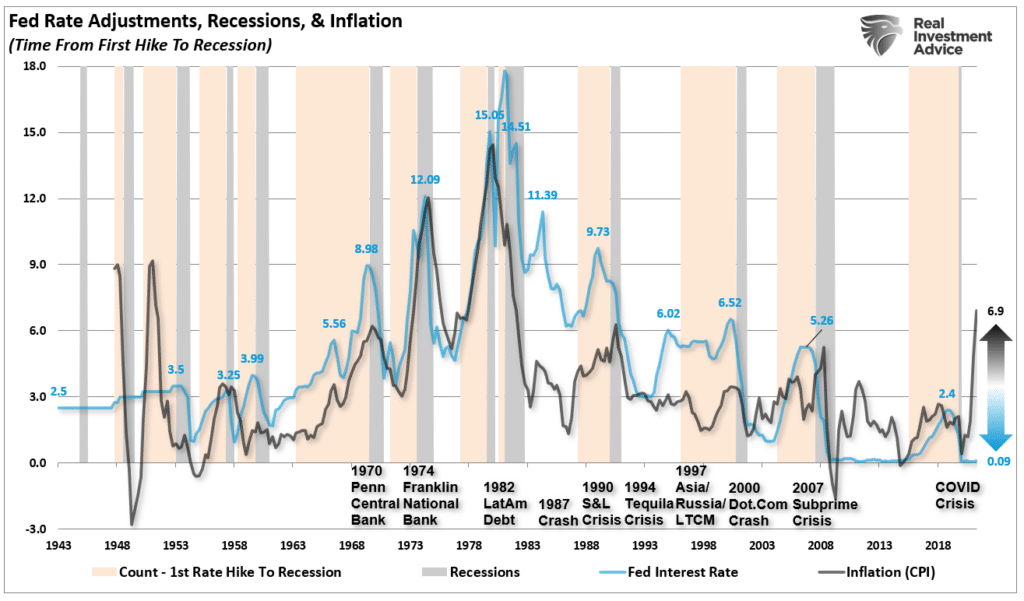
Since 1980, every time the Fed tightened monetary policy by hiking rates, inflation remained “well contained.” The chart below shows the Fed funds rate compared to the consumer price index (CPI) as a proxy for inflation.
There are three essential points in the chart above.
  1. The Fed tends to hike rates along with inflation, to the point it “breaks something” in the market.
  2. For the majority of the last 30-years the Fed has operated with inflation averaging well below 3%.
  3. The current spread between infaltion and the Fed funds rate is the largest on record.
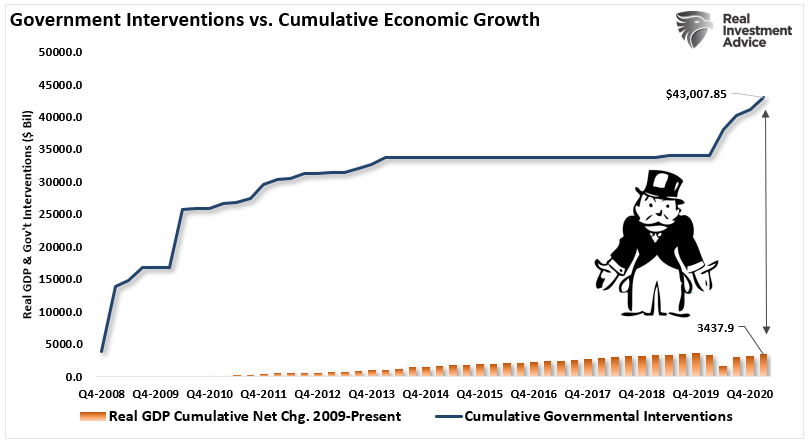
Historically, the Fed hiked rates to combat inflation by slowing economic growth. However, this time the Fed is hiking rates after short-term fiscal stimulus pulled-forward demand, creating inflationary pressures and a surge in wages. Combined with already high levels of leverage, an aggressive rate campaign is precisely the “catalyst” needed to ignite “instability.”
The Fed Will Have To Choose
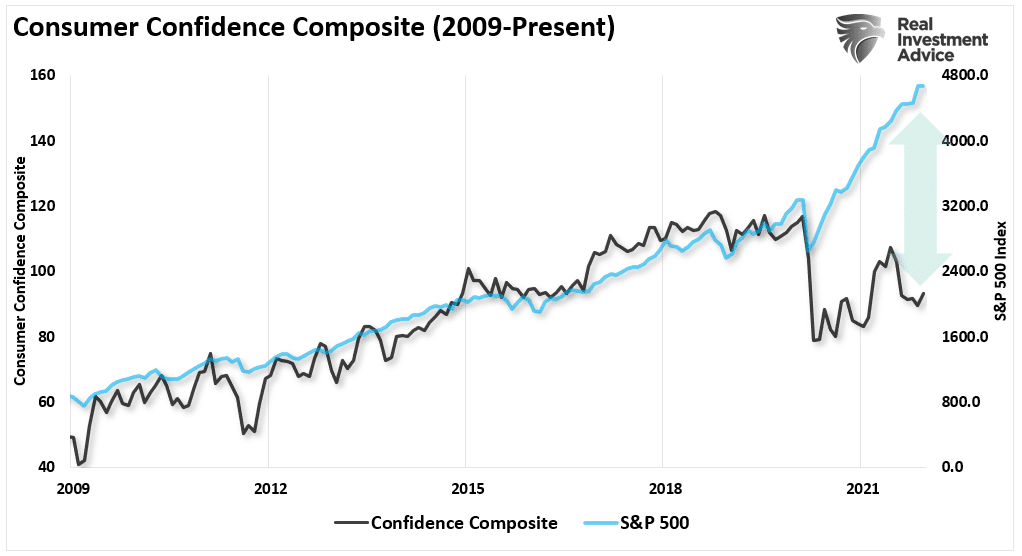
In 2010, Ben Bernanke launched “quantitative easing” to lift asset prices, increasing consumer confidence. While that worked previously, it isn’t working now.
More importantly, Jerome Powell and two other Fed members are heavily hinting at more aggressive policy.
  • BOSTIC SAYS FED COULD EASILY PULL $1.5 TRILLION OF “EXCESS LIQUIDITY” FROM FINANCIAL SYSTEM. THEN WATCH MARKET REACTION FOR FURTHER BALANCE SHEET REDUCTIONS.
  • MESTER: ABLE TO LET BAL SHEET TO RUN DOWN FASTER THAN LAST TIME.
  • POWELL: WE EXPECT TO ALLOW BALANCE-SHEET RUNOFF LATER IN 2022.
  • POWELL: BALANCE SHEET IS FAR ABOVE WHERE IT NEEDS TO BE.
The problem with a more aggressive campaign, as Hyman Minsky alludes, is the potential unwinding of that leverage. Such has historically had poor outcomes.
As noted above, the Fed didn’t have inflation during successive rounds of monetary interventions. The trillions in bond-buying programs did inflate asset prices, not to mention “wealth inequality.” However, Q.E. didn’t translate into surging price inflation. Such was because the Fed’s monetary interventions remained contained in the financial markets rather than leaking into the general economy.
Today, however, is a very different story, and the Fed’s biggest problem is maintaining stability.
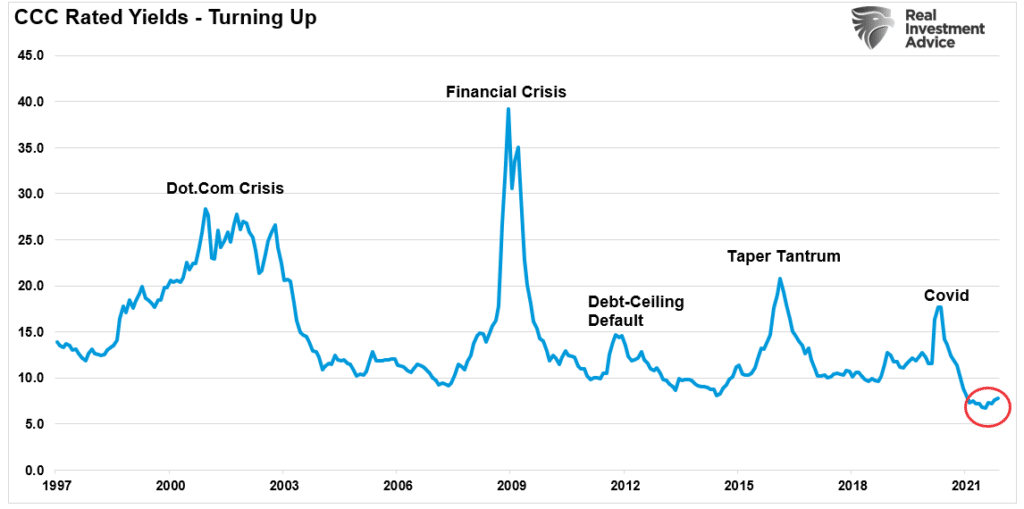
The Fed’s ongoing interventions have created a “moral hazard” in the markets by inducing investors to believe they have an “insurance policy” against loss. Therefore, investors are willing to take on increasing levels of financial risk, as shown by yields of CCC-rated bonds. These are corporate bonds just one notch above “default” and should carry very high yields to compensate for that default risk.
As noted, with the entirety of the financial ecosystem more heavily levered than ever, the “instability of stability” is now the most significant risk.
The Fed must now choose between supporting asset prices and maintaining stability or combating inflation.
It is a lose-lose proposition.
Outcome Will Be The Same
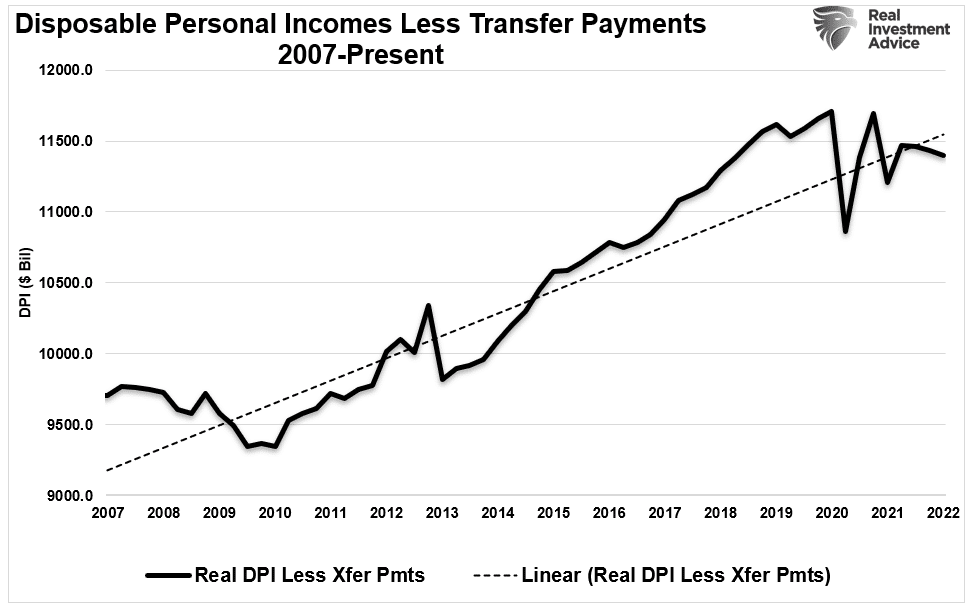
While the Fed is currently “hopeful” that economic growth will remain strong in 2022, they are likely to be very disappointed once again. Given the economic surge was a function of temporary liquidity, the expansion will also be just as transient. Savings rates and disposable incomes already show early signs of reversion.
Unwittingly, the Fed has now become co-dependent on the markets. If they acknowledge the risk of weaker economic growth, the subsequent market sell-off would dampen consumer confidence and push economic growth rates lower.
If they ignore inflation to keep asset prices elevated, inflation will eat into the consumer’s ability to sustain their standard of living. In turn, consumption will slow, and the economy will slide into a recession.
The Fed has a tough challenge ahead of them with very few options. While increasing interest rates may not “initially” impact asset prices or the economy, it is a far different story to suggest that they won’t. There have been absolutely ZERO times in history the Federal Reserve began an interest-rate hiking campaign that did not eventually lead to a negative outcome.
The Fed is now beginning to reduce accommodation at precisely the wrong time.
  • Growing economic ambiguities in the U.S. and abroad: peak autos, peak housing, peak GDP.
  • Excessive valuations that exceed earnings growth expectations.
  • The failure of fiscal policy to ‘trickle down.’
  • Geopolitical risks
  • Declining yield curves amid slowing economic growth.
  • Record levels of private and public debt.
  • Exceptionally low junk bond yields
Such are the essential ingredients required for thenext “Minsky Moment.”
When will that be? We don’t know.
What we do know is the Fed is going to make a “policy mistake” as “this time is different.”
Unfortunately, the outcome won’t be.