>>> TradeGate Pre-Market Indications

DAX:
  • Mercedes (MBG TH) -1.3%
    • Renault Shares Crushed by Concerns About Russia Exposure (1)
  • Deutsche Bank (DBK TH) -1.4%
    • DWS Says Its Mutual Funds Won’t Make New Investments in Russia
  • Zalando (ZAL TH) -1.5%
  • Infineon (IFX TH) -1.7%
  • Siemens Energy (ENR TH) -1.8%
MDAX:
  • Rheinmetall (RHM TH) +4.7%
    • Up 46% this week amid German defense-spending policy shift
  • AUTO1 (AG1 TH) +0.6%
    • Ultra Electronics, SSAB B Among Additions to Stoxx Europe 600
  • Hannover Re (HNR1 TH) -1.1%
  • Uniper (UN01 TH) -1.3%
    • Watch Europe’s Holders of Russian Stocks as Glencore Mulls Stake
  • Aixtron (AIXA TH) -1.4%
  • K+S (SDF TH) -1.4%
  • Aurubis (NDA TH) -1.5%
    • Ultra Electronics, SSAB B Among Additions to Stoxx Europe 600
SDAX:
  • Shop Apotheke (SAE TH) +2.3%
    • Shop Apotheke FY Adjusted Ebitda Loss EU5.29M, Est. Loss EU12.6M
  • Schaeffler (SHA TH) +1.5%
  • Metro (B4B TH) +1%
  • Nordex (NDX1 TH) -1.6%
  • Kloeckner (KCO TH) -1.8%
  • Deutsche PBB (PBB TH) -1.8%
  • VERBIO Vereinigte (VBK TH) -2.8%
  • SMA Solar (S92 TH) -16%
    • SMA Solar Sees 2022 Sales EU900M to EU1.05B

(ZH) "The Market Is Starting To Fail": Buyers Balk At Russian Oil Purchases Desp

"The Market Is Starting To Fail": Buyers Balk At Russian Oil Purchases Despite Record Discounts, Sanction Carve Outs

While in their unprecedented broadside of sanctions on Russia, the U.S. and Western allies went out of their way to spare Russian energy shipments and keep economies humming and voters warm, the oil market has gone on strike anyway. Acting as if energy were already in the crosshairs of Western sanctions officials, refiners have balked at buying Russian oil and banks are refusing to finance shipments of Russian commodities, the WSJ reports citing traders, oil executives and bankers.
This self-imposed embargo which has effectively halted a majority of Russian oil shipments, threatens to drive up energy prices globally by removing a gusher of oil from a market that was tight even before the Russian invasion of Ukraine. Meanwhile, Russia, waging war and in need of revenue with its financial system in turmoil, is taking extreme steps to convince companies to buy its most precious commodity.
We previously reported that owners of oil tankers had already started to avoid Russian ports because of both the military invasion of Ukraine and apprehension that sanctions for oil could also come soon, and as a result rates for oil tankers on Russian crude routes had exploded as much as nine-fold in the past few days.
But now, amid growing fears they will fall afoul of complex restrictions in different jurisdictions, refiners and banks are balking at purchasing any Russian oil at all, traders and others involved in the market say. Market players also fear that measures that target oil exports directly could land as fighting in Ukraine intensifies.
“This is going to make it very complex to trade with Russia,” Sarah Hunt, a partner at law firm HFW who works with commodities traders, said of the sanctions laid out as of Monday. “These sanctions against Russia will have an incredible effect on global trade and on trade finance.”
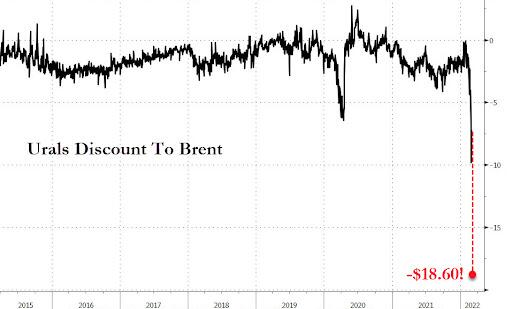
Brent-crude futures, the benchmark in international energy markets, rose nearly 8% Tuesday to above $105 a barrel. But in a sign that demand for Russian oil has evaporated, prices for the country’s flagship Urals crude moved in the opposite direction.
On Tuesday, traders offered Urals brent at a record discount of around $15 a barrel below the price of Brent - with the discount at one point hitting as much as $18.60 - and even then not finding buyers. A drop in the price of Espo, a grade of Russian crude popular in Asia, suggests refiners in Japan and South Korea are hitting pause on purchases alongside those in Europe and the U.S.
“The market is starting to fail,” a trader at a major commodities trading house told the WSJ, which is a problem because with Russia exporting roughly 5 mmb/d, the oil market - already extremely tight - could find itself in a historic supply shortage in just a few days, and will need massive demand destruction, read much, much higher oil prices, to stabilize as Goldman wrote over the weekend.
Oil trading giants including Vitol and Trafigura hold Russian oil bought under long-term deals. But according to the WSJ, they were unable to sell Tuesday, people familiar with their operations said.
In Europe, Swedish refiner Preem and Finland’s Neste Oyj said they have stopped Russian oil purchases and mostly replaced them with Northern European oil purchases. Texas-based Valero Energy also suspended all future purchases of Russian oil.
And while for now, Russia is exporting about as much oil as it was on the eve of Thursday’s invasion, those flows, based on sales made before the war, will slow drastically in the coming weeks once cargoes have been delivered, traders and analysts said.
The importance of Russia’s energy industry—exporter of about 7.5% of the world’s oil—to the global economy led Western governments to carve oil and gas out of their sanctions. In cutting some but not all banks from the financial system’s messaging infrastructure, Swift, the U.S. and others left avenues for traders to pay for oil and gas.
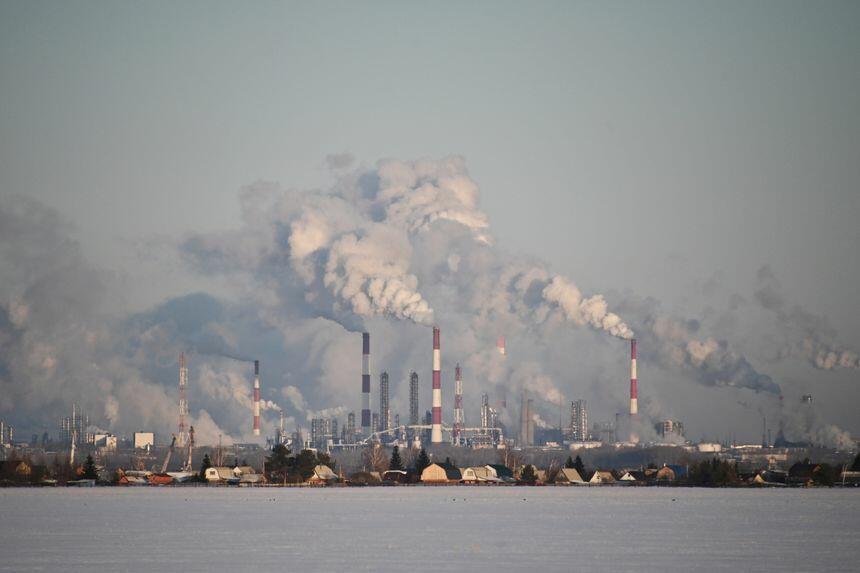
An oil refinery in Omsk, Russia. The country’s energy industry is a major player in the world market
As a result of these sanctions, and fears that a full-blown embargo on Russian oil output will soon follow, energy buyers have balked at the prospect of using the existing "loophole" worried that in just a few days they may be stuck with billions in Russian oil they can't sell. As a result the entire Russian oil supply chain is collapsing.
Which is not to say there are no buyers left: as prices for Russian crude tanked last week, companies in India vacuumed up around seven million barrels of Urals oil, but even there companies are taking steps to limit sanctions risk according to the WSJ.
On Monday, Indian Oil Corp. sent a letter to crude traders stating it would buy Russian oil only if delivery was included, according to a person familiar with the matter and a document seen by The Wall Street Journal. In the document, the Indian refining giant said it would no longer buy two grades of Russian oil, as well as a blend of Kazakh oil, if it had to take responsibility for transporting the oil. This was because some shipping companies are hesitant to load Russian crude.
Russia is responding fast to shore up demand for its oil, a vital source of dollars now the country’s foreign-currency reserves have been frozen by the U.S. and allies.
Companies including state-aligned giant Rosneft have pivoted from offering oil on a so-called FOB basis, in which buyers fix their own vessel and finance and insure the shipment, traders and oil executives say. Instead, they are offering oil on what is known in industry jargon as a CFR basis.
Under this model, Rosneft would use vessels from government-owned Sovcomflot’s fleet and deliver oil to the buyer’s door in return for cash, which means the buyer doesn’t have to worry about transportation, trade finance or insurance.
But buyers are rejecting the proposal, an oil-industry executive and a Middle East oil trader said.
In addition to India, China has also scooped up more Russian Urals, which normally are mostly sold on European markets. Two large tankers, including one chartered by China Petroleum & Chemical, or Sinopec, are en route to the Chinese ports of Ningbo and Zhanjiang and are scheduled to arrive in late March, said Kevin Wright, lead oil analyst at market-intelligence firm Kpler. A Sinopec spokesperson didn’t immediately respond to requests for comment.
Still, traders said China - which today we learned has bought more Iranian oil now than it did before the US sanctions - hasn’t vacuumed up cheap barrels in the way it did when global oil prices crashed at the start of the pandemic, perhaps because Beijing is treading a careful diplomatic line over the war, abstaining on a United Nations vote on condemning the invasion last week. That said, it's probably only a matter of price before China decides to buy up as much Russian oil as it can.
One challenge facing Rosneft and other producers: Governments including the U.K. and Canada are banning Russian oil tankers. On Monday, one such vessel was forced to cancel an arrival to Scotland after the U.K. instituted its ban. Meanwhile, as noted earlier, many Western shipping companies have grown wary of sailing in the Black Sea to the south of Ukraine, and are contending with a jump in insurance rates for operating near a war zone.
Another emerging complication comes from the banks that grease the wheels of international commerce, and which are refusing to finance Russian commodity deals. Lenders including ING, Société Générale and Credit Suisse and even some Chinese banks aren’t issuing letters of credit, a form of trade finance, for oil and other natural resources from Russia.
“The major problem is now on payment terms,” said Igho Sanomi, founder of energy trading company Taleveras. “That has become very difficult.”
The bottom line is that while Russia's economy will likely be crippled and soon, once this final dollar lifeline stops, the removal of millions of barrels of oil from the market will lead to an exponential surge in oil prices until we hit the infamous "demand destruction" trigger - the price beyond which there is no more demand... and a global stagflation beckons.
In short, this is one giant game of chicken between Russia and the west, where the former is suffering tremendous pain this very moment, and where the latter is still cruising thanks to a buffer of relatively cheap oil which however will run out shortly and once it does, prices will go vertical triggering an even bigger oil crisis than what the US experienced in the mid-1970s.
>>> US Close Dow -1.76% S&P -1.55% Nasdaq -1.59% Russell -1.93% VIX 33.32 +10.5%

Closing Stock Market Summary

The S&P 500 fell 1.6% on Tuesday in a risk-off session, which saw oil prices peak above $106 per barrel and Treasury yields drop noticeably in response to worsening geopolitical tensions. The Nasdaq Composite (-1.6%), Dow Jones Industrial Average (-1.8%), and Russel 2000 (-1.9%) also declined more than 1.5%. 

Tensions worsened as Russian forces attacked civilian areas in Ukraine and Russia's defense ministry warned of missile strikes on Ukrainian intelligence and communications facilities in Kyiv. Satellites images of a 40-mile long convoy of Russian military vehicles approaching Kyiv were especially unnerving for the market. 

The stock market tried to shake off the bad news with a flat open, but the understanding that things could get worse before they get better -- with a negative impact to growth prospects -- washed out the buyers. 

Ten of the 11 S&P 500 sectors closed lower, with the financials sector (-3.7%) taking a brunt of the damage and the information technology sector (-1.9%) acting as a heavy drag. Growth and value stocks alike declined together.

The energy sector (+1.0%), unsurprisingly, closed higher, but it was a little surprising to see just a 1.0% gain when oil prices settled higher by 8.3%, or $7.88, to $103.41/bbl. The relative disconnect might have been owed to the view that the high oil prices will give way to decreased demand. 

Interestingly, oil prices received little relief from an agreement among 31 EIA member countries to release 60 million barrels of oil from their reserves. Supply-constraint fears were the primary driver for prices, which in turn, could dampen consumer sentiment and spending. 

The Treasury market was a signpost for growth concerns, which were further exacerbated by more U.S. companies restricting their services in Russia and by disappointing guidance from Zoom Video (ZM 122.78, -9.82, -7.4%), GoodRx (GDRX 16.73, -10.67, -38.9%), and Ambarella (AMBA 96.03, -43.68, -31.3%).

The 10-yr yield accordingly dropped 13 basis points to 1.71% (-28 bps in two days). The 2-yr yield also dropped 13 basis points to 1.30% (-27 bps in two sessions) on the burgeoning belief that the Fed will be less hawkish than previously feared because of the geopolitical risks to the economy. 

The U.S. Dollar Index rose 0.7% to 97.35. The CBOE Volatility Index rose 10.5% to 33.32. Gold futures rose 2.3% to $1944.70/ozt. 

Reviewing Tuesday's economic data:

  • The February ISM Manufacturing Index increased to 58.6% (consensus 58.0%) from 57.6% in January. A number above 50.0% is indicative of expansion. February marked the 21st straight month of expansion for the manufacturing sector.
    • The key takeaway from the report is that new orders growth helped drive the faster expansion activity in February, showing that the effects of the Omicron variant had lessened; moreover, a strong pickup in the backlog of orders index -- the largest since January 2011 -- is a reflection of pent-up production potential that should keep the manufacturing sector in an expansion mode.
  • Total construction spending increased 1.3% month-over-month in January (consensus -0.4%) following an upwardly revised 0.8% increase (from 0.2%) in December. That was the strongest increase since the same period a year ago.
    • The key takeaway from the report is that there was strength in both residential and nonresidential spending, reflecting a fairly broad-based pickup in construction spending activity.
  • The final IHS Markit Manufacturing PMI for February decreased to 57.3 from 57.5 in the preliminary reading.

Looking ahead, investors will receive the ADP Employment Change report for February, the Fed's Beige Book, and the weekly MBA Mortgage Applications Index on Wednesday.

  • Dow Jones Industrial Average -8.4% YTD
  • S&P 500 -9.7% YTD
  • Russell 2000 -10.6% YTD
  • Nasdaq Composite -13.5% YTD

WWD : Cartier Files Lawsuit Against Tiffany & Co. Alleging Stolen Trade Secrets

Cartier Files Lawsuit Against Tiffany & Co. Alleging Stolen Trade Secrets
Cartier alleges that Tiffany hired a high jewelry manager with the intention of stealing insider information relating to its collections.

Cartier has brought a lawsuit against Tiffany & Co. and a former employee in New York courts alleging infringement of “trade secrets.”

Cartier, a subsidiary of Compagnie Financière Richemont, claims that Tiffany — the prized new gem under rival LVMH Moët Hennessy Louis Vuitton’s umbrella — hired a junior Cartier employee with the intention of soliciting insider information about its high jewelry collection from her.

“Plaintiff Cartier has not only uncovered direct evidence of a former employee’s unlawful taking of Cartier’s valuable confidential information and trade secrets, but through determined investigation Cartier has also opened a window into Tiffany’s disturbing culture of misappropriating competitive information,” the suit says.

It goes further to allege that Tiffany’s middle and senior management, “used quick money and title advancement to lure away an underqualified employee from a successful competitor, knowing she lacked the experience and knowledge to perform a high jewelry manager role.

“Immediately upon hire, Tiffany’s president for the Americas met with this junior manager for the express purpose of obtaining information about Cartier, openly asking for highly valuable, detailed confidential information that would foster unfair competition, while in the same breath disparaging Cartier in an unseemly manner. Fully disregarding the new manager’s confidentiality and nonsolicitation contractual obligations to Cartier, Tiffany’s president for the Americas asked her to assist Tiffany in soliciting great talent from Cartier.”

Tiffany said in a statement about the suit: “We deny the baseless allegations and will vigorously defend ourselves.”

A representative for Cartier relayed: “Cartier has filed a complaint against Tiffany and Company with the commercial division of the New York Supreme Court claiming, among other things, unfair competition.

“The basis for the complaint is alleged attempts by Tiffany’s senior management in the U.S. to improperly secure proprietary information about Cartier’s jewelry activities in the U.S. from a former Cartier employee. The former employee, who left to work for Tiffany, is also named in the complaint.

Cartier fully respects the rights of competitors to pursue their commercial objectives. In this case, however, Tiffany’s commercial ambition crossed the line between the ordinary course of business and unfair competition. As this is the subject of litigation, we have no further comment to make on the matter at this time.”

The employee in question, named in the suit as Megan Marino, appears to have deactivated her LinkedIn account. The suit says that Tiffany fired Marino after Cartier began to raise issue around the terms of her employment. Marino worked for Cartier North America for nine years, most recently as assistant manager for merchandising, jewelry, and departed in December 2021. She worked at Tiffany & Co. for less than two months.

An affidavit attached to the case and signed by Marino outlines how she was poached by Tiffany management to fill the high jewelry manager role. After her initial interview at Tiffany headquarters, Marino said she went through her Cartier work computer and share folders, “searching for documents that she believed would help her prepare for a high jewelry merchandising role at Tiffany,” that she then forwarded to her personal email.

These documents were later uploaded to her Tiffany work computer and it’s claimed that she routinely contacted Cartier employees asking for insider business information, often at her employer’s request.

Tiffany’s high jewelry division has been a key part of the jeweler’s elevation under LVMH’s stylized rebrand. In July, Tiffany hired Nathalie Verdeille — Cartier’s longtime creative director for jewelry — as its new vice president, artistic director of jewelry and high jewelry. It is understood that at Tiffany, LVMH leadership hopes to create a visual marriage between management’s French savoir-faire and Tiffany’s distinctively American sensibilities.

Cartier is seeking the return of its trade secret documents and assurance that its revealed secrets will not influence future business decisions made at Tiffany, as well as compensations.

FT : Stoxx to axe 61 Russian companies from its indices

Stoxx to axe 61 Russian companies from its indices
Decision is most concrete move yet by an index provider in wake of Ukraine invasion

Stoxx, the operator of Deutsche Börse’s Qontigo indices, is to axe 61 Russian companies from its indices, the most concrete move yet by an index provider in the wake of Moscow’s invasion of Ukraine.

The list includes most leading Russian companies, such as Gazprom, Lukoil, Sberbank, Rusal and Aeroflot.

Overseas-listed American and global depositary receipts issued by Aeroflot, Sberbank and X5 Retail are also on the list of index constituents that will be deleted on March 18.

Stoxx cited “the extreme or exceptional market conditions” affecting Russian stocks, including “restrictions on capital flows and market disruption that materially negatively influences the aggregated liquidity, capitalisation or tradability of Russia securities, as well as the impossibility for institutional investors to physically replicate the performance of an index”, in the wake of sanctions imposed by the EU, US and UK.

The move will affect indices such as the Stoxx Eastern Europe 50, which features 15 Russian stocks, including three of the four largest, and Stoxx Global 3000.

Moscow’s stock exchange remained closed for a second day on Tuesday, while the country’s central bank has banned foreign investors from selling Russian securities.

There have been high-profile pleas for index providers to take stronger action.

Yuriy Butsa, Ukraine’s government commissioner for public debt management, on Monday called for bond investors to “lobby for exclusion of any Russian instruments from the indices”, and to “lobby rating agencies for the downgrade of the rating of Russian companies”.

Timothy Ash, a fixed-income strategist at BlueBay Asset Management, said “index providers are stalling kicking Russia out of various investment indices. This encourages, even forces, asset managers to invest in Russia.

“I’m not sure that these guys can sit on the fence any more. [It’s time to] put their ESG mouths where their fat wallets are and kick Russian securities out of investment indices.”

Other index providers have so far made more tepid moves than Stoxx, however.

MSCI, which runs the most widely followed emerging market equity index, said on Monday it was seeking feedback from market participants regarding the “accessibility and investability” of Russian equities, as it considered the “appropriate treatment” of the market.

JPMorgan, which oversees the most important EM bond benchmarks, tracked by a total of $842bn, said Russia and Belarus were under review for removal from the environmental, social and governance (ESG) versions of these indices, as of March 31.

Banks placed under sanctions such as VTB Bank and Vnesheconombank, are under review for removal from JPMorgan’s hard currency indices, and new debt from sanctioned entities will no longer be eligible for any JPMorgan index from Tuesday.

Pre-announced plans to include Ukrainian local currency government bonds in JPMorgan’s GBI-EM by the end of this month will now be on hold.

A fund manager at a large investment manager said an important criteria for countries to remain in the EM bond indices was observable secondary market liquidity, which “clearly was not the case [on Monday]”.

“If this continues, we expect the bond index providers to consider the position of Russia,” he added. “Russia is completely untradeable at present, there is virtually zero liquidity in FX and in the sovereign dollar credit market, while the local bond market and equity market remain shut.”

S&P Dow Jones Indices said it was “monitoring the development of the conflict in Ukraine and is reviewing the recently issued sanctions”.

Separately, MSCI downgraded the sovereign ratings of both Russia and Belarus — but only to the second-lowest possible rating of B, though with a negative outlook in both cases.

The ratings provider has slashed Russia’s scores for “stability and peace”, “political rights and civil liberties” and “governance effectiveness”.

As a result, Russia’s “political governance” score is now “very severe”, the lowest category. MSCI also initiated a “very severe” sovereign watch for the other two pillars that feed into Moscow’s overall rating: “economic environment” and “financial governance”, “to reflect the potentially wide-reaching domestic impact of international sanctions and financial isolation on Russia’s economy”.

This categorisation “is reserved only for highly exceptional events that may significantly affect the risks to an economy’s sustainability and competitiveness”, said MSCI.

Belarus has been placed in an identical camp. It previously had a sovereign rating of BB, while Russia was BBB

Ukraine has been held at BB, but with a negative outlook.

WSJ : Cargo Ship Carrying Thousands of Luxury Cars Sinks in the Atlantic

Cargo Ship Carrying Thousands of Luxury Cars Sinks in the Atlantic
The Felicity Ace had caught fire last month, destroying thousands of Porsche, Bentley, VW cars

BERLIN—A cargo ship that caught fire last month with thousands of luxury vehicles on board sank Tuesday morning, the ship’s management company said.

MOL Ship Management Singapore Pte Ltd, which owns the company that operates the ship, said the Felicity Ace sank around 9 a.m. local time about 220 nautical miles (253 miles) off Portugal’s Azores Islands after it began to take on water and tilt to one side.

The Panama-flagged 60,000-ton merchant ship carrying around 4,000 luxury cars—including models from Porsche, Bentley, Audi, Lamborghini and other Volkswagen AG brands—caught fire in February and burned intensely for days.

SMIT Salvage, the Dutch company charged with salvaging the ship, sent a team of large oceangoing tugboats to the scene and was towing the vessel to safety when it sank.

Salvage crews and the Portuguese navy had said that the intensity of the fire might be explained by a large number of electric vehicles on board. Some batteries are known to be flammable and burn at high temperature when they combust, making such a blaze hard to extinguish.

The Felicity Ace fire is one of the first on board a major vehicle carrier loaded with a substantial cargo of electric vehicles. The incident has sparked debate among insurers and regulators about how to safely transport such vehicles, a question that will gain urgency as EVs become more widespread.

While the cause of the fire on the Felicity Ace might never be known because the ship is lying at the bottom of the ocean, experts say there is a danger that batteries in electric cars can short circuit and catch fire. That could mean that precautions not relevant for conventional vehicles might have to be taken into account during transport, regulators said.

After the blaze stopped, Volkswagen AG—the German car maker that owns the Lamborghini, Porsche, Bentley, VW and Audi brands—had said it expected “that large parts of the nearly 4,000 vehicles from several group brands were so damaged in the ship fire that they can no longer be delivered.”

Volkswagen declined to comment on the value of the cargo.

Incident insurance experts Russell Group Ltd. estimated that the cargo on board the Felicity Ace was worth about $438 million, of which the cars on board accounted for about $401 million. Russell estimated that VW could face losses of at least $155 million.

FT : Crypto exchanges resist calls for ban on Russia transactions

Crypto exchanges resist calls for ban on Russia transactions
Most will comply with curbs on individuals, but some say bans ‘fly in the face of the reason why crypto exists’

Crypto exchanges are coming under pressure to block transactions with Russia, as western politicians fear that cryptocurrencies provide a back door to move money around the world while they seek to shut Russia out of the global financial system.

Trading between the Russian rouble and crypto assets such as bitcoin and tether has doubled since the assault on Ukraine began, reaching $60mn a day on Monday, according to data from Chainalysis, a crypto research group. That suggests Russian accounts — barred from the established dollar-based financial system through sanctions — are stashing funds in crypto or moving wealth overseas.

Mykhailo Fedorov, Ukraine’s vice-prime minister, on Sunday called on “all major crypto exchanges to block addresses of Russian users”, saying it is “crucial to freeze not only the addresses linked to Russian and Belarusian politicians, but also to sabotage ordinary users”.

Western allies have imposed sanctions on hundreds of individuals, chiefly oligarchs and politicians close to President Vladimir Putin, and most big exchanges have said they will comply with those restrictions.

But several have pushed back on any Russia-wide bans.

“To unilaterally decide to ban people’s access to their crypto would fly in the face of the reason why crypto exists,” said Cayman Islands-registered Binance, one of the world’s biggest crypto exchanges. Rival Okx, based in the Seychelles, also said it had no plans to bar Russian accounts in bulk.

Western powers have expressed concern about crypto being used to evade sanctions. A White House official said the Biden administration was “continuing to aggressively combat the misuse of cryptocurrency, including to evade US sanctions”. 

Liz Truss, UK foreign secretary, said on Monday that Britain was looking at cryptocurrency as a route that could be used to undermine sanctions aimed at Russian banks and global payments.

“There remains a considerable risk of Russian individuals and entities sanctioned last week continuing to trade in cryptocurrency assets,” said MP Tom Tugendhat, who chairs the UK House of Commons foreign affairs committee, and Tory peer Lord Sarfraz in a letter urging the Financial Conduct Authority do more to crack down on possible sanctions violations. 

But for some crypto market operators, a ban would mark a profound break from early pioneers who conceived the idea of the blockchain precisely to circumvent the global banking system.


Jesse Powell, founder of the exchange Kraken, said his company’s mission was to “bridge individual humans out of the legacy financial system and bring them into the world of crypto, where arbitrary lines on maps no longer matter, where they don’t have to worry about being caught in broad, indiscriminate wealth confiscation”. Kraken “cannot freeze the accounts of our Russian clients without a legal requirement to do so”, he added.

“Bitcoin is the embodiment of libertarian values, which strongly favour individualism and human rights.”

Russia is among the top 20 countries worldwide with the highest level of cryptocurrency adoption, according to a Chainalysis index. Even prior to the war, Russia ranked third among countries that sent the largest share of crypto transfers abroad, after Turkey and Ukraine.

“Capital flight and tax avoidance may also be part of the cryptocurrency adoption story in eastern Europe, particularly in Russia and Ukraine,” Chainalysis said.

Sanctions from the US, UK and EU in recent days have severed links between Russia and the global financial system, barring trade with certain banks and freezing some Russian banks’ access to Swift, the messaging system that underpins global payments. Trading with the central bank is also heavily restricted.

Russia has, meanwhile, introduced capital controls banning Russians from transferring foreign currency abroad or from servicing new debt in foreign currency outside the country.

US-based exchanges Coinbase and Gemini both said that they did not operate in Russia. However, Coinbase said it would not “institute a blanket ban on all Coinbase transactions involving Russian [crypto wallet] addresses”. Bahamas-headquartered FTX has also pledged to honour sanctions on individuals, but not implement a ban on the country.

“You have to make sure that you are not being a gateway for sanctions evasion and money laundering,” said Sam Bankman-Fried, founder of FTX.

Many crypto exchanges operate out of offshore jurisdictions or are unregulated beyond their obligation to comply with money laundering legislation.

Investors can turn their roubles into crypto, which can then be traded on unsanctioned entities. The Financial Stability Board, a global committee of regulators and central bankers, has warned that digital assets could be used to evade sanctions.

Even so, lawyers point out that crypto exchanges face extensive legal risk since transactions recorded on blockchains are public and immutable.

“Crypto operators are at a higher risk than those in the traditional financial services spaces, however, because they will be on the hook for what they ought to have known about the ownership of the assets they handle,” Jason Hungerford, a partner at law firm Mayer Brown in London.

But the role of crypto as a payment system for potentially unlawful transactions from Russia may have longer-term consequences.

“Governments are likely to look at the regulation of crypto as a matter of increasing urgency,” said Paul Donovan, chief economist at UBS Global Wealth Management.

FT : Stellantis plans to double sales by 2030 in electric shift

Stellantis plans to double sales by 2030 in electric shift
Peugeot owner aims to stay ‘competitive’ as governments crack down on carbon emissions

Stellantis aims to double car sales by 2030 and keep profit margins above 10 per cent as it shifts to electric only transactions in Europe with the aim of becoming completely carbon free by 2038.

Half of the sales from the Jeep and Ram owner in the US will be fully electric by the end of the decade, while upmarket brands Alfa Romeo and Maserati will only launch battery models after 2025, the company said on Tuesday in an ambitious strategy update.

Investing in electric cars will lead to the company’s margins falling from 11.6 per cent last year to “more than 10 per cent” until 2027, before climbing to “more than 12 per cent” by the end of the decade, the group claimed.

The company said the amount of cash generated by the business will fall from €6.1bn last year to €6bn in 2024, before rising to €12bn in 2027 and more than €20bn in 2030.

Despite the upbeat ambitions, Stellantis shares fell 5 per cent to €15.62 by late Thursday afternoon in Europe. 

The new strategy for the business, formed a year ago by the €50bn merger of PSA and Fiat Chrysler, is a significant shift towards electric for a company that was among the most critical of battery-powered cars.

Carlos Tavares, chief executive, said the change in targets was designed to keep the company “competitive”, particularly as governments crack down on carbon emissions.

“The frame for electric mobility has been set [by regulators],” he said. “The purpose today is not to express our opinion, it is about being competitive,” he added.

He repeated warnings that rising prices from battery models may push the middle classes out of private car ownership, but stressed shifting to complete carbon neutrality is “the right thing to do for my kids and grandkids”.

Stellantis also aims to grow certain parts of the business, including its commercial vehicle sale, upmarket brands and businesses outside of its North American and European heartlands.

While the US accounts for half of revenues and Europe for a third, the company wants its other regions to account for a quarter of its expanded sales by the end of the decade. It expects group revenues to rise from €152bn in 2021 to €300bn by 2030.

Stellantis hopes to make its commercial vehicle business “the undisputed leader in market share and profitability”, with revenues doubling by 2030 and 40 per cent of sales being zero emission by the end of the decade.

The group’s premium brands, which also include DS, expect revenues to rise fourfold and profits to increase fivefold by 2030, while it will launch 20 battery models across its high-end range.

FT : Russia-focused funds with €4bn in assets freeze redemptions

Russia-focused funds with €4bn in assets freeze redemptions
Western measures to cut off Moscow from global financial markets have knock-on effect for fund managers

Russia-exposed funds with €3.8bn in combined assets have been frozen in Europe, preventing investors from heading for the exits as they grapple with unprecedented western sanctions imposed on Moscow after its invasion of Ukraine.

At least 18 asset managers including JPMorgan, BNP Paribas, UBS, Liontrust, Danske Bank, East Capital and Pictet have suspended funds since the invasion, meaning investors are now stuck with no indication of when they might be able to withdraw their money from these vehicles, data from Fitch show.

More suspensions are expected, with assets held in Russia-focused mutual funds sold in Europe standing at €5.7bn at the end of January, according to Lipper, the data provider.

“We believe further Russia-focused funds may suspend redemptions, driven initially by an inability to trade portfolio securities,” said Alastair Sewell, head of fund and asset manager ratings at Fitch.

“We are monitoring [other] funds closely for signs of unexpected spillover effects,” he added.

The fund suspensions highlight how western allies’ measures to cut off Russia from global financial markets have had a knock-on effect for international fund managers, who hold at least $150bn in Russian assets collectively. Investors’ ability to trade Russian assets both on foreign and domestic markets has sharply deteriorated in recent days, something that has complicated the situation for fund managers as they plot their next steps.

Russian stocks were already down about 40 per cent for the year to date by Friday’s close in US dollar terms. The Moscow stock market was closed on Monday and Tuesday this week, but trading in Russian equities listed abroad suggests the market is set for heavy losses when it reopens. Russian bonds denominated in foreign currencies have also come under heavy selling pressure.

The asset management arm of Danish institution Danske Bank said on Monday: “Danske Invest has been forced to suspend trading in the equity funds that have a significant weight of Russian equities in the portfolio”. Pictet said it would reopen its Russia equity fund “as soon as the market conditions allow”. 

Meanwhile, London-based asset manager Liontrust said it was unable to predict when it might reopen its £181.7mn Russia fund. “We will keep the suspension of the Russia Fund under continual review given it is such a rapidly changing situation and we will update investors as soon as we can,” the company said.

Broader emerging market funds with combined assets of €640bn had an average exposure of 4 per cent to Russia, based on Lipper data. Many EM fund managers were holding “overweight” positions in January because Russian shares were trading on extremely low valuations even before the Ukraine invasion.

‘A financial as well as a moral case for divestment’
At the same time, pension funds around the world are looking to offload, or are reviewing, their Russia investments. Retirement plans representing tens of millions of members in the public and private sectors typically have some exposure to Russia through EM funds, sovereign debt or through stakes in funds and listed companies.

The Universities Superannuation Scheme, the largest private-sector pension plan in the UK, plans to divest assets worth £450mn exposed to Russia — representing about 0.5 per cent of its £90bn portfolio. Its holdings included an £81mn stake in Sberbank, Russia’s largest bank and £84mn in Lukoil, the energy giant, at the end of September 2021.

“In terms of our own position, there is clearly a financial as well as a moral case for divestment with respect to our Russian holdings,” USS said in a statement.

Caisse de dépôt et placement du Québec, one of Canada’s largest pension managers, said “disposal plans” were under way for its Russian holdings which the C$420bn ($330bn) fund described as “marginal” in terms of value.

Australia’s sovereign wealth fund pledged on Monday to divest its remaining holdings of companies listed on the Russian stock exchange, which amounted to about 0.1 per cent or A$200mn ($110mn), of the total portfolio.

Meanwhile, Calpers, the US’s biggest public pension plan with about $480bn of assets, has $900mn exposure to Russia. It said it did not hold any Russian debt, but would not comment further. The California State Teachers’ Retirement System, which held Russian investments worth less than $500mn as of February 23, said it was reviewing its positions.