(ZH) Housing Affordability Hits Record Low As Mortgage Rates Soar To 6.1%

Housing Affordability Hits Record Low As Mortgage Rates Soar To 6.1%

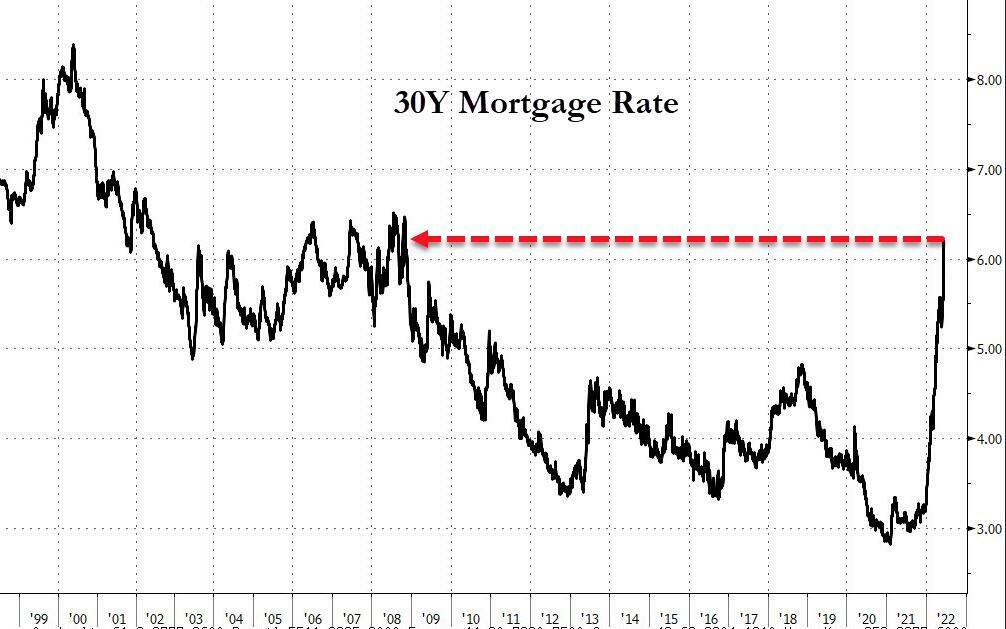
Back in March, when the average mortgage rate was still "only" 4.5%, we anticipated the coming rate explosion and warned that "Housing Affordability Is About To Crash The Most On Record." Fast forward to today when the latest 30Y average mortgage has just surged to a stunning 6.13% from 3.25% at the start of the year ...
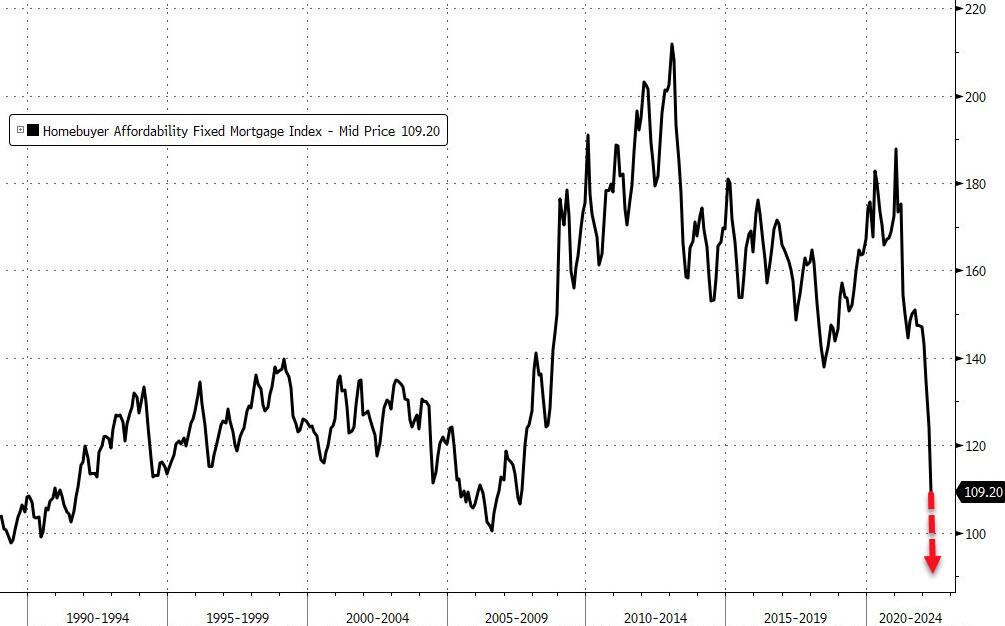
... the highest rate since the great housing crash of 2007/2008, in the process sending housing affordability - just as we warned - to the lowest on record.
Alas, it's about to get even lower, because a simple back of the envelope calculation reveals that the jump in mortgage rates from 3.25% to 6.13% means that new homebuyers face an average monthly payment on a typical new $350,000 mortgage (the median existing home sale price is just under $400K) that has gone up from $1523 to $2128, a 40% increase in 6 months!
Another way of putting this: at a 6.13% mortgage (and rates will still keep rising for a long time with the Fed now set to hike between 125bps and 150bps in the next two months), the average home price needs to fall 30% to reach pre-covid affordability.
Whether it was intended or not, the Fed is about to unleash the biggest housing crisis since the bursting of the 2007 bubble. It also means that in a few weeks, the Fed's scramble to undo the damage it has done to the US economy will make March 2020 seems like a walk in the park.

(ZH) The Great Celsius Implosion: What Went Wrong And How Much More Will Bitcoin

The Great Celsius Implosion: What Went Wrong And How Much More Will Bitcoin Drop (See FULL Attached)

The purpose of this issue will be twofold:

The first will be an in-depth look at the Celsius platform, and breakdown the design of the business/ecosystem to understand what went wrong.
The second is to detail the events that have transpired over the recent weeks with Celsius “yield generation” strategies, and update subscribers on the state of the market, with potentially big ramifications on the horizon.
The following is written by Bitcoin Magazine’s Namcios, detailing Celsius’s core business operations.

Celsius: Design And Assumptions

This section takes a deep look at the inner workings of the project itself, as per its white paper, including some red flags in its design and backboning assumptions that could’ve served as a warning to investors – and can hopefully be applied to other projects to prevent similar losses in the future.

“As more people join the Celsius ecosystem, the more everyone benefits,” per the white paper.

Throughout its white paper, Celsius conflates terms and assumptions, pushing forward design decisions that don’t necessarily play along. One example of this is naming itself Celsius “network” while having an entire section dedicated to showing an “executive team.” It can be argued that networks don’t have executive teams, though Celsius has a few founders, a CEO, a COO and a CTO, as well as marketing and development departments. It also repeatedly refers to a “community” it seeks to create with its network, though the user can be certain that the executive team will almost always preserve its own self-interests instead of the community’s – which is what happened on Sunday as withdrawals were halted in the platform. (The withdrawal issue will be explored in length in a subsequent section.)

WSJ : Elon Musk to Participate in Twitter All-Hands Meeting Thursday

Elon Musk to Participate in Twitter All-Hands Meeting Thursday
Uncertainty over outcome of Mr. Musk’s $44 billion bid persists

Elon Musk is set to participate in an all-hands meeting with Twitter Inc. TWTR -5.00%▼ employees on Thursday, marking the first time the billionaire will have spoken directly with the company’s workforce since he began his courtship of it in April.

Twitter Chief Executive Parag Agrawal announced the meeting in an email to staffers on Monday, saying they could submit questions for Mr. Musk in advance, a spokesman said. The company’s marketing chief, Leslie Berland, will moderate the event, he said.

Details of the meeting were earlier reported by Business Insider.

In late April, Twitter agreed to Mr. Musk’s $44 billion bid to acquire the company and take it private after he rescinded an offer for a board seat. Later Mr. Musk said the deal was on hold over concerns about the accuracy of the company’s estimates of spam accounts on its social-media platform.

Most recently, Mr. Musk earlier this month threatened to terminate the transaction in a letter accusing the company of not complying with his request for data on spam accounts. A Twitter spokesman at the time said that the company was continuing to share information with Mr. Musk and that it planned to enforce the merger.

With Monday’s announcement, it couldn’t be determined whether the plans for Mr. Musk to speak to Twitter employees this week mean the two sides have come to an agreement about how to count the spam accounts.

Twitter shares—which have been trading under Mr. Musk’s offer price, amid investor doubt the deal would happen—climbed close to 3% in after-hours trading Monday following the reports of the all-hands meeting. They ended the regular trading day at around $37, well below the offer price of $54.20.

The uncertainty over the deal’s outcome has left employees bewildered about what their jobs are and will be. It has also raised questions about how to operate a platform with about 229 million daily users while its would-be owner uses it to publicly assail the company for everything from its moderation policies to its business model.

Twitter employees have expressed mixed reactions to Mr. Musk’s bid. When it was announced, some wrote on Twitter’s internal Slack messaging channel that they planned on resigning, employees said, while one tweeted Mr. Musk’s takeover could help with recruitment.

Later, employees asked questions at an all-hands meeting about the standard severance package and what would happen to employees on work visas if they were laid off, according to internal communications reviewed by The Wall Street Journal. Some employees said they were dusting off their résumés out of concern that Mr. Musk could claw back the company’s remote-work policy.

Mr. Musk has said in tweets, regulatory filings and interviews that he would make significant changes to Twitter upon buying it, including offering longer tweets, creating an edit button and opening the platform’s algorithm so anyone can view it and recommend changes.

He has also talked about relying less on advertising and softening Twitter’s stance on content moderation. In May, Mr. Musk said he would reverse the platform’s ban on former President Donald Trump, calling it a “morally bad decision.”

FT : Investors overcharged in securities lending deals, says EU watchdog

Investors overcharged in securities lending deals, says EU watchdog
Wide divergences in fee splits between fund managers and clients criticised by Esma

Big variations in the share of revenues from securities lending retained by asset managers raise questions over whether fund investors are being overcharged, according to the EU’s top financial watchdog.

Securities lending — the practice among institutional investors of temporarily swapping stocks, bonds and exchange traded funds with each other in return for a fee — is a highly lucrative business which generated global revenues of almost $11bn in 2021, according to IHS Markit, a data provider.

Hedge funds borrow stocks and bonds in order to bet that an asset will fall in value — the process known as “short selling” — but market makers are also active participants in securities lending markets as they frequently borrow assets to facilitate the completion of clients’ trades.

Most regulators across Europe take the view that all revenues arising from securities lending transactions, net of costs, should be returned to fund investors.

But many fund managers return only half to two-thirds of the gross revenues generated by securities lending activities to investors, said the European Securities and Markets Authority (Esma) in a report published at the end of last month. Other managers return 90 per cent of the gross revenues to investors.

These divergences raise the risk that investors are “effectively being overcharged,” said Esma.

The growth of index trackers and exchange traded funds over the past decade has provided ETF managers with an enormous inventory of lendable assets, helping them to become some of the most influential players in the securities lending market.

Some large asset managers, most notably BlackRock, operate “in-house” lending arms whereas others, such as Vanguard, employ specialist third-party agents to carry out securities lending activities.


BlackRock’s in-house lending agent retains 37.5 per cent of the gross revenues from securities lending transactions in Europe whereas Vanguard pays about 8 per cent of gross lending revenues to its third-party agent, according to Better Finance, a Brussels-based investor rights group.

Other managers including Amundi, DWS and State Street Global Advisors that use in-house or affiliated lending agents also return significantly less of their gross securities lending revenues to their investors than Vanguard.

Fund managers that use in-house lending arms have discretion in how they calculate the operating costs of these units, leading to the wide divergence in the share of securities lending revenues they retain, rather than passing on to fund investors.

Esma said it was concerned that the fixed fee split arrangements by managers operating in-house lending agents were not adjusted on a regular basis even though competitors could offer the same services more cheaply to fund investors.

Better Finance said the high operational costs of in-house lending agents suggested some managers were earning “hidden revenues” from their securities lending operations.

“Such practices could constitute a breach of a fund manager’s duty of care to retail investors,” said Guillaume Prache, managing director of Better Finance.

It has proposed that the maximum share of gross securities lending revenues that managers, such as BlackRock, can deduct for an in-house lending agent should be limited to just 10 per cent. BlackRock declined to comment.

In addition, the current Esma guidelines covering securities lending revenues should be upgraded into enforceable rules to ensure a level playing field for investors across Europe, said Better Finance.

FT : ESG’s legal showdown: ‘There’s nothing to suggest DWS is a one off’

ESG’s legal showdown: ‘There’s nothing to suggest DWS is a one off’
The boom in ESG investing is drawing regulatory scrutiny on both sides of the Atlantic

When about 50 German police officers raided the Frankfurt office of fund manager DWS last month as part of an investigation into greenwashing, the move marked the beginning of what many believe will be a long legal reckoning for the asset management industry.

Interest in sustainable investing has taken off in recent years, with assets managed in ESG-labelled funds globally ballooning to some $2.7tn, but the industry has also been hit by claims its green credentials are inflated.

DWS, whose chief executive Asoka Woehrmann resigned the day after the police arrived to gather materials and question staff, has been in the sights of regulators in Germany and the US since former executive turned whistleblower Desiree Fixler accused the firm of greenwashing last year.

But with regulatory scrutiny growing on both sides of the Atlantic — and an army of lawyers primed to pursue allegations of mis-selling — few believe the shakeout will end with DWS.

“There’s nothing to suggest DWS is a one off,” said Fiona Huntriss, a partner at legal firm Pallas who specialises in financial litigation. “I think it’s almost inevitable litigation will be brought in lots of different jurisdictions.”

“Where you’ve got statements and documents that are highly regulated [that have been given] to a group of investors who can then work together to litigate against that, that is prime territory for mis-selling claims,” she said.

Regulators across Europe and the US are gearing up to tighten requirements and crack down on overhyped claims, including taking aim at the metrics underpinning ESG ratings. The hunt for greenwashing has accelerated in Washington since March, when the Securities and Exchange Commission announced that it would prioritise uncovering exaggerated ESG performance and advertising claims by investors.

It emerged last week that the SEC is investigating Goldman Sachs’s asset management division over certain environmental, social and governance claims made by its funds. Goldman Sachs declined to comment.

Back in Germany, DWS has modified ESG criteria since Fixler made her revelations public. The amount of “ESG assets” reported in its latest annual report, released in March, were 75 per cent below the €459bn it had said were “ESG integrated” a year earlier. The group has denied wrongdoing.

Rumblings that an industry-wide mis-selling scandal may be brewing began when Fixler made her allegations about DWS public, and former BlackRock sustainability executive Tariq Fancy said ESG investing was little more than “marketing hype”.

The debate was given fresh impetus when Stuart Kirk, HSBC’s head of responsible investing, gave a controversial speech last month in which he claimed central banks and policymakers had overstated the financial risks of climate change.

ESG “has become a bureaucratic tax and we need to get it back on track”, Fixler told the Financial Times. The DWS raid “is the real wake-up call for all ESG practitioners to back up statements and products with substance and data.”


Gary Gensler, SEC chair, told the Financial Times in that “we live in a time where investors are currently making decisions about climate risks. And around the globe, many market regulators just like the SEC are trying to bring some standardisation to those disclosures.”

The agency will prioritise rule writing, but will also use examination and enforcement tools when needed, Gensler said. “It’s about truth in marketing . . . and promoting better competition in our capital markets. If people are competing for funds, let them compete with accurate [and] consistent disclosures,” he said.

The SEC announced its first case against an investment firm over alleged ESG misconduct in May, with BNY Mellon’s investment arm agreeing to pay $1.5mn to settle charges from the regulator. The regulator proposed new rules on labelling and disclosure for ESG funds two days later.

The US regulator will be examining proxy voting behaviour, and a firm could find itself in trouble if its ESG or so-called impact funds voted consistently with corporate management and against ESG-focused shareholder proposals, according to a person familiar with the SEC’s approach.

In Europe, German, Dutch and French authorities have issued additional ESG labelling requirements on top of EU bloc-wide disclosure rules that came into force in March 2021. Although the DWS raid appeared to be the first potential criminal action linked to ESG in any jurisdiction, according to Elaina Bailes, partner at Stewarts Law, civil litigation on greenwashing has taken off more quickly in America.

“We have seen more general shareholder and investor activism in the US. You see the regulator mirroring that and being aggressive,” she added.

The trade body for the German asset management industry pins some of the blame for the current scrutiny on a lack of clarity from regulators on how to define the parameters of ESG investing.

“The supervisors also struggle with the criteria,” the German Investment Funds Association BVI said in a statement. “Currently, we see a vacuum of guidance.”

As scrutiny grows, law firms are enjoying a surge of interest on the subject — both from asset managers wanting to avoid accusations of greenwashing and from investors looking to launch legal action over securities they believe were mis-sold.

These claims often take time to emerge, according to Huntriss at Pallas, who noted that she was still working on cases linked to the collapse of Lehman Brothers in the 2008 global financial crisis.

“This isn’t an immediate flash in the pan, and it will take time for this to unravel. If you don’t see litigation filed next week, it doesn’t mean it’s not going to happen. This has got a long, long way to run,” she said.
>>> US After Hours Summary: ORCL +14% rises on earnings/guidance while OM -24% f

After Hours Summary: ORCL +14% rises on earnings/guidance while OM -24% falls on shipment hold for Tablo Hemodialysis System for home use device

After Hours Gainers:

Companies trading higher in after hours in reaction to earnings/guidance: ORCL +13.8%, BRZE +5.4%

Companies trading higher in after hours in reaction to news: MOR +16.8% (entered into collaboration with Pfizer [PFE] and Incyte [INCY] for Monjuvi and TTI-622), EYE +15.6% (appointed to join S&P SmallCap 600), OSG +10.7% (authorized repurchase of 5 mln shares), APLD +3.8% (announced expiration of share lock-up agreement), WULF +1.5% (announced recent financing actions and near-term ramp of digital infrastructure), ZYXI +1.5% (announced change of auditor), MNTS +1.3% (provided Mission Update for Vigoride-3 spacecraft)

After Hours Losers:

Companies trading lower in after hours in reaction to earnings/guidance: N/A

Companies trading lower in after hours in reaction to news: OM -23.5% (announced shipment hold on distribution of Tablo Hemodialysis System for home use), XPER -8.3% (Adeia business received unfavorable ruling in Videotron litigation)

Business Of Fashion : Zalando Buys Highsnobiety

Zalando Buys Highsnobiety
The German fashion e-tailer has taken a majority stake in the high-end streetwear platform in a bet on the combined power of content and commerce.

Zalando, the German fashion e-tailer with more than €10 billion in annual revenue, has acquired a majority stake in Highsnobiety, the sneaker blog-turned-luxury fashion and lifestyle publisher that began exploring a sale last year. The financial terms of the deal were not disclosed.

Highsnobiety founder and CEO David Fischer will retain a minority stake in the company and continue to run the business as a separate entity with co-managing director Jürgen Hopfgartner. While both Zalando and Highsnobiety are headquartered in Berlin, they will not merge offices.

Highsnobiety will contribute only a small sum to Zalando’s top line. (The company is expected to generate more than $60 million in 2022, with 60 percent of revenue coming from Europe.) But its ability to attract a large audience and inspire readers to shop could prove valuable to Zalando, which started in 2008 as a Zappos clone but has since pushed further upmarket. So could Highsnobiety’s relationships with sought-after brands in both luxury and streetwear.

When Highsnobiety was founded by Fischer in 2005 as a streetwear-focused blog, the promise of content-driven commerce compelled investors to back businesses like Refinery29 and WhoWhatWear — with mixed results. Fourteen years later, in 2019, Highsnobiety launched an e-commerce venture with an exclusive deal to sell Prada’s coveted Linea Rosa line and other luxury brands alongside its own collection, and has since opened physical retail stores.

“Most companies come from one end or the other — and not many have not truly managed to bring these worlds together,” Fischer said.

The Zalando deal is a vote of confidence in the approach.

“Fashion is a lot more than product; it’s about culture and all the stories behind the product,” said David Schneider, Zalando’s co-CEO. “[Customers] want to have more immersive experiences.”

(L) Founder and CEO of Highsnobiety David Fischer, (R) Founder and co-CEO of Zalando David Schneider.
(L) Founder and CEO of Highsnobiety David Fischer, (R) Founder and co-CEO of Zalando David Schneider. (Courtesy)
Fischer began covering streetwear long before it became mainstream fashion. “Highsnob,” as it is known by readers, is now not only a trusted source on streetwear, but also covers the luxury brands that have started selling their own streetwear product and using streetwear’s marketing tactics. Many high-end brands and retailers — including Zalando — also hire Highsnobiety’s creative agency to make everything from podcasts to NFTs.

While its publishing arm still makes up the majority of Highsnobiety’s revenue, its commerce business is growing — making up a “double-digit percentage” of overall sales — and could benefit from Zalando’s technology and distribution capabilities to scale further.

For its part, Highsnobiety, with 35 million users across its platforms, could help Zalando to acquire and engage new customers.

While Zalando’s revenue jumped nearly 30 percent in 2021 to €10.4 billion, sales were flat in the first quarter of 2022. Schneider said that, after two years of “incredible” growth, the company is facing the effects of rapid inflation on consumer spending. Its high exposure to Eastern Europe also means the Ukraine war has hit the company harder than many.

Whereas Zalando serves Europe, Highsnobiety’s audience is global. But the e-commerce giant has no plans to expand to the US or China, where it would face stiff competition from the likes of Amazon and Alibaba.

“For now, it is Europe,” Schneider said.

WWD : Kering Is Betting on Cryptocurrencies

Kering Is Betting on Cryptocurrencies
The French luxury group has invested in crypto fund Haun Ventures, and is testing the use of digital currencies at Gucci and Balenciaga.

PARIS — Kering believes that cryptocurrencies are here to stay, and recently invested in a $1.5 billion fund aimed at supporting the growth of Web3, the next iteration of the internet.

The French luxury group was one of the investors behind Katie Haun’s crypto fund Haun Ventures, launched in March, chief client and digital officer Gregory Boutté revealed on Friday in a presentation at the Kering Imagination Lab, the company’s hub for digital innovation in Paris.

And it recently made the leap into digital currencies by giving customers the possibility of paying in cryptocurrencies at Gucci stores, initially in key U.S. flagships. Balenciaga is set to follow suit “imminently” and will also accept cryptocurrency payments on its e-commerce site through specialized payment service BitPay. Boutté dismissed recent volatility as par for the course.

“We’re convinced that cryptocurrencies are here to stay,” he said. “They’re hugely appreciated. A lot of wealth has been created around these currencies. Some of our customers who hold these currencies would like to be able to use them to buy our products, so in order to offer our clients the best possible experience, it makes sense to offer this option.”

He noted that Kering has a “test and learn” approach and would be closely watching developments at Gucci, which launched the option two weeks ago, as well as Balenciaga, before deciding whether to extend the payment system to other brands.

“That’s one of the beauties of having our own platform: it allows us to decide the developments we want to pursue,” he said. Kering last year completed the process of internalizing its e-commerce operations, which account for 15 percent of overall revenues, by integrating Balenciaga and Bottega Veneta.

Through its Kering Ventures fund, the group makes minority investments in start-ups or technologies aimed at serving the luxury customer of the future.

Haun is a former partner at Silicon Valley venture capital firm Andreessen Horowitz, and Kering executives, including chairman and chief executive officer François-Henri Pinault, also met with Marc Andreessen, one of the industry’s most respected entrepreneurs, on a recent trip to California to explore the potential of the metaverse for its business.

Separately, Kering partnered last year in a fund launched by investment firm Cathay Capital that invests in early-stage Chinese companies with high-growth potential in the consumer goods and retail sectors.

“On China and the topic of Web3 and cryptocurrencies, we feel that we have to learn, so we want to work with people that know these areas better than us, to be able to exchange with them on topics of common interest, and for them to help us formalize how these technologies or regions can adapt to that,” Boutté said.

The Kering Imagination Lab, which opened a year ago and is home to 200 employees, will host a hackathon on July 20 and 21 where employees will be encouraged to submit their ideas for how Web3 can drive the luxury business. A jury headed by Pinault will designate a winner, whose idea might be implemented by one of the group’s labels.

Boutté detailed how innovation and data were being used at every stage of Kering’s activities, from 3D product design, which is now used to develop between 30 and 40 percent of carryover styles, to machine-learning algorithms that help Gucci’s planners place inventory in stores with up to 20 percent more accuracy than before.

“Digital is not just about e-commerce. It can be relevant to every dimension in our value chain,” he said. “I think we’re very much ahead of the curve on this, and we have a very open approach to innovation.”

Kering is also bringing its “test and learn” approach to the metaverse, with Gucci selling a digital version of its Dionysus bag on Roblox, and Balenciaga teaming up with Epic Games’ Fortnite.

“There are 2.5 billion people playing video games every month, who are in this metaverse, who use these platforms and spend a lot of time in these virtual worlds. We believe these virtual worlds will be increasingly immersive and present in our lives,” Boutté said. “We think that Web3 and NFTs in particular represent a real disruption and we want to be at the heart of this disruption.”