(ZH) Japan On Verge Of Systemic Collapse With "Dramatic, Unpredictable Non-Linea

Japan On Verge Of Systemic Collapse With "Dramatic, Unpredictable Non-Linearities" In Financial Markets, DB Warns

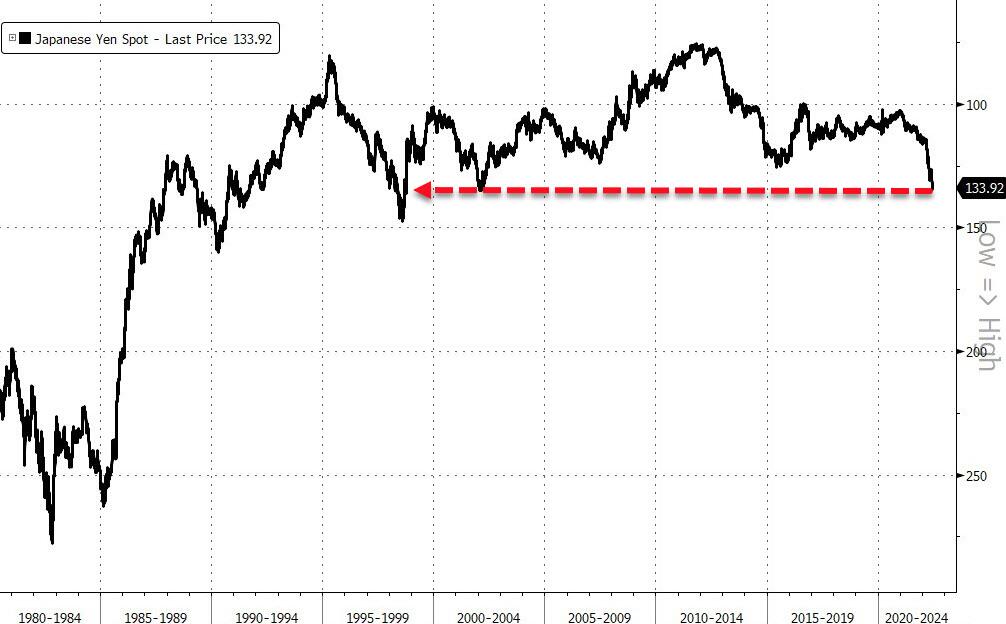
Less than a week ago, we wrote that "As Yen Crash Accelerates, It Puts Catastrophic End Of MMT Experiment In The Spotlight" a less than cheerful assessment echoed this morning by Bloomberg, which writes that "Japan Starting to Crack as Yen Tumbles With Stocks and Bonds" noting that despite the yen crashing to a 24-year low (for the same reasons we have repeated again and again, namely you can't keep your 10Y yield at 0.25% and avoid a currency collapse in a scorching inflationary environment), Tokyo stocks were down the most since March.
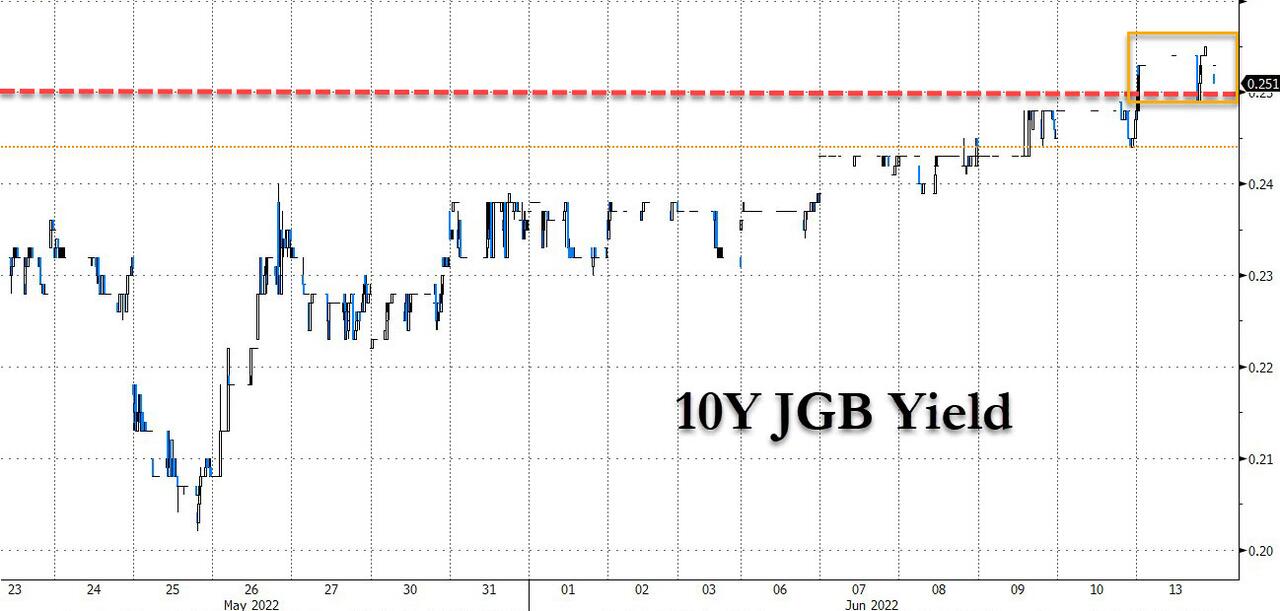
But there was another major development, and one which suggests that days of fiat, and MMT are numbered: with Japanese yields surging, the Bank of Japan today bought more than 1.5 trillion yen of government bonds to defend its yield curve control target as the 10Y JGB rose above 0.25%, the upper end of the BOJ's YCC corridor.
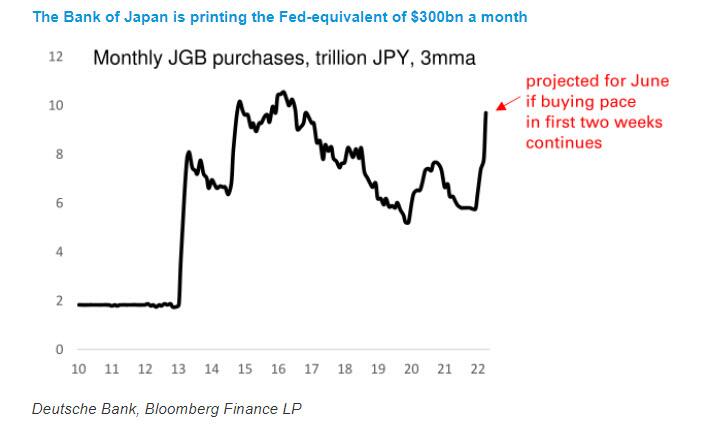
As Deutsche Bank's George Saravelos shockingly calculates in a post this morning titled "The printer is on overdrive", and available to professional ZH subscribers, if the current pace of buying persists, the bank will have bought approximately 10 trillion yen in June. To put that number in context, it is roughly equivalent to the Fed doing more than $300bn of QE per month when adjusting for GDP!
This is a "truly extreme" level of money printing given that every other central bank in the world is tightening policy. It is one of the reasons why we have been bearish on the yen. And as so many have argued, currency intervention in this environment is simply not credible given it is the BoJ itself that is the cause of yen weakness.
More broadly, Saravelos echoes what we said in our preview of the end of MMT, writing that he worries that "the currency and Japanese financial markets are in the process of losing any sort of fundamental-based valuation anchor."
The more global inflation picks up, the more the BoJ prints. But the more easing accelerates, the higher the need to press hard on the brake when the (inflation) cliff approaches and the more dangerous it becomes. As a result, we will soon enter a phase where dramatic and unpredictable non-linearities in Japanese financial markets would kick in, according to the DB strategist, who also notes that "if it becomes obvious to the market that the clearing level of JGB yields is above the BoJ's 25 basis point target, what is the incentive to hold bonds any more?"
This leave us with a few exploding questions:
  • Is the BoJ willing to absorb the entirety of the Japanese government bond stock?
  • Where is the fair value of the yen on this scenario and what happens if the BoJ changes its mind?
  • The BoJ may want to generate inflation, but how does it get there with triggering a complete systemic collapse?
Finally, what happens if and when the yen careens off the fiat cliff, and domestic holders of yen-denominated savings flee into either dollars or cryptos? We will find out very soon.

(ZH) Test Of Russia-Iran-India Trade Route Highlights Shifting Geopolitics

Test Of Russia-Iran-India Trade Route Highlights Shifting Geopolitics

Forty-one tons of wood laminate sheeting is on its way from Russia to India. The cargo isn't newsworthy, but the fact that it's traveling through Iran absolutely is—potentially marking the opening of a significant new trade corridor that strengthens Iran's relationship with India...with big geopolitical implications.
On Saturday, Iran's Islamic Republic News Agency (IRNA) announced that a pilot run for the new trade route was underway, with the wood laminate's transit being managed by the state-run Islamic Republic of Iran Shipping Lines Group. The shipping arrangement enables the use of one bill of lading for the entire journey, which reduces transport costs, red tape and wait times, reports IRNA.
Testing the ease of logistics, customs and other processes, two 40-foot shipping containers will first make their way from Saint Petersburg to the Caspian Sea. After arriving by ship at the northern Iranian port of Anzali, they'll be trucked across Iran to the Persian Gulf port of Bandar Abbas, and then shipped to the Indian port of Nhava Sheva. The trip is expected to take 25 days, according to an Iranian official.
IRNA portrayed the pilot as a partial realization of the long-brewing International North-South Transport Corridor (INSTC). That 22-year old initiative aspires to link the Caspian Sea to the Indian Ocean and Persian Gulf via Iran—connecting major ports and dramatically reducing transit times compared to alternative routes through the Suez Canal, Mediterranean Sea, Atlantic Ocean and North Sea.
Initiated by India, Russia and Iran in 2000, the INSTC association now includes Azerbaijan, Armenia, Kazakhstan, Kyrgyz Republic, Tajikistan, Turkey, Ukraine, Belarus, Oman and Syria.
Iran's INSTC aspirations include building a rail line from the Caspian Sea to the southeastern Iranian port of Chabahar. A far more ambitious vision calls for the construction of a canal directly linking the Caspian Sea to the Persian Gulf. Spanning 750 miles from north to south, the Caspian Sea is the world's largest inland water body, covering an area larger than Japan.
The INSTC pilot comes on the heels of a friendly official visit to India by Iranian foreign minister Hossein Amir-Abdollahian, who was granted meetings with Prime Minister Narendra Modi and India's national security advisor.
The Indian government's official statement summarizing the visit said the countries "share close historical and civilizational ties. Our bilateral relations are marked by strong linkages across institutions, culture and people-to-people ties." India lauded Iran for facilitating India's medical assistance to Afghanistan, and the provision of Covid-19 vaccines to Afghan citizens living in Iran.
India also noted the value of Iran's Persian Gulf port of Chabahar, which "has provided much needed sea-access to landlocked Afghanistan and has also emerged as a commercial transit hub for the region, including for Central Asia."
At The Diplomat, Rajeev Agarwal argues that India-Iran ties are ripe for a reset:
India and Iran share close historical ties from the times of Persian Empire and Indian kingdoms. Iran is an important nation in India’s neighborhood and in fact, the two countries shared a border until India’s partition and independence in 1947. Iran is also important to India as it provides an alternate route of connectivity to Afghanistan and Central Asian republics, in the absence of permission for India to use the land route through Pakistan.
Caving to U.S. pressure, India stopped buying Iranian oil in mid-2019. Before that, India was Iran's second-biggest customer, behind China. With negotiations to resume the Iran nuclear deal at an impasse, Agarwal speculates that India's calculations could change:
No nuclear deal means no lifting of economic sanctions on Iran and no crude oil exports from Iran. India, which has stressed exercising its strategic autonomy while importing oil from Russia amid sanctions on Russia due to its war with Ukraine, could explore a similar decision point in Iran, opening up a huge potential for trade and cooperation.
India is the world's sixth-largest economy. If it were to opt out of the Iran sanctions regime, other countries might follow its lead.
Note that India has been building stronger economic links to Saudi Arabia and other Gulf states. In what could be a complementary development, Iran has been entertaining reconciliation with Saudi Arabia, via five rounds of talks hosted by Iraq.
In May, Saudi foreign minister Faisal bin Farhan Al Saud said, "We continue to encourage our neighbors in Iran to lean into what can be a very, very important sea change in our region...a new era of cooperation" could be beneficial to everyone.
All these developments point to the potential for a significant geopolitical shift, writes Argawal:
Iran enjoys very good relations with China and Russia. It has commenced opening up to other Gulf nations. If India comes on board with Iran, it will create a huge bloc of countries, money, population, and power, which could then make it very difficult to keep Iran locked away and duly sanctioned by the West.

WSJ : Lawmakers Make Bipartisan Push for New Government Powers to Block U.S. Inv

Lawmakers Make Bipartisan Push for New Government Powers to Block U.S. Investments in China
Draft measure in Congress intends to limit U.S. involvement in China’s technology sector, rebuild supply chains

Congress is pressing ahead with legislation that could rewrite the rules for American companies investing abroad, proposing the screening of investments in countries like China seen as adversaries to protect U.S. technologies and rebuild critical supply chains.

The measure, part of broader legislation to bolster U.S. competitiveness with China, would require American companies and investors to disclose certain new outbound investments and authorize the executive branch to form a new interagency panel to review and block investments on national security grounds, according to congressional aides and a revised draft of the bill reviewed Monday by The Wall Street Journal.

Democratic and Republican supporters in the Senate and the House of Representatives have in recent days agreed on revised text narrowing the investment screening to certain specified sectors and technologies deemed critical, the aides said. The broader legislative package has been stuck in debate for months over its scope, though House Majority Leader Steny Hoyer (D., Md.) said last Tuesday that he wants a vote before the July 4 recess.

While the U.S. has for decades regulated foreign investment in U.S. entities and limited American companies’ exports of sensitive technologies abroad for national security, the new bill expands the federal government’s purview over Americans’ investment activities overseas.

The U.S.-China Business Council—which represents American companies doing business in China and is among business groups opposing the measure—has criticized the concept as “unprecedented in 250 years of American history” and warned that such screenings risk generating uncertainty and harming U.S. competitiveness.

Supporters of the measure, which was first proposed by Sens. Bob Casey (D., Pa.) and John Cornyn (R., Texas) and has since picked up wider bipartisan backing, defended the screening as targeted and necessary for economic and national security.

“Creating an outbound investment review mechanism is a critical tool as Congress works to provide guardrails on taxpayer funds and safeguard our supply chains from countries of concern, including the People’s Republic of China,” Messrs. Casey and Cornyn and five House members said in a statement Monday.

The revised screening measure would enable the federal government to restrict certain future transactions in any “country of concern,” defined as “foreign adversary” countries including China, according to the new text. The provisions would apply to greenfield investments, such as the construction of new plants, to deals such as joint ventures that involve the transfer of knowledge or intellectual property and to capital contributions including venture capital and private equity transactions, the text says.

The bill would require U.S. entities and their affiliates to notify the federal government of activities in China if they concern sectors previously specified by the Biden administration as crucial to supply chains. Also covered would be investments that involve “critical and emerging” technologies identified by the National Science and Technology Council and the Director of National Intelligence as vital to maintaining the U.S. position as the world’s leading superpower, the text says.

Those sectors and technologies include semiconductors, large-capacity batteries, pharmaceuticals, rare-earth elements, biotechnology, artificial intelligence, quantum computing, hypersonics, financial technologies and autonomous systems such as robots and undersea drones.

Companies can get exemptions for various deals including those deemed an “ordinary business transaction,” such as a software licensing agreement, according to the text.

Nearly a quarter of the members of Congress have taken part in negotiating the broader package, which is packed with hundreds of billions in spending for semiconductor manufacturing, research in frontier technologies, clean energy and other initiatives.

Lawmakers have touted it as a way to end U.S. supply-chain woes and improve American competitiveness with China. Democrats facing tough re-election races particularly want to see it passed soon and are worried that prospects will slip as the midterm elections approach.

In a closed-door meeting on Thursday focused on the proposed support for U.S. semiconductor manufacturing, Sen. Mark Kelly (D., Ariz) implored about 20 lawmakers to agree on provisions to pass the bill quickly, according to a person familiar.

The White House didn’t respond to requests asking about its position on the bill. When briefed on the revised text by congressional sponsors two weeks ago, White House economic and national security officials reiterated concerns about U.S. venture capital money flowing into key technology sectors in China, according to a person familiar with the matter.

Should the investment-screening measure be cut from the package, or the package itself fails to pass, supporters could also try to pass it via an annual must-pass defense policy bill and could also make another push next year, people involved in the discussions said.

The push to regulate U.S. business activity abroad reflects the solidifying consensus in Washington that China aims to supplant U.S. global leadership and that American capital and expertise are aiding the buildup of Chinese military and economic power.

After business groups criticized the initial investment screening proposal as overly broad, a discussion paper from Sen. Cornyn’s office proposed narrowing the legislation’s scope in order to “meet U.S. business half-way.” But, the paper said, supporters of the bill have no tolerance for “efforts by members, backed by industry that wish to continue to build the scale and technological capabilities of foreign adversaries.”

Mr. Cornyn championed a 2018 law to strengthen export controls and the Committee on Foreign Investment in the U.S., the interagency panel known as CFIUS that can scuttle foreign deals for U.S. assets on national security grounds. He and some other lawmakers are still smarting from successful corporate lobbying efforts to dilute that law, according to the people involved in the discussions.

The updated legislative text calls for the creation of a Committee on National Critical Capabilities to screen outbound investment, though doesn’t specify which agency would lead it. Lawmakers initially proposed the U.S. Trade Representative, but now say they will leave the decision to the president after critics said the USTR doesn’t have the resources, the aides said.

Other possibilities include the Treasury Department, which leads CFIUS. Commerce Department Secretary Gina Raimondo has said she supports regulating outbound investment.

Some supporters of the legislation, however, have criticized the Treasury Department over a proposal, presented as part of discussions over the outbound investment bill, for lacking any mechanism to block deals, according to the people involved in the discussions. Some China hawks, meanwhile, fault the Commerce Department for failing to vigorously enforce the export controls on technology in the 2018 law.

The Treasury and Commerce departments declined to comment.

The revised bill attempts to close what supporters see as loopholes in current regulations. One target, according to the congressional aides, is joint ventures where U.S. companies transfer knowledge or technology to Chinese partners. Legislators have pointed to a 2016 Advanced Micro Devices Inc. deal to help Chinese partners develop advanced computer-chip technology as an example of the type of problematic transaction they want to stop, aides said. AMD said at the time that it complies with U.S. laws and reiterated last week that the technology transferred wasn’t as high-performing as other U.S. products commercially available in China.

Legislators have also focused ire on Silicon Valley venture-capital firms that invest in China, through their U.S. funds or China affiliates, and the limited partners that back those funds and others in China. A handful of U.S. venture firms continue to invest directly in China, with help from U.S. pension funds, university endowments and foundations—whose allocations to Chinese startups remain robust despite political headwinds.

As of November, Sequoia Capital’s China unit had made at least 40 investments in Chinese semiconductor-sector companies since 2020, the Journal previously reported. Sequoia Capital has previously said that its investing units, which focus on different geographic areas, each has a separate team that makes its investment decisions independently under the Sequoia brand. Sequoia declined to comment further.

The revised bill specifies that the investment restrictions would apply to U.S. entities and any “affiliate,” according to the new text. Under the bill, they would be required to notify the government 45 days prior to the planned foreign investment activity, it says. The government could then stop a deal within that time frame or if an entity fails to notify it, it says.
WSJ : One American CEO Argues for Mending Fences With China

One American CEO Argues for Mending Fences With China
‘Engagement is in our interest,’ says Chubb’s Evan Greenberg, pushing for an ‘interest-based approach to our economic relationship’


At a precarious moment in relations between Washington and Beijing, a prominent business leader is speaking up in favor of engagement with—as opposed to decoupling from—China.

“We must recommit to an interest-based approach to our economic relationship with China,” Evan Greenberg, chief executive of insurer Chubb Ltd., CB -2.01%▼ is set to say in a speech to be delivered Tuesday. “I believe deeply that America is strengthened by having its companies compete and thrive in the global marketplace, and in China.”

The U.S. business community for years had been the biggest lobbyist for Beijing in Washington. That lobby has splintered in recent years, as China’s gradual turn toward greater state control over the economy has prompted many American companies to slow their expansion in the country.

Many U.S. companies, especially smaller manufacturers unhappy about a lack of market access in China, have cheered a tough U.S. approach toward Beijing. Financial-services firms have remained relatively more engaged at a time when Beijing has broadened access for foreign banks, brokerages and insurers, one of the few areas of liberalization in China’s economy in recent years.

Mr. Greenberg is a former chairman of the U.S.-China Business Council, a lobbying group for more than 200 U.S. companies doing business in China.

Chinese leaders have long viewed his father, Hank Greenberg, the former CEO of insurance giant AIG, as an “old friend of China.” In 2018, when Beijing celebrated the 40th anniversary of the “reform and opening” policy, which brought China closer to the rest of the world, the older Mr. Greenberg was one of the 10 foreigners who received a “reform friendship medal” from President Xi Jinping.

In his planned speech, the younger Mr. Greenberg, whom senior Chinese officials refer to as “Greenberg Junior,” acknowledges that his pro-engagement argument “may invite criticism” because of Chubb’s business interests in China.

“But I’m willing to make the case because I believe engagement is in our interest,” Mr. Greenberg said in an interview Monday. “In aggregate, we have benefited and continue to benefit from two-way trade and investments with China.”

Chubb is increasing its stake in Huatai Insurance Group, a Chinese insurer and asset manager with 11 million customers, to over 50%. When completed, Huatai will account for less than 5% of Chubb’s revenue, according to Mr. Greenberg.

The Biden administration has taken a tough stance on China in the foreign-policy realm, but many U.S. executives and trade associations say its messaging on trade and economic policy toward Beijing has been less clear.

So far, Washington has largely kept in place steep tariffs imposed by the Trump administration on $350 billion of Chinese imports. The Wall Street Journal reported Monday that draft legislation in the U.S. could further redirect supply chains for some strategic products away from China and limit investment in the country.

While the Biden administration is considering ways to reconfigure some tariffs on some Chinese imports to ease inflation, it is also weighing whether to launch a probe into China’s industrial subsidies, potentially adding new punitive measures.

Tentative signs are emerging that some in the U.S. and Chinese governments want to prevent relations from deteriorating further. When Defense Secretary Lloyd Austin and his Chinese counterpart, Wei Fenghe, met in Singapore over the past week, they emphasized the need to maintain open channels while also delivering pointed criticisms of each other.

U.S. national security adviser Jake Sullivan met for 4½ hours Monday with his Chinese counterpart, Yang Jiechi, in Luxembourg, a senior Biden administration official said. The two discussed the war in Ukraine, Taiwan, security in the Indo-Pacific region and other sore spots in the two countries’ relations in what the official said is an effort to maintain communication with Beijing.

Trade with China has been a politically perilous topic in the U.S. since Donald Trump, first as a candidate and then as president, accused American elites of selling out workers. The Biden administration’s backing for U.S. labor unions and its promise to develop a trade policy for the middle class make any opening to Beijing risky politically.

Meanwhile, Beijing has also done its part to promote at least some forms of economic decoupling. Worried about a potential transfer of sensitive data to the U.S., Beijing has essentially forced Chinese ride-sharing firm Didi Global Inc. to delist from the New York Stock Exchange.

Given what many in Washington see as the threats China poses to the U.S. and the U.S.-led international order, some influential voices in the U.S. security establishment have gone as far as criticizing American companies for “underwriting America’s demise” by doing business in China, according to executives and trade associations.

Mr. Greenberg rejects such criticism.

“We can broadly trade with China while protecting and defending our interests,” Mr. Greenberg said in the interview. Of the roughly $600 billion trade between the U.S. and China, he noted, “most is not in the area that’s sensitive to national security.”

The U.S. should work with other countries, Mr. Greenberg added, to hold China accountable for “what we consider to be unacceptable practices” such as market access that gives Chinese companies an edge over their foreign competitors.

In his planned speech, Mr. Greenberg says, “I tell Chinese officials that I believe they are limiting their country’s growth by overplaying the role of the state in their economy.”

China’s tightened restrictions on data, digital services and businesses overall, as well as its stringent approach to controlling Covid-19 outbreaks, have led to some American businesses pulling out of the country, including Microsoft Corp.’s LinkedIn social-media service, Amazon.com Inc.’s Kindle digital bookstore and Airbnb Inc.

Direct U.S. investment in China plateaued in the past decade, hovering between $13 billion and $16 billion in the years from 2010 to 2019, according to analyst Mark Witzke at Rhodium Group. It dropped to $8.7 billion in 2020 and $8.4 billion last year. A slowing Chinese economy and rising geopolitical tensions “significantly cloud the prospects of continued U.S. investments in the country,” Mr. Witzke said.

Mr. Greenberg is scheduled to make his speech at an event jointly held by the Center for Strategic and International Studies and the Peterson Institute for International Economics, two prominent Washington think tanks.

Some other executives also believe there should be a greater debate on how to engage with China.

Jon Huntsman Jr., former U.S. ambassador to China and now vice chair of policy at Ford Motor Co., said at a China-focused conference in Salt Lake City last week that policy makers have to get beyond taking an aggressive stance toward China to instead engage and come up with solutions to the challenges it poses.

“There has to be coexistence,” Mr. Huntsman said at the event, held by the World Trade Center Utah, a trade group advocating for local businesses in global markets.

U.S. and Chinese trade and financial officials used to meet several times a year to hash out market access and other issues. While some U.S. officials and others came to see these meetings as pointless talk shops, they also provided a regular channel to air problems and resolve some issues.

U.S. business groups and lobbyists say that the lack of regular contacts now adds to an atmosphere of uncertainty about the direction of relations.

“Give us clarity. Give us certainty on the rules,” said one lobbyist. “The environment is not conducive to that in either capital.”

>>> US Close Dow -2,79% S&P -3,88% Nasdaq -4,68% Russell -4,76%

Closing Stock Market Summary

Last week ended on a bad note, and the new week started on an even worse note. There were myriad concerns in today's trading mix that drove the Dow, Nasdaq, and S&P 500 to new 52-week lows and the S&P 500 back into bear market territory.

The troubling writing was on the wall for both the Treasury market and the stock market. The former got clobbered on rate-hike concerns while the latter got clobbered on a combination of rate-hike concerns and growth concerns.

By and large, both markets got knocked out today with repeated jabs of selling interest.

The 2-yr note yield settled the day up 23 basis points at 3.27%, and then climbed as high as 3.43% following the close of the cash session when The Wall Street Journal reported that the Fed is apt to consider a 75-basis point rate hike at this week's FOMC meeting given the bad inflation report seen last Friday. Similarly, the 10-yr note yield settled the day up 21 basis points at 3.37%, and also went to 3.43% following the close of the cash session.

There had already been concerns about the Fed taking a more aggressive rate-hike path, yet the timing of the article, and the source, lent some credence to the idea that the Fed could possibly "surprise" the market this week. That's not a given, but it is intended to explain why there was some knee-jerk selling interest late in the day following the report.

Stocks had already been struggling with the jump in yields, but they cascaded to new session lows, or close to session lows, in the final hour in a move that coincided with the extra spike in Treasury yields following the report.

It was a fitting end to a day where most stocks were treated like punching bags. The body blows came early, and were firing on the following influences:

  • Worries about the Fed taking a more aggressive rate-hike path to fight inflation.
  • Reports of renewed lockdowns/shutdowns in Shanghai and Beijing due to the detection of new COVID cases.
  • A lack of confidence in valuations given that forward earnings estimates have yet to be cut in any meaningful way despite expectations for much slower growth and/or a recession in coming months.
  • Massive losses for cryptocurrencies coinciding with news that crypto lender Celsius has paused customer withdrawals and transfers due to "extreme market conditions."
    • As of this writing, Bitcoin was down 15.5% to $23,212.40 while Ethereum was down 17.2% to $1228.22.
  • General growth concerns tied to rising interest rates and a flattening yield curve.
  • Nervousness about forced selling due to margin calls.

The advance-decline line told the tale of a market lacking any strong buying interest. Declining issues outpaced advancing issues by by a 16-to-1 margin at the NYSE (that spread was 23-to-1 shortly after the open) and by a 7-to-1 margin at the Nasdaq (that spread was 11-to-1 shortly after the open).

All 11 S&P 500 sectors closed with losses that ranged from 2.2% (consumer staples) to 5.1% (energy). Nine of the 11 sectors fell at least 3.0%. The Vanguard Mega-Cap Growth ETF (MGK) dropped 4.5% while the Invesco S&P 500 Equal Weight ETF (RSP) fell 4.0%. The Russell 3000 Growth Index declined 4.5% and the Russell 3000 Value Index declined 3.8%.

In sum, it was a day where nothing worked outside of some individual stocks with company-specific news catalysts, like Duke Realty (DRE 50.32, +0.54, +1.1%), which is going to be acquired by Prologis (PLD 108.35, -8.89, -7.6%) in a $26 billion all-stock deal.

Reflecting the nervous state of the market, the CBOE Volatility Index surged 23.9% to 34.39.

There was no economic data of note today. Looking ahead, market participants will receive the May NFIB Small Business Optimism Index (6:00 a.m. ET) and May Producer Price Index report (8:30 a.m. ET) on Tuesday.

  • Dow Jones Industrial Average: -16.4% YTD
  • S&P 400: -19.3% YTD
  • S&P 500: -21.3%
  • Russell 2000: -23.6% YTD
  • Nasdaq Composite: -30.9%

WSJ : Heat Wave Could Bring Record Highs to Dallas, St. Louis, Chicago and More

Heat Wave Could Bring Record Highs to Dallas, St. Louis, Chicago and More
More than 100 million Americans woke up to heat advisories

Record-breaking temperatures from the high 90s to the triple digits are expected Monday from the Gulf Coast to the Great Lakes as a heat wave blankets much of the country.

More than 100 million Americans woke up to heat advisories as the scorching temperatures that baked the Southwest over the weekend shifted eastward into the central U.S. Record highs are likely in cities including Chicago and Dallas.

The heat wave is expected to stick around for the rest of the week, according to Bob Oravec, lead forecaster for the National Weather Service. The core of the weather pattern will shift back to the Southwest and Midwest by Friday, he said. New England and most of the coastal Northeast are unlikely to see much of an impact.

Dallas is forecast to hit 101 degrees Fahrenheit on Monday. That would tie the record high set on June 13, 2011, Mr. Oravec said. The Electric Reliability Council of Texas, which manages the state’s power grid, said it had a record surge in demand on Sunday, breaking a prior peak set in 2019. The agency said it expects similar surges throughout the week.

St. Louis, meanwhile, is on track to top 101 degrees, which would break the record set in 1952 by three degrees.

“There’s heat advisories stretching pretty much from the Gulf Coast all the way up to the parts of the Great Lakes,” said Mr. Oravec.

Roughly 46 cities set record highs over the weekend in Southern California, the Southwest and into Colorado, Mr. Oravec said. Some were in triple digits while others, depending on their elevation, stayed in the 90s.

Rising energy prices will mean much higher air-conditioning bills for consumers as the heat wave moves into the densely populated Ohio Valley and along the Mississippi River. Electricity prices rose 12% in the past year, according to May’s consumer-price index, and have shown no signs of slowing.

The hot, dry conditions in the southwest and parts of California have exacerbated tinderbox conditions for forest fires. Much of the region has been experiencing an extended and severe drought.

Firefighters in New Mexico have since April been battling two blazes that merged into the largest wildfire in state history.

FT : Why are crypto lenders central to the digital asset market?

Why are crypto lenders central to the digital asset market?
Lenders serve as bridge between retail investors and vast universe of DeFi projects.

The decision by Celsius to temporarily prevent its clients from withdrawing funds has shone a light on a group of crypto lending platforms that have been an important engine powering the growth of cutting edge industry projects.

These lenders have served as a bridge between do-it-yourself retail investors and the vast universe of decentralised finance or DeFi projects seeking financing to help them grow.

The core business model of lending platforms, which include BlockFi and Nexo, is similar to a consumer bank. The platforms take deposits from customers, and then lend that money out for an agreed period to mainly institutional borrowers, such as market makers. The lending platforms then take a cut of the interest on those loans, and pay the rest of the interest back to the depositors.

Consumers have flocked to these platforms because they offer typically interest rates of about 10-15 per cent on their investments, much more than conventional banks and even many traditional investments. Celsius last year said more than 1mn customers had used the scheme.

To meet their promises to pay those outsized returns, crypto lenders have branched out into sometimes riskier activities beyond simple lending. Some firms have themselves traded in crypto markets, such as futures.

But a portion of the money has gone to support new developments in the crypto industry. In particular assets have poured into DeFi projects, which mostly aim to offer replicate parts of the existing financial system, like a stock market, but shorn of the centralised authority that usually underpins the system.

Many need to be backed by pools of assets in order to run their blockchains, and will pay investors who are willing to put their money on the line for a length of time. In return, the consumer receives an attractive yield, which can vary depending on which crypto asset the customer has staked and is happy to receive as payment.

The total assets locked up in DeFi projects rose from $601mn at the start of 2020 to a peak of $253bn at the end of last year, before falling in recent months, according to data from CryptoCompare.

However, crypto lending platforms are generally not subject to the same regulations as banks, meaning clients’ funds aren’t backed by a government guarantee. And some lending platforms activities involve taking on more risk.

DeFi projects are often prone to hacks, design faults or disputes about how they should be run. Critics of lending platforms say that some companies take on excessive risk in their DeFi portfolios, and aren’t transparent enough on what they are doing with client’s money to generate their appealing interest rates.

FT : The new Gulf oil boom poses dilemmas for the west

The new Gulf oil boom poses dilemmas for the west
War in Ukraine has forced US to seek help with supplies from Saudi Arabia

In his State of the Union address days after Vladimir Putin’s forces invaded Ukraine, President Joe Biden listed measures the US was taking to punish Russia in a “battle between democracy and autocracy”. Yet as the west has sought to isolate one autocrat, it has been forced to seek help from others: Saudi Arabia and its fellow absolute monarchies in the oil-rich Gulf.

Since Biden’s February speech, oil and gas prices have hit their highest in more than a decade as the west tries to strangle Russian energy exports. This month, the EU approved a plan to ban Russian seaborne oil imports. The bloc also agreed to co-ordinate with the UK on plans to ban insuring ships carrying Russian crude, which would further stymie Moscow’s ability to export.

Before the war, Russia produced more than 10 per cent of global oil supplies and was a vital source of energy for Europe. The International Energy Agency has forecast its output could now decline by up to 3mn barrels a day. There will be shippers willing to transport Russian crude to China or India. But the level of Moscow’s exports is only heading in one direction, threatening a significant undersupply in the market.

To damp sky-high petrol prices ahead of US midterm elections, Biden is having to turn to a state he pledged to treat as a pariah. Washington has urged Saudi Arabia, Opec’s de facto leader, to raise production. This month, the kingdom and its allies in Opec+, which includes Russia, finally announced a modest acceleration of output.

The White House credited Saudi Arabia for “achieving this consensus among the group members”. Biden is considering visiting the kingdom. That would mean sitting with Crown Prince Mohammed bin Salman — whom US intelligence concluded had authorised the operation to “capture or kill” journalist Jamal Khashoggi, who was murdered four years ago.

The energy crisis is increasing the leverage of MBS and other Gulf leaders. Only Saudi Arabia and the United Arab Emirates, another autocratic state, have the spare capacity to significantly boost oil production. Neighbouring Qatar, the world’s biggest exporter of liquefied natural gas, is meanwhile being courted by European governments and energy companies. While the world frets about energy supplies and inflation, the Gulf is enjoying a boom as the west’s reliance on its hydrocarbons only deepens.

Yet the US has long worried about over-dependence on such a volatile region. Its relations with Gulf states can be fractious. Tensions with Iran amid fears over its nuclear ambitions mean the threat of a conflagration is never far away. US imports from the Gulf have fallen sharply since the shale boom, but its pump prices are still affected by global market dynamics. Even as leaders gathered in Glasgow for November’s COP26 meeting to commit to phasing out fossil fuel use, Biden was berating Russia and Saudi Arabia for not pumping more oil as petrol prices rose.

The reality is that western policymakers were wilfully slow in transitioning to alternative energy sources. Now they are left with few simple solutions to diversify. It typically takes at least three years and billions of dollars to bring a new oil or gas project online, and energy companies will invest only if assured of a long-term market. So the world either locks itself into more fossil fuel projects that undermine net zero targets, or ends up with stranded assets as nations transition to green energy.

Western democracies’ reliance on oil-rich autocrats was always something of a Faustian pact as they turned a blind eye to rights abuses. In the rush to secure alternative supplies to Russian oil and gas they should avoid replicating the mistakes of the past — and not give the likes of MBS a free ride.

FT : UK still fighting to secure UK listing of Arm Holdings, says tech minister

UK still fighting to secure UK listing of Arm Holdings, says tech minister
Chris Philp insists government is ‘working closely’ with Cambridge-based tech group on IPO process

The UK is still fighting to secure the listing of Cambridge-based tech group Arm Holdings, Britain’s tech minister insisted after the launch of a digital strategy to attract and build fast-growth businesses in the UK.

Chris Philp said that the government was still “working closely with” the management of Arm on the IPO process, despite executives having signalled their preference to float the semiconductor group in New York.

Philp pointed to efforts to change the rules on the London stock market to make it more attractive to tech companies. “I think Arm themselves have said that initial comments suggesting that it would be a Nasdaq listing was sort of premature,” he told the Financial Times.

The suggestion by Arm’s owner SoftBank that it was likely to float the British business in America at a valuation of about $40bn has sparked a charm offensive by UK ministers and London Stock Exchange executives.

Philp also pointed to the number of companies that have launched a dual listing in both the UK and US. “Lots of big successful companies use this model. But we’re also obviously wanting to promote the UK as an exclusive venue for listing.”

The government has boasted of the fact that 37 tech companies floated on the London Stock Exchange last year, including companies such as Wise and Oxford Nanopore.

But tech executives say that the decision by Arm over the future of its listing will be taken as a vote of confidence or otherwise in the UK as a place to base a globally significant tech company.

Philp called on tech companies in the UK to be “globally ambitious” as he outlined plans to cut red tape that governs parts of the tech sector to stimulate growth.

“Brexit has not impacted tech one iota. In fact, it creates opportunities because we can adopt a more flexible regulatory regime. So we’re reducing the burdens imposed by GDPR [for example]. And making sure that data can be better used for innovation.”

He also promised a “very light-touch approach” to forthcoming regulations in areas such as digital competition due later this year, as well as in rules governing emerging technologies such as artificial intelligence.

“Lighter regulation is going to be a source of competitive advantage. We have an opportunity to turn the UK into a free trade hub for digital.”

Philp signalled several initiatives to incentivise investment in the autumn Budget, including changes to research and development tax credits, tax incentives to encourage skills training and changes to the existing apprenticeship levy.

The digital strategy, launched at the start of London Tech Week, is a government initiative to co-ordinate tech policies, including a review into advanced computing announced by Rishi Sunak, the chancellor, and a new council of tech executives to advise on how to tackle the digital skills gap.

The upbeat mood came despite a wider slowdown in tech financing in parts of the world, including the UK, with some start-ups now facing a fall in valuations after several years of rapid growth.

The British government wants UK pension funds to invest more in fast-growing start-ups — which can carry greater risks of failure but also higher, longer-term returns — to help finance the sector’s next phase of growth.

“The UK pension system is missing out on higher returns. Their pensioners are missing out on those returns,” said Philp. “Make allocations to UK tech — your pension will be better off.”

He also said that “tech drives innovation, increases productivity, creates new things, whereas buying bonds or buying a bunch of listed equities in very long-established companies [is] not so much really creating anything new”.