All Hiking Cycles That Invert The Curve Lead To Recessions Within 1 To 3 Years
Echoing our earlier thoughts that the Fed officially started the countdown to the next recession (and rate cuts) when it inverted the 5s10s moments after Powell starting speaking, DB's Jim Reid writes that while not every Fed hiking cycle leads to a recession, all hiking cycles that invert the curve have led to recessions within 1 to 3 years. And the problem with the Fed hiking cycle that starts today, he adds with a ZH-esque does of skepticism, is that "there is a decent likelihood that the curve inverts relatively early on. 2s10s peaked at +157.6bps last March and traded as low as +21.9bps last week before settling at around +30bps as we go to print."
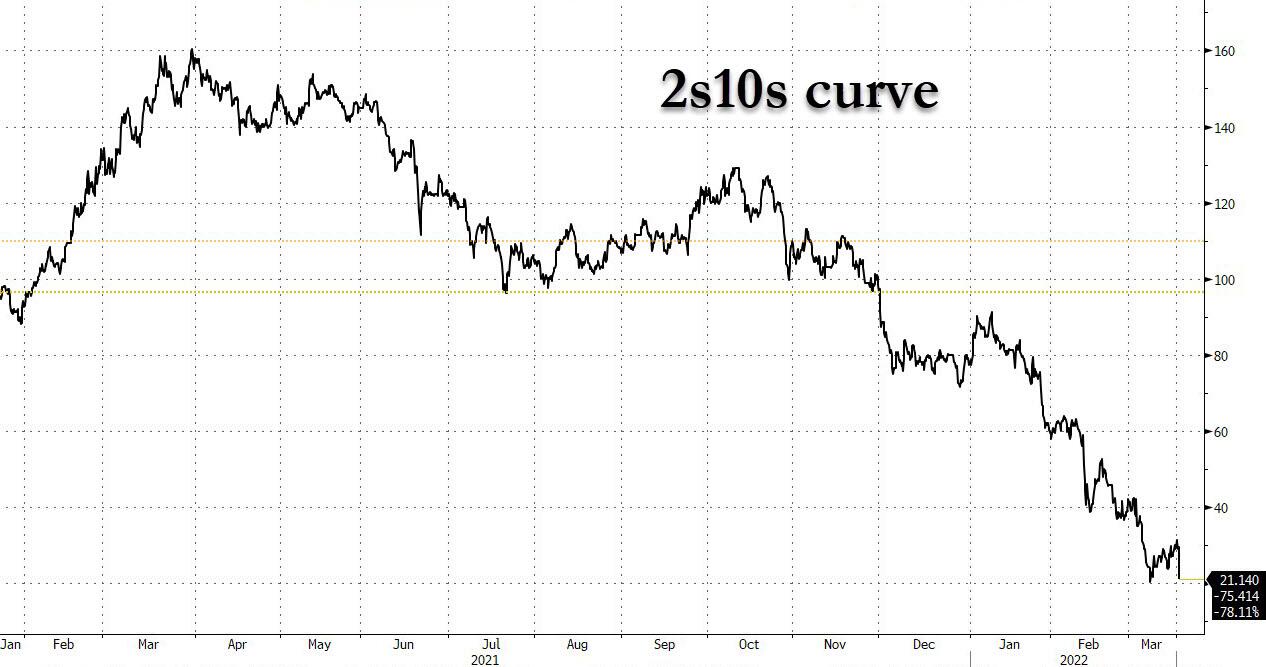
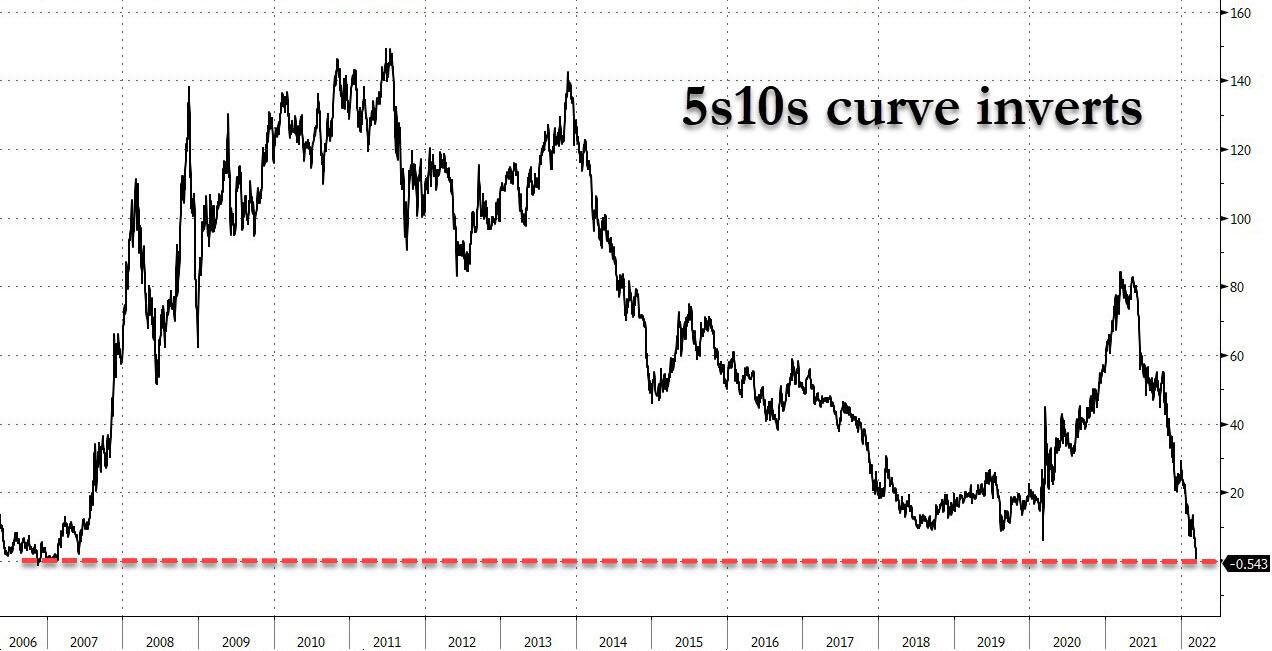
As a reminder, while not as popular as the 2s10s, the 5s10s is also a harbinger of recessions, and usually precedes the 2s10s inversion by weeks. It is this curve that inverted today.
Piling on, CPI is much higher today than it was in any of those instances, and indeed the second highest at the start of any post-war hiking cycle. Thus, according to Reid "there is not only a strong risk that the curve inverts relatively early, but that the Fed will need to continue hiking anyway." A few days ago, we phrased it differently: the Fed wants to push the US economy into a modest recession. The only problem is that the Fed has never been able to achieve such a delicate achievement, and the most likely outcome is a violent slowdown coupled with a quick easing of monetary policy, i.e., a policy error... precisely why risk assets soared later in the day.
That said, the table from DB below shows the details of every Fed hiking cycle over the last 70 years alongside the time to recession, yield curve shape, and inflation at the first hike. Reid has ordered this by length of time from first hike to recession to demonstrate that the quickest recessions following hikes were associated with an inverted curve by the time the Fed stopped hiking.

As shown, on average it takes around three years from the first Fed hike to recession. However all but one of the recessions inside 37 months (essentially three years) occurred when the 2s10s curve inverted before the hiking cycle ended. With all the recessions that started later than that, none of them had an inverted curve when the hiking cycle ended. In fact, hiking cycles that ended with the curve in positive territory saw the next recession hit 53 months on average after the first rate hike, whereas the next recession for hiking cycles that ended with an inverted curve started on average in 23 months, just under two years. All these cycles eventually saw an inverted curve but this happened after the Fed stopped hiking.
As a reminder, none of the US recessions in the last 70 years have occurred until the 2s10s has inverted. On average it takes 12-18 months from inversion to recession. Then again, the Fed has never before started a rate hiking cycle when inflation was already 7.9%.
Reid concludes that, "this all fits in with my view in "Roadmap to the next Recession" that 2022 is unlikely to be a US recession year but that late 2023 or early 2024 are high risk." While we agree that a recession is inevitable, we would add that it will come well before "late 2023", not only because the 2s10s will invert in a few days at this rate, but because as the record collapse in the fwd OIS curve - which was trading at -49bps as of late Wednesday - signals, the market is now pricing in almost two full rate cut in the fwd 1-3 year window, a number which will only grow with every incremental rate hike by the Fed.

Research Calls
- Upgrades:
- CSX (CSX) upgraded to Outperform from Sector Perform at RBC Capital Mkts; tgt raised to $39
- Coca-Cola European Partners (CCEP) upgraded to Outperform from Neutral at Oddo BHF
- Diageo plc (DEO) upgraded to Overweight from Neutral at JP Morgan
- Ecolab (ECL) upgraded to Buy from Hold at Edward Jones
- Health Catalyst (HCAT) upgraded to Buy from Hold at Jefferies; tgt lowered to $28
- HeidelbergCement (HDELY) upgraded to Neutral from Underweight at JP Morgan
- Huntington Ingalls (HII) upgraded to Buy from Hold at Vertical Research; tgt $250
- Limelight Networks (LLNW) upgraded to Outperform from Market Perform at Cowen; tgt raised to $6
- Norwegian Cruise Line (NCLH) upgraded to Equal-Weight from Underweight at Morgan Stanley; tgt $19
- Oak Street Health (OSH) upgraded to Outperform from Market Perform at Cowen; tgt raised to $30
- Oaktree Capital (OAK) upgraded to Outperform from Market Perform at Cowen; tgt $30
- Ralph Lauren (RL) upgraded to Overweight from Neutral at JP Morgan; tgt $142
- uniQure (QURE) upgraded to Buy from Neutral at UBS; tgt $40
- United Natural Foods (UNFI) upgraded to Equal Weight from Underweight at Wells Fargo; tgt raised to $38
- Downgrades:
- 1-800-FLOWERS (FLWS) downgraded to Neutral from Buy at DA Davidson
- Alliance Data (ADS) downgraded to Peer Perform from Outperform at Wolfe Research
- BeiGene (BGNE) downgraded to Mkt Perform from Outperform at SVB Leerink; tgt lowered to $177
- Capital One (COF) downgraded to Peer Perform from Outperform at Wolfe Research
- LifeStance Health Group (LFST) downgraded to Neutral from Buy at UBS; tgt lowered to $10
- Lument Finance Trust (LFT) downgraded to Neutral from Buy at Ladenburg Thalmann
- Synchrony Financial (SYF) downgraded to Peer Perform from Outperform at Wolfe Research
- Union Pacific (UNP) downgraded to Sector Perform from Outperform at RBC Capital Mkts; tgt lowered to $258
- Others:
- Adams Resources & Energy (AE) initiated with a Buy at B. Riley Securities; tgt $45
- Arcutis Biotherapeutics (ARQT) initiated with a Buy at Goldman; tgt $45
- Ericsson (ERIC) initiated with a Hold at Jefferies
- Inspirato (ISPO) initiated with a Hold at Stifel; tgt $10
- Inspirato (ISPO) initiated with an Overweight at Piper Sandler; tgt $12
- Nokia (NOK) initiated with a Buy at Jefferies
- Repare Therapeutics (RPTX) assumed with a Buy at Goldman; tgt $43
- Revolve Group (RVLV) initiated with a Buy at Needham; tgt $60
- Udemy (UDMY) initiated with a Buy at Berenberg; tgt $30
Gapping down
In reaction to earnings/guidance:
- WRBY -12.4%, SCWX -6.5%, ZTO -5.3%, CSIQ -5.3%, DBI -3.7%, LAC -2%, CLB -1.8% (guides MarQ below consensus due to COVID-19 and Russia conflict), LEN -1.1% (also authorizes $2.0 bln for share repurchases), CMC -0.8%
Other news:
- ASPN -8.5% (files mixed securities shelf offering)
- BIOX -6.8% (Bioceres and Marrone Bio (MBII) announce merger agreement)
- ORC -5.8% (announced March 2022 monthly dividend of $0.045 per share of common stock, prior month $0.055 per share)
- SEDG -5.7% (plans to conduct a registered public offering of 2,000,000 shares of its common stock)
- SFT -3.6% (files for $300 mln mixed securities shelf offering)
Analyst comments:
- BGNE -2% (downgraded to Mkt Perform from Outperform at SVB Leerink)
- FLWS -1.7% (downgraded to Neutral from Buy at DA Davidson)
- SYF -1.6% (downgraded to Peer Perform from Outperform at Wolfe Research)
- COF -1.5% (downgraded to Peer Perform from Outperform at Wolfe Research)
- ADS -1.4% (downgraded to Peer Perform from Outperform at Wolfe Research)
Gapping up
In reaction to earnings/guidance:
- PD +13.6%, SIG +8.5%, EDR +7.4%, WSM +7.3% (also announces 10% dividend increase; $1.5 bln share buyback authorization), BAK +7%, ACN +5.1%, SMTC +4.1%, GIII +3.4%, DG +3.3%, BRLT +2.5%, GES +2.3% (also expands buyback auth by $100 mln; intends to enter into a $175 mln ASR; also CFO is stepping down), STLD +1.3%
Other news:
- NETI +7.5% (signs new contract for wind turbine operation and maintenance)
- HLX +3.8% (receives contract extension for decommissioning project in Brazil)
- FSM +3.3% (reports updated Mineral Reserves and Mineral Resources)
- DFH +1.8% (stock offering)
Analyst comments:
- QURE +4.5% (upgraded to Buy from Neutral at UBS)
- LLNW +4.1% (upgraded to Outperform from Market Perform at Cowen)
- DEO +2.1% (upgraded to Overweight from Neutral at JP Morgan)
- RL +1.9% (upgraded to Overweight from Neutral at JP Morgan)
Handbags at Dawn: Chanel Duels South Korean Resellers in Luxury Boom
Chanel has barred nearly a third of would-be shoppers to stop bulk buyers snagging $10,000 bags for resale with markups of 20 percent or more.
:quality(70):focal(1195x519:1205x529)/cloudfront-eu-central-1.images.arcpublishing.com/businessoffashion/7N6FANDQHRH57J3AUQYPJAFAG4.jpg)
Chanel has barred nearly a third of would-be shoppers to stop bulk buyers snagging $10,000 bags for resale with markups of 20 percent or more. (Shutterstock)
As Covid curbs cut travel and duty-free shopping, South Koreans are driving a luxury goods boom at home that has left Chanel barring nearly a third of would-be shoppers to stop bulk buyers snagging $10,000 bags for resale with markups of 20 percent or more.
The storied French fashion and luxury company told Reuters it has seen traffic to its boutiques in South Korea skid since it began screening for customers it believed might be stocking up purely to flip to others in the resale market.
“We were able to identify them (bulk buyers) after having analysed their buying patterns. Since this policy was implemented, the traffic in our boutiques has decreased by 30 percent,” Chanel told Reuters in a statement. It didn’t disclose exactly how it deemed those customers to be potential bulk buyers, and the privately owned business doesn’t disclose sales numbers by country.
Chanel’s strategy, implemented since July last year, came as global demand for luxury goods was picking up after the worst of the coronavirus pandemic. South Korea is the world’s seventh-biggest luxury goods market according to Euromonitor, and the research firm estimates it was one of only two of the top seven markets by revenue — the other being China — to see sales grow last year from 2019 levels.
Supply at brands like Chanel, though, is tightly controlled, preserving exclusivity and boosting appeal with no online shopping option beyond cosmetics, perfumes and some small accessories. Such is the appetite in downtown Seoul that long queues form before dawn outside department stores as shoppers brace for what’s known as an ‘open run’ — a sprint to Chanel’s doors at opening time.
“I arrived... at 5.30 a.m. for an open run and I was notified that there were more than 30 people in front of me,” a shopper told Reuters in front of a Chanel boutique in Seoul. Speaking on condition of anonymity because of privacy concerns, he said by the time he entered the store — nearly 10 hours later — the item he wanted was sold out.
Reflecting such red-hot demand in the resale market, a Chanel medium classic flap bag was sold at 13.5 million won ($11,031) — 20 percent more than its standard retail price — in January on KREAM, a platform offering everything from sneakers to tech and luxury goods that is an affiliate of tech giant Naver Corp.
KREAM, an acronym for ‘Kicks Rule Everything Around Me’, was launched in 2020. It told Reuters its monthly transactions exceeded 100 billion won in December, and said South Korea’s resale market is worth more than 1 trillion won — nearly $820 million — even at the most conservative estimates.
‘Queue Management’
While resale platforms like KREAM offer a range of brands, Chanel, like Swiss watchmaker Rolex, is a particularly sought-after brand because of its status among couples in South Korea as one of the most popular wedding gifts, and frequent price increases of its most iconic handbags.
Chanel increased prices of some handbags, accessories and seasonal ready-to-wear earlier this month in Asia and Europe, including by 5 percent in South Korea — where prices have just been raised for the fifth time in nine months, according to Chanel Korea.
In tandem with its screening for bulk buyers, Chanel said it has implemented a “queue management system”: Clients are asked to give their contact number and reason for visiting the store so that they can be informed via text messages when they will be able to enter the boutique.
Brand experts and consumers are divided on the impact of the new buying pattern on Chanel.
“Consumers are voluntarily doing free ads for Chanel — camping outside (boutiques), doing open runs, posting their experiences on social media,” said Lee Eun Hee, a professor of consumer science at Inha University.
“I think all those phenomena have helped Chanel draw younger customers and make a big chunk of money off it.”
‘Line Standers’
Still, some consumers say long queues and waiting lists have put them off.
“I just gave up buying a Chanel product long ago,” said a Seoul resident in her 30s, declining to be named due to privacy concerns.
“It’s too difficult to buy one, with some 300 people usually on a waiting list, and by the time it’s my turn, there is no product left. This really puts me off and I don’t want to be at the centre of this craziness.”
Not giving up any time soon are the bulk buyer-resellers.
Speaking on condition of anonymity because of the sensitivity of the matter, some resellers told Reuters they’re hiring “line standers” for a fee of up to $125 a day to stand in queues or enter stores on their behalf.
One reseller in his 30s told Reuters he’s been reselling his purchases at usually more than 20 percent profit — and it can be far more profitable when inventory level is low.
He said he sold a Chanel flap card holder recently on secondhand marketplace app Karrot for nearly 1 million won, 40 percent above its retail price — five minutes after it went up for sale.
Lucky Number 111 for Burberry’s Riccardo Tisci
The Italian transforming Britain’s biggest luxury brand is confident at last: ‘It’s a big company to move, but now I feel the boat is in the water.
KEY INSIGHTS
- Last week, British megabrand Burberry staged its first live fashion show in two years.
- New CEO Jonathan Akeroyd started on Monday, following the departure of Marco Gobbetti who left Burberry’s turnaround only partially complete.
- Designer Riccardo Tisci is feeling buoyant on the brand’s revival: “It’s a big company to move, but now I feel the boat is in the water.”
LONDON — Burberry’s first live fashion show in two years was also the 111th show that its chief creative officer Riccardo Tisci has staged in his 20-plus years in fashion. The angel number 111 is believed to symbolise new beginnings. In the past year, Tisci has lost his cherished mother and weathered several bouts of Covid-19. No wonder he mentioned feeling “uncaged” when we sat down to talk on Monday. It’s definitely time for a new cycle. “Though it feels like the first one every time,” he insisted.
It’s taken Tisci four years to feel truly confident at Burberry. “To get another big fashion house in another country is one thing,” said Tisci, who is Italian. “But going into a real heritage house to make fashion is something else. To get Burberry, you’re touching something that is very strong. And such a big company takes time. You have to be careful not to go to one side or the other. Good or bad, after those three years, I know what people want to see. Beginning with the trench, the car coat, the checks, now you can buy trainers, eveningwear, a cocktail dress, suits for women and men, bags… it becomes like a lifestyle.”
As an expression of his self-belief, Tisci’s latest presentation was peerless. The London Contemporary Orchestra, plus full choir, played the music of fashion’s favourite soundtrackist Max Richter in the soaring interior of the Methodist Central Hall in Westminster. Models paraded ceremonially down an imposing staircase and on to the floor where the audience stood around formally laid tables.
“Democracy — everyone standing,” Tisci explained. He thought the table was such an integral part of British culture — central to breakfast, teatime, supper — that when his models walked onto the tables, it felt vaguely transgressive, a reaction he’s always courted. It was also cinematic, like the final scene in “Darling,” the ultimate Swinging London movie, where bored, blonde model Julie Christie, all dressed up with nowhere to go, walks a runway-long dining table in a desperate effort to arouse her Italian aristocrat husband. A British beauty, an Italian man, a last gasp of decadence… Tisci had never heard of the movie, but the scenario was enough to strike a familiar chord.
:quality(70)/cloudfront-eu-central-1.images.arcpublishing.com/businessoffashion/ZIGYVCRLKNH4JGIDYCUMYPWDHQ.jpg)
Riccardo Tisci’s Burberry Autumn/Winter 2022 show took place at the Methodist Central Hall in London’s Westminster where models walked on formally laid tables.(Getty Images)
Tisci emphasised Burberry’s “Britishness” over and over. “It’s much more than a heritage and a fantastic narrative, it represents what England is as a style,” he insisted. Somewhere between the Royal and the Rebel, in his mind. He set about deconstructing and reconstructing everything: the trench, the car coat, the Harrington, all the uniforms, all the street tribes. The Burberry knight appeared without his horse, the horse without his rider. “So much to play with,” Tisci enthused, “and it’s easier for me because I’m not English to really play with what I see, what I feel.”
Is “Britishness” still so important? I wondered. It may be a tough time to trade on Britishness. My gut says Brand Britain has been tarnished by Brexit, Boris Johnson and Andrew Windsor. Tisci would say my gut is wrong. His latest collection referenced another side of Britishness entirely. “Maybe a British person would see it a different way, but I’m Italian so for me this collection was very British. It’s celebrating amazing modern and beautiful style. Strong men and women. Leigh Bowery. Kate Bush. Vivienne Westwood. She changed the world of fashion for everybody. I got obsessed with David Bowie recently. Bowie in the Thierry Mugler skirt on Saturday Night Live with Klaus Nomi.” That was apparently a starting point for the menswear Tisci showed. “I didn’t want to make a caricature of the classic Savile Row gentleman. I wanted to make it modern, new on the eyes.”
But it’s actually the past he most respects about Britishness. And yes, there were shades of history in the show. For the men, there were echoes of the workwear of farmhands, the red of cavalry jackets, the long coats and waders of lifeboatmen, and hoods that looked more like Quaker bonnets. And for the women? Tisci insisted British women surprise him. He loves what he sees as an innately rebellious streak: his dear friend, the late Stella Tennant in an evening dress with flip flops and a car coat, or her grandmother, the Duchess of Devonshire, feeding her chickens in an opera coat. “You didn’t see those women in Italy,” he muses. “They didn’t have the modernity to dress down.” He called the attitude “punk.”
But the waywardness of that notion didn’t translate into his own womenswear whose precision and discipline brooked no British eccentricity. It was, however, “powerful, classic, severe, but sexy,” just as Tisci described the women he imagined wearing it. And it made something else quite clear. It’s less “Britishness” and more “Tisci-ness” that shapes Burberry now. The classic Burberry tropes — beige trench, quilted jacket — were transmogrified here into couture gowns. And if Burberry womenswear often had something of the 1940s under former chief creative officer Christopher Bailey, Tisci has hardened the edges with his own precise version of that decade’s film noir glamour.
When Tisci said, “For me, the biggest achievement of the show was the fact to make a fashion show with real fashion design for a company like Burberry,” he was reflecting the business strategy put in place by former CEO Marco Gobbetti, who hired Tisci in 2018 to help re-energise the British trench coat maker and reposition it further upmarket. (The pair did wonders to rev up LVMH’s Givenchy in the mid-noughties).
That meant higher prices and tighter distribution, as well as a refreshed set of brand signifiers, including a new logo and monogram, and investment in ready-to-wear and leather goods. The birch brown check, which started small in accessories, has attracted a new fashion client and is now generating as much in sales as the classic check, said Tisci. “It’s a big company to move, but now I feel the boat is in the water.”
But Gobbetti left for Salvatore Ferragamo in January, leaving Burberry’s turnaround only partially complete. Its ambitions to become a British Louis Vuitton are still very much a work in progress, and the house is lagging luxury market leaders in its pandemic recovery.
His successor Jonathan Akeroyd started this week after six years at Versace and, before that, McQueen. Tisci has connections with both brands. A farrago of pre-Burberry industry gossip had him headed Donatella-wards at one point. Katy England, Lee McQueen’s right hand, has filled the same function for Tisci at Burberry, though the stylists for the latest show were Ib Kamara and Ana Steiner. And, of course, Tisci succeeded McQueen at Givenchy.
But there was a sturm und drang to Tisci’s Givenchy. Burberry feels so much cooler, more mature. “More luxury,” he interjects. If his early shows for Burberry were unwieldy, overwrought mash-ups of street and salon, compartmentalisation has liberated the luxury. “That’s why they called me,” he said. “I’ve been playing with luxury in the past. Burberry was a good company, but now we’re next to all the big names, Chanel, Vuitton, Gucci. That is very important.” A huge new flagship has just opened on Rue St Honoré's golden mile in Paris. That’s important too.
The day before his London extravaganza, Tisci launched his collaboration with Supreme, to the typically riotous response — literally in this case — that greets most of the streetwear juggernaut’s collabs. “People were waiting, because I used to be famous for collaborations,” said Tisci. “And everyone asked me why this time, to be very honest. Eight years ago, I was one of the first prêt-à-porter designers that did Nike, same time as Comme des Garçons. I did a lot of collaborations at the time so I didn’t want to do one more. The marketing people were, like why? I said, it’s got to come at the right moment. I was ready for Supreme. First, you fix your house before you invite people for dinner. And it was good to launch this week because the collection was so couture, and then you have the reality, the street, the rebellion.”
And it’s still to the street that he turns for a tune-up. Tisci describes his life in London as “very simple, a lot of sport, a lot of work, a lot of walks in the park. But every weekend, I’m trying to see what’s new, what’s next. A lot of underground things happen in London. I’ll go out a lot to raves. People ask why I’m going to clubs. First, I love music. Then to see kids. I’ve seen so many movies in my life, so many museums, I’m 47 and I know what art I like. But the emotion of the young generation is what attracts me and keeps me fresh. I go to Adonis, this beautiful night where kids are pulling looks that are insane.”
Tisci has always been immersed in subcultures. They’ve frequently shown up on his catwalks. In 2010, he caused a furore when he put Lea T, a black trans woman from Brazil, in a campaign for Givenchy. “To be honest, LVMH supported me a lot,” he said. More recently, the Brazilian artist-activist Jota Mombaça showed up in a Burberry lookbook. “Throughout my career, I’ve tried to bring people from the outside inside. When we were first talking about racism, homophobia, transphobia, there were just a few others talking. The fashion industry was very racist at the time. I was criticised. Now every house uses black women, trans women. It’s a big conversation. It’s changing slowly, but it’s changing.”
No one left outside: the man is making amends to the boy who was bullied as a child, always left out. “When I was successful, I was like, you’re coming and you’re coming. I’ve been trying to help others since my young days.” And he believes in karma. He tells a story about his show for Givenchy in New York on the 14th anniversary of 9/11, on a day when the rains came… and came. The show was at 6pm, and there were calls to cancel it. But just before 4pm, the rain stopped, the sun came out. “Riccardo Tisci put Jesus Christ’s face on so many T-shirts that he returned the favour and made the rain stop,” said friend Marina Abramović.
That was Gothic Tisci, saturated in penumbral Catholicism. Earlier in his career, the Goth label was a cross he had to bear. It was particular anguishing for Karl Lagerfeld, one of his early boosters in Paris. “I don’t understand why they’re writing this,” Tisci remembers him wailing one night, “I’m going to call Anna.” Then, despite Tisci’s assurances that he really wasn’t bothered, Lagerfeld leaned in with his unsolicited wisdom. “I have a suggestion. Stop using the word Gothic.” Tisci didn’t, and he bore the brunt of pre- and mis-conceptions until Gothicism bedded in as a trend. “My mum said, sit down and wait. Don’t be the one that passes by. Watch the others, let them pass by.”
Maybe the darkness has never really gone away, though he preferred to think of his new Burberry collection as more mysterious than dark. “My darker side was much more English,” Tisci reflected. “I always had a problem when I started because people didn’t believe I was Italian. I was 17 when I came to England, and Central Saint Martins completely took my virginity, opened up my creativity. Then I went to France and learned the craft of couture. My style has always been very different from the classic Italian designer, more aggressive. Not in a bad way, but Italians have this set culture. There’s amazing design in Italy but there’s never been a Mugler or a Gaultier or a Margiela or a McQueen or a Galliano. I probably could belong more to England — or France.”
His mother Elmirinda died six months ago. She was 93, and she was his inspiration. “We rang each other ten times a day. I was preparing myself for many years, I knew it was going to happen. She died as a queen, beautiful with makeup, no suffering. But after six months, I still reach for the phone to call her when I wake up.”
Elmirinda always hoped her only son (there are eight older sisters) would have a child. And now it’s what Tisci wants most as well. “My son or my daughter will have eight mothers,” he said drolly. That might be the greatest measure of the change in him in recent years. “I was scared to be an adult,” he admitted. “Always been a Peter Pan. My life never let me be a child. After my father died, I was working at eight years old. I was the man of the family, the father of everybody, the husband of my mum. So I never really had time to be a kid, and that’s where my dreams, my craziness came from later on. Today I feel I’m a quiet child, a mature man.”
And Riccardo Tisci is telling the world with his Burberry.
Early premarket gappers
- Gapping up:
- PD +13.3%, WSM +7.6%, NETI +7.5%, EDR +7.4%, BAK +7%, SMTC +5%, GES +3%, VCSA +2.6%, BRLT +2.5%, HLX +2%, DFH +1.8%, STLD +1.6%, FSM +1.2%, UBS +0.8%, JWN +0.5%
- Gapping down:
- ASPN -8.5%, ORC -7.6%, BIOX -5.9%, ZTO -5%, CLB -4.2%, SFT -2.1%, WFC -1.2%, AZN -0.9%, BAC -0.9%, C -0.7%, YUMC -0.7%, LEN -0.6%, USB -0.5%, HSBC -0.5%
China Launches Investigation Into Official Who Promoted Respect for Islam
Probe of Wang Zhengwei, a former top official in charge of ethnic policy, helps Communist Party clear a path to fully embrace new assimilation campaign
TAIPEI—China’s Communist Party has authorized a corruption inquiry into a senior official who was previously an influential advocate of Muslim culture, according to people familiar with the matter, in a signal of Chinese leader Xi Jinping’s resolve to push ahead with the country’s aggressive ethnic assimilation efforts.
Wang Zhengwei, a member of China’s Muslim Hui minority and currently a vice chairman of China’s top political advisory body, the Chinese People’s Political Consultative Congress, is under investigation by the party’s internal disciplinary watchdogs for abuse of power and corruption, the people said.
The investigation was prompted by concerns that Mr. Wang had promoted “unrestrained Muslim culture” and encouraged religious extremism when he served as Communist Party chief of his home region of Ningxia in China’s northwest and later as head of the National Ethnic Affairs Commission, the agency in charge of implementing ethnic policy, the people said.
No formal criminal charges have been announced against Mr. Wang. Party discipline investigations, which are often used to punish officials who step out of line with the Communist Party’s priorities, can be more wide-ranging than police investigations, and the results aren’t always made public.
The National Ethnic Affairs Commission, the State Council’s Information Office and the party’s Central Commission for Discipline Inspection didn’t respond to requests for comment. Mr. Wang couldn’t be reached.
It is rare for a leading ethnic-affairs official to face such a probe. Mr. Wang’s successor as head of the National Ethnic Affairs Commission, an ethnic Mongol, was replaced by a Han Chinese official in late 2020, though he doesn’t face a formal graft inquiry.
Mr. Wang, who studied the economic structures of Muslim countries as a graduate student, spent much of his career in Ningxia, which has a large population of Chinese Muslims. While posted there and at the National Ethnic Affairs Committee, he pushed for legislation promoting certification of halal foods and encouraged the building of mosques on a relatively grand scale—actions seen by senior Chinese officials as strengthening ethnic identification to the detriment of national unity, according to the people.
The investigation arrives as Beijing moves to embrace a “second generation” ethnic policy, loosely inspired by the American melting-pot ideal, which emphasizes the importance of forging a single Chinese identity regardless of race.
China previously offered minority communities nominal political autonomy alongside preferential policies such as extra points on the country’s competitive college-entrance examinations and exemptions from family-planning rules. Growing resentment among Han Chinese of those policies, coupled with outbursts of ethnic violence in Xinjiang and Tibet, have led Mr. Xi and other party leaders to move toward more aggressive assimilation.
The architects of the new approach have been involved in implementing the campaign in Xinjiang, which researchers estimate has led to a million or more Uyghurs and other Turkic Muslims being sent to a network of internment camps.
Speaking to officials from China’s Inner Mongolia region during national legislative meetings earlier this month, Mr. Xi emphasized a need to ensure education that cultivates a sense of ethnic unity, which he described as “the lifeline of all ethnic groups in the country.”
Officials are combing through existing laws related to ethnic issues to see how they can be revised to conform to guidance from Mr. Xi, according to one person familiar with the discussions. The legislature is already considering a change to a law governing local governments that would remove a requirement to “respect ethnic minority customs” and replace it with a clause requiring “protection of the freedom of ethnic minorities to maintain or improve their customs.”
The investigation into Mr. Wang suggests Mr. Xi is “clearing the cobwebs away” in preparation for a changeover in ethnic-policy personnel at a twice-a-decade Communist Party congress this fall, according to James Leibold, an expert in Chinese ethnic policy at Australia’s La Trobe University.
“Xi will certainly be looking to place his folks in charge and remove any of the last remaining barriers to his assimilationist push,” Mr. Leibold said.