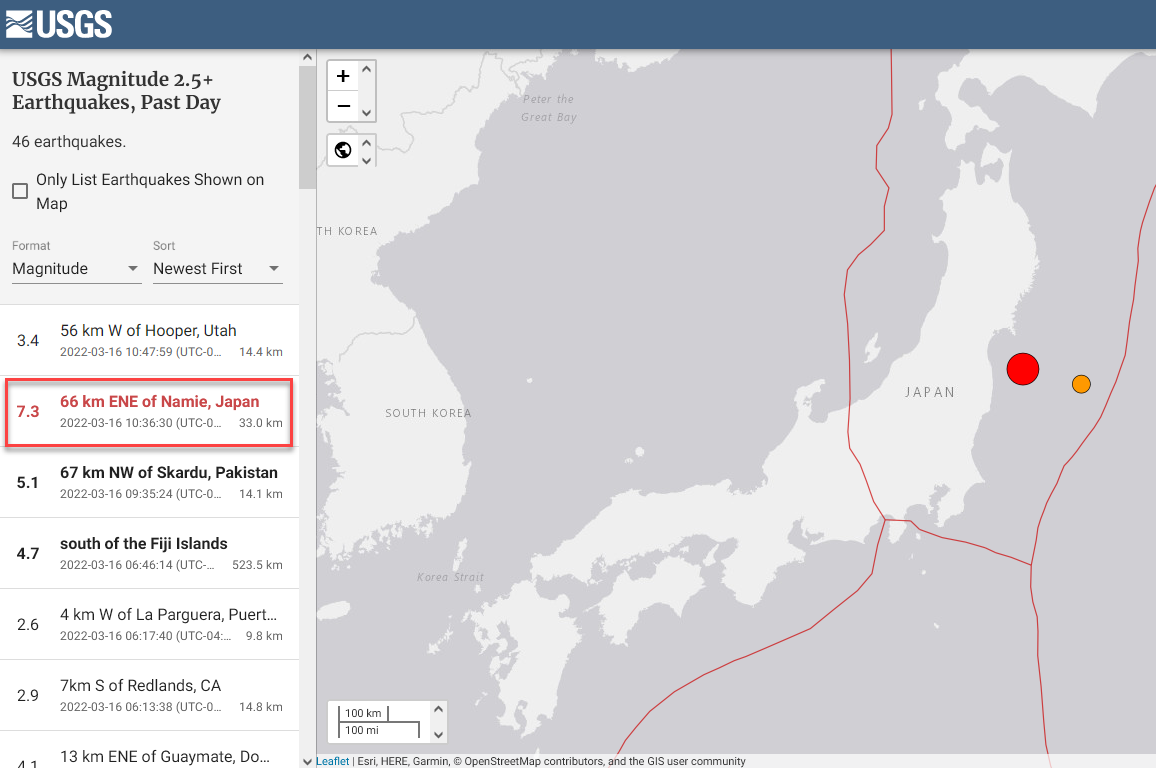
>>> Blackouts Hit Tokyo After Earthquake : 700,000 Buildings have lost power

Blackouts Hit Tokyo After Powerful M7.3 Earthquake Strikes Fukushima

Update (1154ET): Residents in the Miyagi Prefecture of Tokyo on the east coast of Honshu island have been told to evacuate after the quake. Tsunami advisories are still active.
Radiation levels at Fukushima Daiichi Nuclear Power Plant are normal. No abnormalities have been reported at other nuclear power plants in the country.
* * *
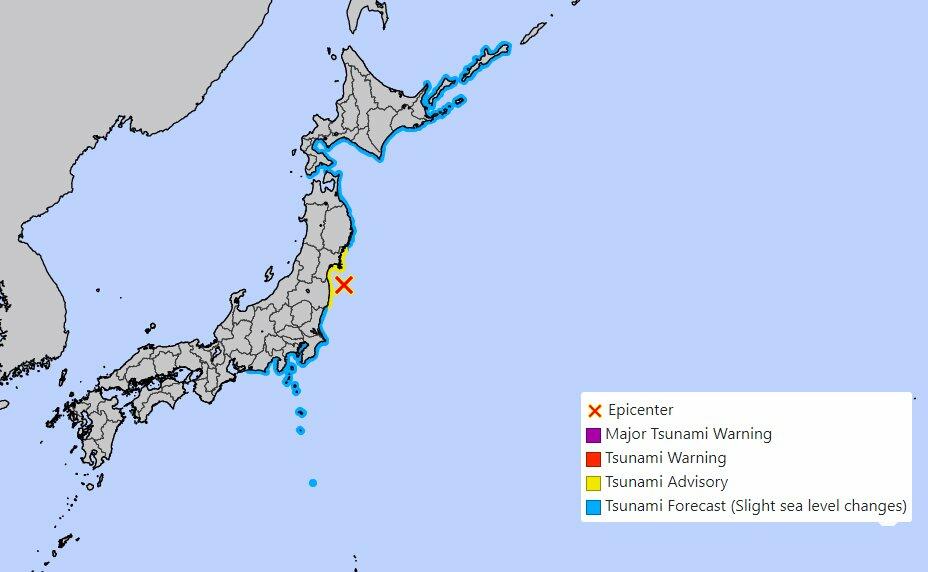
Reports indicate a magnitude 7.3 earthquake has struck off Fukushima, Japan, as a tsunami advisory has been issued, according to NHK World-Japan. The powerful earthquake was felt across the country, shaking buildings in Tokyo and triggering power outages. Reports indicate waves up to one meter may hit Japan's northern coast.
Where the earthquake struck.
The Meteorological Agency has issued a tsunami advisory for coastal areas of Miyagi and Fukushima prefectures.
Reuters' William Mallard said the earthquake was felt around the country. He posted a map that shows some areas in the country recorded magnitude +6.

WSJ : Sycamore and Hudson’s Bay Prepare Kohl’s Bids

Sycamore and Hudson’s Bay Prepare Kohl’s Bids
Offers could value the department-store chain above $9 billion

Private-equity firm Sycamore Partners and Canada’s Hudson’s Bay plan to submit takeover bids for Kohl’s Corp. KSS +14.20% that could value Kohl’s above $9 billion, according to people familiar with the matter.

The private-equity firm and the department-store chain plan to bid in the high $60s a share for Kohl’s, which asked suitors to submit offers by Wednesday, the people said. It couldn’t be learned whether other suitors plan to bid.

A deal is far from guaranteed. Kohl’s has indicated to suitors it believes the company is worth over $70 a share, one of the people said.

Kohl’s shares closed Tuesday at $53.82. They jumped to around $58 a share Wednesday morning after Axios reported that Hudson’s Bay was considering a bid.

A Kohl’s spokeswoman said the board will weigh potential bids against remaining independent and will choose the path that maximizes shareholder value.

Kohl’s has repeatedly been the target of shareholder activists in the past year despite efforts by the company to boost performance. Chief Executive Michelle Gass has forged partnerships with Amazon.com Inc. and Sephora, brought in new brands and beefed up its loyalty program.

She also overhauled the merchandise, dropping poorly performing brands and bringing in new ones. Yet, the retailer’s stock price had languished before takeover interest emerged.

The Wall Street Journal reported that a group backed by Starboard Value LP offered $9 billion for the company, or $64 a share, in January, which Kohl’s rejected as too low. It was around that time that Sycamore made its approach, suggesting it could pay around $65 a share. Oak Street Real Estate Capital LLC has also been named as a possible bidder for Kohl’s real estate.

The Kohl’s board in early February said the indications of interest it received undervalued the company. It formed a committee of independent directors to review its options and hired Goldman Sachs Group Inc. and PJT Partners as advisers. The company said in a March 7 filing that its advisers reached out to over 20 potential buyers, a figure that is typical in such scenarios, and that some had been invited to submit proposals.

New York-based Sycamore focuses on consumer and retail investments. In 2020 it agreed to purchase Ann Taylor, LOFT, Lane Bryant and other chains out of Ascena Retail Group Inc.’s bankruptcy and owns other companies including Staples Inc., Express and The Limited.

Toronto-based Hudson’s Bay is Canada’s oldest department-store chain, founded in 1670. It is owned by HBC, a holding company that also owns the Saks Fifth Avenue and Saks Off 5th chains.

>>> Hudson Bay interested in Kohl - Axios

{us} Hudson's Bay is reportedly considering a bid for Kohl's (KSS), according to Axios citing sources

{X,} "Sources say Sycamore Partners is also considering a bid but whether the private equity firm is serious or just kicking the tires remains unclear."

>>> US Research Calls

Research Calls

  • Upgrades:
    • ACADIA Pharmaceuticals (ACAD) upgraded to Buy from Hold at Canaccord Genuity; tgt raised to $31
    • Host Hotels (HST) upgraded to Outperform from Mkt Perform at Raymond James; tgt $21
    • Magna (MGA) upgraded to Mkt Perform from Underperform at Raymond James; tgt $68
    • Micron (MU) upgraded to Outperform from Mkt Perform at Bernstein; tgt $94
    • Novo Nordisk A/S (NVO) upgraded to Buy from Hold at Deutsche Bank
    • Starbucks (SBUX) upgraded to Overweight from Neutral at JP Morgan; tgt $101
    • Ultragenyx Pharma (RARE) upgraded to Outperform from Neutral at Credit Suisse; tgt raised to $105
    • Wingstop (WING) upgraded to Buy from Neutral at Northcoast
  • Downgrades:
    • SoFi Technologies (SOFI) downgraded to Equal-Weight from Overweight at Morgan Stanley; tgt lowered to $10
    • SSR Mining (SSRM) downgraded to Sector Perform from Outperform at National Bank Financial
  • Others:
    • Cepton (CPTN) initiated with a Buy at Craig Hallum; tgt $19
    • Constellation Energy (CEG) initiated with an Overweight at Morgan Stanley; tgt $63
    • Expeditors Intl (EXPD) initiated with a Hold at The Benchmark Company
    • Inhibrx (INBX) initiated with an Outperform at SMBC Nikko; tgt $40
    • Jounce Therapeutics (JNCE) initiated with an Outperform at SMBC Nikko; tgt $17
    • Standard Lithium (SLI) resumed with a Buy at Stifel
    • WEX (WEX) added to US 1 List at BofA

>>> US Gapping down

Gapping down
In reaction to earnings/guidance
:

  • BRDS -13.1%, GOCO -5.8%, SMAR -5.7%, S -4.7%, RYAN -1.3%

Other news:

  • NLOK -7.8% (UK CMA finds NortonLifeLock purchase of Avast could reduce competition)
  • EXK -6.1% (announces agreement for US$40 mln bought deal financing)
  • SFT -5.7% (to acquire dealer marketplace assets of Fair Technologies)
  • FOLD -5% (reported results from a global Phase 1/2 clinical study (ATB200-02))
  • PRTA -3% (Presents New Data for Alzheimer's and Parkinson's Disease Programs at AD/PD 2022)
  • PRTS -2.1% (CEO steps down to become CEO at LOTZ; co names new CEO and CFO)
  • LAZ -0.6% (files mixed securities shelf offering)

>>> US Gapping up

Gapping up
In reaction to earnings/guidance
:

  • DOYU +14.8%, CAL +10.5% (also boosts its share buyback authorization by 7 mln shares), JBL +9.3%, FF +5.3%, UUUU +3.7%, SRG +2.6%, HOLI +2.2%

Select Chinese ADRs showing strength:

  • PDD +34.1%, LI +22.1%, JD +21.4%, XPEV +19.6%, BABA +19.3%, NIO +18.6%, HUYA +17.6%, NTES +17.2%, WB +15.4%, BIDU +14%, ASHR +9.1%

Other news:

  • BILI +31.2% (to pursue voluntary conversion to dual-primary listing on the main board of The Stock Exchange of Hong Kong)
  • LX +18.8% (authorizes $50 mln share repurchase program)
  • FFIE +13.1% (receives Nasdaq acceptance of plan to regain listing compliance)
  • MAXN +9.9% (announces multi-year order for 315 MW of Performance line solar panels)
  • AVAV +8.5% (report that President Biden could provide Ukraine with Switchblades drones)
  • IOVA +7.9% (FDA allows IND to proceed for IOV-4001)
  • BTBT +6.3% (reports Bitcoin production and mining operations update for Q4)
  • BIIB +4.8% (Long-term phase 3 data show ADUHELM continues to reduce underlying pathologies of alzheimer's disease in patients treated for more than two years) BNTX +4.6% (BioNTech and Pfizer (PFE) submit for Emergency Use Authorization of an additional booster dose of their COVID-19 vaccine for older adults)
  • ADAG +4.3% (receives FDA clearance to proceed with Phase 1b/2 Trial of Anti-CTLA-4 ADG126 SAFEbody in combination therapy with Anti-PD-1 antibody pembrolizumab)
  • VTRS +3.2% (confirms FDA approval for generic Symbicort)
  • SPOT +2.6% (announces partnership with FC Barcelona to bring music and football together)
  • FNF +1.8% (announces a planned transaction to distribute 15% ownership of F&G to FNF shareholders; F&G shares to be publicly listed through a partial spin-off)
  • HRZN +1.3% (leads $10 mln venture loan facility to Aerobiotix)
  • HMC +1% (plans to spend $1.38 bln to upgrade an Ontario manufacturing plant, according to The Globe and Mail)

>>> US Early premarket gappers

Early premarket gappers

  • Gapping up:
    • BILI +30.2%, JD +21.2%, LX +21.1%, DOYU +20.4%, BABA +19.5%, WB +18.8%, BIDU +15.7%, FFIE +12.1%, BTBT +11.9%, IOVA +8.7%, ASHR +8.5%, FF +5.3%, HOLI +4.7%, CAL +4.4%, UUUU +3.4%, HRZN +3.2%, BNTX +2.6%, SRG +2.6%, SPOT +2.4%, FCX +1.9%, RIO +1.9%, BANC +0.8%
  • Gapping down:
    • BRDS -13.1%, GOCO -12.5%, NLOK -6.7%, EXK -5.4%, PRTA -5%, SMAR -2.6%, PAAS -1.9%, PRTS -1.8%, SFT -1.6%, IAG -1.6%, S -1.3%, RYAN -1.3%, GOLD -1%, IAA -0.6%, LAZ -0.6%, ACET -0.6%, UNVR -0.5%

FT : Default looms as Russia hits deadline for dollar bond payments

Default looms as Russia hits deadline for dollar bond payments
Rating agency Fitch says any effort to switch interest payments to roubles would indicate ‘default has begun’

Russia will default on its debt for the first time since 1998 if it tries to make interest payments on its dollar bonds in roubles on Wednesday, rating agency Fitch has said.

Investors are awaiting $117mn in coupon payments on two Russian bonds, the first such payments since western countries responded to Vladimir Putin’s invasion of Ukraine with unprecedented financial sanctions. The deadline marks a crucial test of Moscow’s willingness and ability to continue servicing its external debt.

On March 5, Putin said creditors in “unfriendly” countries that have imposed sanctions should be paid in roubles rather than foreign currency. But such a “forced redenomination” of coupon payments would indicate “that a default or a default-like process has begun”, Fitch said. The company would further downgrade Russia’s credit rating to “restricted default” if the payment is not made in dollars within the 30-day grace period that follows Wednesday’s deadline.

Some of Russia’s dollar and euro-denominated bonds contain a fallback clause allowing repayment in roubles, but the two bonds with coupons due on Wednesday are not among them.

The Russian finance ministry said on Monday it had ordered the payments to be made as usual, but said western sanctions might prevent the money reaching some foreign investors. Finance minister Anton Siluanov said sanctions freezing some of the Russian central bank’s assets were an attempt to force the country into an “artificial default” on its $38.5bn of foreign currency bonds.

“Russia is a powerful, self-sufficient country, so I don’t believe in a default. There is no condition or basis to talk about this. Russia will calmly fulfil all its obligations,” said Anatoly Aksakov, head of the finance committee in Russia’s lower house of parliament.

“Do we need to fulfil our obligations, when our so-called partners aren’t fulfilling theirs? That’s up to the executive and the central bank — they should decide,” Aksakov added, according to state newswire RIA Novosti.


Western investors have been bracing themselves for default since the imposition of US and European sanctions against the Russian central bank last month. The two bonds paying coupons on Wednesday are trading at a price of less than 30 cents on the dollar, although they have risen slightly from their recent lows of around 20 cents. Western investors, who held around $170bn of Russian assets before the invasion have already sustained heavy losses.

A default on Russia’s external debt — of which roughly $20bn was in the hands of foreigners before the invasion — would also raise questions about the country’s larger pile of rouble debt, and around $90bn of foreign-currency bonds issued by Russian companies.

The Russian government has already said that a recent coupon payment on these local bonds would not reach foreign holders, citing a central bank ban on sending foreign currency abroad. Some Russian companies, however, have continued to make interest payments and repay maturing bonds, to the surprise of many investors.

Russia’s last sovereign default in 1998 triggered a financial crisis and led to the near-collapse of US hedge fund Long Term Capital Management. Then, the government restructured its rouble debt and Soviet-era dollar-denominated debt, but continued to make payments on international bonds issued since the collapse of the Soviet Union. The last comprehensive default on foreign debt came in the aftermath of the Russian Revolution, when the Bolshevik government repudiated Tsarist-era debts.

Western investors have already taken heavy losses on Russian assets, where a default has been largely priced in since the imposition of US and European sanctions aimed at severing Russia from the global financial system.

WSJ : Oil Market Faces Biggest Supply Crisis in Decades Unless OPEC Boosts Outpu

Oil Market Faces Biggest Supply Crisis in Decades Unless OPEC Boosts Output, IEA Says
Three million barrels a day of Russian oil output could be lost from April because of sanctions, agency says

Russia’s invasion of Ukraine and Western sanctions on its oil exports threaten a supply shock that will weigh on the global economy and tighten energy markets even further unless major producers increase output, according to the International Energy Agency.

Energy markets were facing the biggest supply crisis in decades, which could result in lasting changes, the Paris-based agency said Wednesday in its monthly report.

Russia’s invasion of its neighbor has prompted Western nations to levy harsh sanctions on Moscow and the Russian economy. While only some nations, including the U.S., have banned Russian oil imports outright, traders, energy companies and shipping firms are shunning Russian crude, fearful of the reputational risk, the IEA said.

The impact could mean 3 million barrels a day of Russian supply effectively cut off from global markets starting next month, the IEA said. The agency slashed its forecast for global oil supply this year by 2 million barrels a day to 99.5 million barrels a day, based on what major producers of the Organization of the Petroleum Exporting Countries have currently agreed to pump.

The lost supply has sent energy prices surging. Oil prices have jumped to multiyear highs, while prices for natural gas, gasoline and coal have also risen. Other commodities upon which the global economy depends and which are produced in significant amounts in Russia, such as some metals and basic foodstuffs like wheat, have also jumped in price.

Those higher prices will “increase inflation, reduce household purchasing power and are likely to trigger policy reactions from central banks world-wide—with a strong negative impact on growth,” the agency said.

The result will also mean a blow to oil demand, but not by enough to balance the lost Russian supply. Demand for oil will be 1 million barrels a day less this year than the IEA was expecting last month at 99.6 million barrels a day. The IEA also cuts its forecasts for oil demand growth this year by 1.1 million barrels a day, to 2.1 million barrels a day.

The oil market will slip into a deficit as early as the second quarter unless the OPEC group of oil producers increase their supply levels, the IEA said. Beyond the spare capacity of leading OPEC members Saudi Arabia and the United Arab Emirates, there are no other sources of additional supply that can balance the market with oil inventories having already been depleted to multiyear lows and the prospect of additional supplies from Iran seemingly a long way off.

The warning highlights how the situation in Ukraine is also increasingly looking like a political headache for OPEC which since 2016 has struck an uneasy alliance with Russia and a group of other oil-producing countries, known as OPEC+.

The cartel has rebuffed pressure from major Western oil consumers to increase the pace of its monthly supply increases, which have so far been capped at 400,000 barrels a day. Doing so could appear to be taking sides—against Russia.

There were signs, however, that a Western diplomatic push urging Gulf oil producers to pump more was working. The United Arab Emirates last week has said it would push other OPEC members to pump more oil.

U.K. Prime Minister Boris Johnson traveled to the Gulf on Wednesday to meet with Saudi and Emirati leaders in a bid to convince them to increase oil output.

The issue has been compounded by OPEC+’s own inability to meet its supply targets, due in part to ailing oil infrastructure in some member countries. The group’s output lags behind its targets by 1.1 million barrels, the IEA says.

The IEA has taken its own steps to ease oil-market tightness. Its members agreed earlier this month to release around 60 million barrels of oil from emergency stockpiles, but the amount was seen as too little to have a meaningful impact. The IEA said that its members were ready to release more crude from inventories.