>>> Europe : Brokers Upgrades & Downgrades - 18th of March 2022

>>> Up
* 1&1 Raised to Buy at DZ Bank; PT 26 euros
* Akzo Nobel Raised to Hold at Jefferies; PT 84 euros
* Bluefield Solar Income Raised to Hold at Jefferies
* BNP Paribas Raised to Buy at SocGen; PT 67 euros
* C&C Raised to Buy at Shore Capital
* Castellum Raised to Buy at Pareto Securities; PT 275 kronor
* Foresight Solar Raised to Buy at Jefferies
* Fraport Raised to Buy at HSBC; PT 60 euros
* Genel Raised to Buy at Renaissance Capital; PT 180 pence
* Greencoat Renewables Raised to Buy at Jefferies
* Johnson Matthey Raised to Hold at Jefferies; PT 2,100 pence
* Softcat Raised to Buy at Berenberg; PT 1,900 pence
* UCB Raised to Add at AlphaValue/Baader
* Wihlborgs Raised to Buy at Pareto Securities; PT 228 kronor
* Zurich Airport Raised to Buy at HSBC; PT 180 Swiss francs

>>> Down
* Atresmedia Cut to Neutral at JPMorgan; PT 5 euros
* MFE Cut to Neutral at JPMorgan; PT 1.40 euros
* Telenor Cut to Sell at SocGen; PT 115 kroner

>>> Initiation
* Anglo American Reinstated Buy at HSBC; PT 4,200 pence
* Becton Dickinson Reinstated Market Perform at Raymond James
* Bridgepoint Rated New Buy at Peel Hunt; PT 380 pence
* Cleantech Lithium Rated New Buy at Fox-Davies Capital
* Farfetch Rated New Buy at Jefferies; PT $25
* Montea Rated New Neutral at Oddo BHF; PT 125 euros

>>> Call
* Siemens Discount ‘Difficult to Justify,’ Morgan Stanley Upgrades

Bus Of Fashion : Bernard Arnault Signals Intent to Lead LVMH Until He Is 80

Bernard Arnault Signals Intent to Lead LVMH Until He Is 80

Billionaire Bernard Arnault is signalling he’s ready to extend his tenure at the helm of LVMH.

LVMH said in a filing that it will seek to raise the age limit for the chief executive officer to 80 from the current 75 at next month’s annual general meeting.

Founder and CEO Arnault is 73. The proposed modification shows that he’s “giving himself a longer time horizon to decide” on his succession plans, said Philippe Pele-Clamour, adjunct professor at business school HEC Paris.

An LVMH representative didn’t immediately reply when asked to comment on Arnault’s plans.

Arnault has five children, who all work at LVMH. The eldest, Delphine, 46, is executive vice president for Louis Vuitton, the company’s biggest brand. Then comes Antoine, 44, who runs image and communications for the group. Alexandre, 29, looks after product and communications at Tiffany, which LVMH integrated a little over a year ago. Frederic, 27, heads the watchmaker Tag Heuer, and the youngest child, Jean, 23, is a marketing and development director at Louis Vuitton watches.

Bernard Arnault also has long-term lieutenants with key roles such as Antonio Belloni, a group managing director who oversees strategy and operations and joined over two decades ago. Michael Burke runs Louis Vuitton and chairs Tiffany, while Nicolas Bazire is in charge of development and acquisitions.

The proposed extension is generally positive for LVMH, “as successor candidates would have more time to mature and gain experience and gravitas,” Sanford C. Bernstein analyst Luca Solca said by e-mail.

>>> US Close Dow +1.23% S&P +1.23% Nasdaq +1.33% Russell +1.69% VIX 25.66 -3.79%

Closing Stock Market Summary

The S&P 500 rose 1.2% on Thursday, extending its rebound rally to a third straight day. The Dow Jones Industrial Average (+1.2%) and Nasdaq Composite (+1.3%) kept pace with the benchmark index while the Russell 2000 (+1.7%) pulled ahead its large-cap peers. 

All 11 S&P 500 sectors closed in positive territory with gains ranging from 0.5% (utilities) to 3.5% (energy). Advancing issues outpaced declining issues by roughly a 4:1 margin at the NYSE and a 3:1 margin at the Nasdaq. 

Strikingly, the stock market was undeterred by an 8% rebound in oil prices ($103.43, +8.01, +8.4%), which was catalyzed by Russia refuting yesterday's reports that described progress in peace talks with Ukraine. Western officials believe that both sides remain far apart on those talks, according to Reuters

The market, to be fair, did get off to a slow start despite an encouraging round of economic data, including housing starts for February, weekly initial jobless claims, and the Philadelphia Fed Index for March. 

Stocks appeared to key off the price action in the 10-yr Treasury note yield, which settled unchanged at 2.19% after dipping below 2.11% overnight. The ability for the 10-yr yield to move higher, undoing some of yesterday's curve-flattening activity, seemed to alleviate some underlying growth concerns. 

The 2-yr yield fell four basis points to 1.94%. The U.S. Dollar Index fell 0.7% to 97.97 amid relative strength in the euro, which rose 0.7% against the dollar to 1.1112. The British pound (unch), meanwhile, moved lower in the wake of the Bank of England's decision to hike its key lending rate by 25 basis points to 0.75%. 

Whether or not it was the Treasury market that got things going for equities, there was little doubt that positive momentum, which was borne out of a bearish sentiment, was on the market's side. 

With today's advance, the S&P 500 finished 5.7% above Monday's close, versus 8.2% and 6.4% gains in the Nasdaq Composite and Russell 2000, respectively. Over the same three-day period, the CBOE Volatility Index (25.67, -1.00, -3.8%) has dropped 19%. 

Reviewing Thursday's economic data:

  • February housing starts increased 6.8% month-over-month to a seasonally adjusted annual rate of 1.769 million (consensus 1.700 million) and building permits slipped 1.9% to a seasonally adjusted annual rate of 1.859 million ( consensus 1.860 million).
    • The key takeaway from the report was that single-family units (+5.7%) drove the strength in starts, yet a 0.5% decline in permits for single units (a leading indicator) tempered some of the enthusiasm for the otherwise encouraging February number.
  • Initial jobless claims for the week ending March 12 decreased by 15,000 to 214,000 (consensus 224,000) and continuing claims for the week ending March 5 decreased by 71,000 to 1.419 million, hitting their lowest level since February 21, 1970.
    • The key takeaway from the report is the understanding that the latest week is the week in which the survey for the March employment report was conducted. With the low level of initial claims, expectations for a strong pickup in job growth -- and a continuation of the strong labor market the Fed chair was discussing -- will remain high.
  • Total industrial production increased 0.5% month-over-month in February (consensus 0.5%) following an unrevised 1.4% increase in January. The capacity utilization rate rose to 77.6% ( consensus 77.9%) from a downwardly revised 77.3% (from 77.6%) in January.
    • The key takeaway from the report is that industrial production is being held back by the output of motor vehicles and parts, which stems from ongoing supply shortages. The output of motor vehicles and parts declined 3.5% in February.
  • The Philadelphia Fed Index for March increased to 27.4 ( consensus 14.0) from 16.0 in February.

Looking ahead, investors will receive Existing Home Sales for February on Friday.

  • Dow Jones Industrial Average -5.1% YTD
  • S&P 500 -7.4% YTD
  • Russell 2000 -8.0% YTD
  • Nasdaq Composite -13.0% YTD

(ZH) Market Faces Major 'Gamma Unclench' From Friday's $3.5 Trillion Op-Ex

Market Faces Major 'Gamma Unclench' From Friday's $3.5 Trillion Op-Ex

Tomorrow's equity option expiration is large, with more near-the-money SPX open interest than any since 2019, and investors will also be watching the ETN market given the substantial size of expiring VXX (VIX futures ETN) call options without the potential (as of now) for new shares to be created.
The Fed-week "rally into Op-Ex" move remains in place but after yesterday's post-hawkish-Powell meltup, some of that short/negative delta has been unwound faster than anticipated. Notably, as SpotGamma explains, yesterday saw a total lack of positive call deltas in the SPY & QQQ. You can see below that SPY traders were fairly heavy call sellers (appears to be in the money call sellers) into the AM short-stock cover, and then after 1PM ET and through the FOMC flow was neutral. The QQQ chart was similar.
The point being that if the Fed tripped some macro buy signal you’d think the response from call buyers & put sellers would be significant positive deltas... and that is not what we saw.
Just how much theoretical Delta are we talking about being bought-back off the lows from two days ago (post-Monday through Wednesday)?
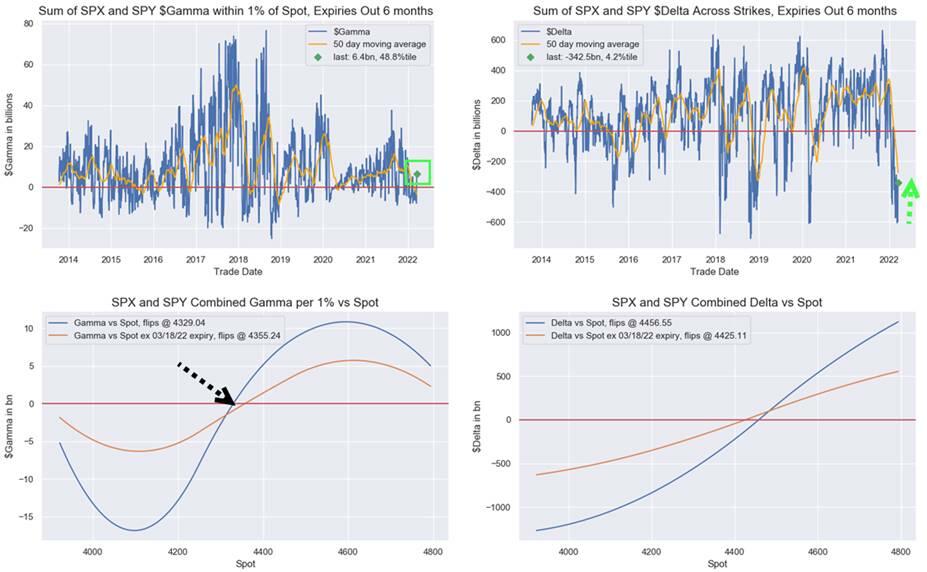
  • SPX / SPY Net $Delta went from -$592.1B to -$342.5B, a +$249.6B change since Tuesday
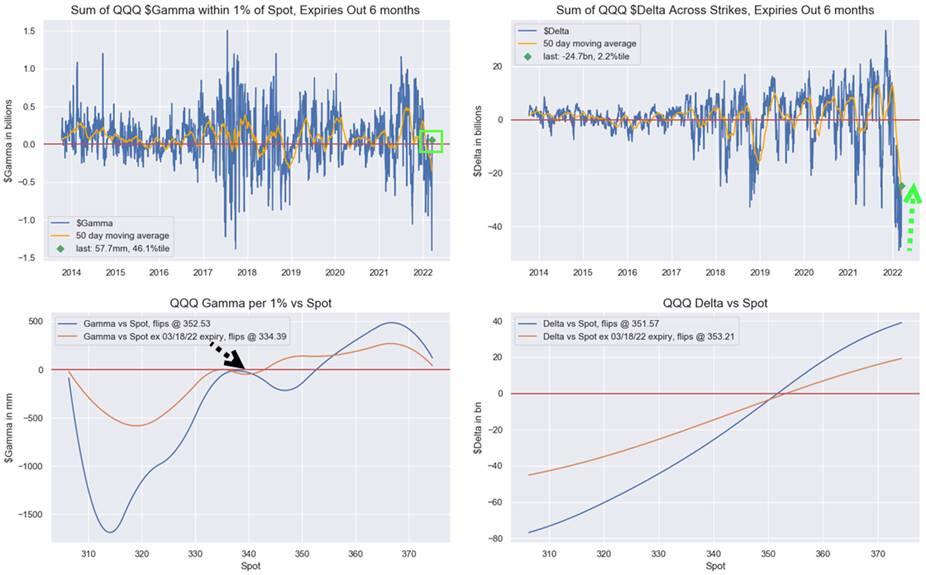
  • QQQ Net $Delta went from -$43.0B to -$24.7B, an +$18.3 two-day change
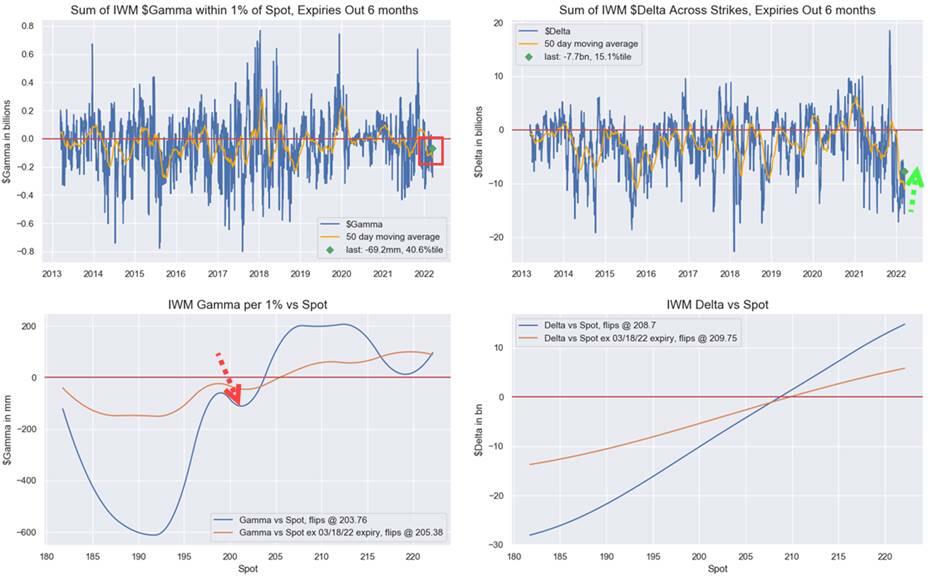
  • IWM Net $Delta went from -$15.5BB to -$7.7B, a +$7.8B two-day change
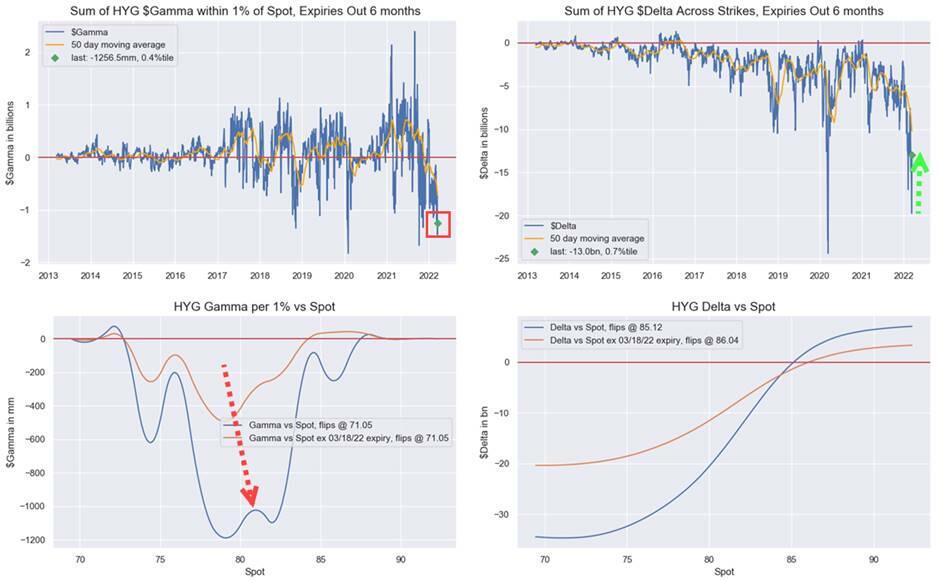
  • HYG Net $Delta went from -$19.8B to -$13.0B, a +$6.8B two-day change
The point being, yesterday was a short cover rally through put destruction. Short cover rallies are inherently unstable, and while short-term markets shifted hawkishly to price in rate-hikes to around 2.00% by year-end, they are also now pricing in 50bps of rate-cuts in 2023-2024!
Sopurce: Bloomberg
As Nomura's Charlie McElligott points the markets are rightfully anticipating widespread curve inversions and ultimately that implies only one thing: recession.
And as implied vols were crushed (and Spot rallied), McElligott points out that actually gave Dealers back some of their “short Gamma” (Vol down -> Gamma up)—where now, at least from the SPX / SPY and QQQ perspective, we are now back in the “Zero Gamma” pocket (4329 and ~$340, respectively), where if we can hold or even temporarily move back into a “long Gamma vs spot” position, it can act to squelch the intraday ranges and persistent overshoots both upside- and downside-, as options Dealers inch back into a location where they can again act as “liquidity makers”
  • Remember, “long Gamma” means Dealers are again able offer futures into upside moves, bid futures into downside moves—providing stability and preventing “shock gaps”
  • But in a “short Gamma” regime, however, options Dealers act as “liquidity takers”—which has been the key determinant in the past few month’s commentary on illquidity which contributes to the volatility (hence my “chicken or the egg” observation!)
So which strikes matter the most now into Op-Ex / what % of overall $Gamma is set to expire / current & max Gamma sensitivity?
SPX / SPY currently “pinning” btwn 4400 strike ($4.1B $Gamma), 4350 ($2.5B), 4300 ($2.4B); currently see ~43% of the $Gamma dropping-off for Friday’s expiration; currently at “Zero Gamma” level, “Max Short Gamma” at 4125 and -$17B per 1% move
Source: Nomura
QQQ $350 strike ($640mm $Gamma), $345 ($608mm), $340 ($595mm); currently see 56% of the $Gamma dropping-off for Friday’s expiration; currently at “Zero Gamma” level, “Max Short Gamma” at $314 and ~-$1.7B per 1%
Source: Nomura
IWM $200 strike ($471mm $Gamma), $205 ($274mm), $195 ($199mm); currently see 63% of the $Gamma dropping-off for Friday’s expiration; currently a modest “Short Gamma vs Spot” at -$100mm per 1% currently, “Max Short Gamma” at $192 and ~-$600mm per 1%
Source: Nomura
HYG $82 strike ($973mm $Gamma), $81 ($799mm), $80 ($477mm); currently see 58% of the $Gamma dropping-off for Friday’s expiration; currently still very “Short Gamma vs Spot” at -$1.0B per 1% move, “Max Short Gamma” at $79, -$1.2B per 1% move
Source: Nomura
That is a lot of gamma to 'unclench'.
McElligott concludes that we still are not seeing a wholesale client shift to “chase” or “play offense” (i.e. big and broad upside Call buying on a sentiment shift), at least as of yet; in-fact, contrarian signal or not, most conversations remain about timing the fade or putting hedge back on into the market rally.
Accordingly, SpotGamma thinks OPEX flows will continue to be supportive of markets into Friday. However, we are currently having a hard time finding data that implies options-based support into next week. This would change if we see a pickup in call flows and/or a push above 4400 in the S&P.

FT : Renault’s Russia dilemma

Renault’s Russia dilemma
French carmaker has one of the largest operations of any multinational in the country but faces risks by staying

Renault had for months been plotting to export a newfangled version of the Lada to the rest of the world.

Although realising that ambition remained some way off, it would have capped the revival of a brand arguably more synonymous with the Soviet Union than any other and which Renault first took a punt on in 2007 after then chief Carlos Ghosn identified Russia as a promising market.

Encouraged by Russian president Vladimir Putin, Renault in 2012 lifted its stake in Avtovaz, the manufacturer of the Lada since the first one rolled off the production line in 1970, to a controlling one.

A decade on, its success in steering Lada through setbacks and market slumps has left Renault with a larger business in Russia than many other foreign companies, just as Putin’s invasion of Ukraine risks turning the country into a pariah state.

In contrast to some multinationals for whom the Russian market amounts to little more than a rounding error in their accounts, Renault has a local workforce of 40,000 and generates 10 per cent of its revenues there.

The carmaker has not commented on its intentions, saying only that it is monitoring the situation in Russia. The scale of Renault’s operations, alongside a lack of political pressure in France to beat a retreat, has left the group minded to try and stay, according to people familiar with the matter.

But as the corporate stampede from Russia grows, the commercial and reputational risks for the company, which counts the French government and Japan’s Nissan as its two biggest shareholders, are rising.


“People are underestimating the potential economic collapse [in Russia], this could be a complete breakdown,” said Mark McNamee, Europe director at FrontierView, a consultancy that advises companies on macroeconomics.

“There’s pressure for companies to not be seen to be dealing with Russia at all,” McNamee added, pointing to a particularly strong move among US consumer brands to “self-sanction” and withdraw.

Renault has already been put on notice of the mounting economic strains in Russia. Its three plants, including one in Moscow that produces models under the Renault brand, have faced stoppages and struggled to source components as some suppliers cut ties with the country.

Avtovaz resumed production of some Lada models on Wednesday after a week-long pause at its vast Togliatti plant, which sits on the Volga river 1,000km east of Moscow. But all Avtovaz factories are set to be idled again from April 4 for 20 days as Renault brings forward a corporate vacation normally scheduled for the summer, while racing to stockpile electronic parts.

Semiconductors would be particularly hard to source within Russia, industry consultants said, even if Togliatti had its own extensive metal stamping operations to make some other components.

Within Russia there was “a lot of pressure on them to never stop again”, one person briefed on Renault’s operations said. The risk of a Russian countermove to seize assets was also an issue, they added.

Some other car plant operators in the country have received unannounced visits from local authorities to check they are still paying workers even when shut, according to people familiar with the visits.

Since Renault first invested in Avtovaz in 2007, its workforce has shrunk from over 100,000 as the French group has sought to modernise assembly lines. Almost all workers are local except for 10 foreigners in top jobs or essential positions, such as Avtovaz head Nicolas Maure, and the group is reluctant to simply abandon its staff, people at Renault have said.

Visits from international employees that normally carry out quality control checks have been cancelled, according to Renault unions.

Although smaller than it was, the size of Renault’s workforce means the stakes are high — both for the company and the Russian government. Its Togliatti plant, one of the world’s biggest car factories, is so large that it used to operate its own hospital and remains a key source of employment for in the surrounding Samara province.

Long-running stoppages risk being very costly. “The question is production and how long do you pay the workers until you can no longer afford it?” said Philippe Houchois, an analyst at Jefferies.

A car brand that resonates far beyond Russia, the Lada has long been the best-selling one inside it, with its cheaper price helping to keep its market share at around 20 per cent, even as foreign rivals have pushed into the country over the last two decades.


Even in the Soviet era, the no-frills Ladas were one of Russia’s most successful exports. EU sales petered out over two years ago when vehicle emissions standards tightened, though the brand still sold new cars outside Russia, including in Kazakhstan and Belarus.

However, under chief executive Luca de Meo, Renault had been considering bringing a hybrid version of its Lada Niva back to western Europe by 2025, building on the revival of its sturdy off-road car first launched in 1977.

Although Renault’s plants have suffered from interruptions to production since the invasion, there are signs that demand is proving to be more resilient — even as the Russian rouble has tumbled in value.

“They’re buying up everything,” said one car dealer in Moscow, pointing out that this was far from business as usual.

“In my view, they mainly want to invest money, buy anything but invest before [the rouble] devalues entirely,” he said. “Those with more money buy apartments, the ones with less money buy cars.”

Fears that spare components for foreign cars would eventually run out were sharpening the Lada’s appeal, the dealer added. Some people have said they keep cars in underground parking or in garages rather than in the streets because of concerns they will be stolen for parts.

“These are Russian products made by Russians for Russia,” an official in the French government told the Financial Times, adding that it was too early to consider a radical halt to production or a departure. Japan’s Nissan, Renault’s alliance partner, declined to comment.

It is a position the French government is maintaining despite Renault holding a 68 per cent Avtovaz stake alongside Rostec, a defence and industrial group run by a longtime Putin ally Sergei Chemezov, who has been under US-imposed sanctions since 2014.

French president Emmanuel Macron, who has held regular talks with Putin since the invasion and urged him to establish a ceasefire, has also stressed that the west was not at war with Russian people.

His government has not pressured companies to depart, even in private exchanges, several people familiar with the matter have said. That includes TotalEnergies, the French company facing the most scrutiny over its continued Russian presence, after oil and gas rivals BP and Shell announced plans to leave.

French companies are among the biggest foreign employers in Russia, with 160,000 local staff in total, according to French officials. Food producer Danone, supermarket group Auchan, DIY retailer Leroy Merlin and lender Société Générale also have large operations.

“The question of whether these companies should leave [Russia] is certainly there,” said Tatiana Kastouéva-Jean, the head of the Russia centre at French think-tank Ifri. “Some French companies have been resisting more than others, but many are more local and have more to lose.”

Germany’s three major car manufacturers, VW, Mercedes and BMW, suspended their sales or operations within days of the invasion. The trio sold less than 300,000 vehicles in the country last year, a fraction of the 13mn cars they delivered worldwide.

That is less than the total of Ladas turned out by the Renault group alone, while the company sold over 482,000 cars in Russia, including under other brands in 2021, a hefty 17 per cent chunk of its total output.

Avtovaz has €3.1bn of assets, according to Renault accounts. Jefferies analyst Houchois said Avtovaz activities were largely ringfenced, limiting the fallout for the wider Renault group. “You could wipe out the value to zero in your accounts and be able to deal with that,” he added.

Nevertheless, Renault’s shares have underperformed other French blue-chip companies since the invasion, falling by more than 20 per cent.

Its Russian dilemma risks weighing on De Meo’s broader ambitions at Renault after the company, hit by corporate scandals and then the disruption from the coronavirus pandemic, only edged back to profit last year after two years of losses.

“I’m anxious for the group,” said a high-level person at Renault, adding that he thought the company should stay after spending years of investment and energy in Russia.

FT Lex : Thyssenkrupp: steeled for more challenges on the way to standalone unit

Thyssenkrupp: steeled for more challenges on the way to standalone unit
Higher prices should burnish the proposed steel spin-off

The latest rash of profit warnings, like those issued in the first year of the pandemic, is more about signalling than actual numbers. Take Thyssenkrupp. It is suspending guidance on free cash flow as a result of the Ukraine war and putting its planned steel spin-off into abeyance.

Both are setbacks to the industrial conglomerate’s rebirth. Once a champion of Germany’s postwar Wirtschaftswunder, or economic miracle, Thyssenkrupp has spent the past few years spinning off units and bolstering its balance sheet. Shares had halved in the two years before the pandemic, which brought a further halving. The suspended guidance ate into the subsequent rally, lopping a tenth off the share price on Thursday morning.

This year, free cash flow, pre-M&A, was expected to break even: a key data point for a company that has bled billions of euros in outflows over the past five years. Russia’s invasion of Ukraine changes that due to secondary effects; the two countries comprise “significantly” under 1 per cent of turnover. Input prices, including energy, are going through the roof and automakers, facing supply chain squeezes, are deferring purchases of steel.

The steel unit was shining up nicely. In the year to end September it produced ebitda of €214mn — it lost more than twice that the previous year — and had been expected to contribute more than half of this year’s targeted €1.8bn operating profit. But plans to jettison Steel Europe have been dogged from the get-go. Brussels blocked a proposed merger with India’s Tata Steel on antitrust grounds in 2019 and an attempted sale fell apart when UK industrial tycoon Sanjeev Gupta’s Liberty Steel failed to secure financing. The spin-off has already been delayed.

Higher steel prices — the spot price of North European cold rolled steel is up by a quarter in the past month — should burnish the proposed unit. But 60 per cent of Thyssenkrupp’s sales are on half-annual, annual or multiannual contracts, reducing flexibility. Challenges to the group’s transformation are “certainly not getting any smaller”, said boss Martina Merz. That was an understatement.