(ZH) One Bank Spots A Big Red Flag For Stocks: Buybacks Are Inexplicably Tumblin

One Bank Spots A Big Red Flag For Stocks: Buybacks Are Inexplicably Tumbling

Forget the inverted yield curve and the coming recession: a far more ominous development for stocks has emerged: stock buybacks are suddenly plunging.
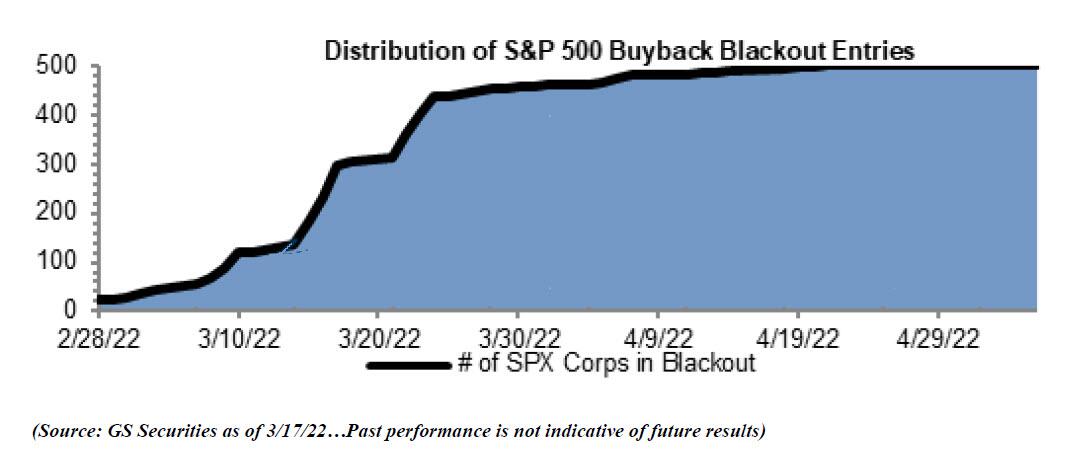
Three weeks ago, when an otherwise bullish Goldman Sachs was urging its clients to (correctly) buy stocks ahead of the quarter-end bear market rally/melt up (the same bear market rally, which Morgan Stanley now says is over), the bank warned that one of the bigger risk factors entering Q1 reporting period is the end of buybacks, and what back then was 45% of the S&P in a buyback blackout has now risen to 95%:
As Goldman wrote, "the avg notional executed by corporates (street wide) during the open window is ~$4b per day in U.S. mkt. During blackout period our corporate desk’s executions typically decline by 25 – 30%. Fair to assume at least $1b of demand is removed from market place on a daily basis during blackout period."
And as we approached the full buyback blackout phase-in late last week ahead of the upcoming official Q1 earnings launch, the lack of indiscriminate stock buying (by corporations) finally got to the market and we saw the biggest stock drop in weeks amid weakness that has spread into the current week.
None of this is a surprise... but this morning Bank of America quant Jill Carey Hall made an ominous observation: in her weekly equity client flow trends note (available to pro subs), she writes that while buybacks typically slow at the end of each quarter ahead of earnings season, buybacks by corporate clients slowed to their lowest weekly level in 12 months, and on a rolling 4-week average basis, are down YoY for the first time since late 2020.
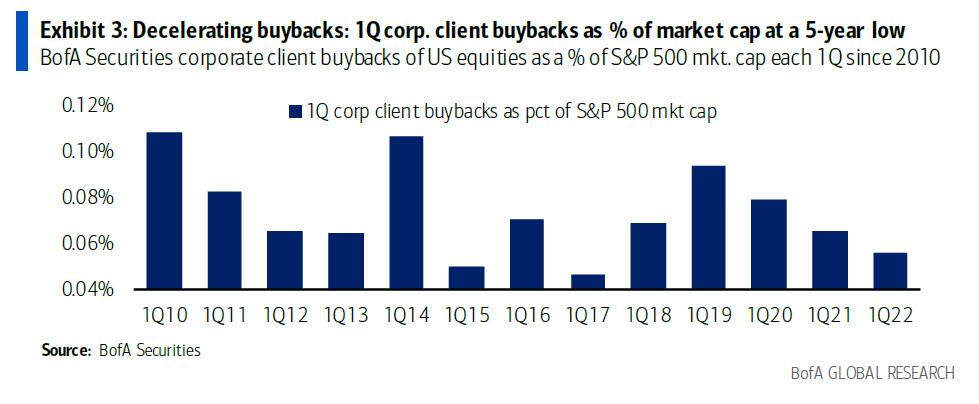
As shown in the chart below, while the $ amount of buybacks in 1Q was above other 1Qs post-crisis, as a % ofS&P 500 market cap, 1Q buybacks were the lowest in five years.
Perhaps even more concerning is that while 1Q S&P 500 buyback announcements (as a % of mkt. cap) – while similar to 1Q21 levels – were 50% below the pre-COVID 5-year avg.
While BofA refuses to argue that buybacks lead to higher stock prices (we are happy to do so: "more buybacks lead to higher stock prices", there you go) the bank make the point that a "backdrop of more supply (IPOs) and less demand (buybacks) as a reversal of a multi-decade bullish trend for US equities (shrinkage)."
The BofA strategists also note that they see a "greater case for dividends > buybacks in 2022 amid political risks to buybacks, a rising cost of debt (fewer levered buybacks), elevated valuations vs.rising demand for dividend income (10 reasons for S&P 500 dividend growth note)."
Finally, in the aftermath of Starbucks' shocking announcement earlier this week, when the company's woke CEO Howard Shultz announced that he was halting buybacks to "invest more into our people and our stores - the only way to create long-term value for all stakeholders" - news which immediately sent the stock tumbling as it clearly destroyed value for all stakeholders- could it now be the case that the only companies that pursue critical - for shareholders - buybacks are the unwoke ones.
Considering the tremendous gains by "evil, dirty, and unsnowflake" fossil fuel companies in recent months - just as we predicted would happen in 2020 - is corporate America about to suffer another painful reminder of "get woke, go broke", and is the blowback against corporate wokeism - observed in the past 24 hours with Elon Musk effectively taking control of the censoring, circle-jerking echo chamber cesspool of liberal "bluechecks" that is Twitter - about to finally hit, because while everyone can pretend to be all up with the latest snowflake bullshit, once people's money is on the line it's amazing how everyone remembers that only one "green" matters and that conservative values actually are far more beneficial for one's financial health than socialist liberal ones.

TheDailyBeast : Victim: Epstein Shared Hotel Suite With Bill Clinton and Worried

Victim: Epstein Shared Hotel Suite With Bill Clinton and Worried About Being Poisoned
STRANGE BEDFELLOWS
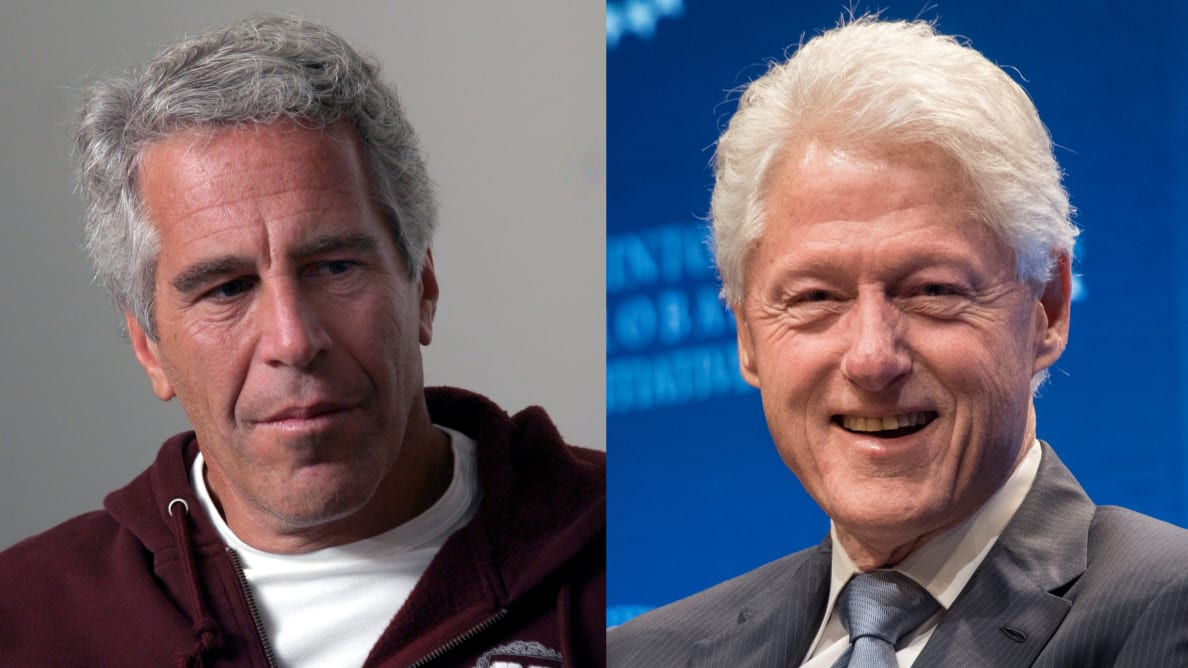
Photo Illustration by Thomas Levinson/The Daily Beast
Juliette Bryant was approached in a Cape Town bar and asked if she’d like to meet the former president and Jeffrey Epstein. It was the beginning of her personal nightmare.
Published Apr. 05, 2022 4:58AM ET
Juliette Bryant was at a Cape Town cocktail lounge with a friend when an associate of Jeffrey Epstein approached her. “This guy is bothering me,” the woman, an American actress named Naja Hill, told them that night in September 2002. “Can I hang out with you guys?”
Bryant, who had just turned 20, understood that women must look out for one another and welcomed the beautiful stranger to join them. When Hill learned Bryant was an aspiring model, she suggested they find her “billionaire” friend Jeffrey, who she falsely claimed was the owner of Victoria’s Secret and could jump-start Bryant’s career.
Hill, who had emphasized Epstein’s celebrity contacts, shared that the financier was currently at a chic restaurant nearby with none other than former President Bill Clinton, and actors Kevin Spacey and Chris Tucker. She asked Bryant if she’d like to meet them. Bryant and Hill then hopped in a car, giddy at the opportunity to make their acquaintance.
“I was a silly young 20-year-old and thought it sounded like such an amazing opportunity considering the people he was here with,” Bryant told The Daily Beast, in her first in-depth media interview about surviving Epstein’s sex ring. She also spoke to BBC Two for its new series about Epstein’s former girlfriend and now-convicted accomplice Ghislaine Maxwell. The show, House of Maxwell, premiered on Monday.

“That’s what gave Epstein credibility,” Bryant added. “The fact that he was with Clinton.”
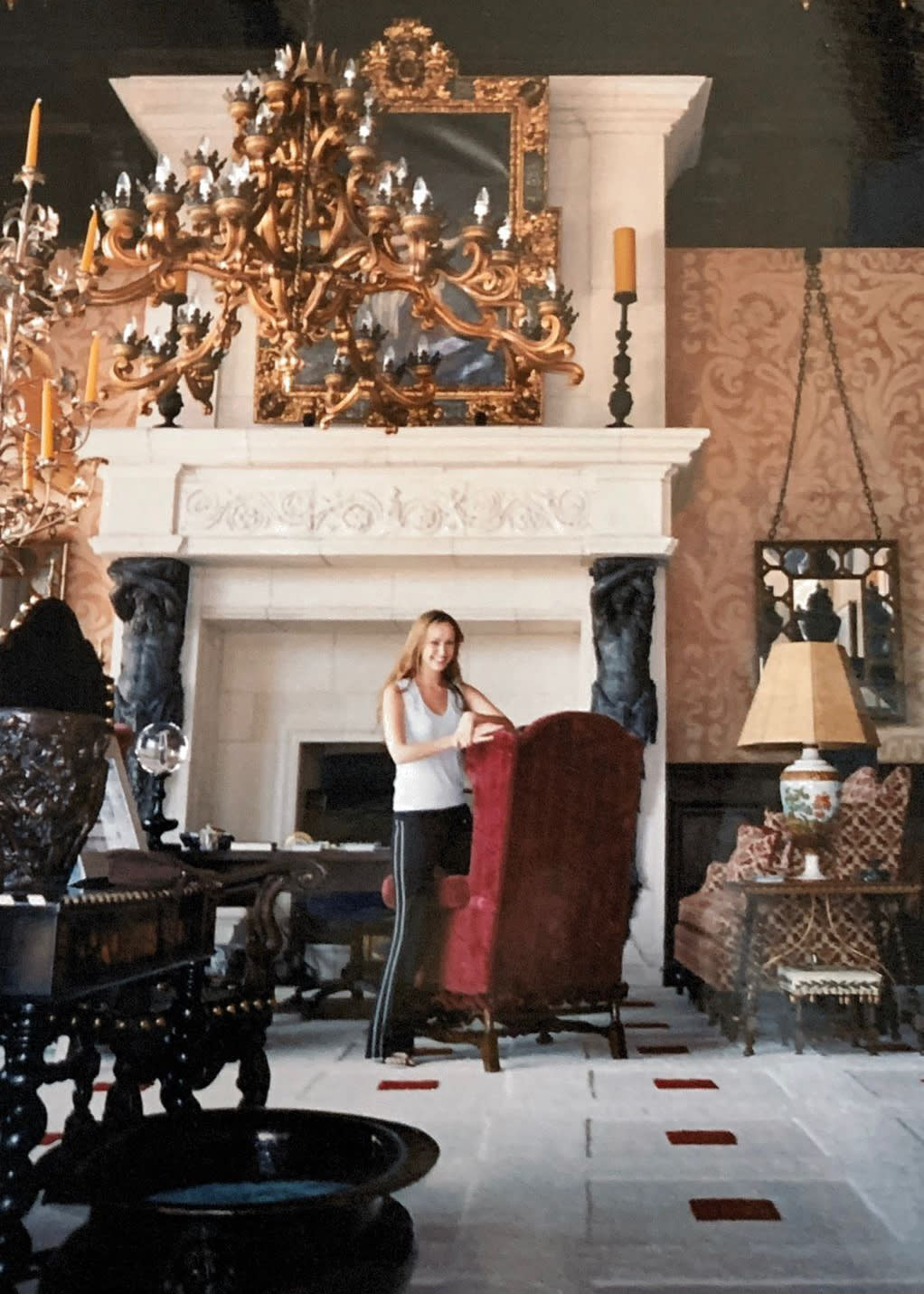
Juliette Bryant at Jeffrey Epstein's private isle in the U.S. Virgin Islands.
Courtesy Juliette Bryant
According to Bryant, when she arrived at the restaurant, Clinton stood up to shake her hand and didn’t let go, even when he began speaking to someone else. “He just kept holding onto my hand,” Bryant told us. “It was like a dream. It was so bizarre.”
She would also see the famous Democrat again the next day, after Hill invited her to join their entourage and show Epstein her modeling portfolio.
Bryant crossed paths with Clinton and Epstein as they toured Africa on a high-profile humanitarian trip, during which the former president, his Secret Service team, and others flew aboard Epstein’s private jet dubbed the “Lolita Express.” Clinton has not spoken publicly about this journey or his multiple other flights with Epstein aside from a 2019 statement which claimed he knew “nothing” about the late sex offender’s “terrible crimes.”
Hill did not return messages left by The Daily Beast, nor did reps for Tucker and Spacey. Angel Ureña, a spokesman for Clinton, referred us the previous statement, which read:
“President Clinton knows nothing about the serious crimes Jeffrey Epstein pleaded guilty to in Florida some years ago, or those with which he has been recently charged in New York. In 2002 and 2003, President Clinton took a total of four trips on Jeffrey Epstein’s airplane: one to Europe, one to Asia, and two to Africa, which included stops in connection with the work of the Clinton Foundation. Staff, supporters of the Foundation, and his Secret Service detail traveled on every leg of every trip. He had one meeting with Epstein in his Harlem office in 2002, and around the same time made one brief visit to Epstein’s New York apartment with a staff member and his security detail. He’s not spoken to Epstein in well over a decade, and has never been to Little St. James Island, Epstein’s ranch in New Mexico, or his residence in Florida.”


Epstein always had platters because I think he was scared of being poisoned. There were platters of food for everyone, and he’d pick off other people’s plates. It was weird.

Epstein ensnared Bryant in his trafficking scheme not long after this Cape Town rendezvous under the guise of offering her modeling jobs in the U.S.
But moments after she set foot on American soil, Bryant was whisked off to the money manager’s home in the U.S. Virgin Islands, where he raped her repeatedly over two weeks before taking her to Palm Beach to continue to the assaults. The sexual abuse would continue at Epstein’s homes around the globe until 2004.
“I was completely conned,” Bryant said. “I wouldn’t go with some random man to the Caribbean. He seemed legitimate. Clinton gave him credibility.”
Now a mother and business owner in South Africa, Bryant says she is coming forward to stand up for victims of trafficking worldwide, and to contribute her own pieces to the jigsaw that is Epstein’s mysterious network. Lately she wonders why Epstein’s prominent friends like Clinton aren’t under further scrutiny, or why his assistants like Sarah Kellen, who allegedly sent her to Epstein’s room to be abused, aren’t facing criminal charges.
In late 2019, Bryant filed a lawsuit against Epstein’s estate which alleged the financier raped her repeatedly for years at his homes in Paris, Palm Beach, and New York, as well as at his compound in New Mexico and private isle in the U.S. Virgin Islands. (She settled with the Epstein Victims’ Compensation Program a year later.)

“I want to back up the other girls,” Bryant told us. “I want to move on with my life, but I can’t. I was a witness to it. Every piece of the puzzle matters, no matter how small the piece.”
Those details, Bryant says, are still fresh in her mind. Twenty years later, she has more questions than answers. And she believes that Epstein and Maxwell were more powerful and dangerous than people could ever imagine.
“Every day is still hard,” she said. “I don’t feel OK a lot of the time. But I’m just grateful to be where I am and to be alive.”
“Epstein was so clever he made everyone feel like it was their fault,” she added. “People need to realize that this man was so evil and capable of so much.”


When Bryant met Clinton and Epstein, she got the impression the men were close—or at least friendly enough to apparently share a suite at the luxurious Cape Grace, a 5-star hotel on the Victoria & Alfred Waterfront.
“Jeffrey really liked you,” Hill told her on the phone the next day. “Can you come to the hotel and show him your modeling book?” Hill informed her that Clinton was also giving a speech that day at a local university of technology and invited her along. Bryant joined the group’s motorcade, which included a police escort, sitting in the back of a van with a Clinton adviser.
Bryant remembers Spacey—whom more than a dozen men would later accuse of sexual abuse and harassment—filming some of Clinton’s remarks and the audience using what appeared to be a digital camera. Spacey, she said, was standoffish and “thought we were a bit of a nuisance,” while Tucker was friendly but didn’t interact with her very much. (In her lawsuit, the influential trio is described only as “a former high U.S. Government official, a famous actor, and a well-known comedian.”)
When the speech ended, Bryant says, all returned to Cape Grace and she grabbed her modeling book from the car. She was told her “casting” would be in Epstein’s room.
She took the elevator to the suite and met three of Epstein’s female assistants, who she was told worked for the agency Karin Models, in a large sitting room. Bryant remembers encountering Kellen and another young woman in particular. Reached by The Daily Beast, that woman confirmed meeting Bryant during the South Africa trip and said she had recently joined Epstein’s circle, too. She denied ever working for a modeling agency or claiming to work for one. “You have to realize, leading up to this, I was still very much in the dark,” the woman said of Epstein and Maxwell. “I saw these two wealthy people who were saying, ‘Hey, do you want to come on this trip to Africa with Bill Clinton?’ As someone in their early twenties, all of that sounds really great. You don’t know what’s lying beneath it all.”
Getty Images

Bryant told The Daily Beast she approached the three assistants, who sat at a long table and paged through her portfolio. “While they did that, Clinton walked through the room and said, ‘Hi guys.’ He and Epstein were sharing the presidential suite,” Bryant recalled, adding that Clinton then retired to his own private room in the suite. (Bryant wasn’t the only survivor to meet the former president. Chauntae Davies, then 22 and traveling with Epstein, was photographed giving Clinton a neck massage during the Africa tour.)
Asked whether Clinton and Epstein shared a suite, Ureña said that the former president did not stay in Cape Town following his university event. “Instead, he flew to Johannesburg where he, amongst other things, met with Presidents Mbeki and Mandela,” Ureña said in an email. “Epstein and Maxwell did not travel to Johannesburg.”
The assistants then told Bryant she could proceed to Epstein, who reviewed her portfolio and declared, “You’ve got the most perfect figure I’ve ever seen. You’re perfect for Victoria’s Secret.” While Hill had previously told her Epstein controlled the lingerie company, Epstein informed Bryant that his “best friend” Les Wexner owned it.

He said he worked for the CIA and was putting her and her family members on a ‘list.’

“I was so excited, because my family was struggling financially,” Bryant told us. “I thought I was going to make a difference for my family. I’d been praying for something good to happen, and thought, ‘Oh my God. My dreams are coming true.’”
Epstein and his traveling companions left the country that day. Soon after, his longtime assistant Lesley Groff called Bryant to set up her upcoming trip to New York. Bryant hardly had any funds, she says, so Epstein offered to cover her travel costs and deduct them from her future modeling work. Epstein’s employees, she added, arranged for her visa. Groff, through an attorney, denied any wrongdoing in connection to Epstein. “After several years of multiple investigations, prosecutors have not filed any charges against Lesley Groff because, at no time during Lesley’s employment, as part of Epstein's professional staff, did she ever engage in any misconduct nor have any knowledge of any wrongdoing,” her lawyer Michael Bachner said.

Bryant says she believed she was safe; her mother spoke to Epstein before he purchased her plane ticket and he said he reserved an apartment for her at an East 66th Street building where he housed models, employees, and distinguished friends. “He assured my mother that this would not only be safe but would be a huge, life-changing opportunity for me,” Bryant said.
An aerial view of Epstein’s estate on the Caribbean island of Little St. James.
Nick Heinemann/Getty Images
It was Bryant’s first time out of South Africa. When she got off the plane, she was awestruck by the chauffeur waiting for her with her name printed on a big poster board. “Like for celebrities,” Bryant recalled. “I was like, whoa. I couldn’t believe it.”
Epstein’s driver brought her to the Manhattan apartment, and within minutes of setting down her luggage, the room’s telephone rang. Kellen was on the line and announced, “Pack your things. You’re going to the Caribbean.” Bryant hadn’t slept throughout her 20-hour flight, didn’t have money or a cellphone, and didn’t know what else to do but comply.
She embarked on a flight out of Teterboro with passengers including Epstein and Kellen. When she sat down, Epstein began groping her crotch area in a sexual manner, and Kellen allegedly laughed at her.
Bryant says she immediately realized Epstein wasn’t the benefactor he professed to be but some sort of sexual predator.

“They didn’t put my name on that flight log so if I vanished, my family would think I’m in New York,” Bryant told us. “I think I’d realized by that point that I’d been conned. I realized if I didn’t do what he wanted, my days were numbered. It just completely freaked me out.”
At Epstein’s Virgin Islands lair, Bryant says she was “trapped,” without any means of contact with the outside world. “I started being called to his bedroom,” Bryant said. “He never mentioned modeling again.”

Epstein used to talk to Clinton on the phone a lot and said he was friends with Fidel Castro.

Bryant said Kellen started ordering her to Epstein’s room, which was “pitch dark and ice cold,” to be sexually abused three times a day. Her lawsuit details the horrors she experienced: Epstein would use massage devices on her, force her to perform oral sex, and rape her.
During her two-week stay, she witnessed another girl perform oral sex on Epstein as they watched a movie. “I started crying and ran out of there,” Bryant told The Daily Beast.
Epstein transported Bryant to Palm Beach for a week after the Caribbean nightmare.

Before she left Florida, Epstein delivered an ominous warning—he said he worked for the CIA and was putting her and her family members on a “list.” A girl had once accused him of rape, he warned, so he planted drugs in her apartment and had her sent to prison.
“He’s a master manipulator,” Bryant said. “I always felt like he was watching me through my phone or computer. It messed with my head very badly.”

Bryant wasn’t the same when she returned home. She says she began drinking to numb the pain, developed eating disorders, and struggled to feel content. Because Epstein bragged about his political connections, she was terrified of him and believed he was “one of the most powerful people on Earth.” At the time, she didn’t tell a soul about his degrading abuse.
And when he demanded to see her again, she obeyed. Flight records reveal Bryant traveled between New York, the Virgin Islands, Palm Beach, Paris, and Albuquerque with Epstein and his associates.
Bryant estimates she spent about eight weeks with Epstein between 2002 and 2004. In that time, she was forced into sexual servitude and says she witnessed dozens of other girls visit Epstein’s homes and remain on call to service him.

Looking back, Bryant believes she and the other young women in Epstein’s orbit were stuck in a sort of “Stockholm Syndrome.” “We’d all be sitting there and he’d call whichever one he wanted,” Bryant said. “He tried to create jealousy. It was almost Stockholm Syndrome, you start to side with your captor because you’re petrified.”
“Obviously we were raped, molested, but there’s more to it: mind control,” Bryant added. “It was a very difficult situation to be trapped in as such a naive young girl.”
The creepy businessman used every opportunity to flaunt his high-powered friends and appeared to call them a lot, even in his vehicle which had three or four phones. “I heard him talking on the phone about buying a fleet of helicopters for $20 million,” Bryant recalled. “He sat at his desk and on the phone a lot. He wasn’t actually doing work. I don’t know what he was doing. It was more like communicating.”
“Epstein used to talk to Clinton on the phone a lot and said he was friends with Fidel Castro,” Bryant said.
Juliette Bryant at Jeffrey Epstein's property in New Mexico.
Courtesy Juliette Bryant
Bryant says Epstein claimed to sometimes work with Clinton. When she asked why Clinton needed to work since he had just been president, Epstein answered that he “needs $1 million a year to pay for daughter’s security because of death threats.”

The decor of Epstein’s home—which included photos of himself, Maxwell, and world leaders—seemed to back up his alleged ties to masters of the universe. Meanwhile, a woman who worked for Epstein for about 15 years told Bryant that she’d served tea to the wealthy pervert and Microsoft founder Bill Gates.
Bryant says Epstein also consorted with Hollywood VIPs including director Michael Bay, who she claims visited Epstein’s private island. “He had a bit of a meeting with Epstein,” Bryant recalled. “It didn’t look like they were that close but it looked like a business thing.” An attorney for Bay, however, told The Daily Beast in an email: “Mr. Bay has never been to the Virgin Islands and never dealt with Jeffrey Epstein.”
Maxwell was a name-dropper, too. “I remember one time she came back to Palm Beach and said she’d been at an Oscars party with Ralph Fiennes,” Bryant said. (The English actor’s name is listed in Epstein’s rolodex, along with contact information for his cousin Susannah.)

I started being called to his bedroom. He never mentioned modeling again.

In Paris, Bryant stayed at Epstein’s apartment with Maxwell and Kellen, who allegedly forced her to do a nude photoshoot for Epstein. A naked photo of Bryant would later be displayed in the financier’s bathroom there—one of many nude photos of girls that hung throughout his properties like trophies. “I remember walking down the corridor and there were girls who couldn’t even speak English,” Bryant recalled.
“So many other girls I saw there I’ve heard nothing of since,” she said. “Where are they?”

“Ghislaine was there and she was always off with Sarah Kellen,” she added of her stay in France. “I used to think they were lesbians they were so close.”
Bryant said Maxwell was frequently at Epstein’s homes and arranging “massages” for him but that the socialite often ignored her. “She’s a very, very frightening woman,” Bryant said. “You felt scared to even say anything to her.”
Juliette Bryant says Jeffrey Epstein and his associates brought her to his private isle in the U.S. Virgin Islands, where he repeatedly abused her.
Courtesy Juliette Bryant
On one occasion, she says, Maxwell flew her in a helicopter to Epstein’s Virgin Islands property. “She was terrible. I thought I was going to die. I remember Epstein said she was getting her license, so it was practice,” Bryant said.
“She ran everything,” Bryant added of the British heiress, “and made sure everything was just as Epstein liked it.”
Bryant also believed Epstein was monitoring his guests via surveillance cameras, an assertion other victims including Davies, Maria Farmer, and Virginia Roberts Giuffre have shared.

One night at his Manhattan mansion, Bryant opened her bedroom window to climb out onto the balcony and light a cigarette. A security guard for Epstein approached her the next day and told her he noticed the temperature had changed in her quarters. He then guided her to what appeared to be Epstein’s camera room, which contained dozens of TV monitors lined up against a wall. “He said, ‘I just want to show you something,’” Bryant said. “I think he was warning me. He showed me all the cameras.”
The security man informed Bryant he had the exact same setup in his own house in New Jersey and watched the footage 24/7.
From Bryant’s perspective, Epstein seemed paranoid at times. “Epstein always had platters because I think he was scared of being poisoned,” she said. “There were platters of food for everyone, and he’d pick off other people’s plates. It was weird.”
Bryant says that her last trip with Epstein was to New Mexico, where she and another victim accompanied him to the governor’s mansion for a brief visit. There she met then-Governor Bill Richardson, who was listed in Epstein’s infamous “Little Black Book” of society contacts and whose political campaigns received donations from Epstein and his employees.
Her lawsuit doesn’t name Richardson but refers to him as “another important government official,” and states that Bryant “believed that Epstein had brought her there so that the official could look her over.” (Bryant does not accuse Richardson of any misconduct, but Giuffre claims Epstein and Maxwell sent her to the former politician to be abused. Richardson adamantly denies this, and in 2019, his spokeswoman said, “To be clear, in Governor Richardson’s limited interactions with Mr. Epstein, he never saw him in the presence of young or underage girls.”)
“Bill Richardson and another man looked at us and shook our hands and went back into their room where they’d been. It was just so weird,” Bryant said, adding that Epstein “never explained” why they visited Richardson in the first place.

While in New Mexico, Bryant says, Epstein didn’t take her to his bedroom and sexually assault her as he usually did. Instead, he laid her on a table in a small room and pressed her stomach and pelvic area, examining her in the way a doctor would.
She couldn’t shake the feeling something more was going on. “Why else go through so many girls?” she asks now.
Epstein was known to dangle the prospects of paid college tuition or acting and modeling jobs to the multitude of girls and young women he molested.
While Epstein offered Bryant $4,000 a month to work for him, and even more money to recruit new victims, she says he never paid her a dime. Her dreams of modeling, something she’d been working toward since age 14, were dashed.
“He tried to make us feel like we were worthless,” Bryant said of Epstein. “I don’t even know how to explain it. We were so scared of him.”

“Epstein used to poke me in the stomach and say I was fat,” she added. “He was controlling in a subtle way.”
Bryant believes Epstein cut ties with her because she was too obstinate and refused to recruit young victims for him. The final straw was when she appeared at his Manhattan mansion around midnight, feeling sick, several hours before she was supposed to get ready to serve drinks to a cadre of renowned scientists aboard his private jet.
She had visited a bar with an assistant to Epstein, even though she and fellow victims weren’t “allowed” to leave his Upper East Side property. “We weren’t really allowed to go out, but I really wanted to since she was going,” Bryant recalled.
But Bryant began to feel unwell, and believed someone had spiked her drink. The assistant, who kept the house keys, instructed her to return to the townhouse and push the front-door buzzer. Epstein was livid at the interruption.
“Epstein wasn’t expecting to be woken by the bell ringing and was furious,” Bryant said. “Tickets were promptly arranged and I was sent home six hours later.”
“He thought I was going to cause too much trouble for him, because I’m a wild card,” Bryant added. “I used to miss my mom and cry. I think he thought I was a pain and not worth the trouble.”

“By this time my life had fallen to pieces and I was a gibbering wreck.”

Even after Bryant escaped his clutches, Epstein would sporadically contact her over the years.
In 2011, the sex offender had an employee email her a nude photo that he’d snapped of her in Palm Beach, as a sick sort of memento. Bryant says Epstein took the picture after barging into her room. “Hi Ju, JE asked me to send this to you :)))” the message from the assistant read.
Two years later, Epstein sent her a connection request on LinkedIn. And in November 2015, he emailed Bryant seeking referrals for new employees. The message, reviewed by The Daily Beast, stated, “I’m looking for new assitants [sic], anyone you know.”
Epstein emailed her again in January 2017, asking whether she knew Sarah Ransome, another survivor of his abuse who sued him, Maxwell, and Kellen over his sex-trafficking enterprise. His email arrived days before Ransome filed her lawsuit in Manhattan federal court under the pseudonym “Jane Doe 43.” (The case was settled in 2018.)

At the time, Bryant did not know Ransome, who was trafficked by Epstein in 2006 and 2007, but considered Epstein’s out-of-the-blue message as a veiled threat.
Epstein also emailed her, she says, about a month before his July 2019 arrest and asked her to send him nude photographs.
The multimillionaire intimidated her, and she was too ashamed to tell loved ones what had happened to her, even as they helped her pay for therapy—and even as she was hospitalized multiple times for panic attacks stemming from his abuse.
Bryant didn’t come forward until after Epstein’s death; she told The Daily Beast she was too afraid to speak up while he was alive.
But seeing other accusers like Giuffre, Annie Farmer, and Ransome speak out has inspired her to join the growing chorus of women demanding justice.
With Maxwell behind bars, and her sex-trafficking conviction no longer in the balance, Bryant feels especially empowered to finally share her story.

“I never realized I was sex-trafficked because I didn’t realize what sex trafficking was,” Bryant told us. “I think people should be educated on trafficking and how many people go missing.”
She hopes standing up now will help support other survivors and encourage more of them to speak out about what they witnessed and endured under Epstein.
“I’ve spent my life being so ashamed but I suddenly realized I have nothing to hide—they do,” Bryant said of Epstein and his accomplices. “I want to speak out for all the people who no longer can.”
Challenges : 18 lancements pour Amazon: l’incroyable commande américaine d’Arian

18 lancements pour Amazon: l’incroyable commande américaine d’Ariane 6
Par Vincent Lamigeon le 05.04.2022 à 16h39
Le géant américain commande 18 lancements d’Ariane 6 pour mettre en orbite sa constellation Kuiper, concurrente du Starlink de SpaceX. Une preuve de confiance énorme pour le lanceur européen, récemment affaibli par le double jeu allemand.

Le monde à l’envers... Quelques jours après le coup de poignard dans le dos de l’allemand OHB, qui poussait la Commission européenne à lancer ses satellites Galileo avec SpaceX plutôt qu’Arianespace, c’est le géant américain Amazon qui fait définitivement décoller Ariane 6, en lui offrant la plus grosse commande de son histoire. En marge du salon Space Symposium de Colorado Springs, près de Denver (Colorado), le groupe de Jeff Bezos a annoncé mardi 5 avril la commande de 18 lancements d’Ariane 64, la version la plus puissante du nouveau lanceur lourd européen Ariane 6. Ces lancements permettront de mettre sur orbite une partie des 3.236 satellites de la future constellation Kuiper d’Amazon, destinée à apporter le haut débit partout dans le monde. Le reste des lancements sera réparti entre la fusée Vulcan d’ULA, la coentreprise entre Lockheed Martin et Boeing, qui effectuera 38 lancements, et le lanceur New Glenn de Blue Origin, le groupe spatial de Jeff Bezos, sélectionné pour 12 tirs plus 15 en option.

Ce contrat géant est un énorme soulagement pour Arianespace. Le groupe était confronté à un redoutable effet de ciseau: d’un côté, l’indisponibilité des lanceurs russes Soyouz, que le groupe européen devait tirer à neuf reprises cette année ; de l’autre, la fin de développement poussive d’Ariane 6, dont le premier vol, toujours annoncé fin 2022, pourrait glisser à 2023. Concrètement, Arianespace se retrouve en manque de lanceurs disponibles: Soyouz n’est plus là ; Ariane 5, en fin de vie, affiche complet pour ses 5 derniers vols ; et Ariane 6 n’est pas encore disponible pour prendre le relais. La méga-commande d’Amazon redonne un coup de boost à toute la filière européenne, dont le soutien à Ariane 6 commençait à s’effriter, notamment en Allemagne. "Ce contrat, le plus important que nous ayons jamais signé, constitue un grand moment dans l’histoire d’Arianespace, assure son président exécutif Stéphane Israël. [Il] marque un succès décisif pour le programme Ariane 6 et toute sa chaîne de valeur en Europe."

Business Of Fashion : Why Shein Might Be Worth $100 Billion, in Four Charts

Why Shein Might Be Worth $100 Billion, in Four Charts
The fast-fashion juggernaut has gone from virtually unknown to rivalling the category’s biggest players in the space of a few years. Now, it’s reportedly raising funding at an astronomical valuation.

Chinese e-commerce giant Shein has upended the retail industry by figuring out how to make clothes even quicker and cheaper than fast-fashion brands that came before it. Independent brands and global retailers alike are changing how they operate to keep up.

The online upstart is only getting started: it’s planning to raise $1 billion at a $100 billion valuation, according to Bloomberg. If successful, Shein would be worth as much as Zara and H&M combined.

Below, a look at Shein’s path to the top.

Business Of Fashion : Why Farfetch and Neiman Marcus Need Each Other

Why Farfetch and Neiman Marcus Need Each Other
As the industry consolidates further, the online luxury platform will invest up to $200 million in the American department store group, powering its tech in the hopes of gaining a stronger grip on the US market.

The online luxury market is in consolidation mode, and Farfetch is leading the charge.

On Tuesday, the company, which operates its own luxury marketplace and a whole stable of businesses — including brand accelerator New Guards Group, sneaker seller Stadium Goods and beauty retailer Violet Grey — announced that it was joining forces with the US-based Neiman Marcus Group (NMG).

As part of the deal, expected to be completed by the third quarter of 2022, NMG will move New York department store Bergdorf Goodman’s website and mobile applications over to the Farfetch platform. Neiman Marcus, which operates over 35 full-line stores in the US, will leverage some Farfetch technology. Bergdorf Goodman and Neiman Marcus will also sell on Farfetch’s marketplace, with Farfetch investing up to $200 million in the NMG business.

José Neves and Geoffroy van Raemdonck, chief executive officers of Farfetch and NMG, respectively, said that the long-term nature of the agreement meant that the Neiman Marcus website, which generates a large portion of the company’s overall sales, may at some point be powered by Farfetch.

In 2021, NMG said it would spend about $500 million on new technology, including its “Connect” app, which allows in-store associates to better communicate with customers, and the acquisition of software-as-service platform Stylyze, which creates store-like customer experiences on e-commerce. The Farfetch cash, and tech support, frees up NMG to an extent. Its current plan is to pour $600 million into the business, to include supply chain enhancements, $250 million worth of store renovations and $200 million on tech.

The partnership is a significant win for Farfetch’s white-label business, which offers both multi-brand retailers and single brands a suite of plug-and-play products, from full-blown websites and consumer-facing applications to customer relationship management systems used by store employees. While department stores like London’s Harrods have partnered with Farfetch in recent years, NMG is by far the biggest retailer to join the marketplace, with annual sales of over $4 billion pre-pandemic.

Since its debut on the public market in 2018, Farfetch has positioned itself as the leading consolidator of online luxury, building what it considers to be an ecosystem that starts with brand creation (New Guards Group) and ends with several options for the customer, including its own platform, but also British department store Browns and the growing list of retailers who use Farfetch to power their own websites. Last year, the company confirmed that it was in talks with Compagnie Financière Richemont to partner with longtime rival Yoox Net-a-Porter Group, sparked by Farfetch’s joint venture with Richemont, which currently owns YNAP, and Chinese tech giant Alibaba.

Neves said that Farfetch continues to “have those conversations” with YNAP, and is also in talks with other brands about using its white-label service. A deal with NMG, however, gives Farfetch a particular advantage in the US, where a new generation of consumer is emerging. During the pandemic, younger people, and those in lower income brackets, began spending more on luxury than ever before, and existing customers with a surplus of disposable income turned more of their spend toward physical goods.

NMG’s vast network of stores in the US also gives Farfetch a new layer of data about the American consumer and how they are spending across channels. Bernstein analyst Luca Solca called the deal “a strategic opportunity for Farfetch to stand out among service providers and to benefit from the strength of the local US customers” in a recent note.

However, Neves said that the current bump in the US market did not factor into the NMG deal. “This is not out of recent dynamics,” he said, noting that conversations with NMG have been ongoing for a while, and that his focus is on long-term opportunities.

For NMG, the partnership could alleviate challenges most retailers face when it comes to scaling globally online, offering options for e-commerce translation, international payments and worldwide shipping. In particular, Bergdorf Goodman, one of the most iconic American stores still in operation, is poised to grow faster with Farfetch tech support.

The move could prove pivotal for the group, which filed for Chapter 11 bankruptcy protection early in the pandemic, eliminating the majority of its $5 billion in debt. Today, it’s experiencing double-digit sales growth, with adjusted EBITDA (earnings before interest, taxes, depreciation and amortisation) doubling year-over-year.

But beyond taking advantage of easy-to-use technology, joining the Farfetch marketplace will also give NMG a sense of how the concession model can contribute to its top-line growth down the line. As major brands eschew traditional wholesale relationships to focus on direct sales, multi-brand retailers are increasingly offering up the concession model — where the brand essentially rents space in the store, or on a website, and the retailer takes a small cut of sales instead of managing the product themselves for a larger cut — as an option to keep them on board. (Last year, Net-a-Porter entered a concession partnership with Prada, which now sells the vast majority of its products direct-to-consumer.)

However, Van Raemdonck said that while he recognises that the multi-brand store business model “may” continue to evolve, e-concession is not currently part of the NMG plan, and that “maison curation,” or the ability for his team to choose the product sold in Neiman Marcus stores, is key to making the brand feel unique. (He cited a global exclusive with Prada, actually, as a proof point.)

Regardless, industry competition is only intensifying, and the partnership could be viewed as an offensive move that put both parties in a better position. Whether or not the YNAP deal finally materialises, the industry can expect to see more efforts to consolidate from Farfetch, as well as others.

(ZH) The Best Offense Is A Good Defense Company

The Best Offense Is A Good Defense Company

In this week’s Dirty Dozen [CHART PACK] we look at mean reversion and record hedging driving the indices higher, we pair this bullishness with some concerning cyclical action and a downright bearish indicator, before then taking a look at global defense spend, a defense contractor, and big whales getting out of big tech, plus more…
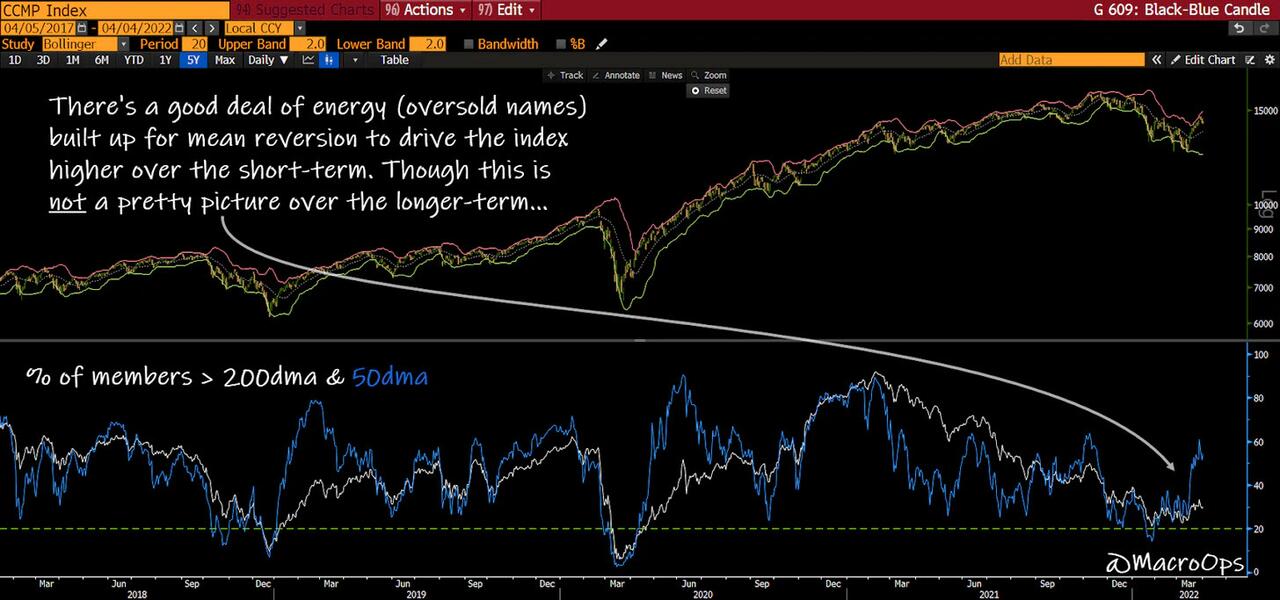
1. Sometimes breadth gets so bad it’s good. This is due to the power of mean reversion. One of the three driving factors of market technicals, the other two being trend, and momentum. This is the case for the Qs right now where the percent of members trading above their 50 and 200 day moving averages fell to the 20% level two weeks ago. The market bottomed soon after. Short-term this is bullish. Longer-term these weak breadth trends are bearish…
2. Sentiment and positioning have also been a tailwind to the bulls as of late. Here’s a chart of the aggregate commercial hedger positioning amongst the major indices, showing near record longs (implying very short specs).
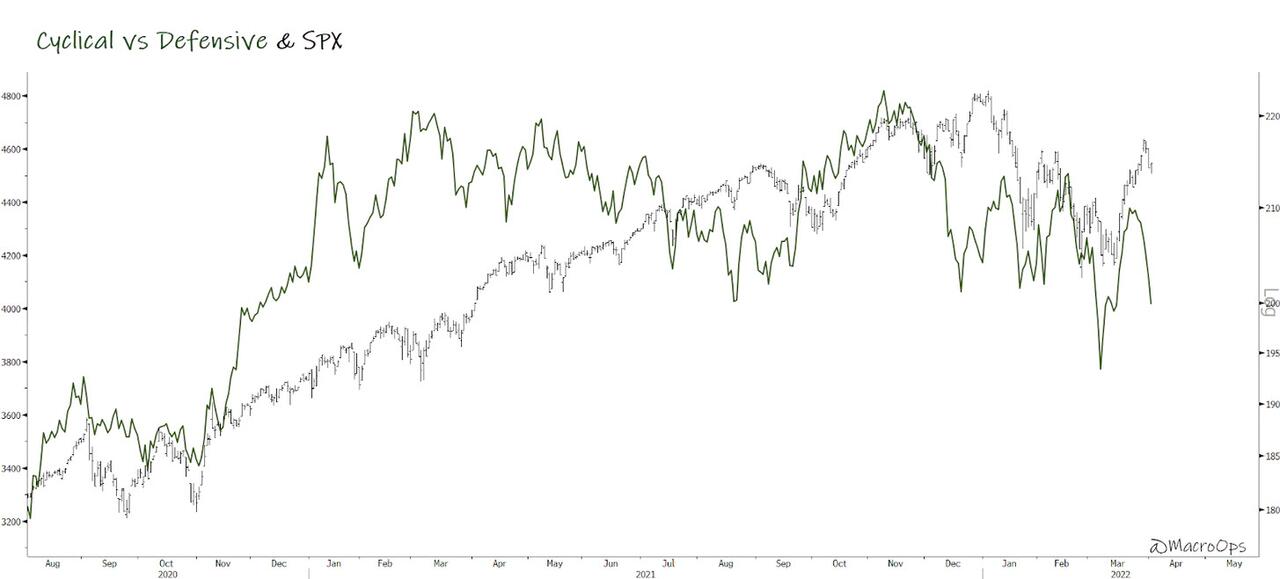
3. Not all is rosy though and one thing you should be tracking is Cyclical vs. Defensives, which led the market weakness at the turn of the year.
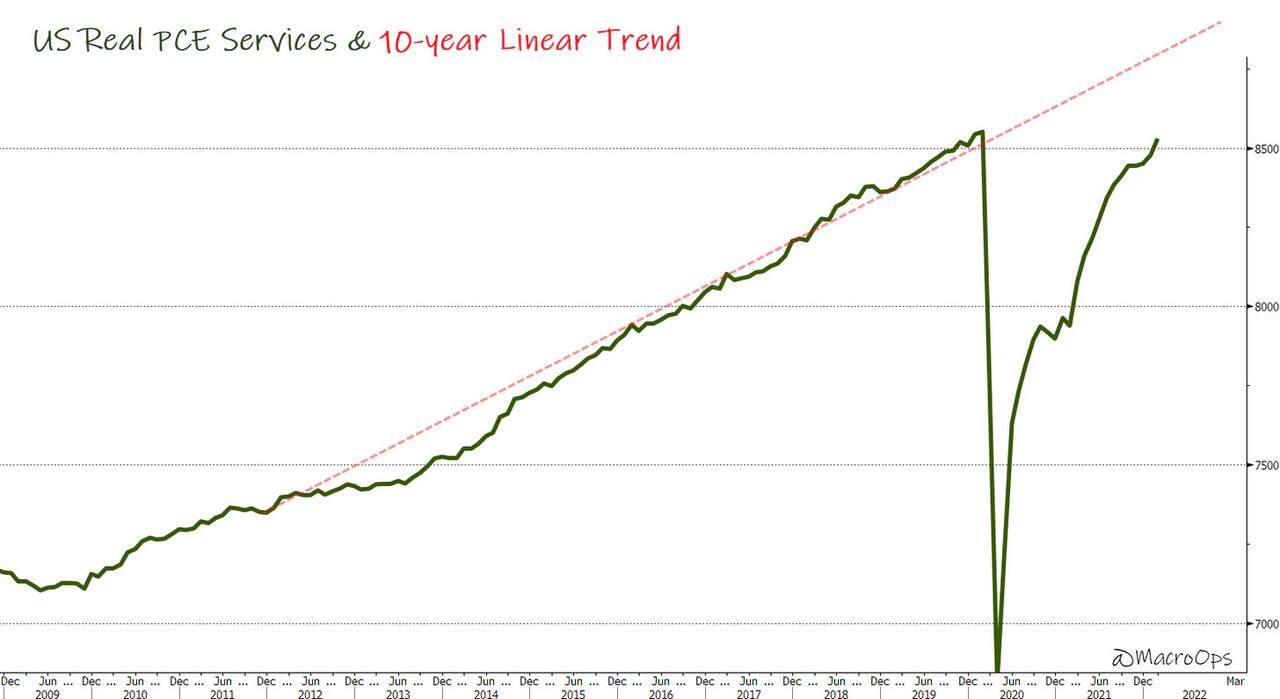
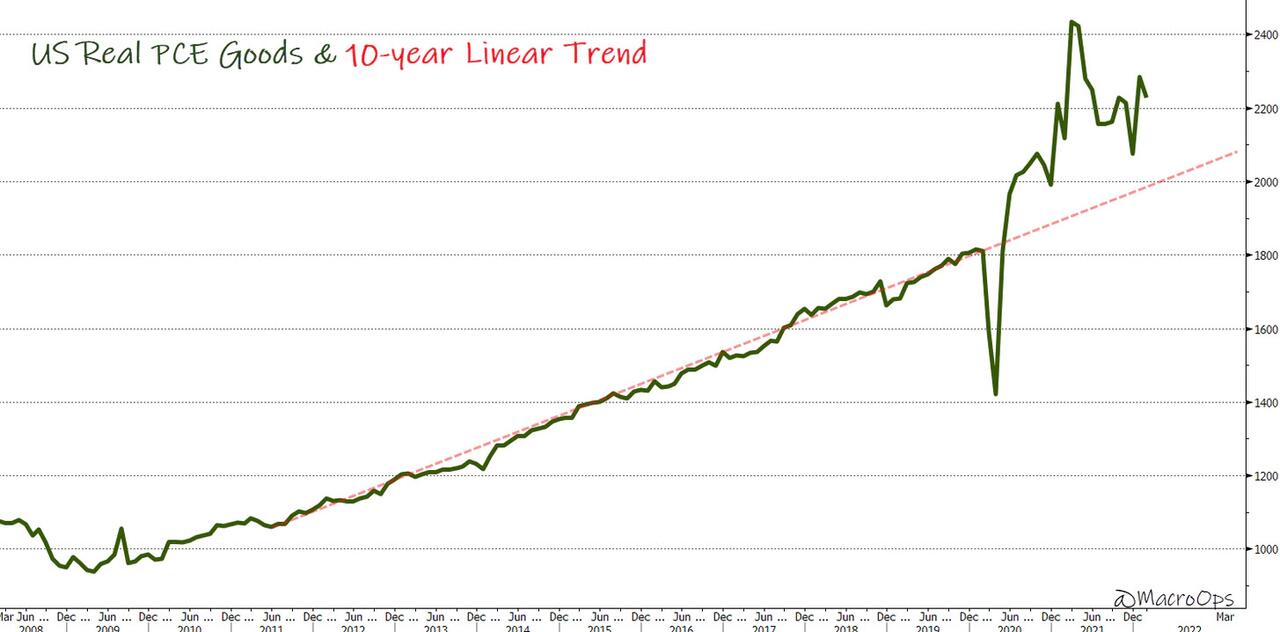
4. We are witnessing the great convergence between services and durable goods. Expect a continued pickup in consumer demand for services and experiences…
5. And a slowdown in goods which should ease up pressure on supply chains as well as inflation.
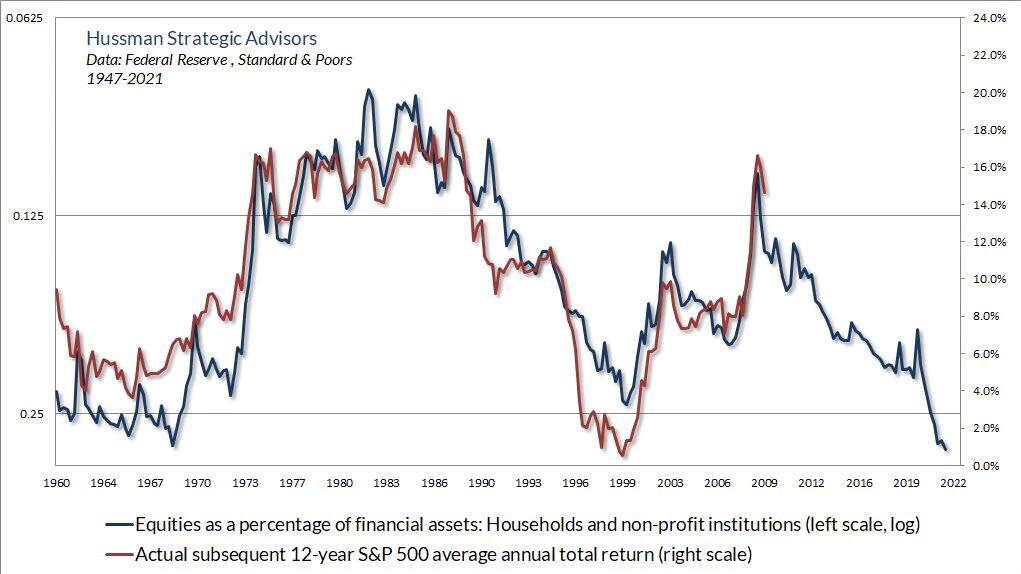
6. US equities are a bit rich… @hussmanjp tweeted the following last week:
So this is fun. The share of household financial assets invested in stocks ended 2021 at the highest extreme in history (and our most reliable measures are even worse). The last two times we got close, the S&P 500 lagged T-bills for the next 13-18 years.
This is the perfect long-term backdrop for precious metals though (link here)…
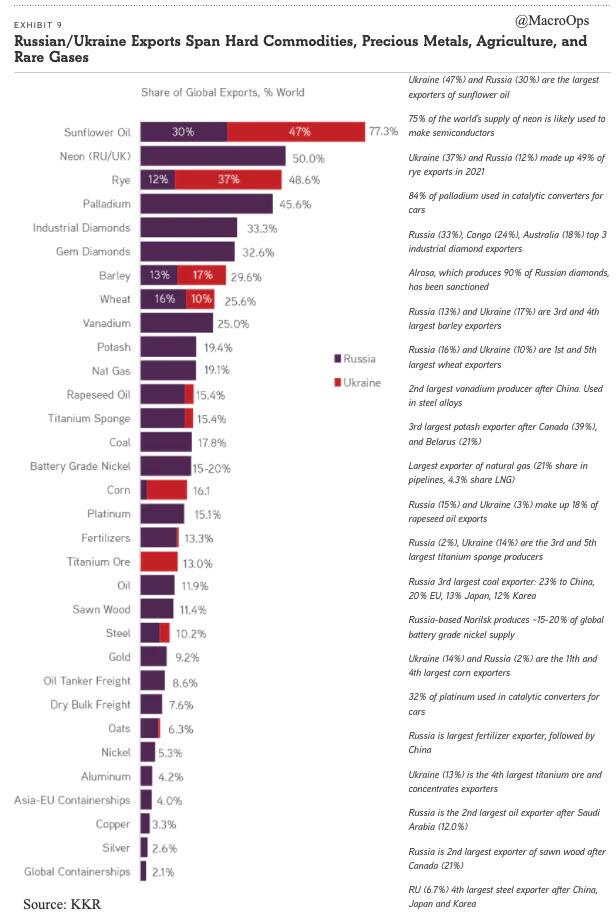
7. Russia/Ukraine Commodity exports as a % of world total via KKR.
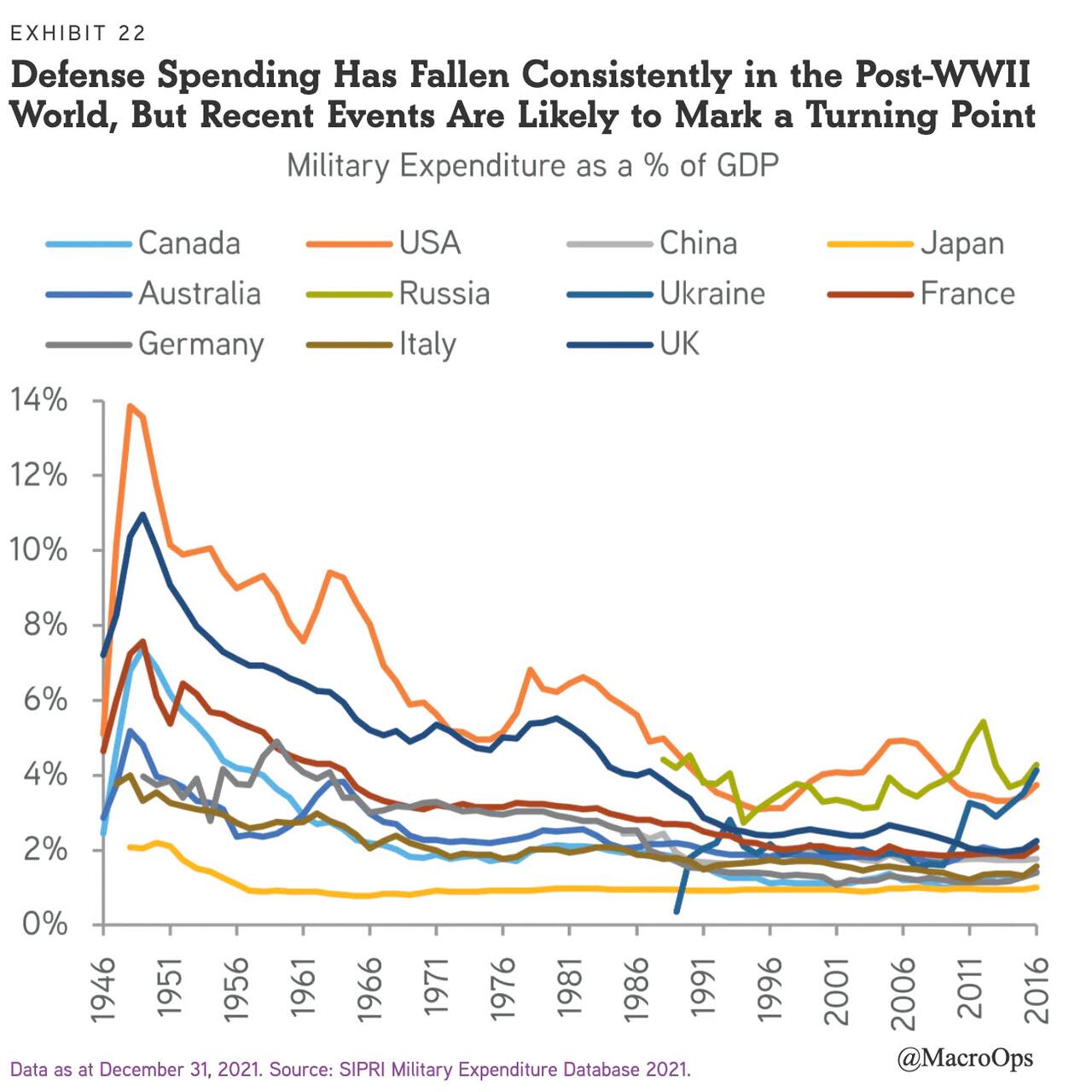
8. Sadly, it’s probably a pretty good bet that we’re starting a new secular bull in defense spending (chart via KKR).
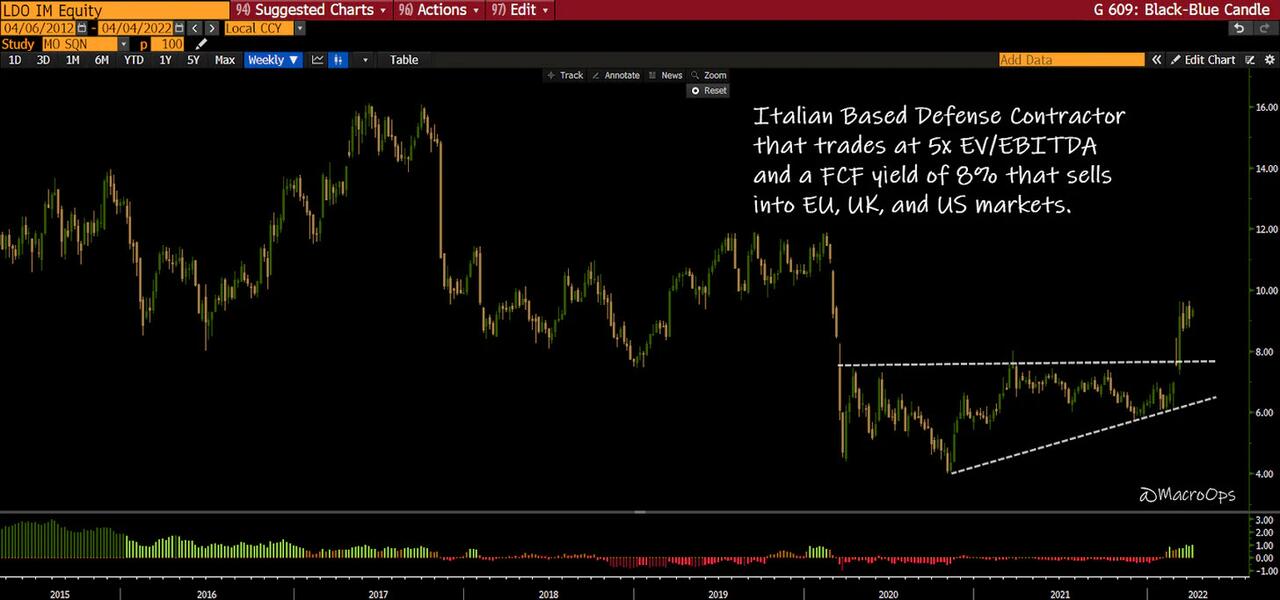
9. Leonardo (LDO:MIL), an Italian-based defense contractor, will be a big beneficiary of this trend. LDO sells into markets across the EU, UK, and the United States. The stock is cheap, has broken out from a major triangle bottom, and has a few fundamental catalysts coming down the pipe to drive improved growth and margins. We’ll be putting out a report to Collective members on the company soon.
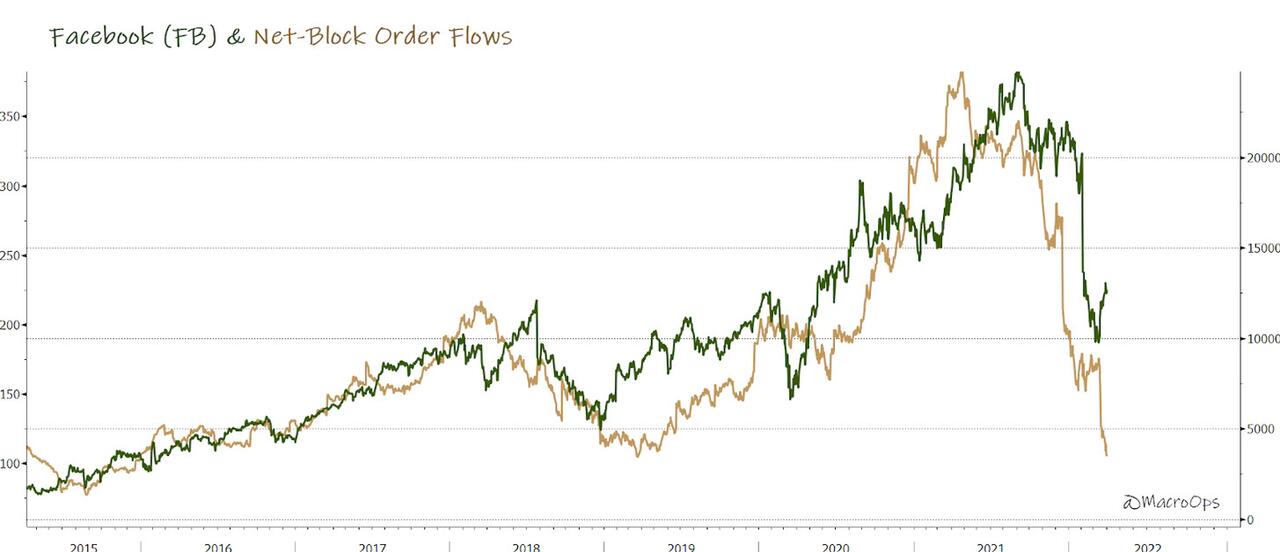
10. Net-block order flows don’t paint a pretty picture for FB. Note that this gave a solid lead on the selloff.
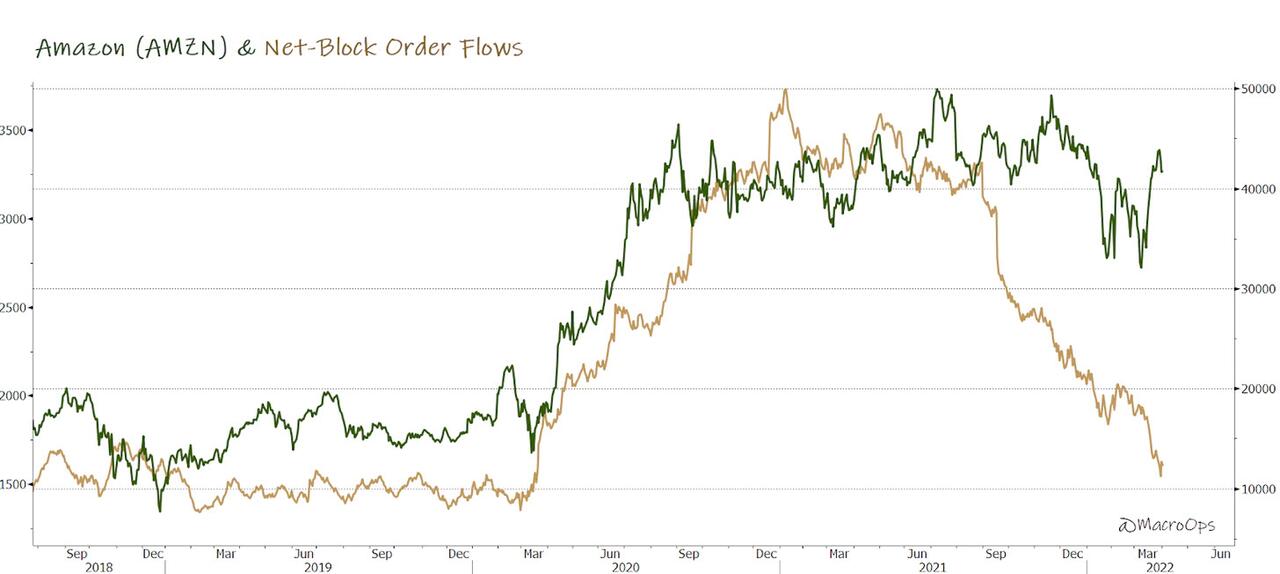
11. Same with AMZN... The whales are dumping their holdings of big tech, passing the shares to future bag holders.
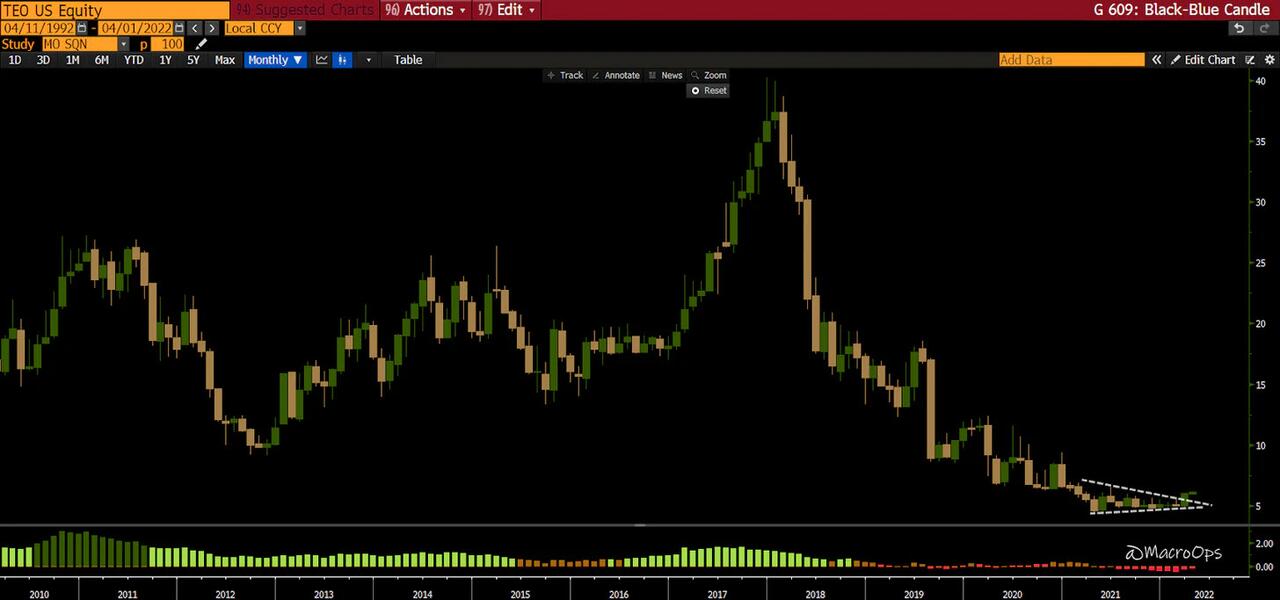
12. Here’s another Argentinian stock (last week I shared TGS). This one is TEO, a TelCo play. The chart below is a monthly. I know nothing about the fundamentals. They’re probably garbage. And, again, this is an Argentinian stock so full caveats apply. But… there are some great long-term technical setups in that market and they’re a large exporter of Ags, so *shrugs*...
Stay frosty and keep your head on a swivel.

(ZH) Iran Says Nuclear Negotiations Effectively Over, Blames US for Impasse

Iran Says Nuclear Negotiations Effectively Over, Blames US for Impasse

Officials with Iran’s Foreign Ministry are giving indications that the Vienna negotiations are not just "stalled" but effectively over. They say they are prepared to return to Vienna to sign the final deal, but not if it’s just for more negotiations.
Its not always clear how the Vienna talks are going since the US and Iran have been the only really negotiating parties for weeks, and they don’t meet face to face. Indirect talks through EU negotiators look similar no matter how active they are.
Iran's Foreign Ministry spokesman Saeed Khatibzadeh, IRNA/AFP via Getty Images
All the reports of things being "close" seem to be accurate, with Iran interpreting things as finished, and just waiting for the US to settle any internal issues on accepting the final pact.
The big question remains the removal of Iran’s Revolutionary Guards from the US terror blacklist, something that is politically difficult for the US. Iran is also keen to get a US assurance that the next president won’t unilaterally withdraw from the deal, but that may not be achievable.
Iran’s Foreign Ministry spokesman Saeed Khatibzadeh accused the United States during a Monday press conference:
Khatibzadeh accused the United States of bringing the talks to a "suspension point." He said, “What has become clear for us in the last two weeks is that [US President Joe] Biden and the White House have not made a decision.” He continued that the United States has made the nuclear talks a "hostage" in domestic partisan issues.
...He added, “The US is responsible for the suspension of the negotiations.” If talks are resumed, the United States must provide a “logical answer” to Iran’s demands, Khatibzadeh said.
State Dept officials offered an unusually upbeat assessment, saying they believe differences can still be overcome. This is a stark difference to their usual predictions that the deal will fall apart. It’s not clear if they picture more negotiations either, or if they, who also believe the deal is near, might resolve the last little bit on their own.
Iran’s Foreign Ministry also indicated openness to resume other talks in the region to resolve key issues outside of the nuclear deal, including getting back to bilateral talks with Saudi Arabia.
Efforts to keep regional issues separate from the nuclear one is probably a good idea, because some regional powers, like Israel and Saudi Arabia, are so generally hostile to Iran that they’re liable to use anything and everything as an excuse to pressure the US away from a nuclear pact.

WWD : Chanel Blocks Sales to Russian Passport Holders, But Not in China

Chanel Blocks Sales to Russian Passport Holders, But Not in China
As of Tuesday, it appears that the retail team in China was never instructed to ask Russian nationals to sign any declarations before making any purchase.

LONDON — While Chanel is restricting sales to overseas Russians in Europe, the Middle East and North America because of its invasion of Ukraine, it appears that Russians in China, a nation that has not yet imposed any sanctions on Russia, are not required to sign any papers when shopping at Chanel, according to salespeople working at the brand’s stores there.

A sales associate, who requested anonymity, told WWD that as of Tuesday, the retail team was never instructed to ask Russian nationals to sign any declarations before making a purchase. In China, there are a considerable number of Russians living and working in cities like Shanghai, Guangzhou, Shenzhen and Hong Kong, where Chanel has a retail presence. In theory, they can act as shopping proxies to help those in Russia buy from Chanel without a problem.

Over the weekend, Chanel was once again caught up in controversy as wealthy Russians, who fled to places like Turkey and Dubai to continue their luxury lifestyles, found out they are no longer welcomed at Chanel in those countries.

Lisa Litvin, a Russian interior designer at Partners Pro, was among the first to share her in-store experience.

“I went to a Chanel boutique in the Mall of the Emirates. They didn’t sell me the bag because (attention!) I am from Russia,” she wrote on Instagram last Friday.

She was told that Chanel “has a new order that they only sell after I sign a piece of paper saying that I won’t wear this bag in Russia,” and she has to provide ID details and a Russian phone number.

“Next, the manager said that starting from today they were selling to Russians only if they sign an agreement not to wear their items in Russia,” she added.

Her Instagram account has been private since Monday.

Fashion show presenter Anna Kalashnikova claimed that Chanel refused to sell her earrings and a bag in Dubai because she is a Russian celebrity.

She also claimed a manager at the store told her that, “We know you’ll be taking purchases to Russia, so we can’t sell our brand’s items.”

Russian influencer Yana Rudkovskaya, the wife of Olympic figure skating champion Alexander Plyushenko, who is said to have spent more than 1 million euros at Chanel over the years, said the ban is “somewhat humiliating.”

“This is a shock for a woman who’s been buying Chanel and Chanel Haute Couture for more than 20 years, and who sat at its shows in the front row,” she added.

Maria Zakharova, Moscow foreign ministry spokeswoman, later accused Chanel of joining “the Russophobic campaign to cancel Russia.”

In a statement sent to WWD, Chanel said “the most recent EU and Swiss sanction laws include a prohibition on the ‘sale, supply, transfer or export, directly or indirectly, of luxury goods to any natural or legal person, entity or body in Russia or for use in Russia.’ Under the applicable EU sanctions, this prohibition applies to luxury goods listed insofar as their value exceeds EUR 300 per item (CHF 300 under the CH sanctions).”

“This is why we have rolled out a process to ask clients for whom we do not know the main residency to confirm that the items they are purchasing will not be used in Russia. We recognize that this process of walking through the law has caused disappointment to some of our clients.

“We are currently working on improving this approach and we apologize for any misunderstanding this may have caused, as welcoming all our clients, regardless of where they come from, is a priority for Chanel,” the brand added.

Since the beginning of March, luxury players including LVMH Moët Hennessy Louis Vuitton, Hermès, Kering and Chanel have “temporarily” closed their stores in Russia in response to the escalating situation, although in some cases they continue to wholesale there.

Chanel at the time said it would no longer deliver to Russia.

“We will close our boutiques and we already suspended our e-commerce,” the company wrote. “The safety of our employees is our priority and we remain closely connected to our local teams who we will continue to support.”

WWD : KPMG Consumer Metaverse Study Indicates Enormous Potential and Enthusiasm

KPMG Consumer Metaverse Study Indicates Enormous Potential and Enthusiasm
It is estimated that 70 percent of brands will have a presence in the metaverse in the next five years.

While new applications of augmented reality might seem as surreal as the trailers for the upcoming Marvel movie, “Doctor Strange in the Multiverse of Madness,” the metaverse is more grounded, and safe. For brands, it offers a captured audience and seemingly endless new possibilities to engage.

According to a new consumer pulse survey report from KPMG, called “Go boldly, not blindly, into the metaverse: enabling a new consumer world,” nearly two-thirds of consumers are now familiar with the metaverse and, what’s more, they’re ready to interact.

Breaking down awareness, KPMG’s survey found 71 percent of males are familiar with the metaverse compared to 59 percent of female consumers. Awareness did trend higher from younger generations with 86 percent of Gen Z and 81 percent of Millennials reporting they are familiar with the metaverse.

With this in mind, the authors of the report said, “more likely than not, a big part of your customer base is already embracing the metaverse and is comfortable interacting virtually.” Put simply, by entering the metaverse, a company is meeting consumes where they are.

Moreover, just under half (46 percent) of consumers agree “the metaverse can provide a forum to interact with friends in a way that is as meaningful as in person” and 44 percent of respondents agree that “engaging with friends in the metaverse is an authentic way of interacting.”

For consumer and retail organizations, authors of the report said they are “limited only by the imagination” as they get ready to “take advantage of new business opportunities and selling channels” and win by developing a strategy for this market. In the luxury sector specifically, KPMG predicts tremendous growth opportunities, citing industry analysts who predict the growing demand for luxury goods in the metaverse could reach $50 billion by 2030.

Almost 60 percent of luxury consumers surveyed by KPMG reported they are participating on a metaverse platform — many of these platforms feature personalized avatars to reflect unique identities. “Luxury brands can offer digital products and services that help shape these identities — driving new revenue streams, testing new product innovations, increasing loyalty with existing customers and acquiring new customers,” authors said of the report.

Still, partnering with video games is just one way into the metaverse.

Underscoring the importance of continuing to provide an authentic, meaningful experience, KPMG notes it is important to ask the right questions to determine strategy:

• How are consumers engaging in the metaverse now?

• What is my brand strategy for the metaverse? What is it worth to my brand?

• Can you create an immersive experience?

• How will the decentralized internet improve customer engagement?

• What needs to be considered to address the data protection and privacy?

• Who will build your virtual kingdom?

Ultimately, the metaverse is still being built. The urgency, KPMG said in its report, should be placed on figuring out your brands impact on the metaverse and how it is impacting your brand rather than immediate execution.