(ZH) "The Biggest Story No-One Is Talking About": Why Albert Edwards Expects "So

"The Biggest Story No-One Is Talking About": Why Albert Edwards Expects "Something In The Market Is About To Snap"

It was exactly one month ago - on March 24 - when we first laid out the big dilemma facing the Bank of Japan, which on one hand was hoping to avoid a currency collapse (for obvious reasons) and prevent a crash in the yen, while on the other hand, was also hoping to keep the 10Y yield below its extremely dovish 0.25% yield curve control rate ceiling. The problem is that while the BOJ can control one or the other, it can't control both; this is what we said then:
Japan, that paragon of MMT crackpots everywhere, suddenly finds itself trapped in a lose-lose dilemma: intervene in the bond market and spark a furious, potentially destabilizing and uncontrolled plunge in the yen which would also lead to galloping (if not worse) inflation, which could collapse what little faith remains in the BOJ, or do nothing and contain the slump in the yen while risking far higher yields which in a country where the debt is orders of magnitude greater than GDP, could also spell fiscal and monetary doom.
As a result, the market - having long gotten used to amicable interventions from the BOJ - will now surely test one of these two outcomes, and how the BOJ responds could have dramatic consequences for this original MMT test case. Should the BOJ's reaction spark further erosion of faith in either Japan's fiscal or monetary policies, the outcome for the world's most indebted nation would be disastrous.
A few days later, SocGen's permaskeptic (he is not big a fan of the word "permabear") Albert Edwards picked up on this line of thought and in an extensive note laying out his thoughts on Japan's "lose-lose dilemma", added a new twist, namely that as the yen implodes, China - whose currency has been surprisingly strong even as its economy has hit a brick wall - will follow suit and devalue its own currency.
Since then two things have happened: i) as we predicted, the Japanese yen has crashed and as we discussed last week, suffered its longest stretch of one-day declines in history pushing it to a 20 year low, and prompting the BOJ to quietly beg Janet Yellen for some coordinated currency intervention (which however, the US Treasury shot down late last week)...
... and just as importantly, ii) the yuan has also suddenly cratered, suffering its biggest weekly loss since the surprise devaluation in August 2015, after tumbling 2.1%; in a move which we said on Friday has spurred "Whispers Of Yuan Devaluation After Biggest Weekly Plunge Since 2015."
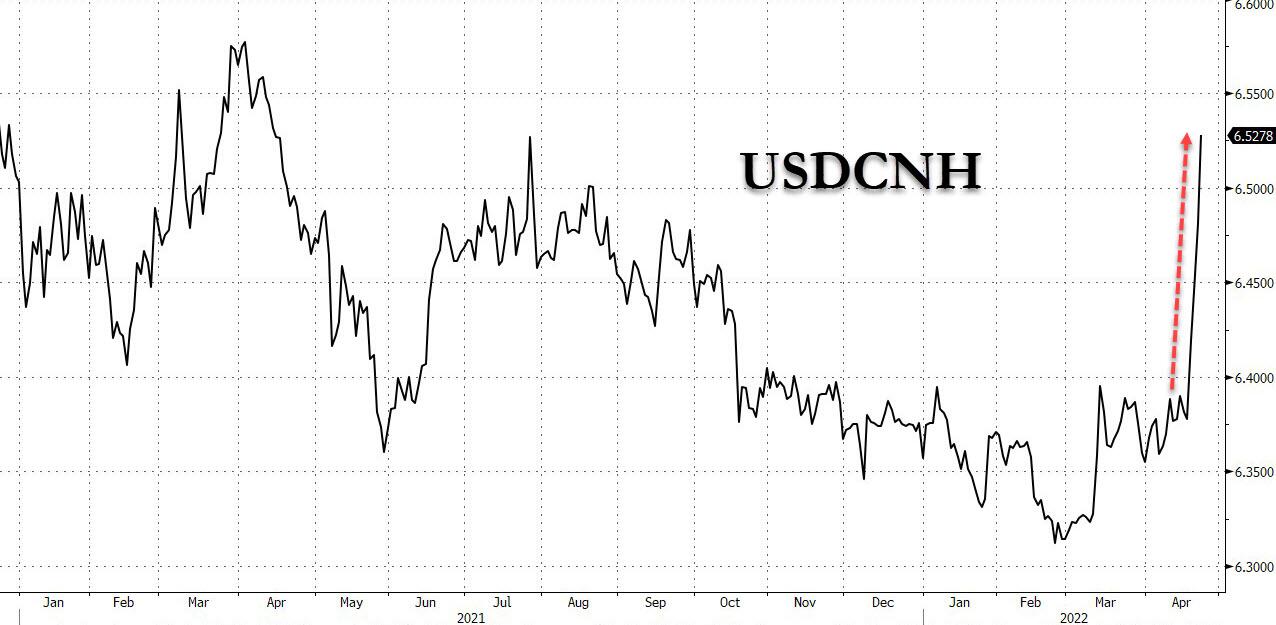
Ok, so both the yen and the yuan have cratered, largely due to fundamental schism in monetary policy as both Japan and China are the two major central banks who are currently easing (or in the case of China, mostly pretending to) even as the Fed is about to hike more than 10 times in 2022 according to market estimates. Hardly shocking and to be expected (at least for our readers).
But according to Albert Edwards, who refuses to let this story drop, not only is this divergence about to get much worse, but it will lead to catastrophic market consequences. It's also "the biggest story no-one is talking about."
In a note published late last week under the same title (and available to all professional subscribers), Edwards turns his attention to the yen and yuan, and writes that "surely all of us working in finance realize by now that something is likely to snap in the financial system and probably quite soon."
Why? Because according to the SocGen strategist, "the rapidity of current market moves and the polarisation of the now extreme Fed (hawkish) and BoJ (dovish) policies almost guarantees that outcome.... Maybe the outcome wouldn’t be so ugly if central bankers had not spent recent decades ramping up asset prices to today’s grotesque levels through their monetary incontinence. But they did."
Comparing the monetary policy divergence between the US and Japan to "a car crash in slow motion", Edwards writes that polarization in central bank monetary policy between the US Federal Reserve and Bank of Japan is being stretched ever wider to the point where "at some point soon your life might even flash before you (btw that really does happen. I know because it has happened to me twice, although only one was a vehicle collision)" he writes.
And while nobody died trading FX on Friday (that we know of), that's when the Bank of Japan continued to hold the line on its Yield Curve Control policy capping the 10y JGB yields at 0.25%, and even offered a second round of extremely dovish unlimited 10y bond purchases for a four-day period; at the same time the Fed's "super hawks" were trying to convince the market that a series of 50bp (or even 75bps) Fed Funds hikes were imminent (and judging by the crash in the Dow, they may have succeeded). Between these extremes of behavior, Edwards adds that "what the ECB and PBoC are getting up to is effectively just a sideshow, although still an important one."
It's not just Edwards who focuses on the divergence between the Fed and the BOJ: frequent ZH guest, Larry McDonald, author of the excellent Bear Traps Report writes that the current policy divergence consists of “a) the PBOC (cutting rates, 530bn yuan additional liquidity), b) the ECB winding down net asset purchases this quarter and setting up for a 2H rate hike, c) the BoJ’s aggressive balance sheet expansion, and d) the Fed’s promising 9-12 rate hikes looking out a year with QT aggressively involved.” and concludes “This type of insane monetary policy divergence will clearly break something, that is certain."
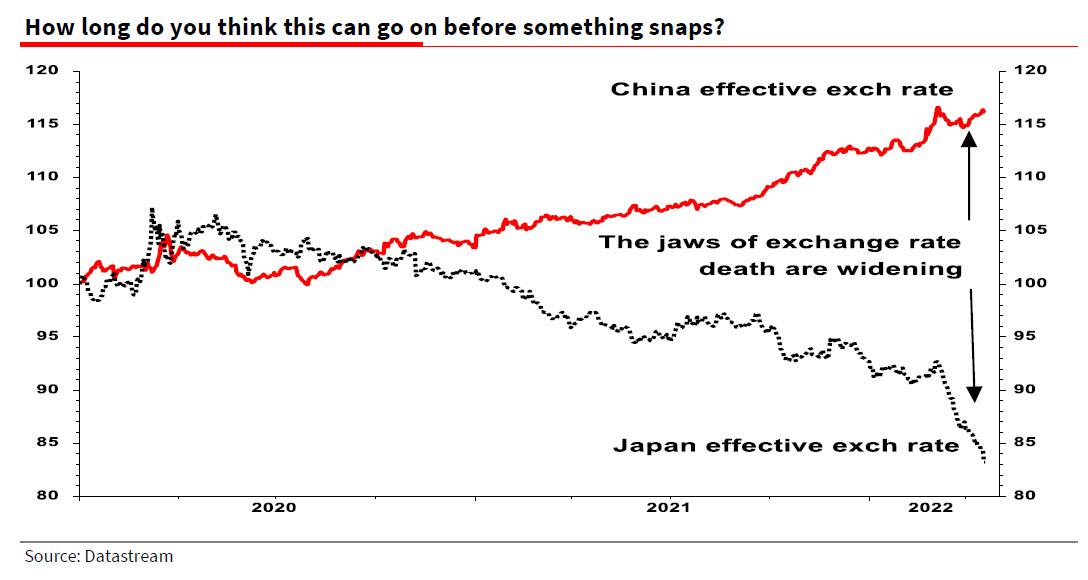
Picking up on this dire warning, Edwards notes that one place where something might break soon is in China; he quotes SocGen China expert Wei Yao who believes that the Chinese "economy is now in severe distress and requires aggressive easing. In that context, its strangulation caught between a rising renminbi and a slumping yen, is simply intolerable." This divergence - which SocGen calls the "jaws of exchange rate death" can only go on for so long before something snaps...
Stepping away China's problems for a moment, Edwards turns the spotlight to the Fed, whose "increasingly loud [and hawkish] chest-beating" is "for most commentators the most important financial market development at the moment."
Having moved from ‘expecting the recent surge in inflation to be transitory’ to admitting they are way behind the tightening curve, it seems the Fed is now willing to hike rates by 50bp multiple times this year. Meanwhile bond prices continue to abseil at an increasingly rapid pace in the face of this gathering gale.
Here Edwards interjects that a just as important development is what we first highlighted a month ago, namely that "the BoJ is engaged on an equally aggressive demonstration of their power – this time in refusing point-blank to acknowledge that 10y JGB yields will hardly even rise above 0.25% despite soaring yields elsewhere in G7. Its Yield Curve Control policy is not just being maintained, but the quantity of QE needed to maintain YCC is accelerating at warp speed. Japan central bankers are now also beating their chests in a demonstration of their power unseen in my working lifetime."
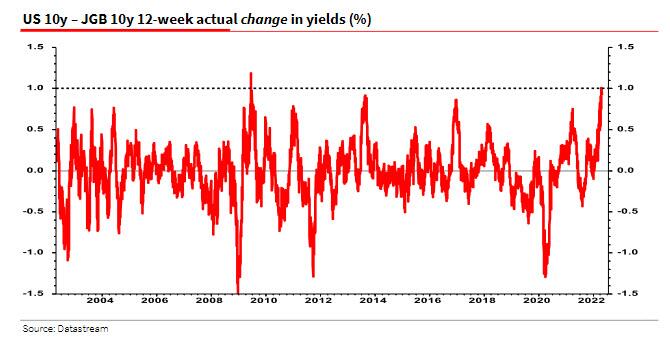
One can see the direct result of this in one of the most rapid divergences in the US-Japan 10y spread in history.
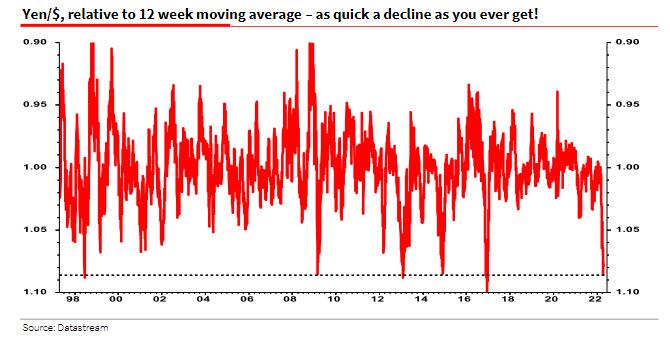
One can also see the consequence of this yield and QE/QT divergence in the rapidity of the yen exchange rate decline recently.
Of course, in the end one of the two central banks will capitulate first, and that will most likely be the BOJ as it has far less firepower - both monetary and verbal - than the Fed. One can watch this in real time as US Treasury yields soar higher, while the 10y JGB yield keeps knocking at that 0.25% YCC door "and the louder it knocks, the more rapidly the yen plunges." Indeed, as we forecast a month ago, at some point, either the yen will snap, or the BOJ's defense of the upper YCC barrier will fail (or both).
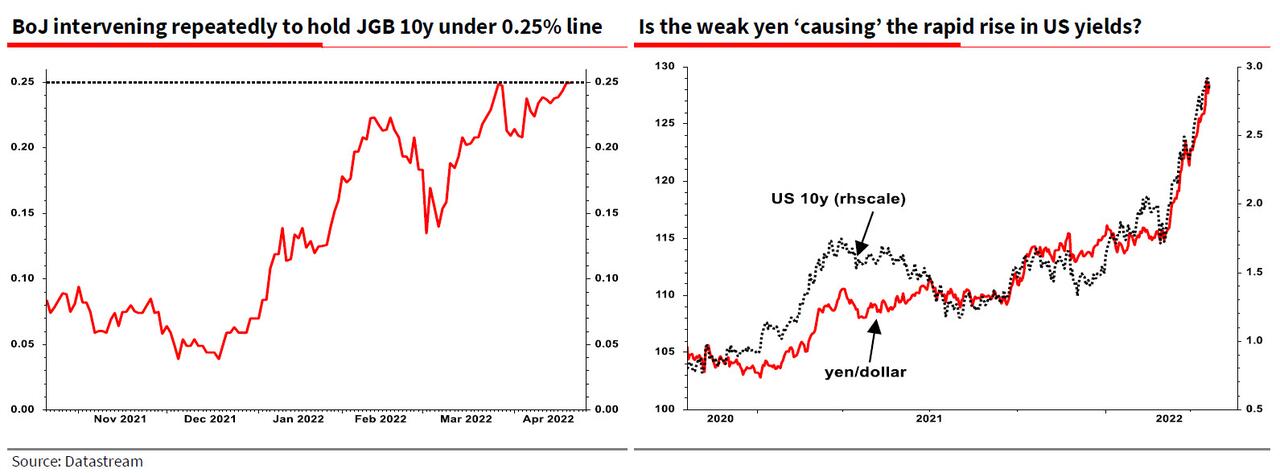
What happens then? Well, according to Edwards, the crashing yen has been propping up US Treasuries, as yen carry traders flee local assets and find (relatively) safety in US paper. This means that any direct intervention to prop up the yen by the BOJ will lead to another snap higher in US yields as the Japanese carry trade buyer drops out of the picture.
But the move higher in US yields would be child's play compared to the total collapse that would follow in Japan as the entire MMT paradigm is exposed for one epic fraud. To wit, when answering the question what happens to JGB yields when the BOJ pulls an RBA and no longer defends the 0.25% barrier, Edwards writes that while "the BoJ will persist in maintaining the 0.25% cap and all that implies" once "it abandons this ceiling or resets it higher" look no further than Australia for what happens next, which he shows shows below.
The conclusion: "When Australia ended YCC yields snapped higher – much higher!" A similar interest rate move in Japan, still the world's second largest economy, and one can kiss all remaining central bank credibility goodbye forever... and with it, also say goodbye to the fiat regime, which perhaps may just be the endgame here.

Business Of Fashion : Nike and RTFKT Reveal Their First Virtual Sneakers

Nike and RTFKT Reveal Their First Virtual Sneakers
The shoes were unveiled after holders of the first co-branded NFT from the companies spent months solving elaborate riddles to unlock it.

Variations of RTFKT's virtual Nike Dunk sneaker. (RTFKT)

In February, the virtual fashion start-up, which Nike acquired last year, had released a non-fungible token it called the MNLTH, a metallic cube bearing both the RTFKT and Nike logos. Since then, owners of the MNLTH NFTs have been completing “quests” RTFKT posted on Twitter and in its Discord channel in order to discover what was inside.
The answer, revealed today, was a pair of virtual Nike Dunk sneakers whose look owners appear to be able to change with different digital skins. Opening the MNLTH yielded the sneakers, one “skin vial” and another MNLTH, suggesting future reveals to come.
RTFKT has emerged as one of the most prominent names in the NFT space, releasing collaborations with different partners that fetch high prices online. One NFT from its collection with artist Takashi Murakami sold for more than $1 million in February.
The market for NFTs has cooled some since a surge last year, but many brands are still just getting started exploring the space. Gucci and Adidas, for instance, have released their own NFTs that serve as digital collectables but also have features of membership programmes, granting owners access to different perks.

Business Of Fashion : Is It Time for Gap Inc. to Go Private?

Is It Time for Gap Inc. to Go Private?
Market share is shrinking, discounts are deepening and the group’s once-powerful grip on the consumer has disintegrated. As a public company, its options are limited.

Gap is in crisis, once again.
On Thursday, the San Francisco-based apparel retailer announced the abrupt exit of Old Navy chief executive officer Nancy Green, whose success building the company’s activewear brand Athleta earned her the top job at Old Navy when Sonia Syngal was promoted to boss of the group.
Green may have done well with Athleta — the business reached nearly $1 billion in sales when she was running it — but she was generally not viewed as a good leader, according to former and current executives.
“The sudden nature of Green’s exit indicates that Gap’s casual statement about it being time to bring in someone new to head up the brand is somewhat fanciful,” said GlobalData retail analyst Neil Saunders in a note. “There has clearly been tension or something which has led to this abrupt change during a critical time.”

Whatever was going on behind the scenes, it’s clear that Old Navy, once the brand carrying the rest of the business, is in trouble. The company said sales would be down by the low double digits in the first quarter of its 2022 fiscal year. It’s blaming “macroeconomic challenges,” but also poor execution, warning that there would be even more discounting than usual.
On Friday, the stock dipped 20 percent to $11.50 per share after the news of Green’s exit, down about two-thirds from a year ago, illustrating why this firing and the sales warning felt like catastrophic news for the parent company. Old Navy accounted for nearly 55 percent of Gap Inc.’s sales in its most recent fiscal year, and has historically has been a reliable growth engine as Gap and Banana Republic’s market share continued to shrink. But its cute branding is no longer enough for many price-driven consumers, who are buying online from Amazon and Shein, which offer trendier, and sometimes cheaper, garments.
Gap Inc. has spent the last few years pruning its portfolio, selling off smaller, less-aligned companies like multi-brand store Intermix and kid’s label Janie and Jack. And as it closed more Gap stores in order to “right size” the business, it used that prime real estate to open Athleta stores, capitalising on the demand for activewear through broadened distribution.
More sales don’t always equal more profits, however, and Gap Inc.’s margins continue to suffer. An attempted revival of Banana Republic, which garnered favourable press, has attracted higher income shoppers and helped to increase the average amount of money people spend at the store, but has yet to result in growth. Gap, the brand, has made headlines over the past year with its Yeezy collaboration, but has yet to prove that the theoretical popularity of that collection — which is not sold in Gap stores and does not include many products — has driven sales to the core brand.
While many consumers still seem to have a sentimental attachment to Gap, it’s not enough to make it their go-to retailer. The products simply aren’t as compelling as they used to be, and the stores feel like they haven’t been updated in decades.
Over the past 10 years, the company has considered selling off one of its bigger divisions — like Gap or Banana Republic — according to former executives. It also publicly made a play for Old Navy to IPO in hopes of improving overall prospects. However, it may now be time for the business to be taken private in the face of dwindling returns. The likely buyer, should the company pursue this option, would be a private equity firm that deals with retailers in transition.
The challenge for the board of directors — which still includes three members of the founding Fisher family, who own more than 40 percent of the company — is that it would have to sell at what they might consider a discount. At the same time, the turnaround efforts have so far proven that the company is not currently able to do more than play the price game, a competition that is increasingly difficult to win.
Added Saunders, “Although the Gap group has been more creative of late, there is a still a sense that this is a retailer which is really struggling to focus its efforts around a coherent plan for success.”

CrunchBase : The Week’s 10 Biggest Funding Rounds: More Musk As The Boring Compa

The Week’s 10 Biggest Funding Rounds: More Musk As The Boring Company Digs Up $675M, Upside Foods Cultivates $400M Round
This is a weekly feature that runs down the week’s top 10 funding rounds in the U.S. Check out last week’s biggest funding rounds here.
If the venture market truly is slowing down, it is interesting to see how investors are placing bets in so many different areas. It would seem logical in a down market to bet on tried-and-true platforms, but this week VC put money into Elon Musk’s big-dig company, a meat grower and an electric vertical take-off and landing aircraft (eVTOL) firm. And that was just the top three rounds of the week. Even in this market it seems VCs are willing to dream big.

1. The Boring Company, $675M, infrastructure: Elon Musk has had a hard time staying out of the news recently—although he surely doesn’t mind. The Boring Company, one of several companies founded and/or led by Musk, closed the biggest round this week when it landed $675 million at a nearly $6 billion valuation. The round was led by Vy Capital. The Boring Company is responsible for the Vegas Loop—an electric high-speed public transportation system—and the Prufrock, a large piece of construction equipment that mines underground. The company last raised $120 million in July 2019 and has now raised more than $900 million, according to Crunchbase.

2. Upside Foods, $400M, foodtech: This week saw the largest raise for a startup in the cultivated meat space ever. Berkeley, California-based Upside—which claims to be the first cultivated meat startup to produce lab-grown meat from multiple species—locked up a $400 million Series C led by Temasek and Abu Dhabi Growth Fund at a valuation of more than $1 billion. Founded in 2015, the company has raised more than $600 million to date, according to Crunchbase data. The new round is just the latest in the growing sector. Last year was a record for the foodtech industry, as more than $12.8 billion was invested, according to Crunchbase.

3. Beta Technologies, $375M, aviation: With everyone talking about supply chain disruption, some companies are looking to solve the problem: Case in point, South Burlington, Vermont-based Beta Technologies. The electric vertical take-off and landing aircraft (eVTOL) maker touched down on a $375 million Series B led by TPG Rise Climate and Fidelity Management & Research Co. The company, which hopes to achieve Federal Aviation Administration certification by 2024, is looking to help improve both last-mile and regional cargo delivery—including that of human organs. Founded in 2017, the company has raised nearly $890 million, according to Crunchbase.

4. Crusoe Energy Systems, $350M, energy: While the market for all things bitcoin is growing, so is the environmental concern over how much energy is used to mine it. That’s where Denver-based Crusoe is looking to help. The company helps power mining by harnessing natural gas that is typically burned during oil extraction and puts it toward powering the data centers needed for bitcoin mining right at the drilling site. That business model was enough to close a $350 million Series C equity round led by G2 Venture Partners, as well as credit facilities of up to $155 million. The new round values the company at $1.75 billion, according to The Information.

5. Tessera Therapeutics, $300M, biotech: What if scientists could write therapeutics right into your own genome to cure a disease right at its source? Sounds kind of science fiction-y, but that is what Somerville, Massachusetts-based Tessera Therapeutics is trying to do. The gene-writing technology firm closed a $300 million Series C, which included investment from SoftBank Vision Fund 2 and funds and accounts advised by T. Rowe Price Associates. Founded in 2018, the company has raised more than $530 million, according to Crunchbase data.

6. Reify Health, $220M, health care: Boston-based Reify Health raised a $220 million Series D co-led by Altimeter Capital and Coatue that values the company at more than $4.8 billion. Founded in 2012, the company, which develops cloud-based software tools for the clinical trial ecosystem, has raised nearly $480 million, according to Crunchbase.
7. (tied) Convoy, $160M, supply chain: Seattle-based digital freight network Convoy closed a $160 million Series E equity round led by Baillie Gifford and funds and accounts advised by T. Rowe Price Associates, along with a $100 million venture-debt investment. ​​The equity round values the company at $3.8 billion.

7. (tied) Lygos, $160M, biotech: Berkeley, California-based biotechnology company Lygos took in $160 million of growth capital as part of an agreement to merge with publicly traded Flexible Solutions International, a developer and manufacturer of biodegradable products. Founded in 2011, the company had raised $50 million before the announced merger.

9. (tied) Agility Robotics, $150M, robotics: Corvallis, Oregon-based Agility Robotics raised a $150 million round led by DCVC and Playground Global. The recently announced Amazon Industrial Innovation Fund also participated in the round. Founded in 2015, the company has raised more than $175 million, according to Crunchbase.

9. (tied) Oyster, $150M, human resources: Employment platform developer Oyster—with offices in San Francisco and London—raised $150 million in a Series C led by Georgian at a $1 billion-plus valuation. Founded in 2020, the company has raised a total of $227 million to date.

FT : Fundraising takes Cambridge venture investor to $1bn of assets under manage

Fundraising takes Cambridge venture investor to $1bn of assets under management
CIC likens innovation and entrepreneurship in UK university city to Silicon Valley

Cambridge Innovation Capital has raised its largest round of funding to date as the venture investor seeks to capitalise on the UK city’s growing life sciences and tech economy.

CIC — which benefits from a unique contract with Cambridge university — has raised £225mn to invest in early stage start-ups operating in areas from cell therapies to quantum computing, bringing it to $1bn in assets under management.

Andrew Williamson, managing partner, said Cambridge was reaching a concentration of research and innovation that he had only previously seen when he worked in Silicon Valley.

“Every dinner party you go to, every parent you meet at a kid’s soccer game, they are working in innovation or entrepreneurship or commercialisation,” he said. “It’s reached that critical mass where it’s feeding on itself.”

Williamson added that until recently, the missing piece had been large corporations to provide a talent base and opportunities to partner. But Cambridge’s expertise in artificial intelligence, antibodies, and cell and gene therapies had now attracted both Big Tech and Big Pharma.

“Our offices are on Station Road and I’m looking at Microsoft, Amazon, Samsung and AstraZeneca all on the same street,” he said.

While Oxford showed the world its biomedical prowess by creating a Covid-19 vaccine, Cambridge has had a more mature life sciences ecosystem. Together with London, they form the so-called Golden Triangle cluster.

About half of the investment in the round came from UK funds, with other investors in the US, the Middle East and Asia. Williamson said the firm was attracting more interest from UK investors, despite regulatory hurdles for pension funds such as caps on fees that deter active management, which he hopes will soon be removed.

“We are keeping on at politicians to make sure that gets done this year,” he said. “I think we are going to soon unlock quite a lot more UK pension fund money . . . and that’s likely to start by coming into the later stages, the more de-risked scale-up rounds.” 

VC investment in Cambridge has almost doubled every two years since 2017, according to data platform Beauhurst. In 2021, companies received £1.5bn in funding, £800mn of which went into later stage rounds.

CIC focuses on “series A” funding — companies’ first significant round of venture capital financing — but its limited partners have joined in later rounds for the most successful start-ups.

About half of its investments come directly from intellectual property created by academics at the university. Its contract, which was renewed in 2018 and expires in 2033, allows it to invest alongside the university’s seed fund and gives it the right to participate in future follow-on rounds to scale up the spinouts.

CIC also runs two accelerators to form companies in the life sciences and “deep tech” sectors, such as AI and advanced electronics.

Williamson said a promising area for the city was the nexus between AI and life sciences, such as using machine learning for drug discovery.

“Often the best innovations come at the intersection or cross-fertilisation between sectors and in a university-centric culture like Cambridge, that just happens naturally,” he said. “A professor of AI meets a professor of drug discovery in the pub.”

FT : Failed UK power supplier Bulb pays millions in bonuses

Failed UK power supplier Bulb pays millions in bonuses
Payments using taxpayer funds were made to retain staff as ministers seek buyer for business

The failed gas and electricity provider Bulb Energy has been paying millions in bonuses to retain staff since its £1.7bn government bailout in November, according to people familiar with the payments.

Bulb was effectively nationalised last year after collapsing with 1.6mn customers. That has left the taxpayer with a bill which, according to official estimates, will reach £2.2bn by next year, making it the biggest state bailout since Royal Bank of Scotland in 2008.

The company continues to operate with taxpayer funds while in special administration as the government tries to find a buyer. But officials fear a staff exodus could affect its ability to continue servicing customers.

Hiring replacements would probably be difficult because of the UK’s tight labour market and the uncertainty surrounding the group. Around £2mn has been paid in quarterly retention bonuses so far, according to one person close to the government.

The payments, which are not in the employees’ contracts, are being made to retain key staff, including customer-facing people, to continue critical operations and to support the attempts to sell the business, said two people familiar with the matter.

The Department for Business, Energy and Industrial Strategy said the employee retention scheme was needed to “maintain operational effectiveness and support Bulb’s customers whilst the energy administrators discharge their statutory responsibilities and to support the process of finding a buyer for the company”.

The costs will add to the burden on taxpayers of supplier collapses at a time when energy bills are soaring. It emerged at a parliamentary hearing last week that Hayden Wood, chief executive and founder of Bulb Energy, was still being paid the same £250,000 salary he received before the company’s rescue.

Labour MP Andy McDonald, a member of the House of Commons business select committee, asked MPs last week whether it was “morally justifiable” for taxpayers to be paying Wood’s salary.

The company, which had never made a profit since being established in 2015, owed £254mn to customers who had paid for their electricity and gas in advance when it collapsed last November.

In March 2020 it recorded a £63mn loss despite sales of £1.5bn. However, Wood and co-founder Amit Gudka together earned more than £8mn from a share sale in 2018, according to figures first reported by the Sunday Times.

Bulb said: “As part of Bulb’s fundraise in 2018, shareholders were offered the opportunity to sell shares to allow new investors to buy into the business. Hayden participated in that share sale alongside other shareholders.”

Bulb was the biggest supplier out of the 29 companies that have failed since the middle of last year as a result of poor capitalisation, inadequate hedging and a rise in wholesale gas prices.

Although millions of customers from other collapsed suppliers have been transferred to solvent rivals, Bulb was considered too large so the costs are being borne by taxpayers.

Companies that took over smaller failed suppliers have claimed £1.84bn from the energy regulator Ofgem to cover the costs. This is being passed to customers through a £68 charge on every household bill in the year from April — contributing to the almost £700 rise in bills to £1,971 this year for those consumers on a tariff covered by the price cap.

Bulb’s special administration is being run by the consultancy Teneo but most of its staff are employed through its parent company Simple Energy, which is in a separate administration run by Interpath Advisory.

Staff had worked “incredibly hard” to ensure the business continued to trade “against the backdrop of personal uncertainty” created by the administration, said Interpath, which declined to confirm the size of the retention payments.

Separately, Centrica — the owner of British Gas — and Masdar, an energy company from Abu Dhabi declined to comment on a Sunday Times report they are among bidders for the business.

Lazards is advising on the sales process, where the second phase is under way. Bulb, Teneo and Lazards also declined to comment.