Crash Is King
This may be one of many revaluations of capital vis-a-vis labor and resources and core vis-a-vis periphery.
You've heard the expression "cash is king." Very true. But it's equally true that "crash is king:" when speculative excesses collapse under their own extremes, the crash crushes all other narratives and becomes the dominant dynamic.
Everything that the mainstream uses to predict "value," market action and "the future" is tossed out the window. Price-earnings, "growth," "innovation," cash flow, yields, the bat-guano-quatloo carry trade, etc., etc., etc.-- none of it stops the crash or makes sense of the crash, which happens for systemic reasons beyond conventional explanations.
In the context of conventional concepts of "value" and central bank power, crashes are impossible. According to conventional explanations, the central banks control the markets and so crashes are brief and shallow because the banks will quickly change course and flood the financial markets with free money.
In the conventional view, markets are rational and liquid: there will always be a a buyer for every seller (i.e. liquidity) because there will always be a rational reason and cash/credit available to buy an asset at the current price.
Crashes reveal this as false: there is no buyer for every seller in crashes because it's not rational to buy assets which have been grossly overvalued and are resetting at new valuations in a chaotic freefall. Indeed, the entire concept of "value" is in doubt, and as we all know, markets hate uncertainty.
Secondly, there may not be cash or credit available to purchase assets, as credit dries up as fast as liquidity: the last thing lenders want is for reckless gamblers to borrow their money and then lose it all trying to catch the falling knife.
This is why crash is king: when liquidity dries up, the entire structure of "there's always a buyer" collapses. When there are only sellers and few buyers, markets crash. When the underlying value of the asset can no longer be known with any certainty, it's not rational to gamble that the first or second leg down is "the bottom."
When future supply and demand are up in the air, tumbling chaotically, there is no way to pin down the value of anything. Money and credit are no different than any other commodity: the cost and value of money is dictated by demand for that particular flavor of "money" and credit. When "money" loses purchasing power and credit is no longer available, the demand for assets collapses right as assets are dumped to limit losses and raise cash.
It may be time to revisit core and periphery. Like many others, I find the model insightful and useful: The Core-Periphery Model (June 11, 2013).
Crashes reveal what's core and what's periphery because the core controls the destiny of the periphery. In systems terminology, the initial conditions set the parameters of potential options and the limits of the efficacy of various choices. The core's initial conditions are considerably more constructive than the initial conditions of the periphery.
In network terms, every connection between nodes runs through the core. This is not the case for the nodes. The dependency chains are asymmetric: each node looks stable and independent until push comes to shove. Everyone is dependent but some are less dependent than others.
The vast majority of the grandiose claims of what's truly core will be revealed as false in a crash. The crash in core assets is less severe and the bounce back is quicker, as the underlying value of the core resets more readily.
Crashes in the periphery are one-way slides. These assets never recover their speculative-excess valuations because the eventual reset of underlying value strips out all the artificial / phantom value.
It's instructive to look at these charts of the Japanese yen (USDJPY). Something is happening, and the punditry is rushing to stake claims of understanding it all. I am circumspect about this tsunami of explanations. There are a lot of major revaluations underway and these act as feedback for each other in complex ways.
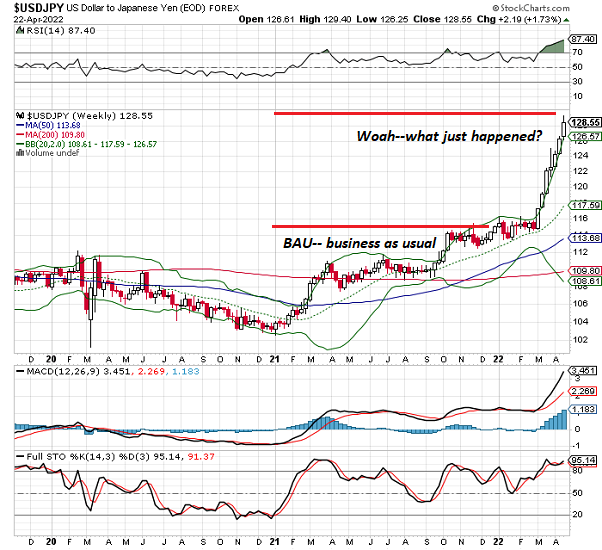

This suggests to me that any one explanation will very likely be wrong / misleading.
It may be nothing more than a zephyr, but I find it interesting that the long-term chart of the USD-Yen appears to be a multi-decade inverse head and shoulders which if it plays out would suggest a massive revaluation of the yen is underway in the direction of devaluing the purchasing power of the yen.
This may be one of many revaluations of capital vis a vis labor and resources and core vis a vis periphery. Cash may be king but when crash is king you have to choose the right kind of cash to avoid the general decimation of "wealth."
Every node claims to be core, but that's not how it works. There may only be one core. While the crash will garner everyone's attention, it's the aftermath of the crash that will inform us what's core and what's periphery.
China Unexpectedly Cuts FX Reserve Ratio To Support Plunging Yuan
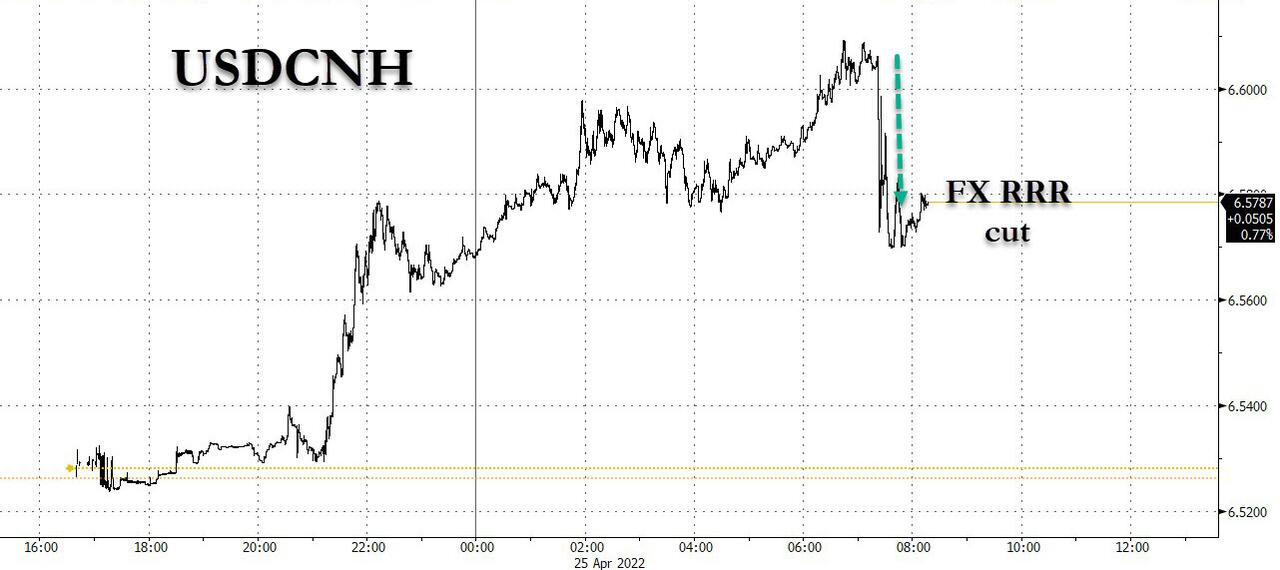
Just minutes after the offshore yuan's extended slide dragged it below the key psychological level of 6.60, a level not breached since Nov 2020, China signaled that while it is now ok with a sliding yuan, there is a limit how much devaluation it will take, and shortly after 7am EDT the PBOC moved to limit the drop in the yuan by cutting the reserve requirement, or how much money banks need to have in reserve for their foreign currency holdings.
The move, which is the opposite of a RRR hike unveiled by the PBOC back in December and which was meant to prevent the yuan from rising too far, came after the yuan plunged in reaction to a growing Covid-19 outbreak in Shanghai and as of this weekend, Beijing too. Financial institutions will need to hold 8% of their foreign exchange in reserve starting May 15, the central bank said in a statement Monday, down from than the current level of 9%.
In a statement, the PBOC said that the cut is aimed at “increasing banks’ capabilities of forex fund use” and will help liquidity management. The change would increase the supply of dollars and other currencies onshore and relieve the yuan’s weakness.
Today' cut follows two hikes last year when the central bank was trying to limit a strong currency, the opposite of the situation now.
While the news did manage to prop up the yuan modestly, with the offshore yuan narrowing arrowed its loss to 0.7% from 1.3% earlier in the day and trading at 6.5711 to the dollar after the announcement, it is still down on the day, and we don' anticipate any material reversal in the recent downtrend in the yuan since China' economy is desperately in need of more stimulus or faces a major hit to growth, both of which hint at far more weakness in the yuan.
Research Calls
- Upgrades:
- Advanced Micro (AMD) upgraded to Strong Buy from Outperform at Raymond James; tgt $160
- BioMarin Pharm (BMRN) upgraded to Overweight from Equal-Weight at Morgan Stanley; tgt raised to $113
- GoDaddy (GDDY) upgraded to Overweight from Neutral at Piper Sandler; tgt raised to $110
- Gap (GPS) upgraded to Buy from Neutral at Guggenheim; tgt $22
- Huntington Banc (HBAN) upgraded to Overweight from Equal-Weight at Stephens; tgt raised to $17
- Marvell (MRVL) upgraded to Outperform from Mkt Perform at Raymond James; tgt $80
- Downgrades:
- AGNC Investment (AGNC) downgraded to Neutral from Overweight at JP Morgan; tgt lowered to $11.50
- Alnylam Pharma (ALNY) downgraded to Equal-Weight from Overweight at Morgan Stanley; tgt lowered to $178
- Avalara (AVLR) downgraded to Neutral from Buy at BofA Securities; tgt lowered to $100
- AZEK (AZEK) downgraded to Hold from Buy at Loop Capital; tgt lowered to $25
- BankUnited (BKU) downgraded to Underweight from Neutral at JP Morgan; tgt lowered to $43
- Barrick (GOLD) downgraded to Mkt Perform from Outperform at Bernstein
- Charles River (CRL) downgraded to Hold from Buy at Jefferies; tgt lowered to $280
- Claros Mortgage Trust (CMTG) downgraded to Neutral from Overweight at JP Morgan; tgt raised to $19
- Coterra Energy (CTRA) downgraded to Neutral from Positive at Susquehanna; tgt raised to $32
- Deere (DE) downgraded to Neutral from Buy at BofA Securities; tgt lowered to $450
- First Hawaiian (FHB) downgraded to Mkt Perform from Outperform at Keefe Bruyette; tgt $34
- Kellogg (K) downgraded to Hold from Buy at Deutsche Bank; tgt lowered to $73
- National Energy Services Reunited (NESR) downgraded to Sector Perform from Outperform at National Bank Financial; tgt lowered to $11
- National Grid (NGG) downgraded to Hold from Buy at Deutsche Bank
- National Energy Services Reunited (NESR) downgraded to Sector Perform from Outperform at National Bank Financial; tgt lowered to $11
- Newmont Goldcorp (NEM) downgraded to Mkt Perform from Outperform at Bernstein; tgt $57
- Overstock.com (OSTK) downgraded to Neutral from Buy at BofA Securities; tgt lowered to $38
- Squarespace (SQSP) downgraded to Neutral from Overweight at Piper Sandler; tgt lowered to $26
- Syneos Health (SYNH) downgraded to Hold from Buy at Jefferies; tgt lowered to $75
- Trex (TREX) downgraded to Hold from Buy at Loop Capital; tgt lowered to $68
- Verizon (VZ) downgraded to Neutral from Buy at Goldman; tgt lowered to $55
- Wix.com (WIX) downgraded to Underweight from Neutral at Piper Sandler; tgt lowered to $78
- Others:
- Acushnet (GOLF) assumed with an Equal-Weight at Morgan Stanley; tgt lowered to $48
- Arbor Realty Trust (ABR) initiated with an Overweight at Piper Sandler; tgt $20
- AT&T (T) resumed with a Buy at Goldman; tgt $23
- AZEK (AZEK) resumed with a Neutral at BofA Securities; tgt $26
- Darling Ingredients (DAR) initiated with a Market Perform at Cowen; tgt $80
- Dave, Inc. (DAVE) initiated with a Hold at Jefferies; tgt $5
- DoorDash (DASH) initiated with an Equal-Weight at Morgan Stanley; tgt $100
- Expensify (EXFY) initiated with an Outperform at BMO Capital Markets; tgt $25
- Snowflake (SNOW) initiated with an Outperform at Wolfe Research; tgt $250
- Starry (STRY) initiated with a Buy at Goldman; tgt $10
- thredUP (TDUP) assumed with a Neutral at Goldman; tgt lowered to $10
- Trex (TREX) initiated with an Underperform at BofA Securities; tgt $60
Gapping down
In reaction to earnings/guidance:
- PHG -11.4%
Other news:
- VALN -14.5% (Provides regulatory update on its inactivated COVID-19 vaccine candidate)
- GOSS -10.2% (announces topline results from its Phase 2 SHIFT-UC Study clinical trial studying GB004 in patients with mild-to-moderate active ulcerative colitis)
- ESTE -5.4% (Cypress Investments discloses 11.9% stake -- 13D filing )
- LLAP -5.3% (common stock offering)
- NXE -5.2% (signed Impact Benefit Agreement with the Clearwater River Dene Nation covering all phases of the Rook I Project)
- NKTR -4.8% (presentS preclinical data on NKTR-255, a novel IL-15 receptor agonist, in combination with CAR Cell therapies )
- RDW -4.6% (mixed securities shelf)
- KGC -2.6% (old a 90% interest in the Chirano mine in Ghana to Asante Gold Corp (ASGOF) for $220 mln in cash and shares)
- WBD -2.3% (mixed securities shelf)
- ICL -1.8% (details litigation updates)
- TTM -1.7% (announced a price increase across its passenger vehicles, to partially offset the rise in input cost)
- USFD -1.6% ( Sends Letter to Shareholders Highlighting Strong Preliminary First Quarter 2022 Results and Highly Qualified Board Nominees)
- ALC -1.2% (demonstrates enhanced efficiency and time savings for cataract surgeries )
Analyst comments:
- OSTK -5% (downgraded to Neutral from Buy at BofA)
- WIX -4.8% (downgraded to Underweight from Neutral at Piper Sandler)
- GOLD -3.9% (downgraded to Mkt Perform from Outperform at Bernstein)
- DE -3.3% (downgraded to Neutral from Buy at BofA),