Abramovich denies wanting repayment of £1.5bn Chelsea debt
As US investors close in on club’s sale, oligarch says he has not reneged on plan for proceeds to go to charitable foundation
Roman Abramovich has denied that he demanded personal repayment of around £1.5bn of debt owed by Chelsea, as American investors close in on buying the west London football club from the sanctioned Russian.
In a statement posted to Chelsea’s website on Thursday, Abramovich said it was “entirely false” to suggest that he had “asked for any loan to be repaid to him”.
Fordstam, Chelsea’s parent company, owes around £1.5bn to Camberley International Investments, a Jersey-based entity which has ties to Abramovich. The Channel island last month froze more than $7bn in assets linked to the oligarch, while Fordstam is operating under UK government restrictions that mean it is not free to make payments to other entities.
The statement followed a report in the Times that raised fears Abramovich was trying to “renege” on a pledge he made in March that he would “not be asking for any loans to be repaid”.
The loans underline the uncertainty facing Chelsea, which has been bankrolled by Abramovich since he acquired the club in 2003, and the investors lining up to buy it. The club is operating under a special UK government licence that allows it to play matches despite an asset freeze on the Russian tycoon imposed because of the war in Ukraine.
US financier Todd Boehly and private equity group Clearlake Capital are in exclusive talks to buy the club, which Abramovich put up for sale shortly after Russia’s invasion. However, the auction has been complicated by sanctions imposed as a result of his connections to Vladimir Putin.
The statement, attributed to a spokesperson for Abramovich, said that following “sanctions and other restrictions imposed on Mr Abramovich by the UK since announcing that the club would be sold, the loan has also become subject to EU sanctions, requiring additional approvals”.
Abramovich reiterated on Thursday that the proceeds from the club’s sale are “earmarked” for a new charitable foundation. His “team has identified senior representatives from UN bodies and large global charitable organisations who have been tasked with forming a foundation and setting out a plan for its activities”, his spokesperson said.
“That means that the funds will be frozen and subject to a legal procedure governed by authorities. These funds are still earmarked for the foundation. The government are aware of these restrictions as well as the legal implications.”
Abramovich has previously said the foundation would “be for the benefit of all victims of the war in Ukraine”.
“To be clear, Mr Abramovich has no access or control of these funds and will not have any access or control of these funds following the sale,” the statement said.
Boehly and Clearlake were granted preferred bidder status last week, placing ahead of rival bidders, including a group led by private equity tycoons Josh Harris and David Blitzer, and another by basketball moguls Stephen Pagliuca and Larry Tanenbaum.
Raine Group, the US merchant bank running the auction, is not considering an eleventh hour bid by chemicals tycoon Jim Ratcliffe and his UK-headquartered group Ineos, which made an offer despite not taking part in the formal process.
The Fed owes the American people some plain-speaking
Chair Jay Powell must acknowledge that free money has made asset prices unsustainably high
This week financiers’ eyes have been firmly fixed on the Federal Reserve. No wonder. On Wednesday the US central bank raised rates at the most aggressive pace for 22 years, as Jay Powell, Fed chair, finally acknowledged the obvious: inflation is “much too high”.
But as investors parse Powell’s words, they should spare a thought for a central bank on the other side of the world: the Reserve Bank of New Zealand.
In recent years, this tiddler has often been an unlikely harbinger of bigger global trends. In the late 20th century, for instance, the RBNZ pioneered inflation targeting. More recently, it embraced climate reporting ahead of most peers.
Last year, it started tightening policy before most counterparts. And this week it went further: its latest financial stability report warns of a “plausible” chance of a “disorderly” decline in house prices, as the era of free money ends.
Unsurprisingly, the RBNZ also said it hopes to avoid a destabilising crash. But the key point is this: the Kiwi central bankers know they have an asset bubble on their hands, since property prices have jumped 45 per cent higher in the last two years and “are still estimated to be above sustainable levels”. This reflects both ultra-low rates and dismally bad domestic housing policies.
And it is now telling the public and politicians that this bubble needs to deflate, hopefully smoothly. There is no longer a Kiwi “put” — or a central bank safety net to avoid price falls.
If only the Fed would be as honest and direct. On Wednesday Powell tried to engage in some plain speaking, by telling the American people that inflation was creating “significant hardship” and that rates would need to rise “expeditiously” to crush this. He also declared “tremendous admiration” for his predecessor Paul Volcker, who hiked rates to tackle inflation five decades ago, even at the cost of a recession.
However, what Powell did not do was discuss asset prices — let alone admit that these have recently been so inflated by cheap money that they are likely to fall as policy shifts.
A central bank purist might argue that this omission simply reflects the nature of Powell’s mandate, which is to “promote maximum employment and stable prices for the American people”, as he said on Wednesday. In any case, evidence about the short-term risk of asset price falls is mixed.
Yes, the S&P 500 has dipped into correction territory twice this year, with notable declines in tech stocks. However, the American stock indices actually rallied 3 per cent on Wednesday, after Powell struck a more dovish tone than expected by ruling out a 75 basis point rise at the next meeting.
And there is no sign of any fall in American property prices right now. On the contrary, the Case-Shiller index of home prices is 34 per cent higher than it was two years ago, according to the most recent (February) data.
However, it beggars belief that Powell could crush consumer price inflation while leaving asset prices intact. After all, one key factor that has raised these prices to elevated levels is that the Federal Reserve’s $9tn balance sheet almost doubled during the COVID-19 pandemic (and has expanded it nine-fold since 2008.)
And, arguably, the most significant aspect of the Fed’s decision on Wednesday is not that 50bp rise in rates, but the fact that it pledged to start trimming its holdings of mortgages and treasuries by $47.5bn each month, starting in June — and accelerate this to a $90bn monthly reduction from September.
According to calculations by Bank of America, this implies a $3tn balance sheet shrinkage (quantitative tightening, in other words) over the next three years. And it is highly unlikely that the impact of this is priced in.
After all, QT on this scale has never occurred before, which means that neither Fed officials nor market analysts really know what to expect in advance. Or as Matt King, an analyst at Citibank, observes: “The reality is that tightening hasn’t really started yet.”
Of course, some economists might argue that there is no point in the Fed spelling out this risk to asset prices now, given how this might hurt confidence. That would not make Powell popular with a White House that is facing a difficult election, Nor would it help him achieve his stated goal of a “soft” (or “softish”) economic landing, given that consumer sentiment has wobbled in recent months.
But the reason why plain speaking is needed is that a dozen years of ultra-loose policy has left many investors (and households) addicted to free money, and acting as if this is permanent. Moreover, since the Fed has repeatedly rescued investors from a rapid asset price correction in recent years — most recently in 2020 — many investors have an innate assumption that there is a Fed “put”.
So if Powell truly wants to emulate his hero Volcker, and take tough measures for long-term economic health, he should take a leaf from the Kiwi book, and tell the American public and politicians that many asset prices have been pumped unsustainably high by free money.
That might not win him fans in Congress. But nobody ever thought it would be easy to deflate a multitrillion dollar asset price bubble. And the Fed has a better chance of doing this smoothly if it starts gently and early. Wednesday’s rally shows the consequences of staying silent.
Why Did The Market Just Break? Nomura Explains
Yesterday, while stocks were surging in the aftermath of the Powell presser during which the Fed chair took away the possibility of a 75bps rate hike, we joked that the bullish market reaction is precisely the opposite of what bulls - or Powell - want...
... as the easing in financial conditions (i.e., higher stocks) would undo almost all of the tightening from the incremental 50bps rate hike (first of many... or not many, now that the BOE confirmed that all developed central banks are hiking right into a recession). And just to make sure the market understood what was going on, we repeated it again this morning.
Which brings us to today's remarkable U-turn in stocks, and the complete reversal in stocks observed yesterday.
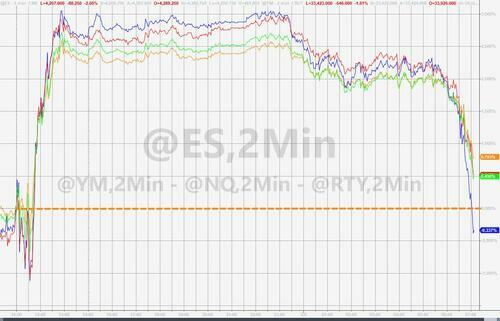
But first, a quick recap of what sparked the post-Fed rally, which as we explained yesterday was nothing more than the latest giant gamma squeeze, an observation confirmed this morning by Nomura's Charlie McElligott who writes the following:
I believe the scenario which might have scared [Powell] the most would have been going so hard with the potential “50bps May / 75bps June / 75bps July” which would have gotten them to “Neutral-ish” by end of Summer and stuck sitting on their hands…but then, risk being caught in a situation where the MoM inflation data stays persistently higher while unemployment data makes new lows—which would then see the market “expect even more” again, off what was already a “75bps hikes prior” and risking an enormous “policy / communications error” hawkish-escalation “hard landing” accidentAs this was clearly then perceived by a VERY front-footed “hawkish” market as “UNDER-delivering” on said expectations for a “hawkish messaging,” we then saw Stocks blow higher thereafter, thanks to a massive “Short Gamma” squeeze and the corroborated “Vanna sling-shot” feedback loop we have been discussing, as implied Vols were just clobbered with the “hawkish left-tail” then viewed as almost essentially “removed” from the scenario distribution going-forward.
Precisely what we said yesterday, but recall we also said the following: "while it is easy to turn optimistic here, a warning: the last thing the Fed wants is for its 50bps rate hike - the biggest in 22 years - to be viewed as a green light to more risk on. In fact, if we indeed see stocks surging in the next few days, we fully expect the next crew of Fed talking heads which will hit the mic as soon as Friday to warn that not only is a 75bps - and even as 100bps - rate hike on the table, but that an emergency, inter-meeting announcement is distinctly positive if algos ignore the Fed call at their own peril."
Which brings us to the even more important question of "where to from here" which prompted a witty rejoinder Charlie McElligott who writes today that "a client said something which struck me two days ago: “Bulls and Bears both want a rally.”
That, of course, corroborates with what we said yesterday and Nomura's feedback from many in the “impulse FCI tightening” bear-camp, who have been saying they wanted to fade a large post-Fed relief / mechanical rally.
To the Nomura strategist, this then means the best way to continue trading this environment is “Short Vol, Short Delta.”
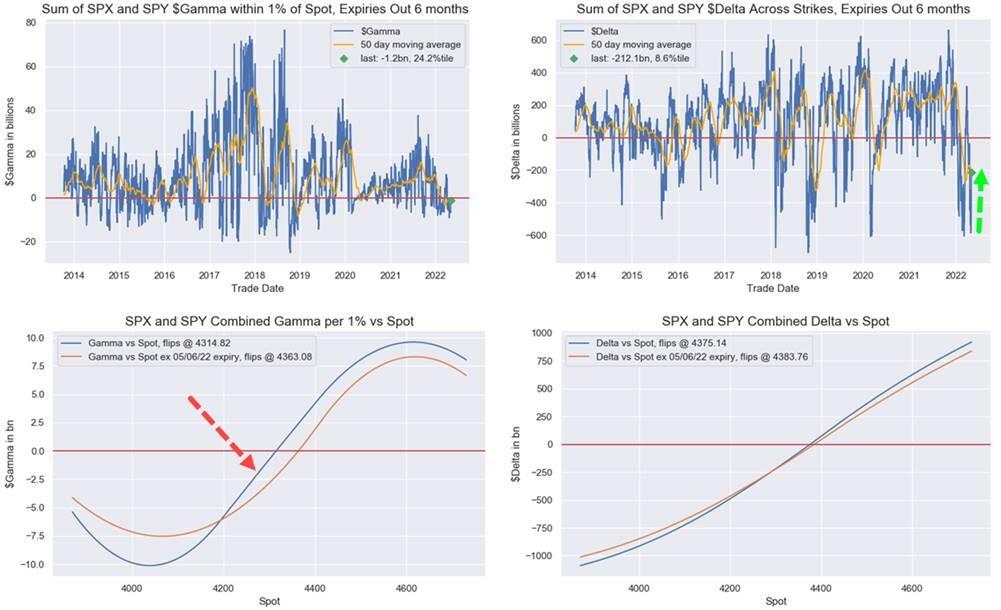
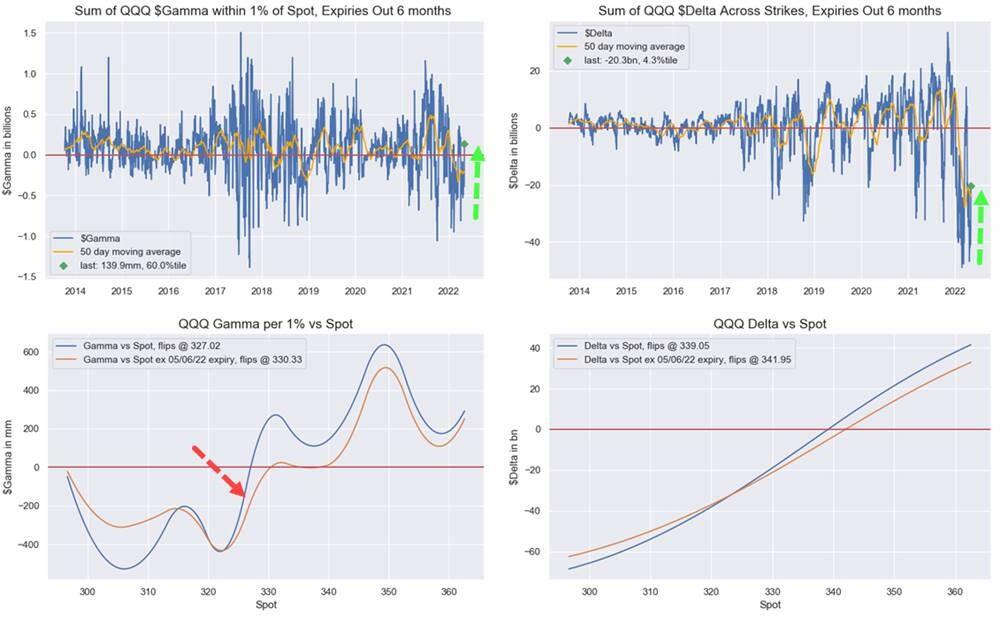
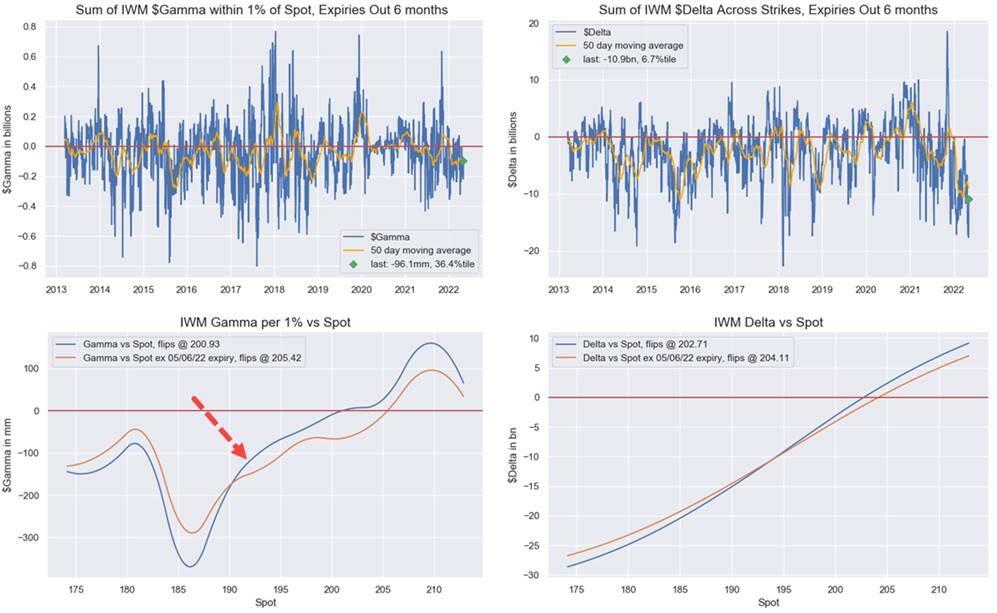
Practically, key levels for Bulls to reclaim from here are the “Zero Gamma” lines—where it truly feels that “THE” force which continues to drive the market are these “short Gamma” hedging pinch-points, where particularly SPX and QQQ are within reach—but still below—reclaiming this as a “stabilizing” force moving-forward:
- SPX / SPY $Gamma -$1.2B (jumping up to 24.2%ile now), “Zero Gamma” neutral line up at 4314 (currently nearing “Neutral Gamma vs Spot” but still “Short”)
- QQQ $Gamma +$139.9mm (jumping up to 60.0%ile now), “Zero Gamma” neutral line up $327.02 (currently nearing “Neutral Gamma vs Spot” but still “Short”)
- IWM $Gamma -$96.1mm (jumping up to 36.4%ile now), “Zero Gamma” neutral line up at $200.93 (currently still VERY “Short Gamma vs Spot”)
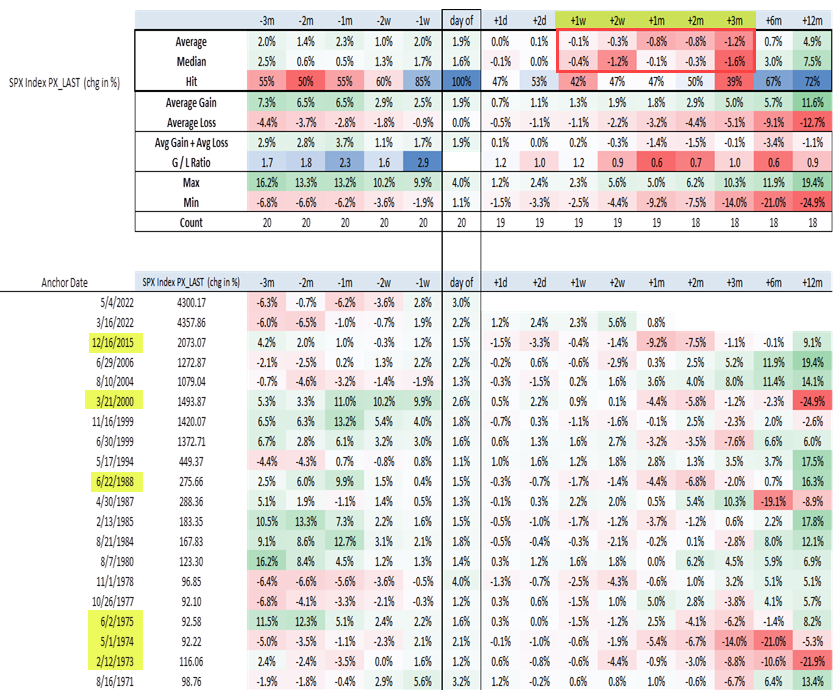
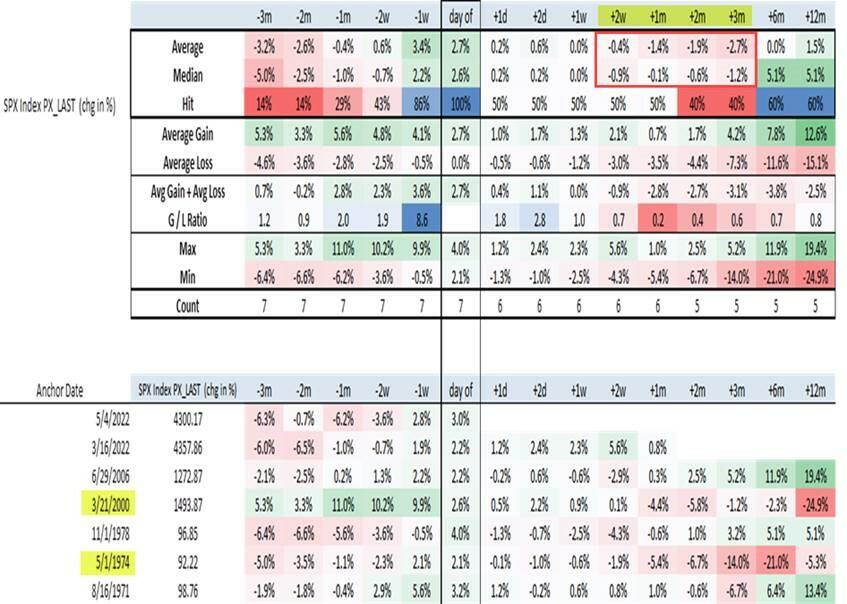
Charlie then looks at history to make an “analog” observation; specifically he took a look at days when the Fed hiked Rates and the SPX was up by more than either +1% or more than +2%. The read? Both show forward returns are locally “mixed at best” with a median SPX trade that is LOWER out 3m thereafter for both “triggers” (which is very rare for 3m windows in SPX tbh)…while revealing some especially “cringe” dates on the backtest:
1% moves on Fed hikes:
2% moves on Fed hikes:
McElligott concludes by noting that the Fed's “reset” of expectations to “buy time” for data to fit their view "feels risky to me — I mean, we are talking an attempt at threading the needle, but with a MOAB — as it risks both another “hawkish escalation” down the road which would almost certainly then see the market price “policy error / hard landing” bets even more aggressively, as the Fed would then be pushing into outright “restrictive” territory."
Of course, by extension if a market rally is the opposite of what bulls wanted yesterday, pushing into "outright restrictive" territory - i.e., accelerating the next recession - is just what the bulls need, as it means rate cuts and a fresh QE can't be far behind. In fact, today's crash is precisely what the bulls want...
More in the full note available to professional subscribers in the usual place.
Deep Under the Antarctic Ice, Scientists Discover Vast Reservoir of Ancient Water
Such pockets of water may play a role in how fast the continent sheds ice into the ocea
A vast reservoir of ancient water has been found thousands of feet under the ice in western Antarctica, scientists said in a paper published Thursday in the journal Science.
Researchers had long suspected but never before established the existence of such hidden pockets of Antarctic groundwater, which they believe act to lessen friction between ice sheets and underlying bedrock to make the ice more prone to slide from the continent’s interior toward the surrounding ocean.
The first-of-its-kind discovery—made possible by an electromagnetic field-measuring technique that is rarely used in polar environments—shows that there’s far more water under the Antarctic ice than scientists realized. It also adds to a growing body of evidence showing the complex computer models scientists use to calculate Antarctic ice loss and the resulting sea level rise are incomplete.
“Because there were no observations of groundwater prior to our study, it hasn’t really been incorporated in our models of understanding like how ice flows,” said Chloe Gustafson, a postdoctoral researcher at the University of California, San Diego’s Scripps Institution of Oceanography and a co-author of the paper. “I don’t know if you could say we’re underestimating ice loss, but we are missing a process in trying to understand how ice moves off the continent.”
Slawek Tulaczyk, a University of California, Santa Cruz professor of Earth science who wasn’t involved in the new research, called the finding an “intellectual template for understanding the water world beneath the ice” in most of western Antarctica as well as parts of the continent’s eastern region. “It’s kind of satisfying for me,” Dr. Tulaczyk added, “because it more or less kind of confirms what we expected.”
Most of Antarctica is covered with a thick ice sheet, the edges of which periodically slide into the surrounding Southern Ocean to form floating ice shelves. Friction associated with the sliding and heat rising from Earth’s core together form streams of meltwater just below the sheet, lubricating the ice in some areas and facilitating those areas’ glissade off the rock and into the ocean.
Kerry Key, an associate professor of Earth and environmental sciences at Columbia University and another co-author of the paper, likened those mobile areas of ice, known as ice streams, to chilly Slip ’N Slides. “The streams control how fast Antarctica will push ice out into the ocean and cause sea level rise,” he said, adding that they can transport ice at speeds of up to 10 feet a day.
The newly discovered reservoir, a layer of water-saturated sediment nearly 2 kilometers thick in some places, was detected nearly 3,000 feet below the previously characterized Whillans Ice Stream.
“Think of it like a sponge,” Dr. Gustafson said of the sediment layer. “Water can come out of that sponge, and contribute to the Slip ’N Slide flow, or the sponge can soak up water, and take water away from the Slip ’N Slide and make it flow slower.”
For now, the study authors said, the pressure of the ice atop the sediment layer keeps the reservoir water from rising. But as the climate warms and thins the ice, the water could move upward into the ice stream above. That change could speed Antarctic ice loss by increasing the speed of the stream, and transporting the ice it carries more quickly toward the ocean.
The steady flow of ice streams like Whillans makes it hard to study the layers beneath them. Drilling can’t reach deep enough before the ice shifts and potentially shears off the drill bit, according to Dr. Key, and seismic observations and airborne radar commonly used for other Antarctic research have trouble penetrating layers below the ice.
So the researchers behind the new study turned to magnetotelluric imaging, in which instruments placed in pits on the ice gauge how much of the electromagnetic energy generated in Earth’s atmosphere and surrounding magnetic fields has penetrated the ground below. Saltwater, freshwater, ice and sediment conduct that energy differently, and the instruments can detect these differences to create a sort of map of the subsurface terrain.
Drs. Key and Gustafson and two of their colleagues deployed instruments across the 60-mile-wide ice stream, taking readings at nearly four dozen locations. The readings showed not only the depth and existence of the reservoir but also that it holds a mix of saltwater and freshwater.
Some of the water at the reservoir’s deepest point may have been there since the last time this part of Antarctica was ice-free—and covered in a shallow ocean—around five million years ago, Dr. Key said.
Bernie Ecclestone asked to guarantee $10mn loan, money laundering trial hears
Former Formula One boss agreed to request from ex-son-in-law, who is on trial for alleged involvement in £266mn crime
Former Formula One chief executive Bernie Ecclestone was asked by his ex-son-in-law James Stunt to provide a $10mn guarantee for a business venture “which made no commercial sense”, it was claimed on Thursday in one of Britain’s biggest ever money laundering prosecutions.
A jury at Leeds Crown Court was told on Thursday about the alleged involvement in the scheme of James Stunt, who is one of eight defendants standing trial for allegedly laundering £266mn.
Stunt, who was married to Bernie Ecclestone’s daughter Petra from 2011 to 2017, was the chair of Stunt & Co, one of three companies which prosecutors have claimed were used in the operation. All eight defendants deny wrongdoing.
The Ecclestones are not defendants in the trial and are not accused of any wrongdoing.
The trial has heard allegations that between January 2014 and September 2016, millions of pounds of what prosecutors have dubbed “criminal cash” was couriered to the Bradford offices of gold dealer Fowler Oldfield. It was then allegedly paid into the company’s NatWest bank account “to hide its true origins and give it a veneer of respectability” as part of a “very sophisticated money laundering system”.
The money was then used to buy gold which was shipped to Dubai, the trial has heard.
The prosecution has claimed that there were close links between Fowler Oldfield and Stunt & Co. On Thursday prosecutors alleged that £28mn in cash had been collected from the Mayfair offices of Stunt & Co after it was counted there and later deposited into Fowler Oldfield accounts. The Crown alleged the operation had “all the hallmarks of a classic money laundering operation.”
On Thursday prosecutor Nicholas Clarke QC claimed that through marriage to Petra Ecclestone, Stunt “enjoyed an extravagant lifestyle, although his own personal finances are shrouded in mystery”.
“Backed by his father-in-law’s wealth, Stunt was able to establish business support, and through his marriage he had access to his wife’s money. There is evidence of transfers of very large amounts from her accounts into his. They also had joint accounts that, effectively, had unlimited resources,” Clarke claimed.
Stunt’s divorce from Petra Ecclestone “and the fact that the river of money from the Ecclestone sources may have been running dry” may “be an explanation as to why he got involved in a process that has been demonstrably proven to have involved the laundering of millions of pounds of cash,” Clarke alleged to the trial.
The court heard that Stunt contacted the Canada-based Bank of Nova Scotia in 2015 with a business venture which involved creating Stunt-branded gold bars and “Formula One gold coins”. The bank signalled it was willing to do business with Stunt if the bank facility was underwritten by a letter of credit which Stunt could not provide, prosecutors told the jury. Bank of Nova Scotia has not been accused of any wrongdoing.
“James Stunt claimed he was not able to guarantee it himself as all his money was tied up in America. Instead, he put forward his father-in-law Bernie Ecclestone as guarantor,” Clarke claimed, adding that the agreement was only secured by way of a letter of credit whereby Bernie Ecclestone would provide a $10mn guarantee.
“The lack of provable personal wealth and available capital resources is demonstrated by the fact Stunt had to go to his father-in-law for the guarantee . . . If Stunt were the billionaire that he claims then there would be no need for the outside guarantee at all, “Clarke claimed. He added that only a few Stunt & Co branded bars were ever made, no Formula One gold coins were ever made and Stunt’s business venture “made no commercial sense”.
Stunt, 40, along with his former personal assistant Francesca Sota, 34, and Alexander Tulloch, 41, a former vice-president of Stunt & Co, all from London; as well as Gregory Frankel, 44, of West Yorkshire; Daniel Rawson, 45, from Leeds and also Paul Miller, 45, of Wetherby, Heidi Buckler, 45 of Leeds and Bradford jeweller Haroon Rashid, 51, all deny one count of money laundering. Stunt and Sota also deny one count of forgery.
The trial continues.
Former Airbus unit paid £9.7mn in bribes to Saudi military, court told
Senior executive and associate of GPT stand trial over corruption concerning UK defence contracts
A senior executive and associate of an Airbus subsidiary paid £9.7mn in bribes to Saudi Arabian military officials to secure contracts for the UK government a court was told on Thursday.
The prosecution barrister Mark Heywood QC said the case concerned “deep corruption in overseas defence contracts” at the start of the trial at Southwark Crown Court.
Jeffrey Cook, 65, former managing director of GPT Special Project Management, a now defunct unit of the European aerospace group, and John Mason, 79, former financial officer at two of GPT’s subcontractors, are on trial.
Both men, who deny the allegations, are charged with taking part in a bribery scheme between 2007 and 2012 to win lucrative UK government contracts to provide military communications to the Saudi Arabian National Guard, which protects the Kingdom’s royal family.
Cook has also been charged with misconduct in a public office between 2004 and 2008 over commissions he was paid on deals placed when working for the Ministry of Defence.
On Thursday, Heywood told the court that GPT had paid £4mn a year to Simec, a foreign registered entity part-owned by Mason, which was then used to bribe high-ranking Saudi officials. Mason was also Simec’s finance officer.
Heywood told the court that just over 12.3 per cent of all revenue collected by GPT “went out the door almost immediately” to subcontractors including Simec which ultimately passed it to the bank accounts of certain members of the Saudi National Guard. “In a single word the case is one of ‘bribery’,” he said.
According to the prosecution, over 70 per cent of the money paid to Simec [received by the middlemen] “were paid straight on . . . to highly placed individuals”, including Prince Miteb bin Abdullah bin Abdulaziz, a Sandhurst-educated member of the Saudi Arabian royal family.
Other recipients included a Lebanese businessman with close ties to the King, the court was told.
Heywood said Saudi individuals and intermediaries in the Saudi National Guard were paid a total of £9.7mn between 2007 and 2010 which they did “nothing legitimately” to earn.
Mason was “the one who received the money and actioned the payments, who did the accounting work and ensured that the foreign officials and their intermediaries received their share,” he said.
Cook was also paid “kickbacks” in the form of “tens of thousands of pounds” and cars, a Nissan Micra and a Honda Civic, while he was working for the MoD, enabling him to “double his annual salary” in just over a year, Heywood said.
A former MoD official Terence Dorothy, 81, was charged with “aiding and abetting that offence” but was found to be “too unwell” to face a trial and is no longer being prosecuted.
The Serious Fraud Office launched a criminal probe into GPT in mid-2012.
Vivendi’s Canal Plus working on bid for stake in US TV channel Starz
Movie studio Lions Gate has said it is open to selling the maker of premium series
Vivendi’s pay-TV business Canal Plus is working on a potential bid for a minority stake in Starz, the US premium channel known for hit shows including “Outlander”, as it seeks to bulk up amid fierce competition among streaming services, according to people familiar with the matter.
The French group controlled by billionaire Vincent Bolloré has made expanding in pay-TV and streaming a priority after selling most of its stake in Universal Music Group, leaving Canal Plus as its main source of profit.
As technology groups and media companies spanning Amazon, Apple, Netflix and Disney search for titles to add to their streaming services, the value of popular television content and movies has soared.
Lions Gate Entertainment, the Hollywood movie studio that owns Starz, said last year that it was looking to sell or spin off the business, with vice-chair Michael Burns citing recent “transaction multiples” as a reason to consider an exit. Amazon this year paid more than $8bn for MGM, the studio behind the James Bond franchise, a signal of how much streaming groups are willing to pay for coveted intellectual property.
Starz, which competes with networks like Showtime and HBO, had about 20mn streaming subscribers at the end of 2021. The sale process is still ongoing, said the people, with initial bids due before summer.
In addition to Vivendi’s Canal Plus, Starz has also attracted interest from set-top box maker Roku, which has teamed up on a bid with private equity group Apollo, for a stake of up to 20 per cent. The Wall Street Journal first reported their plans to bid.
Lions Gate is seeking a valuation for Starz along the lines of the $4.4bn, including debt, it paid for it in 2016, said the people, although the potential bidders have cast that figure as too high.
The group was boosted by franchises such as The Hunger Games and Twilight films in the 2000s. But the company’s stock has halved in recent years as revenue shrank at its movie studio, which has struggled to produce hits. Analysts have noted that Lions Gate’s stock market valuation is less than the sum of its parts.
Buying a stake in Starz would bring Vivendi a chunk of new subscribers to add to the 24mn it now has at Canal Plus, which would probably improve its profitability by allowing TV and movie production costs to be spread over a larger base. Driven by acquisitions outside its home market of France, Canal Plus has more than doubled its subscribers in the past five years with about 15mn of them in Europe and 7mn in Africa, but it has no presence in the US.
Lions Gate and Vivendi declined to comment.