CrunchBase : The Week’s 10 Biggest Funding Rounds: Biotech’s Big Week; Resilienc

The Week’s 10 Biggest Funding Rounds: Biotech’s Big Week; Resilience Takes Top Spot With $625M Round

Drug developers and health care tech had no problem attracting investors’ interest this week, as biotech startups took four of the top 10 rounds. In addition, another company in the health care space made the list. However, in general, rounds continue to trend lower, as there was only one raise more than a quarter-billion dollars this week in the U.S.

1. National Resilience, $625M, biotech: Raising rounds of more than a half-billion dollars can make a company pretty resilient. San Diego-based National Resilience has now raised two such rounds in about 10 months. The company, an end-to-end biopharmaceutical manufacturing and development firm, announced this week it raised a $625 million Series D after closing a previously unannounced $600 million Series C in August. Resilience develops therapeutics in its 10 facilities across North America. The company has more than 1 million square feet of manufacturing space and over 1,600 employees. Although it did not announce who specifically participated in the round, it said it included “venture capital funds, public mutual funds, pension funds, biopharma companies, sovereign wealth funds and private family offices, among others.” Resilience has now raised more than $2 billion in equity since being founded in 2020, according to the company.

2. Knock, $220M, fintech: The housing market is hot and homebuyers need to move fast. Knock’s home-buying app lets people do just that. It lets existing homeowners access the cash they need before they even sell their current home. The New York-based company closed a $220 million round led by the Foundry Group. While some expect to see the housing market weaken as interest rates rise, the Opendoor competitor seems to be betting that the current market stays strong. Founded in 2015, Knock has now raised a total of $900 million of debt and equity, according to the company.

3. Branch, $147M, insurance: Columbus, Ohio-based Branch became one of the latest unicorns to join the growing herd this week. The insurtech company locked up a $147 million Series C led by Weatherford Capital that values it at $1.05 billion. Branch allows companies to bundle home and auto insurance in a single transaction, using data and automation to make the monotonous process of buying insurance easier. The company claims it has helped members save an annual average of $548. Founded in 2019, the company has now raised nearly $230 million, according to Crunchbase data.

4. Aledade, $123M, health care: Trying to help doctors provide better care is a big undertaking, and now Bethesda, Maryland-based Aledade has more money to try to do it. The company raised a $123 million Series E led by OMERS Growth Equity. Fidelity Management & Research Co. and other current investors also participated. The company did not release a valuation, but Business Insider reported it as $3.1 billion. Aledade, which realized more than $300 million in revenue last year, offers a platform to help doctors create and run accountable care organizations, providing coordinated care among doctors. Founded in 2014, the company has raised nearly $418 million, according to Crunchbase.

5. Mineralys Therapeutics, $118M, biotech: As we said earlier, biotech was big this week. Philadelphia-based clinical-stage biopharmaceutical company Mineralys Therapeutics raised a $118 million Series B led by RA Capital Management and Andera Partners. The company is developing new therapies for uncontrolled hypertension. Founded in 2020, the company has raised a total of $162 million, according to Crunchbase data.

6. Vanta, $110M, security: San Francisco-based security monitoring platform Vanta closed a $110 million Series B at a $1.6 billion valuation led by Craft Ventures. Founded in 2017, the company has raised $163 million, according to Crunchbase.

7. Immuta, $100M, cybersecurity: Boston-based data security firm Immuta secured a $100 million Series E led by NightDragon. Founded in 2015, the company has raised $267 million to date.

8. Shield AI, $90M, artificial intelligence: San Diego-based cybersecurity provider Shield AI, which develops AI pilots for the defense industry, raised $90 million in equity and $75 million in debt as part of a Series E led by Snowpoint Ventures valuing the company at $2.3 billion. Founded in 2015, the company has raised more than $500 million, according to Crunchbase.

9. Owkin, $80M, biotech: New York-based AI precision-medicine company Owkin raised $80 million from Bristol Myers Squibb, Business Insider reported. Founded in 2016, the company has now raised more than $334 million, according to Crunchbase.

10. Code Biotherapeutics, $75M, biotech: Hatfield, Pennsylvania-based biotechnology firm Code Biotherapeutics closed a $75 million Series A led by Northpond Ventures. Founded in 2020, the gene therapy company has raised a total of $85 million, according to Crunchbase.

Big global deals
Three of the five biggest rounds this week happened outside the U.S., including one deal across the pond worth more than $1 billion.

  • London-based software consultancy and developer The Access Group closed a round worth more than $1.2 billion from existing shareholders Hg and TA Associates.
  • London-based edtech platform Multiverse raised a $220 million Series D.
  • Singapore-based software developer Envision Digital locked up a $210 million Series A.
MW : ‘We’re in technical recession, but just don’t realize it’: Bank of America

‘We’re in technical recession, but just don’t realize it’: Bank of America sees more ‘shocks’ to come

Beware when a ‘shallow recession’ turns deep, say strategists

The shocks aren’t over. Get ready. That’s the timely Friday advice of Bank of America, delivered hours before worse-than-expected U.S. inflation data knocked the wind out of Wall Street and left investors bracing for more aggressive central-bank action.
Data showed the cost of living surged 1% in May amid higher rents and gas and food prices, keeping the rate of U.S. inflation at a 40-year high. Annual inflation now sits at 8.6%, up from 8.3% and a new cycle high, the most rapid increase since 1981. The S&P 500 index SPX, -2.91% tumbled 2% early Friday.
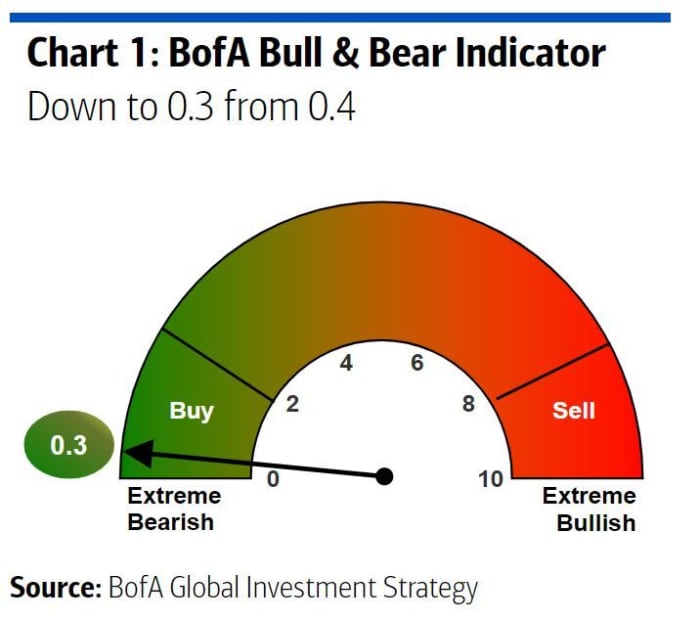
Taking a fresh look at the so-called bear-market rally in U.S. stocks that took hold in late May was a team at Bank of America, led by Michael Hartnett, the chief investment strategist. The bank’s own bull and bear indicator is now deep in “contrarian bullish” territory — with credit also looking “deeply oversold,” noted Hartnett.
BOFA GLOBAL INVESTMENT STRATEGY
So why do investors keep selling those rips? The inflation shock isn’t over, as driven home by Friday’s data, an interest-rate shock is just taking shape, an economic-growth shock is looming, and there is “no release valve from a peak in yields,” while the bear-market rally itself is “too consensus,” in Hartnett’s view.
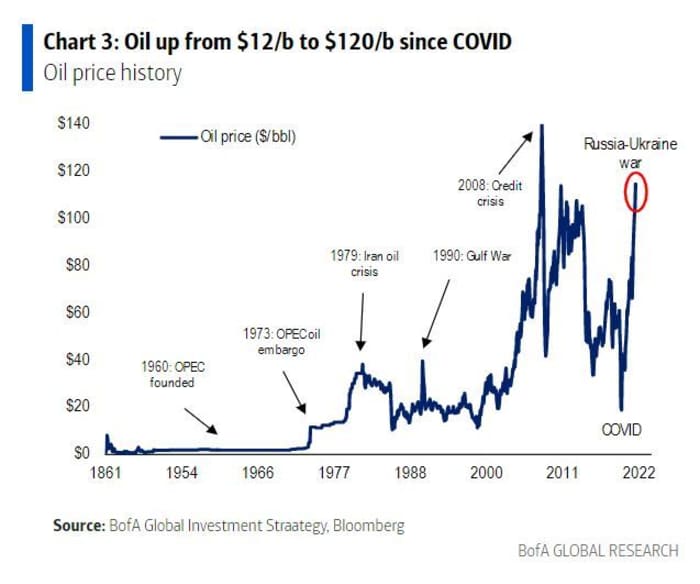
He rattled off a number of such spikes in prices since the start of the year — a 141% surge in natural-gas prices; gasoline up 91%; wheat, 39%; soybeans, 33%; and corn and cotton, 30% each.

BOFA GLOBAL INVESTMENT STRATEGY, BLOOMBERG
“We’re in technical recession, but just don’t realize it,” said Hartnett, who notes ever murkier consumer data and household and consumer balance sheets indicating a shallow recession ahead. He added that “what can turn shallow into deep is the great unknown of the shadow banking system.”
And of course, stagflation is also a risk, one that’s incompatible with the “goldilocks” S&P 500 price/earnings ratio of 20 over the past 20 years, he said, observing it should be nearer to 15 times.
And panicky investors may be getting more whiffs of reality, with the bank noting that $54.2 billion flowed to cash according to latest weekly data, the biggest in six weeks. Just $12 billion went to equities.

Barrons : Your Weight Loss Could Be Eli Lilly and Novo Nordisk’s Gain

Your Weight Loss Could Be Eli Lilly and Novo Nordisk’s Gain

I weigh an eighth of a ton. That’s ideal for a harbor seal or panda, but not for a 6’4” man. The good news is that I’ve lost 11 pounds, and I’m told that if I drop seven more I’ll win a status upgrade from obese to overweight. Call me a dreamer, but I feel like I can hit husky by August.

There are powerful new medicines for weight loss. I’ll pass, for reasons I’ll explain, but Wall Street is making colossal sales projections for two key pharma players.

The first is Denmark’s Novo Nordisk NVO –1.17% (ticker: NVO), the world’s top maker of insulin. For more than a decade, it has sold drugs that help manage blood sugar levels, with the happy side effect of weight loss, so it has won approvals for both Type 2 diabetes and obesity. The drugs are called GLP-1 agonists, meaning they mimic a certain hormone that both stimulates insulin secretion and causes a feeling of fullness.

The latest of these is semaglutide, which is sold as Ozempic for Type 2 diabetes and as Wegovy for obesity. It won U.S. approval for obesity just last year. Wegovy is more effective than Novo’s older obesity drug and requires only weekly self-injections, down from daily, so sales have taken off, but supply has been held back by problems with a contract manufacturer.

Novo’s total obesity drug sales doubled year over year to 3.4 billion Danish kroner during the first three months of the year, or about $480 million. By the middle of the decade, the company had an obesity sales target in kroner equal to $1.69 billion, but now it says $3.72 billion. And that might be just the start.

Here comes another insulin giant. Eli Lilly LLY –2.06% (LLY) received Food and Drug Administration approval last month for tirzepatide for diabetes, which it will sell as Mounjaro. It mimics both GLP-1 and GIP, a second hormone that plays a role in insulin and appetite. In tests, this dual-acting drug appears more effective and tolerable than Novo’s Wegovy.

The weight-loss evidence in particular is “truly stunning,” David Risinger, who covers Lilly for SVB Securities, tells Barron’s. This month, Lilly presented new details at a big diabetes conference in New Orleans. Patients on the highest dosage dropped an average of 22.5% of their weight, which worked out to 52 pounds. That would shrink a guy like me straight into healthy territory on the height/weight charts.

As with many drugs, the full warning list is long and daunting. Key side effects appear to include gastrointestinal killjoys like nausea, diarrhea, and vomiting, which fade over time. Lilly could seek approval to market tirzepatide for obesity this year or next.

I’m not buying. Trainers like to say, “No pain, no gain,” but my fitness motto is just “No pain,” which extends to both crunches and unnecessary needles. The Novo drug could be available in pill form in the U.S. as soon as 2024. Then again, Novo is working on an even more promising drug that could come to market in 2025. Lilly, too, is already working on a follow-up. So for now I’ll just keep mixing in more fruits and veg and taking my daily dose of NoChipsOrBeer. Plus, I do virtual hikes, bike rides, and rows on my big-screen exercise machines. Yes, I know I can do that stuff outside—don’t screen-shame me.

There’s also the expense. I just canceled a CVS Health CVS +0.46% (CVS) program that costs shoppers $5 each month in exchange for a $10 store credit, because my utilization rate fell below what I had modeled in my break-even analysis, so imagine how keen I would be to pay the $1,350-a-month list price for Wegovy. My last complaint is that because these drugs work on appetite, patients might have to keep taking them even after they reach the weight they want.

What about insurance? “Historically, insurers have really tried to put anti-obesity medications in the bucket of cosmetic type drugs, along the lines of a Botox for wrinkles,” says Risinger. “But the transformational health benefits that these drugs offer really, we think, will drive much greater adoption by both health plans and employers in coming years.” Those benefits appear to include reduced blood pressure and triglycerides.

My reservations aside, the market for these new drugs will be immense. Some 42% of Americans are now obese, up 10 percentage points from 2000. Much of the rest of the world is catching up. Worldwide, there are half a billion potential customers.

J.P. Morgan reckons Lilly’s new obesity drug will sell for $19 a day, after subtracting for discounts, and that Novo’s Wegovy, now $25, will come down to match. It predicts $34 billion in overall annual obesity drug sales by 2031, or $5 billion more than Lilly’s total sales today.

Novo will ultimately grab 60% of the market, J.P. Morgan predicts. This past week it upgraded Novo shares to Overweight, calling for 20% upside. Judging by consensus estimates, Novo’s obesity drug sales could overtake its insulin within five years. Risinger at SVB doesn’t cover Novo but is bullish on Lilly, predicting about 12% upside. Both stocks go for more than 30 times earnings. Lilly could double its earnings per share in four years, and Novo, in five.

The secondary effects of all this are difficult to guess. Will insulin sales fall off? Will insurance premiums rise, or will insurers be able to squeeze drugmakers while saving on obesity-related ailments? What about sales of fast food and snacks? History says to bet against miracle obesity cures, if not fitness altogether. We’ll see.

Now if you’ll excuse me, it’s treadmill time. I’m hoping to drop from panda-weight to something more flattering, like warthog, and Kilimanjaro isn’t going to virtually climb itself.

Barrons : This Industrial-Gas Giant’s Stock Is Steady in a Volatile Market. It A

This Industrial-Gas Giant’s Stock Is Steady in a Volatile Market. It Also Scores High on ESG.

In a world where even the most reliable of big-name stocks are vulnerable to dips in the market, investors may want to consider companies with a track record of steady returns.

Linde (ticker: LIN) is one of three major industrial-gas makers, alongside Air Products & Chemicals (APD) and Air Liquide (AI.France). The relative scarcity of such providers ensures that Linde is able to pass on higher raw materials costs, and the diversity of its projects makes it less susceptible to swings in the economic outlook.

What’s more, despite dealing in chemicals and carbon-emitting natural resources, Linde scores highly in the MSCI environmental, social, and governance rating. That’s due to the kinds of projects Linde works on—carbon capture and storage, for example. The company also has ambitious plans to reduce the greenhouse gases it emits and to double its purchase of renewable energy by 2028.

“Linde has generated steady earnings growth, high levels of cash flow and attractive returns for some time,” says Sebastian Bray, an analyst at Berenberg in London. “This is a reasonably safe place to park your money.”

Linde employs 72,327 staff and has a market value of $166 billion. It operates all over the world and, in addition to selling industrial gases, offers engineering services. The company fetches 26 times this year’s expected earnings and is valued at a 60% premium to its peers. Shares have slipped 4% this year to a recent $334. Berenberg’s Bray has a target price of about $360 and rates the shares a Buy.

“The reason they’re more expensive than many peers is that the chances of unexpected [hits to earnings] are quite low,” Bray says.

The company traces its roots back to 1879, when inventor Carl von Linde assembled a group to make machines for refrigeration in Wiesbaden, Germany. One of the first investors was a Rhineland brewer who saw the potential to expand his market by keeping beers cold. In 1907, Linde added a U.S. subsidiary. That business was confiscated by the government in the World War I, but would, many years and mergers later, become Praxair.

Praxair and Linde merged in 2018 to create Linde, the world’s biggest maker of industrial gases. It moved its domicile from Germany to Ireland, with its headquarters now in Guildford, U.K., just outside of London. Its shares are still listed in New York and Frankfurt.

The company’s projects range from medical oxygen to producing hydrogen for clean fuels. It serves the chemicals, electronics, manufacturing, and food-and-beverage industries. In April, Linde announced a long-term agreement with a “major space-launch company in Florida” to provide liquid oxygen and nitrogen from its air-separating plant there.

Linde reported diluted earnings per share of $2.30 for the first quarter of 2022, up 24% from a year earlier. The company expects earnings per share between $2.90 and $3 for the second quarter, as much as 11% higher than the previous year. Chief Executive Officer Sanjiv Lamba hailed the record return on capital for the quarter, at 18.9%. “The business model continues to deliver in any environment, demonstrating resiliency during economic downturns and significant growth during the recovery,” he said when earnings were released.

The company increased its margins in the first quarter, despite higher input costs from soaring energy and commodities prices.

With the S&P 500SPX –2.91% index on the brink of a bear market this year, and riskier shares on the Nasdaq CompositeCOMP –3.52% down even further, Linde can offer a strong defensive investment with environmental credentials.

WSJ : Luxury Brands Are Making Watches Even Fewer People Can Afford

Luxury Brands Are Making Watches Even Fewer People Can Afford
Swiss watch revenues hit a record high, driven by high-end models, but lower volumes spark concerns the industry is too elitist

Luxury watchmakers had their best ever year in 2021—by selling fewer watches.

The Swiss watch industry is moving ever further upmarket as brand owners target rich consumers and try to differentiate their products from the Apple Watch and other wearable tech.

Still, while this approach is boosting revenue now, it could lead to trouble in the future if the industry keeps shrinking itself by selling fewer, pricier models, analysts say.

Swiss watch revenues rose by roughly one-third last year compared with 2020 to reach a record 21.2 billion Swiss francs, the equivalent of $21.5 billion, according to the Federation of the Swiss Watch Industry, an industry association. U.S. sales grew 28%.

The rise was driven by a resurgence in demand for higher-end watches, the association said, which have benefited from a broader boom in luxury goods as the pandemic has receded.

At the same time, volumes have been dwindling. Swiss watchmakers sold 15.7 million watches last year, half as many as a decade earlier, the association’s data shows. The decline has been led by a collapse in demand for affordable models, which compete directly with Apple Inc.’s $399 to $799 watch.

Those trends have continued this year, with watch sales rising 13% by revenue in the first four months of 2022 compared with the same period last year, the association said.

Watchmakers say the demand for pricey models demonstrates consumers’ enduring interest in watches despite predictions from some analysts that the business of making classic, mechanical watches would soon be swept away by smartwatches and other new gadgetry.

An expensive watch is more like a collectible jewelry piece than a device, said Georges Kern, chief executive of Breitling SA, adding that far from being a handicap, low functionality is core to the appeal.

“People want to balance the overkill of the digital age,” said Mr. Kern. “I don’t know anyone collecting Apple iPhones or watches—there’s no emotion there, you use it and then throw it away.”

That sense of cachet tempted John Royer into swapping his Apple Watch for a $10,000 Rolex GMT-Master II when he turned 40 recently. “I wanted something that I could pass on to my son when he is older,” said the Alabama-based physician.

Top brands such as Rolex, which have always commanded high prices, are the prime beneficiaries of the greater demand for high-end watches.

While there are roughly 350 Swiss watch brands, four independent watchmakers—Audemars Piguet Holding SA, Patek Philippe SA, Richard Mille Horometrie SA and Rolex SA—accounted for 61% of the industry’s 8.5 billion franc profits in 2021, Morgan Stanley estimates.

Other brands are trying to capitalize on the trend by adding high-end models to their lineups.

Last year Breitling, whose watches start at $3,300 in the U.S., launched its Super Chronomat range, raising the top price of an existing product line to $25,650. Mr. Kern said Breitling had boosted demand for its watches by modernizing its stores and refreshing its marketing with slick commercials featuring movie stars such as Adam Driver and Charlize Theron to appeal to younger consumers.

The company now plans to increase output to 250,000 watches next year, nearly double the number in 2017, Mr. Kern said, a move that makes it an industry outlier and reflects a continuing turnaround.

Hermès International SCA has also recently reported a rise in watch sales, which analysts attributed to the luxury company’s move away from relatively affordable products. Efforts to target wealthier clients include the sale of unique watches costing six-figure sums. One recent example was the Arceau Pocket Aaaaargh!, a pocket watch featuring a leather mosaic of a Tyrannosaurus rex on its cover and a price of €300,000, equivalent to about $315,000.

Not all watchmakers are following suit. Rolf Studer, chief executive of watchmaker Oris SA, said that while the average purchase price of a Swiss watch has risen by roughly half since 2019, his company was resisting the trend to chase superrich clients.

Excessive price rises risk making Swiss watches too elitist, Mr. Studer said, adding that Oris had increased prices by about 10% over the past three years to cover higher costs.

“If we’re only talking to the richest 100,000 people in the world, maybe we no longer have the reason for being here that we used to have,” Mr. Studer said.
Oris, whose watches start at around $2,000 in the U.S., increased its share of the declining “affordable” watch market last year by offering an “inclusive” form of luxury to which most consumers can realistically aspire, Mr. Studer said.

A trend among enthusiasts to buy multiple watches from brands they find appealing, irrespective of price, is helping more affordable brands such as Oris, he added.

Many other watch brands are struggling to grow, however, and relying on selling fewer but costlier models could jeopardize the structure of the industry, analysts say.

“It’s a risky game: They have to be very careful not to make it too small and too exclusive,” said Oliver Müller, founder of Switzerland-based consulting firm LuxeConsult.

Besides alienating everyone but the millionaire buyer, there is a danger of volumes falling to a critical level at which suppliers start to fail, triggering a cascade of closures among smaller brands that can no longer source parts, he said.

“There is a risk of stagnation, of losing know-how and craftsmanship because we’re not producing enough,” Mr. Müller said.

FT : SEC investigating Goldman Sachs for ESG claims

SEC investigating Goldman Sachs for ESG claims
US regulator has been putting more focus on potential ‘greenwashing’ in finance

The US Securities and Exchange Commission is investigating Goldman Sachs’s asset management division over certain environmental, social and governance claims made by its funds, according to a source familiar with the matter.

The civil investigation is scrutinising certain Goldman Sachs funds with clean energy or ESG in their names, according to The Wall Street Journal, which first reported the investigation. Goldman rebranded its Blue Chip Fund as the US Equity ESG Fund in June 2020, the report said.

A person familiar with the situation confirmed the report. Additional details could not immediately be gleaned. Goldman Sachs declined to comment and the SEC did not respond to requests for comment.

The investigation marks the latest development in the SEC’s hunt for potential greenwashing. In 2021, the agency’s enforcement arm launched an ESG task force to investigate sustainability claims by investment managers and companies. In May, BNY Mellon became the first asset manager to settle with the agency for allegedly misleading investors about ESG claims.

The SEC alleged that BNY Mellon Investment Adviser suggested in documents that all investments in the funds had undergone an ESG quality review, even though that was not always the case. BNY Mellon, which paid a $1.5mn fine, said it updated its fund documents.

The BNY Mellon case was seen as the tip of the iceberg in the SEC’s ESG enforcement efforts. The agency had been investigating fund companies on ESG and some of those inquiries have been referred to the enforcement division, sources familiar with the matter have said.

“I think it is highly likely that . . . we will see more cases similar to the BNY Mellon case,” said Kristin Snyder, a former deputy director in the SEC’s examinations division who is now a partner at Debevoise & Plimpton. “I would expect to see additional cases before September 30”, when the SEC’s fiscal year ends, she added.

Authorities are also investigating DWS, Deutsche Bank’s asset management division, for possible greenwashing. Earlier this month, DWS chief executive Asoka Wöhrmann resigned hours after the company’s offices in Frankfurt were raided and evidence was seized by police investigating claims of greenwashing. DWS has denied wrongdoing.

The SEC also recently proposed rules determining what language a mutual fund can use to describe itself as environmentally friendly.

FT : US pledges to maintain military capacity to defend Taiwan

US pledges to maintain military capacity to defend Taiwan
Lloyd Austin warns China against ‘provocative’ activity at Asian defence forum

US defence secretary Lloyd Austin accused China of stepping up coercive behaviour towards Taiwan as he stressed that Washington would maintain its military capacity to resist any force that threatened the country.

Speaking at the IISS Shangri-La Dialogue defence forum in Singapore, Austin said China was engaging in provocative behaviour across the Indo-Pacific region that ranged from dangerous naval and aerial manoeuvres to increasingly assertive military activity around Taiwan.

“We’ve witnessed a steady increase in provocative and destabilising military activity near Taiwan,” Austin said on Saturday. “That includes PLA aircraft flying near Taiwan in record numbers in recent months.

Addressing an audience that included General Wei Fenghe, China’s defence minister, Austin said there had been an “alarming increase” in unsafe aerial intercepts and confrontations at sea by Chinese military ships and aircraft.

Austin referred to recent incidents in which Chinese air force fighter jets conducted “dangerous intercepts” in the South China Sea and East China Sea of aircraft flown by US allies — in a reference to Australia and Canada.

Speaking several weeks after President Joe Biden said in Tokyo that the US would intervene militarily to defend Taiwan from any Chinese attack, Austin said Washington would adhere to the Taiwan Relations Act by ensuring that Taiwan maintained a sufficient defence capability.

“And it means maintaining our own capacity to resist any use of force or other forms of coercion that would jeopardise the security or the social or economic system of the people of Taiwan,” he added.

Austin stressed that US policy towards Taiwan had not changed and that the administration remained opposed to any unilateral changes to the status quo across the Taiwan Strait — from Taipei or Beijing.

His comments came as US officials have grown increasingly worried about the Chinese threat to Taiwan, over which China claims sovereignty.

Austin used his speech to highlight the Biden administration’s efforts to boost co-operation with allies, including the Quad — a security group that includes the US, Japan, Australia and India — and the Aukus security pact agreed by the US, UK and Australia last year.

Paul Haenle, director of Carnegie China, a think-tank, said Austin’s speech “struck the right balance”, noting that the US defence secretary said US policy towards Taiwan had not changed while “stressing that key components of that policy are helping Taiwan maintain a sufficient self-defence capability and maintain a robust US capacity to resist any Chinese use of force”.

Austin spoke one day after meeting Wei, in what was the first senior-level meeting between the militaries since Biden assumed office.

Despite putting a positive spin on the meeting between the defence chiefs, China launched a blistering riposte to Austin’s speech.

“The US has already messed up Europe and the Middle East, do they now also want to mess up Asia? We will absolutely not allow that,” said Lieutenant General Zhang Zhenzhong, deputy chief of the Joint Staff Department of China’s Central Military Commission.

In what the Chinese delegation called Beijing’s official response to Austin, Zhang rejected the US defence secretary’s pledge that Washington was not seeking a new cold war, an Asian Nato or a region split into hostile blocs.

“Their words do not match their deeds,” Zhang said. “The true intention of the US is to use this to maintain their hegemonic system. They are trying to create small circles by roping in some countries.” He added that the US Indo-Pacific strategy was one of geopolitical rivalry and bloc competition.

Pointing to the Global Security Initiative, a still-vague security concept proposed by President Xi Jinping in April, Zhang said China was a “sustained contributor to and firm supporter of regional peace” and a provider of public goods, in contrast with the US, which he called the “biggest source of instability” and a “backstage manipulator”.

Zhang also warned Washington against further support for Taiwan. The US had “seriously hollowed out and undermined” its pledge to stick to a one-China policy, he said, pointing to Washington’s approval on Wednesday of the sale of $120mn worth of spare parts for warships to Taipei.

Steps taken by the US in the past year were a reminder that Taiwan was the one issue with the biggest potential to lead the geopolitical rivals into conflict, Zhang said, adding: “This is extremely dangerous.”

Wei is scheduled to address the Shangri-La Dialogue on Sunday morning.

Major General Guo Ruobing, commander of the National Security College at the National Defence University, sharply dismissed Austin’s criticism of Chinese intercepts of Australian and Canadian military aircraft. “They are the ones disturbing stability,” he said, adding that “the US always says one thing but does another”. Washington has repeatedly rejected such Chinese criticism by pointing out that its aircraft fly in international airspace.

Austin outlined three areas where the US was working more closely with allies, including sharing research and development to ensure they had the right capabilities to deter aggression and stepping up exercises and training.

He added that the US Coast Guard was boosting its presence in the Indo-Pacific, a shift illustrated by the fact that Admiral Linda Fagan was the first Coast Guard commandant to attend the Shangri-La Dialogue.

FT : Investors bet on AI start-ups to turbocharge drug development

Investors bet on AI start-ups to turbocharge drug development
Companies have raised hundreds of millions of dollars despite a troubled biotech market

Start-ups promising to use artificial intelligence to transform drug development are raising hundreds of millions of dollars and signing deals with Big Pharma, despite the recent sell-off in biotech stocks.

Owkin, a French company, is partnering with Bristol Myers Squibb to improve how the US drugmaker designs its trials in a deal worth up to $180mn, including milestone payments if the drugs pass regulatory hurdles.

The collaboration comes after three other start-ups raised a total of $150mn this week. The move comes amid a wider market rout for biotech stocks that has left investors wary of companies focusing on developing one or two drugs.

Hussein Kanji, a partner at Hoxton Ventures, said there was a “new rush of money” into this budding market from both tech and life sciences investors because of the “compelling” prospect that you could build a platform that speeds up and cuts the cost of the lengthy drug development process.

“The genuine newness brings in a bunch of new money that may or may not know what it’s doing,” he added. “Everyone is running experiments right now on what’s going to work and what’s not going to work.”

Hoxton Ventures invests in Peptone, a London-based start-up that uses machine learning to fix “disordered proteins” that traditional drug discovery methods have struggled to target. The company announced a $40mn series A round led by healthcare and technology venture capital group F-Prime Capital and Bessemer Venture Partners.

F-Prime Capital also co-led a $50mn round in another London-based company Charm Therapeutics, which was set up just last September, alongside healthcare-focused investor OrbiMed.

Charm’s platform DragonFold is built on Alphabet’s AlphaFold and RosettaFold, developed at the University of Washington in the lab of David Baker, a co-founder of Charm. They use AI to determine the three-dimensional structure of proteins.

Charm has extended them to predict how proteins will fold around ligands — small molecules that could have pharmacological effects — and is searching for new cancer drugs.

Earlier in the week, Insilico, a Hong Kong-based start-up, raised $60mn in a round led by BCG, following a $255mn round last year. Insilico has its first drug candidate — a treatment for lung-scarring — in an early-stage clinical trial.

All three start-ups plan to spend some of their funds on new facilities, which will help create new biological data.

Vishal Gulati, founder of VC firm Recode Health, said originally many companies thought they could apply new data technologies to publicly available data sets. But they found the data was not good enough to provide “fruitful” insights, he added. “Smart companies started generating their own data for the purposes of discovering new drugs.”

Investors are also tempted by the prospect of partnerships with large pharmaceutical companies, which are recognising they do not have all the skills they need in-house. Bristol Myers Squibb already signed a $1.2bn deal with AI company Exscientia last year, and both Owkin and Exscientia recently signed partnerships with French drugmaker Sanofi.

Venkat Sethuraman, head of global biometrics and data services at Bristol Myers Squibb, said the company was “very bullish” on how AI could help improve the designs of clinical trials and wanted to work with Owkin because of its “complimentary data set”. Owkin uses federated learning, a machine learning technique, to train its algorithm on hospital data, without ever seeing the data itself.

Thomas Clozel, Owkin’s chief executive, said pharmaceutical companies were more interested in investing in a way to “hack the system”, than acquiring a biotech’s single potential drug. “Everybody really wants to believe there is a way to find not one treatment in 10 years, but 10.”

FT : Saudi Arabia’s $2bn swing at golf shakes up global game

Saudi Arabia’s $2bn swing at golf shakes up global game
Kingdom’s oil riches fund breakaway league and spark allegations of sportswashing

Phil Mickelson strolled up to the opening tee at an exclusive private golf course just outside London to cheers from his fans earlier this week. But despite his status as one of the most skilled and marketable players in the game, he was no longer wearing the logos of any of his sponsors.

These days he has bigger financial backers. Lefty, as he is known, is participating in LIV Golf Investments' new tournament, a breakaway league that threatens to upend golfing’s status quo. It has been bankrolled by Saudi Arabia’s $620bn sovereign wealth fund to the tune of at least $2bn. Total prize money is $250mn, the most valuable reward in the game.

The $200mn fee rumoured to have been paid to Mickelson, who brings his global army of fans and credibility to this week’s event in a private Hertfordshire club, is being paid from the kingdom’s Public Investment Fund. He has declined to comment on his contract and the figure has not been confirmed.

Players have been criticised by activists over their acceptance of huge fees because the new league is backed by a country that has faced western criticism for its poor human rights record, the murder of journalist Jamal Khashoggi by Saudi agents in 2018 and its military operations in Yemen.

Mickelson himself has previously dubbed the Saudis “scary motherf - uckers to get involved with”. “We know they killed [Jamal] Khashoggi and have a horrible record on human rights. They execute people over there for being gay. Knowing all of this, why would I even consider it? Because this is a once-in-a-lifetime opportunity to reshape how the PGA Tour operates.” So controversial was Mickelson’s participation that he only confirmed his attendance last week.

The controversy is the latest indication that Saudi Arabia’s oil riches are shaking up global sport, following the PIF-led £305mn acquisition of English Premier League football club Newcastle United in October last year, its purchase of a stake in the group that owns the McLaren racing outfit and state oil company Aramco’s sponsorship of Formula One, which now races in Jeddah.

PIF’s investments are designed to reduce the Saudi economy’s reliance on oil and support Riyadh’s plan to modernise the conservative kingdom. It is not the only energy rich Middle Eastern nation to invest in sports. Qatar is hosting this year’s Fifa football World Cup, Qatar Sports Investments bought French football champions Paris Saint-Germain and Abu Dhabi royal Sheikh Mansour owns English football champions Manchester City.

But some activists have accused Saudi Arabia of “sportswashing” to improve the country’s image. “Saudi Arabia is trying to use the good reputation of the world’s best loved sports stars to obscure a human rights record of brutality, torture and murder,” Lucy Rae, a spokeswoman for Grant Liberty, the human rights organisation, said.

Simon Chadwick, professor of Eurasian sport at Emlyon Business School in Paris, acknowledges the “reputational and image benefits that may flow from an association with the world’s top golfers” but points to wider reasons for Saudi’s investment in LIV.

“The country is encouraging people to play golf, especially females as the government seeks to effect positive social change,” he said. “Plus, there are tourism goals; government in Riyadh wants to entice tourist dollars to the growing number of golf courses in Saudi Arabia.”

Before his election, US president Joe Biden vowed to treat the kingdom as a “pariah”. But Russia’s invasion of Ukraine and the subsequent energy crisis have led to a rethink in Washington as the Biden administration presses the world’s top oil exporter to increase crude production.

At a press conference ahead of Thursday’s launch, some players offered awkward answers to justify their participation. “I don’t condone human rights violations at all,” said Mickelson. Others struggled to say whether they would play in a tournament organised by Russian president Vladimir Putin.

Aside from concerns about Saudi involvement, the new league also presents a serious challenge to the US PGA Tour, the main home for most top-ranked players. Irish golfer Rory McIlroy said this week that LIV would “fracture the game” and that “boatloads of cash” were the motive behind many players’ defection.

The PGA Tour, which had warned golfers that playing in breakaway competitions without permission could lead to bans, has suspended Mickelson and 16 other LIV participants. LIV called the ban “vindictive”. Of the 17 players, 10 had already resigned their PGA membership.

Meanwhile, the baseball caps and shirts on sale at the Centurion Club hinted at LIV’s commercial goals. They featured names such as the Fireballs, Crushers and Iron Heads — denoting the newly established teams, or franchises, that are at the core of its plans.

Golf already features events in which players represent teams rather than playing as individuals, such as the men’s Ryder Cup and women’s Solheim Cup.

But LIV aims to create teams akin to those in F1 car racing, which holds a championship to crown not only the best driver but also the top team. It has said it also hopes to emulate the Indian Premier League cricket tournament, which has attracted institutional investors.

Unencumbered by longstanding television deals, analysts say, LIV is also free to exploit its media rights. Its opening tournament was screened free-of-charge live on YouTube and Facebook.

Still, the lack of sponsors coupled with the big pay outs to players mean it could be a long time before the PIF will realise a return on its investment, analysts say.

More players are following Mickelson. “Ultimately the money [ for players] here is too great to discount,” said one senior sports executive. “Many more players are going to be walking across the picket line when they see what these guys are making.”