FT : Elon Musk’s bankers have a dilemma: do they help him kill the Twitter deal?

Elon Musk’s bankers have a dilemma: do they help him kill the Twitter deal?
Tesla boss has suggested financing is at risk, but so are fat fees

Wall Street lenders bankrolling Elon Musk’s $44bn acquisition of Twitter may soon find themselves in an awkward position: should they help the world’s richest person scupper the deal and thereby lose out on one of the industry’s biggest paydays?

Musk suggested this week that $13bn in debt financing crucial for the Twitter deal could be at risk if the social media company does not satisfy his stated concerns about fake accounts on the platform. This, Musk says, could give him grounds to walk away from a deal, which has become less attractive since tech valuations plummeted.

For the banks working on the deal, though, a huge payday is on the line. Morgan Stanley, Goldman Sachs, JPMorgan Chase, Bank of America, Barclays and Allen & Co stand to earn $191.5mn in fees, the largest fee pool so far this year and the third-biggest since 2020, according to Refinitiv data.

However, the bulk of that is contingent on the acquisition closing. If the deal is called off, Goldman would earn $15mn, only 18.75 per cent of the $80mn it would make if Musk completes the buyout, according to regulatory filings. JPMorgan stands to make $53mn but will only pocket $5mn if Musk walks away. 

Goldman declined to comment while JPMorgan, Twitter and Musk did not respond to requests for comment. 

This does not include the fees a syndicate of banks — Morgan Stanley, Bank of America, Barclays, MUFG, BNP Paribas, Mizuho and Société Générale — stand to earn if they end up underwriting the $13bn in debt financing. The banks declined to comment on whether they were still committed to the transaction.


Musk’s Twitter deal was a bright spot in a year that has so far been disappointing for Wall Street banks. Bankers had expected a slowdown in fees this year after a record haul in 2021 but were still optimistic for an above-average year, telling investors in January that deal pipelines were very healthy. 

But with company leaders fretting about a potential recession and the uncertainty of Russia’s war with Ukraine, global investment banking fees have plummeted to around $46bn so far this year. This is down from $70.5bn in the same period last year and is the lowest fee haul for this point in the year since 2016, according to Refinitiv data.

The banks’ returns on the Twitter deal have already been reduced by Musk deciding against using a margin loan to help finance it. He had initially secured commitments from banks for $12.5bn in loans against a portion of his Tesla stock, thrashing out terms over Easter weekend. 

Weeks after announcing the terms, Musk cut it in half to $6.25bn before ultimately scrapping the margin loan altogether. 

Musk had agreed to pay interest payments on the three-year margin loan of 300 basis points over the three-month Secured Overnight Financing Rate or zero, whichever is higher. Bankers viewed the terms as favourable given that the loan was capped at 20 per cent of the value of the Tesla shares and the stock is heavily traded. 

At a minimum interest rate of 3 per cent, Musk would have paid lenders at least $375mn each year had the original $12.5bn been fully utilised. He would have owed at least half of that for the reduced margin loan. 

In the end, the 12 lenders on the loan pocketed a nominal fee for committing to the loan for one month, according to one person familiar with the matter. 

“We spent Easter on it,” said one banker on the Twitter deal. “That’s the life of a banker.”
WWD : Bankruptcy Chatter Continues to Plague Revlon (-52,8% on Friday)

Bankruptcy Chatter Continues to Plague Revlon
Supply chain issues and increased competition have added to the beauty company's debt woes.

Revlon Inc. could be heading to the bankruptcy courts.

Multiple reports are swirling that the struggling beauty company, whose brands include namesake Revlon, Elizabeth Arden and Almay, is considering filing for Chapter 11 bankruptcy as early as next week, although nothing is final at this stage.

One source told WWD: “It was just a matter of time in the absence of an agreement to restructure the debt.”

Market chatter of a looming bankruptcy filing sent Revlon’s stock tumbling 53 percent to close at $2.05 Friday, marking its biggest daily drop ever, although representatives for the company are yet to comment publicly on the matter.

Revlon has been struggling with a hefty pile of debt (more than $3 billion long-term) that it spent much of 2020 renegotiating, which enabled it to avoid a more formal restructuring process. But supply chain issues and increased competition from the likes of The Estée Lauder Cos. and a plethora of digital start-ups have only exacerbated the situation and these factors, combined with the loans that are coming up for renewal, are forcing it to once again consider a bankruptcy filing, according to sources.

The business is majority owned by MacAndrews & Forbes, run by Ronald Perelman, who said in 2020 that he’d been selling off assets — from companies to fine art. At the beginning of this year, he offloaded his opulent Lily Pond Lane mansion in East Hampton for $84 million. This was down from the original listing price of $115 million.

Another industry source added that while the industry believes bankruptcy is only a matter of time, “Ron Perelman has too much pride to let it go under so it must be really bad if it’s the case. They divested some brands last year but I’m guessing barely made anything.”

Since 2018, Revlon has been run by chief executive officer Debra Perelman, Ron Perelman’s daughter. In early May, to coincide with the release of Revlon’s latest set of results, she said: “While the supply chain challenges continue to have an impact, our first-quarter results were strong on both the top and bottom line. Each of our reporting segments grew over the prior year, and we experienced our best Q1 adjusted EBITDA in six years.”

But sources stressed that the business has not improved enough to deal with Revlon’s liquidity needs

WSJ : Earnings Are Under Threat, Another Blow to Sagging Stock Market

Earnings Are Under Threat, Another Blow to Sagging Stock Market
Microsoft, Target warn results will be lower than expected as forecasts are trimmed across industries

Stocks have fallen this year in the face of rising interest rates. With inflation showing little sign of cooling, many investors fear corporate earnings could be the market’s next support to fall.

The S&P 500 has dropped 18% in 2022, its worst start to a year since 1962, as the Federal Reserve embarks on a rate-rising campaign to bring down four-decade-high inflation. The tightening of monetary policy has trampled on the rich valuations stocks carried at the start of the year, leaving earnings growth as a key pillar for the market to regain its footing.

But recent days have cast doubt on the durability of corporate profit growth, further darkening the outlook for stocks. Companies from Target Corp. TGT -3.16% to Microsoft Corp. MSFT -4.46% have warned that their results will be lower than expected, while analysts have trimmed earnings forecasts across industries. Investors will get further clarity next month when companies begin reporting their results for the second quarter.

U.S. companies are facing challenges on multiple fronts. Target’s warning points to changes in consumer tastes that have left retailers with excess inventory. Microsoft, on the hand, cautioned that the strengthening dollar is denting its profits. The WSJ Dollar Index, which measures the dollar against a basket of 16 currencies, is up 8% this year.

When the dollar rises, Americans see their money go further when they buy goods and services from overseas. But American products also become less affordable to foreigners, which cuts into international sales for all kinds of businesses. Technology companies, drug companies that sell medical products in international markets and manufacturers with big export markets are among those vulnerable to the impact of a rising dollar.

Friday’s consumer inflation data, meanwhile, hit another four-decade high in May, dashing hopes that subsiding price pressures would allow the central bank to ease up. Instead, federal-funds futures show traders ramping up their expectations for higher rates. Separately, preliminary results from the University of Michigan showed U.S. consumer sentiment plunged in June to the lowest reading on record, an ominous sign for economic growth.

The disappointments propelled stocks lower, with the S&P 500 wrapping up its worst two-week decline since March 2020.

With sustained red-hot inflation and potentially increased hawkishness from the Fed, investors might decide valuations still look too high as corporate profits come under pressure.

Investors this week will be watching the Fed’s policy meeting, at which officials are expected to again raise interest rates by a half-percentage point. They will also scrutinize data on producer prices and retail sales as they monitor the course of inflation and health of consumers.

Some analysts have cautioned that the market’s expectations for earnings are too high.

“Our general view is the bear market is not over because those earnings numbers now need to come down,” said Michael Wilson, chief U.S. equity strategist and chief investment officer at Morgan Stanley. “We don’t think the selloff is over yet.”

Mr. Wilson and colleagues wrote in a recent note that they expect a hawkish central bank and falling earnings expectations to draw the S&P 500 toward 3400 by middle to late August—a decline of 13% from Friday’s close.

The rapid shift away from near-zero interest rates has punished stocks trading at lofty valuations and made the market as a whole cheaper than its recent past.

The S&P 500 traded late last week at just under 17 times its projected earnings over the next 12 months, according to FactSet, down from 21.5 times at the end of last year. The current multiple is about in line with its 10-year average, suggesting many investors still don’t think stocks look cheap.

Robust profit growth had buttressed stocks during the recent turmoil. With nearly all S&P 500 companies having reported, analysts project first-quarter earnings rose 9.2% from a year earlier, according to FactSet. For 2022 as a whole, profits are projected to climb 10%.

In the early stages of the current spell of inflation, many companies were able to pass higher costs along to consumers by raising prices. Analysts expect the S&P 500 net profit margin to come in at 12.3% for the first quarter, above the five-year average of 11.1%, according to FactSet.

There are signs that those days might be numbered.

Recently, high-profile examples of costs squeezing corporate earnings have jolted the market. Walmart Inc. WMT 0.56% shares dropped 11% in a single day last month after the retail giant said higher product, supply-chain and employee costs eroded its profits. Target shares plummeted 25% the following day after the company said it would absorb elevated costs this year instead of raising prices.

“Time is not the friend of profit margins in an inflationary environment,” said David Donabedian, chief investment officer at CIBC Private Wealth US. “At some point your customers are going to no longer be willing to pay the next price increase.”

Less than three weeks after reporting those results, Target returned to the spotlight last week to warn its profit would drop this year as it offers discounts and cancels vendor orders to try to get rid of excess inventory. Microsoft, meanwhile, cut its earnings guidance for the current quarter earlier this month, citing the effects of a stronger U.S. dollar. Salesforce Inc. also recently cited the stronger dollar in lowering its sales outlook for the year.

Expectations for earnings have been edging lower for big U.S. companies as a whole. Analysts now expect profits from S&P 500 companies to rise 4% in the second quarter, down from estimates on April 22 for 6.6% growth, according to FactSet. Projections for third-quarter earnings growth dropped over the same period to 10.6% from 11.4%, while fourth-quarter forecasts fell to 10.1% from 10.9%.

Not everyone is concerned about the earnings picture. Stephanie Lang, chief investment officer at wealth-management firm Homrich Berg, said the market could be in a position to turn higher once profit forecasts stabilize.

“If you go ahead and take the pain now, the companies are going to be better set to meet expectations for earnings going forward,” she said.

FT : UK poised to agree deal to keep coal-fired power station open over winter

UK poised to agree deal to keep coal-fired power station open over winter
Ministers and EDF are finalising terms to ensure West Burton A power station can be used until March

The UK is poised to strike a deal to keep open a coal-fired power station that was set to close as the government scrambles to strengthen its domestic energy security.

Ministers and EDF are expected to finalise plans this week to extend the life of the West Burton A power station in Nottinghamshire, which is run by the French energy company, from October to March.

The government would have a standby arrangement with EDF for the plant to remain available for back-up generation, providing enough power for about 1.5mn homes.

The deal was set to be signed last week but EDF is still negotiating the price with the government, energy regulator Ofgem and National Grid’s Electricity System Operator over how much the company would be paid.

Industry experts say the cost is likely to be tens of millions of pounds, with this being levied on consumers’ energy bills.

If finalised, the agreement will prompt a backlash from environmental groups which fear the government is set to backtrack on its net zero 2050 pledge. But the government insist that it will still close all coal-fired power stations by 2024 despite the temporary extension.

The West Burton A Power station was opened in 1966 and was due to close last year but has already had its life extended until September.

EDF will also need to import coal from South Africa, Australia or Kentucky — rather than Russia, from where it drew resources historically.

EDF said was is “working hard to finalise an agreement with National Grid ESO to support the government’s request to keep West Burton A power station available over next winter.”

The government is also in discussions with Drax about reopening its coal plant in Yorkshire, as well as part of Uniper’s Ratcliffe-on-Soar coal plant in Nottinghamshire, both of which were due to close in September.

The rest of the Uniper plant will run until 2024, when all coal generation will cease. The units could generate electricity for about 4mn homes when running at full capacity.

Uniper and Drax confirmed they had been asked by the government to explore the option of keeping plants open and that discussions were continuing.

Coal is the most polluting form of power generation and was Britain’s biggest source of electricity in 2013 but provided only 2 per cent of the mix last year. Gas now provides the biggest share of electricity supplies, with only three power stations still burning coal in Britain.

The government said: “While it remains our firm commitment to end the use of coal power by October 2024, this is a welcome step in further boosting our energy security and domestic supply in light of Russia’s illegal invasion of Ukraine.”

National Grid ESO said it was “in discussions with a number of generators, however we cannot provide any further detail at this stage”.

FT : China fires back at US claims of aggression as it admits to developing new

China fires back at US claims of aggression as it admits to developing new weapons
Defence minister Wei Fenghe says annexation of Taiwan ‘must be achieved’ at Asian security forum

China’s defence minister has strongly pushed back against US accusations of aggression, and sought to present Beijing as a responsible power and western countries as outsiders undermining stability in Asia.

The stance came as Beijing tried to avoid a further escalation in tensions over Taiwan, after a meeting between General Wei Fenghe and US defence secretary Lloyd Austin on Friday that was dominated by discussions about the island that were described as “frank, positive and constructive”.

Austin had also warned Beijing against “a steady increase in provocative and destabilising military activity near Taiwan”, telling the IISS Shangri-La Dialogue security conference in Singapore on Saturday that the US would maintain “our own capacity to resist any use of force” against the country.

In his own address on Sunday, Wei said China aimed to be “a builder of world peace, a contributor to global development, a protector of the international order and a provider of public goods”, using a keynote phrase coined by Chinese president Xi Jinping.

Wei’s remarks came as defence and foreign policy officials and analysts at the forum confronted China over the threats against Taiwan, aggressive interceptions of western countries’ military aircraft in the South China Sea and ambitions to build footholds for its expanding armed forces.

China’s message regarding Taiwan remained inflexible but not more belligerent than usual. Wei claimed that it was “China’s Taiwan” and reiterated that Beijing perceived annexation of the island as a historic mission that “absolutely must be achieved” and for which its military would be ready to fight.

But Wei said peaceful unification remained “the biggest hope of the Chinese people, and we continue to hold the greatest sincerity and are willing to make the biggest effort” to achieve it.

“Wei laid out a fairly compressive position that I viewed as firm, but didn’t break any new ground,” said Bonnie Glaser, director of the Asia Program at the German Marshall Fund. “He repeated the statement [China’s president] Xi [Jinping] made to [Joe] Biden last November that China will do its utmost to pursue peaceful reunification.”

However, China’s mild messaging also belied a position that remained hardline in substance. One US official said People’s Liberation Army officers had told their US counterparts in recent months that the Taiwan Strait was not international waters. “That sounds like a new position, and has operational implications,” Glaser said.

While Beijing has in the past mostly complained about US support for Taiwan, Wei also objected that “other countries” were interfering in China’s affairs over the island.

“He put out a veiled statement acknowledging they are watching what other countries are doing in support of Taiwan,” said Meia Nouwens, an expert on the Chinese military at IISS, the think-tank and organiser of the conference.

Wei also defended the PLA’s rapid modernisation and expansion.

He said it was natural that China was developing new weapons, when asked by the Financial Times about a highly advanced Chinese hypersonic weapon test in July 2021 that shocked the Pentagon.

“Many countries are testing weapons. There is no surprise that China is doing so,” Wei said. “These weapons are for protecting the national interest of China . . . It is natural for us to have some new weapons.”

The FT reported last year that the PLA had tested a nuclear-capable hypersonic weapon that flew around the world and fired a missile as it flew over the South China Sea.

The Chinese foreign ministry previously denied the FT report, saying China had tested a space plane. Wei’s comments marked the closest Beijing has come to confirming the hypersonic weapons test.

“[General] Wei has acknowledged that the test last year was a weapons demonstration, contradicting earlier alibis from the foreign ministry,” said Ankit Panda, a nuclear expert at the Carnegie Endowment for International Peace. “The subtext to his comments is that we should expect more such tests, perhaps, as China continues to modernise.”

“We still don’t understand whether China intends to field such a weapon, however,” he added.

FT : Thoma Bravo seizes on pay issue to lower Anaplan buyout price

Thoma Bravo seizes on pay issue to lower Anaplan buyout price
Private equity firm negotiates reduction after alleging software company violated merger terms

Thoma Bravo has successfully pressured software company Anaplan to cut the $10.7bn price at which it is selling itself to the private equity firm, in one of the largest buyout deals to be renegotiated since this year’s market turmoil began.

California-based Anaplan disclosed on Friday that Thoma Bravo had asserted that the company had violated its merger agreement by overpaying new workers, leading the enterprise software group to agree to a 3 per cent reduction in the price of the buyout.

The buyer and seller had already announced four days earlier that the deal price of $66 per share, first announced in March, had been reduced to $63.75, to resolve a condition of closing the deal that may not have been satisfied.

But Friday’s filing offered fuller details of a dispute that erupted privately in May between Anaplan and Thoma Bravo, which has emerged as one of the dominant buyout groups that focus on technology.

Anaplan said it believed its management had “acted at all times in good faith compliance” with its merger agreement, arguing that Thoma Bravo had merely used the pay issue as a pretext to either lower the purchase price or walk away. However, the risk of protracted litigation, in which the deal could have fallen apart completely, made the lower bid acceptable given the sharp fall in software valuations in recent months.

Contractual fights over signed — but yet-to-close — buyout deals are common in periods of stock market volatility, with the technology-focused Nasdaq index having fallen 18 per cent since Thoma Bravo agreed to acquire the software company.

The renegotiation of the Anaplan deal comes as Elon Musk has threatened to walk away from his $44bn acquisition of Twitter, accusing the social media company of failing to provide enough information about fake accounts.

On May 23, Anaplan’s chief executive Frank Calderoni informed Thoma Bravo that the company expected to hand $137mn in “merit-based and new hire grants” to hundreds of new workers, $32mn more than the amount outlined in its merger agreement.

Calderoni argued that the higher figure was still in keeping with running the company in the “ordinary course”, as the contract dictated, while also arguing that the overrun was a “minor amount” that was ” immaterial in relation to the size of its business”.

While the Anaplan chief later offered to reduce pay grants to himself and other senior executives, Thoma Bravo was unmoved and the firm feared that attempts to “remediate the actions would risk damaging employee morale”.

Anaplan’s board of directors eventually accepted the idea of a “modest price reduction”. On June 3, Thoma Bravo offered to pay $61.00, which in the following days was negotiated up to the $63.75. The reduced purchase price will still cost Anaplan shareholders more than $400mn.

As a quid pro quo, Thoma Bravo has raised the termination fee it would owe if the deal collapses entirely from $586mn to $1bn, while agreeing to tighten several contractual terms, making it harder for the private equity firm to renegotiate the deal again.

US courts have rarely allowed buyers to escape signed merger and acquisition deals if a company’s operating performance declines before closing. This has led buyers looking to renegotiate deals to focus instead on alleged violations of “interim operating covenants”, which dictate how companies manage the business between signing and closing.

Thoma Bravo suggested to Anaplan that the cost overrun could have threatened its ability to raise the necessary financing to fund the buyout deal at the original price. Thoma Bravo and Anaplan did not immediately respond to requests for comment.

Orlando Bravo, the billionaire Thoma Bravo co-founder, has tweeted regularly about the recent fall in the valuations of technology companies. On June 3, he wrote: “The software industry is still so early. Love how so many great innovators are now embracing cost reductions, EBITDA, and FCF. The best will adapt quickly and build incredible businesses.”

FT : UK regulator puts Credit Suisse on watchlist after scandals

UK regulator puts Credit Suisse on watchlist after scandals
Financial Conduct Authority is concerned the lender has not done enough to improve its culture after a series of crises

The UK financial regulator has put Credit Suisse on its watchlist of institutions requiring tougher supervision, the latest blow to a bank that is struggling to draw a line under a series of crises.

The Financial Conduct Authority told Credit Suisse last month that it was taking the step because of its concern that the bank had not done enough to improve its culture, governance and risk controls.

In a letter sent in the middle of May, and seen by the Financial Times, regulators asked the bank’s senior management to provide evidence of the steps it would take to prevent misconduct and improve accountability.

Officials also urged the bank to address “persistent” cultural issues, including a lack of internal challenges to risky transactions and said they had not yet seen “sufficient evidence of effective remediation.”

Being added to the watchlist signals that the FCA has serious concerns, according to a person familiar with how the list operates. Only 20 or so institutions are on the list at any one point out of the roughly 60,000 the FCA regulates, the person added.

Groups on the list are closely monitored by top-level officials at the regulator, required to show progress and address the root causes of issues that are of concern.

Among the companies that have been on the list are Lendy, the now defunct UK peer-to-peer lender, and Provident Financial, the subprime lender that has been investigated by the regulator over its assessment of loans.

Rolling scandals over the past 24 months at Credit Suisse have exposed weak risk controls, forced the bank to issue a succession of profit warnings and battered its share price.

Among the highest-profile was the implosion of Greensill Capital in March 2021, which forced the bank to shut $10bn of funds tied to the supply chain group. Weeks later Credit Suisse suffered a $5.5bn trading loss — the largest in its 166-year history — following the collapse of family office Archegos.

Last October, the bank agreed to pay a £147mn FCA fine as part of a package of settlements with four regulators in three countries for its role in the long-running Mozambique ‘tuna bonds’ scandal.

The FCA has put the bank’s international division and UK operations on the watchlist because it regulates those.

In the May letter, the watchdog asked the bank to take a number of steps, including to conduct a review in the second half of the year on the effectiveness of Credit Suisse International’s board, risk and audit committees.

The FCA said it had made the requests for the reviews after consulting with Finma, the Swiss regulator. Finma declined to comment.

The FCA also has concerns over whether the bank adequately reported breaches of conduct rules for a number of years, according to the letter, which also noted a lack of curiosity from the bank about the root causes of its failings.

In late April, Credit Suisse said that David Mathers, the bank’s chief financial officer and chief executive of Credit Suisse International, a role he has held since 2016, would be stepping down from both positions once a successor had been found.

Several people with direct knowledge of internal discussions said Mathers had been in talks with group chief executive Thomas Gottstein about his departure for at least two years and it is not linked to any regulatory matters.

In a statement to the Financial Times, Credit Suisse said: “We do not comment on our discussions with regulators, nor would it be appropriate for us to do so. As we have summarised before, we are now well advanced in executing the plan to strengthen our businesses and our risk culture.”

The FCA declined to comment.

(ZH) How Fast Does The Job Market Need To Crash To End The Fed's Hiking Panic? G

How Fast Does The Job Market Need To Crash To End The Fed's Hiking Panic? Goldman Answers

With inflation coming in red hot, hotter than most had anticipated, and unlikely to revert back to normal any time soon especially as exploding energy, food and rent prices will remain in the stratosphere for a long time (absent a depression), the last hope bulls have is that the jobs market will crater (a process which real-time indicators suggest is already in pla, yet which the BLS stubbornly refuses to acknowledge, likely for obvious political reasons with a critical mid-term election looming).
And if not crater, then certainly the US labor market needs to slow down well beyond recent trendline in order to short-circuit the vicious wage-price spiral and allow inflation to reset. Indeed, as Goldman's chief economist Jan Hatzius said on Friday, a combination of higher labor force participation and lower labor demand will likely be necessary to restore balance to the labor market and bring inflation back toward the FOMC’s 2% inflation target.
To be sure, indicators of labor demand have already softened in recent months, with job openings declining 4% in April and the monthly pace of payroll growth slowing to roughly 400k from 600k in the winter, but as even the most optimistic economists will admit, demand needs to cool meaningfully further (in fact, as even Bloomberg now admits, "Powell Facing Choice Between Elevated US Inflation and Recession.")
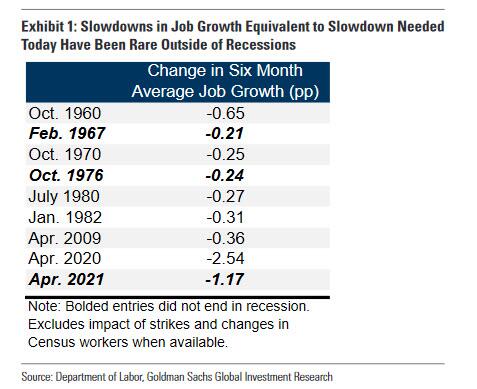
So doing some quick math, Goldman calculates that payroll growth will need to slow to roughly 150k on average in the second half of the year in order to begin to rebalance the labor market and calm wage and price pressures, and the faster the better. The problem is that as Goldman also concedes, according to historical data and statistical analysis "such a slowdown may be hard to achieve: slowdowns of this magnitude have only happened a few of times outside of recessions in modern US history, and while the recent trend of payrolls growth—the best predictor of upcoming payrolls growth—has slowed, the pace is still elevated."
Here are some more details on why the hurdle for job growth to slow by the required amount appears high on a historical basis..
The chart below shows the nine instances since 1960 that payrolls growth has slowed by more than 0.20% — roughly the amount Goldman thinks is required to restore balance to the labor market today, expressed as the change in the six-month average monthly percent change (in Goldman's framework, monthly payroll growth needs to decline from 0.34% over the last six months to 0.11% over the next six months).
Although slowdowns of 0.20% or more have been quite uncommon outside of recessions, today’s economic backdrop - at least until a recession is officially declared in a few months - is somewhat comparable to the three historical instances where job growth slowed and a recession was avoided: ahead of the slowdowns in 1976 and 2021, job growth was running well above trend as the economy was recovering from a recession, and ahead of the slowdown in 1967, the Federal Reserve tightened monetary policy to combat inflationary pressures.
As an aside, Goldman economists points out that the recent pace of payroll growth is one of the best predictors of upcoming payrolls growth and even more useful than knowing the future rate of output growth (the predictive power of job momentum likely reflects lags in the hiring and firing process, the cost of large personnel changes, and the pro-cyclicality of capacity utilization.)
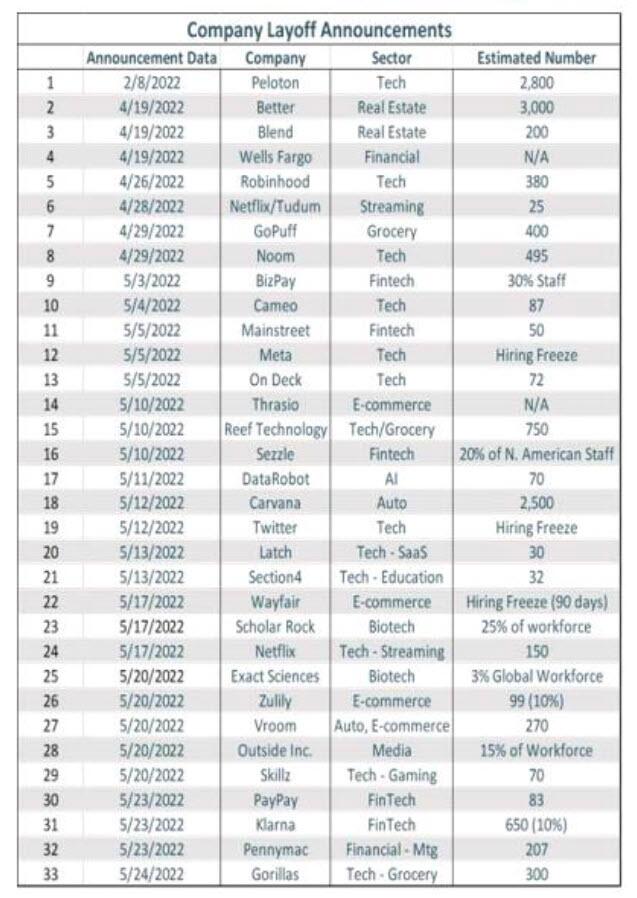
With payrolls growing just over 400k per month over the last three months (if slowing), putting a high weight on momentum would suggest a high hurdle for job growth to slow enough in coming quarters to restore balance to the labor market. However, it is also the case that employment growth has recently slowed to roughly 225k per month over the last three months in the noisier household survey, suggesting that the underlying trend could be overstated by just looking at nonfarm payrolls. Furthermore, while not captured yet by the US labor bureau, leading labor market indicators such as mass layoff announcement has surged in recent weeks, with dozens of announcements in the otherwise rock-solid tech sector. Expect similar weakness across the rest of the rest of the labor market.
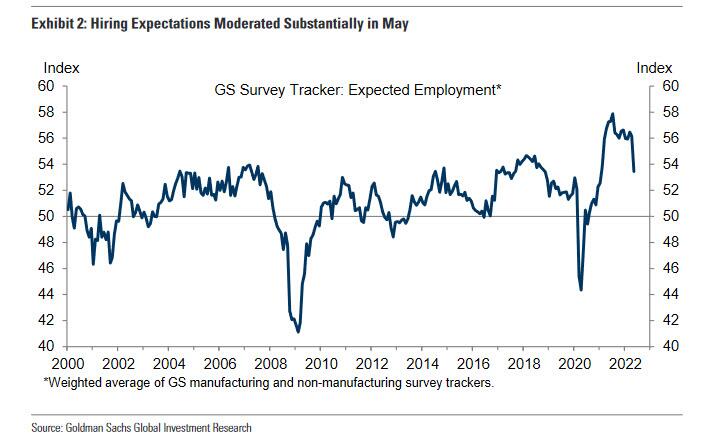
Goldman itself admits as much: "recent anecdotes of hiring freezes and more selective hiring indicate that companies expect payroll growth to slow, and the most recent business activity surveys corroborate these signals."
In the next chart, the bank constructs an aggregate index of employment growth expectations by replicating its own survey tracker methodology on the employment expectations components of eight regional Fed manufacturing and services surveys. It found that in May, this series recorded its third largest monthly decline since 2000—behind only October 2008 and March 2020—yet even so it remains at a historically elevated level... but not for long.
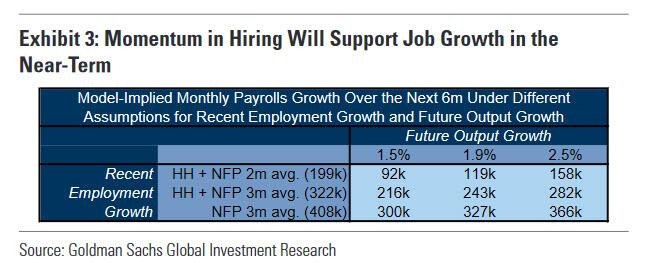
Which brings us to punchline #1: to get a sense of how much employment growth could slow - or rather should slow - over the coming months, Goldman estimates a model of future payroll growth based on lagged payroll growth, changes in output growth, and lagged changes in survey-based employment growth expectations. It then uses the model coefficients to project future payrolls growth based on different assumptions about the recent employment growth trend and future output growth.
Goldman derives two conclusions from the scenarios above:
  • First, different plausible assumptions for the recent employment growth trend imply a wide range of outcomes for future payrolls growth: coupling the bank's baseline (and recently cut) H2 2002 GDP growth forecast with the different employment growth trends suggests that monthly payrolls growth could range from roughly 125k up to 325k (middle column).
  • Second, the balance of risks to near-term employment growth appears skewed to the upside relative to Goldman's own forecasts of 215k per month over the next three months and 160k over the next six months (suggesting that Goldman is once again overly optimistic on the economy and will soon be slashing its jobs, and GDP, forecasts again).
One final point: while Goldman does not say it, but is generously implied in its analysis, the bigger the recession, the faster US job growth turns negative and the quicker wage growth implodes, the better for the bulls even if it sends the odds of more summer violence (if not before the midterms, then certainly next year after the GOP has won control of Congress) through the roof.

(ZH) Goldman Sees S&P Tumbling To 3150 When The Recession Hits

Goldman Sees S&P Tumbling To 3150 When The Recession Hits

After plunging on Friday, S&P futures are starting off the new week even lower with spoos at 3,860 in Sunday evening trade, just 4 points away from a bear market (3856 is 20% off the January all time high), with all other assets - treasuries, commodities and cryptos - all puking as well in the latest "crash correlations to 1" trade as markets freak out that the Fed will crash and burn everything - stocks, bonds, the economy, Biden's approval rating - just to contain inflation, forgetting that once the Fed achieves its mission of a hard landing (because a soft-landing won't push jobs nearly low enough to short-circuit the wage-price spiral), it will be up to the Fed to restart the US economy (since Democrats will be kicked out of Congress in an avalanche this November) and with Biden president, there will be no fiscal stimulus for at least two more years.
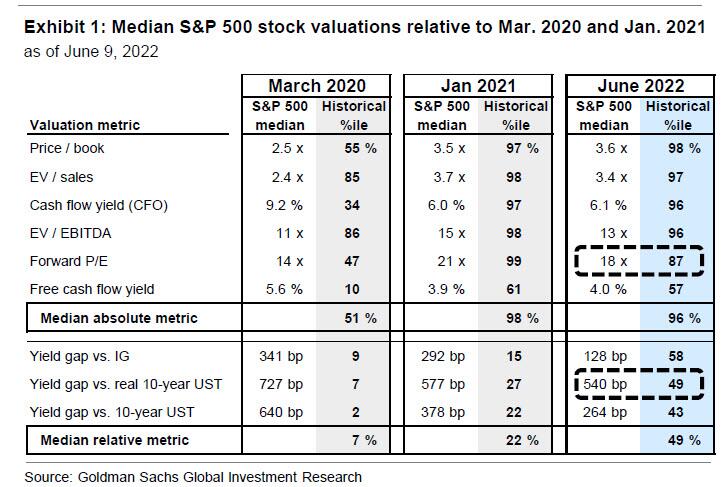
With that in mind, Goldman's chief equity strategist - whose economists now expect the Fed to hike 50bps in September, if keep the June hike at 50bps despite some banks such as Barclays now expecting a "surprise", non-consensus 75bps rate hike this week - cautions clients that equity valuations remain far from depressed, to wit:
The median S&P 500 constituent’s P/E ratio of 18x ranks in the 87th percentile since 1976. For context, in March 2020 the median stock’s P/E was 14x (47th-percentile). Valuations appear more attractive in the context of interest rates, but still do not look “cheap.” The 540 bp gap between the median stock’s EPS yield and the real 10-year Treasury yield ranks in the 49th percentile, whereas in March 2020 the yield gap was 727 bp (7th percentile).
Yet as David Kostin writes in his latest Weekly Kickstart note (available to professional subs) his base case forecast valuation is expected to remain roughly flat while earnings growth does the heaving lifting and pushes the S&P back to 4300 at year-end 2022, some +10% from here - or at least until Kostin slashes his year end forecast once again, and for the 4th time in a row- as he himself hedges when warning that "inflation surprises like this morning’s will also affect the path of multiples, for better or worse."
How do we know that Kostin is just biding his time until he cuts his S&P price target again (which will likely mark the bottom of stocks in the current cycle)? Because as he admits next, "some of the economic developments that have boded well for the Fed’s battle with inflation have intensified concerns about the earning outlook." As a result, he notes that while "Valuations dominated investor focus in early 2022, but recent client conversations have centered on risks to EPS estimates" which of course is not news to regular readers and to those who have been focusing on Wall Street's more bearish strategists, such as Morgan Stanley's Mike Wilson, who has been warning for a while now that attention has shifted from multiples to earnings. Anyway, back to Kostin who writes that "company announcements have added to these concerns. Just weeks after shares fell by 25% on disappointing 1Q margins, Target (TGT) cut margin guidance this week as it struggles to manage excess inventory. Investors have also focused on a string of downbeat comments from tech companies. In recent weeks firms including AMZN, MSFT, and NVDA have signaled intentions to slow hiring. This development is positive in terms of balancing the labor market but reflects management anxiety about growth and inflation."
Catching up to what Wilson has been saying for months, Kostin finally concedes that he, too, "expects further downward revisions to consensus earnings estimates."
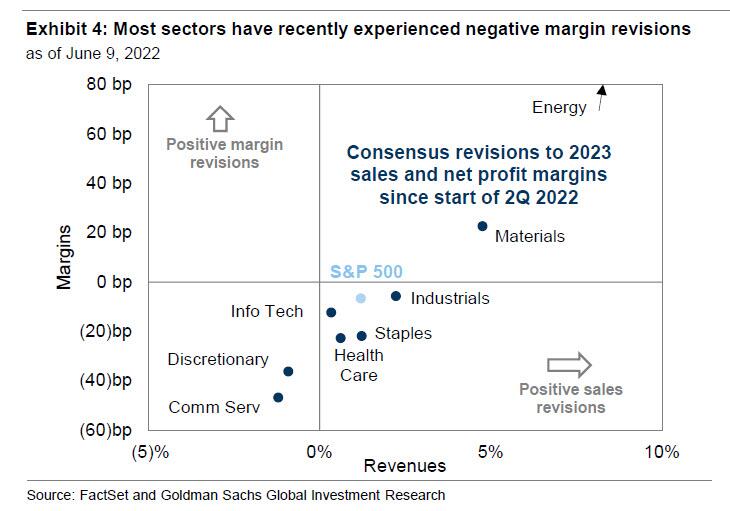
The Goldman strategist also warns that while "margins have driven the majority of recent analyst cuts, estimates still appear too high" and Kostin now expects S&P 500 net margins excluding Financials and Energy will slip from 12.7% in 2021 to 12.6% in 2023, even as consensus idiotically expects a 30 bps rise to 13.0%, even though most sectors (with the notable exception of Energy) have recently experienced negative margin revisions.
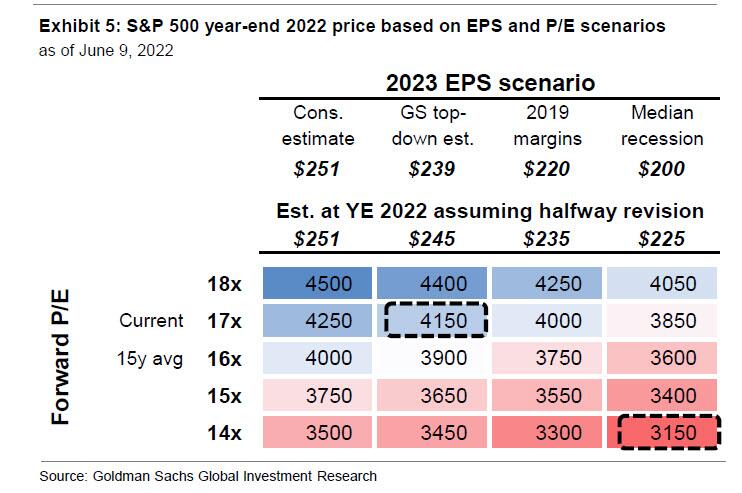
Keeping in mind that his latest note is just a placeholder for the forthcoming S&P price target cut, Kostin notes that his "base-case 2023 EPS forecast is $239, 5% below consensus of $251. If the economy contracts, the 13% median historical recession decline would bring 2023 EPS to $200. If the economy avoids recession, but margins and revenues for most sectors return to pre-COVID trends, S&P 500 EPS would equal roughly $215."
The chart below summarizes the potential S&P 500 levels at year-end 2022 based on various EPS and P/E scenarios (which a first year analyst can do on their own, of course). The scenarios assume that by year-end consensus 2023 EPS forecasts move halfway from current estimates to eventual actual EPS. For example, if the consensus 2023 EPS estimate moves halfway to our top-down forecast of $239 and the P/E multiple remains at 17x, the implied index level would equal 4165. If the EPS estimate moves to $225, halfway to the recession scenario of $200, a 14x P/E would bring the S&P 500 to 3150.
What we find more interesting is Goldman's admission that a worst-case scenario is likely, and what that would mean for the S&P:
In a recession, if the EPS estimate moves halfway to $200, a 14x P/E would bring the S&P 500 to 3150.
What does all this mean for investors, especially those who aren't dumping everything yet because they realize that the coming Fed freakout and equity ETF buying will be something never before seen:
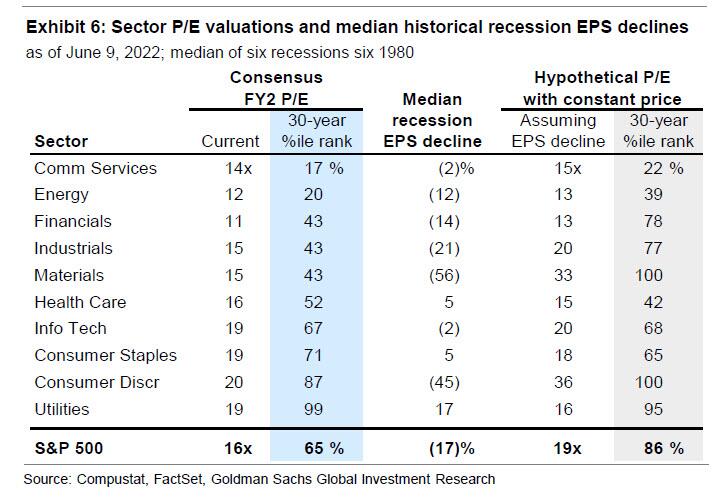
Investors looking for value opportunities should consider both valuations and potential downside risk to earnings estimates. For example, at the sector level, Energy trades well below its 30-year average P/E multiple in absolute terms, and close to record lows relative to the S&P 500. Even haircutting its EPS by the median of the past six recessions, the P/E ratio today would still rank below the 30-year average. While Health Care trades at a P/E close to its 30-year average, it has grown EPS during each of the last six recessions, and looks more attractively valued today than other defensive sectors like Utilities.
What about growth stocks ahead of the coming recession? Somewhat controversially, Kostin is not overly negative here, and writes that at a factor level, "the macro environment is becoming more favorable for Growth stocks" yet valuations is one reason he still prefer “quality” attributes.
Hints of easing inflation and less need for FCI tightening help explain the recent Growth stock rebound, including the past month’s 30% return for the GS Non-Profitable Tech Basket (GSXUNPTC). Concerns about corporate earnings also increase the appeal of secular growth stocks. However, the outlook for the Fed’s battle with inflation remains uncertain, as underscored by today’s CPI data and our commodity strategists raising their Brent forecast to $140/barrel. In addition, the valuation spread between Growth and Value remains wide relative to history. In contrast, our sector-neutral low volatility, high profit margin, and high return on capital factors each trade at discounts to their historical average valuations.
Bottom line: we commiserate with Kostin who is tacitly hinting that yet another S&P price target cut is looming, especially when one considers that a recession is now just months if not weeks away, (one which as Kostin concedes would send the S&P tumbling to 3,150) an outcome which is abundantly clear when reading the latest note from that other Goldman trader and strategist, Tony Pasquariello, who unlike Kostin is not afraid to say what he really thinks.