>>> TradeGate Pre-Market Indications

DAX:
  • Bayer (BAYN TH) -0.2%
    • Bayer Defeats Cancer Victim’s Claims in Missouri Roundup Trial
  • BASF (BAS TH) -1%
  • Mercedes (MBG TH) -1%
  • Siemens (SIE TH) -1.2%
  • BMW (BMW TH) -1.2%
MDAX:
  • Grand City Properties (GYC TH) +0.8%
  • TeamViewer (TMV TH) -1%
  • Aixtron (AIXA TH) -1.2%
  • Rheinmetall (RHM TH) -1.3%
  • Wacker Chemie (WCH TH) -1.4%
  • K+S (SDF TH) -1.6%
SDAX:
  • About You (YOU TH) +1.8%
  • Nordex (NDX1 TH) -0.1%
    • Germany Justice Ministry Vetoes Wind Energy Laws: Spiegel
  • SGL (SGL TH) -0.3%
  • Heidelberger Druck (HDD TH) -0.4%
  • Bilfinger (GBF TH) -0.5%
  • Deutsche PBB (PBB TH) -0.5%
  • Schaeffler (SHA TH) -0.8%

(ZH) Louisiana Transgender Sports Ban To Become Law

Louisiana Transgender Sports Ban To Become Law

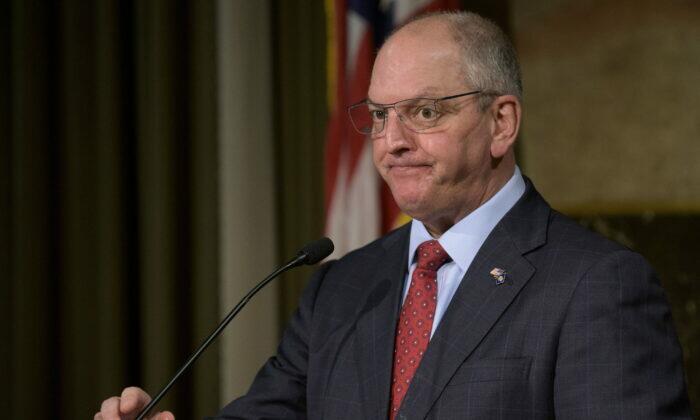
Transgender females will be banned from playing on girls and women’s sports teams at schools and colleges in Louisiana after the governor took no action to veto or sign a bill passed by the GOP-controlled legislature.

Gov. John Bel Edwards, a Democrat, who is opposed to the bill, said he took no action on Senate Bill 44 because it “was going to become law whether or not I signed it or vetoed it” because of the current make up of the Louisiana State Legislature.
Under Louisiana law, any bill that passes the state’s House and Senate automatically becomes law by the end of the legislative session if the governor takes no action.
“It became very clear to me after two years, seeing the votes on both sides, and in the conversations that I had with a number of legislators, that that bill was going to become law regardless of what I did,” Edwards told reporters on Monday.
The bill, titled the Fairness in Women’s Sports Act (pdf), will require K–12 schools and universities to “designate intercollegiate and interscholastic athletic teams according to the biological sex of the team members” recorded at birth.
It specifically provides that teams designated for females “are not open to participation by biological males,” which includes transgender females.
Louisiana is not the first state to enact such laws. The issue of transgender athletes competing in female sports has been a significant issue.
Proponents of similar bills have argued that the physical advantage transgender females have as biological males in the sporting arena is taking opportunities away from biologically female athletes.
SB44 seeks to address that, stating that “the biological differences between females and males” provide biological males, at puberty, with “lifelong effects” that are “most important for success in sports.”
Categorically, they are strength, speed, and endurance generally found in greater degrees in biological males than biological females,” the bill states.
The bill therefore seeks to protect biological women and girls from that physiological advantage that transgender females benefit from in sports owing to being born biological males.
In further comments, Edwards noted that he knew of no example in Louisiana of an openly transgender athlete trying to complete in a female sport, and that this was a reason he vetoed a similar bill last year.
He said he thinks some of those advocating SB44 and similar bills elsewhere are sending a negative message to transgender people.

>>> What to look at today -10th of June 2022

Stocks fell in Asia Friday but came off session lows as investors assessed China’s outlook and girded for the latest US inflation data. An Asian equity index shed less than 1%, sapped by Japan. European futures retreated and US contracts edged up after the S&P 500 lost 2.4% on Thursday. Chinese technology shares including Alibaba Group Holding Ltd. reversed an early-session swoon. Investors are weighing up speculation about whether the initial public offering of Jack Ma’s Ant Group Co. could be revived as Beijing loosens a regulatory crackdown on internet companies.
Mainland bourses rose after the latest Chinese data showed some moderation in price pressures, potentially boosting scope for monetary easing.  Short-dated US Treasury yields hovered near 2022 highs following a euro-area bond-market selloff after the European Central Bank opened the door to a half-point interest-rate hike in the fall. 
A dollar gauge slipped from a three-week high. The dollar-yen pair was steady but still in sight of the 2002 peak of 135.15 per dollar. The US inflation print on Friday is the next test for markets. The figures will provide clues about how aggressively the Federal Reserve must raise rates. The data are expected to show annual consumer-price gains of more than 8%. In commodities, oil edged lower in part on concerns about demand as Shanghai prepares to lock down seven districts this weekend to conduct Covid testing. Chinese President Xi Jinping called on his government to adhere “unwaveringly” to its Covid Zero policy, while at the same time striking a balance with the needs of the economy. US After Hours DOCU -24.1% falls sharply on earnings, billings guidance; CMTL -14.8%, SFIX -14.8% also lower on earnings; ILMN -6.6% falls on CFO departure

Nikkei -1.36% Hang Seng +0.10% CSI +1.00% Shanghai +0.99% Shenzen +1.67%

Eur$ 1.0631 CNH 6.6972 CNY 6.6910 JPY 134.05 GBP 1.2497 CHF 0.9792 RUB 57.8063 TRY 17.2301 WTI$ 120.78 -0.60% Gold 1,845.43 -0.14% BTC 30,050 -0.37% ETH 1,787.86 -0.31%

S&P +0.14% Nasdaq +0.34% EuroStoxx -0.81% FTSE -0.79% Dax -0.74% SMI-0.77%

Macro :
- Einhorn Declares at Sohn ‘We Have an Inflation Problem’
- Druckenmiller Warns ‘Bear Market Has a Ways to Run’ as Fed Hikes
- Yellen Says Crypto Is ‘Very Risky’ Option for Retirement Savers
- Germany’s IG Metall Union Demands 7% Wage Increase: Sueddeutsche
- El-Erian Warns Inflation Has Yet to Peak as Energy Prices Rise
- Ukraine Likely to Win Initial EU Backing for Path to Membership
- European Car-Sales Growth Only Due in 2H on Easier Comparisons

Keep an eye on :
- ANE SM : Sacyr, Acciona Energia to Join Spain’s IBEX 35 Benchmark
- ASR IM : AS Roma Bid Document Approved by Italy’s Consob
- ATO FP : Atos Shares Slump on Report of Disagreement on Strategic Options
- BAYN GY : Bayer Defeats Cancer Victim’s Claims in Missouri Roundup Trial
- BELU BB : Chainius Solutions Plans EU3.40/Share Offer for Belgium’s Beluga
- BIO GY : Biotest Achieves Milestone in Phase III Fibrinogen Trial
- CARM FP : *CARMILA JOINS SBF 120 & CAC MID 60
- DBV FP : DBV Tech ADRs Jump by Most on Record With High Volume
- FGR FP : Eiffage Consortium Wins Contract for Senegal Desalination Plant
- ERICB SS : Ericsson’s Corruption Scandal in Iraq Sparks US Probe by SEC
- EURN BB : Frontline Buys 3.82% Of Euronav Stock Issuing 10.8M New Shares
- RACE IM : Ferrari Plots Expansion of Italian Factory for Electric Vehicles
- GMAB DC : Genmab Starts New Arbitration Under License Pact With Janssen
- GVOLT PL : Greenvolt to Raise EU100m in Offering of Shares at EU5.62 Each
- MNTC SS : Mentice Offering of 800,000 Shares Prices at SEK75/Share3 Govt
- OX2 SS : OX2 Holder Altor Equity Partners Offers 10m Shares
- IPS FP : Ipsos Names Dan Levy as Group CFO
- REP SM : Repsol Sells 25% of Renewables Unit for $965 Million
- RET BB : Retail Estates Offering of 859,375 Shares Prices at EU64/Share
- SGO FP : Saint-Gobain Invests About C$90M in Plasterboard Plant in Canada
- SAN SM : *SANTANDER IN TALKS WITH ECB OVER CEO APPOINTMENT: CONFIDENCIAL
- SHOT SS : Scandic Prelim 2Q Adjusted Ebitda SEK1.00B to SEK1.10B
- TKWY NA : Apollo Said to Be Among Possible Suitors for Just Eat’s Grubhub
- OR FP : L’Oreal China CEO Says Consumer Sentiment Improves in Shanghai
- ROG SW : Roche Presents Positive Data From Blood Cancer Portfolio at EHA
- SAS SS : SAS Could Lose $8-9 Million a Day From Pilot Strike: Sydbank
- SCYR SM : Sacyr, Acciona Energia to Join Spain’s IBEX 35 Benchmark
- SHEL LN : Workers Say to Begin Strike at Shell’s Prelude LNG Facility
- URW NA : Simon Property Sees Growth in Retail Brands Amid Outlet Focus
- VAR1 GY : Varta Says No Decision Made On Battery Plant in Romania
- VOW GY : Volkswagen Plans to Sell First Electric Car in India in 2023

>>> Europe : Brokers Upgrades & Downgrades - 10th of June 2022

>>> Up
* Aryzta Raised to Hold at Kepler Cheuvreux; PT 1.10 Swiss francs
* Countryside Raised to Neutral at JPMorgan; PT 295 pence
* EVS Broadcast Raised to Buy at Kepler Cheuvreux; PT 26 euros
* Knorr-Bremse Raised to Buy at Citi
* Signify Raised to Buy at Citi

>>> Down
* GFT Cut to Hold at Berenberg; PT 48 euros
* Kojamo Cut to Hold at SEB Equities; PT 19 euros
* Titan Cement Cut to Sell at Berenberg; PT 10 euros
* Travis Perkins Cut to Hold at Berenberg; PT 1,380 pence
* Workspace Cut to Neutral at JPMorgan; PT 870 pence

>>> Initiation
* Ageas Rated New Hold at ING; PT 45 euros
* Realites Promotion Rated New Hold at Kepler Cheuvreux

>>> Call

WSJ : Facebook Rethinks News Deals, and Publishers Stand to Lose Millions in Pay

Facebook Rethinks News Deals, and Publishers Stand to Lose Millions in Payments
Social-media company pays more than $10 million a year to a handful of news organizations to feature their content on its news tab

Meta Platforms Inc.’s Facebook is re-examining its commitment to paying for news, people familiar with the matter said, prompting some news organizations to prepare for a potential revenue shortfall of tens of millions of dollars.

The company has paid average annual fees of more than $15 million to the Washington Post, just over $20 million to the New York Times, and more than $10 million to The Wall Street Journal, according to people familiar with the matter. The Journal fee is part of a broader Facebook News deal largely negotiated by parent company Dow Jones & Co., including annual compensation worth more than $20 million, people familiar with the partnership said.

At the heart of these deals is Facebook’s dedicated News section, which curates a selection of free articles for readers. Facebook, which pays news publishers to feature their content without a paywall, in 2019 agreed to three-year deals with various publishers that are set to expire this year.

Facebook hasn’t provided publishers with any indication that it plans to re-up the partnerships in their current form, or at all, according to people familiar with the matter. The company is looking to shift its investments away from news and toward products that attract creators such as short-form video producers to compete with ByteDance Ltd.’s TikTok, according to some of the people. The company is also investing heavily in the metaverse, as highlighted by its recent name change to Meta.

Also, Meta CEO Mark Zuckerberg has been disappointed by regulatory efforts around the world looking to force platforms like Facebook and Alphabet Inc.’s Google to pay publishers for any news content available on their platforms, people familiar with the matter said. Such moves have damped Mr. Zuckerberg’s enthusiasm for making news a bigger part of Facebook’s offerings, they said.

Last month, Campbell Brown, the former NBC and CNN journalist who was the architect of Facebook News, announced she took on a new, broader role overseeing global media partnerships, which encompasses tie-ups with everything from sports leagues to film studios.

The Information earlier reported that Facebook was reconsidering its payments to publishers and shifting its emphasis.

If Facebook pulls back on its payments to U.S. news publishers, it would represent the end of a certain detente in the fraught relationship between online content makers and the social-media giant.

Publishers that have struggled to compete for digital ad revenue with Google and Facebook have criticized the tech giants for not paying for the news content that is featured and shared on their platforms. Dow Jones parent News Corp was among the most vocal critics.

The Journal gets the bulk of the Dow Jones payments, which are made up mostly of cash but also include other forms of compensation, such as credits for marketing on Facebook, according to people familiar with the matter. The deal encompasses other Dow Jones publications as well as the New York Post, which is owned by News Corp.

Many other U.S. news publishers are getting payments from Facebook to have their content featured in its news tab, but they only get a fraction of the sums paid to the Washington Post, the New York Times and Dow Jones, according to people familiar with the matter. Facebook is paying more for access to paywalled content, while publishers whose stories are accessible for free are getting less money, a person familiar with the deals said. The smaller deals usually are for less than $3 million a year, the people said.

Dow Jones, the New York Times and the Washington Post declined to comment. The Times last year had revenue of $2.1 billion, while Dow Jones reported $1.7 billion in revenue for its last fiscal year, which ended June 30, 2021.

Facebook announced the launch of Facebook News—which users can find as a tab on the mobile app or website, similar to the Facebook Watch tab for video—in the fall of 2019, on the heels of widespread criticism about the impact that Facebook and Google’s growing share of the digital ad market was having on news organizations—particularly local ones. By 2018, Facebook and Google were getting 77% of the digital advertising revenue in local markets, and 1,800 U.S. newspapers had closed down since 2004.

The launch of the News tab was a crowning achievement for Ms. Brown, whom Facebook hired to improve its relationships with publishers, according to people familiar with the matter.

Facebook first rolled out the product in the U.S., offering upfront payments to news organizations. It expanded it to the U.K., Germany and Australia in 2021, and France this year.

All the while, Facebook was facing a continuing regulatory onslaught around the world. Regulators in the European Union, France, the U.K., Australia and the U.S. took steps aimed at forcing the platforms such as Google and Facebook to pay publishers for news content available on their services. Facebook opposed a law that passed in Australia so vehemently that it moved to block the publication of any news story on its platform in the country. In the process, it also ended up shutting down the Facebook pages of many of Australia’s health, charity and emergency services for five days—a move that whistleblowers allege was deliberate and that Facebook described as an accident.

This spring, a revamped version of the U.S. legislation aimed at forcing the platforms to negotiate payment with publishers began circling in Congress, this time with a provision that would require the platforms to engage in baseball-style, “final offer” arbitration—the same measure that prompted Facebook to pull news in Australia. Canada, meanwhile, recently proposed a law modeled on Australia’s.

WSJ : The China-Germany Investment Nexus Frays

The China-Germany Investment Nexus Frays
Europe’s industrial and trade heavyweight, long a cheerleader for strong China ties, has been sounding more ambivalent lately

Germany Inc. and China Inc. have long been wrapped in the tightest of corporate embraces. But lately there have been increasing signs that the bonds of friendship—and profit—have started to chafe a bit.

The latest sign came last week, when The Wall Street Journal reported that the German government had declined to renew state-sponsored insurance covering losses related to political upheaval for Volkswagen’s operations in China. Berlin cited concerns over human-rights violations in China’s Xinjiang region, where Volkswagen has a plant. Volkswagen says there is no forced labor at its factory and that it still sees China as the world’s key driver of economic growth.

In public, corporate leaders from Germany—and other European countries—have in fact been sending very mixed signals on China recently. While a recent interview in the Economist with German chemical giant BASF’s chief executive struck a bullish note, nearly a quarter of the companies responding to an April survey by the European Union Chamber of Commerce in China said they were considering shifting current or planned investments to other countries. the highest percentage in the past decade.

It is wise to take such sentiment surveys with a dose of salt. But hard data on actual investment spending actually tells a similar story—and one that predates this spring’s outbreak of China-skepticism triggered by the ham-handed Shanghai lockdown.

For much of the past decade, China ranked first or second among recipients of German foreign direct investment outside Europe, with a surge that gained steam in the years after the 2008 financial crisis. Particularly in the mid-2010s, the rest of Asia looked like mostly an afterthought.

German investment in China cratered in early 2020 but then roared back: By the end of 2021, Bundesbank data shows, net German FDI into mainland China and Hong Kong had rebounded to €6.4 billion, equivalent to $6.8 billion—close to twice its prepandemic 2019 total. At the same time, however, a funny thing happened: Germany’s investment in the rest of Asia surged to €14.2 billion, more than three times its 2019 total.

This suggests that the trend toward diversification, if not decoupling, actually predates recent tensions over China’s Covid-control policies and tacit support of Russia in its war with Ukraine. The shambolic state of the China-Europe bilateral-investment treaty, basically defunct since China sanctioned several members of the European Parliament in retaliation for the EU’s Xinjiang sanctions in early 2021, is one likely culprit.

Pressure from the German government goes back to 2020, when the economy minister flagged the risks of overdependence on China in the wake of that year’s supply-chain disruptions. And since late last year Germany has had a coalition government that includes the progressive Green Party, a vocal critic of China’s human-rights record.

German companies are heavily invested in China and not leaving. But Germany Inc. is starting to hedge its bets more aggressively. And the nation punches far above its weight in global trade networks, with the value of its merchandise trade equivalent to 66% of its gross domestic product in 2020, according to the World Bank. Where Germany leads, others may soon follow.

FT : The billion pound battle for prestigious Claridge’s of London

The billion pound battle for prestigious Claridge’s of London
A fiery dispute has erupted between the hotel’s Qatari owners and former developer Paddy McKillen

Claridge’s hotel is busy preparing for trade to roar back from the pandemic.

Its penthouse suite is due to reopen this year after extensive redevelopment, with a bespoke Steinway piano and a price tag that could stretch to £100,000 a night.

Beneath the art deco lobby a team of Irish builders has been working on an ambitious five-storey excavation that will house a luxury members’ club and spa — often digging by hand to avoid disturbing the high-paying guests 10 metres up.

Sir Jony Ive, the former head of design at Apple who has stayed at Claridge’s “four or five times a year” for the past 15 years, told the Financial Times the structural renovation was “unlike anything I have ever seen before”. 

But behind the scenes in Mayfair a dispute has erupted that could prove to be the most costly in the storied history of the 220-year-old grande dame of the global hotel industry.

Billions of pounds could be at stake in a fight between Paddy McKillen, the Irish property developer who owned about a third of a hotel group that also includes the Berkeley and Connaught between 2004 and 2015, and a group of Qatari investors that acquired the properties in 2015 following a bitter ownership dispute.

The battle centres on how much luxury hotels are worth in a post-Covid world where well appointed rooms are once again filling up with guests willing to pay thousands of pounds a night.

McKillen claims he is owed billions of pounds under an agreement to share future profits struck with the Qataris at the time of the 2015 sale, which valued Claridge’s, the Connaught and the Berkeley at £1.3bn.


The terms of the contract appear clear: McKillen is in line for 36 per cent of the upside valuation of the hotels minus capital expenditure. That payout could be significant, given the work his management company has carried out to add space and improve facilities, people close to McKillen claim.

Some estimates have put a current value of more than £5bn on the hotels, although Tim Stoyle at Savills warned that luxury hotels trade so rarely “it is very hard to draw definitive trends”.

Maybourne, the hotel operator ultimately owned by Qatar’s former prime minister, Sheikh Hamad bin Jassim bin Jaber al-Thani, and its former emir, Sheikh Hamad bin Khalifa al-Thani, accepts McKillen is owed something — but disagrees on how much.

The two parties cannot even agree which hotels are included in the deal, with the contract definitely covering Claridge’s, the Berkeley and Connaught but, Maybourne argues, not newer luxury hotels in the US and France.

Owner tensions
Claridge’s has long been one of Britain’s most prestigious residences and is the flagship London hotel of the Maybourne group. Winston Churchill decamped there in 1945 after the second world war, when it had offered a refined sanctuary to the kings and queens of Norway, Holland and Greece. Britain’s current Queen has eaten so often at the hotel that it has become known as the “annexe” to Buckingham Palace.

Other guests have ranged from Diana, Princess of Wales, to Elizabeth Taylor and Audrey Hepburn to Lady Gaga.

McKillen, a Belfast Catholic and friend of prominent Irish figures such as Bono of U2, became involved with the London hotels in 2004, when he acquired a stake of just over a third in a consortium led by Irish investor Derek Quinlan.

He had built up his fortune in real estate but this was his most high-profile deal yet. The years that followed were successful for Claridge’s but punctuated by tensions over ownership.

The financial crash came quickly after the deal was struck, leaving Quinlan with unsustainable debts that were at risk of being seized by Nama, the Irish state agency set up to deal with bad loans. Quinlan sought help from Sir David and Sir Frederick Barclay, leaving McKillen angry and blindsided.

McKillen battled through a £50mn legal fight with the Barclays to try to regain control of the hotels in one of the most costly legal battles in British court history. He turned to Qatar as the “white knight” to resolve the ownership impasse.

Qatar wanted to own 100 per cent of the hotels, so struck an unusual deal that is only now being tested. McKillen emerged debt free but with a lucrative seven-year management agreement, due to end this December.

McKillen ousted
That was cut short in April this year, when McKillen awoke to an email sent to staff — and seen by the Financial Times — from Marc Socker and Gianluca Muzzi, Maybourne’s new chief executives, saying he would no longer be involved in the management or project management of the hotels with immediate effect.

Hume Street Management Consultants, McKillen’s company, was told it was not required for further work and should not seek access to the hotels’ offices or staff.

Ive, a long-time associate of McKillen, said he was “shocked” by the move. But no one was more shocked than McKillen himself, who colleagues said had expected a “dignified” jog towards retirement at the end of the year rather than a terse letter of dismissal.

McKillen had already stepped back from running two Maybourne hotels in Los Angeles and the French Riviera in January. But when the letter arrived, McKillen and his team were busy working on Claridge’s new penthouse and members’ club.

The McKillen team, which has also developed houses for Calvin Klein and Beyoncé, was hopeful of opening these before the summer. Maybourne told the Financial Times there was still “a very significant amount of work” needed to complete the Claridge’s project.

When the FT visited the development works under the hotel in April, the wood-lined spa areas were finished although the swimming pool was a shell and some levels were still walled in concrete. The rest of the work will now be carried out by other developers.

Maybourne said it had “not renewed our contract with HSMC, the company Paddy controls, after appointing new co-chief executives to reflect the changed direction of Maybourne from the management of individual assets to the creation of a global, ultra-luxury brand”.

“As is standard practice, this means HSMC staff no longer have access rights to Maybourne offices,” it added. Companies House records show that McKillen and his business partner Liam Cunningham left the board on April 1.

The Qataris are in part represented on the Maybourne board by Michele Faissola, a former Deutsche bank executive who was last month acquitted by a Milan appeals court over alleged market manipulation and false accounting linked to his role in the Monte dei Paschi banking scandal.

The Italian motor racing enthusiast has run Dilmon, the al-Thani family office since 2018, according to his LinkedIn profile.

Requests for interviews with Claridge’s management and Maybourne were declined by Maybourne.

Ready to fight
The difficulty now for the teams of advisers being assembled is to agree on a value of the hotels — and so of McKillen’s contract.

A London-based real estate consultant said that given the Ritz sold for £800mn, or £5mn per room, in 2020, the renovated 190-room Claridge’s alone would be worth “substantially in excess” of what the Qataris paid in 2015 for the group of three London hotels.

Hume Street also argues that all of the Maybourne hotels and subsidiaries, which would include the French and US sites, are part of the deal.

Maybourne said it covers only Claridge’s, the Connaught and Berkeley hotels, and the others were brought in after McKillen’s time as a part-owner of the group.

Both sides insist the contract is clearly supportive of their view, which means the warring sides may yet head to the courts for a decision in multiple jurisdictions.

A spokesperson for McKillen said: “Any owner of the Maybourne hotels must recognise that they are custodians of unique assets that are a vital part of London’s cultural life. The Qataris have indicated that they value the hotels at a substantial discount to their acquisition cost.”

People familiar with the management’s position said an independent valuation had been made that was substantially above the acquisition price but that the large costs for works specified in the agreed contract have brought McKillen’s payment lower than he might like.

Guests who use the hotels simply hope service will run to the usual levels expected.

Samuel Johar, a headhunter who eats in Claridge’s three to four times a week, said McKillen had made the hotel “a joyous place to go to”.

“Let’s hope these two [new] guys . . . don’t screw it up.”
FT : Investors bet against pound over ‘dire’ threat of stagflation

Investors bet against pound over ‘dire’ threat of stagflation
Traders question how far the Bank of England can raise rates in the face of cost of living crisis

Investors are lining up bets that the pound will fall further after a tough start to 2022 as a “dire” mix of towering inflation and slowing growth darkens the UK’s economic outlook.

Wagers that sterling will fall are near their highest level in almost three years, according to Commodity Futures Trading Commission data, which track how speculative investors are positioned in futures contracts, a proxy for sentiment in the $6.6tn-a-day foreign currency market.

Even as Boris Johnson survived a parliamentary confidence vote this week — potentially averting a period of political turmoil — markets are focused on the gloomy economic backdrop, say analysts, meaning the UK prime minister’s victory is unlikely to prompt a change in course for the currency.

Sterling whipped back and forth around Monday’s vote, but on Thursday traded close to where it was against the US dollar a week ago at $1.254. It has shed 7 per cent this year against the dollar.

Currency traders say the implications of Johnson’s win were muddied by uncertainty over who might have replaced him. At the same time, the political twists and turns largely remain a sideshow for a foreign exchange market focused on the potential for a UK recession later this year, which could halt the Bank of England’s efforts to tame inflation by raising interest rates.

“The market is very bearish on sterling,” said Sam Lynton-Brown, head of developed markets strategy at BNP Paribas. “Domestic political uncertainty hasn’t been a big driver of the currency. So even if it alleviates, you shouldn’t expect the pound to recover. We still think it can weaken further.”


The BoE has lifted interest rates four times since it began to tighten monetary policy in December — well ahead of counterparts such as the US Federal Reserve and the European Central Bank. Even so, the pound has lost ground against the euro and the dollar this year as investors begin to wonder how long borrowing costs can continue to rise with consumers facing an acute cost of living crisis.

“By the time we get into the autumn in the UK, the impact on household incomes of inflation but also of higher rates will be so marked that the window of opportunity for the BoE to raise rates will be closing,” said Jane Foley, head of currency strategy at Rabobank.

The problem of how to rein in inflation without choking off growth is not unique to the BoE. But some investors worry the UK’s dilemma is more acute than that faced by other big developed economies. The OECD on Wednesday forecast that the UK economy will grind to a halt next year, with only sanctions-hit Russia faring worse among G20 nations.

“Even as inflation comes back down in other major economies, we are likely to have a more persistent problem in the UK,” said Mark Dowding, chief investment officer of BlueBay Asset Management. “A stagflationary environment will be pretty dire for all UK assets and for the pound,” he said, describing the blend of surging prices and slowing growth. “We could end up with a scenario where the pound is on its way to parity with both the euro and the dollar.”

Recent comments from governor Andrew Bailey that the BoE is “helpless” to fight inflation have not helped, according to Dowding.

“Even if they think that — they shouldn’t be telling everyone. It’s only going to push up inflation expectations even further,” he said.

Lynton-Brown said that stubbornly high inflation would hit foreign demand for UK government debt, which trades at some of the lowest inflation-adjusted yields in the world. Without persistent inflows into gilts to fund the UK’s current account deficit, the exchange rate would have to adjust lower, he said.


For some analysts, the gloom surrounding sterling could actually be a source of resilience in the short term. A global rebound in stock markets would likely boost the pound, which tends to move in tandem with riskier assets, as bearish investors exit their short positions, according to Nomura strategist Jordan Rochester.

Investors might also embrace a renewed threat to Johnson’s position, betting that his successor would be less likely to inflame trade tensions with the EU by ditching the post-Brexit trade deal for Northern Ireland, he said.

“The market has become so negative on politics in the UK that it tends to lean towards the positive if there’s any promise of change,” said Rochester. “But you have to be careful because we don’t know what a change of leadership means for policy, for spending, or for reform, because we don’t know who comes next.”

“The next Tory leader might not be racing to tear up the Northern Ireland protocol, but you could also get an even harder Brexiter,” he added.

FT : The world must brace itself for a further surge in oil prices

The world must brace itself for a further surge in oil prices
Outlook for production is bleak with Russian shortfalls hard to replace

JPMorgan’s chief executive Jamie Dimon thinks oil prices could surge to $175 a barrel later this year. Jeremy Weir, the head of commodity trader Trafigura, says oil could go “parabolic”.

Energy Aspects, a consultancy with clients stretching from hedge funds to state energy companies, says we are facing “perhaps the most bullish oil market there ever has been”. Goldman Sachs thinks oil prices will “average” $140 a barrel in the third quarter of this year.

It is tempting to dismiss this mass outbreak of bullishness as book-talking by banks and traders positioned for a short-term rise in crude, which has already reached $120 a barrel.

Those with long memories recall the surge in oil to $147 a barrel on the eve of the financial crisis, when Goldman was among the chief cheerleaders for a rally that quickly reversed as the economy went south. Oil was at $40 a barrel by Christmas 2008, yet some of the bonuses earned by Wall Street energy traders that year went down in market lore.

But while a healthy dash of scepticism is usually warranted with price forecasts, you only need to scratch the surface of the oil market to see that these bullish calls are, this time, well-founded.

The energy crisis, which started with Russia squeezing natural gas supplies to Europe before spreading across the commodity complex after the invasion of Ukraine, is far from over. It is likely to get worse before it gets better, with grave ramifications for a world economy already riddled with inflation.

The key issue is a simple one: there is barely enough oil to go round. And with Russia’s sanctions-hit oil output facing an increasingly difficult route to market there are legitimate fears supply could fall much further.

The EU has just banned seaborne cargoes of Russian oil, forcing Russia to ship its crude ever further distances to buyers willing to turn a blind eye to its actions in Ukraine. India and China have snapped up heavily discounted cargoes after many buyers in Europe self-sanctioned.

But as the volumes of displaced Russian oil rise, there are questions over the ability and willingness of refiners in Asia to keep absorbing them.


The big challenge is a looming ban on insurance in the EU and UK for ships carrying Russian oil. It would effectively shut Russia out of mainstream tanker markets, leaving them with vastly reduced options for shipping their oil. Oil tankers do not just need to insure expensive cargoes but against liabilities such as Exxon Valdez-style spills with multibillion-dollar clean-up costs.

Rory Johnston, a commodity strategist, argues that most major ports simply will not accept tankers without protection and indemnity insurance — a market the UK and EU dominate — and conservatively estimates that Russian production declines will double to about 20 per cent from pre-invasion levels — or 2mn barrels a day — by the end of the year.

Russian output could fall much further, with the International Energy Agency predicting a decline of 3mn b/d — the equivalent of losing almost all Kuwait’s production.

This potential shortfall will not be easy to replace. Western governments have already tapped into strategic reserves, releasing about 1mn b/d since the invasion. But that has only tempered the price rise, not reversed it, and cannot continue indefinitely.

The only countries with significant spare production capacity are Saudi Arabia and the United Arab Emirates, but their ability to pump is not unlimited. Saudi Arabia’s production is approaching 11mn b/d after agreeing to slightly accelerate output increases. But to add another 1mn b/d would push their output towards uncharted territory, straining their oilfields if they need to hold production there for more than a few months.

Other Opec members are struggling to boost production even back to pre-pandemic levels after years of mismanagement and under-investment. A potential US nuclear deal with Iran that could free more of their barrels is stuttering.


Spiralling food prices risk unrest in many oil-producing countries, further threatening supplies.

Western oil majors remain hesitant to invest. Even if they ignored pressure to go green, large developments outside the US shale patch take years to come on stream.

If supply is deeply troubled, that leaves demand to balance the market. But governments have made short-sighted cuts to fuel taxes that support consumption, while people frustrated by two years of Covid-19 disruption have been willing to pay up at the pump.

China is reopening. People are flying again. Demand is going in the wrong direction.

All these factors point to rising oil prices until a level is reached that reduces consumption, probably by triggering an economic slowdown large enough to curtail demand. In other words, a recession for many economies.

Policymakers could encourage conservation, from lowering speed limits to reinstating taxes. But the evidence to date suggests they are happier stumbling into disaster than upsetting motorists. They must hope that when oil gets cheaper again, voters will still have a job to drive to.