WSJ : Airbus Calls on West to Avoid Sanctions on Russian Titanium

Airbus Calls on West to Avoid Sanctions on Russian Titanium
European plane maker has warned against restrictions on the key material while rival Boeing has stopped purchases

Airbus EADSY 0.69% SE is pushing against sanctions on Russian titanium sales, amid a flurry of restrictions on the export of other Russian goods ranging from vodka to steel.

Airbus, the world’s largest commercial plane maker, is still importing hefty amounts of titanium from one of the country’s biggest exporters. It has publicly called for the European Union to hold off imposing sanctions on the metal, which is used to manufacture critical components of its aircraft, from landing gear and fasteners to the pylons that connect an engine to a wing. About 65% of Airbus’s titanium supply comes from Russia, according to consulting firm Alix Partners.

“We think sanctioning titanium from Russia would be sanctioning ourselves,” Airbus Chief Executive Guillaume Faury said over the weekend. Russian titanium sales are “one of the few areas of business where it is in the interest of no party to disrupt the current situation,” he told reporters at an aviation gathering in Doha, Qatar.

Titanium has so far been kept off the EU and U.S. sanction lists, but many buyers have reduced their exposure to Russian sources and have found alternative suppliers for a number of reasons, including the difficulty of making payments into Russia.

Airbus isn’t the only Western company still buying titanium but is among the biggest Western aerospace firms still doing so, demonstrating the challenges in quickly replacing Russian supply chains. Airbus’s reliance on Russia exposes it to the risk of new sanctions imposed by either Europe or the U.S., or export restrictions from Russia. It is also subject to reputational risk amid rising public pressure on companies to withdraw financial support for the Russian economy.

Airbus gets its Russia-sourced titanium from VSMPO-Avisma PJSC. VSMPO is part-owned by Russian defense firm Rostec, which manufactures arms for the Russian military. The company is headed by sanctioned oligarch Sergey Chemezov, identified as one of President Vladimir Putin’s known close associates. Rostec is subject to some sanctions, too, but VSMPO sales of titanium aren’t. Rostec and VSMPO didn’t respond to requests for comment.

Airbus rival Boeing Co. , which before the war purchased about one third of its titanium from Russia, said at the onset of the invasion of Ukraine that it would suspend its titanium joint venture in Russia and halt purchases of the metal from there. Chief Executive David Calhoun said in April it was “in the spirit of doing the right thing.”

Raytheon Technologies Corp. , which owns engine maker Pratt & Whitney, has halted its $50 million annual spending on Russian titanium and said that would lead to some delivery delays this year. General Electric Co. ’s aviation business had already turned to other supplies after Russia’s annexation of Crimea in 2014, reducing its exposure to Russian titanium to two parts, or about 1% of its total titanium use. The unit has over a year’s supply in storage, the company said.

Part of the challenge for Airbus is the lengthy certification procedure for bringing on new suppliers and components, a process that can take between 18 and 24 months, according to Pascal Fabre, managing director of Alix Partners.

“There is a heavy dependency on one specific supplier,” Mr. Fabre said. “It’s very difficult to radically change the setup.”

Titanium has become an increasingly important material in aircraft production because of its high strength-to-weight ratio and resilience against corrosion. While it is mined the world over, production of titanium sponge, the unfinished raw material, is centered in key areas such as Japan, China and Russia. About 13% of it comes from the latter, according to the U.S. Geological Survey.

The market for titanium is relatively small compared with other metallurgical goods. Russia’s titanium exports amounted to $415 million in 2020, compared with $16 billion for iron and steel, according to Trade Data Monitor.

Even so, the EU has been weighing whether to impose sanctions on the material. In comments in late April, EU trade commissioner Valdis Dombrovskis said the bloc needed to look for new suppliers for raw materials used by aerospace manufacturers, including titanium, palladium and nickel.

Airbus is preparing to bring online secondary sources of titanium, a process that it laid the groundwork for in the wake of the Crimea annexation, Mr. Faury said. He said Airbus had about six to 12 months worth of titanium stored at the outset of Russia’s invasion of Ukraine in February this year. Airbus has said it is looking for new titanium sources in the U.S. and Asia.

(ZH) Netherlands Follows Germany, Lifts Restrictions On Coal-Fired Power Station

Netherlands Follows Germany, Lifts Restrictions On Coal-Fired Power Stations Amid Drop In Russian Gas Supplies

The Netherlands is following in the footsteps of neighboring Germany and lifting a cap on production by coal-fired power stations in an effort to prevent a winter energy crisis amid a drop in gas supplies from Russia.
“Because the risk of gas shortages has increased, the cabinet has decided today to withdraw the production limitation for coal-fired power stations for 2022 to 2024 with immediate effect,” climate and energy minister Rob Jetten said in a statement announcing the move on Monday.
“This means that the coal-fired power stations are allowed to produce at full capacity again so that less gas is needed for the production of electricity by gas-fired power stations. This reduces the risk of gas shortages and makes it easier to fill the gas storage facilities in the Netherlands and Europe.”
The Netherlands is in the first phase of a gas crisis, according to Jetten, which has prompted the government to initiate its Gas Protection and Recovery Plan.
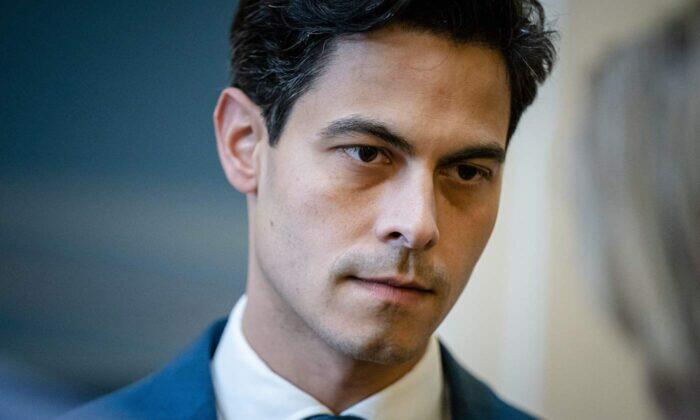
Netherlands Minister for Climate and Energy Rob Jetten after the weekly Council of Ministers at the Binnenhof in The Hague on April 22, 2022. (Bart Maat/ANP/AFP via Getty Images)
Jetten said the overall aim of removing the restrictions on coal-fired power stations is to fill gas storage facilities across the Netherlands with more than had previously been agreed by Europe to ensure that plenty of gas is saved ahead of the winter.
The Netherlands capped its coal-fired power plant production at just 35 percent of capacity as it seeks to transition away from higher carbon dioxide emissions to clearer energy.
Its removal of the cap on coal-fired energy production is expected to save 2 billion cubic meters (bcm) of gas use per year but Jetten noted that the Netherlands would still meet its 2030 climate goals, which included phasing out its last four coal-fired power plants by 2030.
The Dutch cabinet will announce additional measures aimed at reducing the extra CO2 to offset emissions from coal-fired power stations in the near future.
In the short-term, officials are working on a “temporary gas-saving tender that will give large gas consumers a financial incentive to reduce their gas consumption,” Jetten said.
Back in May Russia’s Gazprom cut off gas supplies to Dutch gas trader GasTerra after it had failed to pay for deliveries in Russian rubles as requested by Russian President Vladimir Putin in March.
That decision means Gazprom will not deliver some 2 billion cubic meters of gas to the Netherlands between now through Oct. 1, when its contract with GasTerra was set to end. However, Jetten stressed on Monday that there was currently no shortage of gas in the Netherlands.
“There are currently no acute gas shortages in the Netherlands, but the declining gas supplies could have consequences,” the climate and energy minister said.
“With the declaration of the first level of a gas crisis, gas companies must provide additional detailed information on current gas supplies and stocks on a daily basis. This will enable the government to monitor the gas market even more closely and immediately take additional measures if the situation so requires.”
The latest decision by the Dutch government comes just a day after Germany’s economy minister Robert Habeck said that the country will limit the use of natural gas for electricity production and instead increase coal burning to compensate. The move comes amid decreased supplies from Russia and fears over potential shortages.
Elsewhere on Monday, the Dutch government also announced plans to produce 2.8 billion bcm of gas from the Groningen gas field in the year ending October 2023, scaling back on the 4.5 bcm in the current production year.
“Due to the uncertain geopolitical developments, State Secretary Vijlbrief has decided not to close any wells definitively this year,” the government said.

FT : Terraform: crypto collapses lessen pressure on banks and regulators

Terraform: crypto collapses lessen pressure on banks and regulators
For traditional finance, the sector’s woes could not have come in a handier form


Anti-authoritarian crypto fans are finding out where power really lies. South Korea has banned some employees of Terraform Labs from leaving the country. This unusually strict measure suggests prosecutors are escalating a probe into the spectacular collapse of the TerraUSD stablecoin.

You can almost hear the sighs of relief from so-called “Tradfi” at worldwide reversals for the crypto sector. The pressure is off central bankers to develop digital currencies. Regulators face an easier task reining in an industry battered by price collapses they warned about.

Terraform’s Luna token was once one of the top 10 global cryptocurrencies by market value. It gained over 12,000 per cent in the span of a year. It lost 99.99 per cent of its value in just 48 hours after its paired stablecoin TerraUSD crashed.

Investors had been promised a 20 per cent yield for depositing their TerraUSD coins. Instead, they lost more than $45bn.

Korean authorities are investigating Do Kwon, outspoken co-founder of Terraform Labs. One line of inquiry is alleged tax evasion. Another is alleged embezzlement from the company’s bitcoin holdings. The entrepreneur has said he is innocent of any wrongdoing.

Lawsuits brought by investors could set a wider pattern. They typically claim that TerraUSD depended on incomplete algorithms, vulnerable in times of market declines. Legislation covering digital assets is scanty worldwide, however. That reduces investor protection. For the most part, crypto companies such as Terraform are not even classified as financial institutions.

Terraform’s collapse and the gating of withdrawals by Celsius Network, a crypto lender, have rattled the industry. It was already spooked by bitcoin’s fall of over a half in response to sliding stock prices.

For traditional finance, crypto woes could not have materialised in a handier form. They have disproved claims that prices were uncorrelated to conventional assets. They have shown that investors can easily lose their shirts. And they have had little spillover because the sector is still relatively unconnected and small. For example, the total value of stablecoin assets of around $190bn is less than one per cent of the $50tn market value of US equities.

Regulators cannot dodge every bullet. Investors happy to bank unregulated gains still seek recompense for unregulated losses. Proliferating class-action lawsuits demonstrate this.

In the aftermath of the current shakeout, financial watchdogs around the world will need to carve regulated territory from the crypto badlands. Resistance should be helpfully low.

FT : Kellogg to split into three separate food businesses

Kellogg to split into three separate food businesses
Proposed spin-offs will distribute shares to investors in cereal and plant-based companies

US foods group Kellogg is to split into three public companies by spinning off its North American cereal and its plant-based food businesses, which together account for about a fifth of its sales.

The proposed spin-offs will distribute shares to Kellogg investors in the cereal company, which will generate about $2.4bn in net sales, and the plant-based group. Shares will given out pro-rata relative to investors’ stakes in the parent company.

The global food brand said on Tuesday that it expected the North American cereal branch to be split off first and was aiming to complete both transactions by the end of next year.

The plant-based group, which generates about $340mn in sales, will be anchored by the MorningStar Farms brand.

The remaining 80 per cent trunk of the Michigan-based food group, which generated about $11.4bn in 2021 net sales, focuses on snacking, international cereal and noodles, as well as frozen breakfast products in North America. Nearly 60 per cent of net sales are from global snacks, such as Pringles, Pop-Tarts and Cheez-It.

The global snacking business “is expected to be a higher-growth company than today’s Kellogg Company”, the group said in a statement on Tuesday.

North America will represent less than half of its net sales, with emerging markets bringing in around 30 per cent and developed international markets another 20 per cent.

“These businesses all have significant standalone potential,” said Steve Cahillane, Kellogg’s chief executive and chair.

WSJ : Mondelez to Acquire Clif Bar for $2.9 Billion

Mondelez to Acquire Clif Bar for $2.9 Billion
Deal adds Clif Bar, Luna and Clif Kid brands to global snack maker’s food business

Mondelez International Inc. said it would acquire Clif Bar & Co. for at least $2.9 billion, in a deal that adds the brands Clif Bar, Luna and Clif Kid to Mondelez’s food business.

The global food giant said Monday that it would continue to operate Clif Bar’s business out of the company’s headquarters in Emeryville, Calif., and would continue to manufacture products out of facilities in Indiana and Idaho.

Mondelez said it expects the deal, which it said could pay out more to the sellers over time, to close in the third quarter.

The snack maker and other food companies have said they would continue to raise prices amid escalating costs. Mondelez CEO Dirk Van de Put said this month that the company’s price increases haven’t curtailed purchases, which he said was surprising. But there would be more price increases to come over the next year, he said.

Clif bar was started in 1992 by Gary Erickson, who came up with the idea for the company’s eponymous snack while on a 175-mile bicycle ride near San Francisco two years earlier, according to the company’s website. Mr. Erickson, who remains on the company’s board, worked with his mother to develop what he thought was a tastier energy bar than the products available at the time. The company rebuffed a $120 million sale to Quaker Oats in 2000.

Mr. Erickson led the company as co-CEO alongside his wife, Kit Crawford, until Sally Grimes was named chief executive in May 2020. Mr. Erickson and Ms. Crawford have remained on Clif Bar’s board of directors since then, according to the company’s website.

Mondelez said in April that it would pay $1.3 billion to buy the Ricolino confectionery business from Grupo Bimbo.

>>> US Research Calls

Research Calls I

  • Upgrades:
    • ABM Industries (ABM) upgraded to Outperform from Neutral at Robert W. Baird; tgt $50
    • American Tower (AMT) upgraded to Overweight from Underweight at JP Morgan; tgt raised to $285
    • Aveanna (AVAH) downgraded to Equal-Weight from Overweight at Stephens; tgt lowered to $3.50
    • Centene (CNC) upgraded to Outperform from Neutral at Credit Suisse; tgt raised to $88
    • Charles Schwab (SCHW) upgraded to Buy from Neutral at UBS; tgt raised to $75
    • Chewy (CHWY) upgraded to Outperform from Neutral at Wedbush; tgt raised to $35
    • Church & Dwight (CHD) upgraded to Overweight from Equal Weight at Wells Fargo; tgt $95
    • CubeSmart (CUBE) upgraded to Buy from Neutral at BofA Securities
    • Exxon Mobil (XOM) upgraded to Outperform from Neutral at Credit Suisse; tgt raised to $125
    • FMC Corp (FMC) upgraded to Buy from Underperform at BofA Securities
    • LTC Properties (LTC) upgraded to Market Perform from Underperform at BMO Capital Markets; tgt raised to $40
    • Pearson Plc (PSO) upgraded to Buy from Hold at Deutsche Bank
    • Renasant (RNST) upgraded to Outperform from Market Perform at Hovde Group; tgt $34
    • Suncor Energy (SU) upgraded to Outperform from Sector Perform at RBC Capital Mkts
  • Downgrades:
    • Adobe (ADBE) downgraded to Equal-Weight from Overweight at Morgan Stanley; tgt lowered to $362
    • China Petroleum (Sinopec) (SNP) downgraded to Sell from Neutral at Goldman
    • Hyliion (HYLN) downgraded to Underweight from Neutral at JP Morgan
    • Int'l Paper (IP) downgraded to Neutral from Buy at Citigroup; tgt lowered to $46
    • Life Storage (LSI) downgraded to Neutral from Buy at BofA Securities; tgt lowered to $133
    • National Health (NHI) downgraded to Market Perform from Outperform at BMO Capital Markets; tgt $62
    • Pennant Group (PNTG) downgraded to Equal-Weight from Overweight at Stephens; tgt lowered to $17
    • Sunnova Energy (NOVA) downgraded to Neutral from Buy at Goldman; tgt lowered to $24
    • SunPower (SPWR) downgraded to Sell from Neutral at Goldman; tgt lowered to $13
    • UBS AG (UBS) downgraded to Neutral from Outperform at Exane BNP Paribas
    • Under Armour (UAA) downgraded to Market Perform from Outperform at Cowen; tgt lowered to $10
    • WestRock (WRK) downgraded to Neutral from Buy at Citigroup; tgt lowered to $45
  • Others:
    • Arvinas (ARVN) initiated with a Hold at Jefferies; tgt $42
    • Compass (COMP) initiated with a Buy at Compass Point; tgt $8
    • DoorDash (DASH) resumed with a Neutral at Goldman; tgt $67
    • FREYR Battery (FREY) initiated with a Neutral at Goldman; tgt $8
    • Inari (NARI) initiated with an Overweight at Piper Sandler; tgt $100
    • KE Holdings (BEKE) initiated with a Buy at Citigroup; tgt $22.50
    • Mainz Biomed B.V. (MYNZ) initiated with a Buy at H.C. Wainwright; tgt $25
    • Maxar Technologies (MAXR) initiated with an Overweight at Wells Fargo; tgt $39
    • Offerpad Solutions (OPAD) initiated with a Buy at Compass Point; tgt $5.50
    • Opendoor Technologies (OPEN) initiated with a Neutral at Compass Point; tgt $6
    • Palantir Technologies (PLTR) initiated with a Buy at BofA Securities; tgt $13
    • Redfin (RDFN) resumed with a Neutral at Compass Point; tgt $8.50
    • Rexford Industrial Realty (REXR) initiated with a Peer Perform at Wolfe Research; tgt $63
    • Rocket Lab USA (RKLB) initiated with an Equal Weight at Wells Fargo; tgt $5
    • Symbotic (SYM) initiated with an Outperform at Cowen; tgt $18
    • Veeva Systems (VEEV) resumed with a Buy at Guggenheim; tgt $252
    • Virgin Galactic (SPCE) initiated with an Underweight at Wells Fargo; tgt $4

>>> US Gapping down

Gapping down
In reaction to earnings/guidance
:

  • HIMX -2.1% (guidance)

Other news:

  • ACAD -32.1% (provides update from FDA Advisory Committee for NUPLAZID; concluded pimavanserin is ineffective for the treatment of hallucinations and delusions in the ADP population)
  • RADA -3% (RADA Electronic Industries & Leonardo DRS agree to all-stock merger combining top defense technology companies into leader in advanced sensing and force protection)
  • FXLV -1.1% (files for 18857319 share common stock offering by selling shareholders)

Analyst comments:

  • HYLN -3% (downgraded to Underweight from Neutral at JP Morgan)
  • SPWR -2.7% (downgraded to Sell from Neutral at Goldman)
  • IP -2.1% (downgraded to Neutral from Buy at Citigroup)
  • PNTG -1.3% (downgraded to Equal-Weight from Overweight at Stephens)
  • NOVA -0.8% (downgraded to Neutral from Buy at Goldman)
  • ADBE -0.6% (downgraded to Equal-Weight from Overweight at Morgan Stanley)

>>> US Gapping up

Gapping up
In reaction to earnings/guidance
:

  • ALV +8.1% (reaffirms outlook), LEN +3.9%

Other news:

  • CNVY +138% (To Be Taken Private By TPG for $10.50 per share in cash)
  • VALN +83.8% (Valneva SE and Pfizer (PFE) enter into an equity subscription agreement and update terms of collaboration agreement for VLA15)
  • SAVE +8.8% (JetBlue (JBLU) submits proposal with increased offer of $33.50 per share in cash) K +8.4% (plans to separate into three independent companies)
  • BNR +7.6% (announces $10 million share repurchase program)
  • PAYA +7.1% (considering sale according to Bloomberg)
  • EJFA +6.6% (shareholders approve proposed business combination with Pagaya Technologies; will trade on the Nasdaq under symbol "PGY")
  • NRZ +5.3% (to change its name and rebrand as Rithm Capital (RITM); now operates as an internally managed REIT)
  • SWN +5.2% (announces $1 billion share repurchase program)
  • ABMD +5% (entered into a new 10b5-1 plan to continue repurchases of the Company's common stock under the Program)
  • TRMR +4.7% (confirms that it is currently in discussions with Amobee alongside a number of ongoing strategic discussions with other third parties)
  • IREN +4.3% (re-iterated expected total online operating capacity of 3.7 EH/s by the end of Q3 2022)
  • EXAS +4.2% (entered a long-term supply agreement for Ultima's next-generation sequencing technologies)
  • OCGN +3.7% (Publication of Positive Results of COVID-19 Vaccine Trial for Children 2-18 in The Lancet Infectious Diseases)
  • FANG +3.1% (announces further enhancement to its capital return program and intention to increase base dividend)
  • STNG +3.1% (President of the Company and Scorpio Holdings Limited a related party have purchased common shares of the Company in the open marke)
  • AZN +2% (Eplontersen met co-primary and secondary endpoints in interim analysis of the NEURO-TTRansform Phase III trial for hereditary transthyretin-mediated amyloid polyneuropathy (ATTRv-PN))
  • TWTR +1.7% (discloses that it recommends that shareholders vote for the adoption of the merger agreement)
  • JBLU +1.4% (JetBlue (JBLU) submits proposal with increased offer of $33.50 per share in cash)
  • ULCC +1.4% (JetBlue (JBLU) submits proposal with increased offer of $33.50 per share in cash)
  • CRON +1.4% (Cronos Group and Ginkgo Bioworks (DNA) achieve THCV Equity Milestone; Cronos has issued to Ginkgo approximately 2.2 million common shares)
  • MDLZ +1.2% (acquires Clif Bar & Company for $2.9 bln)

Analyst comments:

  • CHWY +5.1% (upgraded to Outperform from Neutral at Wedbush)
  • SU +4.9% (upgraded to Outperform from Sector Perform at RBC Capital Mkts)
  • PSO +4.8% (upgraded to Buy from Hold at Deutsche Bank)
  • CUBE +3.7% (upgraded to Buy from Neutral at BofA Securities)
  • SCHW +3.2% (upgraded to Buy from Neutral at UBS)
  • FMC +3.1% (upgraded to Buy from Underperform at BofA Securities)
  • XOM +2.6% (upgraded to Outperform from Neutral at Credit Suisse)
  • CHD +2.4% (upgraded to Overweight from Equal Weight at Wells Fargo)
  • AMT +2.2% (upgraded to Overweight from Underweight at JP Morgan)
  • CNC +1.6% (upgraded to Outperform from Neutral at Credit Suisse)

>>> US Early premarket gappers

MEarly premarket gappers

  • Gapping up:
    • VALN +83.8%, SAVE +10.4%, ALV +8.1%, TRMR +6.3%, SHEL +6.2%, BP +6%, LEN +5.5%, HIMX +4.8%, BNR +4.6%, TTE +4.5%, IREN +4.3%, XOM +3.5%, NRZ +3.4%, SLB +3.4%, FANG +3.3%, TWTR +3.2%, HAL +3%, ULCC +2.9%, XLE +2.8%, FMC +2.5%, AZN +2.5%, IWM +2.1%, OIH +2.1%, QQQ +1.9%, ACAD +1.9%, SPY +1.8%, USO +1.8%, DIA +1.7%, ABB +1.7%, NOC +1.6%, LMT +1.2%, PSX +1.1%
  • Gapping down:
    • LEV -5.9%, EJFA -4.1%, VXX -3.5%, RADA -3%, FXLV -1.1%

(ZH) Bank of Japan Spends A Record $81 Billion To Avert Collapse, But $10 Trilli

Bank of Japan Spends A Record $81 Billion To Avert Collapse, But $10 Trillion JGB Market Is Now Completely Broken

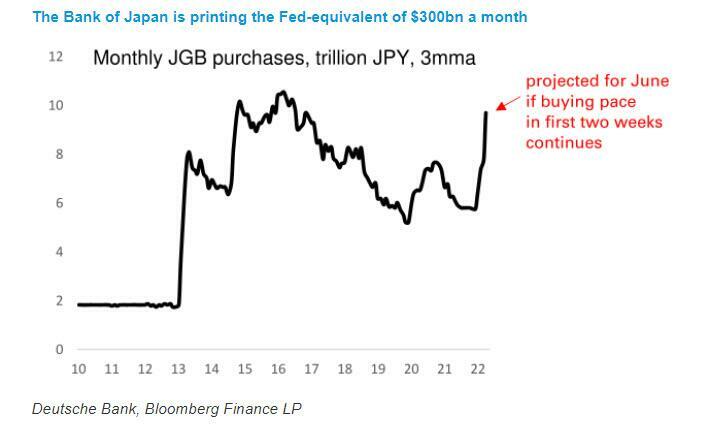
Exactly one week ago, when quantifying the dizzying cost of the BOJ's defense of its Yield Curve Control policy (at the expense of the collapsing yen), Deutsche Bank's George Saravelos calculated that the "the BOJ printer is on overdrive", and if the current pace of buying persists, the bank will have bought approximately 10 trillion yen in June. To put that number in context, it is roughly equivalent to the Fed doing more than $300bn of QE per month when adjusting for GDP.
Somewhat redundantly, the DB strategist said that this is a "truly extreme" level of money printing given that every other central bank in the world is tightening policy and is one of the reasons why he has been bearish on the yen. And as so many have argued, "currency intervention in this environment is simply not credible given it is the BoJ itself that is the cause of yen weakness."
More broadly, Saravelos echoes what we said in our preview of the end of MMT, writing that he worries that "the currency and Japanese financial markets are in the process of losing any sort of fundamental-based valuation anchor" and, as a result, "we will soon enter a phase where dramatic and unpredictable non-linearities in Japanese financial markets would kick in."
He was proven right the very next day, when not an insigificant part of Japan’s bond market imploded as the central bank battles to keep control of its policy goals as some of the largest hedge funds in the world pile on billions in bets that the BOJ is about to lose control, in a repeat of Soros' dramatic crusade against the BOE (which the billionaire democrat ended up winning, and affording him the wealth to be the US government's shadow puppetmaster to this day).
As Bloomberg explained, a small tweak to the Bank of Japan’s bond purchase plan this week blew up an arbitrage strategy popular with overseas investors known as the basis trade (the same basis trade which blew up in 2019 in the US cash/futures market sparking the historic repo crash and the Fed's return to QE). It also exacerbated a supply shortage of government bonds that has ramped up pressure on domestic financial institutions, leading them to turn to the BOJ for help to relieve the strain.
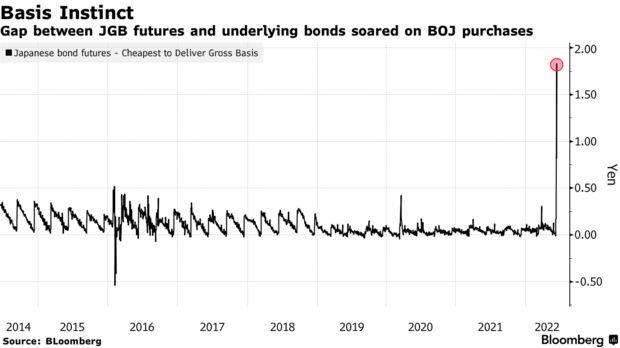
One week ago we described how after four straight days of declines in Japanese bond futures, the central bank announced unlimited purchases of so-called cheapest-to-deliver 10-year notes for Thursday and Friday - securities closest linked to the contracts. That sent the spread between the futures and the bonds underlying them soaring to the widest since 2014 - a massive shock for traders with positions between the two.
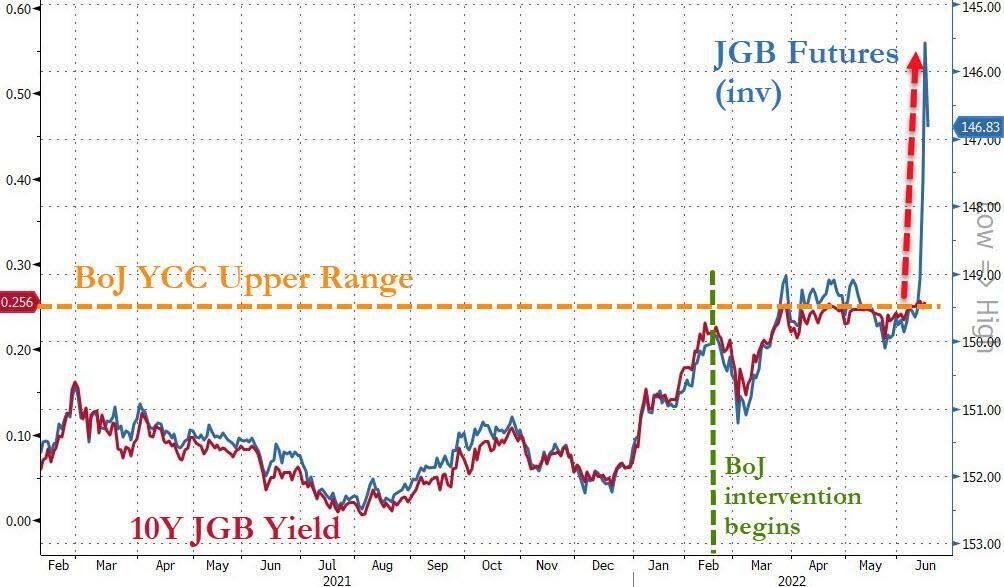
As a result, 10Y JGB futs crashed by the most since 2013 as traders bet that the BOJ will be forced to abandon its pledge to cap yields at 0.25%...
... while the gap between JGB futs and underlying cash bonds soared the most on record.
The chart below is another way of visualizing this historic divergence between futs and cash JGBs, clearly signaling the market's belief that the BoJ will fold on its unlimited bond buying curve control program.
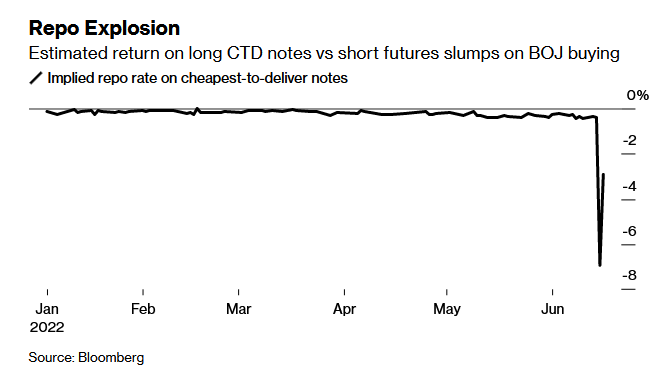
Needless to say, arbs who were short the cheapest-to-deliver bonds and long the futures contracts suddenly faced steep losses and found it impossible to close their positions (remarkably all this was happening in the world's 2nd largest bond markets, amounting to some 1.24 quadrillion yen or about $10 trillion, yet all everyone can talk about is crypto). As Bloomberg notes, the BOJ had effectively cornered the market in the cheapest-to-deliver bonds making it almost impossible for others to purchase them, while the futures price slumped to the brink of a trading halt as those caught out rushed to close.
By late day Wednesday, a Bloomberg estimate of the cost to close this so-called short basis trade widened to about minus 7% from minus 0.4% the day before. It remained at distressed levels Friday -- around minus 2% -- suggesting some investors were still stuck on the wrong side of the trade.
"The selloff in futures has killed arbitrage opportunities,” said Mari Iwashita, chief market economist at Daiwa Securities. “This situation will eventually end up in a total stalemate in markets."
By stalemate, he means "crash."
Speculative attacks on Japanese bonds have mounted as a growing number of funds - most notably the giant, $127 billion BlueBay - bet the BOJ will cave in to pressure and change its increasingly isolated super-easy monetary policy. The central bank confounded its critics Friday, holding firm with its rock-bottom interest rates and continuing with its fixed-rate bond purchase plan.
Benchmark bond yields fell further below the 0.25% ceiling, after the central bank announced a fixed-rate purchase operation for the afternoon.
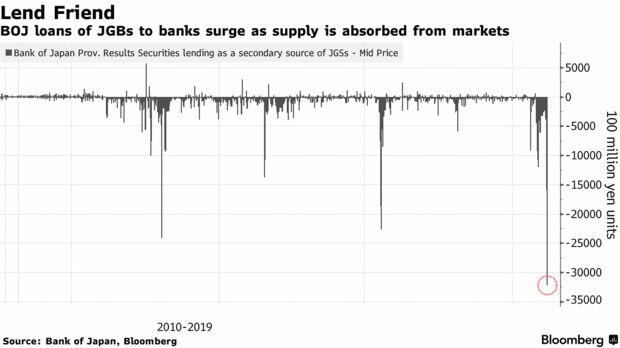
But the bigger problem for the BOJ is that those purchases, which preserving the BOJ's YCC "credibility" (for now) are also sucking up what little liquidity is available in the JGB market, piling pressure on local institutions, something which can be seen in the usage of the BOJ’s lending program -- another gauge of stress in the market.
Yes: on one hand the BOJ continues to buy billions in JGBs via QE, but on the other it is forced to lend what it has bought back into the market to avoid a terminal paralysis of what was once the second deepest bond market.
The amount of bonds the central bank has lent "temporarily" to financial institutions to relieve supply tightness has hit a record, Bloomberg data show. The BOJ lent 3.2 trillion yen ($23.9 billion) of JGBs through its Securities Lending Facility on Thursday, well above the 2.3 trillion yen lent at the peak of coronavirus fears in March 2020.
BOJ Governor Kuroda told reporters on Friday that the BOJ will take appropriate measures to address any decline in bond market liquidity. But he also said he isn’t thinking about raising the 10-year yield ceiling from 0.25%, which means that the liquidity situation will only get worse in the coming days.
“Market functioning and liquidity have deteriorated sharply with the BOJ’s massive JGB purchases,” Barclays strategist Shinji Ebihara wrote in a note.
Meanwhile, and going back to the original point brought up by DB's Saravelos above that the BOJ is spending monstrous amounts of yen just to keep the JGB market from crashing, as traders countdown to the complete Ice-9ing of the Japanese bond market (which in recent months has seen its share of days without a single trade crossing) Bloomberg has calculated how much it cost the BOJ to preserve calm after last week's catastrophic slide in futures, and the answer is some 10.9 trillion yen ($81 billion) of government bond purchases last week, the most on record. By way of comparison, European Central Bank asset purchases under its so-called APP program averaged about $27 billion - per month - this year through May. But fear not, once Europe's dominoes start falling and peripheral yields explode to all time highs, Lagarde's hedge fund will make BOJ's purchases seems like a walk in the park by comparison.
And while every day could be the BOJ's last, market watchers see the temporary calm as an eye in the proverbial hurricane, as the BOJ continues to defy an intensifying global wave of central bank tightening and concentrated market pressure on the yen and government bonds. Treasuries remain a key driver as does the direction of the dollar-yen, hovering around a 24-year low.
“If the yen weakens further as a sell-off in foreign bonds resumes, it would not be surprising were the yen rates market to start testing the BOJ again,” wrote Citigroup Inc. strategist Tomohisa Fujiki in a note.
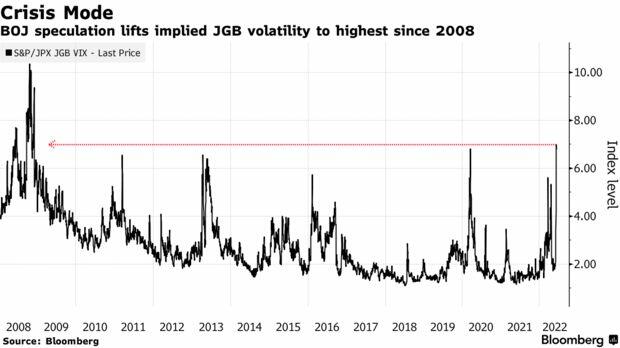
One place where the pressure is building up, is in implied volatility for 10-year JGBs, which however eased modestly after rising to the highest since the global financial crisis in 2008 on Friday. The BOJ said Friday its bond buying will continue for an extended period of time.
“Since the JGB market volatility has been initiated by the global reaction to US CPI and the Federal Reserve’s tightening, the structure keeping it unstable remains quite intact,” said Mari Iwashita, chief market economist at Daiwa Securities. “Even as the BOJ steps up efforts to defend its turf, the structure behind the challenges remain the same.”
Speculative attacks on Japan’s bond market have mounted amid bets the BOJ will cave in to pressure and tweak its increasingly isolated easy monetary policy -- something it reconfirmed at its policy decision Friday. But the impact of the central bank’s bond purchases have squeezed some corners of the futures markets, putting at least some arbitrage traders under pressure.
And yet, the most ominous sign yet for the BOJ is the recent quiet appointment of a Japanese government bond expert with experience of the market turmoil of the late 1990s to a key role in the Finance Ministry, which caught the attention of market watchers in Tokyo. Michio Saito -- dubbed “Mr. JGB” -- will head up a division that covers the bond market and may strengthen lines of communication with the central bank, according to some strategists.
For the BOJ to seek a smooth exit from massive bond purchases, close cooperation with the finance ministry is essential, so the appointment of an experienced person in charge is very significant, Iwashita said. This “is positive news for the market,” she said.
Most disagree, however, although they know better than to take the BOJ head on: after all, shorting JGBs has been a widowmaker trade for decades. Still, there is a sense of ominous capitulation vis-a-vis the Japanese bond market in recent days, almost as if we are now well past the point of no return and the final collapse of not just the JGB market, but the entire fraudulent MMT paradig, is just days if not hours away. Indeed, as Rabobank's Michael Every put it, with every attempt to preserve the status quo, the BOJ is pulling even further on a monetary elastic band that will hurt far more when it does inevitably come snapping back the other way, and concludes that when the BOJ's YCC peg eventually breaks, markets are going to get hit hard: "Japan is currently a source of ultra-cheap financing in a world of rising rates, and with a currency that is only going one way - down. If both reverse at once,… ouch!"