After Hours Summary: GDRX +55.9%, LMND +13%, SWAV +8.6%, QLYS +7.4%, PUBM +7% higher on earnings; NVAX -32.5%, CARG -15.6%, DDD -13.8%, TREX -11.2%, UPST -9.8% lower on earnings; HEAR -34% falls on earnings an decision to remain independentAfter Hours Gainers:
Companies trading higher in after hours in reaction to earnings/guidance: GDRX +55.9%, LMND +13%, EGIO +10%, SWAV +8.6%, QLYS +7.4%, PUBM +7%, DM +4.8%, VLDR +4.7%, DCGO +4.2%, NWSA +3.6%, HBM +3.4%, PFG +3.3%, DOCN +2.3%, AAON +2%, INSG +1.5%, OKE +1.5%, VAC +1.3%, CBT +1.2%, BCOR +1%, APPS +0.8%, AIG +0.5% (also to defer Corebridge Financial IPO), HIMS +0.5%, MRC +0.3%, ESE +0.2%, PRA +0.2%, VSAT +0.2%, PRI +0.1%
Companies trading higher in after hours in reaction to news: MRSN +17% (MRSN announces collaboration with GSK, granting option to co-develop and commercialize XMT-2056), RXST +5.4% (files for $200 mln mixed securities shelf offering), VALN +4.1% (PFE and VALN announce initiation of a Phase 3 clinical study), MDU +3.2% (Corvex discloses 4.99% active stake; intends to enter into discussions), SKIN +0.8% (Luxor Capital Group discloses 5% passive stake), GSK +0.2% (MRSN announces collaboration with GSK, granting option to co-develop and commercialize XMT-2056), EVTL +0.1% (stock offering), CRM +0.1% (names new COO)
After Hours Losers:
Companies trading lower in after hours in reaction to earnings/guidance: NVAX -32.5%, CARG -15.6%, TASK -14.9%, BIRD -14.8%, VRM -14.6%, DDD -13.8%, WPRT -12.3%, TREX -11.2% (expects a significant reduction in revs in 2H22), UPST -9.8%, CLOV -8.8% (also to transition role of CEO to co-founder Andrew Toy), BLNK -7.9%, FRPT -7.8%, ME -7%, SDC -7%, VXRT -6.8%, LPSN -6.5%, EHTH -6.4%, ACCO -5.7%, NCMI -5.6%, OPRT -4.9%, FGEN -4.1% (also files mixed securities shelf offering), TXG -4.1%, GRPN -3.7%, YMAB -3.7%, ACM -3.4%, TTWO -3.4%, ACAD -3.1%, DOOR -2.3%, IGMS -1.8%, SKT -1.6%, ICUI -0.6%, HLIO -0.2%, VVNT -0.2%, NE -0.1%, NHI -0.1%, SWCH -0.1%, PWSC -0.1%, TPTX -0.1%
Companies trading lower in after hours in reaction to news: CRMD -61.1% (receives a second CRL regarding DefenCath NDA), HEAR -34% (provides update on strategic review; will remain a standalone business; also reports earnings), QTRX -25.7% (exec chairman stepping down), SOVO -9.4% (stock offering), PTLO -6% (stock offering), PFLT -5.7% (stock offering), GOEV -4.8% (files mixed securities shelf offering), METC -3.2% (to acquire 100% of membership interests in Maben Coal LLC for $30 mln), RLYB -1.7% (files for $300 mln mixed securities shelf offering), KRTX -1.2% (stock offering), BRBR -1.1% (stock offering), RCUS -0.4% (names new CMO), PFE -0.3% (PFE and VALN announce initiation of a Phase 3 clinical study)
-
DAX:
- Zalando (ZAL TH) +1.5%
- Stock gained 13% last week
- E.On (EOAN TH) +1.4%
- EON Concerns Now Somewhat Priced In, Morgan Stanley Upgrades
- HelloFresh (HFG TH) +1.3%
- Infineon (IFX TH) +1.2%
- Adidas (ADS TH) +1.1%
MDAX:- Uniper (UN01 TH) +3.5%
- Thyssenkrupp (TKA TH) +1.8%
- Rheinmetall (RHM TH) +1.7%
- Rheinmetall Raised to Outperform at Exane; PT 212 euros
- Duerr (DUE TH) +1.5%
- Siltronic (WAF TH) +1.4%
- Siemens Energy (ENR TH) -1.5%
- Siemens Energy Posts Loss on Russia Exit, Wind-Turbine Unit
SDAX:- About You (YOU TH) +3.4%
- Adler Group (ADJ TH) +2.8%
- BayWa (BYW6 TH) +2.4%
- Traton (8TRA TH) +2.2%
- PNE AG (PNE3 TH) +2.1%
- Deutsche Euroshop (DEQ TH) -1.2%
- Takkt (TTK TH) -2.5%
- Takkt Downgraded to Hold at Berenberg as Risks Begin to Mount
- Zalando (ZAL TH) +1.5%
A bounce in stocks paused and US equity futures wavered Monday, hampered by expectations of aggressive interest-rate hikes by the Federal Reserve to tackle the highest inflation in a generation. Retreating tech shares were among the drags on MSCI Inc.’s Asia-Pacific stock index. Covid lockdownsin a Chinese resort island also hit sentiment, while Hong Kong’s move to cut mandatory quarantine failed to ignite much optimism. S&P 500 and Nasdaq 100 contracts fluctuated after global shares completed a third straight advance last week in a rebound from bear-market lows. European futures painted a more upbeat picture, hinting at modest gains.
Strong US jobs data Friday added to the case for more Fed monetary tightening. That’s pushed up Treasury yields and the dollar. A key part of the US bond curve is close to the most inverted level since 2000, suggesting investors foresee a recession ahead as the Fed applies the brakes on the economy. Crude oil remained below $90 a barrel, restrained by worries about the demand outlook. Both gold and Bitcoin struggled to make much progress. Traders now see greater odds of another 75 basis-point Fed hike in September, part of a global wave of rate increases. US inflation data this week could shape views on that policy path and inject more market swings. While price pressures may be topping out, it’s unclear if they will persist a stubbornly high levels. The US Senate passed a landmark tax, climate and health-care bill, speeding a slimmed-down version of President Joe Biden’s domestic agenda on a path to becoming law. Incoming reports showed China’s trade surplus rose to a record. The nation’s economic rebound faces potential global headwinds as well as domestic Covid flareups and property-sector woes.
Nikkei +0,28% Hang Seng -0,78% CSI -0,28% Shanghai +0,15% Shenzen +0,47%
Eur$ 1,0185 CNH 6,7688 CNY 6,7632 JPY 135,25 GBP 1,2079 CHF 0,9613 RUB 61,0135 TRY 17,9397 WTI$ 89,20 Gold 1,773,15 -1,3% BTC 23,380 +4% ETH 1,721,15
S&P +0,00% Nasdaq +0,10% EuroStoxx +0,65% FTSE +0,38% Dax +0,56% SMI
Macro :
- Italian Stocks In Focus After Center-Left Coalition Collapses
- Watch Solar, Wind Stocks After US Senate Passes Landmark Bill
- Hedge Funds Appear to See Everything as Overpriced
- *CHINA JULY TRADE BALANCE 682.7B YUAN; EST. $600.0B YUAN
Keep an eye on :
- AIR FP : The French Backwater Transforming Airbus Jets to Feed Cargo Boom
- AAPL US : Apple Loses Bid to Dismiss Consumer Biometric Privacy Lawsuit
- BAYN GY : Bayer Gets FDA Approval for Widening of Nubeqa Use
- BLUE US : *BLUEBIRD BIO SPIKES 21% AFTER REPORT OF PFIZER FOR GBT TALKS
- COFB BB : Cofinimmo to Buy Nursing Home in Juelich for EU18m at 4.5% Yield
- DTE GY : *T-MOBILE ISSUER CREDIT RATING TO INVESTMENT GRADE BY S&P
- EDF FP : Con Ed’s $3 Billion Green Arm Said to Draw Total, RWE Interest
- EOAN GY : EON Concerns Now Somewhat Priced In, Morgan Stanley Upgrades
- GBT US : Pfizer in Talks to Buy Global Blood for About $5 Billion: DJ
- HYQ GY : Hypoport 1H Ebit EU30.2M Vs. EU21.8M Y/y
- JOUL LN : Next Is in Talks to Buy a Stake in British Retailer Joules: Sky
- MITRA BB : Mayne Pharma Says FDA Approves Abbreviated NDA for Haloette
- AERO SW : Montana Aerospace 1H Adjusted Ebitda EU33.9M Vs. EU22.6M Y/y
- NEXT LN : Next Is in Talks to Buy a Stake in British Retailer Joules: Sky
- PNL NA : PostNL Cuts FY Normalized Ebit Forecast
- QQ/ LN : QinetiQ Seeks US Expansion in $590m Avantus Deal: M&A Snapshot
- RNO FP : Renault Is On Right Track With New Electric Vehicle, CEO Says
- RWE GY : Con Ed’s $3 Billion Green Arm Said to Draw Total, RWE Interest
- SAS SS : SAS Pilots Vote to Approve New Labor Deal That Ended Strike
- ENR GY : Siemens Energy 3Q Adjusted Ebita Loss EU429M, Est. Loss EU245.3M
- TIT IM : Telecom Italia May Explore Plan B for Network Spinoff, CEO Says
- TERB BB : Ter Beke Faces In-Depth Dutch Probe of Stegeman Acquisition
- TSLA US : Tesla Slips After 3-for-1 Split Gives Investors What They Wanted
- UPS US : UPS Nears Deal to Buy Italian Healthcare-Logistics Provider Bomi Group -- WSJ
- VIE FP : Macquarie Said to Near $2.5 Billion Deal for Suez’s UK Waste Arm
- WETG US : WeTrade Soars Amid Monkeypox Test Partnership, Up 455% Since IPO
>>> Up
* Playtech Raised to Buy at Deutsche Bank; PT 602 pence
* Rheinmetall Raised to Outperform at Exane; PT 212 euros
* Saipem Raised to Hold at Jefferies; PT 90 euro cents
* Totens Sparebank Raised to Buy at Norne Securities
>>> Down
* Aurskog Sparebank Cut to Hold at Norne Securities; PT 215 kroner
* Aurskog Sparebank Cut to Hold at Norne Securities; PT 215 kroner
* Close Brothers Cut to Hold at Investec; PT 1,170 pence
* Just Eat Takeaway Cut to Equal-Weight at Morgan Stanley
* Marel HF Cut to Hold at Berenberg; PT 4.60 euros
* M&G Cut to Underweight at JPMorgan; PT 210 pence
* Roku Cut to Sell at Pivotal; PT $60
* Subsea 7 Cut to Underperform at Jefferies; PT 70 kroner
* Takkt Cut to Hold at Berenberg; PT 12.90 euros
* Vestas Cut to Sell at Fearnley; PT 155 kroner
>>> Initiation
* Deezer Rated New Hold at Deutsche Bank; PT 5 euros
* De Nora Rated New Buy at Goldman; PT 24 euros
* Var Energi Rated New Overweight at Barclays; PT 53 kroner
>>> Call
* Close Brothers Cut at Investec on ‘Unremarkable’ Return Profile
* Just Eat Takeaway Cut at MS on More Challenging Growth Case
* Takkt Downgraded to Hold at Berenberg as Risks Begin to Mount
Henkel: A Strategic Review
What Germany's second largest beauty manufacturer is getting right — and wrong.
Henkel AG, the German maker of Schwarzkopf, Dial and Diadermine products, has been reassessing its business model, but a fix remains elusive — especially for its beauty retail activity.
The Düsseldorf-based company holds a top rank worldwide in the professional hair care category, but has been underperforming against its cohorts such as L’Oréal, Unilever and Proctor & Gamble in the large and dynamic beauty space.
Henkel placed 16th in WWD Beauty Inc’s Top 100 Global Beauty Manufacturer ranking for 2021, which estimated the group’s beauty sales hit 3.49 billion euros that year, down 1.9 percent versus 2020 and 5.2 percent against 2019.
Over the last five years, Henkel’s organic top-line beauty growth was minus 0.7 percent. The previous five years it was plus 2.5 percent, and the five years prior to that plus 4.8 percent, according to Eva Quiroga, managing director of European Consumer Staples at Bank of America.
So why this persistent downward trajectory? And what might be done to reverse the slide?
Henkel is a rare breed — the only top 20 beauty company with beauty as a minor activity. In 2021, the category rang up just 18 percent of Henkel’s total sales of 20.07 billion euros, versus adhesive technologies with 48 percent and laundry and home care combined with 33 percent.
Looking back some 10 to 15 years ago, Quiroga shined a light on Henkel’s heyday in beauty. That was when Tina Müller — now chief executive officer of Douglas — was running the firm’s hair care business, and Hans Van Bylen was the executive vice president for the Beauty Care division.
“They basically did innovation, but in a focused way,” said Quiroga, who explained Van Bylen had a table in his office, and whatever Henkel was launching had to fit on that table — otherwise, it was too much.
“Which meant there was definitely much greater focus on bigger ideas,” she said. “He also took the view that if a product doesn’t work quickly, it’s not going to work. And they were also super smart with their marketing. It was a shift from being boring to being quite funky. That made a massive difference.”
Müller launched the Syoss hair care brand just after the financial crisis, in 2008 and 2009.
“Syoss resonated unbelievably well with the German consumer, because it was perceived as a professional brand in a big bottle and at an affordable price. It was just perfectly executed,” Quiroga said. “It was the most successful hair care launch in years. Since then, however, momentum has been slowing.”
That is partly due to other players ramping up competition when they saw Henkel as a threat, especially in hair care. Also, Müller left the group.
Henkel has been acquisitive in professional hair care, especially in the U.S., and became strong in the category that way. In 2014, it bought Sexy Hair, Alterna and Kenra, followed by Nattura Laboratorios and the North American Hair Professional business from Shiseido three years later.
In North America last year, Henkel ranked second after L’Oréal in the category, and worldwide it placed third, following L’Oréal and Wella, according to Kline & Co.’s Salon Hair Care global series.
This February, Henkel announced it would buy Shiseido’s professional hair business in the Asia Pacific region, a deal that CEO Carsten Knobel at the time called “a step-change” for the company’s professional activity. That’s because it would significantly increase the group’s market position in Japan and China, the world’s top-two and -three professional hair markets, and key centers of trends and innovations. Additionally, it could elevate Henkel to the number-two worldwide rank in the segment.
Last year, about 70 percent of Henkel’s beauty sales were from hair care, and of that, one-third was professional and the remainder retail, including care, color and styling. Approximately one-quarter came from body care, such as deodorants, shower gels and soaps, and then some 5 percent from oral care.
By geographic region, most of Henkel’s business is rung up in developed markets, such as Europe and North America.
Henkel ranks 11th in the U.S. market in overall beauty, which include the fragrance, hair care, makeup, skin care and toiletries categories, Kline data shows.
“They play in only two,” said Carrie Mellage, head of beauty and personal care at Kline, referring to hair care and toiletries. “There’s a lot of things they’re not doing, like participating in some key sectors of beauty that most of the other leaders are doing. They’re not as diversified.”
She pointed out the top five beauty players trade in every or almost each product class. Yet even in those two, Henkel is not leading in either. Kline rankings show Henkel is fifth in the U.S. hair care and U.S. toiletries markets, where Dial is a force in personal cleansing.
“But they really struggled last year with the brand,” Mellage said. “They had a slowdown in 2021 relative to the rest of the category. Some of the brands that were performing better were like Dove or Olay — more skin care oriented. Bath & Body Works is another key player that did really well in that space and more fragrant body care. Dial is really none of those things.”
In comparison, Henkel’s professional hair care business fared well, outperforming the U.S. market. But the same didn’t hold true for its beauty activity. According to Kline’s Cosmetics and Toiletries USA 2021 program, the country’s total beauty market grew 9.5 percent, whereas Henkel’s beauty sales there, consolidating consumer purchases only, declined 5.4 percent.
“While the professional business has been doing quite well over the last few years, the retail business has been struggling, consistently underperforming its peers for years now,” Quiroga said.
In late January, Henkel announced plans to merge its Laundry and Home Care and Beauty Care divisions to form a new Consumer Brands business, and expects to divest or discontinue non-core brands and activities, while making acquisitions in the consumer-goods space.
The company said the new organization, designed to create more scale, capture synergies and grant further agility, should be operational by early 2023 at the latest. The group anticipates from it leaner structures, faster decision-making and attractive opportunities.
However, some industry experts believe that combining two underperforming businesses might not be the best fix. Nor would selling Henkel’s skin care holdings, such as Diadermine, which is strong in countries such as Germany and France.
“Skin care is obviously structurally the most attractive part of the beauty industry in the long term,” Quiroga said.
Mellage agreed, noting: “They’ve been very successful growing by way of acquisition, and I do see that could be a path forward for them in the other areas.”
Skin care is the biggest product class, and Henkel does not trade in it.
“Lots of opportunity there,” she said.
Goldman Warns Oil Is 'Down But Not Out': The Good, Bad, & Ugly In The Energy Complex
Oil prices have tumbled 25% since early June, driven by low trading liquidity and a mounting wall of worries: recession, China's zero-COVID policy and real estate sector collapse, the US SPR release, and Russian production recovering well above expectations.
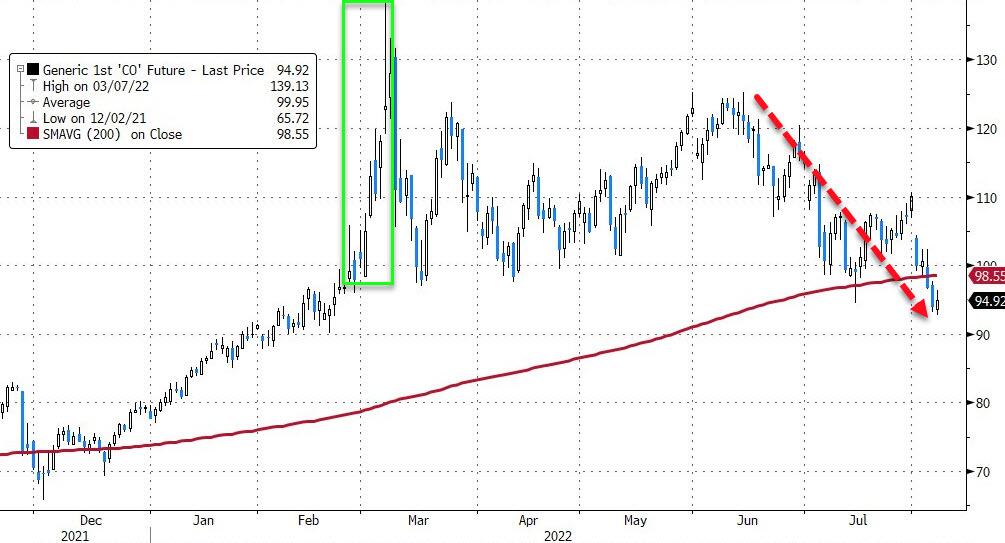
However, Goldman's Damien Courvalin believes that the case for higher oil prices remains strong, even assuming all these negative shocks play out, with the market remaining in a larger deficit than we expected in recent months.
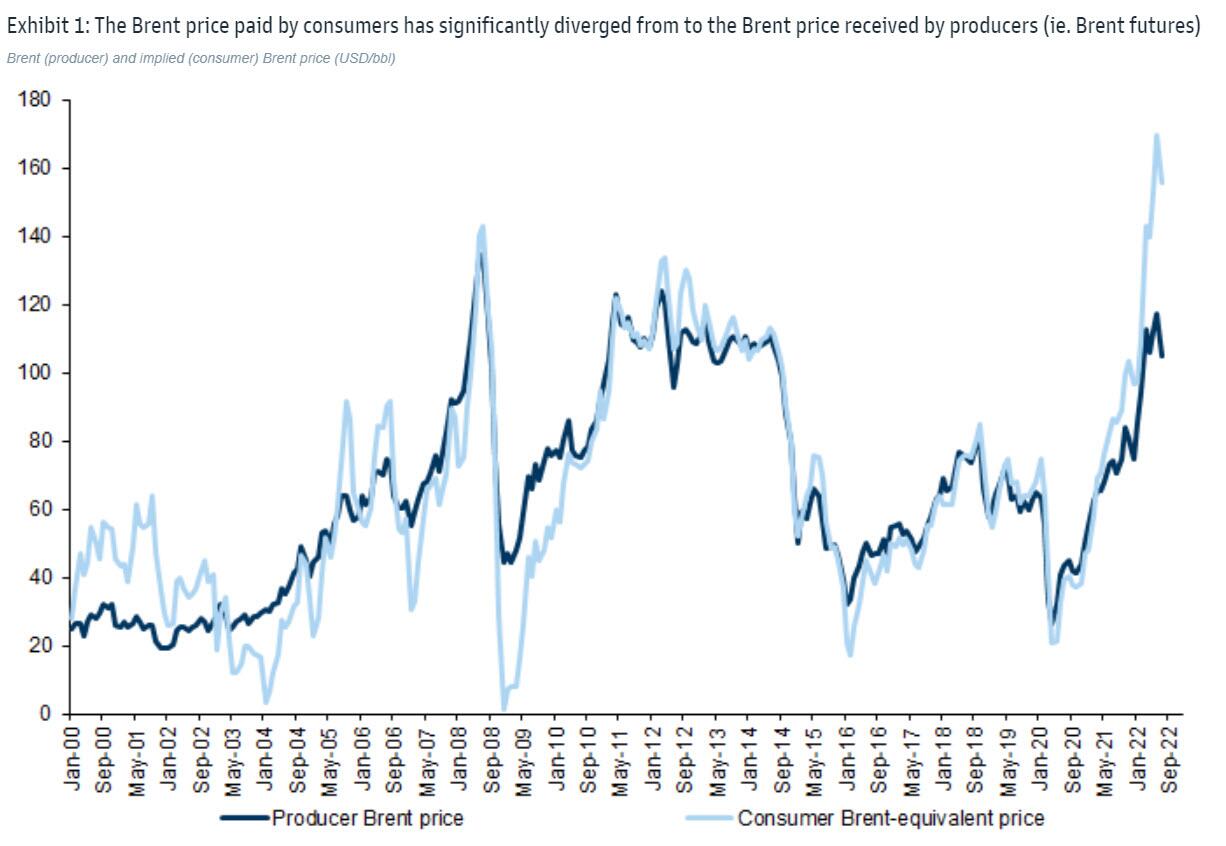
The bullish thesis does though require addressing the huge divergence between Brent prices, which averaged $110/bbl in June-July, and the $160/bbl Brent-equivalent global retail fuel price.
Conceptually, two prices matter for modeling the oil market:
(1) the retail price of fuels paid by consumers as it drives demand elasticity and(2) the crude price received by producers as it drives supply elasticity.
Up until 2021, retail prices followed a stable relationship to Brent prices but this is no longer the case due to significant distortions to each of the steps required to transform crude oil coming out of the ground into fuels consumed by producers.
Goldman sees three main takeaways from this:
- The good: retail prices - while not tradable - came in close to our forecasts despite all the current macro uncertainties.
- The bad: the disconnect between retail and Brent financial prices was much wider than expected, keeping Brent futures well below our forecast.
- The ugly: our retail price forecast - which proved broadly accurate - did not result in enough demand destruction to end the current, unsustainable deficit.
The much wider than expected gap between Brent physical prices (i.e. Dated Brent, not ICE Brent futures) and global retail fuel prices in Brent-equivalent terms (c.$45/bbl on average in June-July vs. our c.$25/bbl assumption) can be linked to the Russian energy and EU gas crises.
Goldman states that growing lack of financial participation in the commodity futures market helps explain this record wide premium as well as the recent new collapse in Brent prices as well as the current extreme level of crude backwardation.
Market liquidity plumbing new depths...

Courvalin and his team continue to expect that the oil market will remain in unsustainable deficits at current prices.
Balancing the oil market therefore still requires oil demand destruction on top of the ongoing economic slowdown, where we are more cautious than consensus.
This requires a sharp rebound in retail fuel prices - the binding constraint to balancing the oil market - back to $150/bbl Brent equivalent prices, equivalent to US retail gasoline and diesel prices reaching $4.35 and $5.45/gal by 4Q22.
As Goldman concludes, the unprecedented discount of Brent prices, even wider than we expected, can be explained by the worsening Russian energy crisis, as it boosts the costs of transforming crude out of the ground (Brent) into retail pump prices around the world through surging EU gas prices, freight rates, USD and global refining utilization.
While they assume that the exceptional wedge between retail fuel and Brent futures prices will remain wider than previously expected, Goldman still expects that Brent prices will need to rally well above market forwards, with their 3Q-4Q22 forecasts now $110-125/bbl vs. $140-130/bbl previously (with their $125/bbl 2023 forecast unchanged).
Concerns about their bullish view are warranted though - as recession risks are rising - but as Courvalin notes, reported oil demand has held up surprisingly well
Data for our monthly reported demand sample (covering c.81% of global demand for May and 55% for June) shows demand tracking above our expectations following downward revisions in April.

The demand recovery has been led by jet fuel (+1mb/d YoY for the sub-sample), with the expected weakness in gasoline demand (-0.5 mb/d, given higher price elasticity) offset by strength in industrial products potentially being pulled into the power stack.
The prevalence of retail government interventions such as price freezes/controls (such as those in China and India, versus tax holidays in the OECD) continues to shield oil demand more than expected.
Signs Of Ukraine Export Stability As 4 More Grain Ships Leave Ports
This weekend saw four more ships carrying grain and sunflower oil depart Ukraine ports through the UN-brokered safe maritime corridor in the Black Sea, overseen by a joint coordination center in Istanbul staffed by Ukrainian, Russian, Turkish and UN officials.
This as the Razoni cargo ship which was the first to depart Odesa carrying 27,000 tonnes of corn last week, is making its way to the Lebanese port of Tripoli, though not on time. The latest series of ships departed the ports of Odesa and Chornomorsk on Sunday, and their sailing has given rise to greater hopes of export stability, BBC reports, as millions in Ukraine-grain dependent countries are facing famine conditions.


Via Reuters
Two of the vessels are reportedly bound for Italy, while the other pair are going to China, after they are expected to dock in Turkey for international inspections under the terms of the UN safety corridor deal. In total they've been estimated to be laden with 160,000 tons of corn and other foodstuffs.
The BBC writes, "Ukrainian authorities say there are good signs that the grain exports are safe, and have urged companies to return to the country's ports." And further: "The hope is that the exports will help ease the global food crisis while bringing in much needed foreign currency."
And according to further details in NBC, referring to the Joint Coordination Center in Istanbul, "The JCC said late on Saturday it had authorized the departure of a total of five new vessels through the Black Sea corridor: four vessels outbound from Chornomorsk and Odesa carrying 161,084 metric tons of produce, and one inbound."
Last week, Ukrainian President Volodymyr Zelensky visited Odessa port to oversee the departure of the first grain ship under the UN deal, though he suggested Russia could be trying to sabotage the agreed upon export mechanisms.
"It is important for us that Ukraine remains the guarantor of global food security," he had said at the time, given a recent Russian missile strike on Odessa.
The question of the safety of shipping crews also remains a concern, given the ships must navigate waters which have for months seen explosive mines placed off Ukraine's coast. The Razoni's safe passage through the Black Sea days ago was a big milestone showing the UN safety mechanisms can work.
"Revolution Has Begun": 75,000 Brits To Stop Paying Power Bills Amid Inflation Storm
The resistance is growing as more than 75,000 irritated people in the UK have pledged not to pay their electricity bill this fall when prices jump again.
"75,000 people have pledged to strike on October 1st! If the government & energy companies refuse to act then ordinary people will! Together we can enforce a fair price and affordable energy for all," tweeted "Don't Pay UK," an anonymous group spearheading the effort to have more than one million Brits boycott paying their power bill by Oct. 1.
The strike comes as an inflation storm of high energy prices has obliterated household incomes. Brits are the most miserable in three decades as inflation is expected to hit 13%. And while Bank of England (BoE) Governor Andrew Bailey hiked interest rates the most in 27 years to tame inflation, risks are mounting of a recession.
On Oct. 1, the average household will pay almost £300 a month for power, the BoE warned. Couple surging power costs with negative real wage growth, and it becomes apparent households are being squeezed. This excludes soaring prices for shelter, food, and petrol at the pump -- this trend is unsustainable and could result in social instabilities.
British news outlet Glasgow Live said the strike is similar to the "action in the late 1980s and '90s to fight against the poll tax brought in by PM Margaret Thatcher. In protest, 17 million people refused to pay."
UK financial journalist and broadcaster Martin Lewis said this about the strike:
"I think I can categorise it more accurately now, the big movement that I am seeing is an increase of growth in people calling for a non-payment of energy bills, mass non-payment. Effectively a consumer strike on energy bills and getting rid of the legitimacy of paying that."We are getting close to a Poll Tax moment on energy bills coming into October and we need the Government to get a handle on that, because once it starts becoming socially acceptable not to pay energy bills people will stop paying energy bills and you're not going to cut everyone off."
Meanwhile, Ofgem (UK energy regulator) Chief Executive Jonathan Brearley told BBC Radio 4's Today on Saturday that people shouldn't join the strike for two reasons.
"First of all, it will drive up costs for everyone across the board. And secondly, if you are facing difficulty in paying your bill, the best thing you can do is get in touch with your energy company."He added: 'I would not encourage anyone to withhold their paying their bill because that just damages things further and it will impact them personally.'
Last week, the UK government slammed the movement, calling it "highly irresponsible."
"This is highly irresponsible messaging, which ultimately will only push up prices for everyone else and affect personal credit ratings," a government spokesperson was quoted by The Independent.
Don't Pay UK believes 6.3 million UK households will be pushed into power bill poverty this winter, with millions more feeling the stress of out-of-control inflation.
People on Twitter responded to the moment by saying, "the Revolution has begun" and "a bit of civil unrest on its way onto our streets & rightly so."
Perhaps the movement's involvement will be an excellent proxy for the growing discontent festering among Brits that could result in civil unrest this winter as millions will struggle with keeping the lights on, the furnace hot, and putting food on the table.