WSJ : Chess.com, Magnus Carlsen Court Filings Fire Back at Hans Niemann’s Allega

Chess.com, Magnus Carlsen Court Filings Fire Back at Hans Niemann’s Allegations in Cheating Lawsuit
New legal filings accuse the teenage grandmaster at the center of the cheating scandal of filing a meritless lawsuit as a public relations ploy

Lawyers for world champion Magnus Carlsen and Chess.com moved to dismiss a lawsuit filed by Hans Moke Niemann, the teenage American grandmaster who is facing bombshell cheating allegations, writing in court filings Friday that Niemann’s claims are a public relations ploy with no factual or legal basis.

Chess.com’s filings say that Niemann’s complaint presents no evidence for any sort of conspiracy to damage his career, and that Niemann has failed to plausibly show how anything Chess.com has said about him is false.

“It is so plainly without merit that it could have been brought only as a public relations stunt,” lawyers for Chess.com said in the filing.

Carlsen’s lawyers from Axinn, Veltrop and Harkrider wrote: “After years of trying to curate a reputation as the bad boy of chess, Plaintiff Hans Niemann wants to cash in by blaming others for the fallout from his own admitted misconduct.”

Niemann, who was accused of cheating by Carlsen earlier this year in a scandal that plunged chess into chaos, filed a lawsuit in October against Carlsen, Chess.com and others alleging that they had defamed Niemann and violated antitrust law while colluding to torpedo the 19-year-old’s career. The lawsuit, filed in Eastern Missouri District Court, sought $100 million for the purported damages.

Chess.com has moved to dismiss the lawsuit against both itself and its chief chess officer Danny Rensch.

“As our motions make clear, Chess.com believes Hans Niemann’s claims lack any merit,” said lawyers Nima Mohebbi and Jamie Wine of Latham & Watkins. “We will present our arguments to the Court so Chess.com can get back to focusing on growing the game of chess for fans around the world.”

Lawyers for Niemann, who previously accused Chess.com and Carlsen of monopolizing the chess industry, maintained that he has been treated unfairly throughout the drama.

“Hans beat Magnus fairly. The way he was treated was not,” said Terrence Oved and Darren Oved. “Hans is a winner on and off the board. We are confident his greatest victories are yet to come.”

The controversy that engulfed chess began in September when Niemann won a stunning upset over Carlsen, the five-time world champion from Norway, at a prestigious tournament in St. Louis. Carlsen responded by doing something he had never done before: withdrawing from the event entirely.

Although Carlsen said little about his reasoning at the time—at first, his only comment was a cryptic tweet—chess insiders quickly interpreted his action as a sign of protest and that Carlsen was insinuating that Niemann was a cheater. The notion completely consumed the chess community, with rampant speculation and outrageous theories about how Niemann might have received illegal assistance.

Organizers did not find any evidence Niemann had cheated to beat Carlsen, but they later instituted enhanced security measures at events to deter cheating. The situation was so outlandish that one competitor suggested playing naked to prevent any player from having a hidden device on their person.

In a later tournament, Carlsen resigned from a game against Niemann after one move. He soon confirmed everyone’s suspicions about his actions, writing in a statement that he believes “Niemann has cheated more—and more recently—than he has publicly admitted.”

Amid the drama, Niemann launched a public defense, saying he never cheated at in-person chess. In the past, Niemann said, he had cheated in limited instances on Chess.com, but the last time was when he was 16 years old. The only time he cheated with prize money on the line, he added, was when he was 12 and he described those incidents as the biggest mistakes of his life. He further questioned why he was banne

A subsequent investigation by Chess.com, first reported by The Wall Street Journal, concluded that Niemann had likely cheated in over 100 online games, and more recently than he had indicated, including events with prize money. The report said Niemann privately confessed in 2020, when he was caught, and thanked Rensch when he gave Niemann a second chance on the site following a suspension.

“That is more than completely fair and I really really appreciate you trusting me and giving me this chance,” Niemann wrote to Rensch in Slack messages that are included in both the investigation and Chess.com’s motion to dismiss. “Not even my closest friends have given me the benefit of the doubt and you’ve gone out of your way to help me.”

The Chess.com investigation did not make any conclusions about whether Niemann had cheated during in-person games, as it only officiates online events, but it flagged a handful of over-the-board games that it said warranted further investigation. FIDE, the global chess governing body, is currently looking into the Carlsen-Niemann matter.

While Chess.com has historically handled bans for top players discreetly, it said it deviated from that protocol because Niemann had publicly misstated the breadth of his cheating on the platform.

Shortly after the U.S. Chess Championship in October, where Niemann and other competitors had to navigate intense security measures because of the scandal’s fallout, Niemann filed his lawsuit against Carlsen, Rensch, Chess.com and Hikaru Nakamura, another American grandmaster.

The lawsuit accused the parties of defaming Niemann and broadly alleges that Carlsen and Chess.com were in cahoots to orchestrate Niemann’s downfall. Chess.com is buying Carlsen’s app, PlayMagnus, for over $80 million, but has said it did not consult with Carlsen on any of its decisions regarding Niemann.

Nature : Did physicists create a wormhole in a quantum computer?

Did physicists create a wormhole in a quantum computer?
An unusual teleportation experiment is just ordinary quantum physics, but was inspired by tunnels through an exotic ‘toy universe’.

Physicists have used a quantum computer to perform a new kind of quantum teleportation, the ability of quantum states to be transported between distant places, as though information could travel instantly. Although teleportation is an established technique in quantum technology, the purpose of the latest experiment was to simulate the behaviour of a passage called a ‘wormhole’ through a virtual universe.

The researchers behind the experiment, described in Nature on 30 November1, say that it is a step towards using ordinary quantum physics to explore ideas about abstract universes where gravity and quantum mechanics seem to work harmoniously together. Quantum computers could help to develop a quantum theory of gravity in these ‘toy’ universes (developing a quantum theory of gravity for our own Universe is one of the biggest open questions in physics). “It’s a test of quantum-gravity ideas on a real lab experimental testbed,” says Maria Spiropulu, a particle physicist at the California Institute of Technology who led the study.

Tunnels in space-time
Physicists Albert Einstein and Nathan Rosen proposed the idea of wormholes — passages through space-time that could connect the centres of black holes — in 1935. They calculated that, in principle, wormholes were allowed by Einstein’s general theory of relativity, which explains gravity as an effect of the curvature of space-time. (Physicists soon realized that even if wormholes exist, they are unlikely to allow anything like the interstellar travel that feature in science fiction.)

Because they were working with an exotic toy universe, the latest research didn’t simulate anything resembling the kind of wormhole envisioned by Einstein and Rosen that could conceivably exist in our Universe. But their teleportation experiment can be interpreted as analogous to a wormhole in their virtual system — quantum information fed into one side of the researchers’ ‘wormhole’ reappeared on the other side.

“The surprise is not that the message made it across in some form, but that it made it across unscrambled,” write the authors of an accompanying News and Views article. “However, this is easily understood from the gravitational description: the message arrives unscrambled on the other side because it has traversed the wormhole.”

Exotic physics
The experiment was inspired by earlier research linking the physics of exotic universes and their own version of gravity to more-standard — but still virtual — quantum system. The main idea is that some abstract versions of space-time emerge from the collective behaviour of ordinary quantum particles living in a sort of ‘shadow world’ — similar to how a two-dimensional hologram can create the illusion of a three-dimensional image. That ‘holographic’ behaviour dictates how the emergent space-times curve upon themselves, producing the effects of gravity.

Although physicists do not yet know how to write quantum theories of gravity for emergent universes directly, they know that such phenomena should be fully encapsulated in the physics of the shadow world. This means that gravitational phenomena such as black holes — which still pose riddles to theoretical physicists — or wormholes must be compatible with quantum theory.

The latest experiment follows a scheme that co-author Daniel Jafferis, a theoretical physicist at Harvard University in Cambridge, Massachusetts, and his collaborators proposed in 20172. That work focused on the simplest such holographic correspondence, known as SYK after the initials of its creators. In this toy model universe, space has only one dimension rather than three.

In the latest study, Jafferis and colleagues simulated an even more stripped-down version of such a hologram using the quantum bits, or qubits, of Google’s Sycamore processor. They expected their simulated quantum particles to reproduce some behaviours of gravity in the virtual universe — but they were limited by the capabilities of today’s quantum computers. “We had to find a model that kind of preserves the gravity properties and that we can code on a quantum processor that has a limited amount of qubits,” says Maria Spiropulu, a particle physicist at the California Institute of Technology who led the study. “We shrunk it down to a baby model, and we checked that it preserves gravitational dynamics.”

“Before we worked on this project, it wasn’t obvious that a system with such a small number of qubits could exhibit this phenomenon,” Jafferis adds.

Some researchers believe that this line of research is a promising pathway for developing a quantum theory of gravity for our own Universe, although others see it as a dead end. The theory tested at the Google lab “only has a very tangential relationship to any possible theories of quantum gravity in our Universe”, says Peter Shor, a mathematician at the Massachusetts Institute of Technology in Cambridge.

FT : Marshall Wace partners to share £720mn profits

Marshall Wace partners to share £720mn profits
Bumper payout comes during highly mixed period for $3.8tn hedge fund industry

Marshall Wace, one of the world’s biggest hedge fund firms, is sharing profits of more than £720mn among its partners after its computer-driven trading systems made strong gains during a turbulent period for global financial markets.

The London-based firm, which was founded by Sir Paul Marshall and Ian Wace in 1997 and manages around $60bn in client assets, made the profits as its turnover jumped 62 per cent to more than £1.5bn, the firm said in a filing for its results for the year to February.

The news comes after Sir Christopher Hohn, the billionaire founder of hedge fund firm TCI Fund Management, paid a dividend of $690bn to a company he personally controls for the same period, up from $152mn the previous year.

The bumper payouts come during a highly mixed period for the $3.8tn hedge fund industry.

While some managers have profited handsomely from betting on a huge sell-off in government bonds or the start of a bear market in stocks, many traders were caught out when the high-growth technology bets they favoured during the seemingly never-ending bull market were hard hit by steep rises in inflation and interest rates.

Chase Coleman’s Tiger Global, once one of the world’s top-performing hedge funds, was down more than 50 per cent this year to October. In contrast, Crispin Odey has gained around 150 per cent in his Odey European fund, helped by bets against bonds, while Haidar Capital has gained more than 250 per cent.

Equity hedge funds on average are down 11.3 per cent this year to the end of October, while hedge funds on average are down 4.5 per cent, according to data group HFR.

Marshall Wace made strong gains in its computer-driven funds, as some quant managers were able to profit by buying up stocks they considered to have been oversold during the bear market.

Its Tops Market Neutral fund, which analyses buy and sell recommendations from about 1,000 external analysts, gained 23.7 per cent last year and is up more than 17 per cent this year, according to numbers sent to investors and seen by the Financial Times.

The firm’s flagship $17bn Eureka fund, run by Marshall, gained 10.8 per cent last year and is up 4.4 per cent this year.

The firm’s profits were shared among 23 partners, which included Marshall and Wace as well as parent company Marshall Wace Asset Management.

Hohn’s TCI, meanwhile, which tends to bet on rising rather than falling stock prices and which has benefited from the strong bull market seen during the coronavirus pandemic, posted a 160 per cent rise in profits to $714mn, lifted by performance fees.

Most of the dividend paid to Hohn’s company was subsequently invested into TCI’s hedge fund.

So far this year the fund is down around 12 per cent, according to an investor.

Marshall Wace and TCI declined to comment.

(ZH) Something Is Rigged: Unexplained, Record 2.7 Million Jobs Gap Emerges In Br

Something Is Rigged: Unexplained, Record 2.7 Million Jobs Gap Emerges In Broken Payrolls Report

A superficial take of today's jobs report would note that both jobs and earnings "blew past expectations, flying in the face of Fed rate hikes", and while that is accurate at the headline level, it couldn't be further from the truth if one actually digs a little deeper in today's jobs numbers.
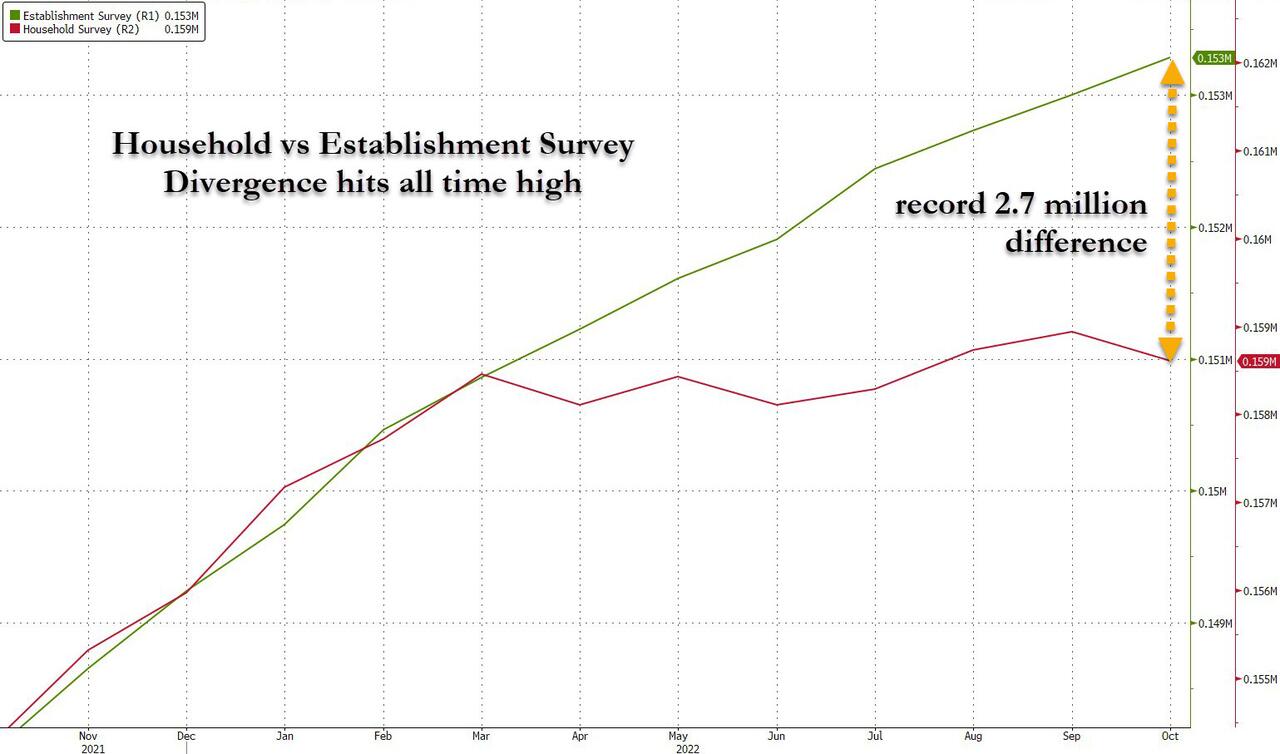
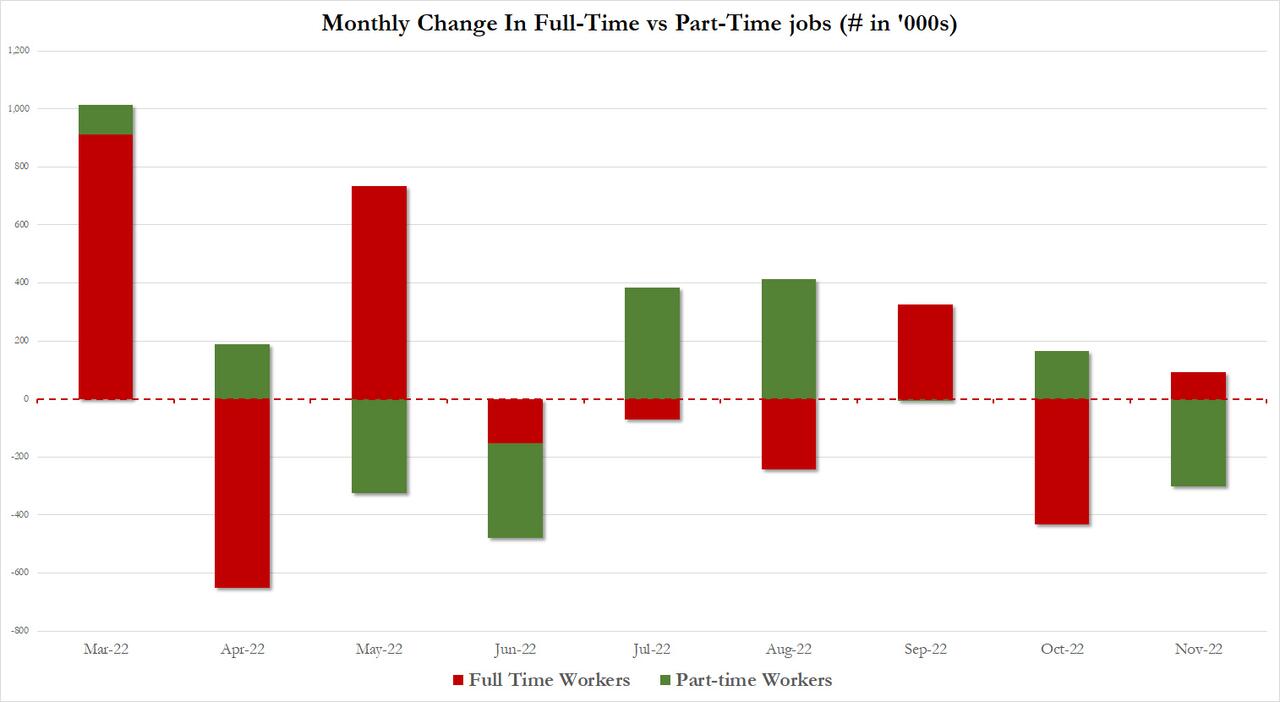
Recall that back in August, September, and October we showed that a stark divergence had opened between the Household and Establishment surveys that comprise the monthly jobs report, and since March the former has been stagnant while the latter has been rising every single month. In addition to that, full-time jobs were plunging while part-time jobs were surging and the number of multiple-jobholders soared.
Fast forward to today when the inconsistencies not only continue to grow, but have become downright grotesque.
Consider the following: the closely followed Establishment survey came in above expectations at 263K, above the 200K expected - a record 7th consecutive beat vs expectations - and down modestly from last month's upward revised 284K...
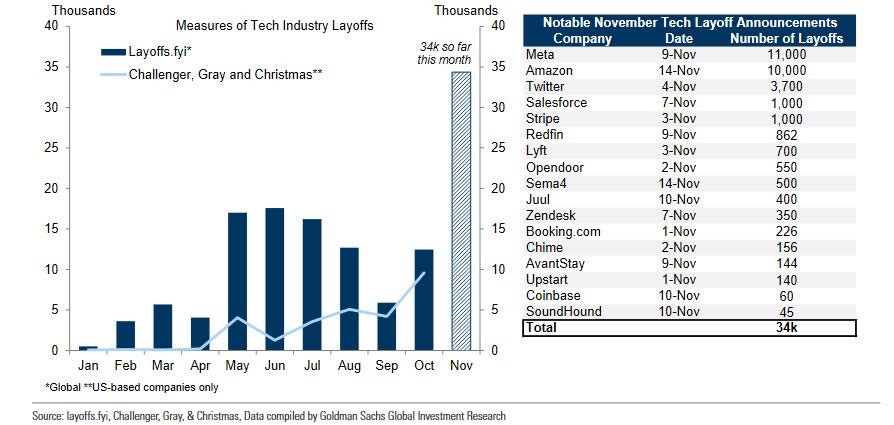
... numbers which confirm that at a time when virtually every major tech company is announcing mass layoffs...
... the BLS has a single, laser-focused political agenda - not to spoil the political climate at a time when Democrats just lost control of the House as somehow both construction (+20K) and manufacturing (+14K) added jobs according to the BLS, when even ADP now reports that these two sectors combined shed more than 100,000 workers in November.
Alas, there is only so much the Department of Labor can hide under the rug because when looking at the abovementioned gap between the Household and Establishment surveys which we have been pounding the table on since the summer, it just blew out by a whopping 401K as a result of the 263K increase in the number of nonfarm payrolls (tracked by the Household survey) offset by a perplexing plunge in the number of people actually employed which tumbled by 138K (tracked by Household survey). Furthermore, as shown in the next chart, since March the number of employed workers has declined on 4 of the past 8 months, while the much more gamed nonfarm payrolls (goalseeked by the Establishment survey) have been up every single month.
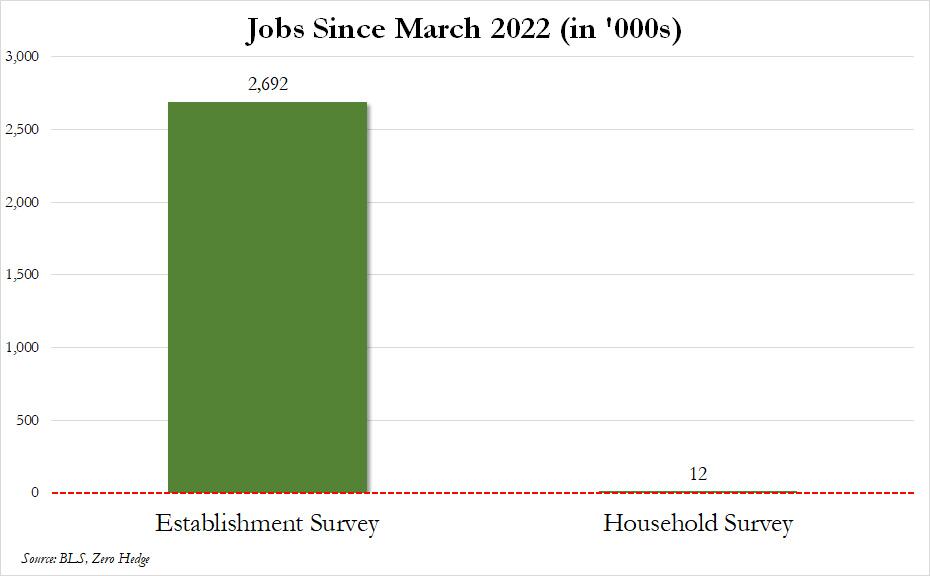
What is even more perplexing, is that despite the continued rise in nonfarm payrolls, the Household survey continues to telegraph growing weakness, and as of Nov 30, the gap that opened in March has since grown to a whopping 2.7 million "workers" which may or may not exist anywhere besides the spreadsheet model of some BLS (or is that BLM) political activist. In fact, one look at the chart below confirms all one needs to know about BLS "data integrity."
Showing this another way, there were 158.458 million employed workers in March 2022... and 158.470 million in November 2022 an increase of just 12,000 over 8 months, a period in which the number of payrolls (which as a reminder is the number the market follows) reportedly increased by 2.7 million!
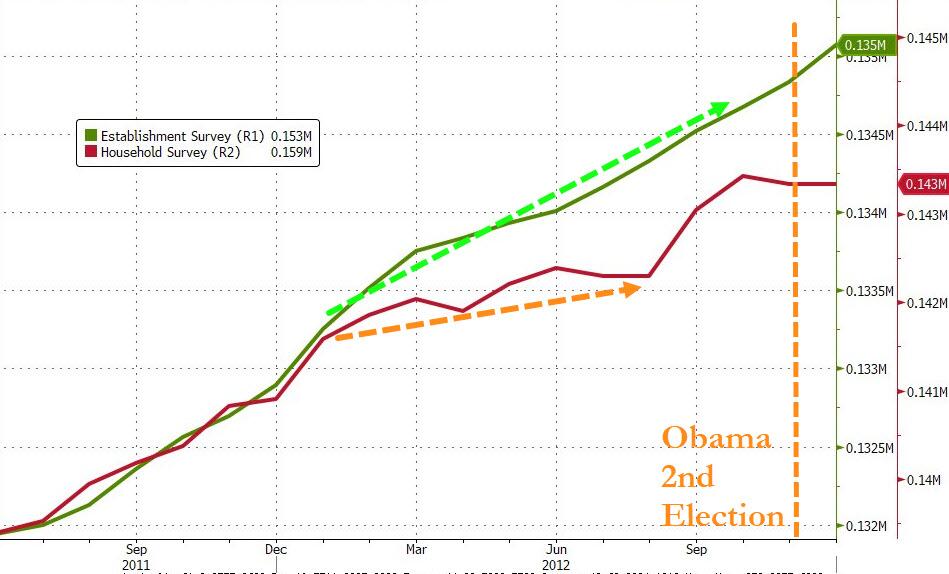
As an aside, it appears this is not the first time the "apolitical" Bureau of Labor Statistics has pulled such a bizarre divergence off: it happened right before Obama's reelection:
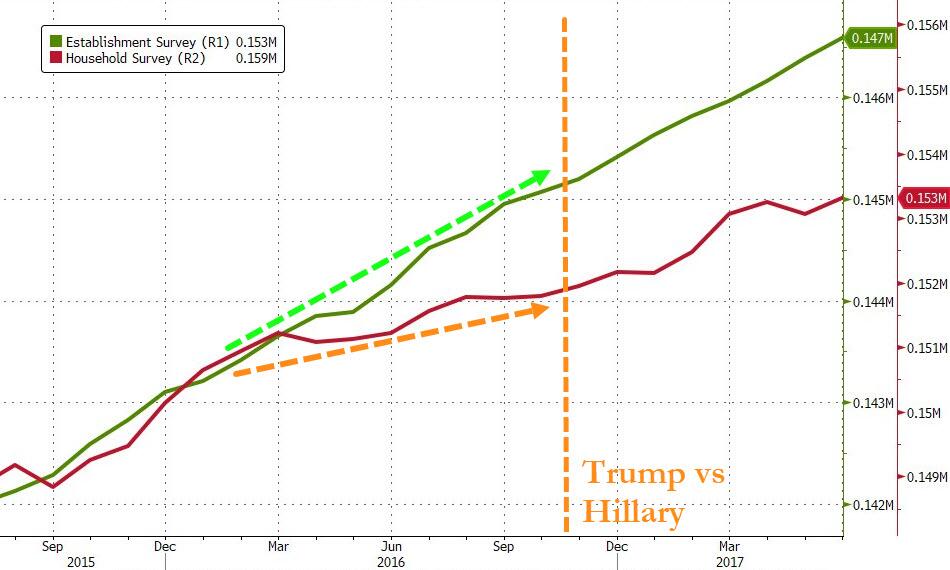
And then again: right before Hillary's "100% guaranteed election (because one wouldn't want a soft economy to adversely impact her re-election odds).
It gets better: digging in even deeper into the far more accurate and nuanced Household Survey, we find that the November drop in Employment was the result of a plunge in part-time workers, more than offsetting the modest increase in part-time workers which had declined in 3 of the past 4 months heading into November.
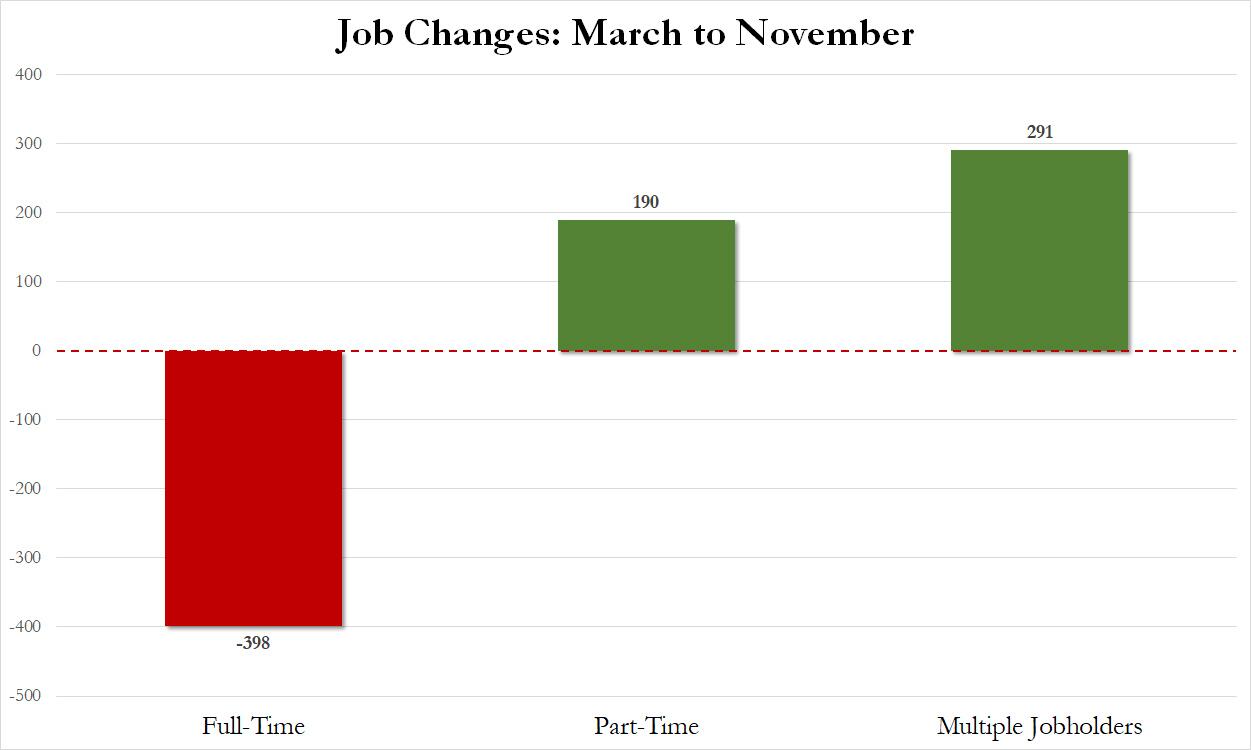
Further to this point, as shown below, since March, the US has lost 398K full-time employees offset by amodest gain of 190K part-time employees, while a whopping 291k workers were forced to get more than one job over the same period.
And while none of the above is really new - we have documented the record divergence between payrolls and employment for half a year now - there were two new developments: first, to facilitate its rigging of the data, the BLS has resorted to the oldest trick in the book, boosting the core goal-seek factor, the business "birth death" adjustments, which in October hit a record high 455K, and although it has since dipped to 14K in November, the trend in speculative BLS assumptions about the viability of the US economy (more businesses are created than are shut down only when there is economic solid growth) is clearly visible in the chart below.
One final point: a former Fed staffer Julia Coronado points out, we have reached the absurd part of the business cycle when average hours are declining in certain sectors even as hourly earnings are rising, prompting her to wonder if we are not in fact seeing a spike in hourly income courtesy of lump-sump severance payments.
So what's going on here?
The simple answer: as shocking as this may sound, there has been no change in the number of people actually employed in the past 8 months, but due to deterioration in the economy, more people are losing their higher-paying, full-time jobs, and switching into much lower- paying, benefits-free part-time jobs, which also forces many to work more than one job, a rotation which picked up in earnest some time in March and which has only been captured by the Household survey. Meanwhile the Establishment survey plows on ahead with its politically-motivated approximations, seasonal adjustments, and other labor market goalseeking meant to make the Biden admin look good and provide the Fed with ammo to keep rates high (thus forcing even more real layoffs, which unfortunately the BLS is incapable of capturing due to political reasons).
And since the Establishment survey is far slower to pick up on the nuances in employment composition, while the Household Survey has gone nowhere since March, the BLS data engineers have been busy goalseeking the Establishment Survey (with the occasional nudge from the White House especially now that the Biden admin needs something to hang its hat on after the GOP recaptured the House) to make it appear as if the economy is growing strongly, when in reality all they are doing is applying the same erroneous seasonal adjustment factor that gave such a wrong perspective of the labor market in the aftermath of the covid pandemic (until it was all adjusted away a year ago). In other words, while the labor market is already cracking, it will take the BLS several months of veering away from reality before the government bureaucrats accept and admit what is truly taking place.
As an aside, here we admit we were wrong: back in August we said that "we expect that "realization" to take place just after the midterms, because the last thing the Biden administration can afford is admit the labor market is crashing in addition to the continued surge in inflation." Little did we know just how stubborn and intent the White House is to stick to the broken narrative that all is well in the US.
Or, putting it otherwise as BofA's Michael Hartnett did earlier today (and as we will discuss in a subsequent post) - "unemployment in ’23 will be as shocking to Main St consumer sentiment as inflation in ’22."

WSJ : United Airlines Close to Deal for Dozens of Boeing 787 Dreamliners

United Airlines Close to Deal for Dozens of Boeing 787 Dreamliners
Carrier is in late-stage discussions with Boeing for wide-body jets worth billions of dollars

United Airlines Holdings Inc. is close to a deal to order dozens of Boeing Co. BA +3.09% 787 Dreamliners, people familiar with the matter said.

An agreement between the Chicago-based carrier and Boeing could be completed as soon as this month, some of these people said.

If completed, the deal would be worth billions of dollars in revenue and mark a victory for the U.S. plane maker over its European rival Airbus SE, which had competed for the deal, people familiar with the matter said. Boeing has resumed deliveries of the Dreamliner after a nearly two-year freeze following a string of manufacturing and regulatory issues.

Airbus has been dominating the market for smaller, narrow-body aircraft with its A320 family and expanding its lead over the rival 737 MAX since the latter’s previous grounding following two fatal crashes of that jet in 2018 and 2019. But Boeing has retained a larger share of the market for wide-body jets, which hold more passengers and are generally used for long-haul international routes.

Dreamliners are popular among airlines for their fuel-efficiency and ability to make new direct routes profitable, bypassing the need to connect cities via a central hub. Each carries a list price of about $300 million before typical discounts, according to Boeing’s latest publicly available list prices.

United, Boeing and Airbus declined to comment. Deals for new aircraft can fall apart even in their later stages.

United has communicated privately that the airline is preparing to order some 100 airplanes to replace its aging wide-body jets, people familiar with the matter said.

Over the last year, United has experienced operational issues with its Boeing 767 fleet, accelerating the need to decide on a replacement for those planes, people familiar with the matter said. The deal in the works is designed in part to replace those aircraft, some of these people said. The carrier has more than 50 of the wide-body jets in its fleet, according to a securities filing earlier this year.

It wasn’t immediately clear how many Dreamliners United would order under the deal. People familiar with the talks said United and Boeing have recently been in late-stage discussions about a sizable order that could involve a mix of confirmed orders and options for future purchases for as many as 50 aircraft or more.

Airbus is expected to continue vying for a potential follow-on order from United as the carrier weighs options for the replacement of its bigger Boeing 777s, people familiar with the matter said.