Barrons : Former Disney CEO Michael Eisner Buys Up IAC Stock

Former Disney CEO Michael Eisner Buys Up IAC Stock

Former Walt Disney DIS +0.85% CEO Michael Eisner just scooped up a large block of shares of the embattled internet and media company IAC.

IAC IAC +0.86% stock (ticker: IAC) has lost almost two-thirds of its market value so far this year. Business has slowed at the company’s majority-owned home-services business, Angi ANGI +3.95% (ANGI). A weak advertising market has pressured the bottom line. Some think that IAC stock is primed for a rebound after a stretch of underperformance.

Eisner paid $5 million on Nov. 22 and Nov. 23 for a total of 106,241 IAC shares, at an average price of $47.13 each, according to a form he filed with the Securities and Exchange Commission. He now owns 157,084 shares in a personal account, in addition to another 40,555 shares through a trust.

Eisner didn’t respond to a request for comment left with Tornante, his investment vehicle that invests in media and entertainment properties.

He last purchased IAC stock on the open market in August 2020, when a trust he controls paid $5 million for 40,555 shares, an average price of $122.85 each. Eisner left Disney at the end of 2005 and was succeeded by Bob Iger, who recently returned to head Disney again.

Credit Suisse analyst Stephen Ju raised his target price on IAC stock to $108 from $101 on Nov. 10, after the company reported third-quarter earnings. Ju maintained an Outperform rating, citing the company’s exposure to “multiple attractive end markets,” including online advertising, online gambling, peer-to-peer ride-sharing, and the large stake in Angi.

Barrons : Another Bad Sign for Tech Stocks—Cloud Spending Is Fading

Another Bad Sign for Tech Stocks—Cloud Spending Is Fading

The move to cloud-native software was supposed to be unstoppable. But this past week, we learned even the best secular trends have their limits and aren’t completely immune to a slowing global economy.

For much of this year, enterprise spending for cloud projects held up better than consumer-oriented end markets. Many analysts expected demand to remain robust because the shift to the cloud from legacy on-premise technology offered real cost savings, better reliability, and flexibility.

But corporate demand seems to be faltering. On Wednesday, Salesforce CRM –1.66% (ticker: CRM)—the market leader in sales and marketing cloud software—disappointed investors by forecasting less revenue than expected for the current quarter. Fiscal third-quarter billings, a metric viewed as a leading indicator for future revenue, also fell short of Wall Street consensus by nearly 10%, coming in at $6.21 billion, representing year-over-year growth of just 5%.

Beyond the softening financial numbers, Salesforce’s commentary about business trends and the economy were worrisome. On the earnings call with analysts and investors, Salesforce executives said that as the third quarter progressed they began to see a “more challenging buying environment,” with customers increasingly scrutinizing every dollar spent for its return on investment.

While not as bad yet, co-CEO Marc Benioff compared the current buying behavior and uncertainty among clients to what he saw in prior financial crises in 2001 and in 2008-09. Another executive said the company would take a “hard look” at its cost structure, which could mean further expense cuts and staff reductions in the future. Either action would mean the company isn’t expecting a return to higher growth soon.

Salesforce wasn’t alone. Earlier in the week, cloud cybersecurity firm CrowdStrike Holdings CRWD –0.06% (CRWD) provided revenue guidance below the consensus for the January quarter. The company’s net new annual recurring revenue for the fiscal third quarter also missed estimates by about 8%.

CrowdStrike CEO George Kurtz was downbeat in a call with investors, saying smaller companies were taking longer to pull the trigger on purchases as recession fears grew during the quarter. CrowdStrike now expects corporate customers to be more hesitant to spend in the coming months, even if they have budget left over for the year.

In assessing the latest software earnings, J.P. Morgan analyst Mark Murphy noted the stark change in tone from the industry. “The macro appears to be worsening and most of the cautiously optimistic language that was present...in the July time frame, also appears to have evaporated,” he wrote in a note to clients. “We don’t think any vendor will be immune.”

CrowdStrike and Salesforce investors reacted accordingly to the disappointing numbers. CrowdStrike shares tumbled 15% the day after it reported earnings, and Salesforce stock fell 8% following its results.

The reports added to a difficult year for the cloud sector. The WisdomTree Cloud ComputingWCLD –0.95% exchange-traded fund (WCLD), which tracks the performance of an index of cloud-computing software and services companies, has declined 50% this year, compared with the 15% drop for the S&P 500SPX –0.12% .

Shares of CrowdStrike and Salesforce are both down roughly 40% year to date.

Given the big drops, investors may be tempted to go bargain hunting. That may not be a good idea. First, while valuations may be lower than they were in the past, they are still high on an absolute basis given the anemic growth outlooks. Salesforce now trades at 27 times next year’s earnings estimates, but Wall Street expects revenue growth to slow to under 10% over the next two quarters. Not an attractive combination.

Second, cloud-software names face the prospect of downward earnings revisions that could make the stocks more expensive on a price/earnings basis. CrowdStrike trades at more than 60 times next year’s analyst earnings estimates. If the profit outlook deteriorates, the valuation would surge higher.

The high valuations and the latest round of weak data points around corporate spending aren’t the only negative factors. There was another signal this past week that a quick upturn isn’t imminent: Alongside its earnings, Salesforce announced that co-CEO Bret Taylor is stepping down at the end of January to return to his “entrepreneurial roots.” One way to read that message is Taylor sees greener pastures elsewhere versus leading Salesforce for the intermediate future.

Cloud-software investors should brace for more turmoil. It pays to be patient until valuations get much cheaper or there is visibility around a real bottom.

Like Benioff, I’ve seen a number of these downturns before. The cycles tend to last several quarters after they begin—and this one is just getting started.

Barrons : The World Cup Is a Score for This Sports Betting Stock

The World Cup Is a Score for This Sports Betting Stock

The twists and turns of the FIFA World Cup, including the U.S. team’s nail-biting win against Iran and Saudi Arabia’s stunning victory over Argentina, is good news for sports betting giants.

British sports betting and gaming group Entain (ticker: ENT.UK) is one of those set to benefit from the most-watched global sporting event. But the FTSE 100UKX –0.03% company has a lot more going for it than a short-term soccer boost, and it may be time to consider betting on the stock.

Entain employs more than 25,000 people and operates in 31 territories in 20 offices across five continents. It owns a number of brands, including Ladbrokes, Coral and PartyCasino, and has a joint venture—BetMGM—with MGM Resorts International MGM –0.51% (MGM).

Its extensive portfolio across Europe, in particular, means Entain sees net gaming revenue growing by a high single-digit percentage in the final three months of the year, due to the World Cup. It expects to return to mid single-digit growth the following quarter.

But the growth opportunity in the U.S.—one of the host nations of the next World Cup, in 2026—can keep the momentum going. In fact, BetMGM makes the company well placed to benefit from the burgeoning U.S. sports betting market.

That’s something the market hasn’t yet fully priced in. The stock trades at 17.6 times 2023 earnings, a 40% discount to FanDuel owner Flutter Entertainment (FLTR.Ireland).

There’s no guarantee, of course. California overwhelmingly voted to reject a ballot proposition legalizing sports betting in November. But sports betting is now live in 31 states, and legal but yet to launch in another five, according to the American Gaming Association.

UBS expects BetMGM to triple revenue to $3 billion by 2025, turning profitable next year. The bank’s analysts, led by Louise Wiseur, said Entain’s current share price “significantly undervalues” the U.S. opportunity and the online business. They have a Buy rating with a target price of 17.70 pounds sterling ($23.23), implying a 34% gain from a recent £13.17.

Analysts are generally bullish on the stock—90% of those covering the shares rate them Buy, with an average target price of £18.44, according to FactSet data.

The company, with a market value of £8.2 billion, expects Ebitda for the full-year 2022 to be between £925 million and £975 million, or 5% to 10% growth. The years ahead could see growth accelerating, with analyst estimates forecasting £1.06 billion Ebitda in 2023, £1.16 billion in 2024 and £1.25 billion the year after. The company’s sales, set to break the £4 billion barrier for the first time this year, are expected to top £5 billion by 2025, according to estimates.

Outside of the U.S., the company is also growing. Entain completed its acquisition of Croatian gaming and sportsbook operator SuperSport at the end of November and is expected to close the purchase of Dutch sports betting brand BetCity by the end of the year.

Expectations for BetMGM to turn profitable next year implies a pivot to “much higher net cash generation that should validate the acquisitions strategy and the investment in the U.S.,” Peel Hunt analysts, led by Ivor Jones, said. They have a Buy rating and a £19 target price.

The threat of increased regulation in the key U.K. markets remains a risk. A government gambling review has been postponed several times this year, largely due to political upheaval. The eventual outcome of the review will lift uncertainty and could be a positive for the stock.

Even if the review has some nasty surprises, the growth opportunity in the U.S. and the undervalued stock means Entain may be a gamble worth taking.

(ZH) Elon Musk Releases THE TWITTER FILES: How Twitter Collaborated With "The Bi

Elon Musk Releases THE TWITTER FILES: How Twitter Collaborated With "The Biden Team" To Cover Up The Hunter Laptop Story

In a greatly anticipated Friday night drop of what has was expected to be a cache of information involving the censoring of Hunter Biden's notebook story days ahead of the 2020 presidential election, moments ago Elon Musk - who worked in collaboration with the notoriously independent gonzo journalist Matt Taibbi of "Vampire Squid" fame - has published the "Twitter Files."
Shortly before their release, Matt Taibbi sent the following email to his substack subscribers:
Dear TK Readers:
Very shortly, I’m going to begin posting a long thread of information on Twitter, at my account, @mtaibbi. This material is likely to get a lot of attention. I will absolutely understand if subscribers are angry that it is not appearing here on Substack first. I’d be angry, too.
The last 96 hours have been among the most chaotic of my life, involving multiple trips back and forth across the country, with a debate in Canada in between. There’s a long story I hope to be able to tell soon, but can’t, not quite yet anyway. What I can say is that in exchange for the opportunity to cover a unique and explosive story, I had to agree to certain conditions.
Those of you who’ve been here for years know how seriously I take my obligation to this site’s subscribers. On this one occasion, I’m going to have to simply ask you to trust me. As it happens, there may be a few more big surprises coming, and those will be here on Substack. And there will be room here to to discuss this, too, in time. In any case, thanks for your support and your patience, and please hold me to a promise to make all this up to you, and then some.
Moments later Elon confirmed that he did, in fact, work with Taibbi:
And this is what Taibbi has been tweeting in the past few minutes (link here):
1. Thread: THE TWITTER FILES
2. What you’re about to read is the first installment in a series, based upon thousands of internal documents obtained by sources at Twitter.
3. The “Twitter Files” tell an incredible story from inside one of the world’s largest and most influential social media platforms. It is a Frankensteinian tale of a human-built mechanism grown out the control of its designer.
4. Twitter in its conception was a brilliant tool for enabling instant mass communication, making a true real-time global conversation possible for the first time.
5. In an early conception, Twitter more than lived up to its mission statement, giving people “the power to create and share ideas and information instantly, without barriers.”
6. As time progressed, however, the company was slowly forced to add those barriers. Some of the first tools for controlling speech were designed to combat the likes of spam and financial fraudsters.
7. Slowly, over time, Twitter staff and executives began to find more and more uses for these tools. Outsiders began petitioning the company to manipulate speech as well: first a little, then more often, then constantly.
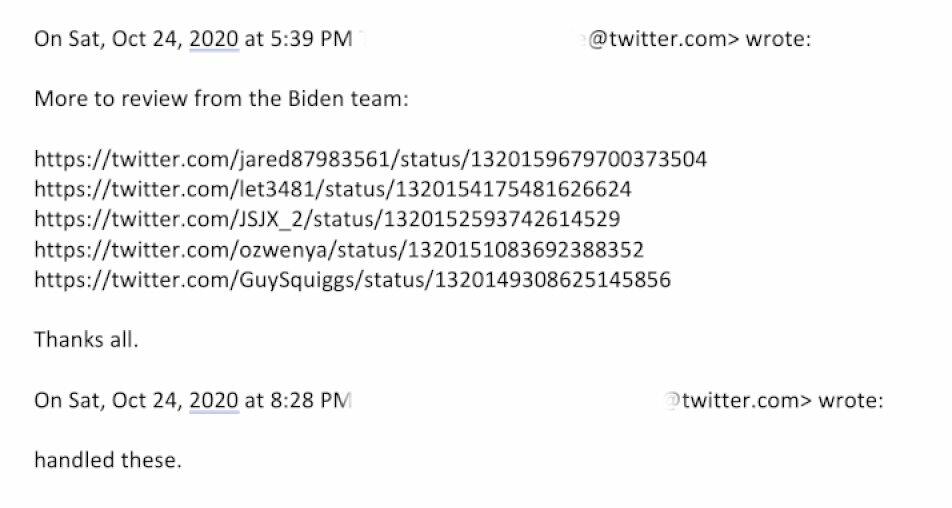
8. By 2020, requests from connected actors to delete tweets were routine. One executive would write to another: “More to review from the Biden team.” The reply would come back: “Handled.”
9. Celebrities and unknowns alike could be removed or reviewed at the behest of a political party:
10.Both parties had access to these tools. For instance, in 2020, requests from both the Trump White House and the Biden campaign were received and honored. However:
11. This system wasn't balanced. It was based on contacts. Because Twitter was and is overwhelmingly staffed by people of one political orientation, there were more channels, more ways to complain, open to the left (well, Democrats) than the right.
12. The resulting slant in content moderation decisions is visible in the documents you’re about to read. However, it’s also the assessment of multiple current and former high-level executives.
... Okay, there was more throat-clearing about the process, but screw it, let's jump forward
16. The Twitter Files, Part One: How and Why Twitter Blocked the Hunter Biden Laptop Story
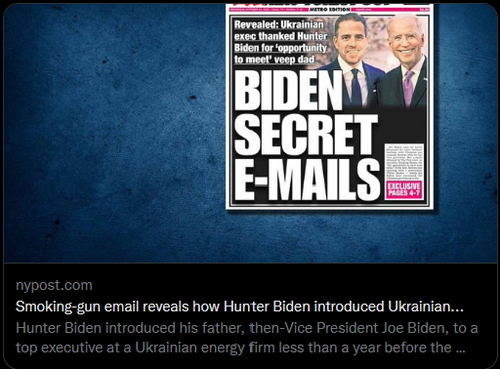
17. On October 14, 2020, the New York Post published BIDEN SECRET EMAILS, an expose based on the contents of Hunter Biden’s abandoned laptop:
18. Twitter took extraordinary steps to suppress the story, removing links and posting warnings that it may be “unsafe.” They even blocked its transmission via direct message, a tool hitherto reserved for extreme cases, e.g. child pornography.
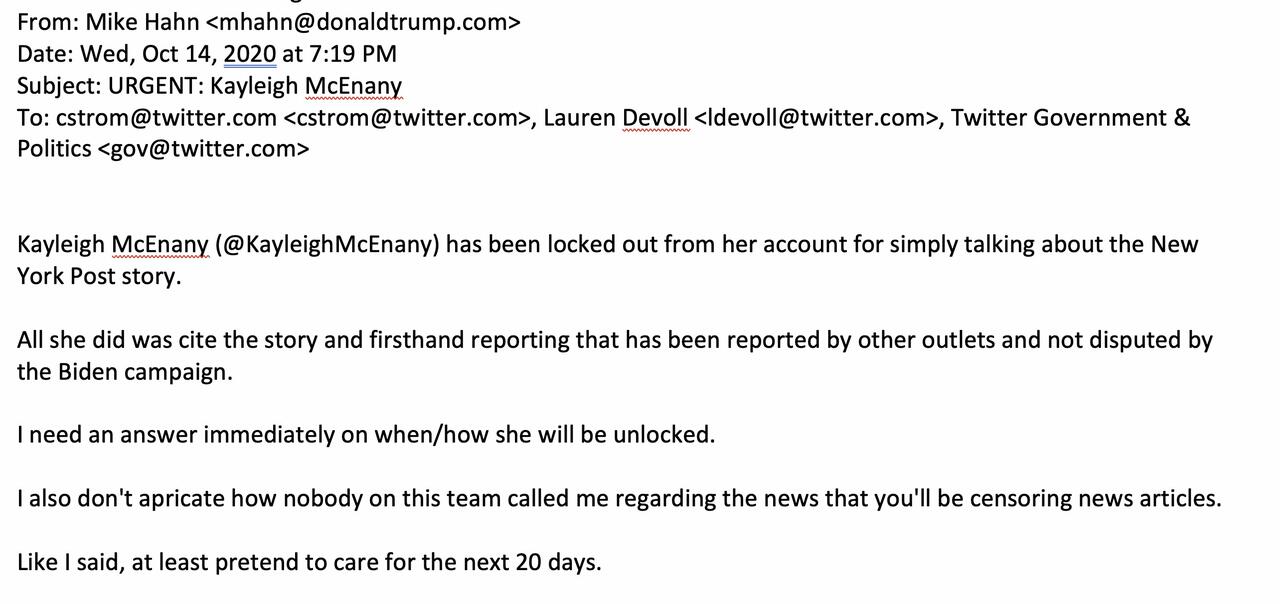
19. White House spokeswoman Kaleigh McEnany was locked out of her account for tweeting about the story, prompting a furious letter from Trump campaign staffer Mike Hahn, who seethed: “At least pretend to care for the next 20 days.”
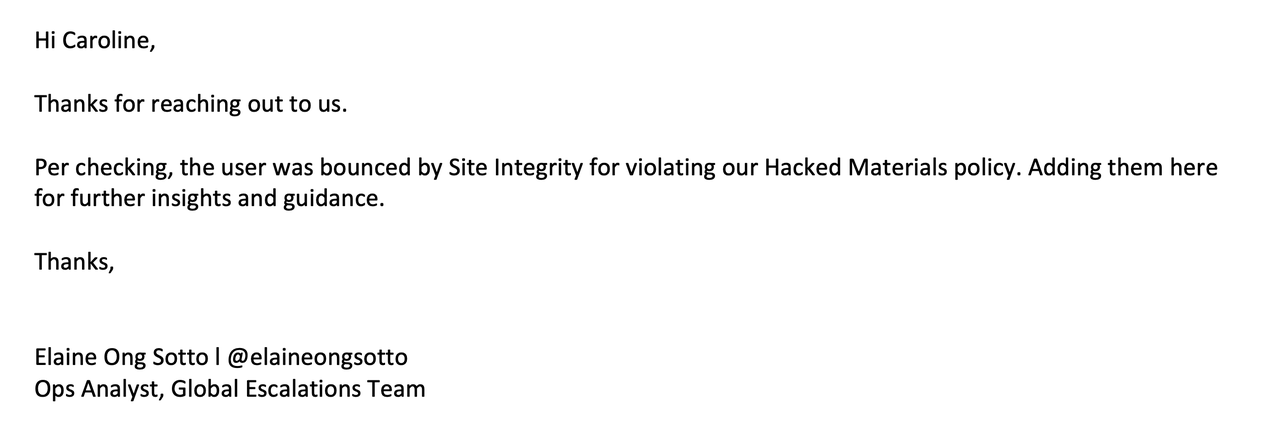
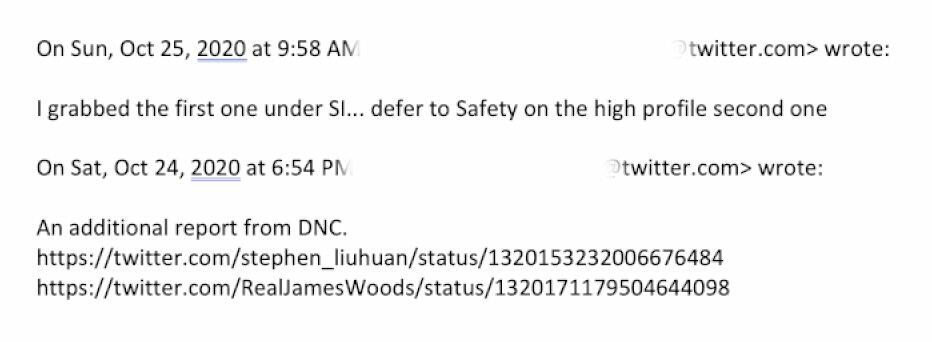
20.This led public policy executive Caroline Strom to send out a polite WTF query. Several employees noted that there was tension between the comms/policy teams, who had little/less control over moderation, and the safety/trust teams:
21. Strom’s note returned the answer that the laptop story had been removed for violation of the company’s “hacked materials” policy: https://web.archive.org/web/20190717143909/https://help.twitter.com/en/rules-and-policies/hacked-materials
22. Although several sources recalled hearing about a “general” warning from federal law enforcement that summer about possible foreign hacks, there’s no evidence - that I've seen - of any government involvement in the laptop story. In fact, that might have been the problem...
23. The decision was made at the highest levels of the company, but without the knowledge of CEO Jack Dorsey, with former head of legal, policy and trust Vijaya Gadde playing a key role.
24. “They just freelanced it,” is how one former employee characterized the decision. “Hacking was the excuse, but within a few hours, pretty much everyone realized that wasn’t going to hold. But no one had the guts to reverse it.”
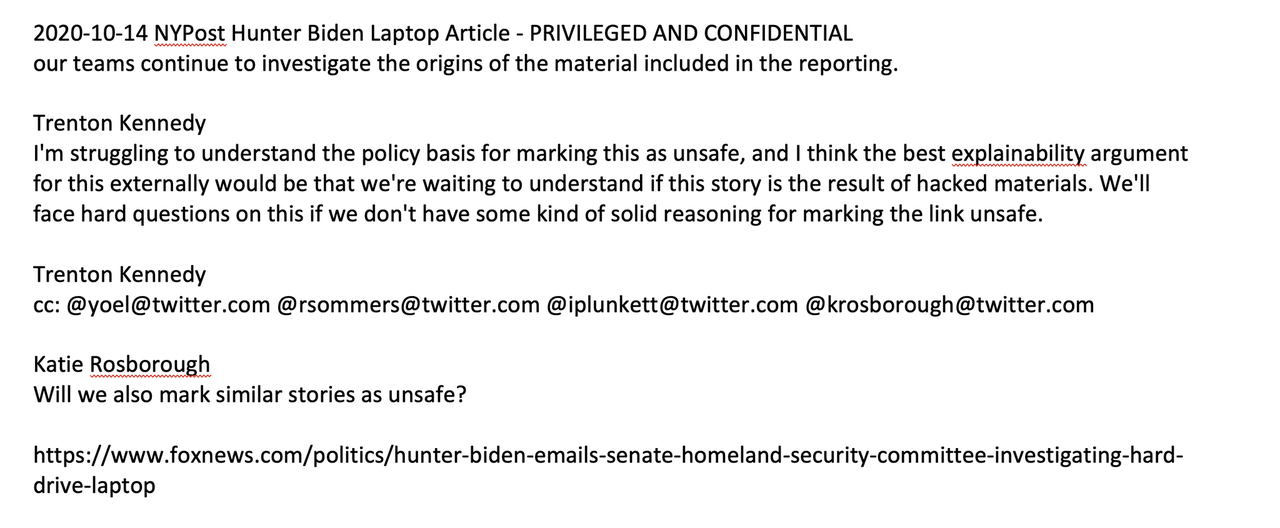
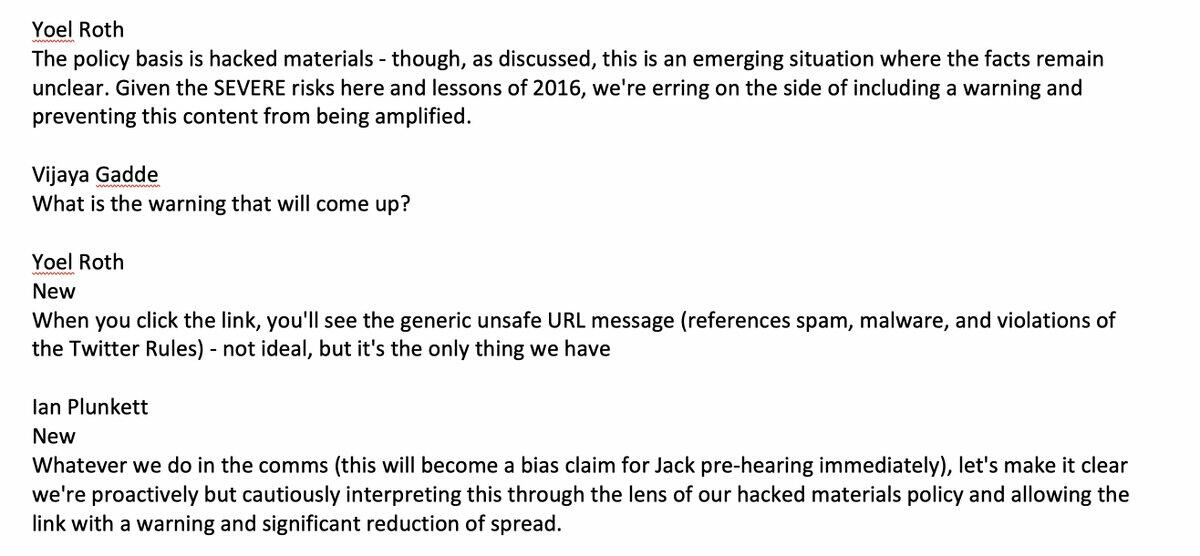
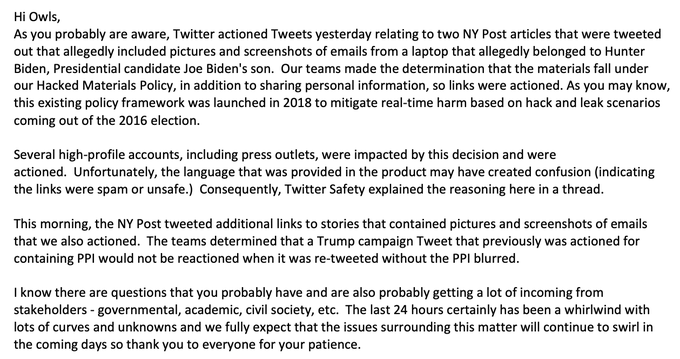
25.You can see the confusion in the following lengthy exchange, which ends up including Gadde and former Trust and safety chief Yoel Roth. Comms official Trenton Kennedy writes, “I'm struggling to understand the policy basis for marking this as unsafe”:
26. By this point “everyone knew this was fncked,” said one former employee, but the response was essentially to err on the side of… continuing to err.
27. Former VP of Global Comms Brandon Borrman asks, “Can we truthfully claim that this is part of the policy?”
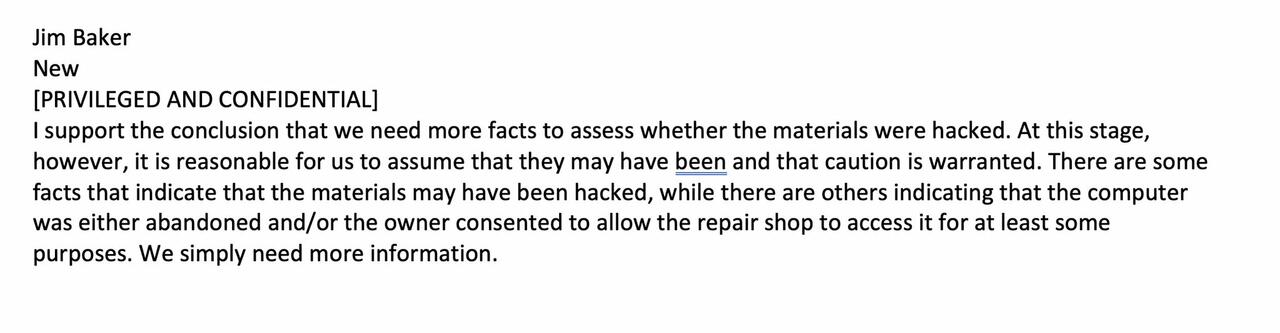
28. To which former Deputy General Counsel Jim Baker again seems to advise staying the non-course, because “caution is warranted”:
29. A fundamental problem with tech companies and content moderation: many people in charge of speech know/care little about speech, and have to be told the basics by outsiders. To wit:
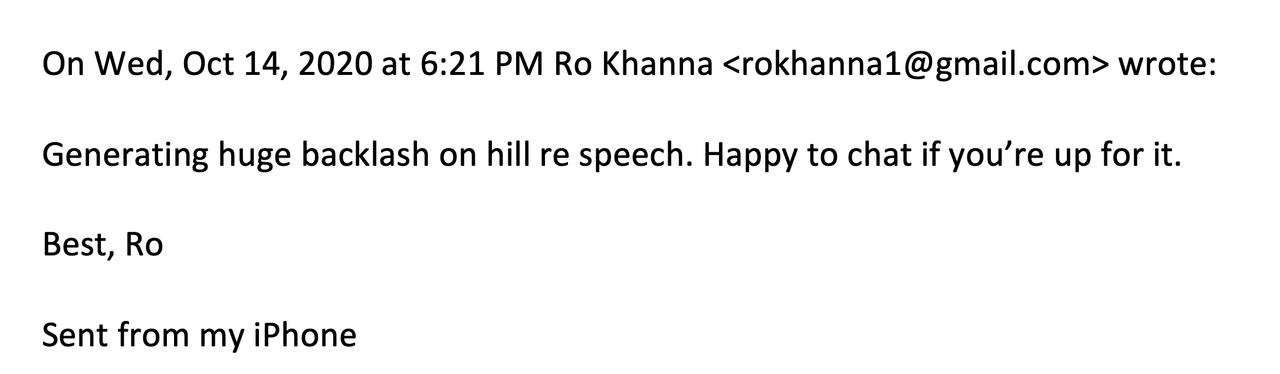
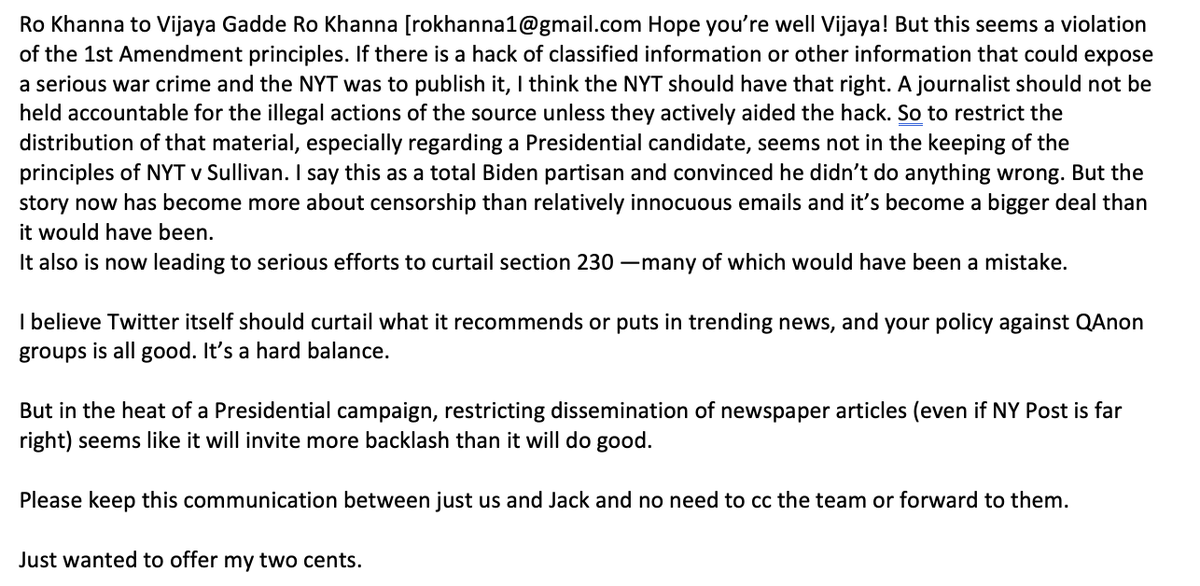
30. In one humorous exchange on day 1, Democratic congressman Ro Khanna reaches out to Gadde to gently suggest she hop on the phone to talk about the “backlash re speech.” Khanna was the only Democratic official I could find in the files who expressed concern.
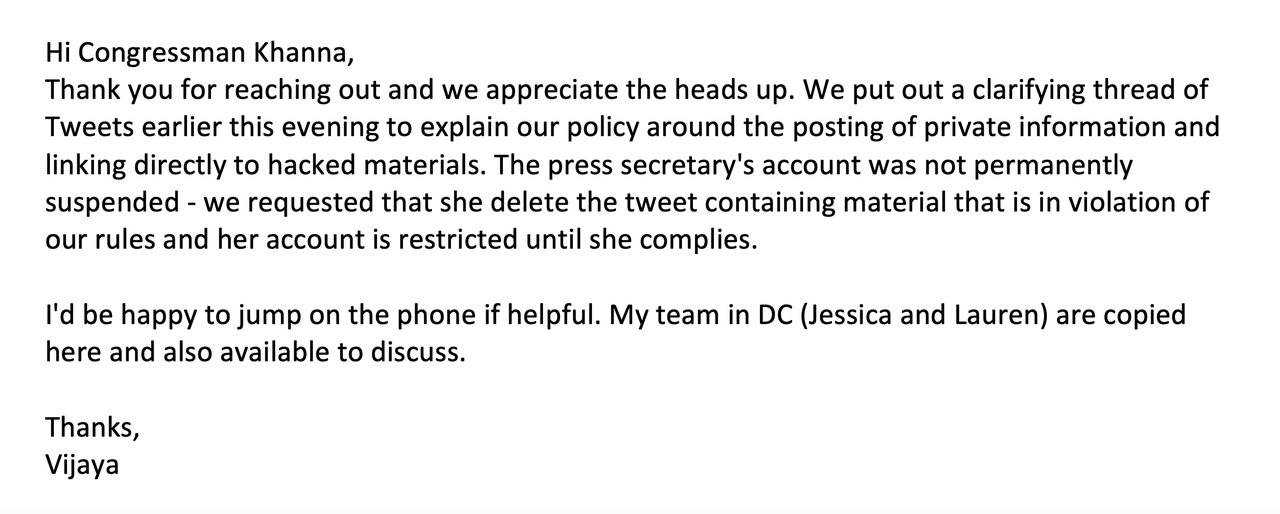
31. Gadde replies quickly, immediately diving into the weeds of Twitter policy, unaware Khanna is more worried about the Bill of Rights:
32.Khanna tries to reroute the conversation to the First Amendment, mention of which is generally hard to find in the files:
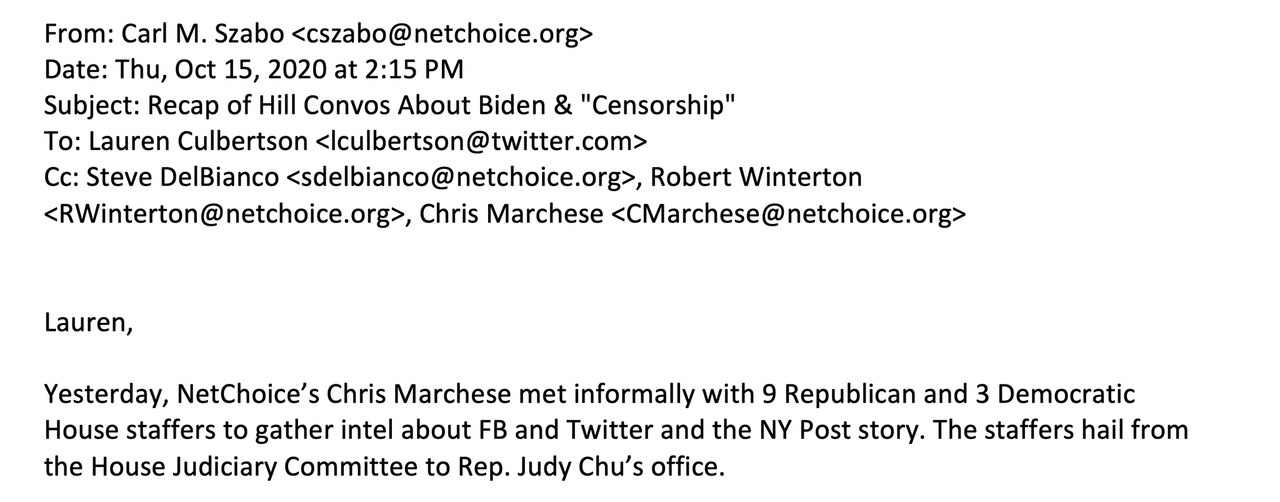
33.Within a day, head of Public Policy Lauren Culbertson receives a ghastly letter/report from Carl Szabo of the research firm NetChoice, which had already polled 12 members of congress – 9 Rs and 3 Democrats, from “the House Judiciary Committee to Rep. Judy Chu’s office.”
34.NetChoice lets Twitter know a “blood bath” awaits in upcoming Hill hearings, with members saying it's a "tipping point," complaining tech has “grown so big that they can’t even regulate themselves, so government may need to intervene.”
35.Szabo reports to Twitter that some Hill figures are characterizing the laptop story as “tech’s Access Hollywood moment”:
36.Twitter files continued: "THE FIRST AMENDMENT ISN’T ABSOLUTE”
Szabo’s letter contains chilling passages relaying Democratic lawmakers’ attitudes. They want “more” moderation, and as for the Bill of Rights, it's "not absolute"
37. An amazing subplot of the Twitter/Hunter Biden laptop affair was how much was done without the knowledge of CEO Jack Dorsey, and how long it took for the situation to get "unfncked" (as one ex-employee put it) even after Dorsey jumped in.
38. While reviewing Gadde's emails, I saw a familiar name - my own. Dorsey sent her a copy of my Substack article blasting the incident
39. There are multiple instances in the files of Dorsey intervening to question suspensions and other moderation actions, for accounts across the political spectrum
40. The problem with the "hacked materials" ruling, several sources said, was that this normally required an official/law enforcement finding of a hack. But such a finding never appears throughout what one executive describes as a "whirlwind" 24-hour, company-wide mess.
41. It's been a whirlwind 96 hours for me, too. There is much more to come, including answers to questions about issues like shadow-banning, boosting, follower counts, the fate of various individual accounts, and more. These issues are not limited to the political right.
42. Good night, everyone. Thanks to all those who picked up the phone in the last few days.
* * *
The release was telegraphed one week ago, when Musk acknowledged that revealing Twitter's internal discussions surrounding the censorship of the New York Post's Hunter Biden laptop story right before the 2020 US election is "necessary to restore public trust."
Recall that the Post had its Twitter account locked in October 2020 for reporting on the now-confirmed-to-be-real "laptop from hell," which contained still-unprosecuted evidence of foreign influence peddling through then-Vice President Joe Biden - including a 2015 meeting with an executive of Ukrainian gas giant Burisma.
Users who tried to share the link to the article were greeted with a message saying, “We can’t complete this request because this link has been identified by Twitter or our partners as being potentially harmful.”
Then, days after Musk's tweet, Twitter's former head of Trust and Safety, Yoel Roth, admitted it was a 'mistake' to censor the Hunter Biden laptop story.
In his first public appearance since becoming an ex-employee, Roth suggested that the Hunter Biden laptop story was simply 'too difficult' for Twitter to verify. Alternatively, the company could have perhaps simply trusted the Post, one of America's oldest publications that doesn't have a reputation for fabricating bombshell stories - like Twitter does with countless anonymous bombshells from other major publications.
We didn’t know what to believe. We didn’t know what was true. There was smoke,” Roth said during an interview at the Knight Foundation conference, as noted by the Epoch Times. “And ultimately for me, it didn’t reach a place where I was comfortable removing this content from Twitter.
“It set off every single one of my finely tuned APT28 ‘hack and leak campaign’ alarm bells,” he said, referring to a notorious team of cyberspies affiliated with Russian military intelligence. “Everything about it looked like a hack and leak.”
When asked whether if it was a mistake to censor the story, Roth replied, “In my opinion, yes.”
Would Roth have suppressed the story if it was a Don Jr. laptop full of incriminating evidence?
* * *
Finally, it will be very interesting to see which "independent", "impartial" and "objective" members of the Mainstream Media cover the Twitter Files, which unlike all that Russia collusion bullshit, was a real and actionable attempt to interfere with US democracy by covering up one of the most explosive political stories of a generation, not to mention an event that would have swayed the 2020 presidential election.
FT : Swedish scientist behind Alzheimer’s drug has big ambitions

Swedish scientist behind Alzheimer’s drug has big ambitions
Lars Lannfelt had a key role in developing a drug that has shown some promise in tackling Alzheimer’s

As Japanese drugmaker Eisai this week presented data confirming it had developed the first drug to slow cognitive decline in Alzheimer’s patients, the audience at a conference in San Francisco burst into applause.

Among those in attendance was Lars Lannfelt, a little-known Swedish scientist who invented the groundbreaking drug, known as lecanemab, and will make a fortune if it is approved and successfully marketed.

BioArctic, the company he co-founded in 2003 with Pär Gellerfors, struck a licensing deal on the monoclonal antibody therapy with Eisai in 2007, entitling it to hundreds of millions of dollars in milestone payments and royalties on lecanemab sales.

About 55mn people live with dementia worldwide and Alzheimer’s disease accounts for up to 70 per cent of these cases, according to the World Health Organization.

Analysts forecast the drug could generate sales worth up to $10bn a year, a prospect that would transform BioArctic, as well as Eisai and its partner on the drug, US biotech Biogen.

“It is nice to have money but this is not what has been driving me. It has been the science and the opportunity to build a Swedish company,” the 73-year-old told the Financial Times.

“We want [BioArctic] to be a fully-fledged pharmaceutical company: that is our ambition.”

Shares in BioArctic, which has just 75 employees, have more than tripled in value since Eisai disclosed in September that lecanemab slowed the rate of cognitive decline in early-stage Alzheimer’s patients by 27 per cent.

The Stockholm-listed company is now worth almost $2bn and rapidly recruiting staff, with the ambition of selling the drug in Nordic countries where it owns the rights to lecanemab in co-operation with Eisai.

Lecanemab could be approved in the US as early as January under the US Food and Drug Administration’s accelerated approval pathway. But significant hurdles remain, including satisfying physicians’ concerns about its safety and whether the clinical benefits justify the risks caused by side effects.

Investors also need convincing that Eisai will not repeat the mistakes of its partner Biogen, whose shares plunged last year following the botched launch of a similar Alzheimer’s drug called aducanemab that the Japanese group also helped develop.

Biogen initially priced a year’s treatment of aducanemab at $56,000 despite concerns among some health experts who warned there was little conclusive evidence of its benefits.

This week’s presentation of comprehensive data on lecanemab at the Clinical Trials on Alzheimer’s Disease conference in San Francisco, along with publication of a peer reviewed article in the New England Journal of Medicine, was a positive development, analysts said.

“Is it a cure? No. Are we there yet? No. But the data set is clean and shows a clear benefit,” said Evan Seigerman, analyst at BMO Capital Markets.

“Based on these data, we are highly confident in lecanemab’s approval and eventual Centers for Medicare and Medicaid Services (CMS) reimbursement,” he said.

A decision by CMS, the US federal agency administering national insurance schemes, to restrict insurance coverage of aducanemab to people undergoing the clinical trials damaged that drug’s commercial prospects.

Despite the euphoria in San Francisco this week, some researchers and investors remain cautious about the prospects for lecanemab, a drug that targets sticky plaques called beta amyloid that build up in the brain. The therapy, they say, produces only “moderate” clinical benefits compared to placebo and can cause serious side effects including brain bleeds.

The deaths of two patients on lecanemab, who were also taking blood thinning drugs, have also raised questions over whether large numbers of patients on anticoagulants may eventually be excluded from taking the treatment.

“I suspect that the lack of demonstrable clinical effectiveness will mean that lecanemab will not be taken up widely within healthcare systems around the world,” said Robert Howard, professor of old age psychiatry at University College London.

Lannfelt takes issue with that assessment, arguing that a 27 per cent reduction in the rate of cognitive decline is clinically significant and enough to approve and launch the drug. He said the trial results also confirmed a contentious theory known as the amyloid hypothesis, which holds that Alzheimer’s is primarily caused by the build-up of plaques in the brain.

“It is well proven that amyloid beta causes Alzheimer’s disease as much as HIV virus causes Aids. I think it’s the same level of evidence,” he claims.

Many researchers disagree that amyloid beta is now proven to be the “primary cause” of Alzheimer’s, saying rather that it is a complex disease with many contributory factors.

“Amyloid beta probably contributes roughly 30 per cent of the disease in totality, but there are many other disease proteins and other conditions that can add to the rate of decline,” said Dr Keith Vossell, a professor of neurology at the University of California Los Angeles.

It was Lannfelt’s discovery in the early 1990s of a mutation in the gene responsible for amyloid beta that helped establish a link between sticky plaques and Alzheimer’s. Almost a decade later while working as a researcher at the Karolinska Institute — a Swedish medical body — he unearthed another genetic mutation linked to amyloid-beta aggregates called protofibrils, rod-like structures that are a key target of lecanemab.

Named the “Arctic mutation”, it led to the discovery of the monoclonal antibody mAb158, which became lecanemab.

“We founded BioArctic in 2003 based on this idea and we managed to get in contact with Eisai and convince them that to target protofibrils is a very good idea,” said Lannfelt, who owns 33.5 per cent of BioArctic shares but controls 49.3 per cent of the biotech’s voting rights. He sold a small portion of his stake in October.

If lecanemab turns into a commercial success, Lannfelt said BioArctic would use the proceeds to develop drugs targeting Parkinson’s disease and other disorders of the central nervous system. Despite his age, he said he wanted to continue working at BioArctic as long as he could contribute with research.

 “You can’t change your lifestyle at this age,” said Lannfelt, adding that he would indulge himself by buying an electric car.

FT: The mother of all motorcycle rallies

The mother of all motorcycle rallies
A trans-Alpine trip from Austria to Monaco tests riders to their limits

Barrel-chested amateur rugby player Patch McMeekin doesn’t look like a man who takes fright easily, but he admits it was “pretty scary” to spend two hours wrestling his 10-year-old Royal Enfield through the foot-deep, ice-covered potholes littering the floor of the pitch-dark Tunnel de Parpaillon. That said, no one who entered the inaugural Great Malle Mountain Rally was looking for an easy ride. And organisers Robert Nightingale and Jonny Cazzola did advise against taking the optional route through the 500m tunnel, which was built by the French army in 1900, 2,600m up the side of the Col du Parpaillon.

Such situations chime with the “prepared to get lost” mantra that underlies Malle London, the firm founded by the pair in 2012 as a small-scale manufacturer of adventure-based, fit-for-purpose motorcycle luggage. The business has subsequently developed a whole new strand staging light-hearted competitions for “inappropriate motorcycles”. The inaugural event, the Malle Mile Festival in 2014, was held in the grounds of Kevington Hall in London and attracted around 50 riders. Eight years later, the festival – now held in the grounds of Grimsthorpe Castle in Lincolnshire – draws closer to 1,000 entrants (and even more spectators) and is just one of a calendar of live events. Others include an annual beach race, the Scotland-to-Cornwall Great Malle Rally (the longest and largest event of its type in the UK) and, as of this year, the Great Malle Mountain Rally – 1,200 miles from the start of the Alpine range in Austria to its end near Monaco, all covered on small roads and serpentine passes. While it’s a journey that any reasonably organised motorcyclist could arrange for themselves, Malle offers the convenience of a turn-key package that takes care of everything from getting an entrant to the start line to organising nights under canvas and providing decent food – and providing back-up should things go wrong.

I signed up for the mountain rally within days of it being announced. Ordinarily I would have ridden from home to the start on my own machine, but commitments in southern Italy the morning after the rally ended made that impractical. Happily, Malle will arrange motorcycle hire for those who don’t want to bring their own (at a cost of about £1,000) and for me they sourced a new Royal Enfield 650 Interceptor, which was ready and waiting when I arrived in Innsbruck, a half-hour ride from the start of the rally at the majestic Schloss Friedberg. 

Nightingale has become known among Malle fans for his easy but deceptively persuasive manner – and he puts it to good effect when researching the rally routes. He seeks out remarkable buildings in remarkable places before assuring their initially bemused owners that it really would be a good idea to welcome dozens of motorcyclists to spend the night on the premises in bell tents – and that they might like to lay on a lavish supper too. He clearly goes to some trouble to assess the dynamics of each team of riders, a process that begins the evening before the start. For this event there are around 70 of us taking part, with people from all walks of life – from a film-set builder to a fund manager, and a chemist to a PlayStation art director – all bound by the common thread of seeking adventure on motorcycles.

By the time the small groups of riders roar off out of the gates of the Schloss at three-minute intervals, the bonds have already been established, camaraderie is building and the adrenaline is flowing. The first day’s ride is 189 miles to the overnight stop at Castel Katzenzungen in South Tyrol, a route that takes us up the Colle Isarco and into the Dolomites via the Sella Pass – a journey of breathtaking views and unbeatable riding roads. 

It’s beautiful but gruelling. By the time we reach Castel Katzenzungen (home, incidentally, to a single, sprawling grape vine that is said to be the oldest in the world) it has become apparent that the trip is going to be anything but a relaxing holiday. “It is already hard to compare what I expected with the reality,” says Gorana Pecotić, a Croatian-born doctor based in Malta who has entered the event with her partner, Alexandra Pace, a designer, who is riding a BMW F 750 GS. “We only got into motorcycling during lockdown in 2020,” she says, “so I knew a ride like this would be a big challenge – I just didn’t realise how much of a challenge. We’ve driven through the region before by car, but the constant hairpin bends, the terrain and the changing weather conditions are all things we have never experienced on motorcycles.”

The couple’s state-of-the-art machines have removed the variable of unreliability, and plenty of other riders have chosen to make the trip on modern bikes – but others have adopted the early Malle thinking. Phil Hammond, for example, trailered his heavily customised 1979 Honda CBX all the way from his home in San Sebastián to the finish line in Monaco before riding it the 400 miles to the start.

It proves to be a bad decision, because the bike’s engine fails at the start of day two, leaving Hammond’s friend Simon Askew to ride the rest of the rally without him on his highly modified Honda Dominator. 

The prize for the most inappropriate machine of all, however, should probably go to Malcolm “Mally” Barnes and his pillion-passenger wife Amy. He has driven his 888lb Honda Rune cruiser all the way from Madrid and, despite the bike’s near six-foot wheelbase and value as a rare collector’s piece, manages to amaze other rallyists by making light work of the switchbacks and many battered tracks that form much of the route. “Most Runes sit in heated garages as part of highly polished collections,” says Barnes. “I thoroughly enjoy annoying other owners by getting mine filthy dirty and riding it on the type of roads it was never intended to see.” There is respect, too, for 37-year-old private equity fundraiser Joel Gindill who has entered the rally on his Ducati-based DB25, a recently acquired limited-edition race replica built by Surrey-based customising house deBolex (starting price £38,000) that he had ridden only 300 miles before the start.

Whether tackling the fog-shrouded Furka Pass in Switzerland (scene of the famous car chase in the Bond film Goldfinger); sleeping by Lake Sils at the Maloja camp near St Moritz; traversing four miles of gravel hairpins to reach the Berghotel Chäserstatt where we sleep surrounded by snow-capped mountain peaks, or making the final, sun-drenched descent towards the finish line in Monaco, everyone agrees that this has been the six-day adventure of a lifetime. And even though McMeekin had those scary two hours in the Tunnel de Parpaillon, he applauds not only the trip but what the firm’s other events are achieving.

No surprise, then, that the announcement of upcoming rallies in the desert and to the Arctic Circle raises a cheer that could probably have been heard back at the start line in Austria. 

>>> US Close Dow +0,10% S&P -0,12% Nasdaq -0,18% Russell +0,59% VIX 19,06 -3,93%

Closing Stock Market Summary

It shaped up to be a pretty good day for the bulls, all things considered. The session started on a decidedly downbeat note, though, after market participants digested a generally positive November employment report.

The employment report featured stronger-than-expected nonfarm payrolls growth (263,000), higher-than-expected average hourly earnings growth (0.6%), and an in-line unemployment rate of 3.7% that held steady near a 50-year low.

Sellers stepped up their efforts on the heels of the release since this good news seemed likely to defer any eventual pivot by the Fed with its monetary policy, suggesting the target range for the fed funds rate will go higher yet and remain higher for longer, as Fed Chair Powell and other officials have suggested will be the case.

The Dow Jones Industrial Average, S&P 500, and Nasdaq were down 1.0%, 1.2%, and 1.6%, respectively, right out of the gate and the S&P 500 breached support at its 200-day moving average (4,046). 

Buyers got back involved following that breach and brought the S&P 500 back above that key level where it vacillated for much of the day.

Things improved markedly, however, with about 90 minutes to go as the S&P 500 refused to drop back below its 200-day moving average and as Treasury yields continued with a sharp reversal from their post-employment report highs.

The 2-yr note yield, which hit 4.38% earlier, settled at 4.29%. The 10-yr note yield, which hit 3.60% earlier, settled at 3.51%. The U.S. Dollar Index, which was up as much as 0.8% following the employment report, ended down 0.2% at 104.53.

Notably, the Russell 2000 closed with a 0.6% gain and the Dow Jones Industrial Average made its way back above the unchanged line.

Roughly half of the 11 S&P 500 sectors closed in the green. Materials (+1.1%) enjoyed the biggest gain while energy (-0.6%) fell to the bottom of the pack.

  • Dow Jones Industrial Average: -5.3% YTD
  • S&P Midcap 400: -9.4% YTD
  • Russell 2000: -15.7% YTD
  • S&P 500: -14.6% YTD
  • Nasdaq Composite: -26.7% YTD

Reviewing today's economic data:

  • November nonfarm payrolls rose by 263,000 ( consensus 200,000) following a revised 284,000 increase in October (from 261,000). Nonfarm private payrolls increased by 221,000 ( consensus 200,000) following a revised 248,000 increase in October (from 233,000).
  • Average hourly earnings were up 0.6% ( consensus 0.3%) versus a prior revised 0.5% increase (from 0.4%).
  • The unemployment rate was unchanged at 3.7%. The average workweek fell to 34.4 hours from 34.5 in October.
    • The key takeaway from the report is mixed. The report itself is good news from an economic standpoint, yet the market sees it as bad news, thinking it will push out any eventual pivot by the Fed with its monetary policy. In brief, it is a report that screams higher for longer with respect to the target range for the fed funds rate.

Looking ahead to Monday, market participants will receive the following economic data:

  • 9:45 a.m. ET: November IHS Markit Services PMI - Final (prior 46.1)
  • 10:00 a.m. ET: October Factory Orders (prior 0.3%)
  • 10:00 a.m. ET: November ISM Non-Manufacturing Index (prior 46.6%)