(ZH) Hurricane In December? 50% Formation Odds In Atlantic As Storm Churns

Hurricane In December? 50% Formation Odds In Atlantic As Storm Churns

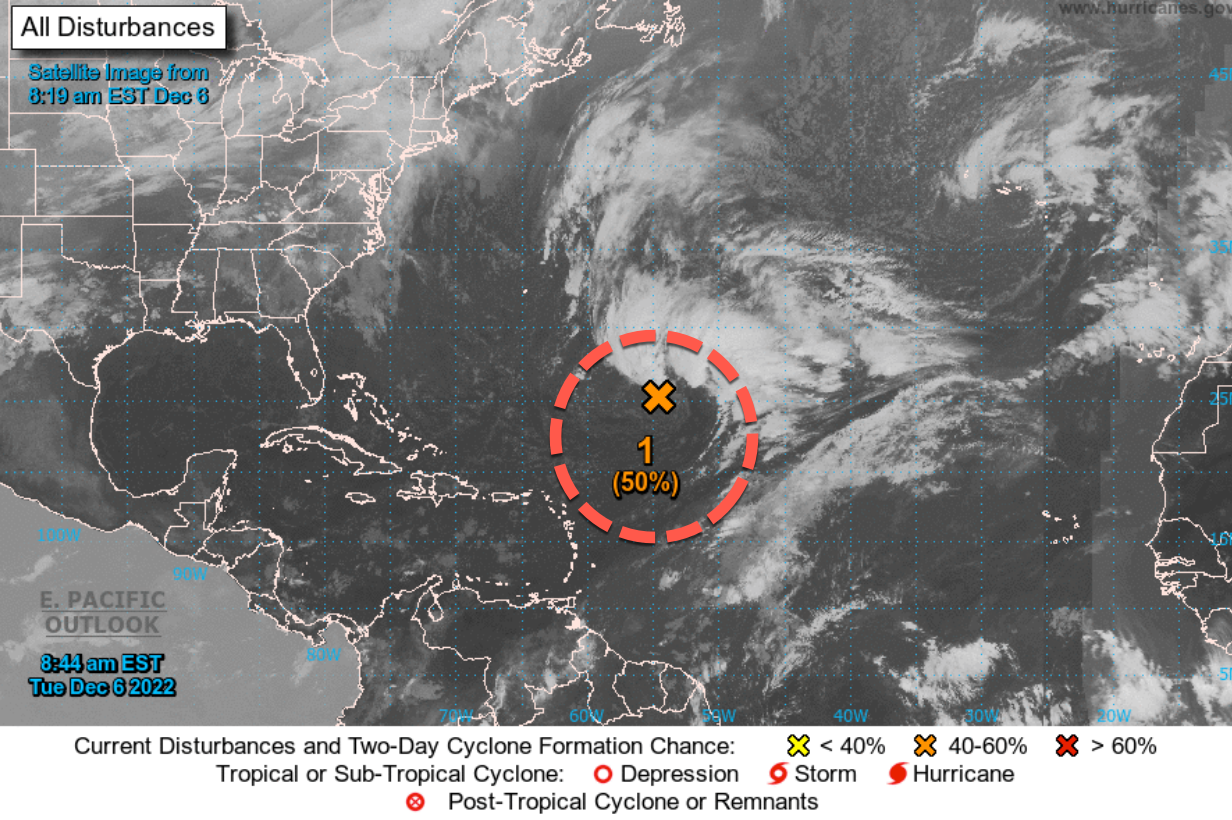
Nearly one week after the 2022 Atlantic hurricane season ended, an incredibly rare tropical disturbance formed over the central subtropical Atlantic.
The National Hurricane Center released a tropical weather outlook on Tuesday, explaining the storm has a 50% chance of becoming the 15th named storm of the season over the next two 2-5 days.
"Environmental conditions appear marginally conducive for development and a subtropical or tropical storm could form in the next couple of days," NHC said. However, it added:
"By Thursday night or Friday, the low will move northeastward over cooler waters and interact with a mid-latitude trough, limiting subtropical or tropical development of the system."
Christianne Pearce, a meteorologist with the National Weather Service's Tampa Bay office, told Tampa Bay Times the storm doesn't threaten Florida or the US as it moves northeast into even cooler waters.
"The probability of having a storm this late in the season is very low because the waters out there are a lot cooler.
"We just have different atmospheric phenomenon happening that kind of put a damper on those things developing," Pearce said.
The Atlantic hurricane season begins on June 1 and concludes on Nov. 30. Tropical storms and hurricanes forming in December are rare. According to Fox 35 Orlando, data between 1851 to 2017 showed that 2% of tropical storms formed outside "off months" (December to May) of the season.
Keep an eye on the Atlantic's tropical region over the next few days. If the storm does form, it will be named "Owen."

(ZH) US Army Selects Bell's V-280 To Replace Black Hawk Helicopters

US Army Selects Bell's V-280 To Replace Black Hawk Helicopters

Late Monday evening, the US Army awarded Textron Inc's Bell unit with the contract to build the next-generation helicopter, ending years of fierce competition between Lockheed Martin Corp.-Boeing Co. to replace the aging fleet of Sikorsky UH-60 Black Hawks by 2030.
The Army's "Future Vertical Lift" award went to Bell's V-280 Valor tiltrotor aircraft, similar to the V-22 Osprey. The new aircraft can take off and land vertically like a helicopter but rotate massive props to fly like a fixed-wing aircraft at impressive speeds.
"The V-280's unmatched combination of proven tiltrotor technology coupled with innovative digital engineering and an open architecture offers the Army outstanding operational versatility for its vertical lift fleet," Bell said in a statement.
"We are honored that the US Army has selected the Bell V-280 Valor as its next-generation assault aircraft.
"We intend to honor that trust by building a truly remarkable and transformational weapon system to meet the Army's mission requirements. We are excited to play an important role in the future of Army Aviation," Scott C. Donnelly, Textron's chairman and chief executive officer, said in a statement.
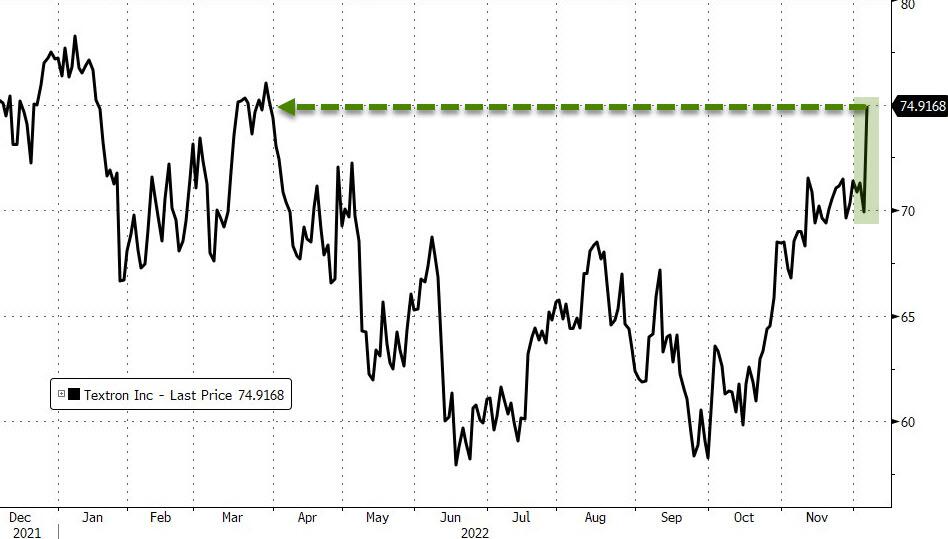
Shares of Textron jumped significantly on the news, back at their highest since April...
Textron didn't release the terms of the contract. However, Bloomberg noted the contract was worth up to $1.3 billion, with development expected to take approximately 19 months.
The Army said V-280 will "provide transformational increases in speed, range, payload, and endurance to replace a portion of the Army's current assault and utility aircraft fleet."
Douglas Bush, Army assistant secretary for acquisition, told reporters at the Pentagon Monday that the selection of the V-280 "is our chance to move to the next step in this vital program." Army officials said if all contract options were exercised, it could rise to $7 billion, including the first initial low-rate production of the next-generation helicopter.
The Army has been testing and evaluating another aircraft besides the V-280: A coaxial lift compound rotor helicopter called Defiant X, built by the Lockheed-Boeing team.
Lockheed-Boeing group released a statement that the fight to win the contract wasn't over:
"We remain confident Defiant X is the transformational aircraft the US Army requires to accomplish its complex missions today and well into the future," the group said. "We will evaluate our next steps after reviewing feedback from the Army."
Rapid modernization efforts are underway for the US military. Last Friday, the Air Force unveiled the next-generation bomber called the B-21 Raider.

WSJ : Jeff Bezos’s Space Company Bids Again for NASA Moon Lander, After SpaceX W

Jeff Bezos’s Space Company Bids Again for NASA Moon Lander, After SpaceX Win
A team including Blue Origin, Boeing and Lockheed Martin wants to build a craft to transport astronauts to the moon

Jeff Bezos ‘s space company said it is making another run at the moon, after the National Aeronautics and Space Administration chose rival SpaceX to handle a high-profile lunar mission last year.

Blue Origin LLC, the space company Mr. Bezos founded and has backed, said Tuesday in a tweet that it is part of a group that submitted a bid to develop a lunar lander capable of transporting NASA astronauts to the surface of the moon on future missions for Artemis, the agency’s space-exploration program. Blue Origin’s partners on its bid include Lockheed Martin Corp. and Boeing Co.

Last year, NASA awarded SpaceX a $2.9 billion contract to use a version of the Elon Musk -led company’s planned Starship vehicle to handle that task, on a mission currently set for 2025.

NASA’s decision to issue a single contract for that lander drew a protest and a lawsuit from Blue Origin, both of which were unsuccessful. It also prompted Mr. Bezos to write a letter to NASA’s administrator, Bill Nelson. “Instead of investing in two competing lunar landers as originally intended, the agency chose to confer a multiyear, multibillion-dollar head start to SpaceX,” his letter from July of last year said.

Mr. Bezos offered to cut the price for its lander bid by waiving payments to Blue Origin and have the company conduct and pay for a test mission. NASA officials weren’t immediately swayed, but facing pressure from Congress, the agency later agreed to seek proposals from companies other than SpaceX for a second lander.

NASA also agreed to award SpaceX additional work using its Starship lander. The agency recently tasked the company with handling another moon landing in 2027.

NASA needs landers to take astronauts from its Orion spacecraft in lunar orbit to the surface of the moon and back, where they would re-enter Orion for a trip back to Earth. The agency launched the first Artemis mission last month, and the uncrewed Orion vehicle used for that flight is expected to return to Earth next Sunday.

Blue Origin and its partners are likely to face competition to win the deal to deliver the second lander. An executive at a division of Leidos Holdings Inc. said at a recent investor meeting that the company planned to submit its own bid. NASA usually makes the names of bidders available after an award and protest period, an agency spokeswoman said.

>>> What to look at today - 7th of December 2022

Stocks in Asia were mixed following declines in the US while the yuan fluctuated as investors balanced signs China would further loosen Covid restrictions with underwhelming trade data. Equity benchmarks in Australia and Korea fell, shares in Hong Kong and mainland China wavered and Japanese equities clung to a small advance. Futures contracts for European stocks and the S&P 500 edged higher. The US stock benchmark fell 1.4% Tuesday for its fourth consecutive decline, the worst run in a month. Weaker-than-expected imports data for China showed sluggish domestic demand, while exports also fell more than expected. The offshore yuan gave up its gains, after advancing earlier on reports China would allow home quarantine of some infected people in the latest relaxation of pandemic rules. The dollar and Treasuries held on to Tuesday gains. Australian bonds followed the rally in Treasuries wiping 5 basis points from the 10-year yield to 3.35%. The Australian dollar maintained its advance after third-quarter gross domestic product missed estimates.  Wall Street turned risk-off as a host of US banks sounded the alarm about the gloomy outlook. Goldman Sachs Group Inc.’s David Solomon warned about pay and job cuts, citing “some bumpy times ahead.” Bank of America Corp. is slowing hiring ahead of a possible economic contraction. Morgan Stanley will reduce its global workforce, while JPMorgan Chase & Co.’s Jamie Dimon told CNBC a “mild to hard recession” may hit next year. Oil fell further after touching the lowest level since last December on Tuesday as investors pared back crude positions amid a broader market sell-off. The decline for West Texas Intermediate, which settled near $74 on Tuesday, erased all of this year’s gains.

Nikkei -0.72% Hang Seng -0.60% CSI -0.27% Shanghai -0.46% Shenzen +0.09%

Eur$ 1.0467 CNH 6.9724 CNY 6.9808 JPY 137.32 GBP 1.2135 CHF 0.9421 RUB 63.2027 TRY 18.6342 WTI$ 74.26 +0.01% Gold 1,772.20 +0.07% BTC 17,040 +0.27% ETH 1,263 +0.060%

S&P -0.00% Nasdaq -0.03% EuroStoxx +0.00% FTSE +0.26% Dax -0.41% SMI -0.15%

Macro :
- Incoming Kraken CEO Ripley Blasts Dimon, Alleges Fraud at FTX
- BofA Institutional Clients Bought Stock for Fourth Straight Week
- *CHINA NOV. TRADE BALANCE $69.84 BLN; EST. $78.05 BLN

Keep an eye on :
- AIR FP : Airbus Looks to Finally Beat Boeing With New Jet to Rival 737
- AIR FP : Airbus Cuts Full-Year Delivery Target Amid Supply Glitches
- AAPL US : Apple Scales Back Self-Driving Car and Delays Launch Until 2026
- MT NA : Itochu to Acquire Stake in ArcelorMittal Mining Canada
- BBVA SM : *BBVA PLANS TO ISSUE DEBT FOR €8B IN 2023: EXPANSION
- BHG SS : BHG Group Offers Up to SEK800 million Shares
- BMPS IM : Giorgetti Confirms Italy Wants Orderly Exit From Monte Paschi
- BC IM : Brunello Cucinelli Sees FY Revenue About +28%
- CLASB SS : Clas Ohlson 2Q Operating Profit Misses, Starts Cost Savings
- COLOB DC : Danish Billionaire Buys Shares in Coloplast for $7 Million
- ACA FP : Crédit Agricole Sells 63.7% of Crédit Du Maroc Stake; No Terms
- DEMANT DC : UK CMA May Refer Cochlear-Oticon Deal to In-Depth Probe
- DWS GY : DWS Targets EPS of EU4.50 by 2025, Might Sell Businesses
- EAPI FP : EuroAPI Cuts FY Guidance On Temporary Prostaglandin Suspension
- EXO NA : Exor to Replace Just Eat Takeaway in AEX-Index, Euronext Says
- TKWY NA : Exor to Replace Just Eat Takeaway in AEX-Index, Euronext Says
- PGS NO : PGS and TGS Expand MultiClient Coverage Offshore Brazil
- PHARM NA : Pharming Announces Positive Phase 3 Results of Leniolisib Trial
- PRX NA : Prosus Values Business at $31 Billion Excluding Tencent Stake
- SAN FP : Zantac Litigation Tossed by US Judge After Ruling on Experts
- TEP FP : Teleperformance Hires Bureau Veritas for Colombia Work Report
- TWTR US : Vestager Says ‘A Lot Can Happen’ at Twitter Ahead of EU Rules
- UCB BB : UCB Says Two Bimekizumab Phase 3 Studies Met Primary Endpoint
- VNCE US : Fashion Brand Vince Is Said to Explore Options Including Sale
- VRLA FP : Verallia to Buy Back Shares up to EU50m
- VOD LN : Vodafone and Three UK Battle Roadblocks to Mobile Tie-Up

>>> Europe : Brokers Upgrades & Downgrades - 7th of December 2022

>>> Up
* Elis Raised to Overweight at JPMorgan; PT 16.50 euros
* Haleon Raised to Overweight at Barclays; PT 360 pence
* Landis + Gyr Raised to Equal-Weight at Morgan Stanley
* Novozymes Raised to Overweight at JPMorgan; PT 500 kroner
* Wacker Chemie Raised to Neutral at JPMorgan; PT 104 euros

>>> Down
* Air Liquide Cut to Neutral at JPMorgan; PT 146 euros
* Cyfrowy Cut to Accumulate at Erste Group; PT 21 zloty
* Johnson Matthey Cut to Underweight at JPMorgan; PT 2,000 pence
* Kering Cut to Neutral at UBS; PT 572 euros
* Pagegroup Cut to Underperform at Jefferies; PT 400 pence
* Persimmon Cut to Hold at Investec
* SKF Cut to Underweight at Morgan Stanley
* Terna Cut to Underweight at Morgan Stanley; PT 7 euros
* Umicore Cut to Underweight at JPMorgan; PT 27.50 euros
* Wood Cut to Neutral at Citi; PT 150 pence

>>> Initiation
* Argenx ADRs Rated New Outperform at William Blair
* CTP Rated New Outperform at Oddo BHF; PT 14.50 euros
* Epiroc Assumed Equal-Weight at Morgan Stanley; PT 192 kronor
* Greenyard Rated New Hold at ING; PT 7 euros
* IMI Assumed Equal-Weight at Morgan Stanley
* JDE Peet's Rated New Overweight at Barclays; PT 40 euros
* JD.com ADRs Rated New Hold at Baptista Research; PT $64
* Metso Outotec Assumed Equal-Weight at Morgan Stanley
* Thermo Fisher Rated New Outperform at RBC; PT $661
* Weir Assumed Underweight at Morgan Stanley

>>> Call
* JDE Peet’s New Overweight at Barclays on Defensive Positioning
* MS Prefers Defensive Capital Goods Names, Cuts Three Stocks
* Pagegroup Downgraded at Jefferies Following Outperformance
* Terna Cut as Morgan Stanley Sees Too Much Growth Priced In
* Subsea 7, Technip Energies, Aker CC Preferred at Citi; Wood Cut

FT : EU regulators shrug off legal setbacks on corporate tax schemes

EU regulators shrug off legal setbacks on corporate tax schemes
Competition commissioner Margrethe Vestager to continue campaign against governments offering what she sees as unfair subsidies

On the day when Margrethe Vestager lost her latest state aid case before the EU courts, the competition and digital chief for the 27-nation bloc insisted that regulators were ready to strike back.

On the face of it, the legal setback was not enormous — at least not in monetary terms. Last month the European Court of Justice, the EU’s top court, ruled that Fiat did not have to pay back €30mn in taxes to Luxembourg.

Shortly after the court’s ruling, Vestager made plain her view that this was not the end of the road for competition enforcement. She said: “Even if the commission’s decision was annulled, it gives important guidance.

“The court confirmed that action by member states in areas that are not subject to harmonisation by EU law is not excluded from the scope of the treaty provisions on the monitoring of state aid.”

Fiat’s win was the latest in a series of cases that have gone against Vestager in her battle to block aggressive corporate tax planning. Last year, judges quashed her order for Apple to pay back €14.3bn in taxes to Ireland. Many legal experts believe that she will ultimately lose this case at the highest court after it completes its consideration of an appeal by the EU.

The rulings have not deterred the Danish commissioner from using EU state aid rules to go after tax schemes by member states such as Ireland and Luxembourg since she took office in 2014.

EU officials also point to a partial victory of sorts for the regulators. Even as they face mounting legal losses, some countries like Ireland and Luxembourg have already made changes to their tax regimes, say people with knowledge of the commission’s thinking.

Nonetheless, some insiders in Brussels are concerned that as the bloc keeps losing cases, some governments will see that as a green light to keep pursuing sweetheart tax deals with the likes of Apple and Amazon.

“The tool Vestager picked [state aid] is not the right tool according to the courts,” said one person with knowledge of the EU’s thinking. “Here we are talking about regimes that are borderline about what’s selective and what’s not. The court has said, let’s give them some margin on how to interpret the law. This might encourage some to tweak their tax regimes.”

The person said the recent court rulings were creating the space for smaller member states to become tax havens through the creation of schemes that would mean corporations are taxed lower than elsewhere across the continent.

So what is the solution? A political willingness to act, according to some experts in Brussels. Assimakis Komninos, a partner at law firm White & Case in the Belgian capital, said the issue of how much tax corporations should pay was about “global governance”. He explained: “You can’t just use competition law and state aid to try to resolve this issue.

“It is complicated. We need an international instrument for that. A lot of work has been done by the OECD. It’s more for states to sit down and deal with that.”

And countries have sat down in efforts to strike deals. Last year, 136 countries supported a tax arrangement orchestrated by the OECD whose objective is to address public discontent over large companies not paying their fair share of tax.

The deal has a two-pronged approach. The first part of the deal is aimed at forcing the largest companies to reallocate a share of profits to where they do business, making sure they pay enough into the system. The second part creates a minimum effective corporate tax rate, currently seen at 15 per cent.

But progress is faltering despite calculations that the deal could raise some $150bn in extra taxes a year from the largest multinationals.

Member states are ready to dust off a digital services levy if the talks fail. Last month Zbyněk Stanjura, finance minister of the Czech Republic, which holds the six-month rotating EU presidency, drew attention to the possibility that the US may not implement the deal, and that in such a scenario EU countries would need to find their own solution.

Meanwhile, Vestager insists that the fight against what she considers unfair tax schemes will go on. At a press conference in Paris recently she said: “The tax practices of some countries . . . effectively amount to little more than granting unfair subsidies. Our enforcement should continue within the clarified limits of the courts that has given us.”

FT : European tech groups lose $400bn in value following funding crunch

European tech groups lose $400bn in value following funding crunch
Investor wariness creates first big test of continent’s tech scene since rise of start-ups Spotify and Revolut

More than $400bn in market value has been wiped from European tech companies since the peak of the 2021 boom, as venture capital dealmaking hit a wall at the end of the summer.

The continent’s start-ups were beneficiaries of a funding frenzy in 2021, leading to the creation of more than 100 “unicorns” — tech start-ups valued at more than $1bn.

That figure has fallen to 31 so far this year, according to a report by London-based venture capital firm Atomico, the lowest level since 2017, excluding the coronavirus pandemic year of 2020. More than 14,000 European tech workers have been laid off, Atomico estimates.

The trend is a reflection of investor wariness of high inflation, rising interest rates and the war in Ukraine. The funding crunch represents the first true test of the European tech scene since a new generation of homegrown companies, led by the likes of Spotify, Revolut and King, became international successes.

“Our view is the challenging macro will persist” well into 2023, said Tom Wehmeier, partner and head of research at Atomico. “There’s no going back, at least for a very long time, to the conditions we saw at the end of 2021.”


Since it began in 2015, Atomico’s annual “State of European Tech” report has charted — and cheered — the rise and rise of start-ups in London, Paris, Berlin and Stockholm, as the region appeared to be finally bridging a decades-long funding gap with Silicon Valley.

The $85bn invested in European tech this year will still be more than double the totals of 2019 or 2020, Atomico estimates, though the second half of 2022 saw a sharp pullback with only 37 funding rounds worth more than $100mn, compared with 133 in the first half.

Separate research published last month by another venture firm, Accel, based on analysis by Dealroom, found that more than 200 VC-backed unicorns in Europe have spawned more than 1,000 new start-ups, thanks to what they call “founder factories” such as Delivery Hero, Criteo and Klarna.

Even VC veterans are struggling to make sense of the moment in start-up financing, amid macroeconomic and geopolitical jolts.

“I’ve been in this game for 20 years and it is exceptionally hard to read the tea leaves at the moment,” said Nic Brisbourne, managing partner at London-based Forward Partners, which has a £95mn portfolio of early-stage tech companies. “I feel a real lack of confidence that if I put money in now, will that company be able to raise money again in the next 12-18 months?”


Investors say that confidence, not capital, is the problem. Atomico estimates there is still around $80bn worth of “dry powder” available in Europe: venture capital funding that was raised in the boom years and has still not been deployed by investors.

Cautious investors could eke that out for years. At a recent London event hosted by Accel for fintech start-ups and investors, Eric Boyle, partner at tech advisers Qatalyst Partners, said he expected the drop-off in deal activity to last for a while, especially with the public markets effectively closed to new listings. After 86 initial public offerings at a $1bn-plus valuation in the US and Europe last year, there have been just three this year.

“We’ve already had a few people ask us when the IPO window reopens,” Boyle said. “We don’t even think about it. The answer is not soon.”

Unless they need capital urgently, most start-ups are avoiding financing activities, especially after so many raised last year. For a fintech start-up, raising now might mean accepting a valuation multiple of up to 10 times their next 12 months’ revenues, while investors were paying 40-50 times last year, Boyle suggested.

This year’s slowdown also reflects that the frenetic pace of dealmaking last year pulled forward many investments that would typically have happened over the course of a few years.

“Normally we fund a great entrepreneur with a great idea,” said Harry Nelis, partner at Accel in London. “Several months ago, a lot of great entrepreneurs were financed who still didn’t have a great idea.”

The expansion of US tech investors such as Sequoia, Lightspeed and General Catalyst into Europe over the past couple of years only accentuated that “fear of missing out” among local VCs, even as they hailed it as a validation of the region’s tech maturity.

Some American firms are pulling back again, particularly so-called “crossover” funds such as Tiger Global and Insight Partners, fearing that a recession may last longer in Europe than in the US. The number of US investors involved in deals of more than $100mn in Europe has fallen 22 per cent so far this year to 122, after jumping from 48 in 2020 to 157 in 2021.

Despite the turmoil, some start-up deals are still getting done, mainly in more sedate corners of business software instead of racy crypto or ecommerce bets.

Paris-based Pigment, which makes business planning software, raised $65mn in September. “It’s good market conditions for us,” said Eléonore Crespo, Pigment’s co-founder. “Our goal is to help companies navigate uncertainty.”

However, after a period of strong growth, Europe’s tech entrepreneurs are facing more sceptical investors and straightened times.

“The last two years were really an aberration,” said Jan Hammer, partner at Index Ventures, one of Europe’s largest venture firms, which raised a new $300mn seed fund last month. “The market got carried away.”
>>> US Close Dow -1,03% S&P -1,44% Nasdaq -2% Russell -1,50%

Closing Stock Market Summary

The stock market retreat continued this session, carrying over yesterday's downside momentum. Today's sell-off saw the S&P 500 get rejected at the 4,000 level and give back all the post-Powell speech gains. 

Concerns about a slowdown in the global economy, along with the market's technical deterioration, were the main driving factors for the continued pullback in equities. 

Price action in the Treasury market reflected a belief that inflation is going to come down further, but stocks didn't rally off that price action due to the understanding that the improvement in inflation is apt to be catalyzed by a significant slowdown in economic activity. The 10-yr note yield, which is more sensitive to inflation, fell nine basis points to 3.51%.

A material slowdown in growth, if not an actual recession that is triggered by the Fed's ongoing rate hikes, has piqued concerns that 2023 earnings estimates are too high.

Cautious-sounding remarks about consumers and/or the economic outlook from the CEOs of JPMorgan Chase (JPM 131.59, +0.22, +0.2%), Walmart (WMT 149.89, -1.76, -1.2%), and Union Pacific (UNP 211.14, +0.08, +0.04%) in CNBC interviews this morning contributed to the market's slowdown worries.

Today's sell off was orderly in nature, but fairly broad based. Declining issues outpaced advancing issues by a greater than 2-to-1 margin at both the NYSE and the Nasdaq.

Ten of the 11 S&P 500 sectors suffered losses today that ranged from 0.7% (consumer staples) to 2.7% (energy). Utilities (+0.7%), meanwhile, was the lone sector in positive territory. 

Other notable laggards among the sectors included communication services (-2.6%), information technology (-2.1%), and consumer discretionary (-1.6%), which felt the pressure of their underperforming mega cap components. The Vanguard Mega Cap Growth ETF (MGK) closed down 2.1%. 

Growth stocks were another spot of notable weakness today, feeling the added pinch perhaps of tax-loss selling efforts. The Russell 3000 Growth Index fell 1.8% versus a 1.2% loss in the Russell 3000 Value Index.

  • Dow Jones Industrial Average: -7.6% YTD
  • S&P Midcap 400: -12.7% YTD
  • Russell 2000: -19.3% YTD
  • S&P 500: -17.3% YTD
  • Nasdaq Composite: -29.6% YTD

Today's economic data was limited to the October Trade Balance, which showed that the deficit widened in October to $78.2 billion (consensus -$77.2 billion) from a downwardly revised $74.1 billion (from -$73.3 billion) in September. That was the result of exports being $1.9 billion less than September exports and imports being $2.2 billion more than September imports.

The key takeaway from the report is that the pickup in imports speaks to a relatively strong U.S. economy in October versus other economies.

Looking ahead to Wednesday, market participants will receive the following economic data:

  • 7:00 a.m. ET: Weekly MBA Mortgage Applications Index (prior -0.8%)
  • 8:30 a.m. ET: Revised Q3 Productivity ( consensus 0.3%; prior 0.3%) and Unit Labor Costs (Bconsensus 3.5%; prior 3.5%)
  • 10:30 a.m. ET: Weekly EIA Crude Oil Inventories (prior -12.58 million barrels)
  • 3:00 p.m. ET: October Consumer Credit ( consensus $26.5 billion; prior $25.0 billion)

NY Post : Microsoft’s president to meet with FTC bigs over $69B Activision deal:

Microsoft’s president to meet with FTC bigs over $69B Activision deal: sources

Mr. Smith is going to Washington — and the hope is to get Microsoft’s $69 billion acquisition of Activision cleared by the feds.

Microsoft President Brad Smith is planning to meet with the Federal Trade Commission’s three Democratic members on Wednesday in a last-ditch bid to keep the tech giant’s blockbuster video-game deal from getting scrapped over antitrust concerns, The Post has learned.

Smith and a small group of his attorneys are slated to meet individually with FTC Chair Lina Khan — who is said to be skeptical of the tie-up and who this summer pledged to scrutinize the deal over its impact on workers — as well as Democratic commissioners Rebecca Slaughter and Alvaro Bedoya, according to sources close to the situation.

On Sunday, The Post exclusively reported that at least one Democrat on the four-member panel has recently taken a sympathetic view of the merger — with insiders speculating it might be Slaughter — potentially paving the way for it to get approved. Republican FTC Commissioner Christine Wilson has already voiced support of the deal.

Sources said Microsoft’s Smith is scrambling to win over the powerful panel in a hurry — partly because Khan is pregnant and expected to go on maternity leave next month.

“Chair Khan is expecting a baby in January and will take a short parental leave before quickly returning to her duties,” FTC spokesperson Douglas Farrar said. “The idea that any possible law enforcement actions by the Commission could be affected by her pregnancy is sexist and absurd speculation with absolutely no basis in reality.”

The FTC’s commissioners are slated for a closed-door meeting on Thursday to discuss the merger and there’s an outside chance they could vote on it, sources said.

The panel also could meet to vote on the deal later this month. Microsoft had believed the FTC would make its final ruling in the first quarter of 2023 but the FTC review has lately moved at a faster pace than it expected, the source said.

An Activision spokesman declined to comment. Microsoft also declined to comment.

Sources said Smith — who on Monday wrote an op-ed in the Wall Street Journal arguing for the deal — will stress that Microsoft is now offering rival Sony a 10-year licensing deal for Activision games including “Call of Duty” on its PlayStation consoles, and that the games would be released to them at the same time it becomes available on Microsoft’s Xbox.

Sony’s concern is Microsoft by owning a leading console maker and a maker of popular video games could have too much market power.

Separately this week, the Communications Workers of America said it supported the deal as news broke that 300 workers at Microsoft gaming studio ZeniMax are voting this month on forming Microsoft’s first union.

CWA said the merger would give Microsoft and Activision Blizzard workers a clear path to collective bargaining and unionization in what it considers a major Microsoft concession. The politically influential union is saying the deal is good for workers and they will be hurt if the FTC sues to block the merger.

As reported by The Post, a fellow Democrat supporting the Microsoft deal could create a difficult path to block the deal for FTC Chair Khan — who according to insiders has eyed Microsoft’s deal as a major target as she looked to burnish her credentials as a trustbuster of Big Tech.

That’s because a 2-2 vote would not only fail to block the deal, but also would result in it getting cleared without any major conditions imposed by a settlement, including the concessions it has recently pledged to Sony.

FTC’s staff was reportedly close to recommending a suit to block the deal, but that was reportedly before the Microsoft floated its settlement offer.

Microsoft has agreed to pay $95 a share for Activision. Its shares were trading Tuesday at $76.11