WSJ : High Oil Prices Lift Saudi Arabia, Bolster Prince’s Economic Plans

High Oil Prices Lift Saudi Arabia, Bolster Prince’s Economic Plans
A bonanza of extra revenue shows how high crude prices are benefiting the Persian Gulf’s resource-rich economies

RIYADH, Saudi Arabia—The Saudi government posted a $27 billion budget surplus Wednesday, as this year’s high oil prices accelerate Crown Prince Mohammed bin Salman ‘s ambitious plans and boost resource-rich economies across the Persian Gulf.

Buoyant crude prices helped the kingdom’s economy expand at one of the fastest rates globally, with the government spending $47 billion more than planned. In a year when global growth is pegged at 3.2%, the International Monetary Fund predicts growth of 7.6% this year in Saudi Arabia. The kingdom’s output is expected to reach $1 trillion for the first time, cementing its place among the world’s biggest economies.

The boom times have extended to Saudi Arabia’s Gulf neighbors, demonstrating how Russia’s invasion of Ukraine has redrawn the world’s energy map and created new economic winners and losers. The United Arab Emirates and its commercial hub Dubai have benefited this year from high oil prices and a flood of Russian money that is continuing to drive economic growth after a strong post-pandemic recovery. In Qatar, high natural gas prices this year have helped cap off $200 billion investment in infrastructure in the capital Doha, helping the soccer World Cup taking place there this month run smoothly.

The kingdom is experiencing a surprisingly successful year even as the U.S., Europe and many developing economies are facing rising inflation and recessions. While much of the world has been hit by rising food and energy prices spurred by Russia’s invasion of Ukraine, oil giants like Saudi Arabia and its neighbors are benefiting from the influx of revenue.

The Saudi government said revenues increased 28% to $328 billion on higher oil sales this year, with $300 billion predicted for next year. It expects oil prices to remain elevated, or above $80 per barrel, according to Abu Dhabi Commercial Bank. Brent crude, the global oil benchmark, was at roughly $78 per barrel Wednesday, down from a high of nearly $130 earlier this year. That is up from an average of $70.86 a barrel last year and $41.96 a year earlier.

It marks the first period of sustained high oil prices for Prince Mohammed, the 37-year-old who rules Saudi Arabia on behalf of his father. He rose to power during the oil-price crash of 2015 and oversaw a period of austerity measures for average Saudis, even as he pushed ahead with an ambitious program to diversify the country’s economy away from oil.

That effort, known as Vision 2030 for the year it hopes to be completed, was initiated in 2016 as the kingdom grappled with depressed oil prices. Its strong financial position now has strengthened the prince’s influence globally, helping restore him to the diplomatic stage after the 2018 murder of journalist Jamal Khashoggi caused Western leaders to shun Riyadh.

Prince Mohammed said the surplus would be used to boost government reserves, support national funds like the Public Investment Fund and strengthen the kingdom’s financial position. The possibility of accelerating some priority projects is also being considered, he said in a statement.

Some of the ambitious projects Prince Mohammed has announced this year: A plan to build a 1,700-feet tall, 75-mile-long skyscraper in a futuristic group of communities known as Neom; an airport that aims to become one of the world’s busiest international hubs; and just this week an island beach resort that hopes to become the French Riviera of the Gulf. The resort is expected to sell alcohol—currently banned in the kingdom—and has a firm date for opening of 2024.

Saudi Arabia is also pouring money into redeveloping the downtown areas of its top metropolises, Riyadh and Jeddah, as well as a dozen of smaller cities. Its sovereign-wealth investment vehicle, the Public Investment Fund, has poured money into new companies, including an effort to create its own electric-vehicle car brand. Property firm JLL estimates $1.1 trillion worth of construction projects are being studied in the kingdom.

“Our challenge today is how we can keep our focus on delivering the Vision 2030,” Prince Abdulaziz bin Salman, the Saudi energy minister, told a conference in Riyadh in October. “The rest to us is just noise.”

Saudi Arabia, the region’s biggest economy, has cautioned that it wants to avoid the boom and bust cycle that characterized previous moments of buoyant oil prices and painful collapses. Oil-fueled surpluses were used to build infrastructure, roads and public works and to boost Saudi public-sector salaries, appeasing a population under autocratic rule.

“We resisted this, big time. And despite the pressures politically we believe it is the right thing to do and people will adapt to it,” he said.

Since 2016, when oil prices fell to historic lows, the Saudi government has pursued fiscal austerity, including cuts to fuel, electricity and water subsidies as well as a new value-added tax that was tripled to 15% at the start of the pandemic.

“The higher oil price allows the government to move away from the focus on fiscal austerity,” said Monica Malik, chief economist at Abu Dhabi Commercial Bank. “The focus is very much on making progress with the investment program, which is essential to the Vision 2030 transformation plan.”

Saudi Arabia’s track record with big development projects, however, is mixed. A $10 billion Riyadh financial district and a new Red Sea city launched in 2005 have attracted fewer residents than planned.

Some of the proposals by Prince Mohammed also will require foreign capital—a scarce resource in the kingdom. International investors have poured money into the Saudi stock market and government and corporate debt. But companies have been reluctant to put people and resources on the ground, concerned, among other issues, about the rule of law.

Despite the boost to revenue, Saudi Arabia plans to keep tapping global debt markets next year to repay maturing bonds and take advantage of attractive terms, as it pushes ahead with the prince’s extensive—and expensive—wishlist.

“Given the sheer scale and number of megaprojects and initiatives being announced or underway in Saudi Arabia, I don’t see how the state can avoid financing obligations for the foreseeable future,” said Robert Mogielnicki, resident scholar at the Arab Gulf States Institute think tank in Washington, D.C.
WSJ : Apple Plans New Encryption System to Ward Off Hackers and Protect iCloud D

Apple Plans New Encryption System to Ward Off Hackers and Protect iCloud Data
‘Advanced Data Protection’ will offer end-to-end encryption on iCloud backups, Notes, Photos and other services—a step that may draw ire from law enforcement

Apple Inc. AAPL -1.27% is planning to significantly expand its data-encryption practices, a step that is likely to create tensions with law enforcement and governments around the world as the company continues to build new privacy protections for millions of iPhone users.

The expanded end-to-end encryption system, an optional feature called Advanced Data Protection, would keep most data secure that’s stored in iCloud, an Apple service used by many of its users to store photos, back up their iPhones or save specific device data such as Notes and Messages. The data would be protected in the event that Apple is hacked , and it also wouldn’t be accessible to law enforcement, even with a warrant.

While Apple has drawn attention in the past for being unable to help agencies such as the Federal Bureau of Investigation access data on its encrypted iPhones, it has been able to provide much of the data stored in iCloud backups upon a valid legal request. Last year, it responded to thousands of such requests in the U.S., according to the company.

With these new security enhancements, Apple would no longer have the technical ability to comply with certain law-enforcement requests such as for iCloud backups—which could include iMessage chat logs and attachments and have been used in many investigations.

The company said the security enhancements, which were announced Wednesday, are designed to protect Apple customers from the most sophisticated attackers.

“As customers have put more and more of their personal information of their lives into their devices, these have become more and more the subject of attacks by advanced actors,” said Craig Federighi, Apple’s senior vice president of software engineering, in an interview. Some of these actors are going to great lengths to get their hands on the private information of people they have targeted, he said.

A spokesman for the Justice Department declined to comment. Representatives at the Federal Bureau of Investigation didn’t immediately respond to a request for comment.

Former Western law-enforcement and intelligence officials said they were surprised by Apple’s decision in part because the company had refrained in the past from rolling out such encryption settings for iCloud. The officials said Apple would sometimes point authorities to the iCloud as a possible means of collecting information that could be useful for criminal investigations.

Ciaran Martin, former chief of the U.K.’s National Cyber Security Centre, said the announcement by Apple could pose legal complications for the company in multiple democracies that in recent years have adopted or weighed restrictions on technology that can’t be responsive to law-enforcement demands.

“Things will only be clearer when further technical details are given,” Mr. Martin said. “But on the face of it, existing legislation in Australia and looming legislation in the U.K. would seem to give those governments the power to tell Apple in those countries effectively not to do this.”

Last year, Apple proposed software for the iPhone that would identify child sexual-abuse material on the iPhone. Apple now says it has stopped development of the system, following criticism from privacy and security researchers who worried that the software could be misused by governments or hackers to gain access to sensitive information on the phone.

Mr. Federighi said Apple’s focus related to protecting children has been on areas such as communication and giving parents tools to protect children in iMessage. “Child sexual abuse can be headed off before it occurs,” he said. “That’s where we’re putting our energy going forward.”

Through its parental-controls software, Apple can notify parents who opt in if nude photos are sent or received on a child’s device.

The new encryption system, to be tested by early users starting Wednesday, will roll out as an option in the U.S. by year’s end, and then worldwide including China in 2023, Mr. Federighi said.

“This development will prompt questions at home and abroad, including whether the government of China will really accept a loss of data access,” said Sumon Dantiki, a former senior FBI and Justice Department official who worked on cyber investigations and is now a partner at the King & Spalding law firm. U.S. officials have long pointed to China’s increasingly strict demands for access to data on companies that operate within its borders as a national-security concern.

In addition to Advanced Data Protection, Apple is also modifying its Messages app to make it harder for messages to be snooped on, and it will now allow users to log in to their Apple accounts with hardware-based security keys made by other companies such as Yubico.

Privacy groups have long called on Apple to strengthen encryption on its cloud servers. But because the Advanced Protection encryption keys will be controlled by users, the system will restrict Apple’s ability to restore lost data.

To set up Advanced Data Protection, users will have to enable at least one data-recovery method. This could be a recovery key—a long list of numbers and characters that users could print out and store in a secure location—or the user could assign a friend or family member as a recovery contact.

Over the past two decades, businesses and consumers have moved much of their data off computer systems that they control and onto the cloud—data centers filled with servers that are operated by large technology companies. That trend has made these cloud systems an attractive target for cyber intruders.

Mr. Federighi said that Apple isn’t aware of any customer data being taken from iCloud by hackers but that the Advanced Protection system will make things harder for them. “All of us in the industry who manage customer data are under constant attack by entities that are attempting to breach our systems,” he said. “We have to stay ahead of future attacks with new protections.”

As Apple has locked down its systems, governments worldwide have become increasingly interested in the data stored on phones and cloud computers. That interest has led to friction between Apple and law-enforcement agencies, along with a growing market for iPhone hacking tools. In 2020, Attorney General William Barr pressured Apple for a way to crack the iPhone’s encryption to help with a terror investigation into a shooting that killed three people at a Florida Navy base.

Advanced Protection will reduce the amount of iCloud information that Apple can provide to law-enforcement agencies, who frequently request iPhone data from Apple as part of their investigations. Apple received requests for information on 7,122 Apple accounts from U.S. authorities in the first six months of 2021, the last period for which the company has provided information.

Apple had already offered end-to-end encryption for some of its services, but the protection will now extend to 23 services, including iPhone backups and Photos. However, three services—Mail, Contacts and Calendar—won’t qualify for Advanced Protection because they use older technology protocols, Mr. Federighi said.

Mr. Federighi said Apple believes it shares the same mission as law enforcement and governments: keeping people safe. If sensitive information were to get in the hands of an attacker, a foreign adversary or some other bad actor, it could be disastrous, he said.

“We’re giving users the option to keep that key only on their devices, which means that even if an attacker were to successfully breach the cloud and access all that data, it would be nonsense to them,” Mr. Federighi said. “They’d lack the key to decrypt it.”

(ZH) Freefalling China, Taiwan Exports Scream Global Recession

Freefalling China, Taiwan Exports Scream Global Recession

There has been a double whammy of good news/bad news from China this morning.
On one hand, and just one week after China was rocked by violent protests over the regime's increasingly draconian and deadly covid-zero lockdown measures, Beijing announced further easing of covid measures even as the number of new infections soar. Specifically, China announced the first explicit endorsement from the central government of isolating asymptomatic or mild coronavirus cases at home rather than at hospitals or centralised quarantine facilities. The new measures, outlined on Wednesday by the State Council, China’s cabinet, were foreshadowed by a meeting of the Chinese Communist party’s politburo that emphasised the importance of stabilizing the economy rather than the battle against Covid-19. As such, the market reaction was limited and Chinese stocks were sold on the news having staged a record surge in recent weeks on the rumor.
However, while the latest relaxation of covid zero was welcome, if more than priced in, there was far worse news in the latest Chinese trade data update which not only showed another month of contraction across both exports and imports, but a dramatic plunge in exports, which came far worse than the worst Wall Street forecast; bottom line: exports and imports both shrank at their steepest pace in at least 2-1/2 years in November, as feeble global and domestic demand, COVID-led production disruptions and a property slump at home piled pressure on the world's second-biggest economy.
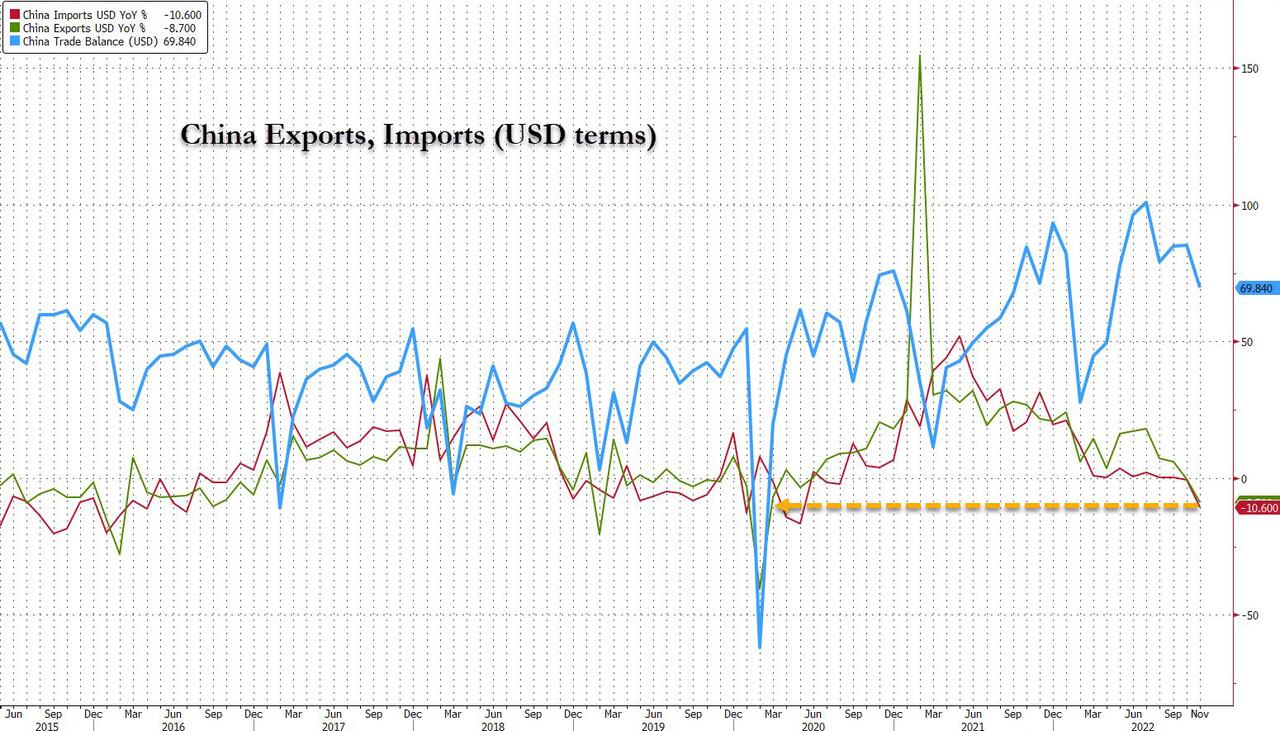
As shown below, in November China's exports contracted by 8.7% Y/Y, significantly below consensus expectations of -3.9% and a huge deterioration to the 0.4% drop in October; the implied sequential export growth dropped to -6.5% M/M non-annualized in November (vs. -3.8% in October). At the same time, imports fell by 10.6% Y/Y, also missing consensus of -7.1%, and also far worse than the -0.7% Y/Y drop in October. Sequentially, imports fell -1.1% M/M in November vs. -3.4% in October.
In other words, exports and imports both contracted at steeper paces in November - and absent the covid crash in early 2020, the fastest pace since 2016 - as external demand weakened and a worsening Covid outbreak disrupted production and cut demand at home.
As Goldman notes, the export weakness broadened across destinations and products. Other than weaker DM demand on global manufacturing slowdown and the ongoing European energy crisis, the contraction of exports partially came from production disruptions in manufacturing hubs in China due to Covid resurgence. The overall trade surplus in November fell to US$69.8bn.
Some highlights from the report:
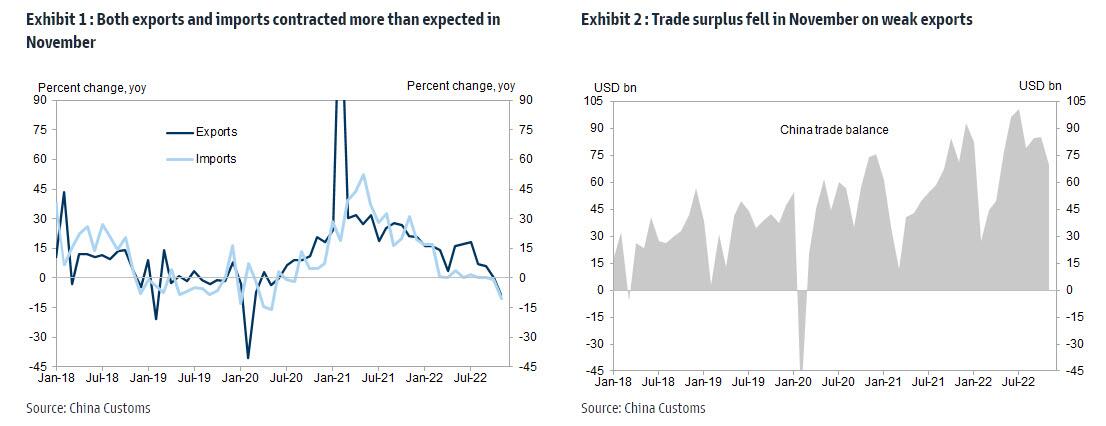
  • 1. In year-over-year terms, China's export growth fell markedly to -8.7% yoy in November (vs. -0.4% yoy in October), and import growth declined meaningfully to -10.6% yoy in November (vs. -0.7% yoy in October) (Exhibit 1). In sequential terms, exports dropped by 6.5% sa non-annualized in November (vs. -3.8% in October) and imports fell by 1.1% sa non-annualized in November (vs. -3.4% in October). China's trade surplus fell to $69.8bn in November (not seasonally adjusted) from $85.2bn in October (Exhibit 2).
  • 2. By major destination, exports weakness broadened in November. The year-over-year growth of exports decelerated across most major trading partners. Among major DM countries, growth of exports to the United States decelerated the most (-25.4% yoy in November vs. -12.6% in October). Growth of exports to the European Union decelerated to -10.6% yoy in November (vs. -9.0% in October). Among major EM economies, growth of exports to ASEAN decelerated sharply to 5.2% yoy in November (vs. 20.3% in October), and the implied sequential growth fell to -7.5% mom sa non-annualized.
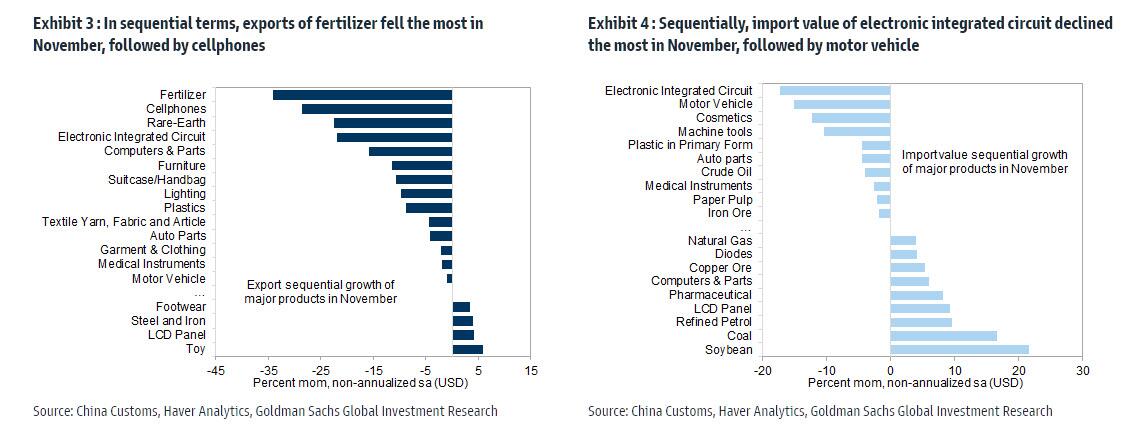
  • 3. By major category, export growth moderated across most products. The export growth of tech-related products dropped notably (see Exhibit 3). For example, exports of cellphones declined 33.3% yoy in November (vs. +7.0% in October), and export growth of electronic integrated circuit slowed sharply to -29.8% yoy in November (vs. -2.4% in October). Among housing-related products, exports of home appliances fell 22.9% yoy in November (vs. -25.0% in October). Among Covid-related products, exports of computers declined 28.3% yoy in November (vs. -16.5% in October).
  • 4. Among major categories, import growth of commodities were mixed while manufacturing related products decelerated (Exhibit 4). Among energy goods, import growth of crude oil decelerated to 28.1% yoy in November (vs. +43.8% in October) with import volume up 11.8% yoy (vs. 14.1% yoy in October). Import growth of coal declined sharply to -26.0% yoy in November (vs. +2.8% in October) with volume down 7.8% yoy (vs. 8.3% yoy in October). Among major metal ores, import values declined on lower prices. For instance, copper ore import value fell 11.6% yoy in November (vs. -14.2% in October) with import volume up 10.2% yoy (vs. +4.0% yoy in October). Among manufacturing related products, imports of machine tools declined significantly in sequential terms (-10.4% mom sa non-annualized).
  • 5. Exports contracted meaningfully in November on Covid-related production disruptions in manufacturing hubs and weak external demand. Import value declined sequentially on the lower commodity prices and weaker imports of manufacturing related products. The export growth surprised notably to the downside, resulting in a weaker-than-expected trade surplus.
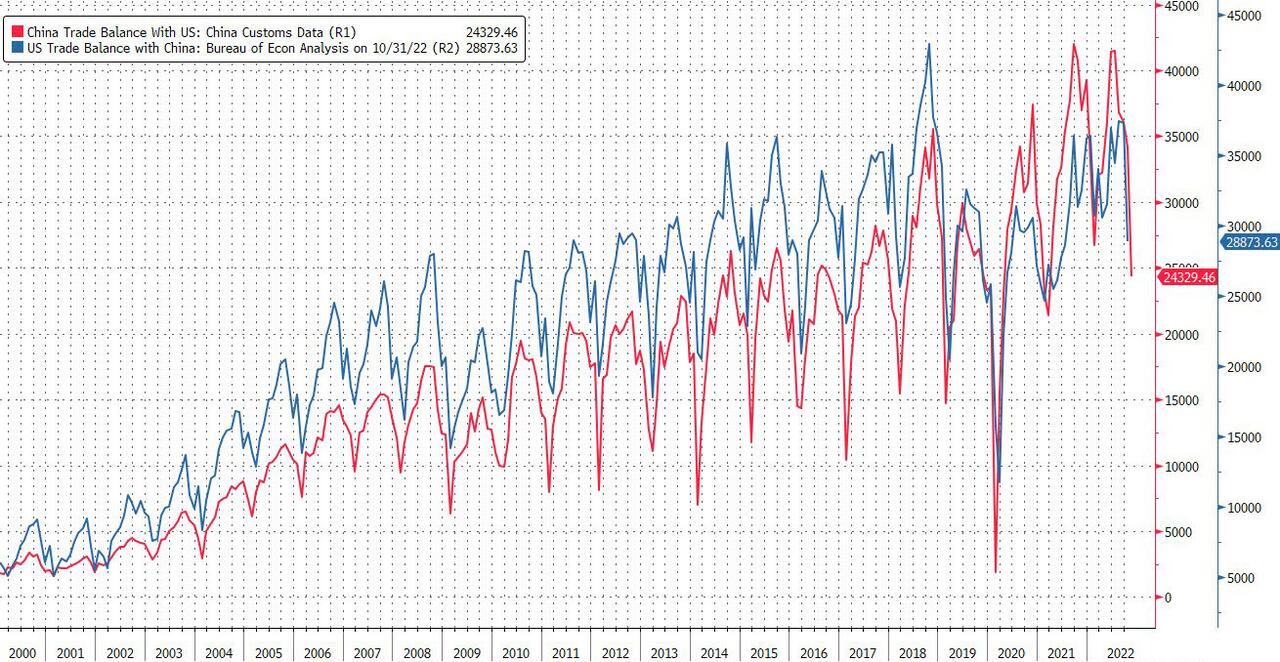
Also of note: the delta between the US reported and China reported trade balance has "renormalized" as the period in which China overreported - which coincided with the covid-lockdown phase - appears to have again ended.
But it wasn't just covid crippling China - one look at Taiwan shows that traade there was far worse: as Reuters notes, Taiwan's exports dropped 13.1% by value last month (November) from a year earlier to $36.13 billion, the sharpest fall in almost seven years, the Ministry of Finance said. That was much worse than a forecast for a 6.7% contraction in a Reuters poll, and followed a 0.5% drop in October.
The ministry said global demand was slowing "more and more obviously", hit by the war in Ukraine, unabated global inflation pressures and interest rate increase cycles in major economies. Ministry official Beatrice Tsai said China's COVID-19 controls had also hit demand for electronic components, pointing to Apple's warning last month on lower iPhone 14 Pro and iPhone Pro Max shipments than previously anticipated due to pandemic curbs at a major assembly plant in China's Zhengzhou.
Taiwan's total exports of electronics components in November fell 4.9% to $15.15 billion, the first drop in three-and-a-half years, with semiconductor exports down 3.4% from a year earlier.
Firms such as TSMC , the world's largest contract chipmaker, are major suppliers to Apple Inc and other global tech giants, as well as providers of chips for auto companies and lower-end consumer goods.
Taiwan's exports to China, the island's largest trading partner, plunged an annual 20.9% to $13.56 billion in November, after a 9.2% drop in October.
Tony Phoo, senior economist for northeast Asia at Standard Chartered Bank, said weakening demand may continue until the first and second quarters of next year for Taiwan. "If it continues into the second half of next year, Taiwan's officially estimated economic growth rate of more than 2% next year will be under pressure," he said.Taiwan's finance ministry said risks ahead included uncertainty around China's coronavirus policy and the U.S.-China tech war, adding that December exports could contract in a range of 8% to 12% from a year earlier.
Translation: global stagflationary recession, which is just what the stimulus-starved market is hoping for.

(ZH) Double Dog Dares And Equity Risk Premiums

Double Dog Dares And Equity Risk Premiums

Back in the day, a double dog dare was often a kid’s first introduction to evaluating risk and reward. The rarely presented double dog dare happens when one kid dares another to do something foolish. Usually, the kid being dared asks for an incentive to complete the challenge.
When assessing a double dog dare, one usually first values the reward. Maybe there are a couple of candy bars or a soda for completing the challenge. Then comes the risk assessment. Does the potential to break an arm or leg exist? Maybe worse, at least in some children’s minds, what will the punishment be for being caught? Simply, is the reward enough to compensate correctly for the risks associated with the double dog dare?
Evaluating the risks and rewards of a double dog dare are not that dissimilar to equity investing, as we explain.
Risk-Free Rates
Investors should expect compensation in the form of capital gains and/or dividends/coupons commensurate with the investment risk. To help evaluate the amount of risk compensation the market is offering, investors need a risk-free return to base the evaluation.
U.S. Treasury securities are a perfect yardstick for this task. They are considered the only risk-free asset in the world. We can debate the merits of their standing all day, but regardless of your opinion, it is a fact in almost all investors’ minds. Further, we can easily find yields for investment terms ranging from next week to 30 years upon which to compare our risky assets.
BAAA
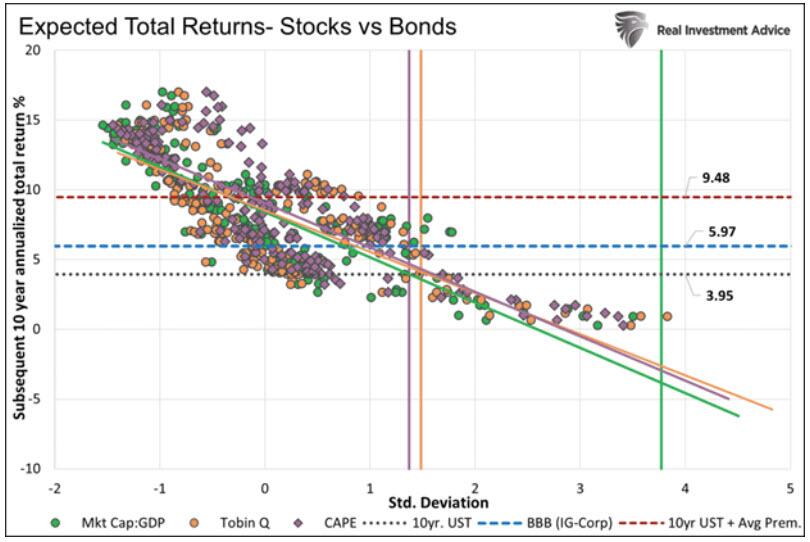
In our article, Goodbye TINA, Hello BAAA, we made the case that expected equity returns for the next ten years are about the same as Treasury bond yields. In the current pricing scenario, the premium paid to stock investors for taking risks is zero. Accordingly, the article makes the case that Bonds Are An Alternative to stocks.
The graph below from the article shows that five popular methods for calculating equity expected returns range from 4% to -4%. At the same time, risk-free Treasury yields are near 4%.
Expected stock returns are on par with risk-free Treasury yields but woefully below the premium spread investors should demand. The simple conclusion is that for the entirety of the next ten years, bonds are the better bet.
Equity Risk Premium
In addition to the long-term stock-bond analysis presented in our article, there are other ways to help gauge whether stocks offer an acceptable premium to compensate investors for taking on added risk. One such model and the topic of this article is the equity risk premium.
The equity risk premium, like the three methods we share in the article, is a valuation-based calculation. However, it tends to rely on shorter-term fundamentals. Essentially our model looks at the expected EPS in one year divided by the current price and compares it to a 1-year forward UST bond yield adjusted for inflation expectations.
The higher the equity risk premium, the more compensation equity investors receive to take on risk.
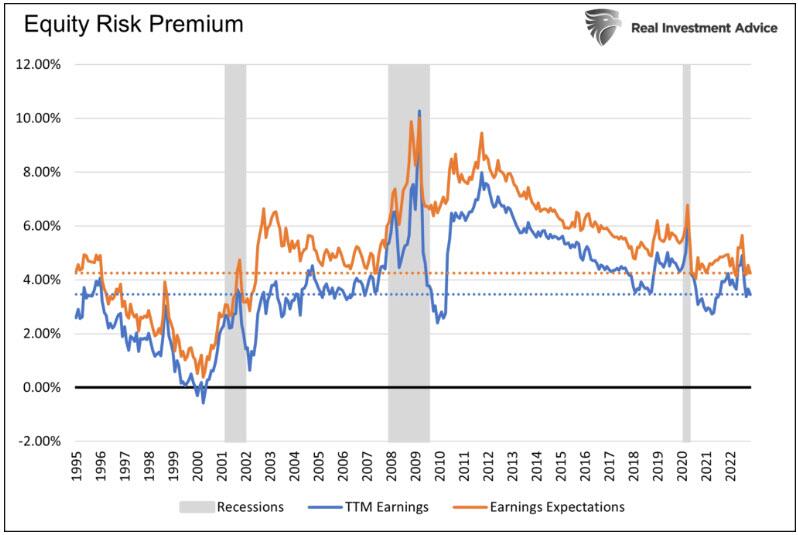
The graph below charts the S&P 500 equity risk premium using trailing and forward earnings. We offer a special thank you to Kailash Concepts for supplying the equity data for the graph.
Fair Compensation?
Based on the graph, are equity investors fairly compensated for owning stocks? We can answer the question in a few different ways.
One way is to compare the current risk premium to recent pre-pandemic averages. As shown, outside of a few short-term instances, premiums have not been as low as they are today in 20 years. Further, those instances similar to today occurred after recessions, when the risk of another downturn was minimal, and earnings had significant upside growth potential as the economy recovered. While the premium was lower than average in those instances, the earnings and economic outlook were brighter, possibly justifying a low-risk premium.
Another way to consider the premium is to assess the risk associated with the current financial and economic environment and compare it to the premium. Today, given the potential market turmoil due to a possible recession, higher interest rates, inflation, an aggressively hawkish Fed, and the geopolitical situation in Ukraine, we should be paid more, not less compensation for taking on risk. The other consideration: playing it safe in bonds pays us a comfortable 4% with no risk.
Given the riskier-than-normal outlook and tighter-than-average risk premiums, bonds deserve more attention. BAAA!
How Equity Premiums May Normalize
Three key factors are used to calculate the equity risk premium: earnings, stock prices, and risk-free rates.
For the premium to rise to a more acceptable level, the numerator needs to increase, and/or the denominator falls. In other words, there must be some combination of higher earnings, lower stock prices, and declining yields. We could create a complex table showing the many combinations, but instead, it best to focus on the elephant in the room – recession risk.
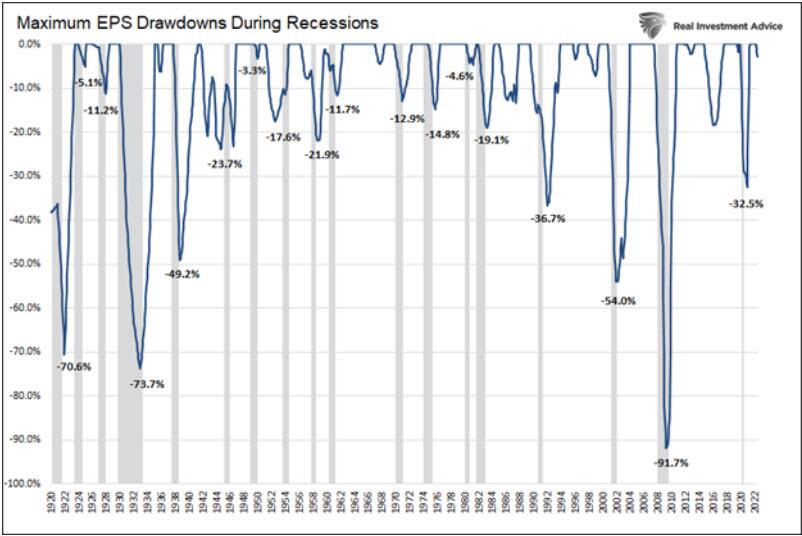
If we are indeed entering a recession, earnings are likely to fall. The graph below shows that earnings often decline significantly during recessions. If they do fall, the equity risk premium will also drop. Therefore, stock prices must also decline to keep the earnings yield stable.
However, the onus is not just on earnings and stock prices. If yields fall appreciably, the premium may rise.
All three factors will change. Appreciating what may change and to what degree, given various economic scenarios, will help you better appreciate how and when the equity risk premium may normalize.
Portfolio Management
The model presented above is for the S&P 500. Each stock has its own risk premium. While we may not think the market is compensating us properly, many stocks and some sectors have potential earnings growth rates well above market levels with potentially less earnings volatility in a recession.
Portfolio management involves holding stock and bond assets. We believe in active management in which the allocations to stocks and bonds change as their risk-reward calculus changes. Lower risk premiums in a risky environment are leading us today to reduce equity risk.
Summary
“There is no analog. Today’s starting points are like none we have seen. The biggest risk is extrapolating to the future from a past that feels comfortable, confirmed by recent data. Disequilibrium is the new equilibrium.” Erik Peters, One River Asset Management
The economic, financial, and geopolitical risks are outsized! Shouldn’t the equity risk premium reflect the situation?
If we double dog dare you to buy stocks, you should ask for a return that compensates for the additional risk in today’s market environment.

>>> US Research Calls

Research Calls

  • Upgrades:
    • Haleon plc (HLN) upgraded to Overweight from Equal Weight at Barclays
    • MongoDB (MDB) upgraded to Mkt Outperform from Mkt Perform at JMP Securities; tgt $215
    • R1 RCM (RCM) upgraded to Buy from Neutral at Guggenheim; tgt $15
  • Downgrades:
    • Airbnb (ABNB) downgraded to Underweight from Equal-Weight at Morgan Stanley; tgt lowered to $80
    • Alliant Energy (LNT) downgraded to Neutral from Buy at BofA Securities; tgt lowered to $56
    • Autoliv (ALV) downgraded to Neutral from Buy at UBS; tgt raised to $86
    • Booking Holdings (BKNG) downgraded to Peer Perform from Outperform at Wolfe Research
    • Chewy (CHWY) downgraded to Peer Perform from Outperform at Wolfe Research
    • Comstock (CRK) downgraded to Sell from Buy at Citigroup; tgt lowered to $14
    • Coterra Energy (CTRA) downgraded to Sell from Neutral at Citigroup; tgt lowered to $23
    • Dominion Energy (D) downgraded to Equal Weight from Overweight at Wells Fargo; tgt lowered to $64
    • EQT Corp. (EQT) downgraded to Neutral from Buy at Citigroup; tgt lowered to $40
    • Expedia Group (EXPE) downgraded to Underperform from Peer Perform at Wolfe Research; tgt $85
    • Gossamer Bio (GOSS) downgraded to Equal Weight from Overweight at Barclays; tgt lowered to $2
    • Gossamer Bio (GOSS) downgraded to Neutral from Outperform at SMBC Nikko; tgt $3
    • Gossamer Bio (GOSS) downgraded to Underweight from Neutral at JP Morgan
    • Lilium GmbH (LILM) downgraded to Underweight from Equal Weight at Barclays; tgt lowered to $1
    • Lions Gate Entertainment (LGF.A) downgraded to Underweight from Overweight at JP Morgan; tgt lowered to $7
    • M&T Bank (MTB) downgraded to Mkt Perform from Outperform at Keefe Bruyette; tgt lowered to $180
    • NRG Energy (NRG) downgraded to Sell from Neutral at UBS; tgt lowered to $30
    • Ouster (OUST) downgraded to Neutral from Buy at Citigroup; tgt lowered to $1.70
    • PagSeguro Digital (PAGS) downgraded to Equal-Weight from Overweight at Morgan Stanley; tgt lowered to $15
    • Sprinklr (CXM) downgraded to Hold from Buy at Stifel; tgt lowered to $8
    • StoneCo (STNE) downgraded to Equal-Weight from Overweight at Morgan Stanley; tgt lowered to $15
  • Others:
    • Applied Materials (AMAT) initiated with a Buy at Loop Capital; tgt $125
    • Bio-Rad Labs (BIO) initiated with an Outperform at RBC Capital Mkts; tgt $565
    • CinCor Pharma (CINC) initiated with an Overweight at Barclays; tgt $22
    • Global Business Travel Group (GBTG) initiated with a Neutral at Citigroup; tgt $6.50
    • Illumina (ILMN) initiated with an Outperform at RBC Capital Mkts; tgt $282
    • Insmed (INSM) initiated with an Overweight at Barclays; tgt $37
    • Maravai Life Sciences (MRVI) initiated with an Outperform at RBC Capital Mkts; tgt $22
    • Pliant Therapeutics (PLRX) initiated with an Overweight at JP Morgan; tgt $42
    • QuidelOrtho (QDEL) initiated with an Outperform at RBC Capital Mkts; tgt $125
    • Repligen (RGEN) initiated with a Sector Perform at RBC Capital Mkts; tgt $190
    • Sachem Capital (SACH) initiated with a Hold at JonesTrading

>>> US Gapping down

Gapping down
In reaction to earnings/guidance
:

  • SWBI -8.6%, ADMA -6.9% (guidance and stock offering), PLAY -5.9%, LOVE -5.3%, SFIX -3.8%, AVAV -3.7%, HQY -3.5%, S -2.1%, ZUO -1.7%, CXM -1.6%, UNFI -1.3%

Other news:

  • IBIO -47.5% (stock offering)
  • SNDX -10.2% (prices offering of 6818182 shares of common stock at $22.00)
  • CLFD -5.8% (prices offering of 1.2 mln shares of common stock at $100.00 per share)
  • CUE -4% (stock offering)
  • BFLY -2.6% (CEO departing)
  • MARA -2.4% (reports November BTC production)
  • GSK -2.4% (pulling back following yesterday's gains after Zantac ruling)
  • AFYA -1.6% (intends issuance of debentures in Brazilian market)
  • MOS -1.5% (curtailing production at potash mine)
  • CXW -1.5% (receives lease termination notice for the California City Correctional Center from the State of California)
  • MSGE -1.4% (exploring spin-off of Live Entertainment business)
  • NBIX -1.3% (updates on Phase 2 Study)
  • MSFT -1.2% (meeting with FTC over ATVI deal according to NY Post)
  • BLK -1% (Bluebell Capital Partners seeking to replace CEO according to Reuters)
  • KLAC -1% (launches X-ray metrology system)

Analyst comments:

  • ABNB -4% (downgraded to Underweight from Equal-Weight at Morgan Stanley)

>>> US Gapping up

Gapping up
In reaction to earnings/guidance
:

  • MDB +25.6%, THO +4.8%, GWRE +4.4%, CPB +2.3%

Other news:

  • RXDX +191.2% (Results for PRA023 in Both ARTEMIS-UC Phase 2 and APOLLO-CD Phase 2a Studies)
  • REPL +37.6% (enters into clinical collaboration agreement with Roche (RHHBY) for the development of RP3 in colorectal cancer and hepatocellular carcinoma)
  • IVVD +3.1% (appoints new COO)
  • AXON +0.9% (prices offering of $600 mln of 0.50% Convertible Senior Notes due 2027)

FT : Blackstone’s plan to juice BREIT

Blackstone’s plan to juice BREIT
Basically, aggressively ratchet up rents and restart evictions

The crown jewel in Steven Schwarzman’s real estate investment empire — the $70bn Blackstone Real Estate Income Trust — has hit a spot of bother lately. But its executives think they know how to get it back on track.

Nadeem Meghji, head of Americas real estate at Blackstone, this week made an appearance on “BX TV”, the company’s Monday morning global video call for employees. According to details passed to FT Alphaville after the event, Meghji chatted with chief administrative officer Vik Sawhney to rally the troops and explain why BREIT is actually awesome.

What followed was a version of the defence that Blackstone had previously released on BREIT’s website: a surge in withdrawal requests had forced it to limit redemptions that were mainly coming from Asian investors taking profits to meet margin calls elsewhere.

The call did help explain, at least partly, the stark divergence between its returns and the performance of the listed REIT universe. BREIT is more exposed to housing in faster-growing “Sun Belt” states, and a canny interest rate hedge has increased in value by $5bn. As Meghji told his fellow Blackstoners: “We picked the right asset classes, the right geographies, and we made a really good call on interest rates.”

More interesting was when Meghji turned to how Blackstone will ensure a “terrific” future for BREIT as well.

To an extent this is because Blackstone estimates that prevailing market rents are about 20 per cent higher than the rents it is charging today, so as leases expire it should be able to jack up costs by at least that level.

This growth is already pretty much “in the piggy bank”, Meghji told colleagues. And if some tenants can’t pay higher rent, they could expect a visit from the bailiff (our emphasis below):

Today on the ground, we’re seeing 5 per cent rent growth, we’re also seeing a meaningful increase in economic occupancy as we move past what were voluntary eviction restrictions that had been in place for the last couple of years.

Blackstone says on its website that, due to the “extreme hardship” many tenants suffered during the pandemic, it didn’t make a single eviction due to non-payment across its housing portfolio for two years. It seems that any remaining forbearance is now finito.

If you’re a student, or live a Blackstone-owned affordable housing unit, you’re not going to get much succour in 2023 either. Here’s what Meghji said on the call:

We’re a big owner of student housing, and in our student housing portfolio we’re signing leases today for next academic year at 9 per cent higher rents than this year. So we know what this growth will look like.

We also have a big affordable housing portfolio where rent growth is a function of inflation on a lag. Here too we know what growth will be next year. It’s going to be in the high single digits.

To be fair, rents for affordable housing in the US (properties that fall under the Low-Income Housing Tax Credit program) are federally regulated, so Blackstone has less discretion here. Though it could presumably decide to eschew the maximum-allowed rent increases, given it has called the lack of housing supply a “national crisis” and vowed to preserve affordable housing.

Blackstone does enjoy full discretion when it comes to its industrial properties — and oooh boy are they squeezing those tenants! Meghji said that BREIT increased rents by 38 per cent on industrial leases that expired in the third quarter, and leases being renegotiated right now were heading towards an increase of over 40 per cent.

This may all be good news for BREIT; but it is less so for tenants. And there’s a question of how sustainable this really is. In a statement to FTAV, Blackstone said:

BXTV is on every week and was designed to keep our people informed about market dynamics impacting our business. Setting the facts straight when there is misreporting is standard course.

We believe we have the most favourable resident policies among any large landlord in the US For two years, Blackstone chose to not make a single eviction for non-payment across our US rental housing portfolio.